




Handling Losing Streaks in Trading
Handling losing streaks in trading requires discipline and strategy. Learn how to recover, manage risk, and regain confidence.
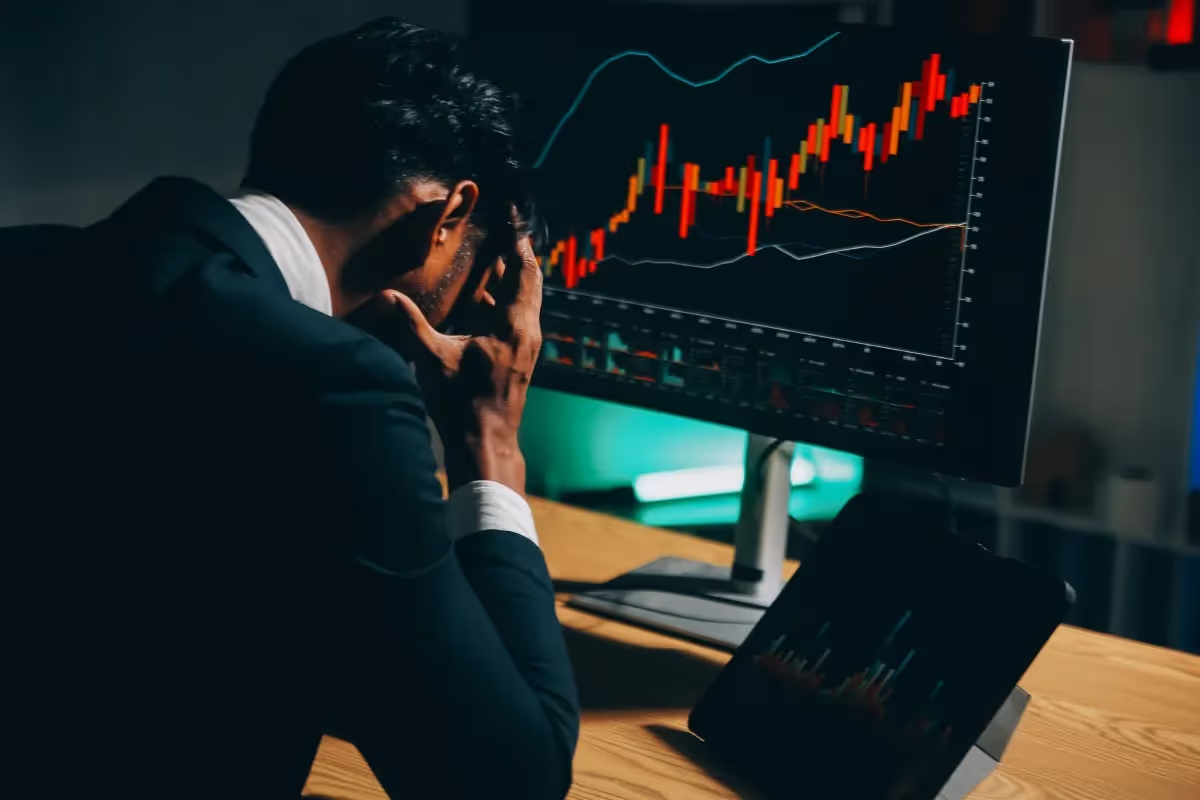
Spoiler alert: every trader loses. And we say this not as a motivational disclaimer or a caveat buried in the small print of trading education; it’s simply a mathematical certainty that applies to every strategy, every timeframe, and every market participant - from the retail trader managing a small funded account to the systematic hedge fund running billions in capital.
The question is never whether losing streaks will occur. They will.
The question is what a trader does when they arrive - and more specifically, whether the response to a losing streak makes the subsequent recovery harder or easier. The traders who navigate losing streaks well do not do so because they are emotionally tougher or constitutionally more resilient than those who struggle. They do so because they have thought carefully, in advance, about what losing streaks look like, what causes them, and exactly what the appropriate response is. By the time the streak arrives, the plan already exists.
What Is a Losing Streak?
A losing streak is a sequence of consecutive losing trades, but the definition becomes more useful when it is personalised to a specific strategy and its statistical characteristics. A strategy with a 60% win rate will produce runs of five or more consecutive losses with a frequency that surprises most traders who have not modelled it explicitly.
A strategy with a 40% win rate will produce such runs more frequently still, even when it is performing exactly as expected. Understanding the normal statistical distribution of losses within your specific strategy - what a typical drawdown period looks like, how long losing streaks have historically lasted in backtesting - is foundational knowledge that transforms a losing streak from an ambiguous crisis into a recognisable event with a known range of probable durations and depths.
How Do You Know If a Losing Streak Is Normal or a Sign of Something Broken?
This is the genuinely difficult question, and the honest answer is that it requires a clear framework established before the streak begins rather than assessed in the middle of it. A useful approach is to define, in advance, a maximum consecutive loss threshold - say, six or eight losing trades - at which point trading is paused for a structured review regardless of how the individual trades felt in the moment. This review should examine whether the losses were taken on setups that met the strategy's entry criteria, whether position sizing was consistent with the risk framework, and whether market conditions have shifted in a way that reduces the strategy's edge. If the losses were all rule-compliant and market conditions appear broadly similar to those the strategy was built for, the most likely explanation is normal statistical variance. If rules were broken, position sizes were inconsistent, or market conditions have changed significantly, the review becomes a diagnostic exercise rather than a formality.
What Are the Worst Responses to a Losing Streak?
The most destructive responses to a losing streak are almost universally driven by the desire to shorten it rather than manage it. Increasing position size to recover losses faster is the most common and most damaging, because it amplifies the financial impact of the next loss at exactly the moment when confidence and execution quality are likely to be at their lowest.
Switching strategies mid-streak, abandoning a tested approach for something that appears to be working right now, is another reliable path to compounding the damage; the new strategy has not been validated under the same conditions, and the emotional state driving the switch is not conducive to disciplined application of anything. Abandoning risk management rules - widening stops, removing daily loss limits, telling yourself that the usual rules do not apply in a recovery situation - is perhaps the most dangerous response because it removes the structural protections at precisely the moment they are needed most.
How Do Drawdown Limits Help During Losing Streaks?

Prop firm drawdown limits, which many retail traders initially experience as constraints, function as one of the most effective protections against the destructive escalation that losing streaks can produce. A trader operating within a funded account will find that the maximum daily loss limit prevents a bad day from becoming a catastrophic one, and the overall drawdown threshold creates a natural review point before losses reach a level that is genuinely difficult to recover from. These are not arbitrary restrictions. Put simply, drawdown limits during losing streaks are structural guardrails that enforce the kind of disciplined response to adversity that many traders struggle to apply voluntarily when emotions are running high.
What Should You Actually Do During a Losing Streak?
The most consistently recommended response among experienced traders is a combination of reduced activity and increased review. Reducing position size immediately when a losing streak begins - not to zero, but to a fraction of normal - limits the financial damage while maintaining the psychological continuity of staying engaged with the market. Increasing the selectivity of trade entries, waiting for only the highest-quality setups rather than normal-quality ones, reduces the frequency of trades during a period when execution may be compromised by emotional pressure.
Reviewing each losing trade with honest attention to whether it was rule-compliant provides the data needed to distinguish between a statistical drawdown and a genuine strategy or execution problem. And maintaining the physical and psychological routines that support clear thinking - sleep, exercise, time away from screens - is as important during a losing streak as any technical adjustment to the trading approach.
How Do You Rebuild Confidence After a Losing Streak?
Confidence after a losing streak is rebuilt through execution quality rather than outcomes, and this distinction is important.
Waiting for the next trade to be a winner before feeling good about your trading again puts confidence at the mercy of factors you do not control. Building confidence around the quality of your decision-making process - whether entries met criteria, whether risk was managed correctly, whether the plan was followed - means that a well-executed losing trade can be genuinely neutral rather than emotionally damaging.
Over time, as the run of rule-compliant trades accumulates, the statistical edge of a sound strategy reasserts itself, and the confidence that follows is grounded in evidence rather than hope. This is the only kind of trading confidence that is durable under pressure.
Get Funded with AquaFunded's Funded Account Platform
Losing streaks are an inevitable part of trading at any level, and the traders who handle them best are those who have built their approach around the reality of variance rather than the hope of avoiding it. As a funded account qualification platform, AquaFunded provides a structured environment in which disciplined responses to adversity are rewarded and reckless responses are naturally limited by transparent risk parameters. With evaluation models across one, two, and three steps, instant funding available, and up to 100% profit split, AquaFunded is built for traders who understand that surviving the difficult periods is as important as capitalising on the good ones.
