




How to Control Emotions While Trading
Struggling with emotional trading? Learn practical techniques to build discipline, reduce stress, and trade consistently.
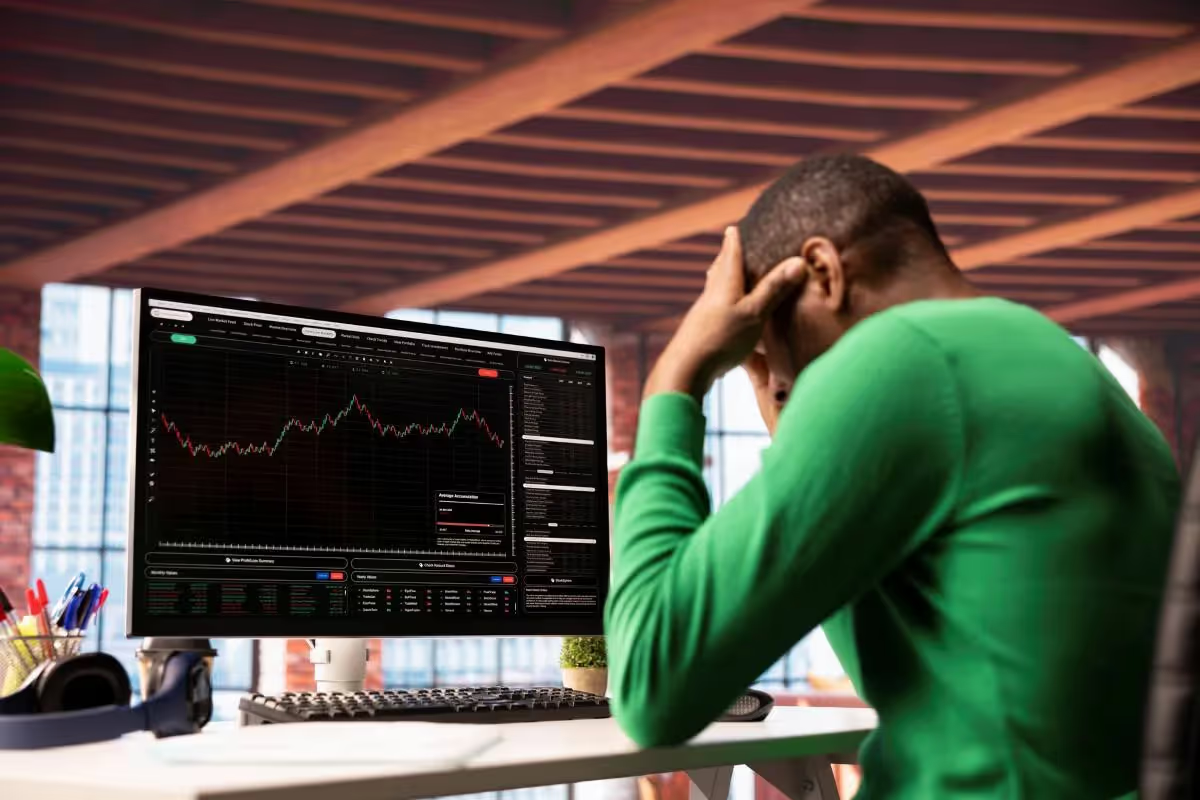
Nobody sits down to trade with the intention of making emotional decisions. Every trader, at every level, would describe their approach as rational, systematic, and rules-based. The problem is that this self-description is formed in a calm state, before the market opens, before a position has moved against them, before the loss that felt manageable on paper starts to feel very different in real time.
Emotional control in trading isn’t about becoming a different kind of person or suppressing natural human responses to financial risk. Instead, it’s about building a relationship with your own psychology that is honest enough to acknowledge how you actually behave under pressure, and structured enough to prevent that behaviour from overriding the decisions you made when you were thinking clearly. And ultimately, that is a harder and more interesting project than it is usually given credit for.
Why Is Emotional Control So Difficult in Trading?
The difficulty is neurological before it is behavioural. When financial loss is imminent or occurring, the brain's threat-response system activates in ways that are largely involuntary. The amygdala, which processes threat and emotional memory, begins to dominate processing. The prefrontal cortex, which handles rational analysis, planning, and impulse control, becomes less effective. The result is a cognitive state that is genuinely less capable of executing the kind of systematic, rule-based decision-making that profitable trading requires.
This is not weakness or lack of character; it is the brain responding to a genuinely stressful situation in the way it evolved to respond to threats. The challenge for traders is that the correct response to a financial threat is often the opposite of what the brain's threat-response recommends: sitting still, following a pre-defined plan, and accepting a loss rather than fighting it.
What Does Emotional Trading Actually Look Like?
Emotional trading rarely announces itself. It tends to arrive dressed as conviction. The trader who moves their stop loss because the trade feels like it just needs more room is not thinking of themselves as acting emotionally; they are constructing a rational-sounding narrative about market structure or volatility. The trader who re-enters immediately after a stop-out, with a larger position, is not consciously seeking revenge; they are telling themselves that the second setup is genuinely better than the first. These post-hoc rationalisations are one of the most consistent features of emotional trading, and they are why self-awareness in the moment is so difficult. The emotional decision and the rational-sounding justification for it are produced almost simultaneously, and distinguishing between them requires a level of honest self-examination that most traders have not been trained to apply.
How Can You Build Emotional Awareness as a Trader?
The most practical starting point is a trading journal that records not just trade data but emotional state. Before each session, note your general state of mind: stress levels, sleep quality, whether you are carrying frustration from the previous session. After each trade, particularly losing ones, record what you were feeling at the moment of entry and exit and whether those feelings influenced the decision. Over weeks and months, patterns become visible that are impossible to see from inside a single trading session. Specific emotional triggers emerge: the time of day when discipline tends to slip, the position size at which anxiety starts to distort judgment, the market conditions that produce the strongest impulse to overtrade. Once those patterns are named and documented, they can be anticipated and managed rather than experienced passively as recurring surprises.
What Pre-Session Habits Help Manage Emotions?

The most effective emotional management happens before the market opens, not during the session. Defining the specific conditions under which you will trade - the setups, the sessions, the maximum number of trades and maximum daily loss - before you open the platform removes the most dangerous decisions from the emotional context in which they are most likely to go wrong. A clearly written pre-session plan functions as a contract with a calmer version of yourself; when the emotional pressure of a live session starts to distort your judgment, the plan provides an anchor. Physical preparation matters more than most traders acknowledge: consistent sleep, avoiding trading immediately after high-stress periods, and building a brief pre-session routine that shifts you into a focused, deliberate state all contribute meaningfully to emotional stability during live trading.
Does Position Size Affect Emotional Control?
Directly and significantly, yes. One of the most consistent findings across trader surveys and performance research is that emotional control deteriorates as position size increases relative to account size. A trader who risks 5% of their account on a single trade will experience a qualitatively different emotional response to a loss than one who risks 1%, even if both traders would describe themselves as comfortable with the risk beforehand. The practical implication is that position sizing should be calibrated not just to the mathematical risk framework but to the psychological threshold above which emotional interference becomes likely. Trading at a size where a loss is genuinely acceptable - where you can watch a stop get hit and move on without a significant emotional response - is one of the most underrated advantages a trader can give themselves.
How Do Professional Traders Stay Emotionally Consistent?
Consistently profitable traders tend to share certain structural habits rather than a particular emotional temperament. They have clearly defined rules for every decision that arises during a trading session, which limits the number of real-time judgment calls required. They review their performance regularly with genuine critical attention rather than seeking confirmation of a positive self-narrative. They treat losses as information rather than verdicts, which allows them to analyse them objectively rather than reacting to them defensively. And they have typically built the kind of track record, through years of disciplined practice, that provides a stable foundation of self-belief that is not dependent on the outcome of any single trade.
The traders who consistently struggle with emotional control, by contrast, tend to be those who have not yet developed a robust enough process to trust, leaving them dependent on in-the-moment judgment precisely when that judgment is most compromised. Recognising this pattern is one of the first steps in avoiding emotional decision-making in trading, and a skill that separates long-term traders from short-term ones.
Choose Aquafunded Today
As a performance-based pathway to managing larger accounts, AquaFunded rewards traders who can maintain disciplined, rules-based execution across a sustained evaluation period - not just on the days when trading feels easy. With account sizes up to $400,000, up to 100% profit split, and on-demand payouts for funded traders, AquaFunded provides the capital framework for traders who have done the psychological work and are ready to apply it at scale.
