




Overtrading: What Is It and How to Avoid It?
Understand overtrading in forex, stocks, and crypto, including emotional triggers and proven ways to protect your capital.
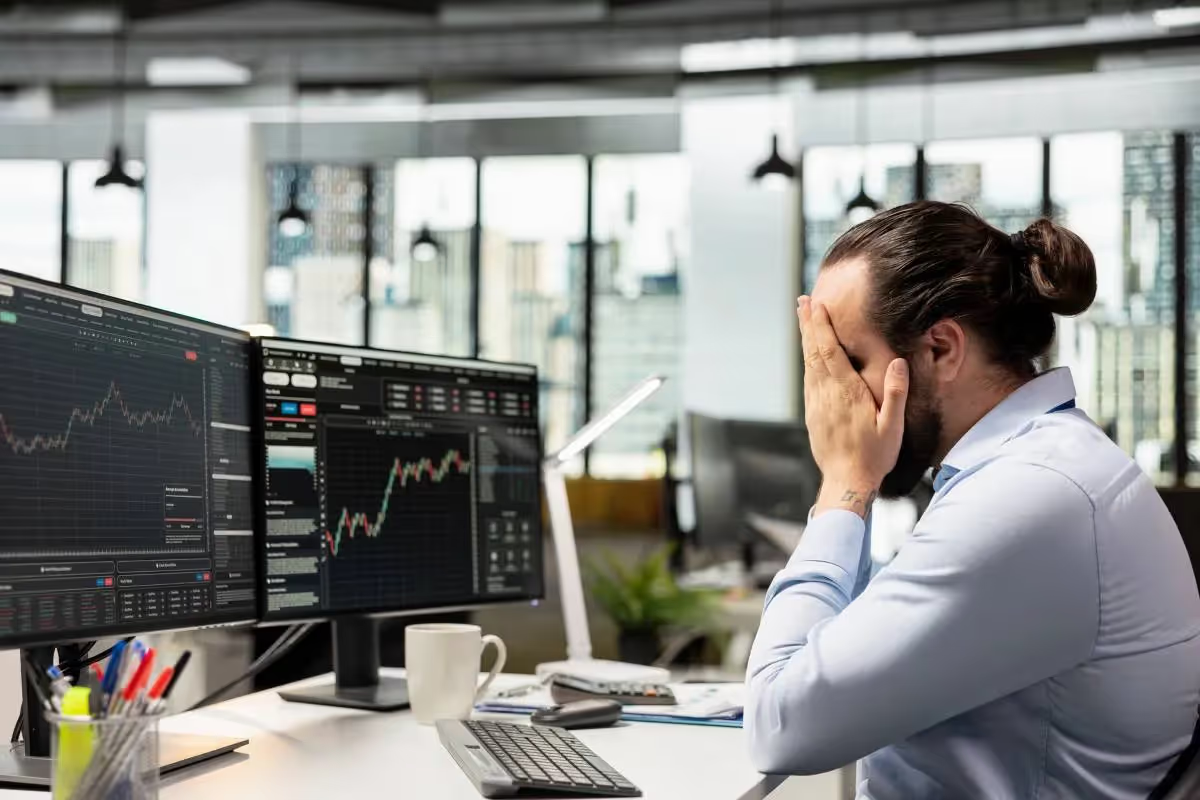
Every trader has a version of the same story somewhere in their history. The session that started well, produced a clean winner, then somehow stretched into three more hours of increasingly poor decisions as the original edge dissolved into impatience, boredom, or the quiet compulsion to stay active in a market that had stopped offering anything worth trading.
Overtrading is rarely dramatic in the moment; it doesn’t feel like a breakdown in discipline; it feels like staying engaged, like refusing to leave money on the table, like being a trader rather than someone who occasionally places a trade and then walks away. That is precisely what makes it so damaging and so consistently underestimated as a risk factor. It looks like effort. It functions, almost always, like self-sabotage.
What Exactly Is Overtrading?
Overtrading occurs when a trader takes more positions than their strategy justifies, either in frequency, size, or both. It can manifest as placing too many trades in a single session, holding too many simultaneous positions, sizing up beyond what the risk framework supports, or entering the market during conditions where the strategy carries no genuine edge. The common denominator across all of these forms is a disconnection between the trades being taken and the analytical logic that should be driving them. Overtrading is not defined by the raw number of trades in absolute terms; a disciplined scalper may take dozens of positions per day within a perfectly coherent system. The problem arises when trades are driven by emotional state, habit, or restlessness rather than defined criteria that the trader could articulate before entering.
What Causes Traders to Overtrade?
The psychological roots of overtrading are well-documented, and they are remarkably consistent across different types of traders and markets. Boredom is a significant and underappreciated driver; traders sitting at screens during low-volatility periods, waiting for setups that do not materialise, will often manufacture reasons to enter positions that do not meet their criteria.
Revenge trading - the impulse to recover a loss by immediately re-entering the market with increased size or frequency - is another common and arguably more destructive pattern, because it compounds a single bad trade into a sequence of them. Overconfidence following a winning streak leads traders to increase both frequency and position size beyond what their edge actually supports, operating on the mistaken belief that recent performance is predictive of immediate future performance. In each case, an emotional state is dictating behaviour that a cold-headed analytical process would not otherwise sanction.
How Does Overtrading Affect a Funded Account Specifically?
In a retail account, overtrading is expensive but survivable over time; there is no structural endpoint, only a slowly eroding balance that serves as feedback. In a funded account, the consequences are more immediate and far less forgiving. Prop firm evaluations and live funded stages carry maximum daily loss limits and overall drawdown thresholds. A trader who overtrades on a losing day - compounding a bad morning into an afternoon of increasingly desperate re-entries - can breach those limits within a single session, ending an account that represented weeks or months of disciplined work to build.
This is one of the most common trading mistakes in overtrading that causes technically skilled traders to fail evaluations they were genuinely capable of passing. The trading ability was there, but the behavioural discipline was not.
How Can You Tell If You Are Overtrading?
Self-diagnosis is harder than it sounds because overtrading frequently feels purposeful and even virtuous in the moment. Several indicators are worth monitoring honestly. Taking trades outside your defined setup criteria is the most direct signal; if you cannot articulate why a trade meets your rules before entering, it probably does not. Increasing position size after a losing trade, without a corresponding change in the quality of the setup, is a reliable marker of revenge trading in progress. Trading during sessions or market conditions that your strategy was not designed for - entering a London session breakout strategy during the Asian session because you are at your desk and the market is open - is another common pattern. Reviewing a trading journal at the end of each week with genuine critical attention to entry quality, rather than just outcome, is one of the most consistently effective diagnostic tools available to any trader.
What Are the Most Effective Ways to Avoid Overtrading?
The most durable countermeasures are structural and pre-committed rather than motivational and in-the-moment. Setting a hard daily trade limit, defined in advance and treated as genuinely non-negotiable, removes the decision from the emotional context in which it is most likely to be made poorly. Defining a personal maximum daily loss threshold - set conservatively below the firm's own limit - and closing the platform entirely when that threshold is reached prevents a bad morning from becoming a catastrophic day. Trading only during the sessions and market conditions that your strategy is specifically designed for, and logging off during periods that do not meet those criteria, reduces the surface area for boredom-driven entries considerably. Pre-session preparation that includes explicitly identifying the conditions under which you will and will not trade - written down before you open the platform - is one of the most consistently recommended practices among professional traders for managing the overtrading impulse before it has a chance to take hold.
Does a Trading Journal Actually Help?
Yes, and more than most traders expect when they first start keeping one. The value of a trading journal is not primarily in recording what happened; it is in creating a structured review process that makes patterns visible over time. A trader who reviews their journal weekly with honest attention to whether their entries were rule-based or emotionally driven will, over a period of months, develop a granular understanding of exactly when and why they overtrade.
Common patterns emerge: specific times of day, specific market conditions, the session immediately following a loss, the day after an unusually profitable week. Once the pattern is visible and named, it is considerably easier to build structural countermeasures around it. The journal does not fix overtrading by itself; it provides the self-knowledge that makes targeted fixes possible.
Explore Our Trader Funding Model at AquaFunded
Overtrading is a discipline problem before it is a strategy problem, and AquaFunded is built for traders who have done the work to understand that distinction. When you explore our trader funding model, you will find evaluation structures designed to reward measured, consistent execution - the kind that overtrading directly undermines. With challenge models across one, two, and three steps, instant funding for traders ready to go straight to the funded stage without an evaluation, and up to 100% profit split across all models, AquaFunded is the natural next step for traders who have their process dialled in and are ready to apply it with serious capital behind them.
