




Price Action Trading Explained
Discover how price action trading works, including support, resistance, candlestick patterns, and market structure strategies.

There’s a school of thought in trading that strips everything back to the bare minimum: no indicators cluttering the chart, no oscillators signalling overbought or oversold conditions, no algorithmic overlays suggesting optimal entries. Just price - its movement, its structure, its behaviour at key levels - read directly and interpreted with the kind of pattern recognition that only develops through sustained screen time and honest reflection on what worked and what did not.
Price action trading is not a shortcut or a beginner's methodology dressed up in minimalist aesthetics. At its best, it is a sophisticated discipline that demands genuine market literacy, the patience to wait for high-probability setups rather than forcing trades from noise, and the humility to accept that even the cleanest setup does not guarantee a clean outcome. It is, in many ways, trading reduced to its most honest form.
What Is Price Action Trading?
Price action trading is a methodology that bases all trading decisions on the raw movement of price itself, without relying on lagging indicators derived from that price. Traders who use this approach read candlestick formations, identify structural levels of support and resistance, recognise chart patterns, and make decisions based on how price is behaving in real time relative to those structures. The underlying logic is straightforward: price is the most direct and immediate reflection of market sentiment and participant behaviour. Everything else - moving averages, RSI, MACD, stochastic oscillators - is simply a mathematical derivative of price, processed and smoothed. It is always one step behind the thing it is measuring, whereas price action traders are attempting to read that thing directly, at the moment it is happening.
What Are the Core Concepts?
Several foundational concepts underpin price action analysis, and understanding how they interact is more important than memorising any individual pattern. Support and resistance are the most fundamental; these are price levels where buying or selling pressure has historically been significant enough to stall or reverse a move, and they retain relevance because enough market participants remember them and act accordingly.
Trend structure, specifically the sequence of higher highs and higher lows in an uptrend or lower highs and lower lows in a downtrend, tells the trader whether a market is directional or consolidating and whether they should be looking for continuation or reversal setups. Candlestick patterns - pin bars, engulfing candles, inside bars, and doji formations - provide context about momentum shifts and potential reversals at key structural levels. None of these concepts is predictive in isolation; their value comes from confluence, when multiple signals align at the same level simultaneously.
Is Price Action Suitable for All Markets?
Price action works across most liquid markets - forex, equity indices, commodities, and increasingly cryptocurrency. The fundamental requirement is sufficient liquidity and consistent participation, since thin or manipulated markets produce erratic price behaviour that undermines the reliability of pattern recognition. Major forex pairs such as EUR/USD, GBP/USD, and USD/JPY are particularly well-suited to price action analysis given their deep liquidity and the volume of institutional participation that creates clean, readable market structure.
Those institutional footprints - the areas where large orders were placed, partially filled, or defended - are visible in the price chart for traders who know what to look for. Illiquid instruments and low-volume markets are far less suitable because price can be moved with relatively small orders, creating structure that misleads rather than informs.
How Do Traders Identify High-Probability Setups?
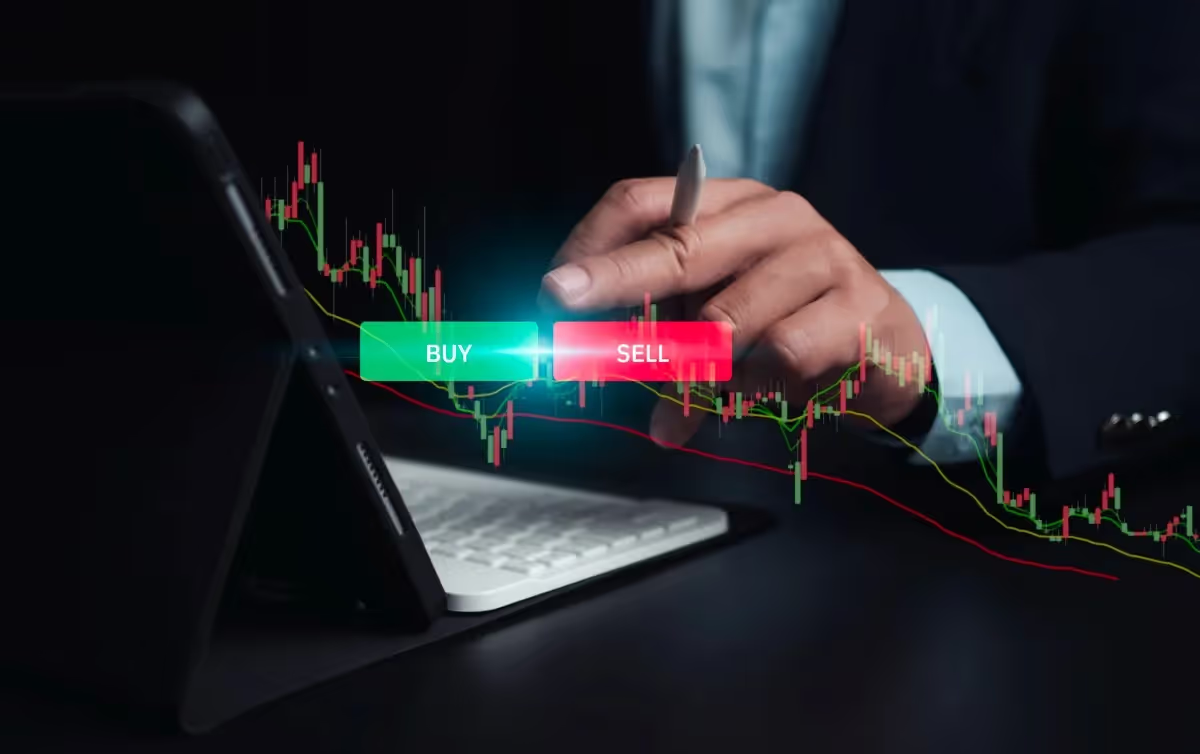
The concept of confluence is central to identifying setups that are genuinely worth trading rather than marginally acceptable ones. A pin bar forming at a random point on a featureless chart means very little. The same pin bar forming at a well-established resistance level, on a higher timeframe, in the context of a broader downtrend, after a retracement to a significant prior structure - that is a materially different proposition.
Experienced price action traders are essentially building a case for a trade rather than reacting to isolated signals. The more independent factors that point in the same direction, the stronger the argument for committing capital to the position. This is also why patience is non-negotiable in serious price action practice; the setups worth trading do not appear every hour, and recognising that fact - rather than manufacturing reasons to trade - is what separates disciplined practitioners from impatient ones.
What Timeframes Work Best for Price Action?
Price action is applied across all timeframes, but the reliability of patterns increases on higher timeframes because more participants are making decisions based on those levels. A resistance level visible on the daily chart carries more weight than one visible only on the five-minute chart, because a broader range of traders and institutions has seen it and is potentially acting on it. Most serious price action traders use a top-down approach: analysing the daily or four-hour chart to establish the broader structural context and directional bias, then dropping to a lower timeframe - the one-hour or fifteen-minute - to identify precise entries with favourable risk-reward. This multi-timeframe approach reduces the number of trades taken but improves the quality of those that are, which is exactly the right trade-off for traders operating within defined risk parameters.
What Are the Limitations of Price Action?
Price action is not infallible, and experienced practitioners are the first to acknowledge this. Markets do not always respect historical levels; structural breaks occur, and what appeared to be strong support can dissolve instantly during a high-impact news release or a sudden shift in macro sentiment. The subjectivity of pattern interpretation is also a genuine challenge: two experienced traders can look at the same chart and reach entirely different conclusions about what it is signalling.
This is not a flaw unique to price action, but it is more pronounced here than in indicator-based systems where entry signals are mathematically defined and therefore consistent. Managing this subjectivity requires a rigorous, pre-defined set of rules applied consistently, and a trading journal reviewed honestly to distinguish between genuinely systematic decisions and ones that were rationalised after the fact. Engaging with technical analysis and chart-based strategies alongside price action principles helps traders build a more complete and grounded analytical framework.
AquaFunded: Built for Traders Who Think Before They Trade
Price action rewards patience and precision over volume and frequency - exactly the qualities that a well-designed prop firm evaluation is built to identify. Traders who wait for genuine confluence setups, manage risk carefully, and treat every trade as a specimen of their process rather than a lottery ticket are the traders that funded models are built around.
As an evaluation-driven capital firm, AquaFunded provides funded accounts of up to $400,000 to traders who can demonstrate that kind of consistent, disciplined execution. With flexible challenge structures across one, two, and three steps, instant funding available for traders ready to skip the evaluation entirely, and up to 100% profit split, AquaFunded is designed for traders who take their craft seriously and want the capital to prove it.
