




Understanding Range Trading: Our 2026 Guide
Understanding range trading in 2026. Learn how to trade support and resistance levels with proven entry and exit strategies.

Not every market is going somewhere.
This is a fact that trend-focused traders spend a great deal of energy fighting against. And the cost of that resistance - measured in losing trades taken on non-existent breakouts and trends that never develop - is considerable.
The reality is that financial markets spend a significant proportion of their time in consolidation: moving sideways between identifiable levels, digesting previous moves, building energy for the next directional phase.
Range trading is the discipline of recognising this condition and profiting from it rather than waiting impatiently for a trend that may be weeks away. It requires a different set of tools, a different entry and exit logic, and a different psychological orientation than directional trading. When it is applied in the right conditions, with appropriate risk management, it is one of the most consistent and structurally sound approaches available to active traders.
What Is Range Trading?
Range trading is the practice of identifying a price range - bounded by a clear upper resistance level and a lower support level - within which a market has been oscillating, and then buying near the lower boundary with the expectation that price will return toward the upper boundary, and selling near the upper boundary with the expectation of a return to the lower one.
The core premise is mean reversion within a defined structure: the assumption that price will continue to respect the established boundaries until a genuine breakout occurs. Unlike trend following, which profits from sustained directional movement, range trading profits from the absence of it, capturing the back-and-forth oscillation that characterises markets in equilibrium between buying and selling pressure.
How Do You Identify a Valid Trading Range?
Not every period of sideways price movement constitutes a tradeable range. A valid range for this purpose has several identifiable characteristics. The boundaries - the support and resistance levels - should have been tested multiple times, with price consistently reversing at or near the same levels; a level that has been respected on two or three separate occasions carries more weight than one that has been touched once. The range should be wide enough to offer a meaningful risk-reward ratio; trading a fifteen-pip range with a ten-pip stop offers almost no margin for normal price fluctuation. The market should be showing clear rejection at the boundaries rather than grinding through them hesitantly, which suggests that genuine buying and selling pressure is present at those levels. Identifying support and resistance zones with this kind of structural precision is one of the foundational skills of range trading and takes time to develop through chart study and live observation.
What Tools Are Used in Range Trading?
Several technical tools complement the range trading approach. Oscillators, particularly the Relative Strength Index and the Stochastic Oscillator, are commonly used to identify overbought and oversold conditions within the range; a reading of 70 or above on the RSI near the upper boundary, combined with price resistance, adds confluence to a short entry.
Bollinger Bands, which expand during trending periods and contract during consolidation, provide a visual representation of low-volatility ranging conditions and can highlight when price is stretched toward the outer limits of recent movement. Candlestick analysis at the range boundaries - looking for pin bars, engulfing patterns, and other rejection signals - provides entry precision and reduces the probability of entering a trade that is about to become a breakout in the wrong direction.
What Are the Risks of Range Trading?
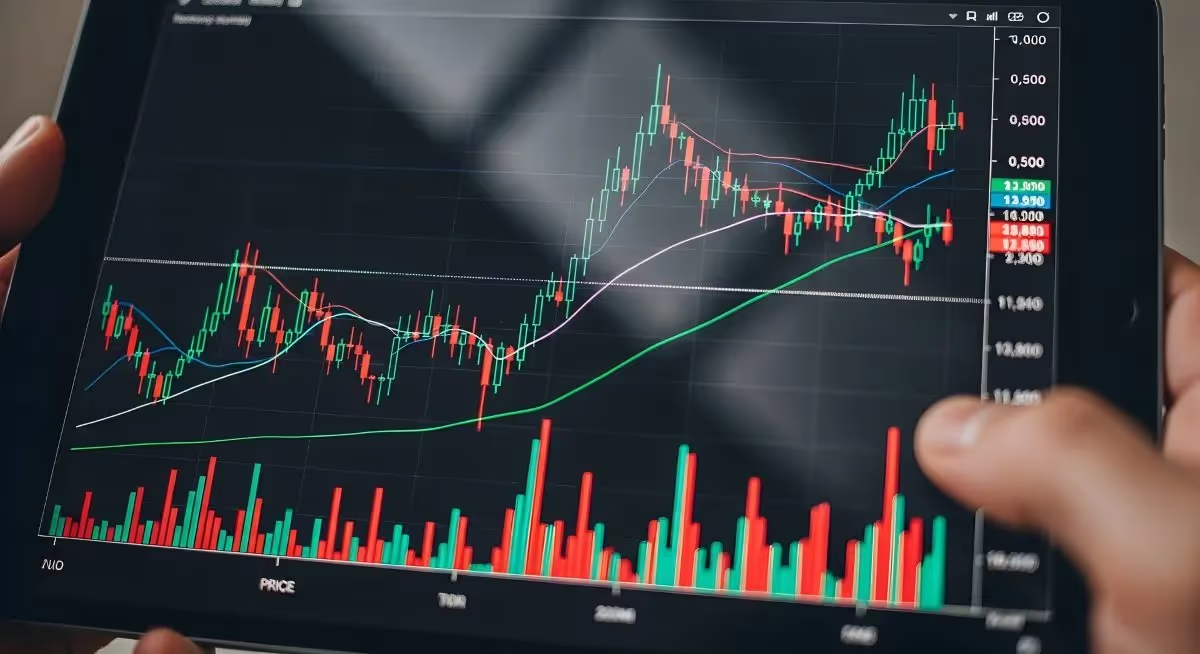
The primary risk in range trading is the breakout: the moment when price stops respecting the established boundaries and breaks through with conviction, continuing in the breakout direction rather than reverting to the range. A trader positioned for a bounce at resistance who is caught by a genuine breakout above that level faces a loss that can exceed the normal risk-reward parameters of the strategy if the breakout is sharp and the exit is delayed.
Managing this risk requires clear stop placement above or below the boundary being traded, with no flexibility around that level; if the boundary has genuinely broken, the trade thesis has been invalidated and the position should be closed. False breakouts, where price briefly penetrates a boundary before reversing back into the range, are common and can trigger stops on well-positioned trades, which is a normal cost of the approach rather than an indicator that something is wrong.
How Do You Know When a Range Is About to Break?
While breakouts cannot be predicted with certainty, several signals are worth monitoring for traders who want to reduce their exposure to breakout risk. Decreasing volume within the range, combined with progressively smaller price swings, often precedes a breakout as the market compresses before expanding. A pattern of price spending increasing time near one boundary rather than oscillating cleanly between the two suggests that buying or selling pressure is building on that side. Major scheduled news events - central bank decisions, economic data releases - are frequent catalysts for breakouts from established ranges, which is a practical argument for reducing or closing range positions ahead of high-impact announcements. When any of these conditions are present, the risk profile of range trading setups at the relevant boundary deteriorates, and reducing activity or tightening stops is a sensible adjustment.
Is Range Trading Suitable for a Funded Account?
Range trading has characteristics that make it well-suited to the funded account environment, provided it is applied with appropriate discipline. The defined risk management structure of a range trade, with stops placed beyond the boundary and targets set at the opposite side of the range, produces a clear and pre-determinable risk-reward profile that is compatible with the drawdown rules of most prop firm evaluations.
The strategy's naturally lower trade frequency during trending periods - when the range trading approach stands aside rather than forcing setups - also reduces the overtrading risk that causes many funded account failures. The most important adaptation for funded account traders is ensuring that position sizes are calibrated to the maximum daily loss limit, accounting for the possibility that a stop at the range boundary may be triggered before the session is over.
Get Funded with AquaFunded's Scalable Capital Programme
Looking for a funded trader programme with scalable capital? AquaFunded gives traders access to accounts from $2,500 to $400,000, with evaluation models designed for traders who can demonstrate consistent, disciplined execution across their chosen strategy. With up to 100% profit split, instant funding available, and on-demand payouts, AquaFunded is where range traders who have developed a genuine, tested edge can apply it at a scale that actually reflects its value.
