




Technical Analysis vs Fundamental Analysis
Compare technical analysis vs fundamental analysis. Learn the key differences, pros, cons, and which trading strategy suits you best.
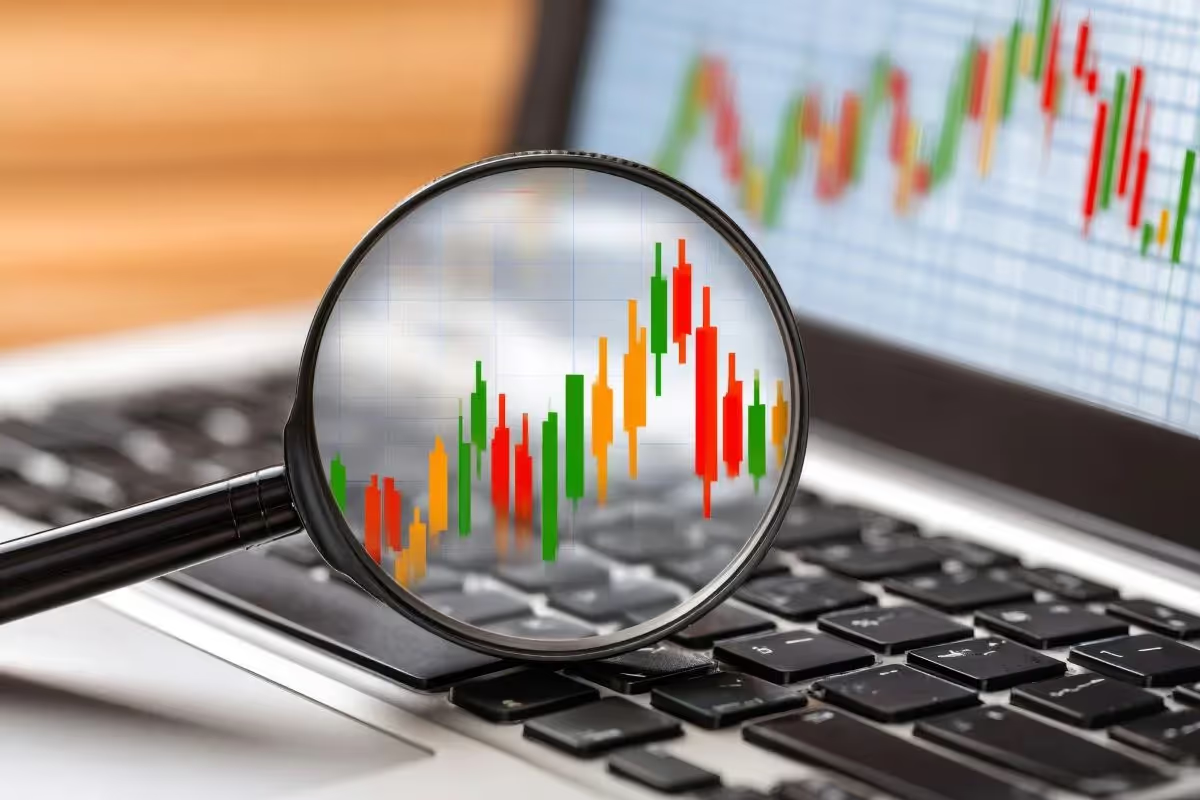
Ask ten traders which approach they swear by and you will get ten different answers, delivered with varying degrees of conviction. The debate between technical and fundamental analysis is one of the oldest in financial markets, and it has never really been resolved - nor should it be. Both methods have produced exceptional traders. Both have also produced spectacular failures.
The more useful question is not which one is superior in the abstract, but what each approach actually does, where it breaks down, and how serious traders think about combining them. The answer reveals something important about how markets actually work, as opposed to how we might prefer them to work.
For any trader trying to build a consistent, repeatable methodology, understanding both sides of this debate is not optional. It is the groundwork on which everything else is built.
What Is Technical Analysis?
Technical analysis is the study of price and volume data to forecast future market movements. It operates on the premise that all available information - economic, political, psychological - is already reflected in the price at any given moment. Rather than asking why a market is moving, technical analysts ask where it is likely to move next, based on historical patterns, chart formations, and statistical indicators. Tools such as moving averages, the relative strength index, Bollinger Bands, and Fibonacci retracements are common instruments in a technical trader's toolkit. The approach is particularly popular in short to medium-term trading, where price behaviour and momentum carry more practical weight than underlying economic conditions. Technical analysis does not require an opinion on the economy; it requires an opinion on the chart.
What Is Fundamental Analysis?
Fundamental analysis takes the opposite starting point. Rather than studying the chart, it studies the underlying asset itself, examining economic data, earnings reports, interest rate decisions, geopolitical conditions, and macroeconomic trends to determine whether an asset is undervalued or overvalued relative to its intrinsic worth. In forex markets, this means tracking central bank policy, inflation figures, employment data, and GDP growth. In equities, it means dissecting balance sheets, revenue trajectories, and earnings forecasts. Fundamental analysts are generally thinking in longer timeframes; they are less concerned with where price is going tomorrow and more concerned with where it is heading over months or years. The approach demands a broad understanding of economics and the patience to hold positions through periods of short-term volatility that contradict the longer-term thesis.
Which Approach Is More Reliable?
Neither, definitively, and any trader or educator who tells you otherwise is selling something. Technical analysis performs well in trending, liquid markets where price patterns tend to repeat with some consistency. It struggles during major news events or structural market shifts that have no historical precedent in the chart; when the unexpected happens, no pattern library prepares you for it. Fundamental analysis provides a strong framework for longer-term directional positioning, but it is notoriously poor at timing. An asset can be fundamentally undervalued for months or years before the market corrects, which is cold comfort if you are managing a leveraged position with drawdown limits and a finite runway. The reliability of either approach depends heavily on the market being traded, the timeframe in use, and the consistency of the trader applying it.
Can You Use Both at the Same Time?
Yes, and many professional traders do. The most widely used hybrid approach involves using fundamental analysis to determine directional bias - which currency, commodity, or index to favour and why - and technical analysis to time entries and exits within that broader thesis. A trader who believes sterling is fundamentally weak relative to the dollar based on diverging central bank policy might use technical tools to identify a precise entry point on a pullback, rather than entering indiscriminately at any price.
This layered approach does not eliminate risk, but it adds a layer of contextual reasoning to what might otherwise be purely mechanical chart-reading. The combination also reduces the two most common failure modes: the technically clean setup in a fundamentally broken market, and the correct fundamental thesis entered at a catastrophically bad price.
How Does Each Method Handle Market Volatility?

Volatility exposes the weaknesses of both approaches in different ways. High-impact news events - central bank rate decisions, non-farm payrolls, inflation prints, geopolitical shocks - can invalidate technical setups in seconds, as price gaps through support and resistance levels that had held for weeks. Traders relying purely on chart structure during these moments often find themselves holding positions through moves that have nothing to do with the pattern they identified.
Fundamental traders are not immune either; markets regularly move sharply against logical fundamental positioning in the short term, driven by sentiment, positioning, and narrative rather than data. A currency can weaken despite strong economic fundamentals if enough market participants are positioned for a reversal and begin unwinding simultaneously. Managing exposure around known volatility events is a discipline in its own right, separate from whichever analytical framework a trader prefers.
What Do Most Successful Traders Actually Use?
The most experienced traders tend to have developed a personalised framework that draws on both methodologies, weighted toward whichever suits their timeframe and temperament. Scalpers and intraday traders lean heavily on technical analysis because they are not holding positions long enough for fundamentals to dominate price behaviour. Swing traders and position traders often place more weight on fundamental context, using technicals for precision timing and risk definition.
What unites successful traders across both camps is not the method but the consistency with which they apply it and the discipline to manage risk regardless of how confident they feel about a given setup. Exploring technical analysis techniques for traders is a solid starting point for building that kind of methodological foundation.
What Should a Trader Prioritise When Starting Out?
For traders early in their development, the most practical advice is to develop genuine fluency in one approach before layering in the other. Trying to synthesise both frameworks without a deep understanding of either tends to produce a muddled methodology that performs worse than either discipline applied cleanly.
Most traders find technical analysis more immediately actionable because its signals are visible and testable on historical data. Fundamental analysis rewards traders who have enough market experience to contextualise economic data correctly; without that context, headline numbers can be misleading. The sequence that tends to produce the most well-rounded traders is technical first, then fundamental, then a considered combination of both as confidence and market understanding develop over time.
Start Trading with a Performance-Based Capital Provider
Understanding analytical frameworks is one thing; having the capital to apply them at a meaningful scale is another entirely. As a performance-based trading capital provider, AquaFunded gives traders access to funded accounts of up to $400,000, with evaluation models built to reward consistent, disciplined execution regardless of which analytical methodology a trader uses. Whether you are technically driven, fundamentally informed, or working with a hybrid approach, the evaluation is designed to identify skill and sustainability. With up to 100% profit split, on-demand payouts, and a platform trusted by over 160,000 traders worldwide, AquaFunded is the logical next step for traders who are ready to stop trading with limited capital and start trading with serious backing.
