




Trend Following Strategies in Trading
Discover trend following strategies in trading. Learn how to identify trends, manage risk, and ride momentum effectively.
There is an old market axiom that has survived every era of financial innovation, every new asset class, and every technological shift in how markets operate: the trend is your friend. Like most durable pieces of market wisdom, it survives not because it is always true but because it is true often enough, and in a consistent enough way, that ignoring it tends to be more costly than respecting it.
Trend following is one of the oldest and most studied approaches in systematic trading; it’s generated some of the most consistent long-term track records in professional money management. But - it has also frustrated and confused retail traders who apply it inconsistently, abandon it during drawdown periods, or misunderstand what following a trend actually requires in terms of patience, discipline, and the willingness to be wrong a significant proportion of the time while still being profitable overall.
This piece examines how trend following works, why it works, and what it actually demands from the traders who use it.
What Is Trend Following?
Trend following is a trading approach that seeks to identify and participate in sustained directional price movements, entering in the direction of the established trend and holding the position for as long as the trend remains intact. It is reactive rather than predictive; trend followers do not try to identify where a trend will begin before it starts, but rather enter after a trend has been established and confirmed by price behaviour. The entry is typically late relative to the start of the move, and the exit is typically late relative to the end of it - the strategy deliberately sacrifices the early portion of a trend and the final portion in exchange for a higher probability that the move is genuine rather than a false signal. This acceptance of imperfect timing is fundamental to how the approach generates its edge over time.
What Are the Core Trend Following Indicators?
Several technical tools are widely used by trend followers to identify and confirm directional moves. Moving averages - particularly the 50-period and 200-period varieties - are among the most commonly referenced, with a price above the moving average generally interpreted as a bullish condition and below it as bearish. The crossover of a shorter moving average above a longer one, the so-called golden cross, is a frequently cited trend confirmation signal.
The Average Directional Index measures trend strength rather than direction, helping traders distinguish between strongly trending markets where the approach performs well and ranging markets where it does not. The MACD provides both trend direction and momentum context. None of these tools is predictive in isolation; their value in trend following comes from providing objective, consistent criteria for defining whether a trend is present and whether it is strengthening or weakening. The full landscape of technical indicators for trend trading is broader than any single methodology, and traders benefit from understanding how different tools complement each other rather than relying on any one signal exclusively.
Why Does Trend Following Work?
The theoretical foundation of trend following rests on a well-documented feature of financial markets: that prices tend to exhibit serial correlation over meaningful time periods. In plain terms, markets that have been moving in a direction tend to continue moving in that direction more often than they reverse, particularly when the directional move is supported by a genuine shift in fundamentals - a change in central bank policy, a structural shift in supply and demand, a broad risk-on or risk-off environment.
Trend following captures these episodes by staying in positions for as long as the directional character of the market is maintained. The losses come from the false signals - the apparent trends that reverse before generating meaningful follow-through - and the strategy's profitability depends on the winning trades being large enough, on average, to more than compensate for the frequency of those false signals.
What Are the Biggest Challenges for Trend Followers?
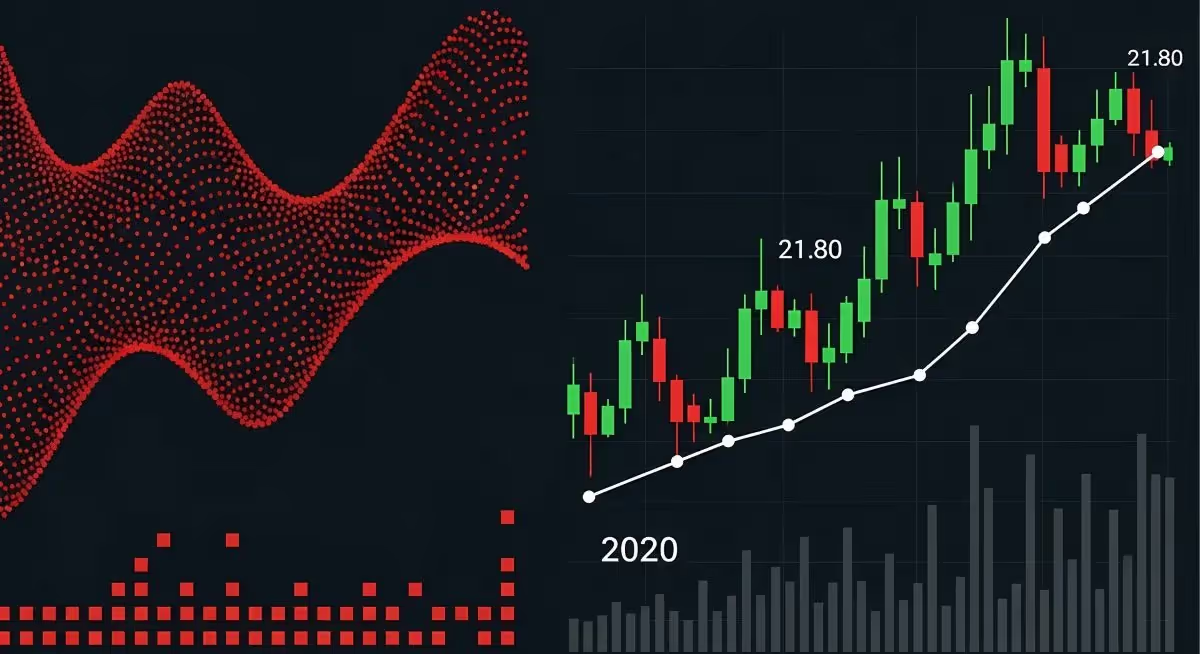
The most significant practical challenge of trend following is the psychological difficulty of the trade distribution it produces. Because trend followers accept many small losses in exchange for occasional large winners, the win rate of a typical trend following approach is often below 50%; some systematic trend following programmes operate profitably with win rates as low as 35-40%. For traders who measure their performance primarily by win rate, this distribution feels wrong.
The long periods between significant trends - the ranging, choppy market conditions where the strategy produces a string of small losses - are psychologically demanding even when they are entirely consistent with the historical performance of the approach. Abandoning a sound trend following system during one of these drawdown periods, only to miss the next major trending move, is one of the most common and most costly mistakes in this style of trading.
How Do You Identify a Strong Trend?
The practical skill of identifying genuine trends rather than short-lived directional moves develops with experience, but several objective criteria are worth establishing from the outset. Higher timeframe alignment - where the daily chart, the four-hour chart, and the one-hour chart all show price moving in the same direction - provides a more reliable trend signal than a move visible on a single timeframe alone.
The clarity and consistency of the trend structure, specifically whether higher highs and higher lows in an uptrend are being made in an orderly, progressive way rather than through violent, erratic swings, is another quality indicator. The behaviour of price at pullbacks is particularly informative; in a strong trend, retracements tend to be shallow and resolved quickly in the direction of the trend, whereas in a weak or potentially exhausted trend, pullbacks deepen and the market spends more time consolidating.
How Does Trend Following Work in a Prop Firm Context?
Trend following within a funded account environment requires specific adaptations to account for the drawdown rules and risk parameters that define the structure. The most important adjustment is position sizing; because trend following by design involves accepting a sequence of small losses during low-trend environments, position sizes must be calibrated to ensure that a normal run of losses does not breach the firm's maximum drawdown threshold. Wider stops, which trend following often requires to avoid being shaken out of valid positions by normal retracements, demand correspondingly smaller position sizes to maintain the same absolute risk per trade. Traders who adapt their approach thoughtfully to these parameters find that the funded account environment, far from being restrictive, actually reinforces the disciplined, patient execution that effective trend following requires.
Scale with AquaFunded
Ultimately, trend following rewards patience and discipline above almost any other quality - exactly the characteristics that AquaFunded's evaluation structure is designed to identify. As a prop trading firm with a structured challenge model, AquaFunded provides funded accounts of up to $400,000 across multiple evaluation paths, with up to 100% profit split and on-demand payouts for traders who qualify. Whether you are trading forex trends on the daily chart or capturing momentum across multiple instruments, AquaFunded gives you the capital to make your trend following approach count at a level that retail accounts rarely allow.
