




Spot Trading vs Futures Trading: Detailed Comparison
Compare spot trading vs futures trading with clear insights to help you choose the right strategy for your goals.
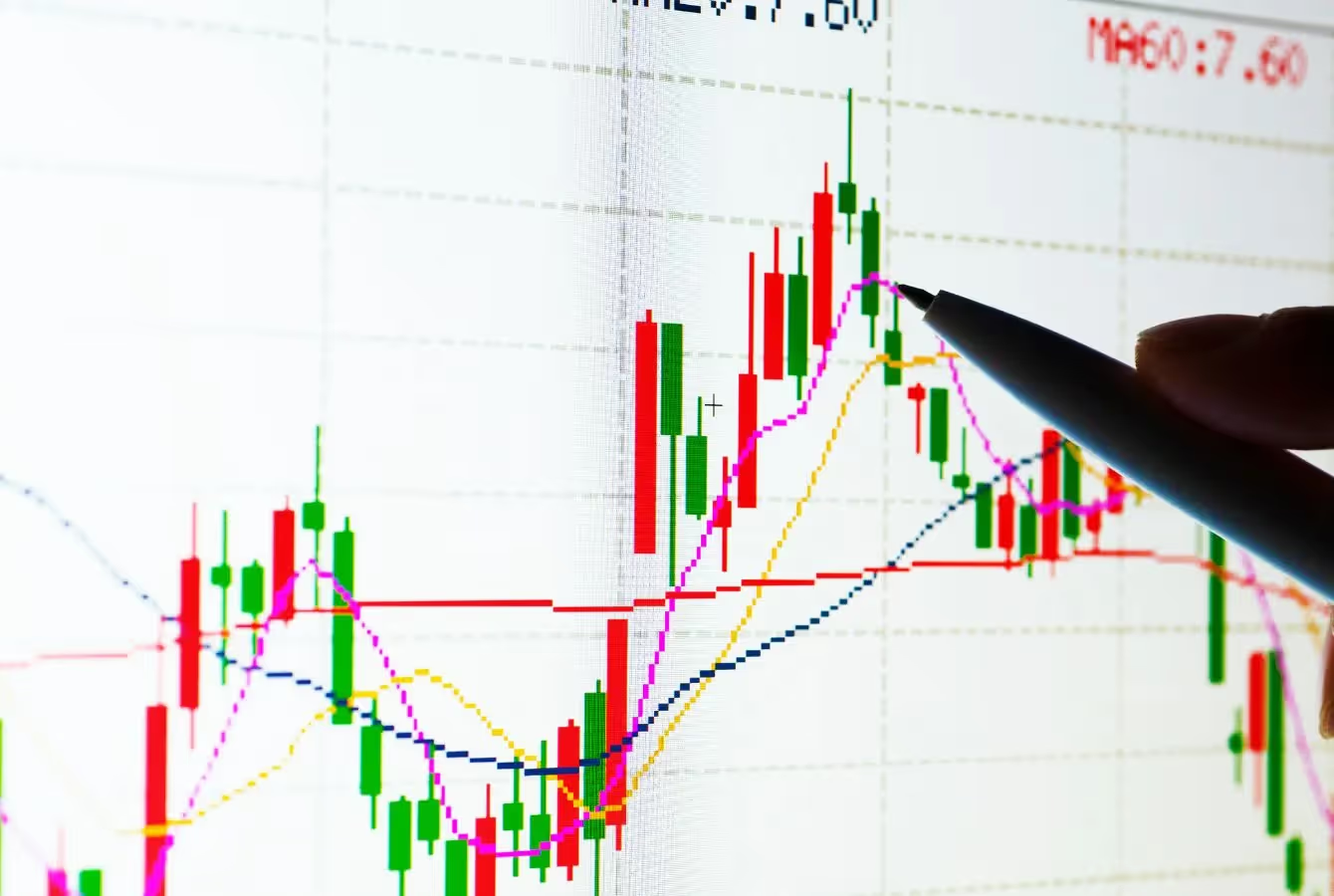
When you watch an index swing on an intraday chart, the choice between buying the underlying cash or trading a futures contract can change your profits, risk, and required capital. Spot Trading vs Futures Trading matters for Day Trading Indices because cash market trades settle differently than derivatives, leverage and margin rules shift your exposure, and expiration, contango or backwardation, and contract rollover can force decisions you did not plan for.
Do you want clear rules for price discovery, hedging, liquidity, order types, and margin calls so you can scale toward trading professionally with funded accounts? This guide breaks down settlement mechanics, leverage, volatility, contract specifications, tax and clearing house differences, and practical steps to help you trade smarter and qualify for funded capital.
AquaFunded's funded trader program supplies capital, a clear evaluation pathway, and straightforward risk rules so you can test index strategies, build consistency, and move toward trading professionally with funded accounts.
Summary
- The futures market is estimated to be 10 times larger than the spot market, and over $30 trillion in futures contracts are traded annually, which helps explain why derivatives often lead price discovery and absorb large flows.
- Spot FX accounts for roughly $2 trillion in daily turnover and about 37% of forex volume, which explains why spot execution tends to offer lower spreads and quicker fills favored by intraday traders.
- Futures trading accounts for approximately 40% of all trading volume, so front-month contracts typically offer the tightest spreads and deepest order books for scalpers and high-frequency traders.
- Retail futures volume on some venues has risen about 150% year over year, increasing competition for capital-efficient exposure and amplifying execution and roll stress for active traders.
- Futures can allow leverage up to 100x, delivering extreme capital efficiency but also dramatically increasing account volatility, shortening the time window to be right, and raising the likelihood of margin calls.
- Manual handling of rolling, margin sizing, and execution becomes a predictable failure mode as scale grows, because concentrated roll periods and fragmented liquidity create slippage and surprise liquidations even for strategies that worked at smaller sizes, especially given the market scale differences above.
- AquaFunded's funded traded program addresses this by centralizing execution, providing deep liquidity across contract months, and automating margin controls to reduce roll slippage and surprise margin events.
What is Spot Trading?
Spot trading means buying or selling an asset at the current market rate, with the intent that the price and settlement reflect what is happening in the underlying market at that moment. It is the cash market where prices update continuously; you can take immediate exposure, and traders often hold positions for very short horizons.
Why Do Traders Use Spot Markets?
What you get is immediacy and simplicity. You trade the live price and, depending on the venue, either take custody of the asset or replicate that exposure through derivatives. For day traders, that means low spreads, straightforward fills, and no contractual expiry to worry about.
How Liquid And Common Is Spot Activity?
Liquidity is a practical advantage you can feel in execution quality. According to Best Brokers, "The daily turnover of spot trading in the forex market is approximately $2 trillion.") This 2023 figure shows how much cash moves through spot FX every day, which is why spreads can compress and fills happen fast. In the same vein, Best Brokers reports that "Spot trading accounts for 37% of the total forex trading volume." That 2023 share explains why many liquidity providers and retail platforms prioritize spot pricing and depth.
What Are The Tradeoffs Traders Must Accept?
The main tradeoff is between simplicity and capital efficiency. Spot trading is straightforward when you want custody or plain ownership. But when you add margin to increase exposure, the same leverage that magnifies gains also magnifies losses, and that amplification is where many active accounts fail to preserve capital. This tension is not theoretical; it is a predictable failure mode: leverage makes PnL swing faster than attention or risk controls can respond.
Numbered Essentials You Need To Know About Spot Trading
1. Definition And Intent, Rephrased
Spot trading is executing a buy or sell at the present market price with the expectation of immediate settlement or an equivalent cash exposure, rather than locking in a future delivery date.
2. Alternate Names And What They Imply
The spot market is often called the cash market or undated market because transactions settle close to the trade date and do not have contractual expiration dates.
3. How Derivatives Mimic Spot Without Delivery
You can access spot exposure through derivatives like CFDs, which mirror real-time price movements without requiring physical delivery or custody of the underlying asset.
4. Real-Time Pricing And Continuous Quotes
Spot prices refresh continuously to reflect underlying supply and demand, so your entries and exits track the market as it evolves in real time.
5. Margin And Leverage Mechanics
Opening a spot position on margin raises your market exposure using a deposit. That increases potential returns, but it also creates proportionally larger downside if the market moves against you.
6. Short-Term Appeal For Day Traders
Day traders prefer spot for its low spreads and lack of expiries, which simplify position management and avoid the complications of rolling contracts.
7. Practical Example, Framed Differently
If you expect silver to rise, you buy the spot silver exposure; profit accrues if the price moves up, loss if it falls, and the direction is the simple, immediate outcome of that trade.
8. Spot Versus Longer-Term Derivative Strategies
Spot trading is one way to access markets; longer-term needs like hedging or leverage-efficient exposure often use futures, options, or forwards because those instruments alter how costs, settlement, and counterparty risk evolve.
9. Markets You Can Access On Spot
You can trade spot in forex (major pairs like GBP/USD and EUR/USD), commodities (oil, gold, silver), single shares (Apple, BP), indices (FTSE 100, Germany 40, US 500), and ETFs (iShares Core S&P 500, Vanguard FTSE 100 UCITS).
10. Platform Labeling And Clarity
On many platforms, these markets are labeled as spot or cash, a small but essential clarity that indicates you are trading current-price exposure rather than a dated derivative.
A Candid Pattern We See With Traders
It is common for traders to default to margin-enabled spot positions because they are familiar and immediate. That approach works up to a point, but as positions scale, execution slippage, overnight funding, and the need for more precise risk controls create hidden costs that erode returns.
It's Hidden Cost, And A Better Bridge
Most traders stick with simple spot trades because they are intuitive and require no extra plumbing. That familiarity hides a cost: when volatility spikes or positions use margin, fragmented liquidity and manual risk checks lead to rapid losses and messy unwinds. Platforms like AquaFunded provide deep liquidity, low fees, and built-in risk controls, giving traders centralized order execution and automated safeguards that reduce the friction and tail risk that appear as scale increases.
How To Think About Custody And Counterparty Risk
Choosing a spot for custody means you accept the friction of asset ownership, along with storage and settlement details. Selecting a synthetic spot via a derivative shifts those frictions toward counterparty and settlement risk, while offering capital efficiency. Pick based on whether your priority is simplicity and ownership, or capital efficiency and hedging flexibility.
Analogy To Clarify The Choice
Think of spot as buying a meal and eating it now, versus using a voucher that lets you reserve several meals later; one gives immediate consumption with straightforward bookkeeping, the other stretches your purchasing power but depends on someone else honoring the voucher.
That tradeoff is only the beginning of the story, and what comes next puts capital, timing, and risk into a different frame of reference.
Related Readin
- What Is Considered a High VIX
- What Is a Trading Session
- What Is Support and Resistance in Trading
- What Is a Stock Market Index
- How to Trade S&P 500 Futures
- How Is the Dow Jones Calculated
- Trading the DAX
- CFD Indices
- Asset Class Correlation
What is Futures Trading?
I treat futures trading as an exchange-traded promise to buy or sell an underlying asset at a fixed price on a set future date, used to take capital-efficient exposure or to hedge existing positions. The contract creates a binding obligation for both sides, and traders manage that obligation through margin, position adjustments, or rolling into later months.
Why Do Traders Prefer Futures?
Liquidity and predictable execution are core reasons traders choose futures. According to MetroTrade, "Futures trading accounts for approximately 40% of all trading volume in financial markets." That market share explains why front-month contracts often offer the tightest spreads and the deepest books for intraday activity.
The scale of the market also matters to significant funds and scalpers alike, which is why [MetroTrade] says "Over $30 trillion worth of futures contracts are traded annually."MetroTrade (2023-10-01) helps explain why large flows can execute without moving the cash market as easily.
1. Definition And Core Obligation
A futures contract is a formal, exchange-standardized agreement that commits a buyer to purchase and a seller to deliver an underlying asset at a predetermined price and date, enforcing performance rather than offering an option to back out.
2. What Counts As The Underlying Asset
Underlyings include stock indices, single equities, commodities, bonds, and unusual bases like weather or volatility metrics; index futures are especially common for delegating broad market exposure without buying each component.
3. How Standardization Shapes Trading
Exchanges define contract size, tick value, delivery terms, and settlement conventions, which convert bespoke risk into fungible units and enable market makers and algorithmic liquidity providers to quote consistently.
4. Where you trade and why exchanges matter
Futures trade on regulated venues such as the Chicago Mercantile Exchange and other derivatives exchanges, which provide centralized clearing, standardized rules, and daily settlement, reducing bilateral counterparty risk.
5. Expiration, front-months, and why roll decisions matter
Contracts have fixed expiry months; the nearest-dated contract is the front month and usually carries the heaviest volume and the tightest spreads, so traders who want to keep exposure must decide when and how to roll into later months to avoid forced settlement.
6. The Mechanics Of Rolling And A Standard Failure Mode
Rolling means closing the near-month and opening a later month, but it creates execution risk and basis shifts. This pattern occurs consistently when traders wait too long to roll, leading to slippage, surprise margin pressure, and emotional stress as expiration approaches.
7. Long, Short, And How Profit And Loss Are Realized
Buying futures expresses a long view; selling expresses a short view. Because positions are marked to market daily, gains and losses settle through margin accounts rather than waiting for physical delivery, so intraday PnL affects available capital immediately.
8. Margin, Leverage, And Capital Efficiency
Futures provide leverage by requiring margin rather than full notional payment, making them capital-efficient for directional bets and hedges. Still, that same efficiency increases the volatility of account equity and raises the probability of margin calls under rapid moves.
9. Settlement Types And Delivery Considerations
Some contracts settle by physical delivery of the underlying, others by cash settlement tied to an index value at expiry; understanding the settlement method is crucial to avoid accidental delivery obligations or unexpected basis exposure.
10. Common Uses, And The Obligation-Risk Tradeoff
Traders use futures to hedge portfolio exposure, express macro views, or execute short-term strategies at low transaction costs; the trade-off is clear: you gain scale and liquidity at the expense of a binding contractual obligation and daily cash flow consequences.
Most traders handle rolling, margin sizing, and execution manually because it is familiar and requires no new tooling. That approach works at a small scale, but as position size or frequency grows, fragmented execution, delayed roll decisions, and manual margin monitoring create avoidable slippage and higher forced liquidation risk. Platforms like Funded Traded Program centralize execution, provide deep liquidity across contract months, and automate margin controls, helping reduce roll slippage and unplanned margin events so traders preserve capital while scaling.
When we teach new index traders, the emotional pattern is evident: excitement about leverage quickly turns to stress as expiry approaches or a sudden move triggers a margin call, which is why practical risk routines and automated safeguards matter more than clever entry signals.
Turn your trading skills into substantial profits without risking your own capital. AquaFunded gives you access to accounts up to $400K with the most flexible trading conditions in the industry, no time limits, easy-to-achieve profit targets, up to 100% profit split, join over 42,000 traders worldwide who've already collected more than $2.9 million in rewards with a 48-hour payment guarantee, and start trading today via the funded trading program or prove your skills through customizable challenge paths and keep up to 100% of what you earn.
The following section will force you to choose a frame for how you trade, and that choice reveals consequences you will not want to ignore.
Spot Trading vs Futures Trading

Spot and futures serve different practical goals: spot gives you direct exposure and custody, futures give you capital-efficient exposure and explicit hedge mechanics. Use spot when you want simplicity and ownership, and futures when you need leverage, shorting, or precise hedges. Each instrument answers a different trading question.
1. What Do Traders Actually Use Each For?
Why Would You Pick One Over The Other Right Now?
Building on the basics already covered, think in purpose terms: spot is the straightforward way to hold an asset and avoid contractual obligations, while futures let you express a directional view or hedge with a fraction of capital and defined contract rules. Traders choose by matching the market outcome they need, not by allegiance to a venue.
2. How Do Prices Diverge In Practice?
What Creates The Gap Between Spot And Futures?
Futures prices reflect expected future supply and demand plus carrying costs, so you see persistent basis moves around macro events, interest rates, and liquidity flows. That basis gives you trade signals, but it also creates execution risk when roll periods concentrate volume into thin contract months.
3. How Much Extra Exposure Does Leverage Actually Give You?
What Happens To Risk When You Add Leverage?
Futures amplify position size and account volatility because margin posts only a slice of notional exposure. That efficiency is valuable, but leverage magnifies drawdowns and shortens the time you have to be right. Use margin sizing rules and stress tests, because capital efficiency without discipline is the fastest path from profit to forced exit.
4. How Do Settlement Timing And Expiry Change Your Trade Plan?
Why Does Expiry Matter Even For Active Traders?
Expiries force decisions: roll, settle, or accept delivery consequences. Perpetual contracts remove expiry but introduce funding flows that move PnL over time. That creates operational work you must manage, from scheduling roll execution to modeling cash flow from funding payments.
5. How Do Funding Rates Affect Returns In Perpetuals?
When Should You Account For Funding In Your Edge?
Funding is a periodic transfer between longs and shorts that tethers perpetuals to spot. Persistent positive or negative funding will erode expected returns for one side, so any short-term strategy must model funding as an ongoing cost or income stream, not an incidental footnote.
6. What Strategies Become Possible Or Impossible With Each Instrument?
Which plays are unique to futures or to spot?
Spot is better for buy-and-hold, stacking, and custody-driven flows. Futures unlock shorting, scalable hedges, basis trades, calendar spreads, and market-neutral pairs that simply cannot be executed efficiently in pure spot markets. That strategic flexibility explains why sophisticated desks use both in combination.
7. What Operational Complexity Do You Actually Need To Manage?
Where Do Most Traders Trip Up As They Scale?
The predictable failure mode is manual risk management. Margin maintenance, dynamic leverage, and roll timing all require rules and tooling. The pattern appears across retail and prop trading: as position size grows, manual checks fail, margin calls occur, and funding or roll costs silently erode performance. That is why disciplined automation and clear margin rules matter more than clever entry signals.
8. How Are Accounts Organized, And Why Does That Matter For Safety?
What Does Separating Wallets Actually Accomplish?
Keeping spot and futures in distinct accounts isolates settlement and counterparty exposures. It forces deliberate transfers, which slows dangerous impulse trades and lets you apply different risk settings to each account type. This structural separation is a practical safety net for both retail traders and institutions.
9. Who Should Favor Spot Versus Futures Right Now?
Which Trader Profiles Match Each Tool?
Spot suits long-term investors, custody-focused users, and anyone who values simplicity over capital efficiency. Futures fit experienced traders, hedgers, and those seeking scalable short-term alpha. The choice is not moral, it is tactical: pick the instrument that matches your capital, time horizon, and pain tolerance.
10. What Do Premiums And Discounts Tell You About Market Psychology?
How Can Basis Moves Guide Decisions?
A futures premium often signals bullish positioning or demand for leverage, while a discount can reveal bearish pressure or heavy shorting. Tracking open interest, funding trends, and term structure gives you a read on whether cash buyers, hedging demand, or speculative leverage drive the market.
A Quick Market Fact To Put Scale In Perspective
According to HighStrike Trading (2025-03-20), the futures market is estimated to be 10 times larger than the spot market, a scale difference that explains why derivatives often lead price discovery and absorb large flows. Also, futures activity has been accelerating rapidly on retail venues, as shown by Binance Square's 2023-10-01 report, which reported a 150% year-over-year increase in futures trading volume, suggesting that more traders are seeking capital-efficient exposure.
Most traders handle this by manually mixing spot and futures because it is familiar and requires no new systems, which feels practical at small sizes. That approach works until margin schedules, roll slippage, and funding drag compound, turning manageable trades into forced liquidations during a single volatile session. Solutions like a funded traded program provide centralized order routing, deep liquidity across contract months, and automated margin controls, compressing execution slippage and reducing surprise margin events, so traders can scale without dedicating time and attention to preventable errors.
A short analogy to keep this concrete: trading futures without automated risk rules is like driving a powerful car with no speedometer; you feel the speed, but you cannot measure how close you are to the limits until it is too late.
That simple framing raises the practical question most traders avoid but must answer next, and it is not the one you expect.
How to Choose Between Spot Trading and Futures Trading
Pick the instrument that matches the constraint you will not relax: custody and low stress, or capital efficiency and active risk control. Use the checklist below to map your temperament, time, capital, and goals to spot or futures so you make a choice you can live with under pressure.
1. Use AquaFunded
AquaFunded lets you trade sizable accounts without risking your own cash, offering funded accounts up to $400,000, instant funding paths or challenge-based entry, no ticking time limits, straightforward profit targets, and profit splits that can reach 100 percent. Traders using these programs often value fast payouts and predictable rules. AquaFunded supports a 48-hour payment guarantee and millions paid in rewards to an extensive global roster of traders, so you can focus on execution rather than funding logistics.
2. Start With Your Risk Tolerance
Which loss profile do you accept? If you want steady, lower-volatility exposure and cannot tolerate being wiped out by a single session, spot is the safer way to go. If you can accept sharp swings, understand margin mechanics, and mentally handle rapid drawdowns, futures offer capital efficiency and amplified returns. Remember, according to HighStrike Trading (2025-03-20), futures trading allows leverage up to 100x, making position sizing and stop discipline nonnegotiable.
3. Check Your Experience Level
Who should start where? Rough-and-ready beginners usually do better on the spot because it gives breathing room to learn price action, position sizing, and emotional responses. Traders with documented experience in stop placement, margin behavior, volatility management, and rolling contracts are the profiles that can use futures responsibly for scaled exposure and leverage-intensive tactics.
4. Consider Your Trading Goals
What outcome are you chasing? Choose a spot if your objective is asset accumulation, custody, or compounding over months to years. Choose futures if you want short-term alpha, the ability to short without borrowing, or to implement calendar spreads and pure hedges that do not require holding the underlying asset.
5. Assess Your Time Commitment
If you cannot check the tape frequently and prefer a simpler routine, spot supports set-and-forget approaches. If you trade intraday, react to funding-rate moves, or run mean-reversion scalps, futures demand frequent attention and quick decision-making.
6. Understand Your Financial Situation
If you have capital, you can park and forget; owning a spot reduces counterparty and funding complications. Suppose you need exposure without tying up full notional. In that case, futures let you do more with less, but only allocate a controlled fraction of total equity to leveraged contracts, so a single adverse move cannot derail your whole plan.
7. Evaluate Your Market View
When you expect extended accumulation or a structural bull run, holding spot preserves upside without expiry mechanics. When you see short, strong trends or intend to hedge directional exposure, futures provide tools that let you profit or protect with less upfront capital and more precise execution in heavy-flow moments.
8. Emotional Discipline Check
This is a practical filter if you panic on sudden ticks or close positions on the first drawdown, the spot will protect you from forced exits. If you can follow rules, accept marked-to-market swings, and never widen stops to “chase” a turnaround, futures can be a powerful instrument.
9. Think About The Type Of Control You Want
Spot gives you absolute ownership, no expenses to manage, and no recurring funding transfers to model. Futures provide you with leverage, the ability to short cleanly, and advanced strategies like spreads and basis plays, without owning the underlying asset physically.
10. If You’re Still Unsure, Follow This Progression Rule
Start on spot, master entries, exits, position sizing, and emotional control, then graduate into futures only after you consistently protect capital, size positions conservatively, and can calculate a liquidation level under stress.
How Traders Scale Without Losing Control
Most traders scale by adding manual checks and larger position sizes because that approach feels familiar and demands no new systems. That works until margin events, roll slippage, and fragmented liquidity turn an otherwise sound edge into a forced exit, often on a single volatile session. Platforms like AquaFunded centralize execution across contract months, provide deeper liquidity and automated risk controls, and let traders preserve edge while reducing surprise liquidations and execution drag.
Practical Heuristics You Can Apply Today
- Allocate a fixed percentage of your tradable equity to futures and never exceed your precommitted stop size, so leverage does not convert a manageable loss into account ruin.
- Structure separate ledgers for spot and derivatives exposure to facilitate deliberate transfers and enforce distinct risk settings.
- Track funding trends and open interest before scaling a short-term futures bet, because persistent funding drains or surges in open interest change expected carry and execution cost.
- Use position-size tables that express risk in dollars or account percent, not in contract counts, so entries remain consistent across volatility regimes.
A Concrete Analogy To Keep This Tidy In Your Head
Think of spot as planting an orchard, a slow setup that yields over seasons, and futures as running a pop-up restaurant that needs high-intensity effort, short-term inventory control, and precise timing to turn a profit.
A concise rule of thumb to end this checklist: start conservative, trade what you can explain to someone else calmly after a loss, and expand into leverage only when your process produces repeatable wins under stress.
That familiar decision feels stable until the single operational choice appears that separates durable growth from fragile gains.
Related Reading
- Where to Place Stop Loss
- Position Size Formula
- Scalping vs Day Trading
- Volatility Indicator MT4
- What Are the Advantages of CFD Trading Over Normal Trading
- How to Profit From CFD Trading
- What Is a Fair Value Gap in Trading
- How to Calculate Stock Volatility
- Difference Between Nasdaq and S&P
- FTSE vs MSCI
Join Our Funded Trading Program Today - Trade with our Capital and Keep up to 100% of the Profit
You’ve built the skill; small operational frictions quietly eat returns and make scaling feel risky. If you want a practical bridge, consider AquaFunded to lower the barrier and trade under more explicit rules that protect your edge.
Related Reading
- CFD Leverage
- Breakout Trading Strategy
- Gap Fill Strategy
- NFP Trading
- Swing Trading Patterns
- Dow Jones Index vs S&P 500
- FTSE 100 vs S&P 500
- CFD Market Hours
- Spot Trading vs Futures Trading
