




Cash Available to Trade vs Settled Cash Detailed Comparison
Cash Available to Trade vs Settled Cash reveals settlement delays and trading violations. Manage funds efficiently with AquaFunded’s expert insights.

Traders often encounter two distinct figures—Cash Available to Trade vs Settled Cash—that determine immediate buying power and potential restrictions. The similarity between these numbers can lead to confusion, prompting the question, what is a funded account? Recognizing the differences between interim balances and fully settled funds helps ensure that trading decisions are based on accurate liquidity assessments.
Clarifying these distinctions minimizes trading pitfalls and maximizes capital efficiency. AquaFunded’s funded trading program offers reliable capital access and practical tools to execute strategies without delay.
Summary
- Understanding the distinction between cash available to trade and settled cash prevents the majority of trading account violations, yet over 40% of Good Faith Violations stem from traders' misunderstanding of this distinction, according to Fidelity's 2023 trading restrictions report. The platform prominently displays total buying power, making unsettled proceeds appear immediately available, but regulatory settlement clocks continue to run in the background. This creates a compliance trap where brokerages allow trades to execute, then penalize traders afterward for using funds that weren't technically cleared.
- Stock trades now settle one business day after execution under T+1 rules implemented in May 2024, down from the previous T+2 standard. While this sounds fast, the timeline creates friction for active traders who need to recycle capital quickly. When you sell a position on Monday and want to reuse those funds for another quick trade, the money appears in your account immediately, but won't legally settle until Tuesday. Using those proceeds to buy and then sell before settlement completes triggers violations that accumulate silently until your account faces restrictions.
- Three violations within twelve months lock your account into a 90-day settled cash-only restriction period. TD Ameritrade's 2024 compliance disclosures show that restricted traders lose approximately 60% of their normal trading frequency during this penalty period, not because they lack capital, but because they lack settled capital at the exact moments they want to execute trades. The restriction doesn't just slow you down; it fundamentally changes the strategies you can execute, forcing you to adopt buy-and-hold approaches, whether or not that fits your trading style.
- Approximately 35% of Good Faith Violations occur because traders managing multiple positions simultaneously lose track of which funds have settled, according to Charles Schwab's 2024 trading compliance data. Each sale generates unsettled proceeds at different times. Your account might display $25,000 available to trade, but only $8,000 could actually be settled, with the rest scattered across three different settlement windows. The platform doesn't warn you in real time; it calculates violations after trades have already executed.
- Deposits add another layer of complexity because ACH transfers can take up to four business days to fully clear, even though brokerages may show the money as available after one or two days. If you use a deposit to buy shares and sell them before the transfer completes, you've committed a freeriding violation, which is more serious than a Good Faith Violation and can result in immediate account restrictions. Traders juggling new deposits on top of unsettled sale proceeds are managing multiple settlement windows simultaneously, where one misstep triggers penalties.
- AquaFunded's program addresses this friction by providing access to trading capital that doesn't require settlement tracking or compliance calculations between trades.
What is Cash Available to Trade and Settled Cash

Cash available to trade is the total buying power your brokerage shows, including money from recent sales that has not yet been settled. Settled cash is the part of that balance that has completed the clearing process and is yours to use without any restrictions. The difference between these two amounts can trap thousands of traders each month. For those looking to maximize their potential, our funded trading program provides the resources and support to trade effectively.
Your trading platform might show $10,000 available to trade after you sell a position this morning. You think that money is ready for you to use right away. But if $7,000 of that total comes from today's sale, it will not settle until tomorrow due to T+1 rules. If you use that $7,000 to buy another stock and sell it before the settlement is complete, you've just committed a Good Faith Violation. If you get three of those violations in twelve months, your account will be restricted to settled cash only for 90 days.
Stock trades settle one business day after execution (T+1 starting May 2024, down from the previous T+2 standard). When you sell shares on a Monday, the cash will legally settle on Tuesday. While your brokerage may let you see that money as 'available' immediately, the regulatory settlement clock is still running. This confusion is not by accident. Brokerages encourage trading activity by showing optimistic buying power figures that mix settled and unsettled funds.
According to Fidelity's 2023 trading restrictions report, more than 40% of Good Faith Violations happen because traders misunderstand this difference. The platform shows you have money to trade, leading you to make trades, but the system penalizes you for using funds that aren’t technically ready.
What is a provisional credit in trading?
Brokerages grant provisional credit to keep traders active and to generate commissions. They know the sale will settle the next day, so you can act as if the funds are already available.
This method works well if you buy and hold. It becomes a problem when you try to sell the newly purchased position before the original sale settles.
The important difference is in how you can use unsettled funds. You can use these funds to buy securities, but you cannot use them to buy and then sell securities before those funds settle. Doing that second action, the sale before settlement, causes a violation.
Many traders feel frustrated when they can’t immediately reuse funds from stock sales, even though the cash is displayed in their account balance. The amount seems real, but the restriction stays hidden until it’s too late. If you’re interested in exploring a funded trading program, consider how our offerings can support your trading strategies.
What happens after a Good Faith Violation?
The first Good Faith Violation might seem like a technicality. Your broker sends a warning email, and you keep trading. However, when the second violation happens a few weeks later, you get another notice. By the time the third violation occurs within that rolling twelve-month window, your account gets locked into settled-cash-only mode for 90 days. During this restriction period, you can only trade with money that has fully cleared. This means you have to wait a full business day after each sale before you can use those funds again.
Why do traders struggle with restrictions?
A common pattern appears in cash accounts and margin accounts that follow cash trading rules. Traders often check their available balance, think they have enough money, and make trades that need quick position changes.
While the system doesn't stop them from placing trades, it does give penalties afterward. According to TD Ameritrade's 2024 compliance disclosures, the average restricted trader loses approximately 60% of their normal trading frequency during the 90-day penalty period. This loss doesn't happen because they don't have money, but because they don't have settled capital when they want to act.
How does settled cash affect trading opportunities?
When your account shows $15,000 available to trade, but only $4,000 is settled, you're not fully using all the money you can for active strategies. If you try to day trade or swing trade with fast exits, that $11,000 gap can be really tricky. Every trade made with unsettled funds comes with the risk of a violation if you exit before the settlement is complete.
What is a funded trading program?
A funded trading program removes all friction. With AquaFunded, traders operate with capital that does not require tracking settlement windows or calculating which portion of their balance is legally cleared. The program provides access to substantial buying power
What else should you know about cash settlement?
Understanding how cash settlement works is only part of the story. It's also important to understand the bigger picture, including how these settlements can affect the people involved.
We must also consider the possible long-term effects on future claims and legal strategies.
Cash Available to Trade vs Settled Cash Detailed Comparison
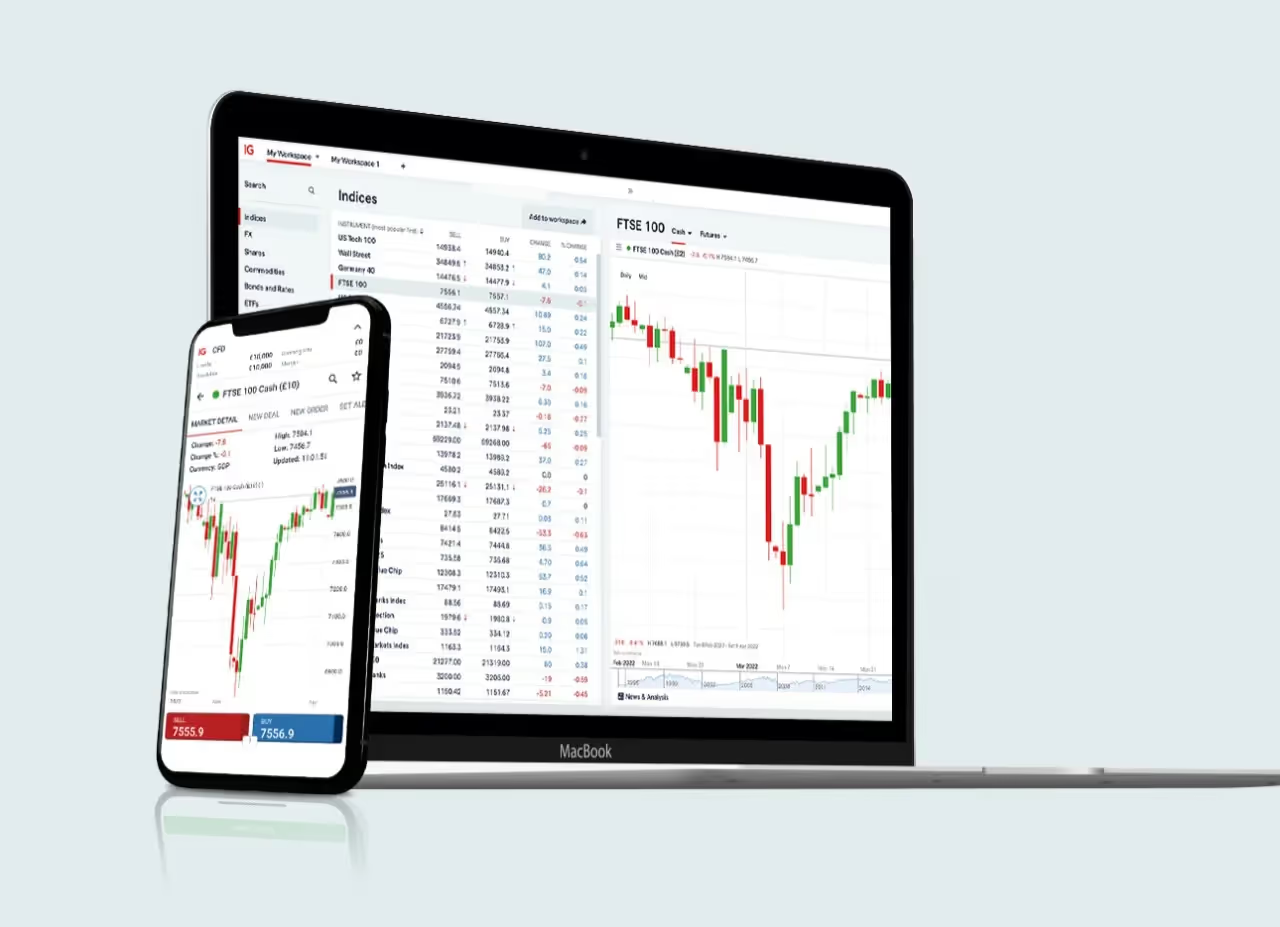
The real difference between cash available to trade and settled cash comes down to permission versus ownership. While your brokerage lets you use unsettled funds for buying, you do not legally own that money until settlement is complete. This gap between what you can see and what you can actually use introduces certain risks depending on how you trade.
Your account balance isn't just one big amount of money; it is a mix of different sources, each with different levels of accessibility. Cash available to trade includes fully settled funds, unsettled proceeds from recent sales, and deposits that haven't cleared yet. Your brokerage calculates this number to show your maximum buying power at that moment.
While the platform wants to show opportunity, not limits, this optimistic number hides an important detail: not all of that money is yours to cycle through multiple trades. For those interested in maximizing their trading potential, consider how our funded trading program can help you access more opportunities.
What happens upon selling shares?
When shares are sold on Tuesday morning, the account shows those proceeds as available immediately. The brokerage expects the sale to settle on Wednesday, so they are giving provisional credit. This lets the trader use that money to buy another position right away.
However, if that new position is sold before Wednesday, the trader is using money that hasn't yet been legally transferred. While the system allows the first action (the buy), it penalizes the second action (the early sell).
What is settled cash?
Settled cash is money that has completed the full clearing process. It is no longer provisional, pending, or subject to reversal.
With settled cash, you can buy securities, sell them the same day if you want, and keep repeating this cycle without breaking any rules. This is the only capital that gives you true flexibility in a cash account.
Settled cash does not include sale proceeds that are still in the T+1 window, deposits that haven't cleared through the bank, or any margin or borrowed funds. Once cash settles, it becomes fully paid-for capital under SEC rules.
You can't borrow against future settlements, and you can't use provisional credit. Instead, you are trading with money that is legally yours to use however you want, as shown in our article on trading with settled cash.
How does this affect active trading?
The real difference shows up when you need to act quickly. If you keep your investments for days or weeks, the difference is not a big deal. But if you buy and sell within hours or over a few days, the settled cash amount is the only one that really matters. Everything else is just an illusion of liquidity.
Stock trades settle one business day after they are done under current T+1 rules. While this might seem quick, it creates problems for active traders.
If you sell a position on Monday and want to use that money for a fast trade, you have to wait until Tuesday for the settlement to finish. Your account shows the funds as available on Monday, but trying to buy or sell before Tuesday can result in a violation.
How do unsettled proceeds impact multiple positions?
Managing multiple positions can be frustrating. You sell Stock A on Monday, Stock B on Tuesday, and Stock C on Wednesday. This process generates unsettled proceeds at different times. By Thursday, your account might show $25,000 available to trade, but only $8,000 is actually settled. The rest is spread across three different settlement windows. If each sale isn't tracked individually, it becomes hard to know which part of your balance is safe to use.
What do compliance violations mean?
According to Charles Schwab's 2024 trading compliance data, approximately 35% of Good Faith Violations occur when traders forget which funds have settled while managing many positions simultaneously. The platform does not warn you in real time. It calculates violations after the trade is executed. By that time, the damage is done.
Brokerages show the cash available to trade to improve the user experience and keep traders interested. This number looks reassuring. When traders see $15,000, they think they have that amount of capital to use. However, if $10,000 of that total comes from a sale made yesterday, they are really working with $5,000 of true liquidity for active trading strategies.
How can traders manage the risks?
This design choice isn't neutral; it shifts responsibility onto the trader to understand settlement mechanics and track which funds are safe to use. The platform gives enough flexibility for traders to make mistakes, then punishes them for not knowing better. Most traders learn about the restrictions only after their first violation, when they receive a warning email explaining a rule they weren't aware of.
The failure point is usually due to behavior, not technology. Traders check their available balance, assume they have enough money, and implement strategies that require quick position changes. Even though the account lets them place trades, the system punishes them afterward. This gap between permission and consequence creates a compliance trap that can catch even experienced traders who simply weren't paying attention to settlement timing.
What about deposits and their effects?
It's not just sale proceeds that create unsettled funds; deposits also get held up during the clearing process. If you transfer $5,000 from your bank via ACH on Monday, your brokerage might show that money as available to trade by Tuesday. However, the ACH transfer hasn't fully cleared yet. If you use that $5,000 to buy shares and sell them before the deposit settles, you've committed a freeriding violation, which is more serious than a Good Faith Violation and can result in immediate account restrictions.
The distinction matters because deposits and sale proceeds settle on different timelines. An ACH transfer can take up to four business days to fully clear, even though your brokerage may give you provisional access after one or two days. If you're layering new deposits on top of unsettled sale proceeds, you're juggling multiple settlement windows at the same time. One misstep, and your account gets flagged.
What is a general trading principle to avoid violations?
Experienced traders follow a simple rule: if they plan to buy and hold, cash available to trade works fine. If they plan to buy and sell quickly, they should only use settled cash. This single distinction prevents most cash account violations.
The rule works because it matches your actions with settlement rules. When you trade only with settled funds, you never deal with unsettled funds. You can also consider our funded trading program for more flexibility in your trading strategy. This rule may seem stricter, but it completely eliminates the risk of noncompliance.
What are the advantages of trading with settled capital?
Trading with capital that doesn't need settlement tracking has big benefits. Funded trading programs give you access to a lot of buying power without needing to figure out which part of your balance is legally cleared. Traders can start taking opportunities right away, without waiting for earlier transactions to settle.
This capital is made for active strategies, helping you focus on executing trades rather than dealing with compliance accounting. Plus, you're trading with funds that don't have the hidden rules that usually come with personal brokerage accounts.
How does knowing about settlements impact trading?
Most traders don't realize how much mental overhead they're carrying until they stop tracking settlement windows. The cognitive load of managing multiple timelines adds friction to every decision.
Remembering which sales have cleared and calculating safe liquidity for each new trade can be overwhelming. When that friction disappears, trading becomes faster and more intuitive.
Knowing when funds are settled provides protection, but only if traders understand what happens when they break the rules.
Cash Trading Account Violations
Three violations in cash accounts matter: good-faith violations, freeriding violations, and liquidation violations. Each one comes from using money before it is legally yours, and all three have the same penalty structure.
If you accumulate three strikes within twelve months, your account will go into a 90-day restriction period during which you can only trade with fully settled funds. Learn more about the 90-day restriction here.
These violations may sound technical, but they all describe the same basic behavior: buying securities with unsettled funds and then selling those securities before the original funds have cleared. The difference between the types of violations depends on timing and sequence, not on intent. Most traders trigger their first violation without realizing they've crossed a line until they receive the warning email.
What is a good-faith violation?
A good-faith violation occurs when a trader buys a security with proceeds from an unsettled sale and then sells that security before the original sale clears.
In this case, the order of the transactions is more important than the amounts.
For example, let's say you sell Stock A on Monday for $5,000. That money won't settle until Tuesday because of T+1 rules. On Monday afternoon, you use that $5,000 to buy Stock B.
Then, on Tuesday morning, before the money from selling Stock A has settled, you sell Stock B. This last sale violates the law because you sold Stock B with money that wasn't legally yours.
This situation often confuses traders who think that seeing money in their account means they can use it right away. Your brokerage shows the $5,000 as available to trade right after you sell Stock A.
The platform doesn't stop you from buying Stock B with that money, but it only warns you about the violation after you sell Stock B too soon. By then, the trade has already gone through, and the violation is noted.
Many traders feel frustrated when they cannot use proceeds from stock sales right away, even though the cash appears in their account balance. The number looks real, but the regulatory settlement clock hasn't finished yet. You're trading on temporary credit, not settled money.
What is freeriding?
Freeriding describes the practice of buying securities in a cash account and then selling them before payment is made for the purchase. This means using the brokerage's funds rather than your own, which violates Regulation T under federal securities law.
Consider a classic scenario: you buy 100 shares of a stock on Monday, but lack enough settled funds in your account to cover the purchase. On Tuesday, you sell those same shares before the payment for Monday's transaction is due. You then use the money from Tuesday's sale to cover Monday's buy. This shows freeriding because you financed the initial purchase with money you didn't have at the time.
This violation is more serious than a good-faith violation because it involves the use of unauthorized borrowed funds. Brokerages give provisional credit for sale proceeds, but do not provide credit for purchases made without any underlying capital. When buying securities with funds you do not actually have, you operate completely outside the rules for cash accounts. For trading insights, see how much money you need.
Typically, the problem occurs with a deposit that hasn't cleared. For example, you might transfer $3,000 from your bank on Monday and see it available to trade on Tuesday. After buying shares on Wednesday and selling them on Thursday, you could be in violation if that ACH deposit hasn't fully settled by Thursday. Sometimes, the deposit might take up to four business days to clear, even though your brokerage showed it as available after just two days.
What is a liquidation violation?
A liquidation violation happens when someone buys securities and then sells other holdings the next day to pay for that initial purchase. This situation occurs when the price execution differs from expectations, resulting in a negative balance that forces the liquidation of other positions.
Here's how it goes: you have $1,000 in settled cash. On Monday evening, you place an order to buy 100 shares of Stock A, which closed at $9.90. Based on that closing price, you have enough money to cover the trade. But on Tuesday morning, Stock A opens higher, and your order is executed at $10.10 per share. Now, your account shows a negative balance of $10. On Wednesday, you sell another position to cover that $10 shortfall. That forced sale triggers a liquidation violation.
The violation occurs because you bought securities without enough settled funds to cover the actual execution price. Even though the brokerage allowed the trade, a debt was created that required the immediate liquidation of other assets.
You weren't trying to overleverage your account; you just didn't consider the price change between when you placed the order and when it was executed.
How can violations affect your trading?
This violation affects traders who keep their available cash too close to zero. If you are using 98% of settled funds for a purchase, any price slippage will push you into negative territory. The safest approach is to maintain a buffer of at least 5-10% of your account value as unused settled cash. This ensures that execution variance does not force unplanned liquidations.
Your brokerage automatically tracks every violation, as do the SEC and FINRA. The first violation triggers a warning, while the second triggers a stronger notice. If you incur a third violation within a rolling twelve-month period, your account will be locked into a 90-day settled-cash-only restriction.
During this restriction period, you can only purchase securities if you have enough settled funds in your account when you place the order. You cannot use unsettled proceeds, rely on provisional credit, or trade with deposits that have not fully cleared.
Every purchase requires cash that has completed the full settlement process, meaning a complete business day must pass after every sale before you can use those funds again.
According to TD Ameritrade's 2024 compliance disclosures, the average restricted trader experiences a 60% reduction in their normal trading frequency during the 90-day penalty period. This is not because of a lack of capital, but due to a lack of settled capital at the exact moment a trade is executed. If you sell a position on Monday and want to enter a new trade Tuesday morning, you cannot. The Monday sale will not settle until Tuesday afternoon at the earliest, leaving you waiting while opportunities pass.
What happens if violations continue?
The restriction doesn't just slow down trading; it also significantly alters trading strategies. Active strategies that rely on quick buying and selling become impossible. Traders cannot respond to intraday volatility or capitalize on multi-day momentum. Instead, they must use a buy-and-hold method, even if that doesn't fit their strategy.
If violations continue after the 90-day restriction ends, the brokerage may close the account. Some traders try to switch to a different brokerage to avoid their violation history, but those records remain available.
FINRA keeps a central database of regulatory breaks. A new broker can see past violations when approving an account, which may result in the account being denied or immediately restricted.
The whole violation system assumes that traders work on multi-day timeframes. For example, if a trader buys on Monday and sells on Friday, the timing of settlements is not a problem. The Monday purchase settles by Wednesday, so the Friday sale can use fully cleared funds. This system works well for position traders and long-term investors.
On the other hand, for traders who buy and sell within hours or over consecutive days, the settlement lag creates ongoing issues. These traders are not trying to cheat the system or trade on credit; they are just moving faster than the regulatory settlement process allows within a cash account.
The platform shows available funds; those funds are used, but the system punishes traders for not tracking which part of their balance has cleared legally.
How can funded trading programs help?
That's where funded trading programs completely remove settlement friction. With a funded account, traders use funds that don't require settlement tracking. There’s no need to figure out which part of the balance is legally cleared or to wait for yesterday's trade to settle before accessing today's opportunities.
The capital is set up for active strategies, allowing entry and exit based on market conditions instead of compliance timelines. Traders avoid managing multiple settlement windows or risking violations every time they make a quick trade.
The mental load of tracking settlement windows across different positions adds friction to every decision. Traders must consider not only price action and entry timing, but also which funds are safe to use, which sales have cleared, and the available balance against the settled balance before every trade.
This extra mental effort can slow decision-making and increase the risk of mistakes.
Avoiding violations is important, and it's not just about knowing the rules after they've been broken. Being aware of settlement requirements helps traders deal with complex regulations effectively.
Related Reading
- How To Edit Video In Google Drive
- How To Make Money Video Editing
- Mac Vs Pc For Video Editing
- Video Editing Workflow Checklist
- Creative Video Editing Techniques
- How To Organize Video Files For Editing
- How To Practice Video Editing
- How To Make A Video Editing Portfolio
- Video Editing Tips And Tricks
- Pc Specs For Video Editing
- Best Free Video Editing Apps For Android
- How To Start Editing Videos
How to Avoid Cash Account Trading Violations

Avoiding violations is easier than the rules might seem. Traders should keep track of which funds have actually settled, avoid using sale proceeds to buy and immediately sell before the settlement is complete, and keep a buffer between their total balance and the amount they are using. These three habits can stop almost every violation before it happens.
Most traders who get violations aren't careless; they just aren't watching the right numbers. The platform shows the total buying power at the top of every screen. However, the settled cash is often hidden in an account details dropdown or a secondary balance view.
The important number is just two clicks away from the visible total, reducing the number of checks. That's when the first violation usually happens.
Brokerages often separate settled funds from the total balance somewhere in the account interface. It's important to find that specific view and bookmark it. Before making any trade, always check that number rather than relying on the larger buying power number shown on the main trading screen. For traders new to this concept, our funded trading program could provide guidance and support.
How to track your settled and unsettled funds?
When you sell shares on Monday, write down the sale amount and the date for Tuesday; that is when those funds can be used for rapid-turnover strategies. If you're managing multiple positions, keep a simple spreadsheet with three columns: security sold, sale amount, and settlement date. Update it after every sale, which only takes 30 seconds per trade. This practice helps avoid confusion that can lead to violations.
Traders who make many transactions daily often lose track of which funds are settled and which are unsettled, especially during busy trading times. The platform won't prevent you from making a trade with unsettled funds; it calculates the violation after the trade is executed, when reversal is no longer possible. Your protection comes from knowing which part of your balance is legally cleared before you click buy. Additionally, consider how our funded trading program can support your trading activities.
What is the simplest rule for avoiding violations?
The easiest rule to avoid good-faith violations is simple: if you sell a position today, wait until tomorrow to use that money to buy or sell another position. You can use the money to buy, but you cannot sell that new purchase until the original sale is fully settled.
What happens when holding positions?
This restriction is important only when closing positions quickly. If you hold for several days, settling is not a problem.
However, for those looking to make money on intraday moves or momentum over several days, the one-day waiting period limits how quickly you can act.
This rule makes traders choose. They must either slow down to match settlement times or change how they use their capital to avoid letting settlement timings control what they do. Most active traders eventually face this challenge: their strategy requires faster capital recycling than a cash account allows.
How to prevent liquidation violations?
Never deploy 100% of your settled cash into a single trade. Price slippage between order placement and execution can increase your purchase cost beyond your available balance, potentially triggering a liquidation violation. This happens when you must sell other holdings to make up for the shortfall.
Keep at least 5% of your account value as unused settled cash. For example, if you are trading with $20,000, leave $1,000 untouched as a buffer. This cushion helps with execution changes without forcing unplanned liquidations. Additionally, the buffer gives you flexibility when multiple trades settle at different times, preventing moments where you become temporarily capital-locked even though you have a lot of account value.
How does a margin account differ?
Switching to a margin account removes settlement restrictions entirely for most trades. This means you're borrowing against your account value, allowing you to buy and sell the same security multiple times in a single day without triggering cash account violations. However, margin comes with different risks and rules.
Margin accounts require minimum balances, usually $2,000 to open and keep. If your account value goes below these levels, you will get margin calls, which force you to either deposit more money or sell positions at bad prices.
Also, if you make four or more day trades within five business days, you become classified as a pattern day trader, which means you must maintain at least $25,000 in account equity.
What consequences do trading violations have?
According to Merrill Edge's violation guidelines, accounts flagged for repeated violations face a 90-day restriction period where only settled funds can be used for trading. This penalty applies whether you're in a cash account or a margin account that follows cash trading rules. The restriction does not go away if you switch account types after getting violations.
Margin accounts can help traders with large account balances who understand leverage. While margins offer flexibility, they also complicate things and increase risk. Borrowed money can increase both gains and losses, and the pattern day trader rule limits anyone who trades actively to those with at least $25,000.
How to manage multiple daily trades?
For those executing 5 or more trades per day, especially when markets are changing quickly, manual tracking becomes very important. While your brokerage statement shows completed trades, it doesn't clearly show the difference between settled and pending funds at any moment.
Create a simple log that includes these fields: date, action (buy/sell), security, amount, and settlement date. Update this log right after each trade. Keeping this record helps you see upcoming settlement dates for all your positions.
Before thinking about a new trade, look over the log to make sure you have sufficient settled funds available. Additionally, consider the benefits of our funded trading program to enhance your trading experience.
Why is organization important?
Organization removes guesswork. Traders don't need to remember which sale happened on Monday or Tuesday, or try to calculate settlement dates in their heads while keeping an eye on price action. A well-kept log provides clear information on which funds have been cleared and which are still pending. This clarity helps prevent overlapping unsettled transactions, which can cause violations during busy times.
What happens when switching brokerages?
Violation history does not reset when switching brokerages. FINRA maintains central records of trading infractions, so a new broker checks this history when you apply for an account. If your record shows repeated violations, the broker may quickly impose restrictions or refuse to open your account.
The 90-day restriction period is more than just an inconvenience; it fundamentally changes the strategies available to you. Active strategies that rely on quick buying and selling become almost impossible, as you have to wait a full day after each sale before you can use your money again. You are not out of money; instead, you lack settled funds at the exact moments when you need to act.
How do funded trading programs help?
That's the friction that funded trading programs eliminate entirely. You're trading with money set up for active strategies, where settlement windows and violation tracking disappear from your tasks.
The account provides you with significant buying power for quick position changes, so you can enter and exit based on market conditions rather than compliance timelines.
You're not figuring out which part of your balance is legally cleared or waiting for yesterday's trade to settle before you can take today's opportunity.
What is the mental toll of violations?
The real cost of violations isn't just the warning emails or temporary restrictions. It's the mental overhead of tracking multiple settlement windows while analyzing price action and executing time-sensitive trades. Every decision involves an additional layer of compliance calculations that slows progress and increases the risk of errors.
Knowing how to avoid violations only helps traders if they can actually access their capital when opportunities come up.
Stop Missing Trades Because of Settlement Delays
Settlement restrictions force traders to choose between active trading and avoiding violations. When each sale requires a 24-hour wait before funds can be used again, traders are not effectively managing risk or analyzing markets.
Instead, they are keeping track of a compliance calendar, which takes away from their trading advantage. If cash settlement rules limit how often you can trade or make you wait days between trades, it’s time to improve your setup. AquaFunded enables active trading without the constraints of settled cash rules. There are no T+1 delays, no good faith violations, and no inactive capital.
You can access funded accounts up to $400,000, ensuring that your trading potential is not tied to whether your cash has "settled" yet. With unlimited timeframes, flexible trading conditions, and up to 100% profit split, you can concentrate on execution instead of brokerage settlement rules. Join over 42,000 traders who have earned $2.9 million in rewards, all backed by a 48-hour payout guarantee.
Your skill matters more than your settlement timeline. funded trading program
Related Reading
- How To Take Profits From Stocks
- Accumulation Distribution
- Short-Term Capital Gain Tax On Shares
- What Is Reit Dividends
- Best Pairs To Trade Forex
- Can You Day Trade In A Roth Ira
- What Is A Conditional Order
- Orb Strategy Trading
- Stop Loss Vs Stop Limit
- Flag Pattern Trading
- Characteristics of Growth Stocks
- Forex Compounding Plan
