




Stop Loss vs Stop Limit Detailed Comparison
Stop Loss vs Stop Limit: Detailed Comparison clarifies risk management for funded accounts. AquaFunded explains stop order strategies to protect trades.

Market volatility demands robust risk management to protect trading capital. Stop loss and stop limit orders provide mechanisms that shield funds against rapid market swings, a practice especially critical for traders using external funding. Effective risk strategies not only safeguard capital but also help maintain essential trading relationships.
Traders often ask, what is a funded account? Debates over stop-loss vs. stop-limit orders highlight the strategic choices required in volatile markets. AquaFunded’s funded trading program equips traders with tools to protect capital while advancing their careers.
Summary
- Trading capital preservation depends on balancing execution certainty with price control, and most traders learn this distinction only after watching protective orders fail at the very moments they needed them most. Stop-loss orders guarantee execution by converting to market orders when triggered, accepting slippage as the cost of certainty. Stop-limit orders guarantee a price by becoming limit orders after activation, risking no execution if markets move too fast. Research from the Journal of Trading found that stop-loss orders during high volatility experienced average slippage of 1.8% beyond the trigger price, with some instances exceeding 5%, while stop-limit orders often failed to execute entirely under the same conditions.
- Position sizing must work backward from stop distance rather than forward from buying power. The standard risk framework limits single-trade exposure to 1-2% of total capital, which means your position size equals your risk tolerance divided by your stop distance. A $100,000 account risking 2% can lose $2,000, so a stop placed $5 from entry allows exactly 400 shares. Traders who calculate position size based on how many shares they can afford rather than how much they can lose are gambling with leverage instead of managing risk with mathematics.
- Over 90% of traders blow up their accounts, according to industry data, often due to transaction cost erosion and overtrading rather than single catastrophic losses. Every trade carries costs beyond the spread through commissions, fees, and the psychological toll of constant decision-making. Quality setups are rare, and traders entering multiple positions daily are usually driven by impatience rather than executing a legitimate high-frequency strategy with proven edge. Each mediocre trade chips away at capital while teaching nothing about better trade selection.
- Diversification reduces risk only when positions don't move together, yet most traders hold concentrated exposure under the guise of diversification. Five tech stocks aren't diversification; they're sector concentration that declines simultaneously during selloffs. True diversification requires understanding the correlation between holdings, recognizing that long crude oil plus long energy stocks doubles down on the same directional bet. Accidental correlation, where you believe you're diversified but actually hold multiple expressions of the same trade, concentrates risk while providing false comfort about portfolio construction.
- Volatility isn't constant, so risk parameters shouldn't be either, yet most traders maintain static stop distances regardless of current market conditions. When Average True Range doubles, stop distances should expand proportionally to maintain the same risk-adjusted buffer relative to current price behavior. Scheduled events like earnings announcements and economic data releases create predictable volatility spikes that warrant either wider stops or reduced position sizes. Traders who maintain normal parameters during these events ignore obvious risk factors and then react with surprise when volatility spikes through their stops.
- AquaFunded addresses this by providing up to $400,000 in trading capital with profit targets of 2-10%, letting traders focus on stop-loss discipline and execution quality rather than account survival, and processing payouts within 48 hours for those who demonstrate consistent risk management.
Types of Orders
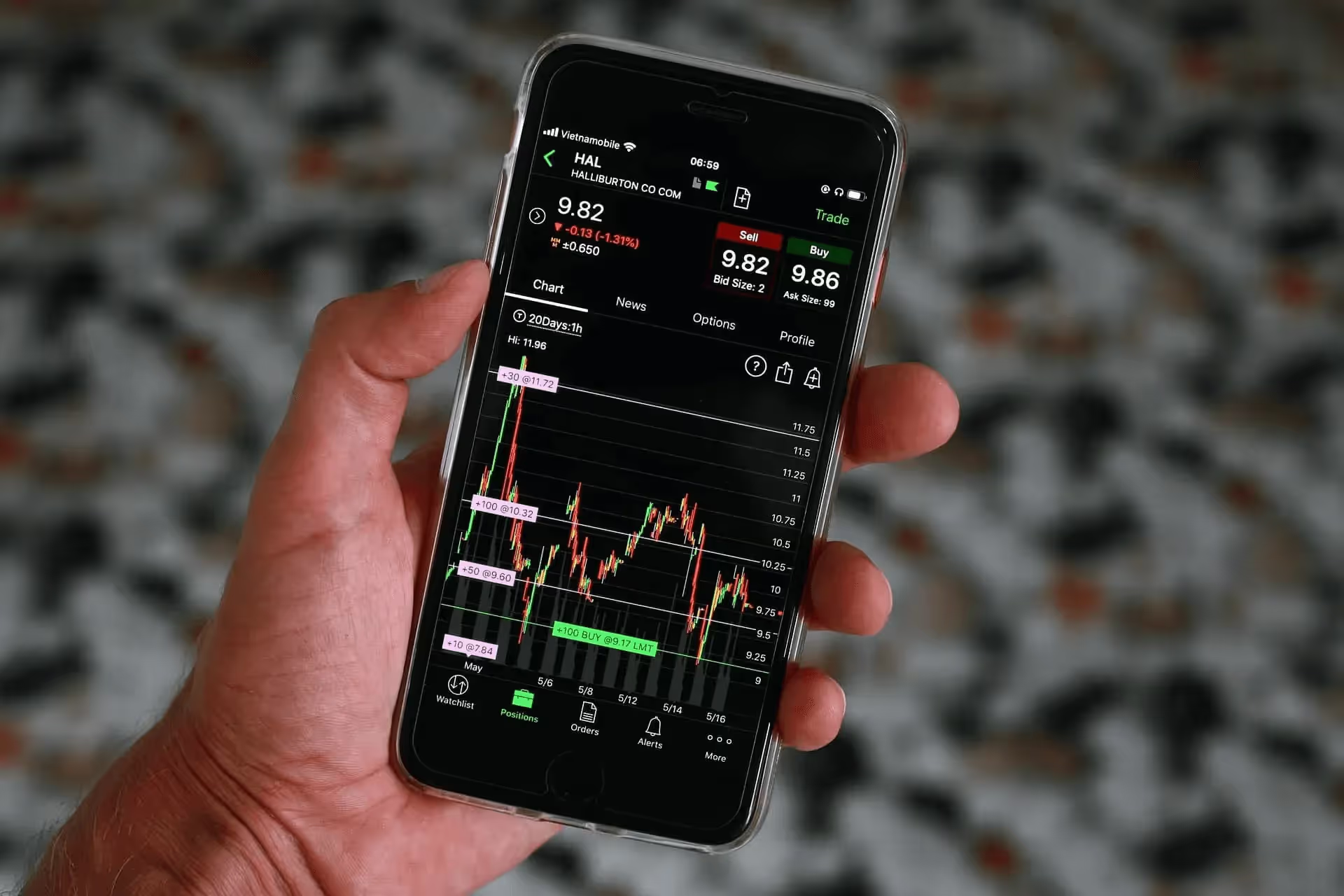
When trading with real money, the type of order you pick affects whether your trading plan can handle the market's first reactions. Each order behaves differently under stress, and understanding these differences can help traders avoid costly surprises when volatility spikes or liquidity dries up. If you’re interested in growing your trading capabilities, our funded trading program can provide the support you need. The available order types are divided into five categories, each suited to different market situations and risk levels. While some strategies work well during calm trading times, they can fail dramatically during earnings announcements or economic releases. The difference between protecting your account and seeing a position go out of control often comes down to choosing the right execution method before hitting submit.
Market Order
A market order executes immediately at the current market price. This method focuses on speed and certainty of execution rather than controlling the price. When you submit a market order, it tells the broker to fill the trade at the best available price, even if that price has changed since the last time it was checked. The advantage is simple: trades fill almost right away, allowing you to enter or exit a position without waiting. If you need to quickly exit a losing trade or to take advantage of a breakout as it happens, market orders can provide that speed. The trade won't stay unfilled while the market moves away.
The cost is also clear. You give up control over the execution price. During times of high volatility, the price you see when you click submit can be very different from the price you actually get. This difference, called slippage, can be especially frustrating in fast-moving markets or securities with low trading volume. Trading Economics reported that new orders in the United States decreased to $604,792 million in October from $612,874 million in September 2025, underscoring how order flow can change with market conditions and liquidity availability.
Limit Order
A limit order only executes at the price you set or a better one. You choose price control instead of execution certainty. When you place a buy limit order, you set the maximum price you're willing to pay. For a sell limit order, you set the lowest price you're willing to accept. The trade only happens if the market reaches your price.
This strategy gives you full control over your entering and exiting prices. You won't overpay when buying or undersell when selling. Whether you are building a position over time or waiting for a certain technical level, limit orders let you set your price and step away. The order stays in the market until your price is hit or you cancel it.
The downside is that your order might never fill. If the market doesn't reach your limit price, you will miss the trade completely. During strong market moves, you might see a position move away from your limit order while you wait for a price that never comes back. Although you protected your price, you might have missed a good opportunity.
Stop Orders
Stop orders activate when the market hits a specific trigger price. They change into a market order or a limit order depending on the type chosen. These orders remain inactive until the price reaches the set level, at which point they become active.
A stop-loss order turns into a market order once the stop price is reached. This ensures that the order will be executed, but not at a specific price. For example, if someone owns a stock at $50 and sets a stop-loss at $48, the order changes to a market order as soon as the stock sells at $48 or lower. The position will close, but the actual price during a fast drop could be $47.50 or even lower. A stop-limit order changes into a limit order when it’s triggered. Traders set both a stop price and a limit price. When the stop price is reached, the order becomes a limit order at that price.
This method offers price protection once triggered; however, there is a chance that the order might not execute if the market moves past the limit price too quickly. As a result, this protective order might not provide any protection.
Trailing Stop Order
A trailing stop order moves with the market price, adjusting your stop level automatically as your position becomes more profitable. You set a trailing distance, either as a dollar amount or a percentage. The stop price moves with the market for long positions or against it for short positions, while maintaining that fixed distance.
This approach locks in gains while allowing your position room to run. For example, if you buy at $50 with a $2 trailing stop, your initial stop sits at $48. If the stock goes up to $55, your stop automatically changes to $53. The stop only moves in your favor, never against you. This system helps you capture upward momentum while protecting accumulated profits.
The main weakness happens during choppy, volatile markets. A temporary spike against your position can trigger your trailing stop too soon, kicking you out of a trade that quickly turns back in your favor. As a result, you may protect gains that don’t need protection, exiting just before the move you’ve been waiting for finally happens.
Bracket Orders
A bracket order combines a profit target and a stop-loss into a single order. When your entry order fills, two exit orders activate at the same time: one to take profits at your target price and one to limit losses at your stop price. Whichever level the market hits first gets executed, while the other order automatically cancels.
This automation removes emotion from your exit decisions. You set your risk and reward before entering the trade, allowing the market to decide which exit triggers to use. You cannot freeze during a drawdown or get greedy during a rally because your exits are already in place. The position is managed in line with your planned strategy.
The main limitation is inflexibility. Market conditions change, but your bracket order does not adapt unless you change it manually. If volatility increases or new information emerges, your preset exits may no longer make sense. You get stuck with yesterday's plan while trading today's market, and that rigidity can cost you when situations change unexpectedly.
Why does order selection matter in funded accounts?
When trading through a funded account, your order selection carries extra weight because it shows that you manage risk well while being evaluated. Programs like AquaFunded assess how well you protect your capital while aiming for profit goals of 2-10%. Using the right order type for each market condition shows that you understand how to execute trades, not just which way the market is moving. This knowledge helps separate traders who can successfully grow their accounts from those who do not pass evaluation phases. However, knowing the order types is only half the equation. Understanding when each order type works best is where the real advantage lies.
Stop Loss vs Stop Limit Detailed Comparison
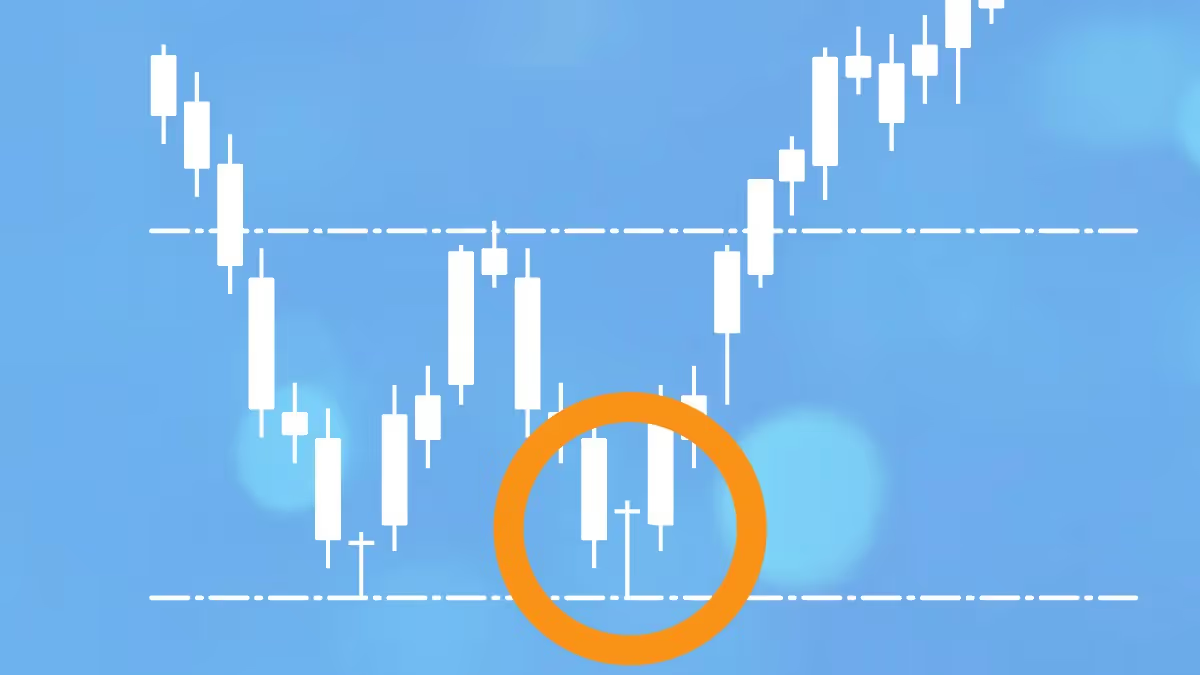
A stop-loss order guarantees that a trade will execute once the trigger price once the trigger price is hit, but it means you give up control over the fill price. On the other hand, a stop-limit order guarantees the price but not the execution. This means a protective order might not help you when you really need it. Neither choice is automatically safer, and picking the wrong one for the current market conditions can actually increase your risk rather than manage it. If you're exploring risk management options, consider a funded trading program that may suit your needs.
Stop-Loss Orders
When stop-loss orders are triggered, they are automatically converted to market orders. You get certainty of execution, but lose control over the price. For example, if the stock you bought at $50 falls to your $48 stop, the order triggers and sells immediately at the next market price. This guarantee is important when you need to exit, no matter the exact price. During sudden market drops or times of news-driven volatility, a stop-loss helps you leave the position before losses get worse. You won’t have to watch your account lose money while an unfilled order waits for a price that the market has already moved past.
The costs of using stop-loss orders are evident during sudden market moves or gaps. Your $48 stop could execute at $46.50 if the market falls sharply between trades. This slippage: the gap between your trigger price and the actual fill can hurt a lot in less traded securities or during after-hours, when there isn’t much buying or selling. Even though you tried to protect yourself from unlimited losses, you might end up taking a bigger hit than what your stop price suggested.
Research from the Journal of Trading (2023) examining retail trader execution quality showed that stop-loss orders during times of high volatility had an average slippage of 1.8% beyond the trigger price. In some cases, slippage exceeded 5% during market gaps. While stop-loss orders guarantee execution, they often entail a measurable, unexpected cost.
Stop-Limit Orders
Stop-limit orders give you extra control over prices once your trigger is hit. You set a stop price, which is the trigger, and a limit price, which is the lowest price you’re willing to accept. When your stop at $48 is reached, the order becomes a limit order at your chosen price, such as $47.50. The trade will only go through if there is a buyer willing to pay $47.50 or more. This setup protects you from catastrophic slippage during panicked selling. You won’t accidentally sell at $45 during a quick crash if your limit is $47.50. The order stays active, waiting for a buyer willing to meet your price. You have set a boundary that the market must follow.
The protection can become a trap if the market never returns to the limit price. For example, if the stock drops from $48 to $46 overnight, your stop-limit order triggers but never gets filled. You're still holding a losing position that's now even worse, while your protective order stays useless at the back of the queue. The very mechanism meant to limit losses leaves you fully exposed to them.
Traders often find this problem when they need protection the most. The market doesn't pay attention to your limit price when everyone else is trying to sell quickly. Your order ends up in a long line with thousands of others waiting for prices that are no longer available.
Execution Certainty vs Price Control
The main difference between these orders is what you are more afraid of: bad execution prices or no execution at all. Stop-loss orders focus on getting out, even if the price isn't great. On the other hand, stop-limit orders focus on sticking to a price, which means you might not be able to exit at all. When the market is normal, with small differences between bid and ask prices and steady trading volume, this difference isn't very important. Your stop-loss usually fills close to your trigger price, while your stop-limit goes through because there is enough liquidity at your limit. These orders act similarly enough that choosing between them often seems like just an academic exercise.
Market Context Determines Effectiveness
Stop-loss orders are most useful when ensuring that the order goes through is more important than losing a little money on slippage. They work well in liquid markets during regular trading hours, especially for overnight positions that can be affected by news. For positions that are too big to watch all the time, knowing there is a guaranteed exit is more valuable than worrying about price changes. Traders are basically paying a small price, through slippage, for the certainty of getting their order filled.
On the other hand, stop-limit orders work better in stable, liquid markets. These orders help traders who can take their time, valuing price control over quick execution. This method is especially helpful when closing out a winning position, trading less-liquid stocks that could incur large slippage, or dealing with tight profits where a bad fill price can wipe out any advantage. In these situations, the price guarantee makes the execution risk worthwhile.
What mistakes do traders make with stop-limit orders?
The mistake happens when traders use stop-limit orders for risk management, thinking they are safe. A stop-limit order does not protect you if it doesn't fill. This gives a false sense of security, leaving traders exposed to the very situation they sought to avoid. Many only realize this after a position drops below their unfilled stop-limit order.
How does trading funded capital relate to these orders?
When trading funded capital, understanding this distinction directly affects the ability to meet profit targets while protecting the account. Programs like AquaFunded not only check whether traders reach their 2-10% profit targets, but also assess how they manage risk throughout the process. Traders who use stop-loss orders during unstable evaluation periods show a commitment to capital preservation instead of trying to get perfect exit prices. This way of thinking, which focuses on making sure things are done right when it matters, goes hand in hand with the risk management discipline that keeps accounts funded and growing.
Practical Execution Differences
Stop-loss orders show how useful they are during market opens, economic news releases, and earnings announcements. These situations can lead to times when stop-limit orders do not work well. Quick price changes can trigger a stop-loss, but may prevent the limit price from appearing in the order book. Because of this, the stop-loss trader might face slippage and leave the position, while the stop-limit trader stays in, hoping for a bounce that might not happen.
Stop-limit orders work well when you want to take profits in markets that are going up. For instance, if you bought at $50 and the stock goes up to $60, you might want to sell, but only if it stays above $59.50. By setting a stop-limit at $59.75 with a limit of $59.50, you can secure profits without losing too much during a brief drop.
In this case, the focus is on achieving the best exit prices on a winning trade rather than managing losses. It's okay to take some execution risk here because the main goal is to protect your gains, not to avoid losses. The context switch matters. What works for locking in profits can fail badly when trying to avoid losses. Traders who use stop limits in both situations often learn this distinction the hard way. Knowing which order type to use only matters if one understands when to use it. This timing depends on reading market conditions, which many traders completely miss.
Related Reading
- How to Grow a Small Trading Account
- What is Trading Commodities
- Long Term Trading Strategy
- Capital Growth Strategy
- What is a Cash Account in Trading
- What is Compound Trading
- How Much Money Do You Need to Start Trading Stocks
- Scale Trading
- Small Account Trading
- How to Evaluate Investment Opportunities
- Blown Trading Account
- What is PNL in Trading
- Do Prop Firms Use Real Money
- Prop Firm Account Management
- Borrowing on Margin
- Trading Leverage
How to Use Stop Loss and Stop Limit
Setting your stop orders correctly means turning your risk tolerance into specific price levels before you let emotions take over. You need a systematic approach that considers volatility, position size, and market structure, not just a percentage chosen from someone else's strategy. The goal isn't to avoid all losses; it's to control exactly how much you're ready to lose before you start the trade.
Step 1: Calculate Your Position-Level Risk Tolerance
Start by figuring out the dollar amount you can afford to lose on one trade. Most professional traders risk 1-2% of their total account on each position; some risk up to 3% on setups they really believe in. For example, if you have a $50,000 account, a 2% risk tolerance means you're okay with losing $1,000 on this trade. This number becomes your limit, acting as the boundary that your stop order must support.
Calculating risk is very important because it matters more than what you think about stock changes. Even if you think a trade will do well, just believing in it won't keep your money safe when things go wrong. The 2% rule helps you size your positions correctly and says you should set your stop-loss orders at levels that match how much risk you can actually handle, not just your hopes for the trade's chances.
Traders managing funded accounts have to be more disciplined. When they trade with money that doesn't belong to them, risk parameters become rules rather than just advice. Where they place their stop can affect whether they keep their funding or lose it. The 2-3% guideline aligns with how most evaluation programs assess drawdown limits, making it important for both personal risk management and professional success.
Step 2: Identify Your Stop Price Using Market Structure
The stop-loss price should be set just beyond the point at which your trade idea is no longer valid. For long positions, this usually means placing the stop-loss below a recent support level, swing low, or some technical structure that caught your attention for the trade. On the other hand, for short positions, stops should be placed above resistance or swing highs. The logic is simple: if the price breaks that structure, your original reason for entering the trade doesn’t make sense anymore.
Avoid placing stops at round numbers or random distances from your entry point. The market does not care that you bought at $50 and want to risk exactly $2. If there is important support at $47.80, you should place your stop there, even if it means risking $2.20 instead of your desired $2. If you focus on tidy percentages rather than market structure, you will likely get stopped out during regular volatility before your trading idea has time to develop.
Volatility should help you decide how much space to give your position. In a stock with an Average True Range (ATR) of $1.50, placing your stop just $0.50 away can leave you too early because of regular price movement. It's important to maintain enough distance to handle normal ups and downs while still staying within your risk limit. If the needed stop distance is more than you can accept, think about making your position smaller or not taking the trade at all.
Step 3: Choose Between Stop-Loss and Stop-Limit Based on Context
Once you know your stop price, decide whether execution certainty or price control is more important for that trade. Use a standard stop-loss order when you are holding positions overnight, trading around scheduled events like earnings or economic data, or managing positions that you cannot watch all the time. These situations require guaranteed execution, since the cost of holding a losing trade is higher than the potential cost of slippage.
Stop-limit orders are best used when you are actively watching your position. These orders work well when trading highly liquid securities during regular hours or when selling profitable trades. In these situations, the main goal is to achieve the best exit prices rather than just stop big losses. Set the stop price as the trigger and the limit price 1-2% below for long positions. This way, you allow some flexibility in execution while avoiding unlimited slippage.
The most common mistake traders make is using stop-limits for everything because they are afraid of slippage. This often results in discovering that their protective order did not help them at the critical moment when they needed itmost. When managing risk, it is better to use stop-loss orders. On the other hand, if you want to optimize profits in stable conditions, stop-limits can be a good option.
Step 4: Implement Trailing Stops for Trending Positions
After a position moves in your favor, change your static stop to a trailing stop to lock in gains while also capturing more upside. Set your trailing distance based on the same volatility metrics that guided your initial stop placement. If you used a 2x ATR buffer at first, keep that same distance as your trailing parameter.
Trailing stops work best in strong, sustained trends where pullbacks are small compared to the overall movement. They often do not work well in choppy, range-bound markets, where normal price fluctuations can cause early exits. Before turning on a trailing stop, it is very important to make sure the market is really trending and not just having a short spike that will quickly reverse.
The discipline here means that you should avoid the temptation to tighten your trailing stop too much as you make profits. Traders often hurt their winning trades by tightening their stop loss too quickly as the position improves. This can result in getting taken out right before the next big price increase. Your trailing distance should reflect current volatility, not just a growing fear of losing your profits.
Adjusting Stops as Conditions Change
Your initial stop placement isn't permanent. As new information comes to light, technical levels change, or volatility increases, your stops should change too. If a stock consolidates and forms a new, higher support level, move your stop up to just below it. You're not moving it arbitrarily closer; you're updating it to reflect the new price.
Never move a stop further away from your entry to avoid being stopped out. This is hope disguised as adjustment, and it has the potential to destroy accounts. If your original stop level is about to be hit, accept the loss or exit manually before it triggers. Expanding your risk mid-trade to avoid admitting that you were wrong changes controlled losses into catastrophic ones.
When trading through evaluation programs, stop adjustment becomes part of your shown risk discipline. Platforms like AquaFunded assess not just whether you hit their 2-10% profit targets, but also how you manage your positions along the way. Traders who consistently adjust stops based on changing market situations, rather than emotional reactions to losses, demonstrate the kind of process-driven thinking that leads to ongoing funding and growing accounts.
Why is understanding the broader risk framework crucial?
Placing stops correctly is important. However, it only matters if one understands the broader risk framework. This framework helps to determine position sizing, correlation exposure, and how individual trades fit into the overall portfolio.
Related Reading
- Sources of Capital
- Cash Reserve Account
- Short Term Stock Trading
- Investment Performance Analysis
- Managed Account vs Brokerage Account
- Systematic Trading
- How to Analyze a Stock Before Buying
- Forex Capital Trading
- What is a Retracement in Trading
- How is Risk Involved in Calculating Profit?
- Convergence Trading
- Liquidity Trading
- Futures Trading Minimum Account Size
- What is Drawdown in Trading
How to Manage Risk in Trading Effectively
Position sizing, diversification, and regular review set traders who survive volatile markets apart from those who fail after their first big loss. Risk management isn't about preventing losses; it's about controlling how much you lose when you make a mistake and ensuring that one mistake doesn't ruin your trading career. The system you use is more important than the result of any single trade. Your position size should never be more than the dollar amount you’ve decided is an acceptable loss for one trade. According to ACY Securities, the rule is 1-2% of trading capital per trade. This rule stops any single trade from causing major harm to your account. If you have a $100,000 account and are okay with a 2% risk, you can lose no more than $2,000 on this trade.
This calculation is based on your stop-loss distance. If your analysis shows that the stop should be $5 away from your entry point, and you can risk $2,000, then you can trade 400 shares. The math is simple: risk tolerance divided by stop distance equals position size. Traders who skip this calculation and buy as many shares as they can afford are gambling, not managing risk. It can be harder to stay disciplined when you feel confident about a trade. This confidence might lead to larger positions because you think this one is different. However, being confident does not lower risk; it increases it. The trades you are most sure about can often turn into the biggest losses because you overlooked important position sizing rules when it was most critical.
Use Stop-Loss and Stop-Limit Orders Strategically
Your stop order choice should match the specific risk you are managing. Stop-loss orders ensure your order is executed even during gaps, overnight moves, and news events, when staying in a position is riskier than accepting some slippage. On the other hand, stop-limit orders help protect against large slippage when taking profits or exiting in stable conditions where the risk of execution is low. A common mistake occurs when traders use stop limits to manage risk, thinking they are protected. However, they may find that their order is never filled during the exact situation they were worried about. For example, if there is a gap down through your stop-limit price, you could be fully exposed while your protective order is still unfilled. This creates a false sense of risk management without any real protection.
Adjust your stop type based on when you are trading and what you are holding. Positions held overnight or through times of scheduled volatility need stop-loss orders. On the other hand, intraday positions in active markets during regular hours can use stop-limits if you are watching closely. The situation ultimately decides the best tool for managing risk.
Diversify Across Uncorrelated Positions
Spreading money across different investments only lowers risk if those investments do not move in the same direction. Holding five tech stocks is not real diversification; it is really concentrated sector exposure that looks like a diversified portfolio. When the tech sector goes down, all five stocks drop together, making your "diversified" account fall as if you owned just one stock.
Real diversification means understanding how your investments relate to each other. If you own crude oil and also own energy stocks, you are making the same bet twice. Intentional correlation happens when one investment protects another. On the other hand, accidental correlation occurs when you think you are diversified but really own several versions of the same trade, which raises risk while making you feel falsely secure.
The practical limit for diversification depends on how many positions you can monitor effectively. It's hard to manage 20 positions while working a full-time job. It is better to own five truly uncorrelated positions that you understand well than to keep track of fifteen correlated ones without much knowledge. The quality of diversification is clearly better than itsquantity.
Adjust Risk Based on Current Market Conditions
Volatility isn't constant, and your risk parameters shouldn't be, either. During low-volatility periods, tighter stops work well because price noise is minimal. When volatility increases, your stops need wider buffers; otherwise, you'll get shaken out of good positions by normal market movement. The same 2% stop distance that worked last month might be too tight this week. Use volatility metrics, such as Average True Range, to adjust stop distances to current conditions. If ATR doubles, your stop distance should expand by the same amount. You're not increasing risk, but rather keeping the same risk-adjusted distance compared to current price behavior. Failing to adjust means getting stopped out too early or taking bigger losses than necessary.
Scheduled events create predictable volatility spikes. Earnings announcements, economic data releases, and central bank decisions all require either wider stops or smaller position sizes. Traders who keep normal position sizes with standard stop distances during these events are ignoring clear risk factors. It's no surprise that they often seem shocked when volatility spikes beyond their stops.
Avoid Overtrading and Transaction Cost Erosion
Every trade has costs beyond the spread. Commissions, fees, and the mental stress of constant decision-making build up faster than most traders realize. According to Trade Path, over 90% of traders blow up their accounts. This often happens because excessive trading eats up capital through costs and emotional exhaustion before the strategy has time to show any advantage.
Quality setups are hard to find. If someone is trading several times a day, they are either using a solid high-frequency strategy with proven advantages orovertrading because they are bored and impatient. Most retail traders belong to the second group; they enter weak setups because staying in cash feels like missing out. Each mediocre trade takes away from their account and teaches them nothing about making better trade choices.
The answer is to define what makes a valid setup before starting to trade each day. If the criteria are not met, the trader should not trade. This rule forces them to wait for real opportunities rather than make excuses to enter trades. Funded account programs like AquaFunded assess traders partly on their consistency and discipline in following processes. They reward those who make fewer, higher-quality trades rather than those who overtrade and end up incurring losses, even if they have some winning trades.
Review Performance and Adjust Systematically
A trading journal should answer a critical question: what's working and what isn't? Track not just the win rate and profit factor, but also how well your stops performed, which setups produced the best risk-adjusted returns, and where your process broke down. A trade that hits your profit target but needs you to move your stop further away isn’t a win; it’s a process violation that just happened to turn out positively.
Review frequency is very important. Daily reviews can create recency bias, leading you to overreact to today’s results. Monthly reviews miss real-time feedback, making it hard to make changes that could stop long drawdowns. Weekly reviews strike a balance between responsiveness and having enough data to spot real patterns rather than just noise.
The toughest part is acting on what you find. If your review shows that breakout trades keep failing while pullback entries work well, you need to stop trading breakouts, no matter how tempting they seem. Many traders finish their reviews, see the patterns, and then ignore them because changing their behavior often feels harder than sticking with familiar mistakes.
Understanding order types is crucial.
Even with perfect position sizing and systematic reviews, misunderstandings of order types can lead to significant risks. It's important to know when each order type actually provides protection and when it creates new threats.
Trade With Confidence Using Stop-Loss and Stop-Limit Orders
Understanding when to use stop-loss versus stop-limit orders is only half the battle. The real test comes when you use that knowledge consistently with the right capital structure behind you. Trading with professional funding changes the situation; you're not scared of losing your own savings. Yet you're still accountable to risk limits that support good habits rather than punish them. Most traders spend years building accounts from small balances, taking small positions that limit both risk and reward potential. The common path involves working through months of 2% gains, while a single mistake wipes out weeks of progress. When trading limited personal capital, every stop-loss that triggers feels like a personal failure. Every slippage event becomes increasingly difficult to handle, and the pressure to be right prevents traders from taking the good setups their strategy needs.
Programs like AquaFunded take away that emotional stress by providing up to $400,000 in trading capital with clear profit targets of 2-10%. This setup lets you focus on executing well rather than just surviving in your account. You keep up to 100% of profits, with payments processed in 48 hours, ensuring that your stop-loss discipline leads to lasting income rather than just trying to recover losses. This change is important because good order execution needs the mental freedom to accept losses as part of the process. When a stop-loss triggers on a funded account, you have protected capital that wasn't originally yours, while showing the exact risk management discipline that keeps you funded and growing.
This experience is very different from watching personal savings disappear because of a delay in placing a stop or using a stop-limit that never filled during the gap you were most worried about. Over 42,000 traders have already earned $2.9 million in rewards by using these order types within a system that values consistency over perfection. Stop wondering if your next trade will succeed. Automate your exits with the right order types, protect capital systematically, and trade with the funding that allows your strategy to thrive. Start your evaluation with AquaFunded today and demonstrate that your stop-loss and stop-limit strategies work at scale, not just in theory. The funded trading program provides professional trading support, making it easier to achieve your trading goals.
Related Reading
- How To Take Profits From Stocks
- Accumulation Distribution
- Short-Term Capital Gain Tax On Shares
- What Is Reit Dividends
- Cash Available To Trade Vs Settled Cash
- Best Pairs To Trade Forex
- Can You Day Trade In A Roth Ira
- What Is A Conditional Order
- Orb Strategy Trading
- Flag Pattern Trading
- Characteristics of Growth Stocks
- Forex Compounding Plan
