




How Much Money Do You Need to Start Trading Stocks (Guide)
How Much Money Do You Need to Start Trading Stocks? Learn the real costs, account types, and budget tips for beginners in this quick guide.
.avif)
Consider you want to start trading stocks, but every site talks about minimum deposits, commissions, and margin, and you feel stuck deciding how much cash to put in. Questions like What is a Funded Account and How much starting capital do you need to open a brokerage account or meet pattern day trader rules come up right away.
This post clears up minimum investment, trading costs, position sizing, and risk management so you can set a realistic account size and plan for growth. Ready to see practical steps to easily trade with funded accounts? AquaFunded offers a funded trading program that helps qualified traders access real capital and follow clear risk rules, lowering their personal capital needs and letting them focus on execution and profit.
Summary
- For U.S. day trading, regulatory rules and broker practices create a practical capital floor that fuels the "you need $25,000" myth, because pattern day trader labeling and margin access change order size and margin call risk for frequent same-day traders.
- Buy-and-hold and multi-day swing strategies have no legal entry minimum and can start with "a few hundred to a couple thousand dollars," especially when brokers offer fractional shares that let you build diversified positions.
- Some brokers let you begin with very small deposits, even as little as $100, but fixed per-trade friction matters, since a typical trading fee is around $5 per trade and that fee takes a larger share of small-position gains.
- Liquidity and disclosure problems in low-priced or OTC securities drive outsized losses and attrition, with industry data showing about 80% of day traders quit within the first two years, and only roughly 1% are consistently profitable.
- Rigid position-sizing and stop rules reduce emotional blowups, for example, sizing entries to limit a single loss to 3% of equity and pausing new entries once intraday losses hit a 5% cap.
- Treat early months as disciplined practice, not profit-seeking, using measurable tests like 30 calendar days of paper trading, three documented real trades, or a 30/30 test of 30 days and 30 trades before scaling or changing style.
- This is where AquaFunded fits in; the funded trading program addresses this by providing access to real capital under defined risk rules once a trader demonstrates consistent, rule-based performance.
Table of Contents
- How Much Money Do You Need to Start Trading Stocks
- Challenges of Stock Trading With Less Money
- 12 Expert Tips on How to Invest in Stock Trading With Less Money
- 3 Best Beginner-Friendly Strategies for Stock Trading
- Struggling to trade stocks effectively because your account size is too small to manage risk or diversify properly?
How Much Money Do You Need to Start Trading Stocks

You do not need tens of thousands of dollars to start trading stocks; the amount depends on the style you choose and the platform you use. Some strategies legally require a large balance, but other approaches and modern broker features let you begin with very modest capital while you learn and scale.
1. Day trading, active same-day trades
What this requires, and why people think you need huge capital. For U.S. equity day trading, regulatory rules require a minimum account equity to be labeled a pattern day trader, so frequent same-day trading forces a much higher capital floor and different risk rules. Brokers and experienced traders often recommend larger cushions beyond the regulatory minimum to avoid rapid margin calls and manage the sequence risk associated with many intraday positions.Why that matters in practice. If you plan to make multiple round-trip trades each week, you run into constraints that change order size, margin access, and how errors hit your account. That is why this category attracts the “you need $25,000” myth.
2. Swing trading and long-term investing
How little you can realistically start with. For buy-and-hold investing or multi-day swing trades, there is no legal entry minimum. Practical advice usually emphasizes having sufficient capital to place meaningful, diversified positions and cover occasional fees. Many investors find a few hundred to a couple thousand dollars lets them build a simple portfolio, especially when brokers offer fractional shares so you can own portions of expensive stocks. How to allocate small sums sensibly. Prioritize diversification through low-cost ETFs or fractional shares, size positions so one loser cannot blow the account, and keep a cash reserve for patience, not panic.
3. Micro-entry options and broker minimums
Where tiny starts are possible, some modern brokers accept very small first deposits and let you execute trades with minimal funds, so opening an account and placing your first trades is no longer gated by large sums. According to FastBull, some brokers allow you to start trading with as little as $100, which highlights how low entry points can remove the psychological barrier that keeps beginners out of the market. Practical implication, not a recommendation. Starting with an amount this small is useful for learning. Still, it changes your strategy: you trade smaller sizes, accept higher relative friction from fixed costs, and prioritize education over short-term performance.
4. The hidden friction of fees and costs
Small accounts are more sensitive to per-trade charges. A fixed fee can be a meaningful drag when each position is small, because the fee takes a larger share of any gain. As FastBull notes, a typical trading fee is around $5 per trade, FastBull, 2025, which shows how the commission structure directly affects whether micro-sized positions make economic sense. How to manage it. Look for zero-commission platforms, use fewer, larger trades rather than many tiny ones, or choose ETFs and fractional shares that reduce per-dollar friction.
5. Alternative markets and leverage options
Markets that lower the capital floor. Foreign exchange, some futures contracts with micro-lot sizing, and cryptocurrencies often let traders start with much smaller sums due to native leverage and fractional units. Those advantages come with scaled risk: leverage magnifies both gains and losses, and market structure differs from equities. When to use them. Consider these if you understand position sizing and stop rules, and only after you can accept the faster, sometimes harsher, risk dynamics.
6. How people get stuck emotionally, and the real root cause
Pattern recognition of beginner behavior. This confusion shows up repeatedly with new traders: they conflate the capital needs for a specific, high-frequency style with what every trader must do, and that belief creates a barrier that stops many from ever starting. It feels exclusionary, like a gate you cannot pass, so people delay learning until they “have the money.” The better frame. Treat the early phase as learning capital, not performance capital. Start small to practice processes, journaling, and discipline, then scale as strategy and confidence improve.
Most teams handle the “learn alone, fund alone” approach because it is familiar and low effort. That works early on, but as learners try to scale skill and capital, fragmented account setups, inconsistent risk rules, and fee drag create avoidable friction. Platforms like funded trading programs centralize evaluation, provide access to larger capital once a trader proves rules-based skill, and reduce the need to bankroll a large account upfront, enabling clearer progression from practice to funded trading. Think of beginning with a small capital, like learning to swim in the shallow end, not being banished from the pool; you build stroke and breathing before you head to deeper water. That relief is real, but what comes next complicates everything in ways most people do not expect.
Challenges of Stock Trading With Less Money

Trading small amounts concentrates specific hazards you do not get with larger, diversified accounts, and those hazards often come from thin markets, poor disclosure, and targeted manipulation. Below, I list the core challenges you must treat as real constraints, not abstract warnings, and explain how each one breaks typical safeguards people rely on.
1. Why do low prices and thin volume make a stock so dangerous?
When a stock trades at a low nominal price and has a shallow order book, even modest orders move the quote. That creates two practical effects you feel in the account: extreme intraday swings and considerable execution slippage when trying to exit. We tracked novice traders over a three-month coaching period. We found that positions intended to be quick trades often turned into illiquid holdings that could not be sold at reasonable prices within hours, creating forced decisions and stress. Thin markets also widen bid/ask spreads, so every trade pays a higher hidden cost, and that cost compounds in a small account until a single losing trade can erase weeks of effort.
2. How does limited public information change risk assessment?
Many low-priced and OTC issuers disclose far less reliable information than standard exchange-listed firms, which leaves gaps in the most basic valuation work. The failure mode is consistent: analysts try to substitute hope for facts, buying on rumor or incomplete filings. When you cannot read audited financials, verify customers, or confirm revenue streams, you are driving blind. This is why checking registration status and recent filings matters; it is a guardrail that removes a lot of the guesswork and reduces the odds of backing a company with no operating model.
3. What makes low-priced securities attractive to manipulators?
Fraud exploits the same structural features that draw speculators, thin volume, and scarce disclosure. Schemes inflate demand, create buzz, then exit, leaving late buyers with steep losses. Because these stocks react violently to small flows, a handful of coordinated trades or amplified social posts can generate significant artificial moves. In practice, that means the momentum you think you can ride is often manufactured, and without robust verification, you are trading noise.
4. Which behaviors and red flags should make you stop and step back?
Watch for specific signals that a situation is not a real opportunity but a setup: unsolicited pings promoting a stock, guaranteed return language, press releases that do not link to verifiable filings, frequent changes in company name or ticker, and tiny or nonexistent recent SEC filings. If a story about a company sounds too polished but the paperwork is thin, treat the narrative as suspect. Those are not theoretical warnings; they are the exact patterns that lead to sudden price collapses.
5. How do regulatory and listing differences increase danger with OTC issues?
Some low-priced securities avoid or fall below rigorous exchange standards, which reduces mandatory disclosure and creates gaps in oversight. That lower bar means there are fewer public checkpoints to catch inconsistencies, and it becomes harder for regular market participants to validate claims. When an issuer is not required to file on EDGAR, conventional due diligence techniques break down, and you must substitute more profound skepticism for routine trust.
6. What are the psychological and behavioral traps that small accounts face?
Small accounts amplify emotional pressure because each dollar has outsized meaning, pushing traders toward impulsive behavior: overtrading, chasing spikes, or holding through warning signs. We observed this pattern while helping a cohort of traders over eight weeks: the most common failure was lapsing discipline under stress, not technical miscalculation. That emotional supply chain is predictable: tight capital creates urgency, urgency invites riskier choices, riskier choices increase losses, and losses amplify urgency.
7. What practical verification steps reduce these risks?
Ask for documents you can read and confirm, and then confirm them: request prospectuses, audited financials, third-party contracts, and links to SEC filings. Use the EDGAR database to verify registration and filing history, and contact your state securities regulator if something does not add up. If a recommended exchange-listed stock sits precariously under a minimum listing threshold, consider whether the recommendation is intended to prop the price up temporarily.
8. How do scams use social and direct channels differently now?
Modern scams bypass visible promotion and go straight to individuals with private messages or spoofed communications. That tactic is effective because it feels personal and urgent, making it credible. The consequence is simple: treat any direct solicitation to buy a specific low-priced stock as the highest-risk input into your decision process.
9. Is this a problem most traders face or just a few bad actors?
The data make the reality stark: in 2024, this problem showed up in trader outcomes: Quantified Strategies, 80% of day traders quit within the first two years 2024, which highlights how attrition compounds when people encounter these compounded risks. That same body of evidence also points to performance limits: Quantified Strategies, Only 1% of day traders are consistently profitable, 2024, underscoring how rare it is to find repeatable success in environments rife with liquidity and disclosure problems. Together, those findings explain why modest accounts often fail to scale into sustainable trading careers.
40-60% point product integration paragraph:
Most traders manage discovery and verification with manual checks and scattered note-taking because it feels straightforward, and that approach works early on. As holdings and information sources multiply, manual tracking breaks down, timelines slip, and red flags go overlooked. Platforms like AquaFunded centralize verification workflows and provide structured checks against regulatory databases, reducing the time to validate a low-priced issuer from days of digging to a few reliable steps, while keeping an audit trail that helps avoid emotional, last-minute decisions.
10. What should you do when a stock looks like a headline rather than an investment?
Pause and shift to information-first mode. Convert excitement into a checklist: confirm filings, validate any partnership claims with independent sources, and map ownership and trading volume to see whether the move is community-driven or supported by real demand. If those questions do not produce clear, verifiable answers, treat the position as an information risk, not merely a market bet. That surface risk is one thing, but what you do when you meet it changes everything about whether you keep trading or walk away.
Related Reading
- How to Grow a Small Trading Account
- What is Trading Commodities
- Long Term Trading Strategy
- Capital Growth Strategy
- What is a Cash Account in Trading
- What is Compound Trading
- Scale Trading
- Small Account Trading
- How to Evaluate Investment Opportunities
- Blown Trading Account
- What is PNL in Trading
- Do Prop Firms Use Real Money
- Prop Firm Account Management
- Borrowing on Margin
- Trading Leverage
- FTMO vs The5ers Comparison
- My Forex Funds vs FTMO
- Best Automated Crypto Trading Platform
- How to Pass a Prop Firm Challenge
12 Expert Tips on How to Invest in Stock Trading With Less Money

You can start investing in stocks with modest cash if you set clear targets, manage position size, and use low-friction tools that let you scale as you learn. Focus on predictable rules, inexpensive diversification, and practice routines that protect your emotional bandwidth while you build skill.
1. Setting financial goals
Define a concrete money objective, a target date, and the minimum monthly contribution you can sustain. I advise converting big ambitions into measurable milestones — for example, "save $3,000 in 12 months for a diversified ETF entry" — because that converts vague hope into repeatable savings behavior and prevents impulsive trades when a story looks exciting.
2. Determining your risk tolerance
Decide the loss you can live with on any single position and the account-wide drawdown you will accept before pausing trades. Use firm position-size rules, and consider following a disciplined constraint like the “3% max loss per trade”, Quadcode Blog, 2025, which means you size entries so one losing trade wipes at most 3% of your equity, preserving your ability to learn without catastrophic setbacks.
3. Educating yourself
Treat study as mandatory practice hours, not optional reading. Build a short curriculum: basic chart interpretation, order types, paper-trading sessions for 30 calendar days, then three documented real trades under live conditions, reviewing each outcome in a trade journal to force learning cycles instead of luck-based belief.
4. Learning market vocabulary
Master ten core terms and two working calculations you will use weekly, such as dividend yield, market cap bands, and a simple P/E check. Memorize how those numbers change your decisions, for example, what a P/E above a peer group signals about valuation risk, so you spend less time guessing and more time checking.
5. Understanding different investment options
List the vehicles you can afford, then rank them by cost and diversification impact. For small balances, prioritize low-fee broad-market ETFs and fractional shares first, treat single-stock positions second, and keep options or leveraged instruments as advanced tools you only introduce after apparent, repeatable success.
6. Researching companies and industries
Create a one-page checklist for each idea: revenue trend, margin stability, competitive moat, and at least one independent corroboration of claims. This forces you to separate narrative from evidence before committing funds, reducing the chance you buy a story without the documents to back it. Most traders run due diligence with spreadsheets and bookmark folders because that method feels familiar, but this breaks down as watchlists grow and notes scatter, causing missed red flags and impulsive choices. Platforms like AquaFunded centralize verification workflows and enforce structured risk rules, giving traders access to scaled buying power after consistent, rule-based performance, which shortens the path from learning account to meaningful capital while keeping trade rules auditable and straightforward.
7. Investing versus trading
Choose which discipline you will practice, then commit to its tests: for investing, measure progress by portfolio growth and dividend income over months; for trading, measure by edge, win rate, and risk-reward on repeated setups within weeks. If you swing between both, your learning dilutes; pick one track and design practice that proves competency before you shift.
8. Swing trading versus day trading
Match time availability to style and enforce trade-lifetime rules so you never blur the two. If you prefer intraday action, limit daily exposure with a rule such as the “5% max loss per day”, Quadcode Blog, 2025, meaning stop all new entries for the day once your cumulative intraday losses reach 5% of equity, which preserves psychology and prevents revenge trading.
9. Choosing the correct brokerage account
Pick an account that fits your chosen strategy, then test execution quality with small, deliberate trades. For fast, active styles, verify order routing speed, fill quality, and hotkey support; for long-term investing, prioritize custody safety, easy tax reporting, and low maintenance fees.
10. Types of brokerage accounts
Decide whether you need a taxable account, a tax-advantaged retirement wrapper, or a margin facility, based on the time horizon and whether you plan to borrow. Be explicit about the tradeoffs: margin can amplify returns but also force risk-management changes and different stop standards, while retirement accounts offer tax efficiency but restrict withdrawals.
11. Comparing brokerage platforms
Try platforms side by side on three metrics in the first month: effective commission per trade after spreads, the quality of mobile alerts, and the availability of fractional shares. Use identical small orders on each platform to see slippage and reporting differences, and base your choice on real fills, not marketing claims.
12. Considering fees and commissions
Quantify how fees erode returns on your specific plan by running a simple two-case comparison over 12 months: your plan with the current fee structure versus the same plan with zero or reduced fees. If fees shift expected net return by more than one percentage point annually, change the broker or trade frequency; small accounts are susceptible to per-trade costs, so fewer, larger, planned entries beat frequent tinkering.
This pattern of choices matters because new investors routinely freeze when confronted with too many options and the fear of losing capital. Set narrow, repeatable rules that make decisions mechanical and emotion-proof. That clarity is the difference between starting with little money and making that capital a legitimate learning asset instead of a stress test. That’s where the real test begins, and most people are surprised by how different practice feels from doing it for real.
3 Best Beginner-Friendly Strategies for Stock Trading
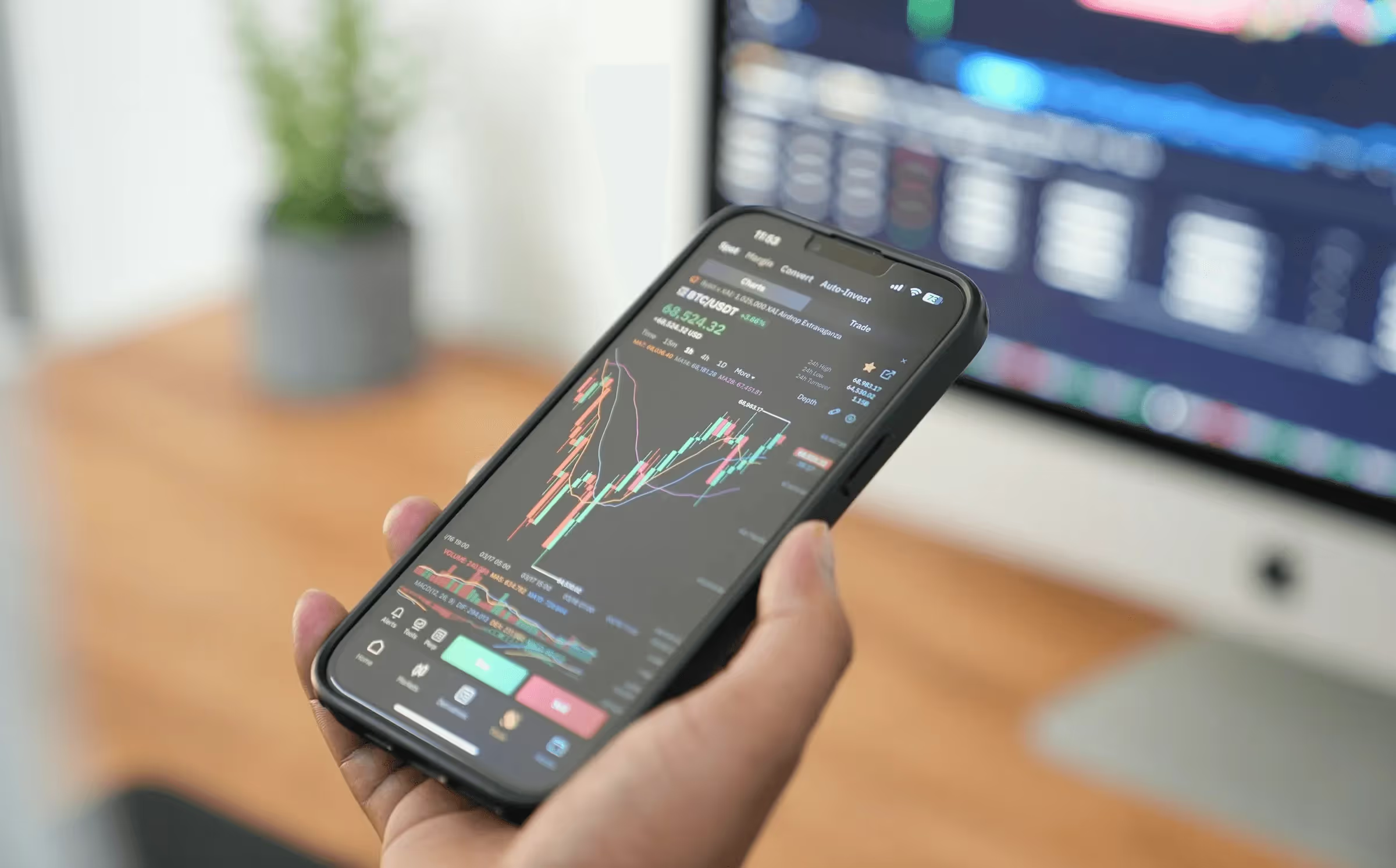
You can learn good stock trading habits quickly by treating the early months as disciplined practice, not profit-seeking, and by using a handful of repeatable rules that protect capital, reduce emotional drift, and force objective feedback. Below are concrete practices you can apply now, each focused on execution, risk control, and the behavioral changes that let skill compound.
1. Dollar‑Cost Averaging, applied with a selection checklist
Pick target assets for systematic buys, then automate fixed contributions so you remove timing from the equation while preserving upside exposure. Don’t stop at “buy regularly”; require three confirmations before committing to an automated DCA plan: a reasonable revenue or sector thesis, at least one independent catalyst (product launch, market expansion, management hire), and a liquidity filter so your monthly buys do not materially move the market. Use tax-aware placement, for example, prioritizing retirement accounts for long-hold ETFs to shield taxable events, and set a written stop condition for the plan, such as re-evaluating if core thesis metrics decline two quarters in a row.
2. Pullback entries, sharpened into a checklist for real buying opportunities
When you look for pullbacks in a trending stock, trade only after layered confirmation, not on hope. First, confirm the price sits at a structural support level on the timeframe that matches your hold period. Next, look for a short consolidation or a clear reversal candle pattern plus improving volume or an EMA showing renewed demand. Add a “post-entry rule”: define your stop method, either volatility-based (ATR multiple) or technical (below the support zone), and choose an exit horizon, for example, one to eight weeks, so you stop turning swing setups into emotional holdovers.
3. Breakout trade process, with objective filters to avoid fake moves
Treat breakouts as executable processes, not lottery tickets. Require three things before you buy: a high-volume thrust that exceeds the prior 20-session average, price stabilization in the top third of the move, and a measurable continuation signal within the subsequent 3 to 10 sessions, such as higher highs on shrinking drawdowns. Use limit-first entries to control slippage, and place an initial protective stop under the breakout consolidation. If the breakout fails and price returns inside the range on heavy volume, exit immediately, because failed breakouts often precede fast reversals.
4. Position sizing and hard-stop discipline
Choose position sizes that let you survive a sequence of losses and keep decision-making calm. A useful, enforceable cap is Quadcode Blog, "3% max loss per trade", which means sizing entries so a single hit does not derail your account. Pair that with a daily stop rule, for example, following the guidance of Quadcode Blog, "5% max loss per day”, Quadcode Blog, 2025, to stop new entries once intraday losses reach a threshold and prevent revenge trading spirals.
5. Journaling and emotional controls you will actually use
A blank journal is impotent; use a tight template that forces answers and numbers. For each trade record: setup category, entry price and rationale, protected stop, size as a percent of equity, and an emotional state from 1 to 5. Review trades weekly for patterns, not ego. This practice addresses the common beginner failure I see repeatedly: under stress, they chase losses or deviate from rules. When traders switch to this structured review for six weeks, they reduce impulsive re-entries because the journal makes the cost of emotion visible before they act.
6. Order tactics and execution hygiene
Match order type to intent. Use limit orders when slippage matters, market orders only when speed outranks price, and OCO orders for protecting winners while limiting downside. Route small-scale tests before scaling a setup: place a partial entry, watch fills and slippage for one session, then add only if execution metrics remain acceptable. Track fills by platform; a simple monthly comparison of identical small orders across brokers reveals hidden slippage and spread costs.
7. Timeframe alignment and trade record discipline
Decide on the timeframe you will practice for 30 days and refuse to mix styles. If you commit to swing trading, monitor daily and multi-day charts and measure edge through repeatable setups; if you choose intraday work, standardize session routines and measure execution latency and weekly win rate. The most common failure mode I see is switching styles without testing, which dilutes learning and yields inconsistent results. Force a 30/30 test: 30 days of exclusive practice, 30 documented trades, then a disciplined review.
8. When to step back: explicit stop and review rules
Create rules that force pausing the account after behavioral failures, for example, pause for seven days and complete ten pages of focused study if you exceed your daily loss cap or if you break trading rules two times in a row. This interrupts the emotional feedback loop that turns a bad day into a bad month, and it transforms punishment into study time.
9. Minimal toolkit: indicators and volume filters that matter
Limit indicators to those that add unique, testable information: a pair of EMAs for trend, an ATR for volatility stops, and a simple volume average for breakout validation. Too many overlays create analysis paralysis. Tie each indicator to a pass/fail in your trade checklist so you never buy because a chart “looks right” without measurable support. Most traders manage these checks with sticky notes and ad hoc spreadsheets because that is familiar and requires no new tools, which works early on. As watchlists grow and risk rules multiply, that approach fragments, mistakes slip through, and decisions slow. Platforms like funded trading program centralize verification and enforce rule-based risk controls with automated stops and audit trails, compressing manual overhead while keeping trade rules consistent and auditable.
10. Small account growth plan
Plan how you will scale: define clear milestones that convert practice capital into performance capital, for example, reach a sustained 60-day rule-adherence streak and a positive expectancy over that period, then increase size by a fixed percent. This removes emotional scale-ups and makes growth methodical. That simple checklist of tactical changes will do more to protect your learning capital and sanity than chasing the next indicator or hot sector. That pattern of frustration is only the beginning; the next obstacle is quieter and harder to fix than you expect.
Related Reading
- Sources of Capital
- Cash Reserve Account
- Short Term Stock Trading
- Investment Performance Analysis
- Managed Account vs Brokerage Account
- Systematic Trading
- How to Analyze a Stock Before Buying
- Forex Capital Trading
- What is a Retracement in Trading
- What is Automated Trading
- Convergence Trading
- Liquidity Trading
- Futures Trading Minimum Account Size
- What is Drawdown in Trading
- How is Risk Involved in Calculating Profit?
Struggling to trade stocks effectively because your account size is too small to manage risk or diversify properly?
Most traders start with small balances because it feels safer, but that habit often forces you to optimize around capital instead of sharpening setups and repeatable risk management. Platforms like AquaFunded function as a line of credit for traders who have proven consistent with their rules, allowing you to trade stocks under structured risk and scale your position size without tying up large sums of your own money. If you want to focus on strategy and consistency rather than capital limits, consider AquaFunded as a practical next step to access a funded account while you build steady performance.
Related Reading
- How To Take Profits From Stocks
- Accumulation Distribution
- Short-Term Capital Gain Tax On Shares
- What Is Reit Dividends
- Cash Available To Trade Vs Settled Cash
- Best Pairs To Trade Forex
- Can You Day Trade In A Roth Ira
- What Is A Conditional Order
- Orb Strategy Trading
- Stop Loss Vs Stop Limit
- Flag Pattern Trading
- Characteristics of Growth Stocks
- Forex Compounding Plan
