




How to Get Profits from the Forex Compounding Plan Fast
Forex Compounding Plan: Discover proven methods to quickly grow profits with AquaFunded's funded accounts and disciplined risk management.
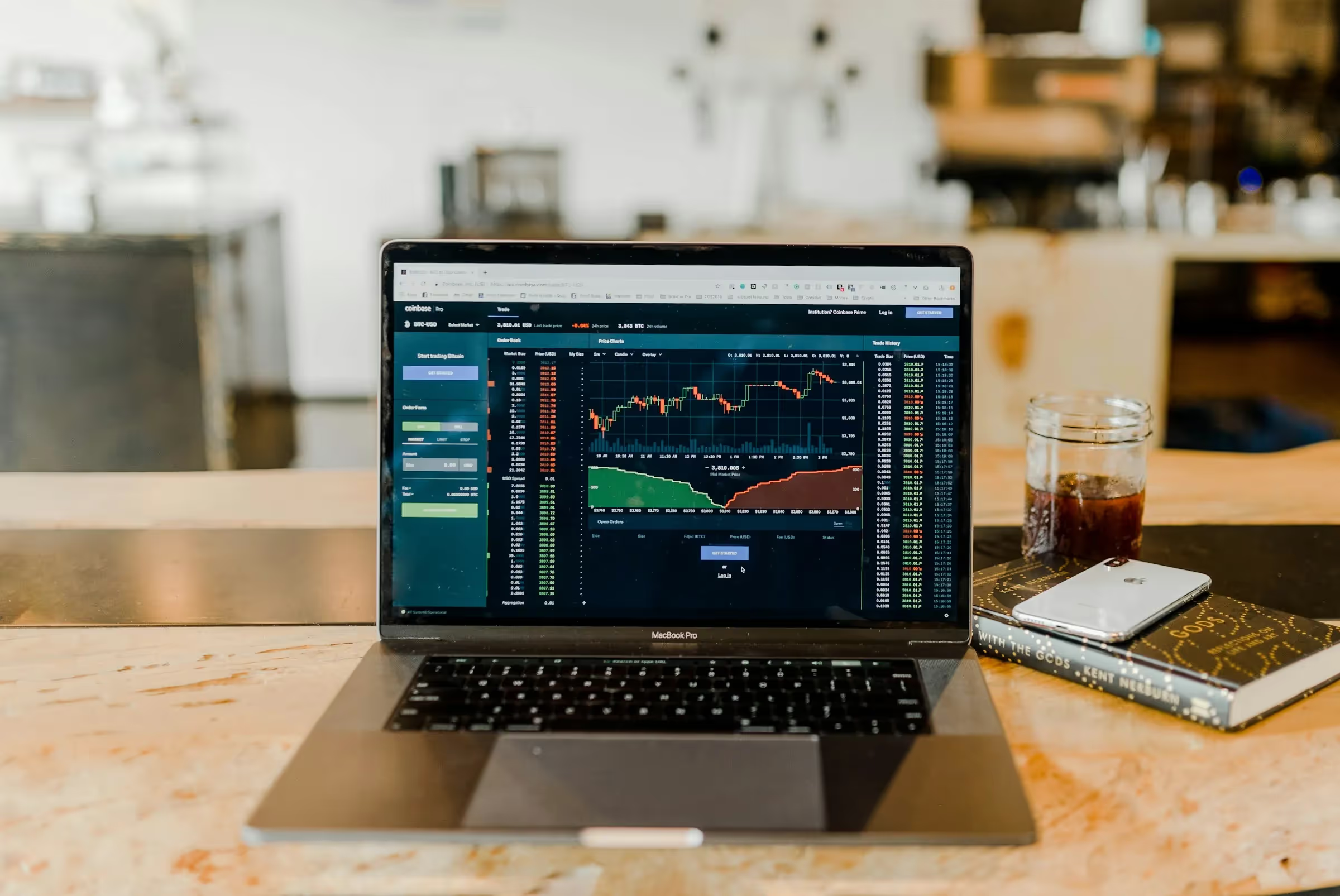
Turning a modest trading account into significant wealth is attainable through disciplined profit reinvestment. A forex compounding plan systematically multiplies gains, prompting traders to ask, what is a funded account? Access to adequate capital accelerates growth and transforms trading strategies over time.
Leveraging external capital enables traders to apply aggressive yet measured compounding techniques without jeopardizing personal savings. A focused reinvestment strategy can rapidly boost trading equity. AquaFunded’s trading program equips traders with the resources and professional support neededto implement this approach effectively.
Summary
- Forex compounding plans systematically reinvest profits by risking a fixed percentage of account equity per trade, rather than a static dollar amount. As your account grows, position sizes scale automatically while keeping risk proportional. This approach eliminates emotional decision-making about when to increase or decrease exposure, allowing the account balance to dictate position sizing rather than trader judgment or recent results.
- Compounding amplifies whatever outcome your strategy produces, accelerating losses just as efficiently as gains. A weak or inconsistent trading approach compounds losses toward account depletion at the same rate a strong strategy compounds profits toward growth. According to ACY Securities, a 10% monthly return compounded over 12 months grows $10,000 to $31,384, but sustaining that consistency requires emotional stability that breaks down as position sizes scale and drawdowns hit harder in absolute dollar terms.
- Traders fail to compound returns because they focus on maximizing returns rather than managing risk. Those who succeed aim for modest, sustainable returns in the 20-30% annual range and maintain execution discipline during inevitable losing streaks. HowToTrade.com found that 90% of traders lose money, often because they chase returns their strategies cannot sustain, breaking their own rules in pursuit of arbitrary targets disconnected from their actual edge.
- Drawdown amplification creates disproportionate recovery challenges as accounts grow. A 10% drawdown on a $30,000 account costs $3,000 compared to $1,000 on a $10,000 account. The percentage looks identical, but you need an 11.1% gain to recover from 10% losses and 25% to recover from 20% drawdowns. The mathematical burden of recovery increases while emotional resilience typically declines, leading traders to abandon proven strategies during normal market variance.
- Milestone-based withdrawal rules prevent traders from disrupting compounding momentum after every winning period. Setting specific account thresholds for profit withdrawals, such as taking 20% of profits after doubling the starting balance, removes emotional negotiation from the decision process. Every dollar withdrawn stops compounding, trading immediate gratification for long-term acceleration that requires sustained discipline.
- AquaFunded's trading program addresses capital constraints by providing up to $400K in funding, allowing traders to apply proven compounding strategies with professional-level capital that would otherwise take years to accumulate independently.
What is a Forex Compounding Plan

A forex compounding plan is a structured system in which you risk a fixed percentage of your account on each trade, rather than a fixed dollar amount or lot size. As your account grows, this percentage increases your position size while keeping risk proportional. Profits remain in the account and are automatically reinvested, allowing growth to accelerate without changing your underlying strategy. In fact, our funded trading program is designed to help traders utilize compounding effectively, enhancing their potential for substantial growth.
The plan addresses a common problem many traders face: slow or inconsistent account growth despite a working strategy. Some might start with limited capital, take profits too early out of fear or need, or maintain the same position size regardless of their account balance. These actions limit growth.
On the other hand, traders who try to break through that limit by increasing risk randomly usually end up losing money. A compounding plan removes this guesswork by allowing the account to determine the position size, so emotional decisions are taken out of the equation.
When trading with fixed lot sizes, returns stay the same. Whether you win or lose, the position size remains the same, so account growth happens at a constant rate no matter the balance. With compounding, you risk approximately 1%-2% of your current equity on each trade.
For example, if you start with $10,000 and risk 1% per trade, that's $100. Once your account reaches $15,000, the same 1% becomes $150. The position size adjusts automatically based on the account balance, not your judgment in the moment.
How does compounding affect risk?
This approach keeps risk proportional as traders grow. They aren't suddenly overleveraging because of confidence, nor are they undersizing out of fear. The rules stay the same; only the account size changes.
This consistency is more important than many traders realize, as it eliminates the internal debate that often precedes each trade. Traders don't have to wonder whether a setup warrants a larger position or whether to reduce it after a loss. Instead, the math decides their next steps.
What are the benefits of reinvesting profits?
Reinvesting profits rather than distributing them allows for exponential growth rather than linear progress. According to Lloyds Banking Group, systematic reinvestment strategies have created £100 million in value across structured trading programs. This shows how steady compounding can amplify results over time when used with strategies that have a good track record. The key point is that small, steady returns compound effectively when left untouched.
For example, a 20% annual return might not seem impressive at first until you see what happens as it compounds over many years, especially as the capital increases.
Does Compounding Guarantee Profitability?
Compounding does not create profitability on its own. It makes whatever result your strategy already gives even bigger. If your approach is likely to generate returns, compounding accelerates growth; however, if your strategy is weak or lacks discipline, compounding can just as easily compound losses.
The same method that can turn $10,000 into $50,000 can also turn $10,000 into $2,000 if the strategy fails. This shows why successful compounding depends much more on risk control, drawdown management, and emotional discipline than on chasing high returns.
What common misconceptions do traders have?
Traders often think that a compounding plan will fix inconsistent results. It won’t. Instead, it shows whether a strategy truly works under constant pressure.
If a trader can't handle a 15% drawdown without abandoning their plan, compounding will reveal that weakness faster than fixed position sizing ever would.
The losing streaks feel more intense because the position sizes were larger during the drawdown. This psychological pressure leads traders to change strategies at the wrong time, confusing normal variance with system failure.
How important is strategy testing?
The structure works best when there is already a strategy with proven mathematical expectancy. This means it has been tested in the past and in real time, giving a clear understanding of its usual drawdown patterns.
When traders know what to expect during tough times, they are less likely to panic when problems come up. Without this strong foundation, compounding risks can become a faster path to loss rather than a way to grow.
What do successful traders focus on?
Most traders fail to compound returns because they focus on maximizing returns rather than managing risk. They see charts showing rapid growth and believe they can double their accounts in just a few months.
This ambition leads to taking on excessive risk, setting overly aggressive targets, and making emotional decisions during downturns. However, traders who succeed with compounding aim for reasonable, sustainable returns in the 20-30% annual range and let time work for them. They recognize that consistency is better than intensity over the long term.
What level of discipline is required?
The emotional discipline needed for successful compounding is high. Traders must stick to their plan even when nothing seems to be working. They need to believe that their edge will come back after enough trades, even after having a series of failures in the last ten setups.
It's important to fight the temptation to increase the risk percentage after a winning streak or to lower it after losses. This kind of discipline is uncommon, which is why most traders never see the full benefits of compounding.
How can funded accounts enhance compounding?
When traders access larger capital through programs such as the funded trading program, the compounding effect becomes even more pronounced. Instead of waiting years to build a $50,000 account from $5,000, traders can use their proven strategies on professional-level capital right away. This change does not alter the strategy or the risk management rules; it simply shortens the timeline.
A 2% monthly return on $5,000 yields $100, but on $100,000 it yields $2,000. The same strategy and discipline are needed, but the larger account size accelerates results in ways that would take a decade to achieve on their own.
What common mistakes do traders make?
Most traders overlook the fundamental reasons why compounding either works or doesn't.
Understanding these principles is important for good trading and lasting success.
Related Reading
- How to Grow a Small Trading Account
- What is Trading Commodities
- Long Term Trading Strategy
- Capital Growth Strategy
- What is a Cash Account in Trading
- What is Compound Trading
- How Much Money Do You Need to Start Trading Stocks
- Scale Trading
- Small Account Trading
- How to Evaluate Investment Opportunities
- Blown Trading Account
- What is PNL in Trading
- Do Prop Firms Use Real Money
- Prop Firm Account Management
- Borrowing on Margin
- Trading Leverage
- Best Automated Crypto Trading Platform
- How to Pass a Prop Firm Challenge
Benefits of the Forex Compounding Plan

Compounding works because it turns time into something helpful instead of something that gets in the way. When you reinvest profits carefully while managing risk, small returns can add up to meaningful growth without requiring extraordinary performance.
The benefit is not just about math. It's also about how you feel, how you plan, and the structure of your approach, which can shape every choice you make. Additionally, our funded trading program can enhance your compounding strategy by providing the capital you need to amplify your results.
When you use a compounding approach, your trading becomes more than just a bunch of individual bets; it starts to look like a business with forecasts. You can predict results over different time frames by using realistic win rates and average returns. This clarity helps you set goals that are not just dreams but are grounded in what your strategy actually delivers.
If you know your edge yields 3% monthly returns with a 15% maximum drawdown, you can estimate where your account will be in six months, a year, or three years. This understanding changes how you view patience and persistence.
How does disciplined reinvestment impact gains?
According to Financial IT, disciplined reinvestment strategies can significantly increase investment gains when combined with proven trading systems over the long term. The key idea here is proven trading systems.
Compounding does not create an advantage; it amplifies any existing advantage. This means the benefit of planning only appears once the required work to validate the method is complete. Without that foundation, predictions become just dreams.
What planning advantages does compounding offer?
The planning advantage goes beyond just growing your account. You can figure out when to take out profits without losing your progress, how much money you need to hit certain income goals, and whether your current strategy scales to larger position sizes. Most traders operate without this kind of foresight; they respond to changes in their accounts rather than aiming for defined outcomes. Compounding encourages you to think in terms of systems rather than individual trades.
How does compounding maintain risk consistency?
One of the most dangerous phases in a trader's development happens after they have some early success. A trader might start with $5,000, grow it to $15,000, and suddenly feel unstoppable. This new confidence often leads to oversized positions because the dollar amounts appear different, even though the actual risk remains the same.
With compounding, the risk percentage remains fixed regardless of the account size. Whether trading $5,000 or $50,000, risking 1% per trade keeps exposure steady. This consistency helps prevent the overconfidence spiral that can lead to the loss of the entire account.
Why is proportional risk important during drawdowns?
The math also protects you during drawdowns. When an account drops from $20,000 to $17,000, position sizes automatically decrease because a percentage of current equity is still being risked. This reduction gives your account some breathing room to recover without compounding losses at the same rate they occurred.
In contrast, static position sizing does not offer that buffer. If you risk $200 per trade regardless of your balance, a losing streak affects your account just as much at $17,000 as it did at $20,000.
Proportional risk adjusts dynamically, a crucial aspect many traders recognize only when they face a serious drawdown.
How does trading structure shape risk management?
This benefit is especially important when earning more through programs such as the funded trading program. Traditional prop firms often have strict risk rules that do not adjust to the accountis performance. These rules create limits that can hurt success.
On the other hand, systems designed to support traders enable the use of tested risk-management methods to control position size as funded accounts grow. This keeps the compounding effect working well without random limits stopping progress. Ultimately, how well a trader's strategy aligns with the capital structure is key to determining whether compounding accelerates or slows.
How does compounding automate position sizing decisions?
Trading without a compounding plan means you have to make constant choices about how much to trade. Should you take on more risk after winning three times, or should you cut back after losing two times? Do you trade less because the market feels unstable? Every trade turns into a back-and-forth with yourself, and most traders usually lose those arguments.
Compounding eliminates that internal struggle. The rules set the position size based on your account balance, not on how you feel or your recent results. This automation significantly reduces emotional interference, resulting in dramatically improved consistency.
How does compounding stabilize strategy adherence?
The structure also makes it easier to stick with your strategy during tough times. When you know your advantage plays out over 50 or 100 trades, instead of just five, you stop reacting to short-term changes.
Trusting the process becomes easier, especially because the plan accounts for losing streaks as a normal part of trading. Without that framework, experiencing three losses in a row can feel like a failure of the system, which can lead to changing strategies at the wrong time. Compounding helps you stay focused on long-term probabilities rather than short-term results.
What does compounding reveal about risk tolerance?
Many traders are surprised by how compounding shows their true risk tolerance. A trader might think they can safely risk 2% per trade until their account balance increases. At that point, that same 2% represents much more money. For example, a $200 risk might feel manageable; however, a $2,000 risk at the same percentage can lead to hesitation.
Although the percentage risk remains the same, this concern highlights psychological limits that need to be addressed. Identifying those limits in a structured way is better than confronting them during an emotional decision that could undo months of progress.
What guarantees success in trading?
Having a good structure doesn’t ensure success if the strategy behind it can’t address the challenges markets present.
Risks of Forex Compounding Strategy

Compounding makes everything your strategy does stronger, which means it accelerates losses just as it accelerates gains. The risks are real. They are structural, psychological, and operational, often surprising even experienced traders. Knowing these weaknesses before they show up in your account decides whether compounding becomes a growth engine or a costly lesson in humility.
When position sizes increase through compounding, normal losing streaks can cause much bigger dollar losses. A 10% drawdown on a $10,000 account costs you $1,000. That same 10% on a $30,000 account, reached through successful compounding, costs you $3,000.
The percentage looks the same, but the recovery challenge gets much harder. You need an 11.1% gain to recover from a 10% loss. After a 20% drawdown, you need a 25% return just to break even. As your account size grows and drawdowns hit harder in real terms, the math of recovery gets tougher while your emotional strength usually gets weaker.
What happens during a 30% drawdown?
The risk increases during prolonged losing streaks. If someone grows their account to $50,000 and then experiences a 30% drop, they end up managing a $35,000 account, but their position sizes may still feel too large relative to their starting capital.
Many traders struggle to maintain discipline at this time. They might either abandon their strategy entirely or reduce their risk to the point that they can't efficiently return to previous levels. The psychological burden of watching larger dollar amounts vanish creates pressure that static position sizing does not cause.
How does emotional control affect trading?
Traders often say that it becomes harder to control emotions as account size increases due to compounding. A $500 loss on a $10,000 account feels okay, but a $2,500 loss on a $50,000 account, which is still a 5% risk, causes different emotional reactions. This discomfort can lead to rule-breaking.
For example, traders might close winning trades early to secure profits, keep losing trades open longer, hoping they will improve, and miss good setups because the dollar risk feels too large. Each time they stray from the plan, they lose the advantage that made compounding work in the first place.
What pressures arise during drawdowns?
The pressure builds during drawdowns. When an account drops from $40,000 to $32,000, people face more than just a math problem. They deal with feelings of failure, wondering if their strategy has stopped working or if they should have withdrawn profits when they had the chance. This inner conversation can hurt more compounding plans than actual strategy failures.
According to ACY Securities, a 10% monthly return, compounded over 12 months, can grow an initial $10,000 investmentto $31,384. However, maintaining that consistency requires emotional stability, which many traders struggle to maintain as their position sizes grow. The math makes sense, but the psychology often falls apart.
How does compounding create hidden vulnerability?
Compounding increases position sizes automatically during profitable times, creating hidden risks. For instance, a 2% risk per trade on a $20,000 account is $400. If a strong run raises the account to $35,000, that same 2% risk now equals $700.
Although the risk percentage stays the same, the exposure has almost doubled. If market conditions change suddenly, these larger positions can lead to bigger losses more quickly than expected. What felt like conservative risk management during the growth phase can quickly turn into overexposure during a reversal.
What is the role of funded trading programs?
This risk becomes critical when traders access larger capital through programs such as a funded trading program. Traditional approaches often cap position sizes or set strict risk limits, which stop natural growth. This forces traders to adjust their strategies manually as their accounts grow. Structures built around trader empowerment enable a proven risk-management approach to control position sizing as funded capital grows.
However, this freedom needs careful attention. Without regular checks on absolute dollar exposure, growth can quietly push traders beyond safe levels during long winning periods. The same mechanism that accelerates growth can also amplify losses when market conditions shift.
How does early success affect your strategy?
Early success with compounding can create dangerous overconfidence. If you grow your account 40% in three months, you might believe that you've mastered the markets. This new confidence leads to subtle but harmful changes. For example, you might increase your risk tolerance from 1.5% to 2.5% because your original plan feels too conservative.
You may also start accepting setups that don't meet your criteria, which can lead to overreliance on your instincts. It's common to ignore warning signs of changing market conditions, thinking that your strategy works everywhere because of your recent success. Each change takes you further from the disciplined approach that helped you achieve success.
What misperceptions surround compounding?
People often think that success from compounding proves their strategy is effective, but it might simply reflect favorable market conditions that won't last. A mean reversion strategy might work well during rough, sideways markets, but could fail badly when strong trends come into play. The compounding effect masks the strategy's weaknesses until market conditions change.
When that happens, larger positions can result in significant losses. Traders who confuse temporary success with a permanent edge often grow their accounts right before the market turns against them.
How can a weak strategy affect compounding?
Compounding only works if your trading method has a real and steady advantage. A weak or unreliable strategy compounds losses just as efficiently as a strong one compounds gains. If your win rate is 45% and your risk-reward ratio is poor, compounding accelerates your path to losing your account. The same math that changes small profits into big growth will also turn small losses into account destruction. Successful compounding relies more on evaluating your strategy than on knowing compound interest formulas.
What should you test before compounding?
The important question isn't whether someone understands the mechanics of compounding, but whether a strategy can handle the stress of growing position sizes during natural drawdowns. Many methods work well with fixed-position sizing because the emotional and financial risks remain the same.
But those same methods might fail when compounding, because larger swings can exceed what a trader can handle emotionally or what the strategy can support mathematically. It's crucial to test the method with gradually increasing position sizes to determine whether it scales effectively before fully committing to compounding.
How do changing market conditions affect your strategy?
A strategy that works well in trending markets might not perform as well when the market shifts to mean-reversion, and the opposite is true. The problem is not just that your advantage disappears; it’s that compounding has increased your position sizes right before the market changes. This means losses can hit harder than they would have if your position sizes had remained the same. For instance, you might have grown your account from $15,000 to $40,000 using a trend-following strategy.
When the market becomes choppy and range-bound, your strategy starts to incur losses. However, your position sizes are still based on the $40,000 balance, so larger positions can result in greater losses during this transition.
What vulnerabilities arise during market transitions?
Traders often underestimate how compounding increases vulnerability during changes between market environments. The same position sizing that felt safe in favorable conditions can become risky when the market changes.
Recovery might mean waiting for conditions to return to what they were, which could take months, or changing strategies mid-trade, which introduces additional risks. Either option becomes more challenging when managing a larger account with greater swings.
Understanding these risks is really important. It helps traders develop approaches to navigate changing dynamics successfully.
How to Get Profits from the Forex Compounding Plan Fast

Set your risk to 1% or 2% per trade and keep it there. This fixed percentage automatically adjusts as your account grows, allowing larger position sizes without making emotional decisions to be more aggressive. The profits remain in the account, growing with each successful trade. This means your growth speeds up over time without changing how you approach trading.
The speed of compounding relies entirely on how consistently you execute trades, not on trying to get larger percentage gains.
A trader who achieves 2% monthly returns with fewer drawdowns will have faster compounding over a year than someone aiming for 10% monthly returns, but suffering 30% drawdowns that take months to recover from.
The math supports reliability over overambition, which often runs counter to how many tradersfeel when they first learn about compounding strategies.
Choose a monthly or weekly return target that your strategy can realistically meet under normal conditions. If your backtesting and live results show 3% monthly gains, don't set a 10% target just because it sounds more appealing. The goal is meant to keep you disciplined, not just to inspire you.
When targets go beyond what your edge can naturally produce, you start forcing trades that don’t align with your criteria. You take weaker setups because you’re trying to catch up, and you hold onto winning trades for too long, hoping they’ll hit unrealistic goals. Each deviation adds up to worse decisions.
Why is setting realistic targets important?
According to HowToTrade.com, 90% of traders lose money, often because they chase returns their strategies can't sustain. They break their own rules while trying to reach arbitrary targets that don't align with their actual skills. Successful traders who compound set goals based on what they have already demonstrated, and then let consistency help them grow. A 2% monthly return might seem small, but it compounds significantly over 24 months if you reinvest it.
The target also acts as a circuit breaker. If you keep missing your reasonable goal, it means that something has changed.
Market conditions may have shifted, your performance may have declined, or your strategy may need adjustments. Without a clear benchmark, traders can lose focus for months without realizing their approach is no longer working. Setting a target makes you accountable for your own standards rather than reacting to market noise or emotions.
How can withdrawal rules impact compounding?
Resist the urge to withdraw after every winning week. Set withdrawal rules based on account milestones, not emotions. Some traders withdraw 20% of their profits once they have doubled their starting balance. Others wait until they have three times their initial capital before taking any withdrawals.
The specific rule is less important than having one and sticking to it. Every dollar you withdraw stops compounding; this means you're choosing immediate satisfaction over long-term growth.
The psychological benefit of milestone-based withdrawals exceeds the financial impact. When you know you'll take profits at a certain point, you stop negotiating with yourself after every good trade. You won't wonder if this win justifies a withdrawal; that choice is already in your plan.
This removes one more emotional variable from your trading process. It is crucial because compounding requires consistent discipline, especially when your account isn't growing.
What are the advantages of funded trading programs?
Many traders find that accessing larger capital through a funded trading program completely removes the pressure to withdraw funds. Instead of taking profits from a small personal account to cover living expenses, traders can let a funded account grow quickly. They can take regular profit splits without stopping the account's growth.
For example, the same 2% monthly return that makes $100 on a $5,000 personal account makes $2,000 on a $100,000 funded account. This provides meaningful income without compromising compounding. This separation between income and growth capital changes the whole psychological aspect.
How to maintain consistency in trading?
Pick one trading method and do it exactly the same way every time. Your advantage comes from repetition, not from changing between different strategies based on market conditions. Traders often think they're adapting to changing environments when they're actually abandoning their plan during normal ups and downs.
For instance, a trend-following system may perform poorly in busy markets. That's not a failure of the system; that's how it's supposed to work. Changing to a mean reversion strategy during that time might seem smart, but it sets your sample size back to zero and causes mistakes because you're using a less familiar method.
Consistency means using the same entry criteria, stop placement, profit targets, and risk percentage across every setup. No changes just because you feel confident. No cuts just because the last three trades lost. The method tells you what to do, not your thoughts on recent results.
That level of discipline can feel unusual at first because people look for patterns and want to continually improve. However, trying to improve while live trading often leads to rule-breaking, and it's often justified as a smart adaptation.
Why is avoiding method changes crucial?
The compounding effect relies on your advantage showing up over enough trades to offset variance. If you keep changing methods, you won't reach the necessary sample size. You're always starting from scratch, making it hard to see if your approach works or if you just haven't given it enough time to succeed.
Successful traders often use boring, repetitive strategies that give small returns with low variance. They understand that consistency is far more important than cleverness when aiming to grow capital steadily over months and years.
How to calculate position sizes accurately?
Let your trading platform or a position-size calculator determine lot sizes based on your current equity and a fixed risk percentage. Avoid manually calculating position sizes and rounding them to convenient numbers, as this can lead to errors that compound over many trades.
If your risk calculation shows 0.17 lots, trade exactly 0.17 lots. If it says 1.43 lots, trade 1.43 lots. Precision is important because compounding depends on exact proportional risk, not approximations that seem cleaner.
Automation removes the temptation to change your rules. Because position sizing is outside your direct control, you cannot easily increase risk based on a good setup or reduce it out of concern.
The system promotes discipline, which most traders struggle to maintain, simply by trying hard. This external structure becomes more useful as position sizes increase and the emotional pressure per trade grows.
How does compounding work implicitly?
Scaling occurs without your noticing when everything is set up correctly. Your account can grow from $15,000 to $18,000, which means your position sizes can increase the same way without needing you to make any changes. You don’t have to decide when to increase your size; the system does that automatically. This way, you can focus on executing trades instead of managing your account.
Staying focused is essential; traders often don’t realize how distracting it can be to manually adjust position sizes while actively trading.
The structure works well only if it applies to capital that lets compounding reach its full potential. For more details, see this article on the futures trading minimum account size.
Related Reading
- Sources of Capital
- Cash Reserve Account
- Short Term Stock Trading
- Investment Performance Analysis
- Managed Account vs Brokerage Account
- Systematic Trading
- How to Analyze a Stock Before Buying
- Forex Capital Trading
- What is a Retracement in Trading
- How is Risk Involved in Calculating Profit?
- Convergence Trading
- Liquidity Trading
- Futures Trading Minimum Account Size
- What is Drawdown in Trading
Maximize Your Forex Compounding Profits with AquaFunded
Compounding only works if your account has room to grow. Most traders hit a capital ceiling too early. This can happen when they start with limited funds or withdraw profits to cover expenses before compounding takes effect. This limitation changes what should be exponential growth into slow, linear progress. It can take years to see real results.
With AquaFunded, traders can use their successful compounding strategy on accounts up to $400K without risking their own money. This addresses the primary challenge most traders face: insufficient starting capital to fully leverage compounding. A 2% monthly return on $5,000 yields $100, but on $100,000 it yields $2,000.
The same strategy and discipline work, but the larger account increases the results in ways that might take a decade to reach on your own. Traders keep their risk management and the principles that made their strategy work, and apply those principles with the right capital to generate meaningful income while still compounding.
The structure is just as important as the capital. AquaFunded has no time limits on evaluations and offers flexible trading conditions for different strategies, as well as up to 100% profit splits.
This allows traders to benefit from compounding returns without limits on their earnings. Traders can execute their compounding plans as designed, taking regular profit splits that generate income while maintaining sufficient capital in the account to support growth. This separation between income and growth capital reduces the psychological pressure that can disrupt compounding in underfunded personal accounts.
Start compounding on significant capital today and let disciplined trading lead to results that truly matter.
Your strategy already works; give it the resources it needs.
Related Reading
- How To Take Profits From Stocks
- Accumulation Distribution
- Short-Term Capital Gain Tax On Shares
- What Is Reit Dividends
- Cash Available To Trade Vs Settled Cash
- Best Pairs To Trade Forex
- Can You Day Trade In A Roth Ira
- What Is A Conditional Order
- Orb Strategy Trading
- Stop Loss Vs Stop Limit
- Flag Pattern Trading
- Characteristics of Growth Stocks
