




10 Practical Tips for Liquidity Trading
Discover 10 practical tips for liquidity trading to improve your execution, reduce slippage, and trade smarter in dynamic markets.

You've heard the whispers in trading circles about liquidity pools, order flow, and smart money moves, but here's what really matters: understanding liquidity trading can transform how you approach the markets. What is a funded account? It's your gateway to trading substantial capital without risking your own savings, and mastering liquidity concepts gives you the edge to prove you deserve that opportunity. This guide breaks down how professional traders read market liquidity, identify high-probability setups around liquidity zones, and apply this knowledge to pass evaluations and trade with a funded account.
AquaFunded's funded trading program gives you access to significant capital once you demonstrate your ability to trade around key liquidity levels and market structure. Their evaluation process rewards traders who understand order blocks, liquidity sweeps, and fair value gaps, the building blocks of institutional trading strategies. When you combine solid risk management with liquidity-based entries, you position yourself to succeed in this challenge and gain access to funding that lets you scale your trading without personal financial strain.
Summary
- Regulatory changes after 2008 pushed over-the-counter derivatives onto centralized clearing platforms, reducing counterparty risk but creating new liquidity challenges across the system. Collateral requirements now demand more capital and faster responses to margin calls, compressing settlement cycles from days to hours. The Bank of England noted these requirements increase system-wide liquidity needs while amplifying idiosyncratic risks at individual firms, transforming liquidity from a background concern into a real-time operational priority that affects execution quality during stress periods.
- Retail traders absorb liquidity costs regardless of account size, as most orders never reach the visible markets. The BIS Quarterly Review found internalization ratios of upwards of 80% across major FX hubs, meaning liquidity providers match orders internally before exposing them to broader markets. When liquidity thins during overnight sessions or holidays, providers widen spreads by 50% to 200% to protect themselves from risk. This spread expansion erodes trading edges faster than poor strategy selection, especially for approaches that rely on tight risk-reward ratios, where execution quality determines profitability.
- Session overlaps create the deepest liquidity pools, with the London-New York window from 8:00 AM to 12:00 PM EST compressing spreads to their tightest levels. Mind Math Money reports that 90% of all forex transactions involve the U.S. dollar, concentrating liquidity in USD pairs during these overlap hours. Traders who shift activity to align with high-participation periods report 30% to 50% reductions in execution costs per trade, not from strategy changes but from reduced spread expenses and slippage.
- Order book depth varies dramatically across instruments and sessions, making fixed position sizing ineffective. A 10-lot order in EUR/USD during the London open executes without price impact, while the same size in an exotic pair during Asian hours walks through multiple price levels. Checking Level II quotes before entering trades reveals whether intended position sizes will trigger slippage, preventing costly execution mistakes that compound over hundreds of trades.
- Market liquidity depends on three core elements working together: order book depth, bid-ask spreads, and transaction volume. Markets Media found that average trade sizes are declining across major markets, fragmenting liquidity into smaller parcels distributed across multiple venues. This fragmentation complicates execution because what used to be a single deep pool now spans exchanges, dark pools, and internalization networks, introducing latency and increasing the risk of partial fills at varying prices.
- AquaFunded's funded trading program addresses capital constraints in liquidity trading by providing accounts up to $400,000 without tying up personal funds, allowing traders to execute during optimal liquidity windows identified through their analysis rather than being sidelined by restrictive hour-based rules or arbitrary lot-size limits common at traditional prop firms.
Why Use Liquidity Trading
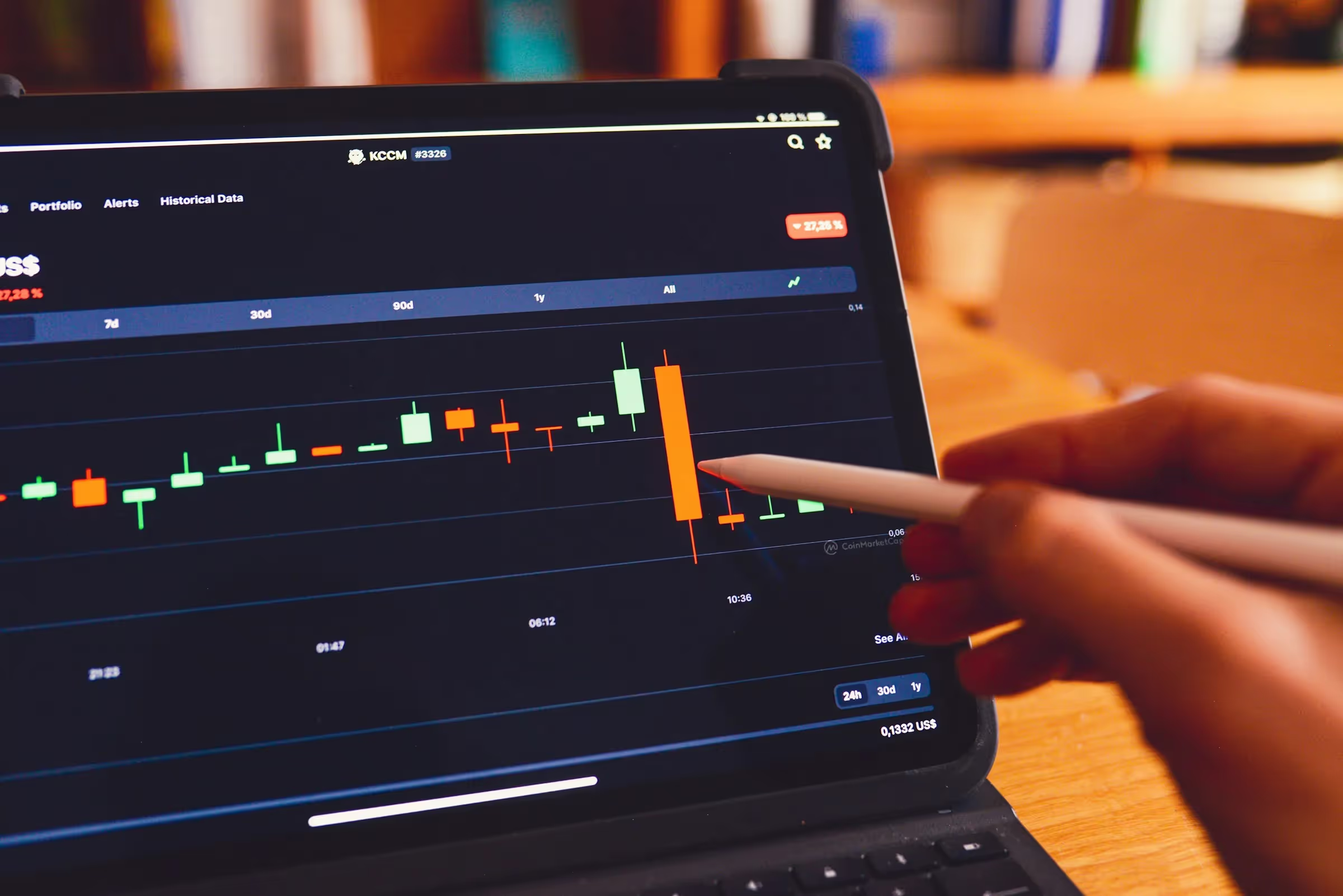
Liquidity trading matters because every order you place interacts with the depth and flow of the market, whether you're trading blue-chip stocks, major forex pairs, or crypto. The spread you pay, the slippage you experience, and the speed at which your orders execute all depend on liquidity conditions at that exact moment. Understanding how liquidity works doesn't just help you avoid costly mistakes. It gives you an edge in timing entries, managing risk, and capitalizing on temporary inefficiencies that others overlook.
The Myth That Liquidity Only Concerns Institutions
There's a persistent belief that liquidity dynamics belong exclusively to hedge funds and market makers. That retail traders can ignore order flow, bid-ask spreads, and depth because those mechanics operate at a scale beyond individual accounts. The reality contradicts this assumption. According to the BIS Quarterly Review, internalisation ratios of upwards of 80% across all currencies in major FX trading hubs mean that most retail orders never reach the visible market at all.
Your trades flow through liquidity providers who decide how and when to execute them, often matching orders internally before exposing them to the broader market. When liquidity thins, those providers widen spreads to protect themselves from risk. You absorb that cost directly, regardless of your account size.
Low liquidity doesn't discriminate. Even assets considered stable, such as EUR/USD or large-cap equities, experience spread expansion of 50% to 200% during overnight sessions, holidays, or pre-expiration windows. If you enter a position during one of these periods without awareness, you pay more to get in and receive less when you exit. The difference between a two-pip spread and a five-pip spread might seem trivial on paper.
Across dozens of trades, it erodes your edge faster than poor strategy selection. Slippage compounds the problem. You set a limit order expecting a specific price, but execution occurs several pips away because there wasn't enough liquidity at your desired level to fill the entire order. That gap between expectations and reality directly impacts profitability, especially for strategies that rely on tight risk-reward ratios.
How Liquidity Awareness Improves Trade Execution
When you recognize periods of thin liquidity, you adjust position sizing, avoid certain hours, or wait for deeper order books before executing larger trades. High-liquidity environments offer tighter spreads, faster fills, and reduced slippage. You enter and exit positions closer to your intended prices, thereby preserving capital and protecting profit margins.
This awareness also helps you avoid getting trapped in positions during sudden liquidity withdrawals. Events like the Flash Crash of 2010 demonstrated how rapidly liquidity can evaporate, triggering cascading stop-loss orders and forcing traders out of positions at catastrophic prices. Retail accounts suffered alongside institutional players because liquidity crises create systemic risks that ignore participant size.
Understanding liquidity also reveals opportunities others miss. Liquidity imbalances between related instruments or across different exchanges create arbitrage windows. Scalpers profit from micro-movements by exploiting temporary inefficiencies in order flow. These strategies require speed, precision, and deep awareness of where liquidity pools exist at any given moment.
Without that knowledge, you're trading blind, reacting to price changes without understanding the mechanics driving them. With it, you can position yourself ahead of predictable liquidity shifts, such as session opens, economic releases, or expiration dates when order flow concentrates.
Why Liquidity Shapes Price Discovery and Market Stability
Price discovery works efficiently when enough buyers and sellers interact to reflect an asset's true value. High liquidity accelerates this process because orders execute quickly without significantly moving prices. Thin liquidity distorts price discovery. A single large order can push prices far from equilibrium, creating false signals that mislead traders into poor decisions.
You might interpret a sudden spike as momentum when it's actually just a temporary liquidity gap being filled. Markets with deep liquidity resist manipulation because moving prices requires substantial capital. Low liquidity environments make it easier for coordinated actors to trigger stop-loss orders systematically, hunting clusters of retail stops during periods when few participants are active. This isn't theoretical. It happens regularly during Asian session lows, during holiday trading, and in the minutes before major news releases, when liquidity providers pull quotes to avoid getting caught on the wrong side of volatility.
Market stability depends on consistent liquidity. When liquidity remains high, sudden price spikes and crashes become less likely. Participants trust that they can enter and exit without encountering major obstacles, which attracts more traders and investors. This self-reinforcing cycle builds confidence. When liquidity dries up, that confidence evaporates. Spreads widen, volatility spikes, and participants retreat, further reducing liquidity in a negative feedback loop. You can't control market-wide liquidity, but you can choose when and how you engage with it.
Traditional prop firms often impose restrictive rules during low liquidity periods, limiting lot sizes, banning certain instruments, or penalizing traders who execute during specific hours. These restrictions exist because the firm wants to protect itself from the costs of slippage and spread widening, but they also limit your ability to trade in line with your own strategy and schedule.
Platforms like the funded trading program remove those punitive restrictions, giving you the flexibility to trade during sessions that align with your liquidity analysis and strategy. When you understand where liquidity sits and how it behaves, you can demonstrate profitability without being constrained by arbitrary rules designed to protect the firm rather than allow the trader.
The Real Cost of Ignoring Liquidity Conditions
Traders who ignore liquidity pay for it in execution quality. You place a market order expecting an instant fill, but it walks through multiple price levels because there wasn't enough depth at the top of the book. You exit a winning trade only to watch several pips of profit disappear into spread and slippage. You get stopped out during a liquidity sweep that wouldn't have occurred during a more liquid session.
These aren't rare occurrences. They're predictable outcomes when you trade without considering order flow and market depth. The frustration intensifies when you realize that your strategy might be sound, but poor execution timing undermines profitability. You win on direction but lose on mechanics.
Risk management also suffers without liquidity awareness. Stop-loss orders placed too close to the current price during thin markets become easy targets for liquidity hunters. Protective stops that would hold during normal sessions get triggered by temporary volatility spikes caused by low order book depth.
Position sizing calculations that assume normal spread conditions become inaccurate when spreads double or triple. You think you're risking 1% per trade, but slippage and spread widening push actual risk closer to 1.5% or 2%, compounding losses over time without you realizing the source of the leak.
But here's what most traders miss: liquidity conditions aren't random noise you have to tolerate.
How Does Liquidity Trading Work

How Market Liquidity Functions in Real Trading Environments
Liquidity describes the ease with which you can convert an asset into cash at a fair price without triggering significant price movement. High liquidity means tight spreads, fast execution, and minimal slippage. Low liquidity means the opposite: wider spreads, slower fills, and price movement caused by your own orders.
The difference between trading EUR/USD at the London open versus trading an exotic currency pair during a holiday weekend illustrates this spectrum. One environment absorbs your order without resistance. The other reacts to it, forcing you to pay more or accept less simply because you showed up.
Market liquidity depends on three core elements: order book depth, bid-ask spreads, and transaction volume. Order book depth reflects how many buy and sell orders sit at various price levels. Deep books absorb large orders without moving prices. Shallow books amplify your impact, turning modest position sizes into market-moving events. Bid-ask spreads measure the gap between the highest price a buyer is willing to pay and the lowest price a seller is willing to accept. Narrow spreads signal abundant liquidity.
Wide spreads indicate scarcity, with market makers protecting themselves from risk by charging you more to facilitate the trade. Transaction volume measures the amount of capital that flows through an asset over a given period. High volume attracts participants, which tightens spreads and deepens order books. Low volume creates conditions in which single trades shift prices, and liquidity providers widen their quotes.
The Mechanics of Order Execution and Price Discovery
When you place a market order, your broker routes it to a liquidity provider who matches it against available orders in their internal pool or forwards it to an exchange. If sufficient liquidity exists at your desired price, the order fills instantly. If not, your order walks through multiple price levels, executing portions at progressively worse prices until the full size completes. This process, known as slippage, becomes more pronounced during periods of thin liquidity. You intended to buy at 1.1050, but the final fill averaged 1.1053 because the order book lacked enough depth at the top level.
Price discovery works efficiently when enough participants trade actively, creating a continuous flow of buy and sell orders that reflect an asset's current value. Liquidity accelerates this process. Each transaction provides information about supply and demand, pushing prices toward equilibrium. When liquidity thins, price discovery breaks down.
A single large order can push prices far from fair value, creating false signals that mislead other traders. You interpret a sudden spike as momentum when it's actually just a liquidity gap being filled by one participant's order. Markets with consistent liquidity resist these distortions because moving prices requires substantial capital and coordinated action.
According to Markets Media, average trade sizes are declining across major markets, fragmenting liquidity into smaller parcels distributed across multiple venues. This fragmentation complicates execution. What used to exist as a single deep pool now spreads across exchanges, dark pools, and internalization networks.
Your broker must search multiple sources to assemble the best possible fill, introducing latency and increasing the chance of partial fills at varying prices. Understanding where liquidity concentrates at any given moment becomes a competitive advantage, not an academic concern.
Accounting Liquidity Versus Market Liquidity
Accounting liquidity measures your ability to meet financial obligations with available liquid assets. It focuses on balance sheets, current ratios, and the speed at which you can convert holdings into cash without distress sales.
A company with strong accounting liquidity can pay debts as they come due without liquidating long-term assets at unfavorable prices. A trader with strong accounting liquidity maintains sufficient cash or near-cash instruments to cover margin requirements, drawdowns, and unexpected expenses without prematurely closing profitable positions.
Market liquidity operates differently. It measures how easily you can trade an asset in the open market without affecting its price. An asset might be highly liquid in accounting terms, meaning it can be sold quickly, but still suffer from poor market liquidity if the order book is shallow. You own shares in a company with solid fundamentals, but trading volume is low.
You can sell, but doing so will push the price down several percentage points, eroding your proceeds. The asset qualifies as liquid on paper, yet executing a trade at fair value proves difficult. This gap between theoretical and practical liquidity creates problems that traders often discover too late.
The distinction matters because strategies built around one type of liquidity fail when confronted with the other. Position sizing based on accounting liquidity assumes you can exit at posted prices. Market liquidity determines whether that assumption holds.
You calculate risk using current spreads and recent execution quality, but those conditions evaporate during volatility spikes or session transitions. The cash in your account remains liquid from an accounting perspective, but your ability to deploy it effectively depends entirely on market liquidity at the moment you act.
How Liquidity Providers and Market Makers Operate
Liquidity providers profit from facilitating trades, not from predicting price direction. They quote buy and sell prices simultaneously, capturing the spread as compensation for the risk of holding inventory. When you buy, they sell from their inventory.
When you sell, they buy and add to their holdings. They manage this inventory by hedging positions in related instruments or offsetting trades internally when they have matching buy and sell orders from different clients. Their profit comes from volume and spread, not from holding directional positions.
During normal conditions, competition among liquidity providers keeps spreads tight. Multiple firms compete for order flow, offering better prices to attract volume. During stress periods, this dynamic reverses. Providers widen spreads to protect themselves from sudden price movements they can't hedge fast enough.
Volatility increases their risk, so they charge more for the service of matching your order. You experience this as execution quality degradation: wider spreads, slower fills, and increased slippage. The provider didn't disappear, but they adjusted pricing to reflect the new risk environment.
Market makers perform a similar function on exchanges, posting continuous buy and sell quotes to ensure that traders can always find a counterparty. They profit from the spread and from rebates that exchanges pay for providing liquidity. When order flow is balanced, market makers earn steady income with minimal directional risk.
When order flow becomes one-sided, they accumulate unwanted inventory and must adjust quotes to discourage further imbalance. This adjustment manifests as wider spreads and quotes that move away from current prices, making it more expensive for you to trade in the direction everyone else is trying to go.
Traditional prop firms often restrict trading during periods when liquidity providers widen spreads or reduce quote sizes, protecting the firm from the costs of poor execution. These restrictions limit your ability to trade around your own analysis of liquidity cycles and session transitions.
Platforms like funded trading program remove those punitive hour-based restrictions, letting you demonstrate profitability by capitalizing on liquidity dynamics rather than being forced to avoid them. When you understand how providers behave under different conditions, you can position yourself advantageously instead of being sidelined by rules designed to protect the firm's risk exposure rather than develop your edge.
Liquidity Cycles and Session Transitions
Liquidity follows predictable cycles tied to global trading sessions and market structure. The London session open brings the highest liquidity for forex pairs involving EUR, GBP, and CHF as European banks, hedge funds, and corporations execute orders. Spreads tighten, order book depth increases, and execution quality improves.
The overlap between the London and New York sessions creates peak liquidity for USD pairs, with the most participants active at the same time. Asian sessions typically see lower participation in major pairs, resulting in wider spreads and thinner order books, especially during holidays when Japanese or Chinese markets close.
Session transitions create temporary liquidity gaps as participants in one region close positions and those in another region have not yet fully engaged. The hour before the London open often experiences spread widening and reduced depth as Asian liquidity providers reduce exposure ahead of European volatility.
Similarly, the transition from New York to Asian open sees liquidity decline sharply, creating conditions where stop-loss clusters become vulnerable to sweeps. Traders who ignore these cycles experience unexplained slippage and stop-outs that would not occur during liquid sessions.
Understanding these patterns allows you to time entries and exits around periods of maximum liquidity, improving execution quality and reducing costs. Scalpers and day traders concentrate activity during high-liquidity windows to minimize spread costs and maximize the probability of fills at desired prices.
Swing traders avoid entering positions during thin periods, waiting for liquid sessions to ensure their orders don't move prices. Position traders use liquidity analysis to determine optimal exit timing, closing large positions gradually during peak liquidity rather than dumping them during quiet hours.
But recognizing when liquidity exists doesn't protect you from what happens when it suddenly vanishes.
Related Reading
- How to Grow a Small Trading Account
- What is Trading Commodities
- Long Term Trading Strategy
- Capital Growth Strategy
- What is a Cash Account in Trading
- What is Compound Trading
- How Much Money Do You Need to Start Trading Stocks
- Scale Trading
- Small Account Trading
- How to Evaluate Investment Opportunities
- Blown Trading Account
- What is PNL in Trading
- Do Prop Firms Use Real Money
- Prop Firm Account Management
- Borrowing on Margin
- Trading Leverage
Challenges of Liquidity Trading

Managing liquidity in over-the-counter derivatives markets has become a persistent operational challenge rather than a temporary inconvenience. The 2008 financial crisis forced participants to confront the very real possibility of institutional failure, prompting regulators to impose rules designed to improve transparency and reduce systemic risk.
The Dodd-Frank Act in the United States and the European Market Infrastructure Regulation (EMIR) in Europe achieved those goals by requiring trading activity to be cleared through centralized platforms. But that shift created an unintended consequence: reduced liquidity across the entire system. You now operate in markets where collateral requirements, margin calls, and intraday settlement cycles demand more capital, faster decisions, and tighter risk controls than ever before.
Dave Ramsden, Deputy Governor of Markets and Banking at the Bank of England, noted in a 2023 speech that while collateral requirements reduce counterparty credit risk and facilitate hedging of interest rate exposure, they also increase system-wide liquidity needs and amplify idiosyncratic liquidity risks at individual firms.
The mechanics are straightforward. When you trade OTC derivatives, you must post collateral to cover potential losses. As positions move against you, margin calls arrive within hours, not days. You need immediate access to liquid assets to meet those calls, or you face forced liquidation at unfavorable prices. This compression of settlement cycles transforms liquidity from a background concern into a real-time operational priority.
1. Navigating Reduced Market Depth After Regulatory Changes
Centralized clearing platforms concentrate liquidity in specific venues, which sounds efficient until you realize that concentration also creates fragility. When everyone routes orders through the same channels, those channels become chokepoints during peak periods. A sudden spike in volatility triggers margin calls across thousands of participants simultaneously.
Everyone needs liquidity at the exact same moment, but the system can't expand capacity fast enough to meet that surge. Spreads widen, execution quality deteriorates, and the cost of maintaining positions climbs sharply. You can't avoid these periods, but you can prepare for them by maintaining excess liquidity reserves and sizing positions conservatively enough to withstand temporary margin spikes without triggering forced exits.
The challenge intensifies because regulatory requirements don't pause during market stress. You still must meet variation margin deadlines even when liquidity evaporates. Traditional prop firms often respond by restricting trading during volatile periods or limiting position sizes to levels that protect their capital reserves rather than your strategy's requirements.
Platforms like funded trading program remove those punitive restrictions, giving you the flexibility to manage positions based on your own liquidity analysis rather than arbitrary rules designed to shield the firm from regulatory exposure. When you understand how margin cycles interact with liquidity conditions, you can position yourself to meet obligations without sacrificing strategic opportunities.
2. Managing Increased Collateral and Margin Requirements
Collateral demands create a liquidity drain that compounds during drawdowns. You enter a position expecting to tie up a specific amount of capital. Markets move against you, and margin requirements increase. You either post additional collateral or close the position. If liquidity is thin, closing costs may be higher than you anticipated due to a wider spread.
If you post collateral, you reduce your available capital for new opportunities or emergency reserves. This dynamic forces you to maintain higher cash balances than your strategy would otherwise require, reducing capital efficiency and limiting the size of positions you can take relative to your total account value.
The problem becomes acute when multiple positions require simultaneous margin adjustments. A correlated move across your portfolio triggers margin calls on several trades at once. You scramble to source liquidity, potentially liquidating profitable positions to meet calls on losing ones. The sequence of these decisions determines whether you survive the drawdown or get forced out at the worst possible moment.
Stress-testing your portfolio against historical volatility scenarios helps you identify how much liquidity you need to maintain across different market conditions. Most traders underestimate this requirement, discovering the gap only when markets move violently and margin calls arrive faster than they can respond.
3. Adapting to Shorter Intraday Settlement Cycles
Settlement cycles have compressed from days to hours, sometimes minutes. This acceleration benefits market efficiency but punishes participants who can't continuously monitor their positions. You execute a trade in the morning, and by afternoon, you receive a margin call based on intraday price movement. If you're not watching, you miss the deadline.
If you can't source liquidity quickly, you face penalties or forced liquidation. This environment demands real-time risk monitoring and immediate access to liquid assets, capabilities that retail traders often lack compared to institutional desks with dedicated operations teams.
The speed of settlement also amplifies the impact of liquidity shocks. A sudden news event moves prices sharply, triggering margin calls across the market within minutes. Liquidity providers pull quotes to avoid getting caught on the wrong side of the move. Spreads explode, and you can't exit even if you want to because there's no one willing to take the other side at a reasonable price. By the time liquidity returns, the damage is done.
Your margin call came and went, your position got liquidated, and you absorbed losses that wouldn't have occurred if you'd had just a few more hours to respond. Preparing for these scenarios means maintaining excess liquidity and avoiding concentration in positions that could trigger catastrophic margin calls during brief but severe liquidity withdrawals.
4. Accessing and Interpreting Comprehensive Market Data
You can't manage liquidity risk without visibility into market conditions. That requires access to real-time data and historical context that reveals how specific instruments behave during stress periods. According to Parameta Solutions, a division of TP ICAP Group, the world's largest inter-broker dealer, participants need full sight of the markets in which they operate, including real-time data and the ability to analyze historical information.
Exploring past events like the 2008 financial crisis, the 2020 COVID-19 pandemic, or the 2022 gilt crisis helps inform current risk management processes by showing how liquidity behaved when it mattered most.
Most retail traders lack access to the depth of data institutional participants use. You see current spreads and recent volume, but you don't have 20 years of historical price data showing how liquidity evaporated during previous crises. You don't have transaction-level data revealing how different derivatives reacted to changes in market conditions, such as heightened volatility or shifts in interest rates.
Without this context, you build risk models on incomplete information, underestimating how bad conditions can get and how quickly liquidity can vanish. Sourcing better data costs money, but the cost of trading blind during the next liquidity crisis far exceeds subscription fees for comprehensive market analytics.
5. Conducting Reliable Stress Testing for Liquidity Scenarios
Stress testing evaluates how your portfolio performs under adverse conditions, focusing specifically on liquidity scenarios rather than just directional price moves. You simulate sudden spread widening, order book thinning, and margin call surges to identify vulnerabilities before they materialize in live trading.
Effective stress testing requires historical data that captures extreme events, not just average market behavior. You need to know how instruments reacted during the Flash Crash, the Swiss franc de-pegging, or the COVID-19 volatility spike. These events revealed failure modes that normal conditions never expose.
The challenge lies in designing scenarios that reflect realistic but severe stress without veering into implausible catastrophes that paralyze decision-making. You want to prepare for liquidity shocks that have happened before and could happen again, not waste time modeling asteroid impacts.
Parameta Solutions notes that its 20 years of historical price data help clients identify patterns, validate hypotheses, and make more informed decisions. This depth of data makes stress testing reliable rather than speculative. You test against actual market behavior during past crises, giving you confidence that your liquidity reserves and position sizing can withstand similar conditions if they recur.
6. Implementing Advanced Technology for Liquidity Analysis
Artificial intelligence, machine learning, and automation have started transforming how participants analyze liquidity and respond to shifts in market structure. These technologies identify patterns in order flow, predict liquidity withdrawals before they fully materialize, and automate responses to margin calls faster than manual processes allow.
You can't compete with institutional desks using these tools if you're still analyzing spreadsheets and executing trades manually. The speed gap creates execution disadvantages that compound over time, eroding profitability even when your directional analysis proves correct.
Adopting advanced technology doesn't require building proprietary systems from scratch. Third-party platforms now offer machine learning-based liquidity analysis, automated risk monitoring, and algorithmic execution designed for individual traders. The barrier to entry has dropped, but adoption remains low because most traders underestimate how much execution quality matters relative to strategy selection.
You spend weeks refining entry signals, but ignore the fact that poor execution timing costs you several pips per trade. Over hundreds of trades, that gap between theoretical and actual performance determines whether you're profitable or not. Technology closes that gap by executing faster, analyzing more data, and responding to liquidity shifts before you even notice them.
7. Building Robust Liquidity Risk Management Policies
Risk management policies define how you respond to liquidity challenges before they arrive. You establish limits on position sizes relative to available liquidity, set thresholds for acceptable spread widening, and create contingency plans for margin call scenarios.
These policies prevent emotional decision-making during stress periods by giving you pre-defined rules to follow. You don't have to decide whether to post more collateral or close a position in the heat of the moment. You already decided when you were calm and rational, and now you just execute the plan.
The most effective policies incorporate liquidity stress testing results, historical data on spread behavior, and realistic assessments of how quickly you can source additional capital if needed. You measure liquidity risk alongside directional risk, treating both as equally important inputs to position-sizing decisions.
You avoid concentrating positions in instruments or time periods where liquidity historically thins, and you maintain reserves sufficient to meet margin calls without forced liquidations. This discipline feels restrictive during calm markets when spreads are tight, and liquidity seems abundant. But when the next crisis arrives, and liquidity vanishes, these policies become the difference between surviving the drawdown and getting wiped out.
But knowing what policies you need doesn't tell you how to execute them when the market turns against you and every decision feels urgent.
10 Practical Tips for Liquidity Trading
Execution quality determines profitability more than most traders admit. You can identify perfect setups, manage risk flawlessly, and still lose money if you consistently pay too much to enter and receive too little to exit. The tips below focus on reducing those hidden costs by aligning your trading behavior with liquidity dynamics rather than fighting them. Each recommendation addresses a specific friction point where traders leak profit without realizing the source.
1. Concentrate Activity During Session Overlaps
The London-New York overlap from 8:00 AM to 12:00 PM EST creates the deepest liquidity pools for major forex pairs. Spreads on EUR/USD, GBP/USD, and USD/JPY compress to their tightest levels as European and American participants trade simultaneously. Order books fill with depth at multiple price levels, absorbing larger position sizes without slippage.
According to Mind Math Money, 90% of all forex transactions involve the U.S. dollar, concentrating liquidity in USD pairs during these overlap hours. If you trade outside this window, you pay wider spreads and accept worse fills simply because fewer participants are active.
This concentration doesn't just improve execution quality; it also improves overall quality. It reduces the probability of stop hunts and liquidity sweeps because the market requires substantially more capital to move prices during high-participation periods. Retail stop clusters become harder to trigger when institutional order flow dominates.
You still face directional risk, but execution risk drops measurably. Scalpers and day traders who shift their schedules to align with these windows report immediate improvements in profitability, not because their strategy changed, but because execution costs fell by 30% to 50% per trade.
2. Size Positions Based on Order Book Depth
You can't trade the same position size across all instruments and expect consistent execution quality. A 10-lot order in EUR/USD during the London open executes instantly without moving prices. The same size in USD/TRY during the Asian session walks through multiple price levels, triggering slippage that erodes profitability before the trade even has a chance to work.
Order book depth shows how much volume sits at each price level, revealing whether your intended position size will affect the market. Check Level II quotes before entering trades. If you see thin depth with large gaps between price levels, reduce position size or wait for liquidity to return.
If depth extends several levels beyond current prices, you can execute larger sizes without concern. This adjustment takes seconds but prevents costly mistakes that manual traders make repeatedly.
Automated execution systems incorporate depth analysis into order routing algorithms, splitting large orders across multiple price levels or delaying execution until sufficient liquidity appears. You don't need custom algorithms to apply this principle. You just need to look at the order book before you click.
3. Avoid Major News Releases Unless Targeting Volatility
Economic releases like Non-Farm Payrolls, FOMC decisions, or GDP reports trigger liquidity withdrawals minutes before publication. Market makers pull quotes to avoid getting caught on the wrong side of sudden price moves. Spreads widen from two pips to ten or more. Slippage becomes unpredictable.
Stop-loss orders execute at prices far from your intended levels. Unless your strategy specifically targets post-release volatility and you've sized positions to absorb spread expansion, avoid entering or holding positions through these events.
The traders who profit from news releases use specialized strategies that account for execution challenges. They expect slippage, plan for it, and size positions small enough that spread widening doesn't destroy profitability. Most retail traders don't prepare this way. They hold normal positions through releases, watch spreads explode, and absorb losses they never anticipated.
The frustration comes from mismatched expectations. You thought you were risking 20 pips, but execution slippage added another 15 without your position even moving in your favor. Knowing when to step aside protects capital better than trying to trade every opportunity.
4. Monitor Correlated Instruments for Liquidity Shifts
Liquidity migrates between related instruments in response to participant preferences and changes in market structure. When spot FX liquidity thins, futures contracts often maintain depth because institutional participants route orders there instead.
When equity index futures see reduced participation, related ETFs might still offer tight spreads. Watching correlated markets reveals where liquidity currently sits, giving you alternatives when your primary instrument becomes expensive to trade.
This awareness also helps you anticipate liquidity shifts before they fully materialize. If you notice depth declining in EUR/USD but remaining strong in EUR futures, it signals that institutional flow is moving away from spot markets. You can adjust your execution venue or wait for liquidity to return rather than forcing trades through unfavorable conditions.
Traders often fixate on a single instrument without realizing that better execution exists in related markets. Expanding your view across correlated assets increases flexibility, improving average execution quality across hundreds of trades.
5. Use Limit Orders During Low-Participation Periods
Market orders guarantee execution but surrender control over price. During liquid sessions, this tradeoff makes sense because spreads are tight and slippage is minimal. During thin periods, market orders become expensive.
You pay the ask when buying and receive the bid when selling, absorbing the full spread and any slippage caused by a shallow order book. Limit orders reverse this dynamic. You specify your price and wait for the market to come to you, potentially earning the spread instead of paying it.
The downside is execution uncertainty. Your limit order might sit unfilled if prices never reach your level. For strategies requiring immediate entry, this creates problems. But for swing traders, position traders, or anyone who can tolerate delayed fills, limit orders reduce costs substantially during low-liquidity windows.
You place a buy limit slightly below current prices and a sell limit slightly above. If filled, you entered at better prices than a market order would have provided. If not filled, you avoided trading during unfavorable conditions. This patience compounds over time, saving dozens of pips per month that would otherwise leak into spreads.
6. Track Historical Spread Patterns for Your Instruments
Spreads aren't random. They follow predictable patterns tied to session transitions, day of the week, and proximity to major events. EUR/USD spreads widen every Friday afternoon as participants reduce exposure ahead of the weekend.
They compress every Monday morning as liquidity returns. Exotic pairs see consistent spread expansion during Asian hours regardless of broader market conditions. Documenting these patterns for the instruments you trade creates a reference guide that informs execution timing.
You don't need complex analytics. A simple spreadsheet that tracks average spreads by hour and day reveals patterns over weeks. Once you identify when spreads are tightest, you schedule trades around those windows. When you see spreads wider than historical norms, you wait rather than force execution.
This discipline feels restrictive at first, especially when you see a setup forming during a high-spread period. But paying an extra 5 pips per trade because you couldn't wait an hour adds up to hundreds of pips per month. Those saved pips convert directly into improved profitability without requiring any change to your strategy.
7. Maintain Excess Liquidity for Margin Call Scenarios
Margin calls arrive without warning during volatile periods, demanding immediate response. If you've allocated all available capital to open positions, you can't meet those calls without liquidating trades. That liquidation often occurs at the worst possible moment, locking in losses that would have reversed if you'd had capital reserves to maintain positions. Keeping 20% to 30% of your account in cash or near-cash instruments provides the buffer needed to survive temporary drawdowns without forced exits.
Traders with limited capital struggle with this recommendation because holding reserves feels inefficient. You could be using that capital to open additional positions and generate more profit. But during the next liquidity crisis, when margin requirements spike and spreads widen simultaneously, those reserves become the difference between surviving and getting wiped out. Traditional prop firms often impose restrictive lot size limits and ban certain instruments during volatile periods to protect themselves from margin exposure.
Platforms like funded trading program remove those punitive restrictions, trusting you to manage liquidity risk through proper reserve levels rather than imposing blanket rules that limit your strategic flexibility. When you maintain adequate reserves, you can trade through volatility without the firm stepping in to close positions on your behalf.
8. Combine Technical Analysis With Liquidity Metrics
Most traders analyze price patterns, support and resistance levels, and momentum indicators without considering liquidity context. A breakout signal matters less when liquidity is thin, as a single large order can trigger false moves. A support level holds more weight during high-participation periods when it takes substantial capital to break through. Integrating liquidity metrics into technical analysis filters out setups that look attractive on price charts but carry high execution risk.
Volume analysis provides the simplest liquidity metric. Compare current volume to historical averages for the same time period. If volume is significantly below normal, treat technical signals with skepticism. If volume is boosted, technical patterns become more reliable because more participants are validating the move.
Average True Range (ATR) measures volatility and, in normal conditions, inversely correlates with liquidity. High ATR with low volume signals thin liquidity and increased execution risk. Low ATR with high volume indicates tight spreads and favorable execution conditions. These metrics take seconds to check but dramatically improve the quality of trades you select.
9. Test Execution Quality Across Multiple Brokers
Execution quality varies significantly across brokers, even for the same instrument at the same time. One broker routes orders to liquidity providers offering tight spreads and fast fills. Another uses providers with wider spreads and slower execution.
The difference compounds over hundreds of trades, creating performance gaps that have nothing to do with your strategy. Testing execution quality requires opening small accounts with multiple brokers and executing identical trades simultaneously to compare spreads, slippage, and fill speeds.
Document average spreads during different sessions, measure slippage on market orders, and track how often limit orders fill at your specified price versus walking through multiple levels. Over a few weeks, patterns emerge showing which brokers consistently deliver better execution for your specific instruments and trading style.
The broker with the lowest account minimums might cost you significantly more in spread and slippage than a broker with higher minimums but better execution infrastructure. Switching brokers based on this analysis can improve profitability by 15% to 25% without changing anything about your strategy.
10. Automate Liquidity Monitoring and Order Routing
Manual monitoring of liquidity conditions across multiple instruments and sessions becomes impractical as you scale trading activity. Automated tools track real-time spreads, order book depth, and volume patterns, alerting you when conditions deviate from normal ranges.
Some platforms route orders automatically to venues offering the best current liquidity, splitting large positions across multiple providers or delaying execution until depth improves. These tools eliminate the latency and inconsistency inherent in manual processes.
Adoption requires upfront investment in software and learning curves, but the execution improvements justify the cost within months. You stop missing opportunities because you didn't notice liquidity had returned. You avoid costly mistakes because you didn't realize spreads had widened. Automation doesn't replace judgment.
It amplifies your ability to respond to liquidity dynamics faster and more consistently than manual processes allow. Institutional desks use these tools as standard infrastructure. Retail traders who adopt similar capabilities close the execution-quality gap that has traditionally separated professional and individual participants.
But even perfect execution won't protect you if you're risking your own capital in an environment designed to extract it.
Related Reading
- Sources of Capital
- Cash Reserve Account
- Short Term Stock Trading
- Investment Performance Analysis
- Managed Account vs Brokerage Account
- Systematic Trading
- How to Analyze a Stock Before Buying
- Forex Capital Trading
- What is a Retracement in Trading
- What Is Automated Trading
- How is Risk Involved in Calculating Profit?
- Convergence Trading
- Futures Trading Minimum Account Size
- What is Drawdown in Trading
Trade Liquidity Opportunities Without Risking Your Own Capital
Liquidity trading requires quick execution and sufficient capital to take advantage of spreads and market imbalances, but using only your own funds limits your ability to act efficiently. When you spot a temporary liquidity gap or a spread worth capturing, hesitation costs you the opportunity.
By the time you calculate risk, verify available capital, and convince yourself the setup justifies exposure, the window closes.
The trader who acts immediately captures the edge. The one who second-guesses because real money sits on the line watches from the sidelines. This psychological friction compounds when you're operating with limited personal capital, turning every decision into a referendum on your financial security rather than a calculated response to market conditions.
Most traders manage this tension by trading smaller position sizes than their analysis justifies, protecting themselves from catastrophic loss but simultaneously capping their ability to profit from valid opportunities. The familiar approach makes sense when you're risking savings or emergency funds. As your skills develop and you identify more opportunities, this constraint becomes a bottleneck.
You recognize liquidity imbalances during session transitions, spot temporary spread expansions worth exploiting, and identify order flow patterns signaling short-term inefficiencies. But your capital base limits how many of these setups you can engage simultaneously, forcing you to choose between opportunities when you should be capturing multiple edges across different instruments.
Programs like funded trading program solve this by providing access to accounts up to $400,000, letting you execute liquidity trades at a meaningful scale without tying up personal funds. You keep up to 100% of your profits while testing strategies in real market conditions, with flexible rules that don't penalize you for trading during the exact liquidity windows your analysis identifies as optimal.
The capital constraint creates a secondary problem that most traders don't recognize until it damages performance. When you're trading your own money, drawdowns trigger emotional responses that interfere with execution discipline. A series of small losses during normal market volatility feels catastrophic when they represent your mortgage payment or your child's tuition savings. You start skipping valid setups because you can't psychologically afford another loss, even though your edge remains intact.
You exit winners early to lock in profit and relieve anxiety, cutting gains that should compound. You widen stops to avoid getting shaken out by normal volatility, inadvertently increasing risk per trade beyond your system's recommendations. These behavioral distortions accumulate, transforming a statistically sound approach into an inconsistent mess driven by fear rather than analysis.
Funded capital changes the psychological equation by separating skill demonstration from personal financial survival. You still care about performance because profit share determines your income, but individual trades no longer threaten your ability to pay rent. This emotional distance restores the mental clarity required for consistent execution.
You follow your system during drawdowns because you're not catastrophizing about bill payments. You size positions according to opportunity rather than fear. You hold winners to their logical conclusion instead of bailing early to soothe anxiety. The strategy you designed during calm backtesting finally gets implemented as intended during live trading, without the emotional interference that personal capital introduces.
Access to larger capital also reveals inefficiencies your smaller account couldn't exploit profitably. Arbitrage opportunities between correlated instruments exist constantly, but they disappear within seconds as algorithms and institutional flow compress the gap. With a small account, execution costs consume the entire edge. Spreads, commissions, and slippage on both legs of the trade erase the few pips available.
With sufficient capital, you can size positions large enough that those same few pips generate meaningful profit despite transaction costs. The opportunity didn't change. Your ability to capitalize on it did. Over 42,000 traders worldwide have collected $2.9 million in rewards by using this model to demonstrate profitability at scale, with payouts processed within 48 hours once profit targets are met.
Liquidity trading specifically benefits from this capital access because the best opportunities appear during brief windows when most participants can't or won't act. Session transitions, post-news volatility, and temporary order flow imbalances create spread expansions and depth irregularities that normalize within minutes. The trader with capital sitting ready executes immediately.
The one who needs to calculate personal risk tolerance or verify available margin misses the entry. Funded accounts remove that hesitation by providing pre-allocated capital specifically for these opportunities. You've already passed the evaluation, demonstrating you understand liquidity dynamics and can manage risk appropriately. Now you execute without the friction that personal capital introduces.
The traditional objection surfaces here. If funded capital is so advantageous, why don't all traders use it immediately? The answer lies in evaluation requirements and restrictive conditions most prop firms impose. Many programs require you to hit profit targets within strict time limits, forcing rushed decisions that are incompatible with patient liquidity analysis.
Others ban trading during news events or specific sessions, the exact periods when liquidity opportunities concentrate. Some impose hard stop-loss rules or maximum lot sizes that prevent you from sizing positions appropriately for different liquidity conditions. These restrictions exist to protect the firm, not develop your skills. They create an environment where passing an evaluation requires luck as much as competence, and successful traders still operate under constraints that limit their ability to respond effectively to market dynamics.
Platforms that remove these punitive restrictions recognize that liquidity trading requires flexibility, not arbitrary rules. No strict time limits mean you can wait for genuine opportunities rather than forcing trades to meet deadlines. Manageable profit targets let you build equity gradually through consistent execution instead of swinging for home runs.
The absence of restrictive stop-loss or lot-size rules means you can adapt position sizing and risk management to actual market conditions rather than generic parameters designed for all traders, regardless of strategy or instrument. This trader-first philosophy treats liquidity as an opportunity for skilled participants to demonstrate profitability rather than a technical obstacle requiring institutional-level infrastructure to navigate.
Trading liquidity opportunities without risking personal capital isn't about avoiding responsibility or seeking shortcuts. It's about aligning your execution environment with the reality of how liquidity works. Markets reward speed, capital availability, and emotional discipline during the exact moments when fear and hesitation paralyze most participants.
Funded capital provides those advantages, letting you act on analysis rather than agonize over personal financial exposure. Your skill determines outcomes. The capital amplifies your ability to convert that skill into consistent profitability across opportunities your own funds could never capture at scale.
Related Reading
- How To Take Profits From Stocks
- Accumulation Distribution
- Short-Term Capital Gain Tax On Shares
- What Is Reit Dividends
- Cash Available To Trade Vs Settled Cash
- Best Pairs To Trade Forex
- Can You Day Trade In A Roth Ira
- What Is A Conditional Order
- Orb Strategy Trading
- Stop Loss Vs Stop Limit
- Flag Pattern Trading
- Characteristics of Growth Stocks
- Forex Compounding Plan
