




What is Drawdown in Trading, Importance, and Risks
What is Drawdown in Trading? Discover clear metrics, risk management tips, and recovery strategies backed by AquaFunded to safeguard your account.

Traders often encounter periods where losses challenge well-planned strategies, raising the questions, what is a funded account?, what is a drawdown in trading? A decline in account equity can disrupt even the most disciplined approach, making it essential to understand how drawdowns impact overall capital management. Recognizing risk parameters and market behavior is key to preserving gains and avoiding severe setbacks.
Funded accounts offer an alternative, allowing traders to deploy significant capital while managing risk effectively. They offer defined loss limits and recovery mechanisms, enabling steady progression even during downturns. AquaFunded’s funded trading program provides tools and clear guidelines to refine strategies and maintain consistent performance.
Summary
- Drawdown measures the distance your account falls from its peak value, and the mathematics of recovery work against you exponentially. A 10% drawdown requires an 11.1% gain to break even, while a 50% loss demands a 100% return just to reach your previous high. According to ActivTrades, 81% of retail investor accounts lose money when trading CFDs, and these recovery mathematics are a major reason why. The exponential difficulty of climbing out of deeper holes statistically eliminates most retail participants before they find their footing.
- Professional traders maintain drawdowns between 5-10% because this range keeps recovery realistic while allowing proper strategy execution. City Traders Imperium reports that this zone is ideal for prop traders, as it enables confident execution without the psychological burden of deep losses. A 7% drawdown requires roughly 7.5% gains to restore your peak, which feels achievable and maintains confidence in your process. Push beyond 15% and recovery becomes statistically improbable and emotionally unbearable for most traders.
- Deep drawdowns interrupt compounding in ways that strong future returns cannot easily repair. A trader who loses 30% from $100,000 to $70,000 and then earns 20% annual returns for three consecutive years ends up with approximately $121,000. Compound that same 20% annual return on the original $100,000 without the drawdown, and you finish with $172,800. The drawdown costs five years of compounding growth on capital that no longer exists.
- Scalping strategies need specific drawdown parameters because high trade frequency means losses accumulate quickly. Forex92 reports that a 5-15% drawdown works well for scalping, since traders taking 30-50 trades daily need a buffer to withstand normal losing sequences without breaching firm limits. The high frequency creates unique pressure where multiple small losses compound faster than position traders experience.
- Position sizing determines whether your strategy survives long enough for its edge to express itself across enough trades. A trader with a genuine edge can still get eliminated if three consecutive losses trigger a drawdown that breaches maximum thresholds. The strategy never got a chance to prove itself across hundreds of trades because the math killed it first. Traders with 10-15% drawdown caps demonstrate far higher long-term survival rates than those chasing aggressive returns.
- AquaFunded's trading program addresses this by providing account sizes up to $400,000 with clear drawdown boundaries and 2-10% profit targets, giving traders enough capital buffer to absorb normal statistical variance while maintaining the 1% risk per trade framework that survives real market conditions.
What is Drawdown in Trading

Drawdown measures how far your trading account falls from its highest point before it recovers. It's not just about one bad trade. It's about how much you lose from your highest amount of money to the lowest point your account reaches afterward.
This distance decides if you can keep trading another day. To help manage this, consider our funded trading program, which can provide the necessary resources for a more resilient trading strategy.
Here's what surprises many traders: the math doesn't help you once you start losing. A 10% drawdown demands an 11.1% gain just to break even. If you lose 25% of your account, you'll need a 33% recovery. If you drop 50%, you need to double your entire account just to get back to where you were.
According to ActivTrades, 81% of retail investor accounts lose money when trading CFDs with this provider, and this recovery math is a big reason why. The growing challenge of climbing out of deeper losses statistically prevents most retail traders from getting back on their feet.
What is the difference between drawdown and loss?
Traders often confuse drawdown with loss, but these terms measure different parts of account performance. Loss compares the current balance to the initial deposit, while drawdown compares it to the highest point your account has ever reached. You can still make money overall even during a big drawdown. For example, think about starting with $100,000, growing it to $150,000, and then going through a tough period that brings the balance down to $125,000.
In this case, you are still up $25,000 from your starting balance, which shows a 25% profit. But you have also experienced a $25,000 drawdown from your highest level, resulting in a 16.7% decline. So, your account shows a profit, but your drawdown points out a level of risk.
The Peak-to-Trough Reality
Drawdown is calculated using the highest amount your account reached, not your starting balance. This highest point acts as your new measuring stick, whether you like it or not. The formula is simple: take your historical high (peak), subtract your historical low (trough), divide by that peak, and then multiply by 100 to find the percentage.
For example, if your account peaked at $120,000 and dropped to a drawdown of $90,000, your drawdown is $30,000, or 25%. You cannot figure out the trough until your account hits a new peak, which means you are trading with uncertainty about whether your current low point is really the lowest it will go.
How does drawdown affect trading psychology?
Drawdowns create psychological pressure that many traders don’t realize when they start. After growing an account to $100,000, watching it drop to $90,000 feels very different than seeing an initial $100,000 deposit fall to $90,000. The first situation feels like losing progress, while the second seems like an unrealized gain, as if the journey hasn’t really started yet.
However, the rules of the prop firm don’t change because of emotions, as they evaluate performance from the highest point. That evaluation ultimately determines whether a trader can continue trading or will be disqualified.
Often, profitable strategies fail not because of a bad approach, but because position sizing leads to drawdowns that occur too quickly. A trader may have an advantage and a reliable pattern that works over time. However, if they risk too much on each trade, even three losses in a row can cause a drawdown that exceeds the maximum limit. As a result, the strategy never has the chance to show its success through many trades; the math undermines it before it can work.
What are the benefits of managing drawdown?
Traders with a 10% to 15% drawdown cap have much higher long-term survival rates than those who aim for quick profits. This advantage arises because they let their strategy work across many trades rather than just a few.
When Patience Becomes a Liability
Patience is very important in trading; everyone knows this. But too much patience without clear exit signals can make losses even worse, making recovery hard. For example, if you keep a losing position, hoping the market will turn, you might see your account drop even further from its highest point.
The ability to wait for high-probability setups is essential for reducing the risk of losses. It’s also important to know when waiting has turned into denial, as this awareness can stop huge losses from getting worse.
How do drawdown rules impact trading?
Proprietary trading firms usually disqualify traders for breaking maximum drawdown rules, not just for having losing trades. A trader using a winning strategy can still be eliminated if they don't manage their drawdown correctly. The rules at these firms often include both a maximum total drawdown and a daily loss limit. For example, City Traders Imperium sets a 10% maximum drawdown threshold.
This daily limit is stricter than the total drawdown limit. Often, it's the daily breach that leads to the end of a trader's evaluation. A single emotional reaction or a large position during a volatile session can make the account go past a line that can't be crossed back.
What is the real challenge of a drawdown?
The real challenge isn't just understanding what drawdown means. It's about dealing with the psychological weight of seeing your account decline after weeks of hard work to reach a peak. Each percentage point that goes down makes the climb back steeper. Traders often describe this experience as a burden and fear.
The pressure intensifies as disqualification thresholds draw closer, changing how you make decisions. You might decide to take smaller positions because you're being careful, which could limit your ability to recover. On the other hand, you might take larger positions out of desperation, which could accelerate the decline you're trying to fix.
Why is drawdown management essential in trading?
Most traders find that drawdown management is very important for their trading, often more important than their ability to spot good setups. You can find perfect entry points all day, but if your position size allows for a 30% drawdown during a usual losing streak, your advantage becomes useless.
Your account can run out of money before the statistics have a chance to work in your favor. Risk management is not just the boring part of trading that comes after learning the exciting parts; it is the foundation that decides if you can keep trading long enough for those exciting parts to be beneficial.
What is the next step in understanding drawdown?
Understanding drawdown as a concept is only the beginning of the story. There is much more to explore about its practical effects and how it impacts investment strategies.
Why Knowing Drawdown in Trading is Important
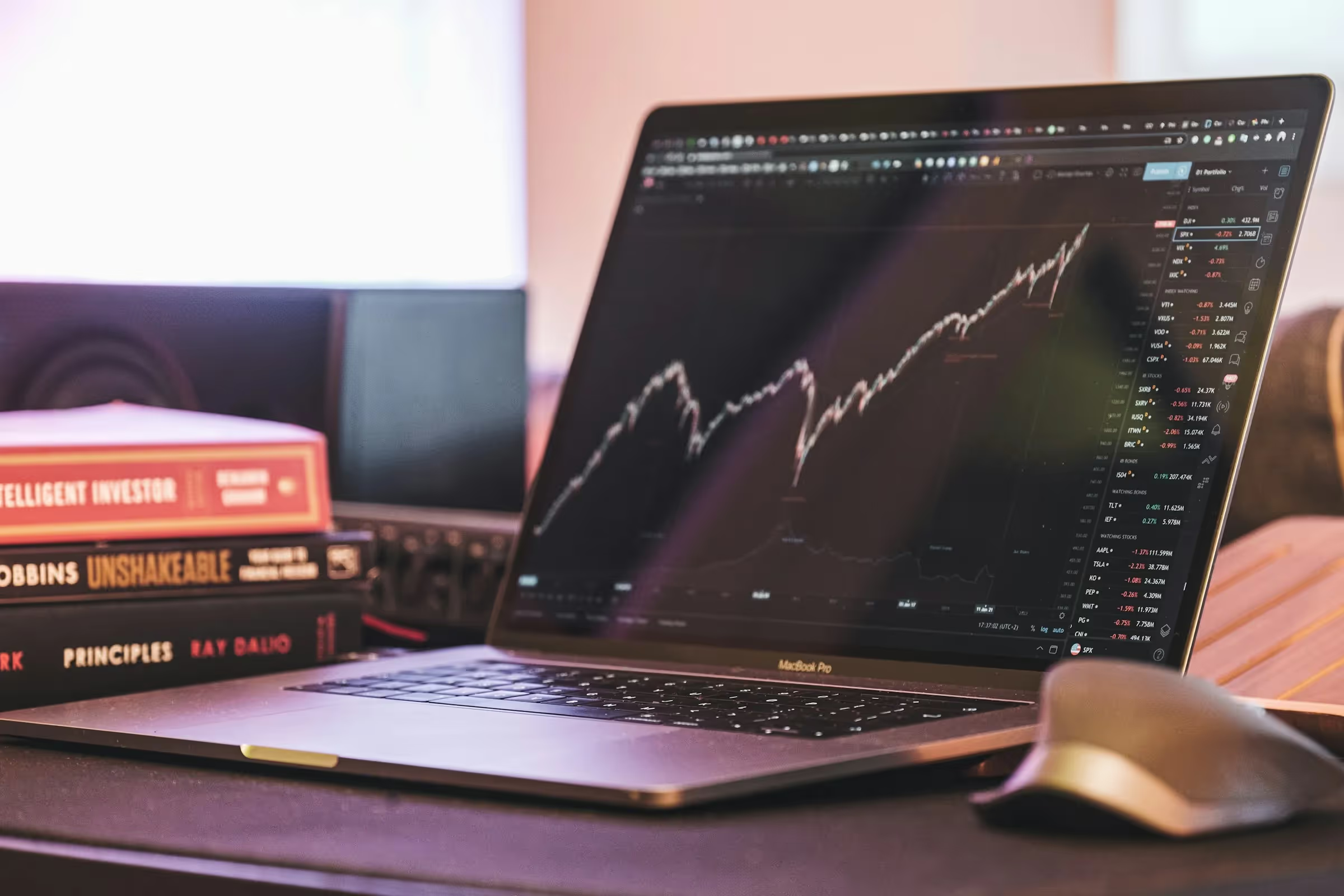
Drawdown shows what returns alone, never will: how much pain you'll have to go through to get those gains. Two trading strategies might each average 15% annual returns, but if one has a 40% drawdown and the other has only a 12% drawdown, the experiences will be very different.
The second trader sleeps well. The first one stares at charts at 3 AM, doubting every choice that took them to this point.
Returns show where you might end up; drawdown tells you if you’ll make it through the journey to get there.
If you're interested in improving your trading outcomes, consider our funded trading program to help you navigate these challenges effectively.
The math of recovery reveals why managing drawdown is more important than many know. According to Mastertrust, a 50% drawdown requires a 100% gain just to break even.
How does drawdown affect recovery?
Consider a trader who grows an account from $50,000 to $80,000 over six months, showing strong performance. After a tough month, the account fell to $60,000, a 25% drop from its peak. To recover the $20,000 loss and get back to $80,000, the trader needs a 33% increase in the remaining funds.
The problem gets worse the deeper one falls; a 30% drop needs a 43% recovery. If the account decreases by 40%, the trader aims for a 67% gain just to return to the previous high.
What emotional challenges do traders face during drawdowns?
This creates a negative cycle in which the trader's risk-adjusted edge is overwhelmed by mistakes in position sizing. The strategy might win 55% of the time with good risk-reward ratios, but if the drawdown exceeds a certain threshold, the statistical advantage no longer matters.
The account may fail before the chances can show themselves through enough trades. Traders give up on methods that could have worked, not because the method was a failure, but because their drawdown tolerance led to account failure first.
Deep drawdowns test something more fragile than account balances; they challenge the ability to stick to a plan when every instinct wants to do something else. Many traders say they feel physically uncomfortable during big drawdowns.
The feeling is similar to loss aversion on a deep level. Traders spend weeks building that equity peak, and watching it go down feels like losing something personal, even though unrealized gains never really belonged to them.
This emotional response leads to predictable behavior patterns. Some traders freeze, unable to take the next setup, because the fear of further losses outweighs their confidence in their process. Others trade too much, trying hard to recover losses quickly by raising position sizes or choosing lower-quality setups. Both of these reactions often make the drawdown worse, not better. The trader who maintains discipline through a 15% drawdown often survives, while the one who panics at 15% and changes their approach rarely makes it past 20%.
How do traders ensure sustainability in trading?
Proprietary trading firms understand this situation, which is why Mastertrust recommends keeping drawdowns below 20% for sustainable trading. This limit is not just an arbitrary risk management rule. It is the point where most traders can still think clearly, follow their process consistently, and trust their strategy without letting emotions take over.
If they exceed 20%, the quality of their decisions declines rapidly. The mental strain becomes too much.
Why do professionals prioritize drawdown management?
Risk-adjusted performance separates professionals from gamblers, but most traders focus only on absolute returns. A strategy that delivers 40% annual gains may seem better than one that delivers 25%, until you look more closely at how each reached those numbers.
The 40% strategy might have faced three separate drops of more than 30%, needing nearly perfect timing to avoid evaluation failures or emotional giving up. On the other hand, the 25% strategy maintained a maximum drawdown of only 12%, allowing the trader to steadily grow returns without incurring excessive account risk.
The second approach is more sustainable because it is actually tradeable by people with normal emotional reactions. Strategies that create smooth equity curves with small drops help traders stay active during tough times.
You cannot compound returns if you get disqualified or stop. In the end, the strategy that lets you keep trading through hard times delivers better long-term results than the high-volatility approach, which may look impressive in backtests but can harm traders mentally in real markets.
How do funded trading programs help manage drawdown?
Funded trading programs at firms like AquaFunded are designed around this principle, with maximum drawdown limits that protect both the firm's capital and the trader's mental health. Instead of harsh restrictions, these limits serve as safety measures, preventing traders from entering a drawdown state where bouncing back is very unlikely and emotionally extremely tough.
The 2-10% profit targets, along with clear drawdown limits, create a setting where a trader's skills can be demonstrated across many trades, rather than being lost during the first losing streak.
What are the long-term consequences of large drawdowns?
Large losses disrupt the compounding process in ways that strong future returns can't easily fix. For example, a trader starting with $100,000 who loses 30% has $70,000 left. Even if they later earn 20% annual returns for three years in a row, they will end up with about $121,000.
On the other hand, if they had compounded that same 20% annual return on the original $100,000 without the loss, they would have finished with $172,800. So, the loss didn't just result in a $30,000 drop; it also cost them five years of compounding growth on capital that is now gone.
How can traders build sustainable capital growth?
This explains why professional traders care deeply about managing drawdowns while amateurs focus on achieving the highest returns. Professionals know that it’s more important to protect their capital during losing times than to maximize their profits during winning times.
An account that grows 15% annually with minimal drawdowns outperforms one that averages 25% annually but has large drawdowns of 40%. The math shows that consistency is better than volatility over any meaningful period.
Traders often learn this truth too late, after a big drawdown forces them to start over with less capital or quit trading entirely.
Those who get this idea early, who see drawdown as the main risk instead of a minor issue, create equity curves that can handle real market conditions. They keep trading five years later, while the ones chasing high returns usually burn out within two years.
What distinguishes understanding drawdown from managing it?
Understanding why drawdown matters and managing its effects on trading are two completely different challenges.
Related Reading
- How to Grow a Small Trading Account
- What is Trading Commodities
- Long Term Trading Strategy
- Capital Growth Strategy
- What is a Cash Account in Trading
- What is Compound Trading
- How Much Money Do You Need to Start Trading Stocks
- Scale Trading
- Small Account Trading
- How to Evaluate Investment Opportunities
- Blown Trading Account
- What is PNL in Trading
- Do Prop Firms Use Real Money
- Prop Firm Account Management
- Borrowing on Margin
- Trading Leverage
Risks of Drawdown in Trading

Drawdown doesn't just threaten your account balance; it puts your ability to think clearly, act consistently, and trust the strategy that got you funded in danger.
The real risk is not the percentage drop itself, but how it affects your decision-making, capital efficiency, and your ability to keep trading effectively.
Sharp market changes ignore your risk management plan. When volatility increases, spreads get wider, and stops trigger at worse prices than expected. Connections that usually offer protection might suddenly line up, causing every position to go against you at the same time.
A trader who plans for a 1% daily risk may suddenly find themselves facing a 3% risk when three unconnected pairs turn around during a central bank announcement. The drawdown can accelerate faster than position-sizing models can keep up with.
How do early losses affect compounding potential?
This sequencing matters more than most traders realize. Taking losses early in a trading journey, when the account is at its highest, permanently damages compounding potential. A trader might have the perfect strategy, with a genuine statistical edge proven across thousands of backtested trades.
However, if market volatility causes a 25% loss in the first month, the trader is left with only 75% of their original capital. Every gain after that applies to a smaller amount. An account that could have grown to $200,000 in two years now struggles to reach $150,000, even with identical win rates and risk-reward ratios. This early damage never fully heals.
Can cash buffers protect against volatility?
Traders often keep cash buffers to get through times of market ups and downs without having to sell their positions at bad prices. This method usually works, but sometimes it doesn't. The buffer helps with regular market swings, but exceptional market conditions, the kind that happen once every few years, can use up their reserves faster than they thought.
For example, a trader might prepare for three weeks of downturn protection, but the market might throw six weeks of craziness their way. As a result, they might have to sell positions they wanted to keep, which locks in losses that could have been avoided if they could just hang on for one more week. In this way, volatility not only causes losses but also leads to decisions that amplify these losses.
How does inflation impact withdrawals from funded accounts?
Traders focus on nominal returns, often forgetting that purchasing power affects actual wealth. A funded account that makes 20% annual returns sounds impressive until you think about what that money can actually buy. The pressure on traders using funded accounts as their main source of income is increasing.
They need to make regular withdrawals to pay for living expenses, but those withdrawals come from capital that should be growing. As a result, inflation reduces the purchasing power of each withdrawal.
Think about a trader withdrawing $2,000 monthly from a funded account to pay for expenses. This seems manageable when the account brings in steady returns. However, even modest inflation of just 2% a year means that the same $2,000 buys less and less each year.
After ten years, keeping the same purchasing power requires about $2,438. After 20 years, that amount rises to around $2,972. So, a trader who doesn't change their withdrawal amounts for inflation is essentially taking a pay cut each year, even if their trading performance stays the same.
What are the consequences of not adjusting withdrawal amounts?
Most traders do not increase position sizes to deal with inflation, as doing so increases drawdown risk. This creates a problem: one must either accept lower real income or take on more risk to maintain purchasing power. The safe choice protects the account, but gradually reduces one's lifestyle.
On the other hand, the risky choice keeps the lifestyle the same but exposes the trader to drawdowns that exceed safe limits. Neither option seems sustainable over a twenty-year trading career.
Why does withdrawal flexibility pose a risk?
Withdrawal flexibility can become a problem when discipline breaks down. Funded accounts at programs like AquaFunded offer fast payouts, sometimes within 24 hours. This quickness brings both chances and temptations.
When you see your account balance, it's simple to justify a big withdrawal for a new trading setup, a vacation you've been putting off, or a home renovation to enhance your trading space. You might believe that one large withdrawal won't hurt, but it actually does.
How significant are the impacts of withdrawals on compound growth?
Every dollar you take out is a dollar that stops compounding. For example, if you take $10,000 from a $100,000 account that averages 15% annual returns, you don't just lose that initial amount. You also lose the $1,500 that money would have made in year one, the $1,725 in year two, the $1,984 in year three, and so on.
Over ten years, this one withdrawal can cost you about $30,000 in missed compound growth. In the end, the lifestyle upgrade you bought for $10,000 actually costs around $40,000 in total wealth.
What happens when spending patterns adapt to account for peaks?
Traders often tie their spending to the highest balance in their account rather than using safe withdrawal rates. For example, when an account grows to $150,000 after a successful quarter, people may think this is the new standard. As a result, they start to withdraw more money to match the higher amount. However, when the expected losing streak happens, and the account drops to $120,000, spending habits usually do not decrease.
This results in withdrawing the same dollar amounts from a smaller base, which speeds up the drawdown and reduces the funds available for recovery. An account that could have handled a 15% drawdown with careful withdrawal habits now must deal with a 25% drawdown under the same market conditions, simply because spending grew faster than sustainable rates.
How do career timelines create unforeseen risks?
Trading careers can last for many years if traders make it through the difficult early times. This timeline highlights risks that many traders don’t consider when they start. They can't know how long they will be able to trade at peak cognitive performance.
There are uncertainties about when market conditions might change in ways that make their advantage useless, or if health problems may interfere with their ability to keep an eye on their positions. Each year, they plan for trading adds another layer of uncertainty.
Traders often underestimate how long they will last in the markets, thinking they will retire or find other sources of income much sooner than they really do. Then reality hits. A trader who thought they would have a ten-year career might still be trading fifteen years later because there are no other job options or because they truly enjoy the work.
However, they usually do not create a plan for managing their losses or a withdrawal strategy for this extended timeline. An account that seemed well-funded for ten years can look worryingly low when extended to fifteen or even twenty years.
What unique challenges do female traders face?
Women face particularly strong pressure when they trade. Since women generally live longer than men, a funded trading account must provide income for more years than men usually need. For example, a female trader who starts trading at age 30 might continue until she is 65.
After that, she will need that money to generate income until she is 90 or even older. This creates a 60-year period during which drawdown events, market regime changes, and personal circumstances pose challenges that are hard to predict from the start. The account that seems strong at 35 may turn out to be insufficient at 75, not because the trading method failed, but because the time frame was longer than what the capital could realistically support.
How do regulatory changes affect drawdown management?
Pension rules change, tax policies shift, and regulations for trading firms are updated. The trading environment that works well today might look very different in five years. Traders who create strategies based on specific tax laws or regulations often find they need to adjust their approaches when governments alter the rules.
This process of restructuring can involve realizing losses, adjusting the types of positions they hold, or changing account structures. These changes can trigger unexpected drawdown events.
Recent changes that make pensions subject to inheritance tax highlight the risks of such structural shifts. Traders using funded accounts as part of their overall wealth planning need to rethink when they withdraw funds, how they hold their accounts, and how they allocate capital for the long term.
These adjustments do not occur on their own; they require decisionsmade in market conditions that may not be optimal. As a result, this creates a risk of drawdown due to regulatory requirements rather than trading performance. Your advantage remains, and your strategy hasn't failed; it's the external rules that have changed, leaving you to deal with a drawdown caused by factors completely beyond your control.
Can being informed eliminate drawdown risks?
Staying informed helps, but it doesn't eliminate all risks. You can read every regulatory update, talk to advisors, and quickly adapt to new rules. However, it's impossible to stop governments from making changes that could hurt certain situations. For example, a trader who set everything up perfectly under 2024 regulations might have tax inefficiencies or compliance problems under the 2027 rules.
The risk from regulatory changes affects both disciplined and undisciplined traders equally. In the end, risk management can't protect against what lawmakers decide.
Why is understanding your drawdown level crucial?
Understanding these risks is important. However, it only matters if one knows their target drawdown level.
What is a Good Drawdown in Trading
The drawdown that works depends on what you're optimizing for. A trader who focuses on capital preservation operates differently from one looking for rapid account growth. Professional systematic traders, who keep 0-5% drawdowns, give up speed for consistency; they build wealth slowly while coping with every market situation.
Most funded traders aim for a drawdown between 5-10% to find a balance between flexibility and recovery math. When you go beyond 15%, experience, discipline, and mental strength become more important than the quality of your strategy.
The right drawdown level matches your trading situation, not some universal standard that is disconnected from reality.
What does holding a low drawdown indicate?
Holding a drawdown between 0-5% signals exceptional risk control. It shows that traders keep their position sizes small and often skip risky setups. They exit quickly when trades go against them, even if there's a chance for the price to turn around later. This careful method can frustrate traders who see opportunities pass by while they wait for perfect confirmation.
As a result, even though their accounts grow, watching peers make 30% monthly returns while they only make 8% tests their patience in ways most traders do not understand.
The real benefit of this strategy shows up over years, not months. Traders who keep their drawdowns in this low range are more likely to survive market conditions that harm aggressive competitors. During volatile times, when connections between assets break down or central banks surprise the market with unexpected changes, the conservative trader's account stays relatively steady.
They keep trading with almost their full capital, while others rush to recover from 25% drawdowns. According to City Traders Imperium, the 5-10% drawdown range is the best balance for most prop traders, allowing them to make confident trades without the mental strain of large losses.
Why do professional funds prefer small drawdowns?
Professional funds operate in this range because their investors prefer stability over high returns. A hedge fund that loses 15% in just one quarter is likely to see investors withdraw their money, no matter how well the fund has performed in the past.
The need to keep shallow drawdowns affects every part of fund management, including decisions on how much to invest, which markets to choose, and how to carry out strategies. Although individual traders don’t have to worry about redemptions, they face something that can be even worse: their own emotional reaction to seeing their hard-earned gains disappear.
How does the 5-10% drawdown range affect trading?
The 5-10% range gives some leeway while making recovery realistic. Traders can have three losing trades in a row without doubting their whole strategy. The math stays simple, as a 7% drawdown needs about 7.5% gains to get back to the highest point, which seems doable. This setup helps maintain confidence in the trading process because losses never become too large to cause panic or desperation.
Funded trading programs design their rules around this range to protect both parties. The firm limits capital at risk while enabling traders to execute their strategies effectively.
Traders can build up their gains without always worrying about hitting maximum drawdown limits. Programs like AquaFunded highlight this balance through clear profit goals (2-10%) and specific drawdown limits, creating a space where traders can focus on their trades rather than worry about disqualification.
What are the risks of a high drawdown?
This range allows position sizing that effectively captures market moves. If traders are too careful, they might miss out on profits, even when their analysis is right. On the other hand, being too bold can lead to mistakes or emotional breakdowns after just three consecutive losses.
A trader operating at a 6-8% drawdown usually risks 1% per trade, keeps proper stop losses, and exits positions that aren't performing without hoping for sudden recoveries. They are trading based on their skills, not their feelings.
Scalping strategies particularly benefit from this range. According to Forex92 reports, a 5-15% drawdown percentage works well for scalping because the high number of trades can quickly lead to a drawdown from several small losses.
Scalpers need enough cushion to handle normal losing streaks without going beyond strict limits. However, they cannot handle the mental strain of 20%+ drawdowns while taking 30-50 trades daily.
What characterizes traders with 10-20% drawdowns?
Traders who accept 10-20% drawdowns usually fall into two groups: those testing new strategies and those seeking faster growth. Both groups need experience that most retail traders lack.
Discipline is important to reduce position sizes as drawdowns increase. Psychological stability is key to following plans when an account is 15% below its highest value. Also, traders need to have mathematical skills to realize that an 18% drawdown requires 22% gains to recover.
This range might seem easy to handle until someone actually experiences it. Watching an account drop from $100,000 to $85,000 creates pressure that planning cannot account for. Every trade starts to feel more important.
Traders start to doubt setups that would have been obvious at a 5% drawdown. The thoughts change from "Does this meet my criteria?" to "Can I afford another loss right now?" That second question can ruin more trading careers than bad strategies ever could.
How should strategy testing be managed?
Strategy testing justifies temporary exposure to this range, as it gathers data about whether the approach actually works. Even then, the testing period should be time-limited with predetermined exit conditions.
If the strategy hasn't proven itself after 100 trades, extending the test through a 15% drawdown won't suddenly make it valid. Instead, you're just burning capital while hoping that probability eventually favors you.
What happens beyond a 20% drawdown?
Beyond a 20% drawdown, math and psychology work against recovery. Robeco explains that maximum drawdown is the largest decline from the portfolio's peak to its trough. At 20% or more, that decline creates a statistical barrier that most traders find hard to get past.
To get back to where you started after a 20% drop, you need 25% gains. If the drop reaches 30%, you will need a 43% return. While these numbers are not impossible, they are unlikely enough that most accounts fail before reaching them.
The emotional side makes everything worse. Traders say they feel physically sick while watching their accounts change in this situation. Sleep gets worse, and relationships suffer.
Overall, decision quality declines as fear overrides analysis. You might freeze, unable to act because the thought of another loss feels too much to bear, or you might overtrade, trying hard to recover with position sizes that break every risk management rule you say you follow.
How do prop firms manage trader drawdowns?
Most prop firms terminate traders before they reach this zone. The daily loss limits act as circuit breakers, preventing single-session disasters from pushing accounts into unrecoverable territory. A trader might have a 10% total drawdown limit but only a 3% daily maximum. This daily rule stops the emotional slide that can turn one bad day into a very bad week.
When faced with big losses, traders get stopped out, take a break, and come back the next day with a fresh perspective, rather than making things worse with desperate trades.
What is the recovery difficulty like?
Recovery difficulty grows exponentially, not linearly. A 10% loss needs 11.1% gains, while a 20% loss requires 25%. A 30% loss requires a 42.9% recovery, and a 50% loss necessitates a 100% recovery.
This progression shows why traders who can withstand 5-10% drawdowns can grow their wealth over decades, while those who often face 20%+ losses find themselves starting over. The math of recovery does not care about how good your strategy is or how much market knowledge you have; it only shows how much money has been lost and what remains to be recovered.
What are the benefits of smaller drawdowns?
Smaller drawdowns create virtuous cycles. They help maintain confidence because recovery feels possible. Traders can stick to their strategies without letting emotions take over. Position sizing stays rational, as there's no urge to quickly recover losses.
This leads to steady account growth, where consistent gains over five years perform better than huge returns interrupted by big losses.
A crucial rule to remember is to risk no more than 1% per trade. Staying disciplined during losing streaks is key, and it’s important to avoid changing strategy in the middle of a drawdown out of panic.
Following this framework helps most traders stay within the 5-10% range, making trading mentally sustainable and mathematically recoverable. Going beyond these limits means relying on luck, hoping probability will save you before your mindset leads to trouble.
How can traders avoid exceeding the right drawdown range?
Knowing the right drawdown range is important, but it doesn't matter if traders can't stick to it when markets go against them.
Related Reading
- Sources of Capital
- Cash Reserve Account
- Short Term Stock Trading
- Investment Performance Analysis
- Managed Account vs Brokerage Account
- Systematic Trading
- How to Analyze a Stock Before Buying
- Forex Capital Trading
- What is a Retracement in Trading
- What Is Automated Trading
- How is Risk Involved in Calculating Profit?
- Convergence Trading
- Liquidity Trading
- Futures Trading Minimum Account Size
Trade Without Letting Drawdown Kill Your Account

Maintaining control during drawdowns isn't just about having the perfect strategy; it's about having enough capital to use that strategy without one bad week ruining your account. Most traders fail because their position sizing and account structure don't allow their edge enough time to work. The strategy itself might be good, but the runway is too short.
When you trade with larger account sizes, drawdowns behave differently. If you have $10,000 and risk 1% on each trade, you're risking $100. After three losses in a row, you're down by $300, which seems manageable until you realize you need three wins just to break even; that’s not counting the psychological weight of being in a hole.
Now, if you use the same 1% risk with a $100,000 account, you're risking $1,000 per trade, leaving you with $97,000 after three losses. The percentage drawdown remains the same, but the actual capital cushion gives you the breathing room you need. You can keep proper position sizing without the constant fear that normal ups and downs will lead to evaluation failure.
Programs that offer account sizes up to $400,000 address a problem most traders don’t see until they face disqualification twice. After finally creating a strategy with a real edge, which you prove through hundreds of demo trades, you pass the evaluation. Then, when real trading starts, and you hit a usual losing streak of five losses over two weeks, the impact is huge. With a smaller account, that streak brings you very close to maximum drawdown limits.
In response, you start reducing position sizes because you're scared. As a result, when your winners do come, they might not make enough profit to cover the losses. The account slowly approaches disqualification, not because your strategy failed, but because your capital base couldn't withstand the normal statistical variance.
When Rules Protect Instead of Punish
Flexible evaluation structures recognize that drawdown management needs psychological sustainability, not just mathematical compliance. A trader with a 10% maximum drawdown and strict daily loss limits can be quickly eliminated by a single wild trading session or an unexpected central bank announcement that moves prices suddenly. Even though these rules aim to protect capital, they often fail to account for how markets actually behave.
As a result, the trader never gets a chance to demonstrate whether their method works across different market conditions. Instead, they were removed by a rule system that treated all reasons for drawdowns as the same.
Realistic profit targets, combined with sensible drawdown limits, create a situation where recovery becomes statistically probable rather than just wishful thinking. Trying to achieve 30% monthly returns to reach very high targets often leads to position sizing that almost guarantees a major drawdown. While a trader might achieve the target two times, the third month could erase all previous profits and end the account.
Targets in the 2-10% range allow for maintaining a 1% risk per trade framework, which actually holds up against real market conditions. This method results in slow compounding, but after five years, that trader is still compounding, while aggressive traders find themselves trying for the eighth time.
Why Contract Flexibility Matters for Risk Control
Trading micro contracts as your account grows is essential, as it helps youmaintain consistent risk percentages. This way, position sizing won't get too small to matter or too large to handle. A trader with a $50,000 account, risking 1% per trade, should risk $500. When trading standard contracts, which usually have stop losses equal to $1,000 moves, it's tough to manage risk effectively.
The trader might skip trades that fit their criteria because the position size is too big, or take the trade and break their risk rules. Micro contracts solve this problem by letting traders adjust position sizes based on their actual risk tolerance, rather than forcing them to match the available contract sizes.
Granular control becomes very important when recovering from a drawdown. After a losing streak reduces your account by 8%, you shouldn't try to recover losses by taking larger positions. Instead, you should keep the same risk percentage with a slightly smaller amount of money, resulting in smaller position sizes.
Micro contracts help make this adjustment accurate. On the other hand, standard contracts force you to either maintain the same absolute position size, which increases your percentage risk and accelerates potential drawdowns, or stop trading in some markets due to sizing constraints.
A trader who starts with micro contracts and gradually moves to standard contracts as their account grows maintains consistent risk exposure throughout their growth journey. They avoid being over-leveraged compared to their capital and never miss good chances because of being under-exposed. This consistency helps create equity curves that compound rather than fluctuate between quick gains and devastating drawdowns.
Your edge needs time to show itself over hundreds of trades, but only if you set up your trading environment to handle the statistical changes that often disrupt most accounts.
Having enough capital, flexible rules, and precise position sizing are not luxuries; they form the foundation that determines whether your strategy can demonstrate its effectiveness.
Think about checking out AquaFunded's funded trading program for a structured approach.
Related Reading
- How To Take Profits From Stocks
- Accumulation Distribution
- Short-Term Capital Gain Tax On Shares
- What Is Reit Dividends
- Cash Available To Trade Vs Settled Cash
- Best Pairs To Trade Forex
- Can You Day Trade In A Roth Ira
- What Is A Conditional Order
- Orb Strategy Trading
- Stop Loss Vs Stop Limit
- Flag Pattern Trading
- Characteristics of Growth Stocks
- Forex Compounding Plan
