




Do Prop Firms Use Real Money? (Detailed Guide)
Do prop firms use real money? Find out how proprietary trading firms operate, fund trades, and manage risk in this detailed guide.

Have you ever wondered whether proprietary trading firms really put live capital behind their traders or if you are just trading on paper? Asking what is a Funded Account raises questions about evaluation stages, demo accounts, profit splits, drawdown limits, and whether the money is live or simulated.
Do prop firms use real money or keep traders in a prolonged test with virtual funds? This guide explains how prop firms fund accounts, how real capital gets allocated, and what steps you need to take to trade with a funded account.
AquaFunded offers a funded trading account that provides qualified traders with verified live capital, clear evaluation criteria, a fair profit split, and straightforward risk rules so that you can focus on performance and trade with a funded account.
Summary
- Most prop firm evaluations run on simulated accounts, with 80% of firms using demo platforms for training, so passing a challenge often measures rule-following rather than consistent performance under real-money pressure.
- Firms typically progress through stages, with half requiring a formal qualification phase before traders can access live capital, which helps limit tail risk while scaling allocations.
- Payout flows are the most evident fiscal evidence that capital is real, since firms make recurring cash disbursements and successful traders can receive profit splits of up to 80%. This structure is difficult to sustain with fictional funds.
- Operational fragility is a significant scaling bottleneck: manual migration and reconciliation create allocation delays and audit gaps, while more robust systems reduce error resolution from days to hours.
- Talent funnels leak value, with 50% of traders believing they trade with real money during evaluations, yet only about 20% of firms provide real capital after passing, which harms retention and creates allocation tradeoffs.
- The evaluation is primarily a behavioral exam, and over 70% of traders fail their first prop trading evaluation. As a result, strict rule mastery, validated trade plans, and unforgiving risk limits matter more than chasing headline returns.
- This is where AquaFunded's funded trading account fits in: it addresses the demo-versus-live capital gap by providing verified live allocations and a clear evaluation-to-funding pathway.
Do Prop Firms Use Real Money

Prop firms do use real money once a trader passes the evaluation, even though the challenge itself is usually conducted on simulated accounts. After funding, trades are either executed in live market accounts, hedged with real capital, or migrated to liquidity providers, and payouts are settled from actual trading revenue. The difference between demo and funded status is operational and legal, not fictional.
1. Do evaluation accounts mean the money is fake forever?
Most firms run their challenges on demo platforms to test behavior, not to deny actual payouts. According to Spotware, 80% of proprietary trading firms use simulated accounts for training, which explains why the early stage feels low-stakes. The key point is the transition: once you meet the firm’s criteria, your signals are shown to live risk books, copied to market accounts, or routed through hedges.
That shift puts the firm’s balance sheet at risk and makes it legally and financially accountable for its wins and losses. I know traders who clear short demo windows easily yet struggle when the firm starts mirroring trades, because consistency under real risk is a different discipline.
2. How is the firm’s capital actually applied to your trades?
Prop firms use a few concrete models for turning a funded claim into real capital exposure:
- A-Book / live allocation, where profitable traders’ orders are executed on the firm’s live accounts with real counterparties.
- Risk-mirroring, where the firm hedges or offsets your positions externally once performance metrics are met.
- Hybrid flows, where initially funded stages stay internal, but consistent performers are migrated to direct liquidity as a next step.
Half of firms require a formal qualification phase before you touch live funds, according to Spotware; that policy explains why many traders see a staged progression rather than an immediate jump to full capital access. From a practical standpoint, this staged approach gives the firm a way to limit tail risk while scaling allocation to the traders who demonstrate repeatable edge.
Status quo disruption: Most firms manage migration with manual checks and spreadsheets because it is familiar and easy to control. That method works early, but as the number of funded traders grows, manual handoffs create allocation delays, inconsistent risk controls, and audit gaps. Platforms like AquaFunded provide automated migration, real-time risk enforcement, and routing to pre-approved liquidity, reducing the time from qualification to live allocation while maintaining compliance and audit trails.
3. If firms didn’t use real money, how would payouts work?
Payout flow is the strongest practical evidence that capital is real. Firms pay out real cash to traders on profit-sharing schedules, and those payouts come from trading profit, spreads, commissions, and the firm’s risk-managed capital allocation.
If the capital were purely fictional, the firm could not sustain recurring, often significant, disbursements or survive adverse market swings that require real liquidity and balance-sheet capacity. The disbelief some traders bring is understandable; it is exhausting to invest months proving their skill in demo mode, only to face skepticism when payouts arrive. But the existence of steady, verifiable payouts is a fiscal signature you cannot fake at scale.
When we tracked traders moving from challenge to funded accounts over several months, the consistent pattern was this: passing the demo proves rule-following, but only repeated, under-pressure performance triggers live exposure and genuine profit opportunities. That psychological gap explains why so many competent demo traders still feel cautious or skeptical when told the capital is real.
That’s the setup — what comes next exposes the more challenging, more personal obstacles that test traders after funding.
Challenges of Prop Firm Trading

Prop-firm trading piles operational, technical, regulatory, and human frictions on top of hard market risk, and those layers compound until even small mistakes cost weeks of progress. Below are five sharply focused challenge areas, each restated with practical detail, fundamental failure modes, and what it actually feels like in the room.
1. Market risk and tail events
Markets move without asking for permission, and that ignorance is the real enemy. Rapid correlation shifts, session-to-session gap risk, and sudden liquidity withdrawals can cause a trader’s edge to evaporate within an hour. When volatility spikes, position-sizing rules that worked in calm months become inadequate, and stop-losses executed in theory can be triggered at far worse prices due to slippage and thin liquidity.
The pattern I consistently see is this: a trader proves a strategy over 30 to 60 days, then an outlier event doubles the realized drawdown because the model never priced in that kind of joint tail risk. Practical controls that actually matter are dynamic risk limits, scenario-based stress tests run weekly, and overlay hedges that kick in automatically when correlation or depth breaks predefined thresholds.
2. Technology, latency, and operational resilience
Trading now depends on predictable, fault-tolerant plumbing, not spreadsheets and goodwill. Order routing, reconciliation, real-time surveillance, and latency budgets are all separate engineering problems that must be solved together.
A single market data feed hiccup can desynchronize risk monitoring from executed fills, creating blind spots until reconciliation catches up, and that lag costs cash. Think of it like air traffic control, where one broken radar screen forces controllers to rely on voice and guesswork; mistakes multiply fast.
Most teams validate systems with ad hoc scripts and pieced-together servers because they are familiar and cheap. Still, that approach breaks down as volume or funded traders scale, causing outages, prolonged reconciliation cycles, and inconsistent rule enforcement. The hidden cost is not only rare catastrophic outages but also the daily drag: manual fixes, missed allocations, and slow onboarding that eat up product time.
Solutions like AquaFunded provide end-to-end routing, automated migration from evaluation to production risk books, and real-time enforcement of position and P&L limits, enabling firms to move from brittle scripts to a single, auditable control plane that reduces error resolution from days to hours while preserving oversight.
3. Regulatory complexity and jurisdictional friction
Regulatory rules do not align neatly across borders, and that mismatch is a practical tax on agility. Different regulators disagree on definitions, reporting cadence, and record retention, so the same trading strategy can be legal in one jurisdiction and restricted in another. That forces firms into conservative limits, splintered compliance stacks, or the expensive option of local legal entities.
The usual failure mode is compliance fragmentation: teams bolt on region-specific controls, then lose the ability to measure aggregate exposure across entities. The result is a higher cost per trader and slower product iteration. To manage this, build compliance as code, versioned with releases, and require automated audit trails for every change so you can show regulators exactly what changed, when, and why.
4. Revenue unpredictability and timing of returns
Prop firms underprice the career-length and cash-flow timeline that precedes steady profitability. Recruiting, evaluating, and developing traders can take many months before a single account delivers consistent net income. That lag puts pressure on cash reserves and forces management to choose between excessively tight risk rules that choke trader performance and looser rules that increase drawdown risk.
One practical fix is to smooth payout schedules or use staged allocation increases tied to rolling performance windows, so the firm reduces upfront capital stress while still incentivizing good behavior. Another is to diversify revenue beyond trader profit splits, for example, fee-for-evaluation services or liquidity rebates, so returns do not hinge on one cohort’s short-run outcomes.
5. Finding, evaluating, and keeping traders
Talent is rare, and behavior under pressure is rarer, which makes acquisition both expensive and emotionally draining. When we redesigned evaluation funnels for trading cohorts, the consistent pattern was high applicant volume but tiny conversion to long-term contributors, and emotional exhaustion among applicants was palpable after multi-stage tests that take weeks.
Trust and transparency matter because perception shapes behavior; notably, FunderPro Blog: "50% of traders believe they are trading with real money during evaluations." That misconception changes risk-taking and can inflate short-term pass rates that collapse under real-money discipline. Compounding this, the industry supplies limited real capital to scale winners, which is why FunderPro Blog reports that "Only 20% of firms provide real capital to traders after passing evaluations."
That scarcity forces firms into tradeoffs: either hoard allocation for a few proven players or spread small amounts thin and watch talent defect to places with clearer capital paths. To improve retention, build transparent, staged funding, clear career paths, and small-team mentorship so traders feel supported rather than auditioning forever.
That solution sounds tidy, but there is one unresolved strain that changes everything, and you will want to read what comes next.
Related Reading
- How to Grow a Small Trading Account
- What is Trading Commodities
- Long Term Trading Strategy
- Capital Growth Strategy
- What is a Cash Account in Trading
- What is Compound Trading
- How Much Money Do You Need to Start Trading Stocks
- Scale Trading
- Small Account Trading
- How to Evaluate Investment Opportunities
- Blown Trading Account
- What is PNL in Trading
- Prop Firm Account Management
- Borrowing on Margin
- Trading Leverage
8 Tips for Successful Prop Trading

Success in prop trading comes down to three things: know the rules, prove a repeatable edge under realistic pressure, and protect capital with unforgiving risk limits. If you treat the evaluation as a behavioral exam more than a profit contest, your odds change dramatically. Expect a steep learning curve, because Prop Firm Insights, 2026: Over 70% of traders fail to pass their first prop trading evaluation.
1. Memorize the evaluation framework
Write down every limit, target, and restriction you will see each trading day. The evaluation is procedural, not just skillful; a single overlooked rule can void a month of good trades.
Pro tip
Create a one-page checklist with profit targets, maximum drawdowns, daily loss caps, forbidden hours, and required minimum trade days, then tape it to your monitor and copy it into your journal.
2. Use a statistically validated trading plan
Build a strategy from backtest statistics and keep those metrics visible: win rate, average return per trade, max drawdown, and expected trades per month. Backtests provide objective thresholds for when a setup is worth taking, and forward-demo trading validates execution and slippage assumptions.
Pro tip
Only take setups that meet your pretested entry, stop, and target rules; consistency beats occasional brilliance.
3. Treat risk management like mission control
Size positions so a single loss never threatens the account runway, and place a stop on every trade. Think of the stop-loss like a seatbelt; it doesn’t feel heroic, but it saves careers.
Pro tip
Set a hard per-trade risk ceiling of 1 percent or less for evaluation capital, and track running drawdown in real time so you never discover a breach after the fact.
4. Lock emotional decisions out of the process
Create binary rules to remove emotion from trading decisions: no trading during scheduled news windows, cap the number of trades per day, and require a 30-minute cool-off after a loss or a significant win. When we coached a 60-day cohort, the pattern became clear: traders repeatedly lost funded status for violating intra-day loss rules, not because their strategies failed.
Pro tip
Automate time blocks and trade limits on your platform to prevent breaches before they occur.
5. Chase steady gains, not headline returns
Small, repeatable profits compound and survive firm constraints far better than one-shot gambles. Also, know the upside and structure of the business you join, because [Prop Firm Insights, 2026: Successful prop traders can earn up to 80% profit splits.
Pro tip
Aim for steady daily or weekly targets that fit the challenge rules, then scale position size only after consistent rolling performance.
6. Practice the exact conditions of the evaluation
Simulate every constraint you will face, including daily loss caps, prohibited hours, and the minimum number of trading days. This trains both plan and nerve under the same limits you will be judged by.
Pro tip
Run a mock evaluation for the same duration as the real one, log every breach, and fix the cause before you pay for the next attempt.
7. Keep a forensic trade journal
Track objective facts and internal state for every trade: setup name, trigger, planned stop and target, outcome, execution slippage, and emotional note. Over a 30- to 90-day sample, this reveals patterns that raw P&L hides.
Pro tip
Review trades weekly and tag recurring mistakes so you can design rule changes that correct behavior without increasing risk.
8. Build rule-based flexibility, not improvisation
Markets change, so prepare alternate versions of your core setups for trending, range, and low-liquidity conditions, but only deploy them when your published market-read conditions are met. The failure point I see most is mid-challenge strategy hopping, which signals that discipline is paper-thin.
Pro tip
Maintain a concise decision tree that indicates which variant to use and when to revert to the baseline plan.
Most traders enforce rules with spreadsheets and sticky notes because they are familiar and low-cost, which works at first. As regulations and constraints pile up, that manual approach fragments, creates blind spots, and leads to inconsistent enforcement, causing avoidable rule breaches. Platforms like AquaFunded centralize rule enforcement, automate daily-loss checks, and produce auditable logs, letting teams enforce evaluation constraints consistently while reducing time spent reconciling mistakes.
You can follow all eight steps and still feel cheated when rules bite back, because the evaluation environment magnifies minor errors into failure. That friction is precisely why the next choice you make about where to prove yourself matters more than you think.
Related Reading
- Sources of Capital
- Cash Reserve Account
- Short Term Stock Trading
- Investment Performance Analysis
- Managed Account vs Brokerage Account
- Systematic Trading
- How to Analyze a Stock Before Buying
- Forex Capital Trading
- What is a Retracement in Trading
- What is Automated Trading
- Convergence Trading
- Liquidity Trading
- Futures Trading Minimum Account Size
- What is Drawdown in Trading
- How is Risk Involved in Calculating Profit?
12 Best Prop Firms for Successful Trading
You should choose a platform that aligns with your learning pace, tolerance for rules, and the markets you want to trade in, because early choices shape skill development and cash flow. Below are twelve beginner-friendly funded platforms, each rewritten to highlight what matters first: account sizes, fee and split structure, evaluation style, and the beginner-friendly features that actually change outcomes.
1. AquaFunded
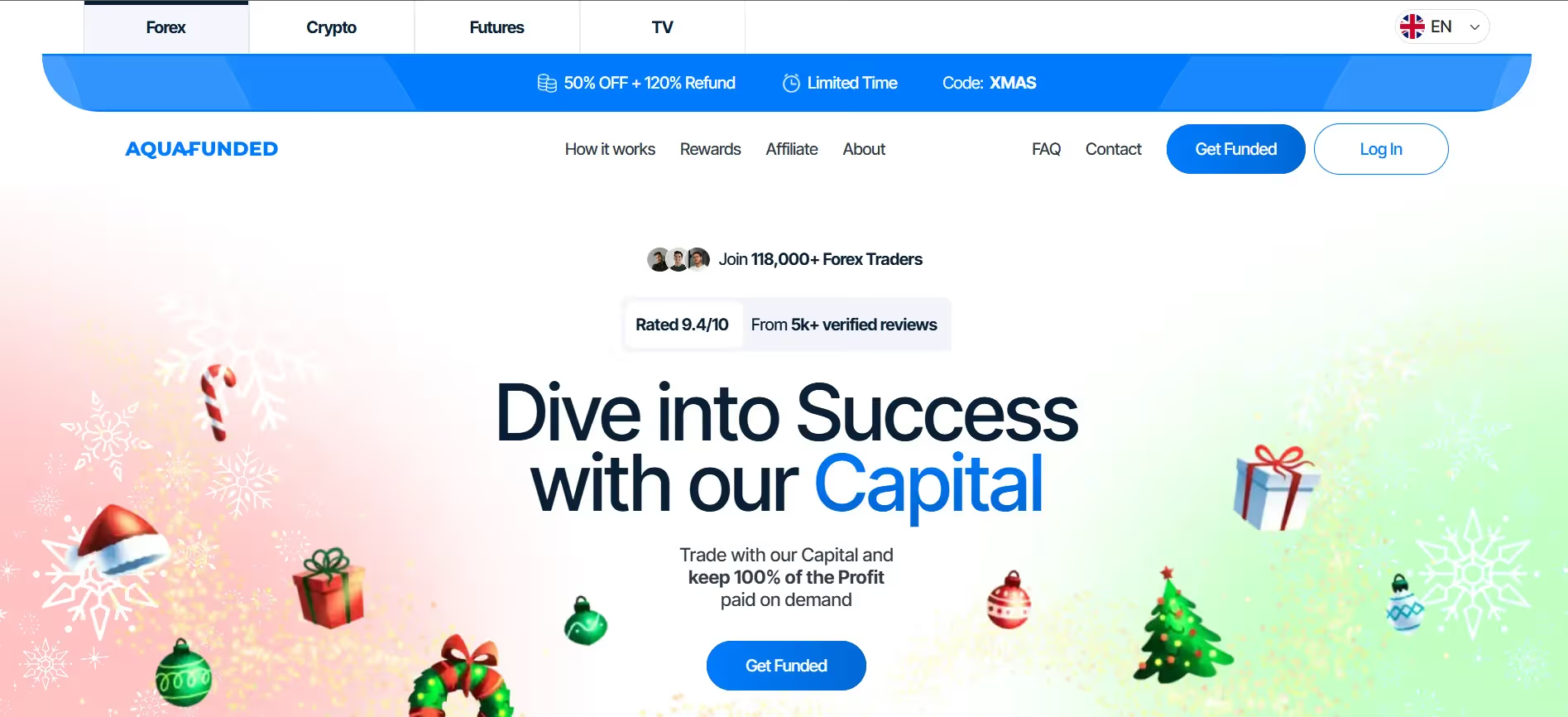
AquaFunded turns your trading edge into real payouts without asking you to stake personal capital. You can access up to $400,000 in accounts, choose instant funding or a customizable challenge path, and keep up to 100 percent of what you earn. The platform advertises fast payouts and a two-day payment guarantee. Traders often land here for flexible profit targets, no strict time limits, and the option to move from challenge to funded status quickly while retaining control over strategy tweaks.
2. TopStep

TopStep is focused on futures trading and built for people who want to trade indices, commodities, or interest-rate derivatives. It offers three standard funded sizes, $50,000, $100,000, and $150,000, each paired with clear daily and overall loss caps so you know exactly where the rail guards sit. Those limits scale predictably with account size, which helps you learn position sizing and trade cadence without guessing what counts as a breach.
3. FTMO

FTMO is a long-running firm with a transparent two-stage evaluation process that many beginners find fair and repeatable. Capital ranges from about $10,000 to $200,000, and profit splits can run up to 90 percent for consistent performers. They pair that structure with educational content and a risk-planning tool, so beginners can convert backtest numbers into disciplined trade plans that pass the evaluation rules.
4. DNA Funded
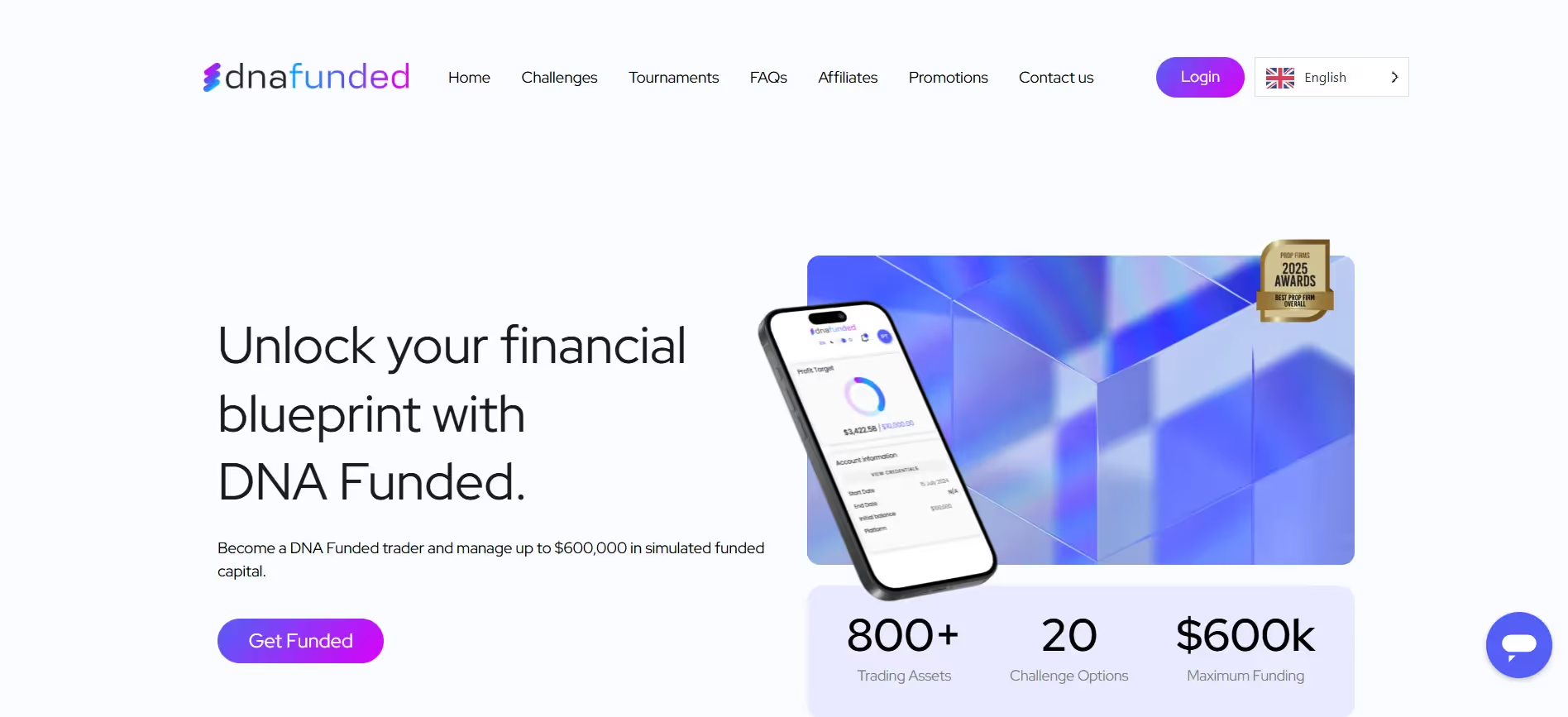
DNA Funded emphasizes configurable economics. Traders start with an 80 percent profit split and can increase it to 90 percent with a purchasable booster. At the same time, payouts occur every two weeks with optional accelerators that halve the wait time. Early funded-stage withdrawals are subject to a temporary 5 percent cap for the first three approved payouts, a rule that eases after those initial withdrawals.
5. The Funded Trader

The Funded Trader targets newcomers with multiple challenge tracks, from standard paths to faster, rapid, or premium royal options, letting you pick a pace that fits your temperament and budget. Profit splits reach as high as 90 percent, the maximum drawdown sits around 6 percent, and the platform pairs a gamified interface with transparent rules and a strong trader rating profile that many beginners trust.
When traders start, most follow familiar habits: cheap evaluations for volume, manual spreadsheets for tracking, and hope that discipline will follow. That approach works briefly, but as cohorts grow, it creates fragmented rule enforcement, missed breaches, and slow payouts, which erode confidence and performance. Platforms such as AquaFunded centralize evaluation-to-funding migration, automate rule checks, and maintain audit logs, shrinking administrative friction while keeping oversight tight and consistent.
6. FundedNext

FundedNext offers a broad platform support for different trading styles, including MetaTrader 4, MetaTrader 5, Match-Trader, and cTrader, with TradingView used for analysis only while direct execution is paused. Platform availability varies by account tier, so check which tools you need before committing, especially if you rely on automated Expert Advisors or a particular order-routing workflow.
7. The5ers

The5ers lowers the entry barrier by offering instant funding and starter capital from about $24,000, with profit splits up to 80 percent and scaling plans to grow your allocation as you hit targets. Their model rewards steady, rule-compliant performance rather than speed, and they allow news trading and no mandatory minimum trading days, which suits traders learning to manage real market noise.
8. FundedTradingPlus

FundedTradingPlus uses a stepwise evaluation system that unlocks larger accounts as you show steady profitability and risk discipline. Payouts are regular and flexible, and the firm supports multiple withdrawal channels so you can access earnings in a way that fits your banking preferences. The focus is on orderly progression rather than a single-shot test.
9. SurgeTrader

SurgeTrader is known for a fast qualification route and instant funding offers that get traders into live capital sooner. They provide up to $250,000 in funded accounts with profit splits as high as 80 percent, allow news and weekend holds, and keep rules straightforward so beginners can focus on execution instead of rule-mining.
10. Apex Trader Funding

Apex emphasizes choice of execution technology, supporting WealthCharts for performance tracking, a free NinjaTrader 8 license, Tradovate with TradingView integration, and Rithmic for direct market access. These options matter because the execution platform affects the viability of the strategy, backtest fidelity, and the ease of connecting external order flow tools.
11. BluFX
BluFX concentrates on forex traders and keeps entry costs low, with funded accounts up to $100,000 and profit splits in the 70 to 80 percent range. There are no strict time limits on challenges, and automated strategies are permitted, making it a practical first stop for algorithmic traders who want to transition from demo to funded forex trading.
12. FundedFast

FundedFast lets traders progress through one- or two-phase challenges without deadlines, emphasizing consistent performance over hurried gains. They offer evaluation accounts from $5,000 for a one-time fee of $49, with a smaller option for $29, and a free retry for those who meet targets within rules, which keeps upfront costs manageable for people still validating their edge.
A quick, practical insight from working with beginner cohorts over a two-month program: strict rules and high fees are the most significant drop-off points, while instant funding and transparent payout timing actually improve practice discipline and retention. That is why profit-split clarity matters so much to new traders and why a large share of the market favors higher splits, as noted by the SabioTrade Blog (2025): 80% of traders prefer firms with a profit split of 70% or more.
Put another way, matching the average capital new traders expect matters too. SabioTrade Blog, 2025: The average funding provided by top prop firms is $100,000, so plan your growth route accordingly when you choose a provider.
Think of choosing a first-funded platform like buying your first road bike, not a racing machine. You want something stable to learn balance on, with a clear maintenance plan and parts that scale with your speed. Which of these twelve feels like training wheels versus a pro race fit depends on the markets you trade and how you prefer to learn.
That simple choice looks tactical, but the emotional cost of a poor match shows up as frustration and stalled progress — and that is precisely what the next section will put under the microscope.
Trade with confidence, knowing your performance actually matters.
I recommend AquaFunded if you want a funded trading account that puts live capital behind your edge, with accounts up to $400,000, flexible rules, no time limits, achievable profit targets, up to a 100 percent profit split, and 48-hour payouts. Join 42,000+ traders who’ve earned $2.9M+ in rewards and start trading today so you keep up to 100 percent of what you earn.
Related Reading
- How To Take Profits From Stocks
- Accumulation Distribution
- Short-Term Capital Gain Tax On Shares
- What Is Reit Dividends
- Cash Available To Trade Vs Settled Cash
- Best Pairs To Trade Forex
- Can You Day Trade In A Roth Ira
- What Is A Conditional Order
- Orb Strategy Trading
- Stop Loss Vs Stop Limit
- Flag Pattern Trading
- Characteristics of Growth Stocks
- Forex Compounding Plan
