




Futures Trading Minimum Account Size + How to Choose One
Futures Trading Minimum Account Size matters—learn to choose an account that withstands market volatility. AquaFunded offers clear, practical guidance.
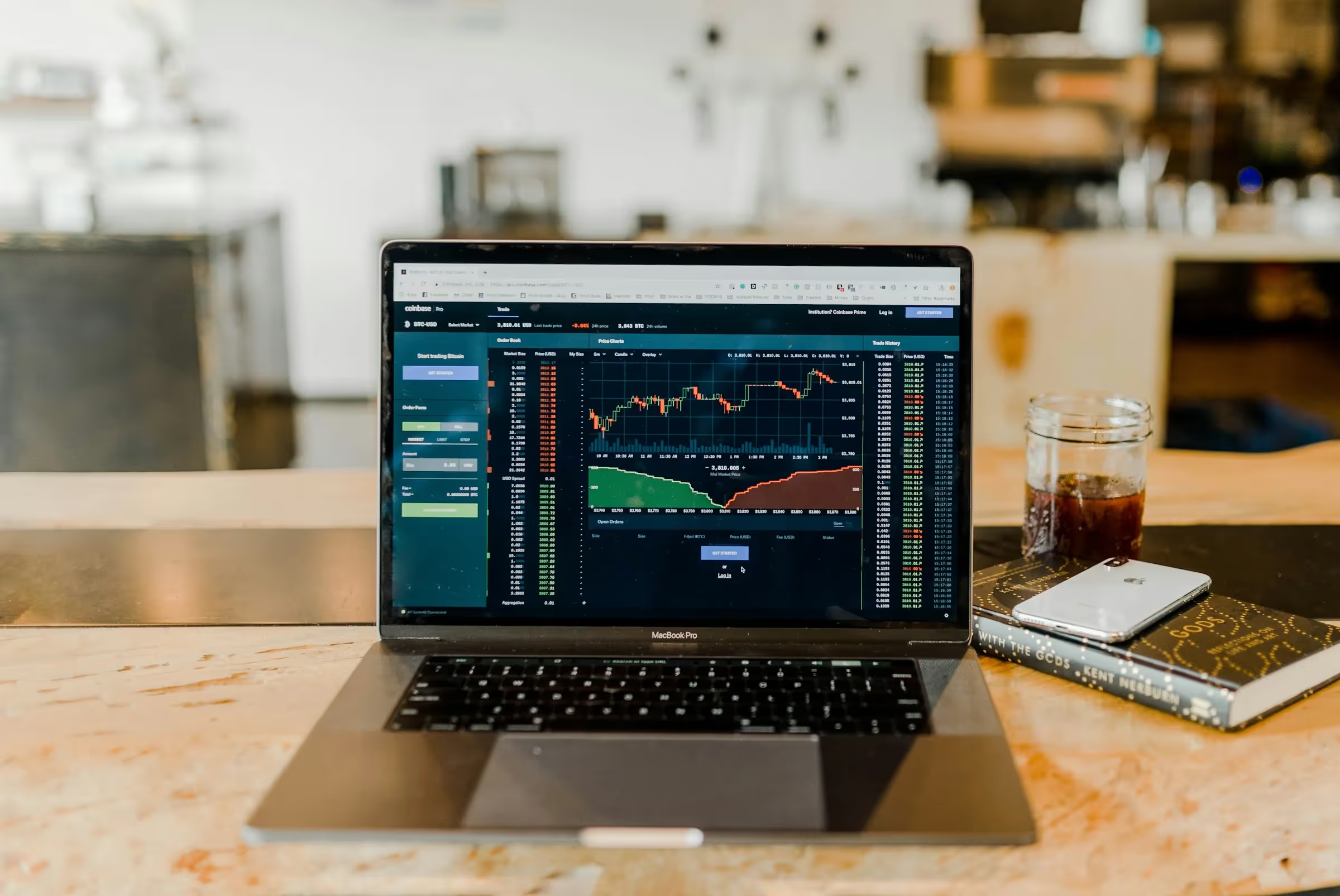
Traders often face high hurdles when required to meet futures trading minimum account sizes, with brokers demanding between $2,000 and $10,000 to open an account, while advising a larger cushion for proper risk management. What is a funded account? It offers an alternative that bypasses the need for large personal deposits by providing access to professional capital.
Evaluating trading skills rather than committing substantial personal funds allows traders to minimize exposure to typical margin risks and drawdowns. This method enables a more balanced approach where potential gains do not come at the cost of significant personal investment. AquaFunded’s funded trading program delivers a streamlined evaluation process and supportive tools that allow traders to access capital with confidence.
Summary
- Trading futures without the pattern day trader rule means you can execute as many intraday trades as your strategy demands, regardless of account size. Stock traders face the $25,000 minimum balance requirement that locks them out of active trading, but futures impose no such limitation. This single structural difference removes one of the most frustrating barriers for traders building capital through frequent execution.
- Micro futures contracts changed accessibility by offering one-tenth the exposure of standard contracts while maintaining identical price discovery and liquidity. A trader can participate in the same E-mini S&P 500 market with $500 of risk instead of $5,000, which transforms learning from a capital-intensive process into an affordable one. This flexibility extends to position management, where scaling into trades with multiple micro contracts provides granular control that all-or-nothing standard contract sizing can't match.
- Futures leverage allows traders to control substantial positions while posting less than 5% of the contract value as margin. According to TradingSim, this capital efficiency stands in stark contrast to other instruments where investors demanded 36% interest during volatile periods. The advantage cuts both ways, amplifying profits and losses equally, making rigorous risk management and position sizing non-negotiable rather than optional.
- Most traders underestimate their capital needs by confusing minimum margin requirements with realistic trading capital. Brokers advertise that you can open a Micro ES position with $80, which is technically accurate but ignores the buffer needed to absorb normal market volatility. A ten-point adverse move that would have reversed in your favor ends your trade prematurely when you've funded your account with exactly the minimum required margin.
- The Pinnacle Institute recommends risking 1 to 2% of account capital per trade, which means a ten-point stop loss on a standard ES contract (representing $500 of risk) demands a $25,000 account minimum. Anything smaller forces traders to either violate risk parameters or avoid trades entirely. The math doesn't care about confidence levels or profit ambitions, only whether your capital structure can withstand being right in a way that requires patience.
- Commission costs and slippage quietly erode small accounts in ways that don't show up in margin calculations. A $2 round-trip commission represents 0.4% of a $500 account, and executing ten trades consumes 4% in friction costs before considering trade profitability. According to the OCC Quarterly Report, which analyzed 50 trading accounts in Q1 2025, the $2,000 to $10,000 range is the most common starting point for serious retail traders, where execution costs become manageable relative to account size.
- AquaFunded's instant funding program addresses this capital constraint by letting traders prove their abilities through profit targets of 2 to 10%, then access simulated capital up to $4M without spending years grinding small accounts where skills generate minimal returns.
Benefits of Futures Trading

No Shorting Restrictions or Day Trading Rules
Futures markets allow traders to enter a short position on any contract at any time, free from the restrictions that hinder traders in other asset classes. When a trader believes a market is going down, they can act on that belief immediately: no borrowing shares, no waiting for uptick rules, and no artificial barriers between analysis and action.
This freedom extends beyond just direction. Unlike stock trading, where the pattern day trader rule forces you to keep a $25,000 minimum account balance to make more than a few day trades each week, futures have no such limitations. Traders can make trades as often as their strategy requires, without worrying that their account size will limit their chances.
This important difference eases one of the most frustrating obstacles faced by active traders still building their capital. To further enhance your trading journey, consider exploring our funded trading program.
How does futures trading respond to market conditions?
When market conditions change quickly, being responsive is very important. The ability to go short smoothly lets traders profit even when the market is going down. This flexibility allows traders to react to what the market shows, rather than waiting for situations that only benefit long-only positions.
Flexible Trade Sizing
Micro futures contracts have made it easier to trade futures. They are one-tenth the size of a standard E-mini contract, allowing traders to access the same markets while reducing the amount of money at risk.
A beginner can try out strategies, build discipline, and gain real market experience without risking thousands of dollars per contract.
These contracts are especially valuable because they keep the same price discovery and liquidity as full-sized contracts. Traders are not working in a secondary, less liquid market; they can access the same order flow, bid-ask spreads, and market depth.
The only difference is the position size, which allows for better control over trading exposure.
This flexibility also helps with position management. By using multiple micro contracts, traders can slowly add to winning positions or gradually lower their risk. Instead of being forced into all-or-nothing choices due to contract size, they can make smaller adjustments to their exposure that align with their confidence level and risk tolerance. This kind of control is especially important when learning to handle multi-contract positions or trying out new strategies.
Increased Leverage
Futures leverage lets you manage large market positions with as little as 5% of the contract value as margin.
According to TradingSim, this stood in stark contrast to other instruments, in which bond investors demanded 36% interest during volatile times.
This capital efficiency enables smaller accounts to participate in significant market moves.
The benefits of leverage come with downsides, too. It increases both profits and losses equally. For example, a 2% adverse move in a position with little leverage can lead to a 40% account drawdown when managing twenty times the margin.
This situation requires strict risk management. Position sizing is no longer optional; it becomes the key factor between successful trading and losing your account.
What strategies do successful traders use?
Traders who succeed with leverage treat it as a tool for efficiency, not a shortcut to big returns. They risk small percentages of their account on each trade. They also use stop losses consistently and maintain an adequate margin buffer to handle normal market ups and downs. The purpose of leverage is to let them participate with less capital tied up, not to promote reckless position sizing.
Virtual 24-Hour Trading
Global markets don't sleep, and futures trading proves it. Nearly 24 hours a day, six days a week, the futures markets stay open and ready for trading.
When economic data is released in Asia or Europe, when political events occur overnight, or when earnings reports are released after the stock market closes, futures traders can react immediately rather than wait until the next session.
The continuous trading hours are important for more than just access. High liquidity during these times, fueled by global participation, keeps bid-ask spreads tight and makes it easy to enter or exit positions.
Traders are not working in a thin after-hours market where a single large order can move prices significantly. The depth and volume remain steady as traders from around the world join in at different time zones.
This creates chances that don't exist in markets with limited hours. A trend that starts during Asian trading hours can be taken advantage of from the beginning, rather than waiting for a gap open. Also, if a position goes against you at 3 AM, it can be managed right away instead of waiting for hours. This real-time response changes how you manage risk and helps traders capitalize on global market movements.
Diverse and Uncorrelated Markets
Futures give direct access to markets that would be hard or even impossible for individual traders to enter. These markets include assets like gold, crude oil, natural gas, wheat, coffee, and copper.
Futures also cover major stock indexes from around the globe, government bonds, and foreign currencies. Importantly, these assets do not move together; they react to different economic trends, supply and demand situations, and geopolitical events.
This variety allows for true portfolio diversification. When stock markets fall, commodities may rise. On the other hand, when the dollar strengthens, some futures markets might weaken, while others might gain.
Unlike owning a group of tech stocks that usually move together or trading various currency pairs that tend to move together, futures markets give access to very different economic areas.
The uncorrelated nature of these markets also offers special trading chances. For example, a weather change might affect agricultural commodities, while an OPEC decision can affect energy markets.
Also, a change in central bank policy can influence bond futures. These factors operate independently of stock market reactions, providing traders with many opportunities to apply their analytical skills and find edges that are not crowded by others pursuing the same strategies.
Fair and Transparent Price Discovery
Every futures trader sees identical prices. Every order goes into the same queue, and every transaction shows up in real-time volume data that all participants can see.
There are no hidden places where institutional orders can stay secret, no insider information that gives some traders an edge, and no special access that gives bigger accounts better execution.
This transparency creates a level playing field that can't be taken for granted across all asset types. When traders place an order, they can be sure they are competing only on the basis of analysis, timing, and execution, not on the advantagesothers have from information.
The futures exchange serves as the clearinghouse, matching orders and ensuring that both sides of every transaction are guaranteed, no matter who is trading.
This fairness in structure is important both psychologically and practically. Traders may believe that losses stem from market movements or analytical errors, rather than from information asymmetry.
Winning shows that a trader has a good understanding of the market, while losses offer opportunities to learn without doubting the game is rigged. This trust in market fairness helps traders focus entirely on improving their trading, rather than questioning the system itself.
Tax Advantages
Section 1256 of the Internal Revenue Code treats futures trading gains differently from stock trading profits. Sixty percent of your gains receive long-term capital gains treatment, while forty percent face short-term rates. This split applies no matter how briefly you held the position. A day trade in futures gets partial long-term treatment, while the same holding period in stocks faces full short-term rates.
For active traders, this tax structure creates meaningful savings. Short-term capital gains rates can exceed 35% for higher earners, while long-term rates top out at about 20%. The blended treatment that futures receive lowers the overall tax burden compared to stock day trading, where every profitable trade is subjected to the higher short-term rate.
Tax laws change, and everyone's situation is different, so talking to a tax professional is very important. The current structure, however, offers a clear advantage for traders who make frequent transactions.
The same trading activity that leads to fully short-term gains in stocks results in a better tax outcome for futures, allowing you to keep more of what you earn.
What regulations govern futures markets?
The Commodity Futures Trading Commission oversees futures markets with strong regulatory standards. Futures exchanges like CME Group act as clearinghouses, ensuring every trade is safe, setting margin requirements, and enforcing contract specifications, whether through cash settlement or physical delivery. This is not a loosely regulated area that works in gray zones; it is a well-established industry with decades of regulatory oversight.
Futures commission merchants must keep customer funds in separate accounts, thereby separating trading capital from the company’s operational funds. This extra protection goes beyond what is typical in some other markets. Your capital is not commingled with the company's assets or affected by the firm's business risks; it is held in a separate account structure designed to protect your assets.
These regulatory frameworks and customer protections did not come about recently in response to issues. Instead, they are basic structures built into how futures markets operate, refined over generations of trading. When you trade futures, you participate in a system designed for transparency, guaranteed settlement, and asset protection, not just hoping those features are there.
What is often overlooked by traders?
Many traders overlook key realities until they try to use these advantages with their own money.
Types of Futures Trading Accounts
Your account size decides which forex trading account types you can use, how much risk you can handle, and whether a single mistake turns into a learning moment or a big loss.
The levels are not random; they show real psychological and practical limits at which trading behavior changes.
This range exists to help you learn without major harm. You will trade micro futures only (Micro ES, Micro NQ, Micro Gold), where each small movement affects your account in dollars, not hundreds.
A bad day might cost you $50 instead of $500, which helps you pay for the tuition that market experience requires. If you're interested in expanding your options, consider our funded trading program to assist with your learning journey.
The smaller position sizes enforce discipline before you naturally develop it. You can't overtrade to the point of serious issues, because the contract sizes won't allow it.
Every choice matters, but no single choice can ruin you. This safety zone helps you focus on executing your trades, keeping a journal of them, and building the habits that set regular traders apart from gamblers.
The limitation is clear when it comes to growth potential. One losing trade can wipe out several gains when your account is this small. You're not creating wealth here; you're building competence, testing whether you can follow your rules when real money (even small amounts) is involved.
Most traders need this phase longer than they want to admit.
What does a common starting range look like?
According to the OCC Quarterly Report on Bank Trading and Derivatives Activities, analyzing 50 trading accounts in Q1 2025, this is the most common starting range for serious retail traders who have moved past just learning. They mainly trade micro contracts, but they can sometimes increase their positions when they feel confident.
The real advantage is having breathing room. A drawdown does not immediately put their ability to keep trading at risk. Traders can handle normal losing streaks without feeling pressure on their accounts. This psychological buffer is more important than many realize until they feel the difference between trading with real fear and trading with manageable concern.
This tier also allows for experimentation in different markets without going too far. Traders might try crude oil for one week and then gold the next, while still holding index futures positions. This variety helps them discover which markets suit their trading personality and schedule, and which setups they can identify in real time, rather than those that only make sense later.
How does confusion between survival and success occur?
The trap at this level is confusing survival with success. Not losing can feel like progress; however, you're not creating meaningful returns for the time you put in.
This sense of survival is okay if you're still working on being consistent. It becomes a problem when you've reached a standstill and mistake being safe for having a strategy.
Consistently profitable traders are in this phase, not hopeful beginners.
You can mix micro and standard contracts based on the setup and market volatility.
For example, a high-stakes trade might require a standard contract, while a less important position could remain in micros.
This ability to adapt changes how you show different levels of certainty.
What are the implications of larger accounts?
A larger account can handle greater temporary drawdowns without causing margin calls or forcing you to sell your positions at the worst time. When a trade goes against you, but your analysis is still valid, having some extra capital lets you keep your position during normal ups and downs. This ability to hold on often makes a difference between profitable trades and early exits that might have worked with just a little more wiggle room.
However, there's a risk associated with overconfidence. After showing you can trade well, a larger account might lead you to increase your position sizes faster than your risk management skills can keep up. Winning a lot can make you feel unbeatable, just before the market reminds you that humility is essential. It's even more important to follow strict risk rules at this level, as ignoring them can lead to outcomes that really match what you've been learning about risk management for months.
What changes at the professional trading level?
Full-time and semi-professional traders work in this environment, regularly trading standard contracts across different markets. The focus changes from just proving trading skills to optimizing trading efficiency. Execution costs that did not matter before in a micro account now significantly affect returns. A few ticks of slippage on each entry, multiplied across many trades each month, become important issues that need attention.
Traders use portfolio-style strategies, managing how positions relate to each other and hedging exposure across various timeframes and instruments. This complexity requires systems to track performance, analyze which setups provide an advantage, and identify where execution does not match the planned strategy. Trading grows beyond simple transactions; it turns into managing a comprehensive trading operation.
How do traders manage capital preservation?
Capital preservation replaces capital growth as the main goal. After building the account, the focus shifts to protecting it while generating steady returns that compound over time. The goal is not to chase big wins that could erase months of gains in just one bad week. For many traders at this level, this mindset shift is often harder than the actual trading.
Proprietary traders and institutions work with substantial capital, trading large positions across multiple contracts simultaneously. The psychological pressure increases, not from the fear of losing money, but from the duty of managing this capital effectively. A 2% return on $250,000 is more significant in real terms than a 20% return on $25,000, which changes how opportunities are assessed against risks.
What are the requirements for compliance in trading?
Risk limits and compliance rules are a non-negotiable structure, not just suggestions. Traders must track their exposure across related positions, keep detailed records for regulatory purposes, and work within guidelines that stop any single trade or day from causing a catastrophic loss. The opportunity to trade larger positions comes with the need for systematic risk controls that take priority over any emotional decisions.
Most traders who reach traditional institutional account sizes spend years building their capital, learning expensive lessons with their own money, and developing the mental strength needed to handle volatility at scale. This approach is effective but usually slow, needing either a lot of starting capital or great patience as small accounts grow.
Alternatively, joining a funded trading program can provide a faster route to access significant trading capital.
How do modern platforms innovate trading access?
Platforms like AquaFunded completely change the traditional way of gaining capital. Instead of taking years to build a $50,000 account through small wins and careful risk management, traders can access simulated capital of up to $4M by showing their skill through profit targets of 2-10%.
This method recognizes that a trader's ability and the money available to them shouldn't always be linked. If a trader can consistently use a profitable strategy, the capital limit becomes artificial. Ability is shown through performance, not by how much personal wealth someone has or how long they've spent on small contracts.
This change is important because spending time trading with too little capital means skills aren't generating equal returns. A trader who can manage $100,000 but is stuck with a $5,000 account isn't learning faster. They are just making less money while making the same quality decisions. Instant funding models fix this problem, letting skill determine access instead of account balance.
What is essential to start futures trading?
Understanding which account tier fits your current ability is important. However, it's essential to know what you really need to start trading futures.
Related Reading
- How to Grow a Small Trading Account
- What is Trading Commodities
- Long Term Trading Strategy
- Capital Growth Strategy
- What is a Cash Account in Trading
- What is Compound Trading
- How Much Money Do You Need to Start Trading Stocks
- Scale Trading
- Small Account Trading
- How to Evaluate Investment Opportunities
- Blown Trading Account
- What is PNL in Trading
- Do Prop Firms Use Real Money
- Prop Firm Account Management
- Borrowing on Margin
- Trading Leverage
Futures Trading Minimum Account Size
The minimum amount required varies by contract type and broker. However, Optimus Futures reports that you can technically open positions with as little as $50 per Micro contract. That said, it's not a good idea to do this.
The listed margin is the minimum you need to start a trade, not the amount you actually need to manage it safely. Most experienced traders suggest keeping at least two to three times the required margin to handle normal market swings without risking a liquidation.
Brokers promote low margin requirements because technically, they are correct. You can start a Micro ES position with $80 in your account.
While this can work and the trade may go through smoothly, market changes can quickly alter the situation. If the market moves three points against you, you might soon get a margin call or face automatic liquidation because you don’t have a buffer.
The minimum margin only pays for opening the position; it doesn’t account for the space a trade needs to breathe. Markets change in unexpected ways. A setup that seems perfect when you start might go against you by ten points before it turns in your favor. If you only funded your account with the minimum margin required, that slight unfavorable movement could close your trade early, often just before it would have become profitable.
This creates a harsh irony. Traders who start with the least amount of money often get stopped out of trades that would have made a profit if they had a bit more room. They’re not wrong about the market direction, and they’re not making poor decisions. They just don’t have enough capital for the market swings they’re dealing with, which can turn their correct predictions into actual losses.
What about micro futures and margin requirements?
Micro futures have made trading easier, but it’s important to understand what each contract requires. The Micro E-mini S&P 500 (MES) moves $5 per point. A ten-point stop loss means a $50 risk.
If a trader risks 2% per trade, they should have an account minimum of at least $2,500. This isn't because of broker rules; instead, anything smaller makes it hard to size positions correctly.
Standard E-mini contracts significantly increase that requirement. The E-mini S&P 500 (ES) moves $50 per point. So, that same ten-point stop now means $500 of risk. Keeping 2% risk per trade raises the realistic minimum to $25,000.
Traders who switch to standard contracts too soon without enough money often overleverage their accounts. This isn't due to carelessness, but because the contract size doesn't fit their account situation.
How do commodity futures complicate margins?
Commodity futures add another layer of complexity to trading. Crude oil, gold, and agricultural contracts each have different margin requirements and point values. According to Optimus Futures, standard contracts usually require a margin of $1,000 to $1,500 per contract. But this is just the entry cost.
The daily volatility in crude oil can easily exceed $500 per contract, making trading with a $2,000 account inefficient.
This situation can lead to capital destruction, creating significant risks for traders.
Why do traders miscalculate their capital needs?
The psychological pull of leverage shapes how traders determine their initial requirements. They see the margin requirement and think that’s the only number that matters. They often hear about traders making big profits with small accounts, which leads them to believe that account size is the main factor, rather than the risk management that enabled those profits.
This way of thinking ignores how volatility really works. A market that usually moves five points in your favor might sometimes spike fifteen points against you first.
If your account cannot withstand that temporary loss, your position will be liquidated during normal market swings. You're not losing because your analysis was wrong; you're losing because your capital structure couldn't withstand the need for patience, even when your analysis was correct.
What is the true purpose of account size?
Traders who get through this learning curve eventually realize that account size isn't just about how much money is needed to start trading. It's also about how much is necessary to stay in trades long enough for one's edge to materialize. This change in thinking changes how one approaches funding decisions.
Even though margin requirements are often the main topic when discussing minimum account sizes, commission costs, and slippage quietly hurt small accounts in ways that aren't reflected in the initial calculations. A $2 round-trip commission might seem small, but it is 0.4% of a $500 account.
If 10 trades happen, that adds up to 4% in friction costs before even considering how profitable those trades are.
How do commissions and slippage affect trading?
Slippage makes the problem worse. The gap between the intended entry price and the actual fill might only be a tick or two, but on Micro contracts, where each point equals $5, two ticks of slippage can cost $2.50. When you add commission, you're really paying $4.50 per round trip.
A trader making twenty trades each month would spend $90 on execution costs alone, which is 18% of a $500 account. This isn't just a trading issue; it's a serious problem.
Larger accounts handle these costs more effectively. The same $4.50 per trade is only 0.045% of a $10,000 account. Even though the trades themselves remain the same, the effect of execution costs varies significantly with account size.
This shows why discussions of minimum account size that focus only on margin often overlook the bigger picture. It’s important to have enough money to ensure that regular trading costs don't create a significant performance problem.
What can small accounts teach traders?
A $1,000 account trading micro contracts serves one purpose very well: learning if you can follow your rules when real money is involved. The amount is small enough that losses won't ruin your financial life, yet large enough that wins and losses bring real emotional reactions.
That emotional authenticity is more important than most traders realize until they see the difference between paper trading and live execution.
The small account creates limits that help new traders. You can’t revenge trade your way into serious problems, and you can't greatly overleverage a single setup. The position sizes are small enough that mistakes cost dollars instead of hundreds.
These guardrails allow you to build discipline before the stakes get high enough where undisciplined behavior can cause long-term harm.
How to approach small accounts as a learning tool?
This approach only works if traders view the small account as a training ground rather than a way to quickly build wealth. Those who think they can turn $1,000 into $10,000 fast often trade too much, use too much leverage, and eventually blow up their accounts.
On the other hand, traders who treat a small account as a way to learn important skills, such as proper execution habits, emotional control, and systematic decision-making, usually advance to larger accounts with the right skills to manage them well.
Platforms like AquaFunded remove the need to spend years working with small accounts while waiting for money to grow. Instead of managing a $2,000 account, where execution costs can eat up a big chunk of potential returns, traders can demonstrate their skills with profit targets of 2-10% and access simulated capital of up to $4M. This setup keeps skill validation separate from growing capital. If traders can consistently follow a winning strategy, the old method of slowly increasing account sizes becomes an unnecessary limit that impedes progress without improving trading.
How to choose the right account size?
Having access to capital, whether through traditional account growth or instant funding, is only valuable if one chooses the right account size.
This selection should align with actual skill level and trading approach, ensuring a better fit for individual trading strategies.
How to Choose the Right Account Size for Futures Trading
Your contract choice needs to match your capital reality, not your profit ambitions. Trading Micro E-mini S&P contracts on a $3,000 account gives you room to handle normal ups and downs. Jumping to standard contracts because you want faster returns just makes it easier to run out of that same account. The right size isn't about what you want to earn. It's about what you can afford to lose while your strategy plays out over many trades.
Micro contracts exist because standard futures need more money than most new traders have. A single point move in the E-mini S&P equals $50, while that same move in the Micro version costs $5. The price discovery is the same, and the liquidity is similar to that of the larger contract. The only difference is that you're controlling one-tenth of the exposure, making a $2,000 account less risky and a good fit.
If you're exploring options for a funded trading program, consider how our offerings can support your trading journey. When you're trading with less than $10,000, Micro contracts are not just a backup option. They're the only smart choice. The numbers don’t care about how confident you feel. A ten-point stop loss on a standard ES contract means $500 of risk. If you believe that 1 to 2% of account capital per trade is responsible position sizing, then one trade needs a minimum of a $25,000 account. Anything less forces you to either break your risk rules or skip the trade completely.
When can you start using standard contracts?
Standard contracts become viable once your account reaches $15,000 to $20,000. This rule applies if your strategy can handle the larger tick values and wider stop distances. Scalpers, who look for three to five points of movement, might still prefer Micros even with larger stakes.
This is because Micros offers greater position-sizing flexibility, enabling precise scaling in and out. On the other hand, swing traders who hold positions overnight benefit from the breathing room that larger accounts provide. However, they also need to manage overnight margin requirements, which can significantly increase the required capital.
How do funded account programs adjust to account size?
Funded account programs set their rules based on drawdown limits that change with account size. A $10,000 evaluation might allow daily drawdowns of $800 and a total drawdown of $1,500. In comparison, a $50,000 account raises those limits to $2,500 daily and $5,000 total. While the percentages stay the same, the actual dollar amounts create different trading realities.
Smaller accounts with strict drawdown requirements require careful position sizing. A trader cannot absorb a large loss, so stop distances must remain small and profit goals modest. This limitation supports strategies with high win rates and small average losses.
Larger accounts, however, offer space to let trades progress, accommodating short-term market swings without causing violations. This extra breathing room helps strategies that may not win as often but can capitalize on bigger moves when they do.
How does account size impact your psychology?
The psychological difference matters as much as the mathematical one. Trading a $5,000 account, where a $400 drawdown ends the evaluation, creates constant tension. Every losing trade feels like it pushes one closer to the edge.
In contrast, a $50,000 account with a daily risk tolerance of $2,500 allows for a greater focus on execution instead of mere survival. While the strategy remains unchanged, the mental space to execute it properly expands dramatically.
What are the costs associated with high trading frequency?
Scalpers making 10 to 20 trades a day have to deal with high commission costs and slippage that can add up quickly. If the cost of going in and out of a trade is $2 each time, and they do this 15 times, that adds up to $30 in daily fees.
For an account with $3,000, that means 1% of your money is used up before you even check whether the trades were successful. On the other hand, doing the same trading activity with a $15,000 account only uses up 0.2%, changing what could be a serious problem into a smaller expense.
How do overnight margin requirements affect trading?
Day traders who close all positions before the session ends avoid overnight margin requirements. This keeps their capital needs lower than those of swing traders.
However, they still face intraday volatility that requires more than just minimum margins. Markets that usually move five points might suddenly spike ten points against a trader during a volatile session. If an account can't handle that temporary movement, the trader risks getting stopped out by normal market noise rather than actual changes in direction.
Swing traders who hold positions across multiple sessions must meet overnight margin requirements that often double or triple their intraday rates. For example, that same Micro ES contract that requires $80 in intraday margin could demand $200 overnight. If a trader holds three contracts through the close, they need $600 in margin just to keep those positions.
They also need an extra buffer for any unfavorable movements. The capital requirements do not just increase with position size; they multiply based on the length of exposure.
What are effective strategies for smaller accounts?
Most traders deal with this pressure by working on small accounts for months, hoping that slow growth will eventually provide enough money to trade comfortably.
While this method works, it makes it take longer for skills to produce proportional returns. A trader who can handle $50,000 but is stuck making the same good choices on a $5,000 account isn't learning faster; they are just earning less while waiting for their money to catch up to their skills.
Platforms like AquaFunded remove that waiting time by letting traders show their skills through reachable profit goals of 2 to 10% and then access simulated funds up to $4M.
This system understands that trading skill and account size should not always be linked when a trader can prove they can execute consistently.
How should you evaluate the cost of account challenges?
Smaller account evaluations have lower upfront costs, making them appealing for testing new strategies or checking how well someone can trade following set rules. For example, a $10,000 evaluation might cost around $150, while a $100,000 one could cost $500 or more.
This difference is important when trying to be consistent, since you might need multiple tries before passing.
However, cheaper evaluations also have smaller profit goals and stricter limits. For instance, that $10,000 account may need $800 in profit to pass, which seems doable until you see it means an 8% return while keeping to strict drawdown limits.
On the other hand, the $100,000 account requires $8,000 in profit, but this is the same 8% threshold with five times the flexibility in position sizing. While the percentage challenge stays the same, the absolute dollar wiggle room increases significantly.
What role do fixed expenses play in trading?
Fixed expenses, such as data costs and platform fees, don't increase in proportion to account size. For instance, a $50 monthly data feed accounts for 0.5% of a $10,000 account but only 0.1% of a $50,000 account.
Because of this, the same fixed costs that can hurt smaller accounts become almost insignificant as account sizes grow. This is why traders who manage to grow beyond the first stages often wish they had started with larger evaluations, once they realized the structural advantages.
How does account size affect decision-making?
Account size affects decision quality in ways not shown in risk calculations. For example, with a $3,000 account, where each trade is important, traders may become so hypervigilant that they make quick exits, missing out on opportunities. They might focus so much on protecting the small capital that they don’t let winning trades grow naturally. The fear of losing gains often overshadows the logic of letting their advantage play out.
On the other hand, larger accounts come with different psychological traps. The comfort of a buffer can result in careless risk management. A trader might think that losing $500 on a $50,000 account is no big deal, which can lead to wider stop losses, larger positions, and the ignoring of important rules. These habits can lead to serious losses. In the end, the comfort that should help improve performance ends up causing carelessness.
What is the ideal account size for traders?
The right account size sits in the range where losses feel real enough to demand respect, but remains small enough to absorb without emotional hijacking. This threshold varies by individual financial situations and trading experience.
For instance, a $5,000 account might feel huge to someone trading their first real capital, while the same amount could seem very small to a trader who has managed six-figure portfolios. Ultimately, the dollar amount matters less than the psychological relationship one has with it.
What do traders learn about account size and execution?
Most traders find out important information only after they choose an account size and start making real trades.
Related Reading
- Sources of Capital
- Cash Reserve Account
- Short Term Stock Trading
- Investment Performance Analysis
- Managed Account vs Brokerage Account
- Systematic Trading
- How to Analyze a Stock Before Buying
- Forex Capital Trading
- What is a Retracement in Trading
- What Is Automated Trading
- How is Risk Involved in Calculating Profit?
- Convergence Trading
- Liquidity Trading
- What is Drawdown in Trading
Trade Futures Without the “Too-Small Account” Problem
The skill a trader develops does not go away just because their account balance is lower than they want. They have learned how to read market setups, manage risk, and act with discipline. What they lack is not skill, but money that matches what they can do. Because of this gap, traders end up taking positions that are too small to yield results or using risk limits so tight that normal market movements hurt them.
Traditional paths often involve a long, tough phase. Traders usually start with a $2,000 account, then move up to $5,000, aiming to reach $10,000. Each goal can take months of perfect execution, during which execution costs can eat up a large share of earnings.
The math might work out eventually, but this timeline assumes traders can wait for their skills to slowly earn small returns while compounding grows. Most traders find this hard, not because they are impatient, but because trading with too little money for years results in lost income and slower learning.
Funded trading programs solve the problem of needing money by separating skill from account balance. AquaFunded lets traders demonstrate their skills by reaching profit targets of 2% to 10%, then gaining access to simulated funds up to $400,000.
Traders do not waste years building their accounts; instead, they prove they can consistently follow strategies and trade with sizes that match their skills. This evaluation process confirms their knowledge of risk management, while the funded account helps them apply it on a scale that delivers appropriate returns.
This setup removes barriers unrelated to trading skills. There are no stop-loss rules that force traders to take tighter exits than their strategy requires. There are no random limits on lot sizes that stop proper position scaling. There are no hidden rules that punish traders for trading during news events or holding onto trades overnight when their analysis supports it.
The main focus is on what truly matters: can they keep making profits while managing losses within set limits? Everything else becomes their choice based on their trading style.
Fast payouts are more important than many traders realize until they see another option. A 48-hour withdrawal process allows profits to quickly become usable capital, rather than being stuck in lengthy review processes that create uncertainty about when earnings can be spent.
This speed strengthens the link between good trading and real results; trade well, get paid, and keep improving. The cycle stays tight enough that performance and reward are connected in helpful ways, encouraging ongoing progress rather than frustration over unreachable gains.
The model works because it aligns incentives correctly: traders do well when they trade well, and the platform benefits along with them. There is no issue with a trader's growth harming the business model or with artificial limits complicating evaluations. Profit targets are set at levels that truly demonstrate skill, without requiring perfection.
A trader who can often earn returns of 5% to 8% while adhering to drawdown limits demonstrates understanding of position sizing, risk management, and execution discipline. This is the key point.
More than 42,000 traders have been able to access capital that reflects their skills rather than being limited by their bank accounts. The $2.9 million in total payouts represents real money earned by people who showed they could trade well with the right position sizes. Some came from years of struggling with not enough capital, while others tested new strategies without using their own money. However, the common thread was not their starting balance; it was their ability to trade consistently within a structured system, which is necessary for any long-lasting trading strategy.
A trader's strategy either works or it doesn’t. Having enough capital cannot fix a bad strategy; however, it can keep a good one from producing limited results. When traders can set their position sizes correctly for their accounts, use stop losses that align with their analysis rather than just margin limits, and scale into strong trades without quickly hitting position limits, the technical trading process stays the same. The returns start to reflect the quality of the decisions made, rather than the size of the initial balance.
This is not about getting rich fast; it’s about ensuring skills can deliver fitting results without waiting years for capital to grow from small contracts to larger ones. Explore our funded trading program to learn more.
Related Reading
- How To Take Profits From Stocks
- Accumulation Distribution
- Short-Term Capital Gain Tax On Shares
- What Is Reit Dividends
- Cash Available To Trade Vs Settled Cash
- Best Pairs To Trade Forex
- Can You Day Trade In A Roth Ira
- What Is A Conditional Order
- Orb Strategy Trading
- Stop Loss Vs Stop Limit
- Flag Pattern Trading
- Characteristics of Growth Stocks
- Forex Compounding Plan
