




What is Automated Trading + How To Do It
Discover what is automated trading, how it works, and simple steps to start using it for smarter, faster investment decisions.
.avif)
Consider watching your trading strategy execute perfectly while you sleep, or sitting in a meeting while algorithms scan markets and place trades on your behalf. Automated trading removes the emotional burden of manual decision-making and runs your strategies around the clock using software, bots, and algorithms. If you're wondering what a funded account is and how automation fits into that picture, understanding these trading systems becomes essential because many traders use automated strategies to manage funded capital more effectively.
That's where a funded trading program like AquaFunded comes in. Instead of risking your own money while testing automated strategies, you can access trading capital through our evaluation process and let your algorithms trade with funded account resources. This approach gives you the financial backing to run your automated systems at scale, while we handle the risk and keep your profits.
Summary
- Automated trading now generates 60-73% of all orders on U.S. equity exchanges, according to Investopedia, fundamentally restructuring markets around speed and precision that only machines can deliver consistently. This isn't experimental technology anymore. It's the dominant force shaping how modern markets function, and retail traders who ignore automation compete at an inherent disadvantage against systems that process data and execute orders in milliseconds.
- Emotional decision-making causes 75% of retail trader losses, according to QuantMan research, with fear driving early exits from winning positions and greed keeping traders in losing positions too long. Algorithms eliminate this vulnerability entirely by executing predefined rules without experiencing panic during drawdowns or overconfidence during winning streaks. The discipline compounds over time as automated systems maintain consistent execution quality whether markets move 0.3% or 3% overnight.
- The May 6, 2010, flash crash exposed fundamental risks when the Dow Jones plunged nearly 1,000 points in minutes before recovering within the same session. Automated systems triggered the cascade as algorithms detected falling prices and issued sell orders to limit losses, which pushed prices lower and triggered more algorithms in a feedback loop. When thousands of systems use similar logic and react to the same market conditions, they create artificial volatility unrelated to actual economic fundamentals.
- Backtesting reveals strategy vulnerabilities before they cost real money by running algorithms against years of historical data in minutes. Testing across at least five years captures how strategies perform during bull markets, bear markets, flash crashes, and consolidation periods. The goal isn't finding settings that produced the highest historical returns but understanding where approaches struggle and whether those vulnerabilities are acceptable given your risk tolerance.
- Virtual private servers eliminate failure points that plague home computer setups, like power outages, internet disruptions, and operating system updates that trigger unexpected restarts. VPS providers offer redundant power, enterprise-grade connectivity, and geographic proximity to broker servers, thereby minimizing latency. Uptime guarantees above 99.9% mean your algorithm runs continuously while you sleep, travel, or face inevitable outages in home networks.
- AquaFunded's funded trading program addresses the capital barrier by providing evaluation accounts specifically designed for automated strategies, letting traders demonstrate consistent execution within clear risk parameters before accessing up to $400K in scaled capital, where algorithms can generate meaningful returns without personal financial exposure.
What is Automated Trading

Automated trading uses computer programs to execute buy and sell orders based on predefined rules and strategies. Instead of manually clicking buttons or watching charts all day, you set the parameters, and the software handles the trades when conditions match your criteria. The system runs on algorithms that process market data, identify opportunities, and act faster than human reflexes allow. The shift toward automation isn't just a convenience upgrade. According to Investopedia, 60-73% of all orders on U.S. equity exchanges are now generated by algorithmic trading. That's not a fringe experiment. That's the market itself, restructured around speed and precision that only machines can deliver consistently.
How Automated Trading Systems Function
These systems rely on algorithmic strategies built around entry and exit rules you define. You might program a bot to buy when a moving average crosses above a certain threshold, or sell when volatility spikes beyond a set percentage. The algorithm continuously monitors the market, waiting for the exact conditions to trigger action. Most trading platforms offer wizards or pre-built templates loaded with technical indicators such as RSI, MACD, and Bollinger Bands. You select the ones that match your strategy, adjust the parameters, and let the system monitor the markets. It's accessible enough for someone without coding skills to build a working strategy in an afternoon.
More advanced traders often work with programmers to create custom algorithms. These systems can incorporate complex mathematical models, statistical arbitrage techniques, or machine learning predictions. Building something this sophisticated takes time and costs more upfront, but the flexibility often justifies the investment. You can backtest these algorithms against historical data to see how they would have performed during past market conditions, which gives you a clearer sense of potential risk and reward before risking live capital.
What Automated Systems Monitor
The beauty of algorithmic trading lies in its ability to process multiple data streams simultaneously. A well-designed system can track price movements, volume changes, news sentiment, and cross-market correlations simultaneously. It reacts to patterns humans might miss or recognize too slowly to exploit. Technical analysis forms the foundation for most retail automated strategies. The algorithm scans candlestick patterns, support and resistance levels, trend lines, and momentum indicators. When the right combination appears, it executes the trade within milliseconds. Some systems go further, integrating fundamental data such as earnings reports, economic indicators, and geopolitical events. These strategies require more sophisticated programming, but they can identify opportunities that purely technical approaches overlook.
The Hands-Off Advantage (and Its Limits)
Automation removes emotion from trading decisions. Fear and greed drive most losing trades. You hold a losing position too long, hoping it recovers, or you exit a winner too early, worried it might reverse. Algorithms don't feel hope or panic. They follow the rules you set, every single time. That consistency matters more than most traders realize. I've watched skilled traders make brilliant calls during calm markets, then abandon their entire strategy during a volatile week because stress clouded their judgment. The algorithm doesn't care if the market dropped 3% overnight. It sticks to the plan. But hands-off doesn't mean hands-free. You still need to monitor system performance regularly. Markets evolve, volatility shifts, and strategies that worked beautifully last quarter might underperform now. The algorithm won't tell you it's struggling. You have to watch the metrics and adjust when conditions change.
Risk Management Within Algorithms
Smart automated systems include built-in risk controls. You can program maximum loss limits per trade, daily drawdown thresholds, or position size rules based on account equity. If the system hits a stop-loss trigger, it exits automatically without waiting for you to make an emotional decision. This protection becomes critical during unexpected market moves. The algorithm can close positions across multiple assets simultaneously, something that is nearly impossible to coordinate manually when volatility spikes and prices move quickly. Most platforms also let you set maximum exposure limits, so the system never risks more than a certain percentage of your capital on correlated positions. That diversification happens automatically, reducing the chance that one bad trade wipes out weeks of gains.
The challenge of testing automated strategies with real capital creates a barrier that many traders struggle to overcome. You need enough funding to run the system at a meaningful scale, but risking your own money while refining an algorithm can drain your account before you prove the strategy works. A funded trading program lets you access trading capital through an evaluation process, giving you the resources to test and scale automated systems without the personal financial risk. You keep the profits, and the program absorbs the downside while your algorithms prove themselves.
The Flash Crash Problem
Automated systems can amplify market instability when too many algorithms react to the same signals simultaneously. On May 6, 2010, the Dow Jones plunged nearly 1,000 points in minutes before recovering most of the loss within the same trading session. Automated trading systems triggered the cascade. As prices dropped, algorithms detected the movement and automatically issued sell orders to limit losses. Those sales pushed prices lower, triggering more algorithms, creating a feedback loop that spiraled out of control.
The event exposed a fundamental risk in algorithmic trading. When thousands of systems use similar logic and react to the same market conditions, they can create artificial volatility that has nothing to do with actual economic fundamentals. A stock might crash not because the company announced bad news, but because enough algorithms decided to sell at the same moment.
Regulators have since implemented circuit breakers and other safeguards to slow down runaway crashes, but the core vulnerability remains. Your algorithm might execute a perfectly logical trade based on its rules, but if it's reacting to price movements caused by other algorithms rather than genuine market information, you're essentially trading against machine-generated noise. But knowing how these systems work only scratches the surface of whether you should actually use one.
Why Use Automated Trading

1. Speed That Actually Matters
The millisecond advantage isn't about showing off technical prowess. It's about accessing price levels that disappear before your mouse cursor reaches the order button. Automated systems can execute trades in milliseconds, enabling them to capture entry and exit points that manual traders can't see or reach. The gap between recognizing an opportunity and acting on it collapses entirely.
Speed matters most during volatile periods when price swings happen in seconds. Your algorithm processes the data, confirms the conditions match your strategy, and places the order before the next candlestick forms. That's not just faster trading. That's accessing a completely different tier of market opportunities.
The real value shows up in your fill quality. Slippage eats profits when you're manually clicking through orders during fast markets. The price you wanted becomes the price you missed. Automated systems dramatically reduce that gap, executing at or near your target price more consistently than human reaction time allows.
2. Emotion Becomes Irrelevant
According to QuantMan, 75% of retail traders lose money due to emotional decision-making. Fear makes you exit winners too early. Greed keeps you in losers too long. Panic during drawdowns triggers impulsive changes to proven strategies. The algorithm doesn't experience any of that. When your account drops 5% in a day, you feel it. The algorithm doesn't. It checks whether the conditions still match the strategy parameters and, if so, continues executing. No second-guessing. No anxiety-driven deviations from the plan you spent weeks developing.
The discipline compounds over time. Manual traders often perform well during calm markets, then abandon their entire approach when volatility spikes. The emotional weight of watching losses accumulate in real-time overrides logic. Automated systems maintain the same execution quality whether the market moved 0.3% or 3% overnight.
3. Backtesting Reveals What Works Before You Risk Anything
You can run your strategy against years of historical data in minutes. The system shows you exactly how it would have performed during bull markets, bear markets, flash crashes, and sideways chop. You see the maximum drawdown, win rate, profit factor, and average trade duration before committing a single dollar of live capital.
This testing phase exposes fatal flaws early. Maybe your strategy crushed it during trending markets but hemorrhaged money during consolidation. Or perhaps it worked beautifully in 2020 but failed spectacularly in 2022 when volatility patterns shifted. Backtesting surfaces these vulnerabilities while they're still hypothetical problems, not real losses.
The optimization process lets you systematically adjust parameters. You test different stop-loss levels, position sizes, and entry triggers to find the combination that maximizes risk-adjusted returns. The data tells you which variables matter and which ones barely move the needle.
4. Risk Controls That Never Sleep
Automated systems enforce your risk rules with perfect consistency. You set a maximum loss per trade at 2% of account equity, and the algorithm never violates that threshold. Not when you're confident about a setup. Not when the last three trades lost money, and you want to "make it back." Not ever.
Position sizing adjusts automatically based on volatility and account balance. If your equity drops, the system reduces trade size proportionally. If volatility spikes beyond your comfort zone, it scales back exposure or pauses trading entirely until conditions stabilize. These adjustments happen instantly, without requiring you to monitor markets constantly or make judgment calls under pressure.
Stop-loss orders execute without hesitation. The algorithm doesn't hold a losing position hoping it reverses, doesn't give it "just five more minutes," doesn't convince itself the analysis was right even though the price action disagrees. It exists at the predetermined level and moves to the next opportunity.
5. Diversification Across Everything Simultaneously
Your system can monitor dozens of instruments, timeframes, and strategies at once. While one algorithm trades breakouts in EUR/USD, another captures mean-reversion setups in gold, and a third exploits correlation inefficiencies across stock indices. No human can track that many moving pieces with equal attention and execution quality.
This diversification smooths your equity curve. When trend-following strategies struggle in choppy markets, mean-reversion strategies often thrive. When one asset class consolidates, another might be trending cleanly. The algorithm captures opportunities across multiple conditions simultaneously, reducing the impact of any single strategy or market going through a rough patch.Cross-market analysis happens in real-time. If crude oil spikes, your system instantly evaluates how that affects energy stocks, currency pairs tied to oil-producing nations, and inflation-sensitive bonds. It identifies second-order effects and acts on them before manual traders finish reading the headline.
6. Constant Market Surveillance Without Burnout
Markets move around the clock. Forex trades 24 hours during weekdays. Crypto never sleeps. Futures have overnight sessions that often set the tone for the next day. No human can watch all those hours effectively while maintaining the mental clarity needed for good decision-making.
Automated systems operate continuously without fatigue. They catch setups that develop at 3 AM your time, execute trades during Asian market hours that affect European opens, and respond to economic data releases regardless of when they occur. The opportunities that happen while you're sleeping or working your day job don't get missed.
This persistence matters more than most traders expect. Some of the cleanest price action occurs during low-liquidity hours, when fewer participants distort natural supply-and-demand dynamics. Your algorithm captures these moves while you're doing literally anything else.
7. Adaptation Through Continuous Learning
Advanced systems incorporate machine learning models that identify pattern shifts in real-time. They detect when market behavior deviates from historical norms and adjust strategy parameters accordingly. The algorithm that traded beautifully during low-volatility environments automatically recalibrates when volatility regimes change.
This adaptability prevents the slow decay that kills static strategies. Markets evolve. Correlations break down. Volatility patterns shift. Participant behavior changes as new technologies and regulations reshape market structure. Systems that can't adapt eventually stop working, but you might not notice until you've already given back months of profits.
The learning process never stops. Each trade generates new data. Each market condition provides fresh information about what works now versus what worked last year. The algorithm continuously incorporates these insights, refining its approach without requiring you to manually update every parameter.
8. Cost Efficiency That Compounds
Automation reduces transaction costs by improving execution quality and optimizing trade timing. The system waits for favorable liquidity conditions, routes orders to venues with tighter spreads, and avoids entering positions during periods of boosted slippage. These micro-improvements accumulate across hundreds of trades.
You eliminate the opportunity cost of constant monitoring. Instead of spending six hours watching charts, you allocate that time to strategy development, risk analysis, or literally anything else that creates value. The algorithm handles execution while you focus on higher-level decisions that actually require human judgment.
Scaling becomes straightforward. Adding capital to a proven automated strategy doesn't require proportionally more time or attention. The system manages $10,000 and $100,000 with the same execution quality and emotional detachment. Your role shifts from operator to supervisor, checking performance metrics and making strategic adjustments rather than clicking through every order.
9. Testing Ground for Skill Development
Most traders need capital to prove their strategies work, but risking personal funds while refining an algorithm creates a painful catch-22. You can't validate the approach without real market conditions, but testing in live markets drains your account before you've optimized the system. Funded trading programs solve this by providing evaluation capital specifically designed for algorithmic strategies. You demonstrate consistent execution within their risk parameters, then scale to larger capital allocations where your automated system can generate meaningful returns without personal financial exposure.
The evaluation process itself improves your strategy. You discover which parameters work across different market conditions, how your risk controls perform under stress, and whether your edge holds up when real money moves based on your signals. That feedback loop accelerates development far beyond what paper trading or small personal accounts provide. But building a system that actually works requires more than just understanding the benefits.
Related Reading
- How to Grow a Small Trading Account
- What is Trading Commodities
- Long Term Trading Strategy
- Capital Growth Strategy
- What is a Cash Account in Trading
- What is Compound Trading
- How Much Money Do You Need to Start Trading Stocks
- Scale Trading
- Small Account Trading
- How to Evaluate Investment Opportunities
- Blown Trading Account
- What is PNL in Trading
- Do Prop Firms Use Real Money
- Prop Firm Account Management
- Borrowing on Margin
- Trading Leverage
9 Practical Tips for Automated Trading

The difference between an automated system that quietly compounds gains and one that burns through capital often comes down to setup decisions most traders rush through. You need software that connects reliably to your broker, risk controls that enforce discipline when markets turn volatile, and testing protocols that reveal fatal flaws before they cost real money. Getting these foundational pieces right determines whether automation amplifies your edge or accelerates your losses.
1. Select Software That Matches Your Technical Depth
Your platform choice shapes everything that follows. If you can't code, forcing yourself into a developer-focused environment creates friction that slows strategy refinement and increases error rates. Look for platforms with visual strategy builders that let you construct logic through dropdown menus and parameter sliders. These interfaces translate your trading rules into executable code, so you don't have to debug syntax errors.
Verify broker compatibility before committing time to any platform. Some software integrates smoothly with your current broker through official APIs. Others require workarounds that introduce latency or connectivity issues during volatile periods. Test the connection during peak market hours. If order execution lags or the data feed drops when volume spikes, that's not a technical glitch you can fix later. That's a structural weakness that will sabotage your strategy when it matters most.
Evaluate the learning resources each platform provides. Quality tutorials, active user forums, and responsive support teams compress your learning curve dramatically. You'll encounter configuration questions, backtesting puzzles, and optimization challenges. Having access to clear documentation and experienced users who've solved similar problems saves weeks of trial and error.
2. Deploy Your System on a Virtual Private Server
Running automated strategies from your home computer introduces failure points you can't afford. Power outages, internet disruptions, and operating system updates that trigger unexpected restarts all of these stop your algorithm at the worst possible moments. According to Asset Whisper, traders should start with a minimum of $5,000 to $10,000 for live trading, which makes system reliability non-negotiable when that much capital depends on continuous operation.
A VPS keeps your trading platform running regardless of what happens to your local devices. The server sits in a data center with redundant power, enterprise-grade internet connectivity, and geographic proximity to your broker's servers, minimizing latency. Your algorithm executes orders while you sleep, travel, or deal with the inevitable moments when your home network goes down.
Choose a provider with server locations near your broker's infrastructure. A few milliseconds of latency won't matter for swing trading strategies, but if you're capturing short-term price inefficiencies, that delay compounds across hundreds of trades. Look for uptime guarantees above 99.9%. Anything less means accepting that your system will go offline during critical market periods.
Security and maintenance become your responsibility once the VPS is running. Keep your operating system patched, your trading platform updated, and your login credentials secured with strong authentication. Schedule regular backups of your strategy configurations and performance data. If the VPS fails or is compromised, you need clean copies of everything to quickly restore operations.
3. Backtest Until You Find the Breaking Points
Historical testing reveals how your strategy performs across market conditions you haven't personally traded through. You see what happens during sustained trends, choppy consolidation, volatility spikes, and those quiet periods where nothing seems to work. The goal isn't finding settings that produced the highest returns in backtests. The goal is understanding where your approach struggles and whether those vulnerabilities are acceptable given your risk tolerance.
Use enough data to capture multiple market cycles. A strategy that crushed it during the 2020-2021 bull run might hemorrhage money in range-bound conditions or during periods of elevated volatility. Test across at least 5 years of historical data, if available. Watch how maximum drawdown changes across different periods. A system that never dropped more than 8% in backtests but hit 25% during one particular quarter tells you something important about tail risk.
Avoid over-optimization. When you adjust parameters until historical performance looks perfect, you're often fitting the strategy to past noise rather than genuine edge. The settings that maximized returns from 2018-2023 might fail spectacularly in 2024 because you've essentially memorized old price patterns instead of identifying persistent market dynamics. Test your optimized settings on out-of-sample data that the system has never seen. If performance degrades significantly, you've likely overfit.
Most traders need substantial capital to validate whether their backtested strategies hold up in live markets, but risking personal funds during this crucial refinement phase creates pressure that distorts decision-making. A funded trading program provides evaluation capital specifically designed for testing automated systems under real market conditions. You demonstrate consistent execution within defined risk parameters, then access larger allocations where your algorithm can generate meaningful returns while the program absorbs the downside during the learning curve. This structure lets you refine strategies based on actual fills, slippage, and market impact without the emotional weight of personal capital at risk.
4. Configure Risk Controls That Override Everything Else
Your algorithm should never execute a trade that violates predefined risk limits, regardless of how compelling the setup appears. Set maximum loss thresholds per trade, daily drawdown limits, and position size caps based on current account equity. These controls act as circuit breakers, shutting down activity before a bad day becomes a catastrophic week.
According to Asset Whisper, you should never risk more than 1-2% of your capital on a single trade. Integrate this constraint directly into your position-sizing logic. As your account grows, the per-trade amount increases proportionally. If equity drops, position sizes shrink automatically. This dynamic adjustment protects you during drawdowns and prevents compounding damage that occurs when maintaining full position sizes while capital erodes.
Implement correlation limits across your portfolio. If multiple strategies or instruments move together during stress events, your actual risk concentration exceeds what individual position limits suggest. Your system should recognize when correlated positions collectively exceed safe exposure levels and either reduce sizes across the board or pause new entries until diversification improves.
5. Match Trade Frequency to Strategy Logic and Capital Base
Some algorithms thrive on high-frequency execution, capturing tiny edges across hundreds of daily trades. Others work best with lower frequency, holding positions for days or weeks while larger price moves develop. The right frequency depends on your strategy's fundamental logic, not arbitrary preferences about how active you want to be.
High-frequency approaches require substantial capital to overcome transaction costs. If commissions and spreads consume 40% of your average profit per trade, you need massive volume or a larger account size to achieve meaningful net returns. Lower-frequency strategies give each trade more room to breathe, but they demand patience during inevitable periods where setup conditions don't materialize for days.
Monitor how trade frequency affects your system's performance metrics. Too many trades can indicate the algorithm is chasing noise rather than genuine opportunities, which shows up as declining win rates and profit factors. Too few trades might mean your entry criteria are so restrictive that you're missing valid setups or not deploying capital efficiently.
6. Validate Broker Reputation Before Trusting Them With Automated Orders
Your broker becomes a critical infrastructure partner once automation takes over execution. They need stable connectivity, fair pricing, and reliable order handling during volatile periods when your algorithm needs to act fast. A broker that requotes prices, widens spreads excessively during news events, or experiences platform outages during market stress will sabotage even the best-designed strategy.
Check regulatory status first. Brokers overseen by established authorities are subject to standards on capital requirements, client fund segregation, and operational transparency. These regulations don't guarantee perfect service, but they create accountability that offshore or unregulated entities lack.
Read trader reviews focused specifically on automated trading experiences. Manual traders might tolerate occasional platform hiccups, but algorithms need consistent API access and order execution. Look for feedback about connection stability, API rate limits, and how the broker handles rapid-fire orders during volatile conditions.
Test their infrastructure with a small live account before deploying serious capital. Execute trades during high-impact economic releases, market opens, and periods of boosted volatility. Measure how often your orders fill at requested prices versus how frequently you experience slippage. Track whether the platform connection remains stable when market activity surges.
7. Monitor Performance Metrics That Reveal System Health
Watching your account balance tells you whether you're making money, but it doesn't explain why or signal when something's breaking. Track metrics that expose the underlying health of your strategy. Win rate shows what percentage of trades close profitably. Profit factor compares gross gains to gross losses. Average win versus average loss reveals whether your system captures enough on winners to offset inevitable losers.
Maximum drawdown matters more than most traders expect. This metric shows the largest peak-to-valley equity decline your strategy experienced. If backtests showed a max drawdown of 12% but you're currently down 18% in live trading, your system is performing outside historical norms. That divergence demands investigation before losses compound further.
Compare live results against backtest expectations regularly. Some deviation is normal because market conditions evolve, and you can't perfectly replicate historical fills in real-time. But if your live win rate is 15 percentage points below backtested performance, something fundamental has changed. Maybe volatility shifted, correlations broke down, or your strategy's edge eroded as more participants deployed similar logic.
8. Stay Informed About Market Conditions That Invalidate Your Edge
Algorithms execute based on rules, but those rules assume certain market structures remain relatively stable. When volatility regimes shift, correlations break down, or regulatory changes alter how instruments trade, your system might keep running even as its fundamental edge fades.
Monitor economic calendars for high-impact releases that temporarily distort normal price behavior. Many traders pause automated systems during major central bank announcements or employment reports because the violent price swings and widened spreads during these events create execution conditions that backtests didn't capture.
Watch for structural changes in the instruments you trade. New regulations, altered trading hours, changes to margin requirements, or shifts in market-maker behavior can all affect how your strategy performs. The algorithm won't automatically recognize these changes. You need to evaluate whether the underlying assumptions that made your strategy profitable still hold.
9. Approach High-Risk Strategies With Extreme Caution
Strategies that promise exceptional returns usually deliver exceptional drawdowns. Martingale systems that double position size after losses, grid trading that adds to losing positions at set intervals, strategies with no stop losses that assume mean reversion will eventually rescue bad trades; these approaches can work for extended periods before a single adverse move wipes out months of gains.
If you choose to test high-risk logic, quarantine it with strict capital limits. Allocate only money you can afford to lose completely, and never let a high-risk strategy access your full account. The psychological appeal of watching these systems generate consistent small wins creates dangerous overconfidence right before they inevitably hit conditions that trigger catastrophic losses.
Test these strategies extensively on demo accounts during various market conditions before risking real capital. Watch specifically for how they perform during sustained trends that move against your positions, because that's usually when the risk management flaws become obvious. But having the right tools and protocols only matters if you're working with platforms that reliably execute your vision.
10 Best Automated Trading Platforms
Choosing the right platform determines whether your automated strategy executes flawlessly or fails during the exact market conditions you designed it to exploit. The best platforms combine reliable order execution, robust backtesting capabilities, and interfaces that match your technical skill level. Some cater to traders who want visual builders and pre-configured strategies. Others serve developers who need API access and custom scripting environments. The platform you select shapes everything from how quickly you can test new ideas to whether your algorithm maintains stable connectivity during volatile sessions.
1. AquaFunded

Most traders face a frustrating contradiction when developing automated strategies. You need substantial capital to validate whether your algorithm performs in live markets, but risking personal funds during this refinement phase creates emotional pressure that distorts decision-making and drains accounts before the system proves itself. AquaFunded removes this barrier by providing evaluation capital specifically designed for automated trading. You demonstrate consistent execution within clear risk parameters using their bot-friendly platforms, such as MT5, and then access up to $400K in scaled capital where your algorithm can generate meaningful returns.
The program absorbs downside risk while you refine entry logic, optimize position sizing, and validate that your backtested edge translates to actual fills and slippage patterns. No time limits on many models give low-frequency strategies room to develop, and profit splits reaching 100% mean successful automation isn't capped by arbitrary revenue sharing. The structure lets you focus on what matters: building systems that compound gains over time rather than gambling personal capital on unproven strategies. Your skill runs the algorithms. Their capital absorbs the learning curve.
2. ProRealTime

Building trading systems without writing code sounds impossible until you encounter platforms that translate visual logic into executable algorithms. ProRealTime delivers this through an interface where you drag conditions, connect indicators, and define rules using dropdown menus instead of syntax. The system automatically converts your visual strategy into code, letting you design complex multi-condition setups in minutes rather than days.
The backtesting engine processes tick-level data sourced directly from exchanges, which means your simulations reflect actual price movements rather than interpolated estimates. This precision matters when your strategy depends on exact entry prices or tight stop-loss levels. Large datasets are processed without lag, so you can test across multiple years and instruments simultaneously to identify which market conditions favor your approach.
Once testing confirms viability, the platform hosts your strategy on dedicated servers that monitor markets continuously and execute trades when conditions align. This eliminates the gap between backtested performance and live results that plagues many platforms. What you tested is what runs, using the same data feeds and execution logic.
The limitation shows up when you want to incorporate external data, like sentiment analysis or alternative datasets. The platform focuses exclusively on price and volume, which works perfectly for technical strategies but restricts approaches that blend fundamental or sentiment factors.
3. TrendSpider
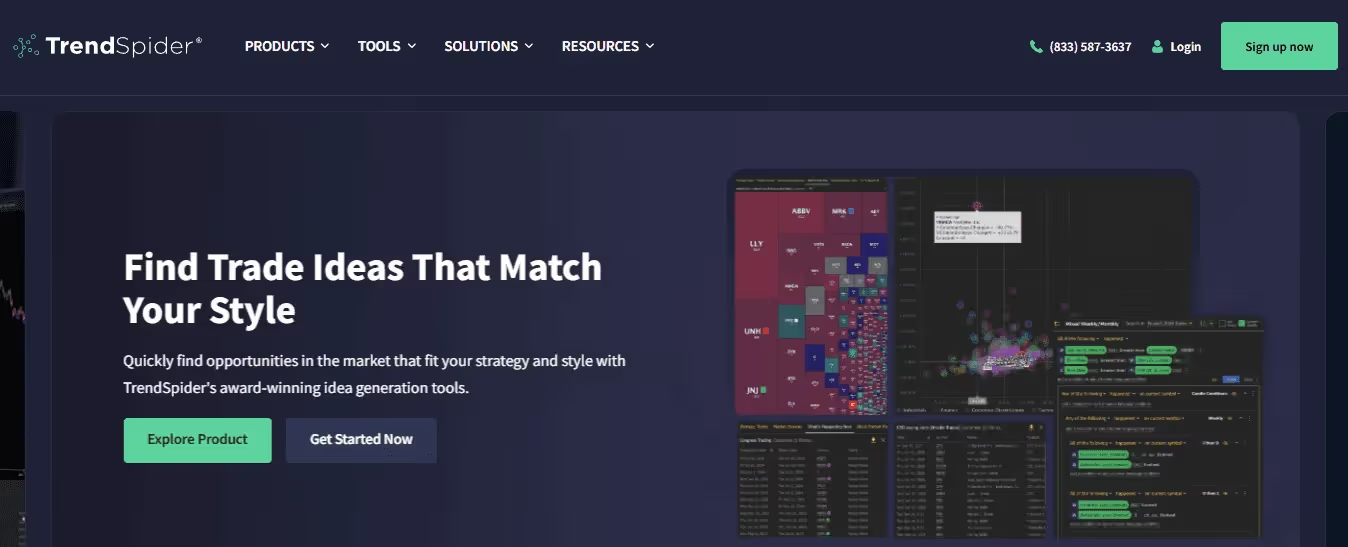
Advanced analytical tools often require advanced programming skills, which creates a barrier for traders who understand market dynamics but lack coding expertise. TrendSpider bridges this gap through natural language strategy builders, where you describe what you want in plain terms, and the system interprets your intent into testable logic.
The testing output appears as visual reports showing win rates, maximum drawdown, profit factors, and equity curves. You see immediately whether your idea holds up across different market phases without parsing code or debugging syntax errors. Adjustments are made through the same conversational interface, dramatically compressing iteration cycles.
Machine learning components add a layer that most platforms skip entirely. You can train custom models to recognize specific pattern combinations, then convert those models into bots that trigger alerts when conditions match. The system learns which setups historically preceded profitable moves in your chosen instruments, then watches for similar configurations in real-time.
The catch appears at execution. While TrendSpider excels at analysis and pattern recognition, it doesn't place orders directly. You receive alerts via webhook integrations with external automation services, but the final trade execution still requires manual intervention or third-party bridges. This semi-automated approach works for swing traders who value intelligent alerts over millisecond execution, but it frustrates those seeking a fully hands-off operation.
4. TradingView

Chart-based analysis reaches millions of traders through TradingView's interface, but fewer realize the platform supports full strategy automation through its proprietary scripting language. Pine Script lets you define entry conditions, exit rules, position sizing logic, and risk controls that execute directly on the charts you're already watching.
According to Best DevOps, TradingView stands among the top AI algorithmic trading platforms in 2025 for its combination of community resources and flexible scripting capabilities. The learning curve exists. Pine Script syntax differs from mainstream programming languages, so even experienced developers spend time adapting. But the community shares thousands of pre-built scripts, indicators, and strategy templates, dramatically accelerating learning.
Backtesting runs directly on historical chart data with adjustable parameters for commission, slippage, and position size. You watch your strategy play out visually across past price action, seeing exactly where entries and exits would have occurred. The system automatically calculates performance metrics, showing whether your edge holds across different timeframes and instruments.
Full automation requires connecting alerts to external execution services through webhooks or APIs. When your script detects a signal, it triggers an alert that routes to your broker's interface or a third-party automation platform that places the actual order. This extra step introduces slight delays and requires technical setup beyond the charting platform itself.
The real value emerges from community engagement. Thousands of active traders share strategies, debug code collaboratively, and publish indicators that extend the platform's native capabilities. When you encounter a programming challenge or an optimization question, someone has likely already solved it and documented the approach publicly.
5. MetaTrader

Free access to professional-grade automation tools sounds too good to sustain, yet MetaTrader maintains this model through broker partnerships that subsidize the software. Both MT4 and MT5 versions support Expert Advisors, the platform's term for automated trading algorithms built in its MQL programming language.
Broker compatibility spans the globe, giving you the flexibility to choose execution venues based on spreads, regulations, and asset coverage rather than platform constraints. The same strategy code runs across different brokers with minimal modification, which matters when you want to test how execution quality varies between providers.
External data integration expands what your algorithms can process beyond price and volume. You can feed sentiment indicators, economic calendar events, or alternative datasets via APIs, and code logic that responds to these inputs alongside technical signals. This flexibility supports sophisticated multi-factor strategies that most retail platforms can't accommodate.
The programming requirement creates the steepest barrier. MQL syntax resembles C++, so traders without coding backgrounds can spend months learning before building functional strategies. Freelance developers and marketplace offerings provide shortcuts, letting you purchase pre-built Expert Advisors or hire programmers to translate your strategy logic into executable code.
Local execution means your computer must run continuously for the algorithm to monitor markets and place trades. Power outages, internet disruptions, or system updates that trigger restarts all halt your strategy at potentially critical moments. Virtual private servers solve this by hosting your MetaTrader terminal in data centers with redundant infrastructure, but that adds monthly costs and setup complexity.
6. TradeStation

Professional-grade resources without institutional pricing barriers define TradeStation's positioning. The platform provides EasyLanguage, a scripting tool designed specifically for traders rather than programmers. The syntax reads almost like plain English, making it accessible even if you've never written code before. Strategy development happens directly within the trading interface. You write rules, backtest against historical data, optimize parameters, and deploy to live markets without switching between separate applications. This integration compresses development cycles and reduces the friction of managing multiple tools.
Asset coverage extends beyond forex to include equities, options, and futures, all tradable through the same platform with unified margin and risk management. If your automated strategy works across multiple instrument types, you can deploy it broadly without learning new interfaces or execution protocols. Transaction costs matter more as trade frequency increases. TradeStation's competitive commission structure benefits active automated strategies that might execute dozens of trades daily. The savings compound quickly compared to brokers charging higher per-trade fees.
The platform includes extensive educational resources and pre-built strategy examples that demonstrate common approaches like trend following, mean reversion, and breakout systems. You can study how experienced developers structure their code, then modify these templates to match your specific criteria rather than building from scratch.
7. E*TRADE Algo Wheel

Complexity intimidates traders who want automation benefits without the programming requirements or the burden of strategy design. E*TRADE's Algo Wheel addresses this by presenting pre-configured algorithmic approaches aligned with common objectives like growth, income, or risk reduction. You select your risk tolerance, investment timeline, and primary goals through a guided interface. The system recommends algorithmic templates that match your profile, handling order routing, execution timing, and position management automatically based on predefined rules optimized for each objective.
This simplification trades flexibility for accessibility. You can't customize the underlying logic or adjust specific parameters beyond the initial profile settings. The algorithms work as packaged solutions, which suits traders who trust the platform's optimization but frustrates those who want granular control over execution details.
The approach works within E*TRADE's broader ecosystem, so your algorithmic trading integrates smoothly with other account features, such as research tools, portfolio analysis, and tax reporting. Everything operates under a single login, without requiring separate platforms or data feeds.
8. Interactive Brokers
Global market access through a single platform creates opportunities most retail traders never encounter. Interactive Brokers' Trader Workstation connects to over 150 exchanges across 33 countries, enabling your algorithms to trade equities, options, futures, forex, and bonds from a single interface. Built-in algorithmic order types handle complex execution requirements without custom programming. You can route orders to minimize market impact, execute over specific timeframes, participate in closing auctions, or target volume-weighted average prices. These pre-built algorithms solve execution challenges that would require sophisticated coding on other platforms.
API support extends to multiple programming languages, including Python, Java, and C++, giving experienced developers full control over strategy logic and execution protocols. The APIs handle real-time data streaming, historical data requests, order placement, and position monitoring through well-documented functions that integrate with popular development environments. The cost structure favors active traders through tiered pricing that reduces per-share commissions as monthly volume increases. Automated strategies executing hundreds of trades benefit significantly compared to flat-rate brokers, though low-frequency approaches might find the monthly minimums less attractive.
Real-time data feeds and customizable interfaces let you build trading dashboards tailored to your specific monitoring needs. You watch multiple markets simultaneously, track algorithm performance across instruments, and adjust parameters in real-time as conditions evolve. Risk management features operate at the account level, automatically enforcing maximum loss limits, position concentration rules, and margin requirements. Your algorithms can't violate these controls regardless of how aggressively they're programmed, which prevents single-strategy failures from cascading into account-wide disasters. But choosing the right platform is only the beginning of the journey toward profitable automation.
Related Reading
- Sources of Capital
- Cash Reserve Account
- Short Term Stock Trading
- Investment Performance Analysis
- Managed Account vs Brokerage Account
- Systematic Trading
- How to Analyze a Stock Before Buying
- Forex Capital Trading
- What is a Retracement in Trading
- How is Risk Involved in Calculating Profit?
- Convergence Trading
- Liquidity Trading
- Futures Trading Minimum Account Size
- What is Drawdown in Trading
Test and Scale Your Trading Bots Without Risking a Dime with AquaFunded
Most trading bots don't fail because of execution. They fail because poor risk rules wipe out personal capital before the strategy is even proven. You spend months refining entry logic, optimizing parameters, and backtesting across market cycles, only to watch real-world slippage and a few bad trades drain your account during the validation phase. The algorithm might be sound, but you never get enough runway to find out.
AquaFunded removes that barrier entirely. You test and scale your automated trading system using firm capital instead of your own savings. Run EAs and algorithmic strategies under clear drawdown rules, no time limits on many models, and realistic profit targets between 2-10%. These are the conditions automation actually needs to survive live markets. You're not chasing 50% monthly returns that sound impressive in marketing but destroy accounts in practice. You're proving your bot can generate consistent, sustainable gains while firm capital absorbs the learning curve.
The structure aligns perfectly with how algorithmic strategies actually develop. Your system needs time to encounter different volatility regimes, correlation breakdowns, and liquidity conditions that backtests can't fully replicate. Without time pressure, your algorithm trades through enough market phases to reveal whether its edge holds across varying conditions. You discover which parameters need adjustment, how fill quality differs from simulated results, and whether your risk controls enforce discipline during drawdowns exactly as designed.
Scale happens once consistency shows up in your metrics. Start with evaluation capital, demonstrate that your automated system respects maximum loss limits and position sizing rules, then access allocations up to $400K where meaningful profits become possible. Your bot manages the same position sizes and risk exposure professional traders use, but you're not gambling retirement savings to reach that scale. The profit splits climb to 100%, meaning successful automation isn't capped by arbitrary revenue-sharing that punishes performance.
Payouts process within 48 hours when your system hits targets. That speed matters because it confirms your algorithm isn't just generating theoretical gains on a dashboard. Real money moves from strategy execution to your account, validating that the edge you coded actually works in live markets. You refine, you scale, you get paid. The cycle repeats without the emotional weight of personal capital evaporating during inevitable rough patches.
This is how you validate automation the professional way. Prove your bot works under real conditions, with real capital, and real accountability. Then trade larger allocations where your system's edge compounds into actual wealth, rather than modest gains on a small personal account that took years to build.
Related Reading
- How To Take Profits From Stocks
- Accumulation Distribution
- Short-Term Capital Gain Tax On Shares
- What Is Reit Dividends
- Cash Available To Trade Vs Settled Cash
- Best Pairs To Trade Forex
- Can You Day Trade In A Roth Ira
- What Is A Conditional Order
- Orb Strategy Trading
- Stop Loss Vs Stop Limit
- Flag Pattern Trading
- Characteristics of Growth Stocks
- Forex Compounding Plan
