




What Is Funded Firm, Limitations & Alternatives
What Is Funded Firm offers clear insights into evaluation rules, risk limits, and alternatives. See how AquaFunded simplifies access to real trading capital.

Skilled traders often face the barrier of limited personal capital despite having solid strategies. Understanding what a funded account is can open access to larger pools of capital and reduce personal financial risk. Demonstrated trading skills through evaluations allow access to accounts that drive growth in trading careers.
AquaFunded removes financial hurdles by providing substantial capital via its funded trading program. Successful evaluations result in accounts in which traders retain a significant share of profits, while the firm absorbs losses. This approach enables traders to focus on executing effective strategies and scaling their trading operations.
Summary
- Funded trading evaluations fail most participants, not because of poor strategy, but because daily loss limits don't accommodate normal market volatility. Research shows that only 5% to 10% of traders overcome these challenges, and even among those who do, many still lose funded accounts during statistically normal losing streaks. A trader risking 1% per position hits a 5% daily threshold after just five consecutive losses, which isn't catastrophic trading but standard variance for any strategy without an 80% win rate.
- The evaluation model creates perverse incentives that prioritize rule compliance over profitable trading. Traders close winning positions early to avoid giving back gains that might approach daily limits, skip valid setups after taking two morning losses, and manage rulebook violations instead of market opportunities. You can finish a week up $2,000 and still lose your account if one day breaches the threshold, because firms measure failure by single-day violations rather than cumulative performance.
- Static drawdown calculations punish account growth by keeping risk buffers fixed at starting balances. A $100,000 account that grows to $108,000 maintains a $10,000 maximum loss threshold from the original balance, not the new high-water mark. This means your absolute dollar risk remains constant while your percentage risk declines, forcing increasingly conservative position sizing as profits accumulate and eliminating strategies that rely on wider stop-losses or averaging techniques.
- Newer prop firms carry operational uncertainty that established competitors have already resolved through years of scaling challenges. Infrastructure designed to handle 100 funded accounts often breaks at 1,000, leading to payout delays, inconsistent rule enforcement, and unexpected account closures during growth phases. You're betting on the firm's stability across multi-year timeframes as much as your own trading skill, which adds risk beyond market execution.
- Platform limitations and mandatory evaluation paths create unnecessary friction for experienced traders with verified track records. Firms that force identical challenges on beginners and professionals alike treat every participant as unproven regardless of documented profitability elsewhere, turning the process into a compliance test rather than a skill assessment. Strategies optimized for specific order types, charting tools, or execution features must be completely rebuilt around proprietary platforms that may not support the same functionality.
- Funded trading programs address this by offering instant funding options that bypass multi-phase evaluations and static drawdown models that replace daily loss calculations, allowing traders to focus on managing capital responsibly in real market conditions rather than navigating arbitrary checkpoints.
What is a Funded Firm

FundedFirm is a proprietary trading company that gives traders access to capital through organized evaluation programs. Instead of requiring traders to put their own money in, the firm provides funded accounts after they demonstrate they can manage risk and deliver steady returns. This model bridges the gap between skill and opportunity, allowing traders to work with real capital while retaining a large share of the profits they generate. If you’re interested in starting with a funded trading program, our program offers a smooth onboarding experience. The firm supports trading in Forex, Metals, Indices, Energies, and Cryptocurrencies, with account sizes ranging from entry-level allocations to six-figure capital commitments. Traders can choose between one- or two-phase evaluation models based on their experience level and preferred timeline. Once funded, they operate under clear risk guidelines while retaining the freedom to hold positions overnight, trade during news events, and use strategies ranging from day trading to swing trading.
How does the evaluation process work?
AquaFunded shapes its evaluation process around profit targets and drawdown limits to ensure consistency rather than luck. The one-phase challenge typically requires an 8%-10% profit target and a maximum overall drawdown of 8%-10%. Daily loss limits are around 4% to 5%. Traders need to complete at least five trading days to demonstrate they are not relying on a single lucky trade. The two-phase model divides the evaluation into different stages, each with its own profit requirement. This method gives traders more time to demonstrate their skills while maintaining strict risk controls. Without arbitrary time limits, traders can avoid the stress of forcing trades to meet deadlines. The focus stays on disciplined execution, not hasty choices.
What makes a well-designed evaluation?
The key factor that distinguishes a well-designed evaluation from a failed one is the alignment between profit targets and risk limits. When firms set a 10% profit goal but allow only a 5% total drawdown, they expect traders to achieve a 2:1 reward-to-risk ratio on every position. This is unrealistic because market conditions can change. AquaFunded's parameters give traders the flexibility they need to handle normal market fluctuations without failing the challenge.
What happens after passing the evaluation?
Once you pass the evaluation, the trading environment will mirror the challenge phase but offer greater flexibility. Leverage can reach up to 1:100 on most instruments, helping you size positions that fit your strategy without requiring excessive margin. Profit splits are still competitive; however, the exact percentages depend on the account type and scaling tier you’ve reached.
Why are overnight and weekend holding permissions important?
Overnight and weekend holding permissions matter more than most new traders realize. If traders must close every position before the session ends, they can't take advantage of multi-day trends or hold positions during consolidation periods. This situation limits them to day trading, even when their edge works better over longer periods. AquaFunded removes that limit, which opens up strategies that would otherwise be off-limits, especially for those interested in a funded trading program.
How does news trading permission impact strategies?
News-trading permission is essential for trading strategies. Some firms prohibit trading during high-impact economic releases because they worry that excessive volatility could trigger stop-loss orders or cause unpredictable price movements. On the other hand, professional traders often use these events to their advantage by developing strategies around them, viewing volatility as an opportunity rather than something to avoid. Trading during news releases ensures traders can participate in some of the most liquid and opportunity-rich moments in the market.
What strategies are prohibited by FundedFirm?
The firm prohibits arbitrage, latency exploitation, tick manipulation, and high-frequency strategies that rely on external price-feed advantages. These rules are in place because these methods do not demonstrate real trading skill; they exploit technical issues that wouldn't exist in a live brokerage setting. If a trader's edge relies on making trades faster than the platform can update prices, they are not really trading; they are gaming the system. Martingale, grid, and doubling strategies are also not allowed for proper risk management. These strategies hide losses by increasing position sizes after losing streaks, which can eventually lead to catastrophic account blowouts. A trader using a doubling strategy might see steady profits for weeks, but could lose everything in just one session if the market turns against them long enough to use up their margin. Firms that allow these strategies either do not understand risk or do not care about their traders' long-term success.
Are Expert Advisors allowed?
Most Expert Advisors are permitted, provided they follow standard trading logic. If an EA makes trades based on technical indicators, price action, or fundamental analysis, it is permitted. However, if it is intended to exploit server delays or copy trades from unrelated accounts, it violates the rules. The main difference is whether the strategy would work well in a real trading environment, with real capital at risk.
How can fine print affect traders?
The difference between a real prop firm and a tricky one often shows up in the fine print. Some firms boast about generous profit splits and large account sizes, yet hide hard-to-meet conditions in their terms. They might allow news trading, but may automatically fail any trader who reaches their profit target during a busy event. Alternatively, they might allow overnight holds but reset daily drawdown limits at midnight in a time zone that catches traders off guard. Many traders enter challenges without really understanding how the daily drawdown is calculated. Some firms measure it from the starting balance, while others look at the highest amount your account gets to during the day. For example, if you're up $500 at noon and then lose $400 by the end of the day, one firm sees that as a $400 loss, while another sees it as a $900 drawdown from your highest point of the day. This difference can ultimately decide whether you pass or fail on the same trading day.
What is AquaFunded's approach to rules?
AquaFunded's approach focuses on clarity rather than complexity. The rules remain the same during both the evaluation and funded phases, so traders do not have to learn a new risk framework after they pass. The firm does not impose hidden restrictions that only appear when traders are ready to withdraw profits. When evaluation rules match those for funded accounts, traders can develop sustainable strategies rather than focusing solely on short-term challenges.
What Determines Access to Trading Capital?
The best prop firms understand that their success relies on trader success. If everyone fails the evaluation, the firm collects challenge fees but does not build long-term relationships. If traders pass but can't keep funded accounts because the rules are too hard, the firm cycles through participants without making real partnerships. Successful prop trading needs aligned incentives so that both the firm and the trader gain from steady, disciplined performance over time. Knowing the rules is only the first step. What ultimately determines whether you can secure that capital?
Programs of Funded Firm

The path to funded capital splits into two distinct evaluation structures. One-phase programs require traders to achieve an 8%-10% profit target while maintaining a 5% daily drawdown and a 10% maximum overall loss. Two-phase programs address this by setting an 8% target for phase one and a 5% target for phase two, with the same risk boundaries. Both require at least five trading days to prove consistency beyond a lucky streak. Account sizes range from $5,000 starter challenges to $200,000 allocations for experienced traders. The choice depends less on ego and more on how much risk capital you can handle in your mind without second-guessing every position. A trader comfortable managing $50,000 in drawdown won't trade the same way on a $5,000 account, where every $250 loss feels catastrophic.
Single-step evaluations consolidate the challenge into a single continuous test. You're aiming for an 8% to 10% gain without breaking daily or total drawdown limits. There are no intermediate checkpoints; you either reach the target while staying disciplined, or you don't. This is where our funded trading program really shines, helping traders refine their strategies while staying focused on their goals. This structure favors traders who already know their edge and can execute without hesitation. If you're still experimenting with strategy or learning how to size positions properly, the pressure of a single-phase challenge makes every mistake feel worse. A poorly timed trade during high volatility can hit your daily loss limit and end the attempt before you've found your rhythm.
What are the advantages of two-phase programs?
The absence of time limits removes artificial urgency, but this freedom can have mixed effects. Some traders perform better with deadlines since these constraints force them to make quick decisions. On the other hand, others may struggle with time pressure and need space to wait for the best setups. According to FunderPro, only 5% to 10% of traders pass these evaluations. This statistic suggests that many people underestimate the challenge of maintaining risk discipline while meeting profit targets. Splitting the evaluation into two stages changes the psychological dynamic. The initial 8% target seems more achievable when traders know they are not risking everything on a single attempt. After successfully completing phase one, they can reset their mindset and pursue the 5% goal in phase two with renewed confidence.
How does mindset affect performance?
The structure also shows how traders handle success. Some traders pass phase one easily, then take too many risks in phase two because they think the second target will be easier. They increase their position sizes or take trades that don’t follow their strategy, believing they’ve already proved themselves. That’s when the daily drawdown limit catches them. The rules stay the same in both phases, but the trader's mindset changes, and their discipline weakens. Two-phase programs are best for traders who are still building confidence in their execution. This intermediate step demonstrates that their strategy holds up under pressure. They aren’t just guessing if their approach will succeed. They have already shown it once, which lowers the anxiety that can lead to impulsive decisions in the final phase.
What should I consider when selecting a trading platform?
MetaTrader 5 is the main platform for all account sizes. If a trader uses TradingView indicators or NinjaTrader automation for their strategy, it is important to adapt that logic to MT5's environment before starting the challenge. The platform supports Forex pairs, indices, commodities, metals, and crypto instruments, but not all firms offer the same asset coverage across all account levels. Execution speed is more important than most traders realize until they are in the evaluation phase. If your strategy relies on scalping 5-pip moves during the London open volatility, even small delays from the platform can add up across many trades. City Traders Imperium reports average execution wait times of about 2000 milliseconds during busy hours. While this may seem small, it becomes a big deal when you are trying to capture momentum breakouts that can reverse in seconds.
What challenges come with crypto trading?
Crypto trading adds complexity because price feeds can vary across liquidity providers. A change in Bitcoin's price that triggers your stop-loss on one price feed might not trigger on another. If your evaluation account uses a different price source than your backtesting data, you're basically trading a slightly different instrument. This difference won't be noticed in your strategy testing, but it will impact your live results.
How do profit splits work?
Funded accounts typically start with profit splits ranging from 80% to 100%. This depends on the account type and your performance. The percentage is less important than the actual amount of money you keep after meeting your consistency goals. For example, a 90% split on a $25,000 account that makes $2,000 every month would leave you with $1,800. On the other hand, a 100% split on a $10,000 account earning $800 each month gives you the full $800, but you're making less in total value.
What are scaling opportunities?
Scaling opportunities arise after maintaining the funded account for several payout cycles, in accordance with risk rules. Some firms allow traders to add accounts or increase allocation sizes after they demonstrate sustained profitability. However, other firms set a limit on total exposure regardless of performance. This limit prevents traders from controlling more capital, even if their results support a larger size.
What tests come after the initial evaluation?
The real test isn't just passing the evaluation. It's about keeping the funded account long enough to receive multiple payouts, while following the same risk rules that got you funded. Many traders succeed in challenges by trading carefully, but then switch to riskier strategies once they are funded, thinking the hard part is done. That's when the daily loss limits and drawdown rules catch them off guard. The evaluation shows that you can follow rules under pressure. The funded phase shows that you can do it consistently without help.
How are daily drawdowns calculated?
Daily drawdown calculations reset at the start of each trading session based on your account equity at that moment. If you're up $1,000 at noon and lose $600 by the end of the day, you've taken a $600 daily loss, not a $400 gain for the day. This distinction is important because it indicates whether you've exceeded your 5% daily limit. A $50,000 account allows $2,500 in daily losses. If you're up $3,000 during the day and then lose $2,600 before the session ends, you've violated the rule even though your account is still positive for the day.
What impact does maximum overall drawdown have?
The maximum overall drawdown is based on the starting balance. If a trader starts with $100,000 and grows it to $108,000, the maximum loss allowed is still $10,000 from the original $100,000, not from the new high of $108,000. This fixed calculation protects traders from losing all their gains. However, it also means that the risk buffer doesn’t increase as profits grow. Traders manage the same absolute dollar risk throughout the evaluation, regardless of how much the account has increased.
What Are the Trading Behavior Expectations?
These parameters dictate a specific type of trading behavior. Traders cannot rely on wide stop-losses that exceed 5% of their account, as a single stopped-out trade could end their evaluation. Averaging into losing positions in the hope of a reversal is also not viable. This is because each additional lot increases exposure toward the daily limit. Consequently, the rules eliminate strategies that depend on surviving large drawdowns before eventual recovery.
What are the common pitfalls traders face?
Many traders encounter hidden catches after encountering activation fees or when promotional codes do not work as expected. The frustration comes from thinking they've gotten through the tough part, only to find the pricing wasn't as clear as it appeared. When unexpected costs arise after the evaluation is complete, it creates doubt and makes traders wonder whether the firm ever intended to support them from the beginning.
What alternatives exist for funded accounts?
Platforms like the funded trading program address these problems by eliminating activation fees. They provide instant funding options that skip lengthy evaluation processes. When traders can access capital immediately with clear payout terms and no hidden upgrade costs, the relationship shifts from suspicion to partnership. The focus shifts from managing complex fee structures to trading. Even with these clear rules, some limits still exist. Sometimes, the structure itself can create issues.
Related Reading
- What is a Funded Account
- How to Grow a Small Trading Account
- What is Trading Commodities
- Long Term Trading Strategy
- Capital Growth Strategy
- What is a Cash Account in Trading
- What is Compound Trading
- How Much Money Do You Need to Start Trading Stocks
- Scale Trading
- Small Account Trading
- How to Evaluate Investment Opportunities
- Blown Trading Account
- What is PNL in Trading
- Do Prop Firms Use Real Money
- Prop Firm Account Management
- Borrowing on Margin
- Trading Leverage
- Does FTMO Offer Instant Funding
- Prop Firm Static Drawdown
- Funding Traders Rules
- What Is Prop Firm Account
- Synthetic Funded Account
- Trading Challenges
- Prop Firm IP Address Rule
- Instant Funding Rules
- Do Prop Firms Use Real Money
- FTMO vs The5ers Comparison
- My Forex Funds vs FTMO
- Best Automated Crypto Trading Platform
- How to Pass a Prop Firm Challenge
Limitations of Funded Firm
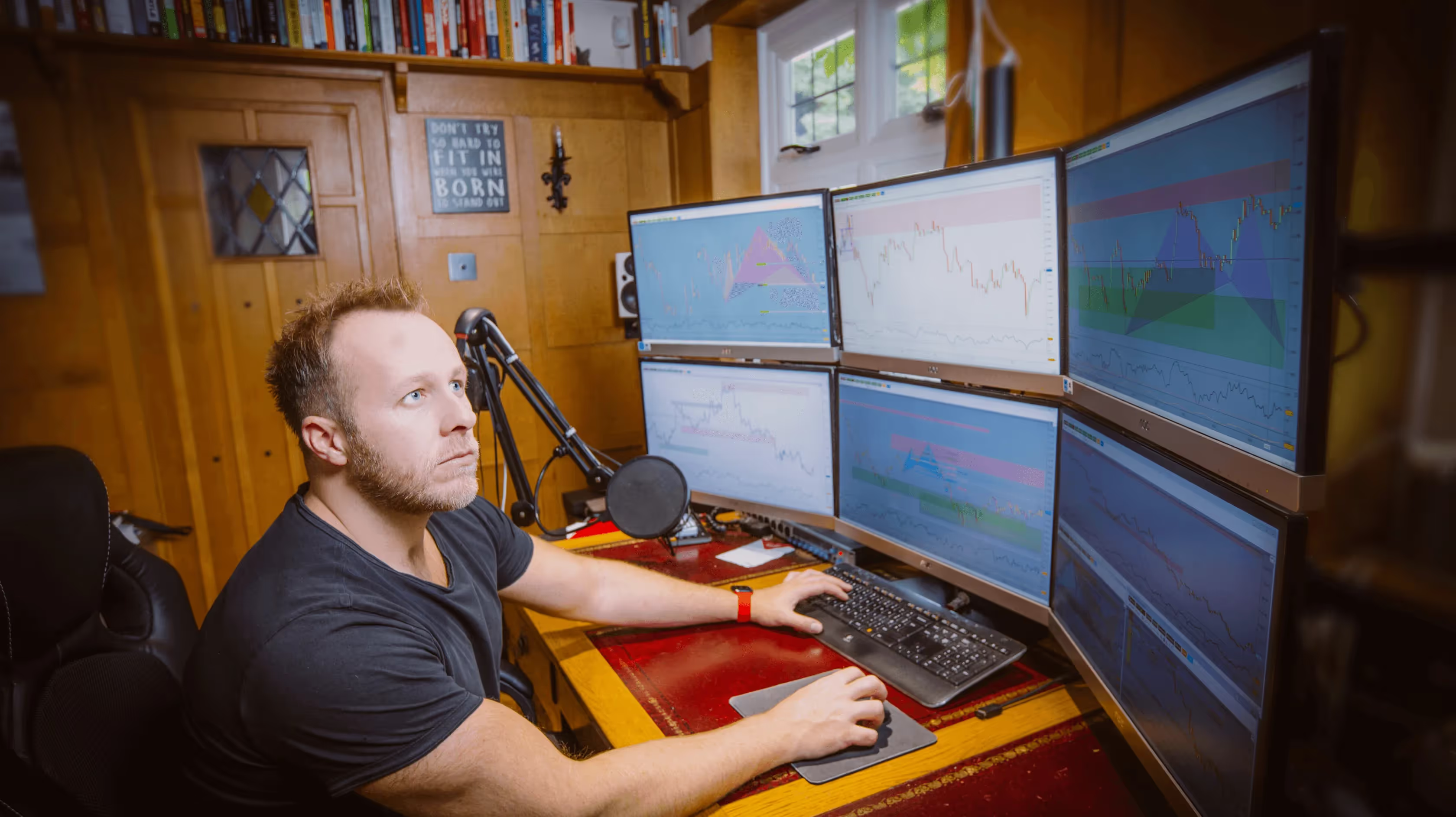
Rule-based limits cause more funded accounts to fail than bad trading decisions. Traders with a 50% win rate, strict risk management, and profitable weeks can still lose accounts. This often occurs when they exceed daily loss limits during normal market swings. The problem isn't with the strategy; it's that market changes don't align with firms' definitions of failure. A 4% to 5% daily loss limit sounds reasonable until you calculate how many losses it takes to reach that limit. If you risk 1% for each trade, five losses in one session can wipe out your account. That's not a huge disaster. It's a normal losing streak for any strategy that doesn’t win 80% of the time.
The math gets trickier when you think about how losses add up over time. Your first loss reduces your account by 1%, but your second loss is calculated from a smaller balance. After the fourth or fifth loss, you hit that daily limit much faster than you expect. Traders who have experienced similar losing streaks in their personal accounts might suddenly find themselves shut out of funded capital because the firm's limits are tighter than in reality.
Why does trader longevity suffer?
According to research from Axcera Blog, this leads to high turnover and short trader lifetimes in the industry. Firms have many participants who pass evaluations but cannot maintain funded status long enough to earn a steady income. While the evaluation demonstrates the ability to follow rules under ideal conditions, the funded phase shows that those rules do not hold up in real-world trading over weeks and months. Traders can end a week up $2,000 but still lose their accounts if one day exceeds the daily limit. The firm does not account for the recovery. They overlook that the monthly P&L is positive. The violation occurred, and the account will be closed regardless.
This leads to a harmful incentive structure. Traders stop focusing on their long-term advantage and start managing rule compliance. They might close profitable positions early to prevent giving back gains that could bring them close to the daily limit. Also, they might skip good setups after taking two losses that morning, worrying they can't afford a third. As a result, the strategy that helped them get funded becomes less important than avoiding rule violations.
How does structural failure impact traders?
Many traders report losing their accounts despite maintaining positive risk-reward ratios and adhering to their plans. The problem wasn't the strategy; it was a structural issue. The firm's risk rules do not align with how an edge works over enough trades to matter. As a result, traders are no longer participating in the markets; they are effectively trading against the rulebook.
What are the challenges with newer firms?
FundedFirm is newer than established prop firms with multi-year track records. This is important when trusting a company with your trading career and relying on consistent payouts. Newer firms haven’t faced market crises, regulatory changes, or the challenges of managing thousands of funded accounts simultaneously. The platform options are limited compared with those of larger competitors. If your strategy relies on specific order types, charting tools, or execution features available on other platforms, you will need to adjust your approach to align with what FundedFirm offers. This not only creates inconvenience but also limits how traders can apply their skills. Educational resources are often limited, especially for traders still developing their skills. Traders are expected to have a working strategy and risk management plan in place. For those who want to learn while trading or need help with position sizing under these rules, support is lacking. The firm emphasizes evaluating execution, not education.
How do scaling opportunities vary?
Scaling opportunities appear smaller than those of competitors offering seven-figure allocations. If your goal is to manage a lot of money across multiple accounts, you'll hit ceiling limits faster than you would at other places. The firm's growth path matters just as much as yours, because it affects how much you can really grow once you've shown you can be consistent. Every trader starts with evaluation-based models; there are no instant funding options. This means even skilled traders with proven track records must go through the same challenges as beginners. You can't move ahead based on past performance or documented profits. The firm treats every participant the same, regardless of experience. This creates difficulties for traders who have already been successful somewhere else. They aren't just testing their strategy; they are demonstrating they can follow this firm's rules while meeting specific profit targets within set time limits. The evaluation turns into more of a compliance check than a skill test.
What alternatives do better firms offer?
Some firms recognize that requiring every trader to undergo the same evaluations creates unnecessary obstacles. Platforms like the funded trading program eliminate activation fees and provide instant funding, avoiding multi-phase processes altogether. When traders can access funds immediately, with clear payout structures and no hidden costs, the relationship shifts from a difficult path to a partnership. The focus shifts back to trading performance rather than to rules. Newer firms come with uncertainty. They haven't built the operational history that demonstrates they can handle payouts reliably during tough market conditions, consistently enforce rules as they grow, or sustain a multi-year trading career. Traders rely on their stability as much as on their skills. Payout delays, disagreements over rule interpretation, and sudden account closures often affect newer firms because their systems and processes haven't been tested under the pressure of thousands of traders and varying market conditions. What works for 100 funded accounts often fails at 1,000. The setup that seems strong during an evaluation may not work well as the firm expands.
Is the evaluation model the real issue?
Choosing where to trade isn't just about avoiding problems; it's about finding the right match for how one actually operates. What if the real issue lies not with the chosen firm but with the evaluation model itself?
9 Best Funded Firm Alternatives for Beginners
When evaluation pressure becomes a hurdle rather than an opportunity to demonstrate skills, traders need companies that can change how they access capital. The options below remove structural friction that causes skilled traders to fail challenges, not because of a bad strategy, but because strict rules do not align with how real trading works. Each company faces specific challenges, from time pressure to daily loss traps, creating paths that suit different trading styles and experience levels.
1. AquaFunded
Structured evaluations with fixed profit targets and tight daily limits can create specific types of failure. Traders end up managing rule compliance rather than market opportunities. AquaFunded removes that restriction by offering flexible funding options with instant access and no mandatory time limits. The pressure that leads to overtrading during traditional challenges goes away when there is no countdown or enforced deadlines. Static drawdown models replace daily loss calculations that can end accounts during normal volatility. Traders know exactly how much total risk they can handle without worrying if an intraday swing will trigger a violation before recovery.
This certainty is crucial for discretionary traders, who need the freedom to let their positions develop over multiple sessions without micromanaging every fluctuation. Beginners benefit from evaluation structures that don't need multi-phase completion. They can demonstrate consistency without going through layered checkpoints that complicate the process before they've built confidence. The firm's approach focuses on sustainable trading behavior over short-term target chasing, aligning incentives with long-term performance rather than evaluation gamesmanship.
2. Apex Trader Funding

CFD-style evaluations do not fit every strategy, especially if an edge works better in futures markets with direct exchange access. Apex focuses on futures-only environments, with capital allocations of up to $300,000 per account. Professional traders can manage up to 20 accounts simultaneously, creating growth opportunities that CFD firms cannot match. The profit split structure rewards early success. Traders keep 100% of the first $25,000 in profits, then 90% of any amount above that. This front-loaded model ensures that early profitable months result in higher take-home income than a flat 80% split from the start. Additionally, the platform supports 14 trading systems, so traders are not limited to a single interface.
A trailing drawdown tightens as an account grows, changing risk management needs as profits rise. What starts as manageable exposure becomes more limited when gains push the trailing threshold closer to current equity. Focusing solely on futures excludes forex and CFD traders, making this method specialized rather than a common option.
3. OneFunded

Time limits create artificial urgency, leading to forced trades that may not align with a trader's strategy. removes evaluation deadlines entirely, allowing traders to focus on valid setups rather than rushing to hit targets before arbitrary cutoffs. This change helps reduce overtrading pressure, which often causes traders to give up their edge as deadlines approach.
Entry costs start at $23, significantly lowering the barrier to entry for beginners who want to assess whether prop trading is a good fit for their skill level. Traders do not have to risk hundreds of dollars to learn that the evaluation model does not match their approach. Additionally, news trading, expert advisors, and holding over the weekend are allowed, ensuring traders are not left out during major events or forced to close positions before the session ends. Account sizes are smaller than at larger firms, which limits how much traders can grow once they demonstrate consistency. The balance between easy entry and the most money they can manage means traders will need to open more accounts or change firms if they want to manage seven-figure portfolios.
4. SabioTrade

Multi-phase evaluations complicate matters and often test how well traders follow rules rather than their actual trading skills. SabioTrade addresses this by structuring the process as single-phase challenges, eliminating the requirement for a minimum number of trading days. Traders can demonstrate profitability and risk management without checks that could disrupt their mindset between phases.
Opening a $20,000 account costs $95, creating a fair risk-reward ratio for traders who believe in their strategy. Built-in educational tools and analytics help new traders improve their skills through evaluations. However, the unique platform setup offers less flexibility for those who have already optimized their strategies around MetaTrader environments. Wide asset coverage includes instruments beyond standard forex pairs. This provides diversification options within a single account.
5. Moneta Funded

A broker-backed firm's smaller community presence results in fewer peer insights and fewer shared experiences than established alternatives with active trader networks. Broker-backed firms offer execution stability that pure prop companies can't guarantee. Moneta Funded works with Tier-1 liquidity providers. This reduces slippage and requote issues during volatile sessions. The Phoenix program creates long-term scaling paths up to $2 million. It addresses the ceiling constraints that limit growth at smaller firms.
Multiple funding paths, one-step, two-step, instant, and Phoenix, let you choose the evaluation structure that fits your experience level. Unlimited time limits remove deadline pressure while keeping profit targets that show consistency. The 88% profit split is slightly below competitors' 90%-100% splits. However, this trade-off includes substantial infrastructure reliability, which becomes more important as account sizes grow.
Most traders struggle to manage evaluation pressure because the system treats consistent profitability and rule compliance as two distinct skills. Platforms like the funded trading program eliminate activation fees and hidden upgrade costs that can arise after traders have already completed challenges. When instant funding bypasses multi-phase evaluations, traders can focus on trading rather than administrative hurdles. The focus changes from proving compliance with arbitrary rules to showing that they can manage capital responsibly in real market conditions.
6. For Traders

Fixed evaluation parameters do not work equally for different trading styles. For example, For Traders allows customizable profit targets and drawdown limits, so traders do not have to fit their strategies into someone else's risk framework. Also, AI-powered analytics and trade journaling help find execution patterns that traditional platforms often miss. Payouts are processed within 48 hours, which is critical for building trading income when waiting weeks for withdrawals is not realistic. Strong transparency about rules and pricing eliminates surprise fees that can erode trust in firms with complex cost structures.
The ability to customize means that profit splits vary with selected parameters, making targets easier to meet while maintaining lower payout percentages. The relative newness of these funding models, compared with established firms, means they have less experience demonstrating their ability to manage growth and market stress over several years. Traders are betting that these firms' setups will grow as they attract more participants.
7. BrightFunded

Static profit targets overlook that consistent traders deserve capital increases after demonstrating their skills. BrightFunded emphasizes unlimited scalability and weekly payouts, with some processed within hours. This approach to frequent withdrawals helps build trust more quickly than firms that need monthly payout cycles to access earnings.
Profit splits of up to 100% reward top performers, but two-phase evaluations still need to occur before funding status is granted. If you’re considering our funded trading program, note that strong crypto-asset offerings create opportunities beyond traditional forex and futures markets, appealing to traders who have an edge in digital-currency volatility. The structured evaluation approach can feel limiting compared to instant funding options. This creates similar pressure that can cause traders to fail challenges, even when they have good strategies. Trainees must progress through phases rather than trade freely from the start.
8. Funded Trading Plus
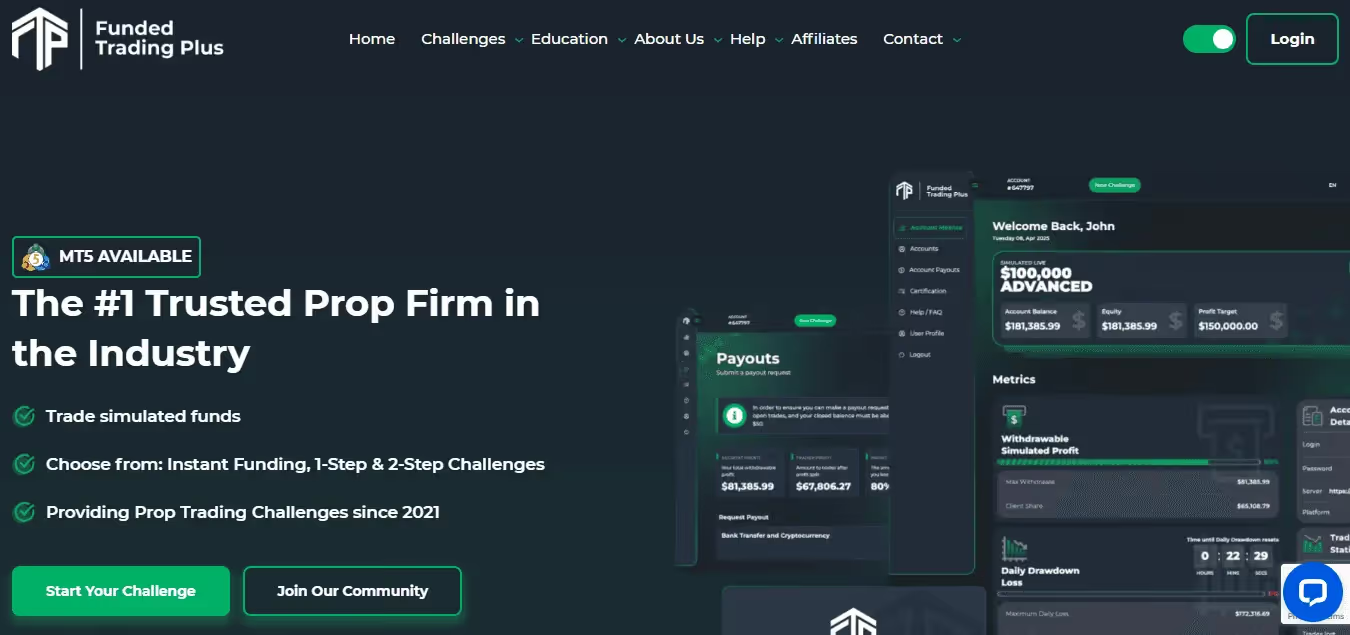
Limited funding models push traders into evaluation setups that might not fit their needs. FT+ offers all available options: one-step, two-step, static drawdown, and instant funding. This variety gives traders the best options for accessing capital. Also, scaling can reach up to $5 million across multiple accounts, helping address growth limits that often keep smaller firms at six-figure levels.
The ability to withdraw on day one means a trader's first profitable session generates income immediately, rather than their funds being locked until they meet minimum payout thresholds. Plus, news trading and weekend holding permissions remove restrictions that often prevent traders from taking advantage of their best opportunities. However, the many options can lead to indecision for beginners who may not yet know which setup best fits their trading style. Strict milestone discipline requirements for scaling create challenges beyond profitable trading. Traders must meet specific targets in a set order to achieve larger returns, which adds administrative complexity to what should be simple capital growth.
9. My Funded Futures

Daily loss limits end more accounts than actual trading mistakes. My Funded Futures removes them completely, replacing strict intraday thresholds with end-of-day trailing drawdowns. This structural change allows you to handle normal intraday volatility without always worrying about whether your next loss will break a rule. High-quality futures platforms, along with clear payout buffers, create transparency around when earnings can be accessed. Simple one-step evaluations reduce complexity for traders who understand their edge and do not need multi-phase validation. This futures-only focus completely excludes forex and CFD strategies, offering a specialized option for commodity and index traders.
Trailing drawdowns still tighten risk as accounts grow; thus, effective risk capacity shrinks when traders are most profitable. This mechanism differs from daily limits but generates constraints similar to those of gains as gains accumulate. However, having options does not resolve the core issue if every choice still requires demonstrating one’s ability through evaluations that prioritize rule compliance over actual trading skill.
Related Reading
- Sources of Capital
- Cash Reserve Account
- Short Term Stock Trading
- Investment Performance Analysis
- Managed Account vs Brokerage Account
- Systematic Trading
- How to Analyze a Stock Before Buying
- Forex Capital Trading
- What is a Retracement in Trading
- How is Risk Involved in Calculating Profit?
- Convergence Trading
- Liquidity Trading
- Futures Trading Minimum Account Size
- What is Drawdown in Trading
- Best Prop Firms in UAE
- Forex Prop Firms With Instant Funding
- Regulated Prop Firms
- Prop Challenge
Stuck Scaling with Funded Firm? Your Strategy Isn't the Problem, The Rules Are.
If the Funded Firm's strict drawdown limits, rigid evaluations, or slow scaling are hindering a profitable strategy, AquaFunded offers a better option. With more flexible risk rules, trader-friendly drawdown structures, and faster access to larger account sizes, AquaFunded lets disciplined traders focus on execution and consistency without being constrained by restrictive prop firm rules. Instant funding eliminates the need for multi-phase evaluations, and fixed drawdown models replace daily loss calculations that can close accounts during normal market fluctuations. This change allows traders to focus on demonstrating their ability to manage capital wisely under real market conditions, rather than proving they can clear arbitrary checkpoints that test patience more than skill. funded trading program
Related Reading
- How To Take Profits From Stocks
- Accumulation Distribution
- Short-Term Capital Gain Tax On Shares
- What Is Reit Dividends
- Cash Available To Trade Vs Settled Cash
- Best Pairs To Trade Forex
- Can You Day Trade In A Roth Ira
- What Is A Conditional Order
- Orb Strategy Trading
- Stop Loss Vs Stop Limit
- Flag Pattern Trading
- Characteristics of Growth Stocks
- Forex Compounding Plan
