




How to Get a Funded Trading Account in 5 Easy Steps
Learn how to get a Funded Trading Account in 5 easy steps, avoid common mistakes, and choose the right path to get funded faster.
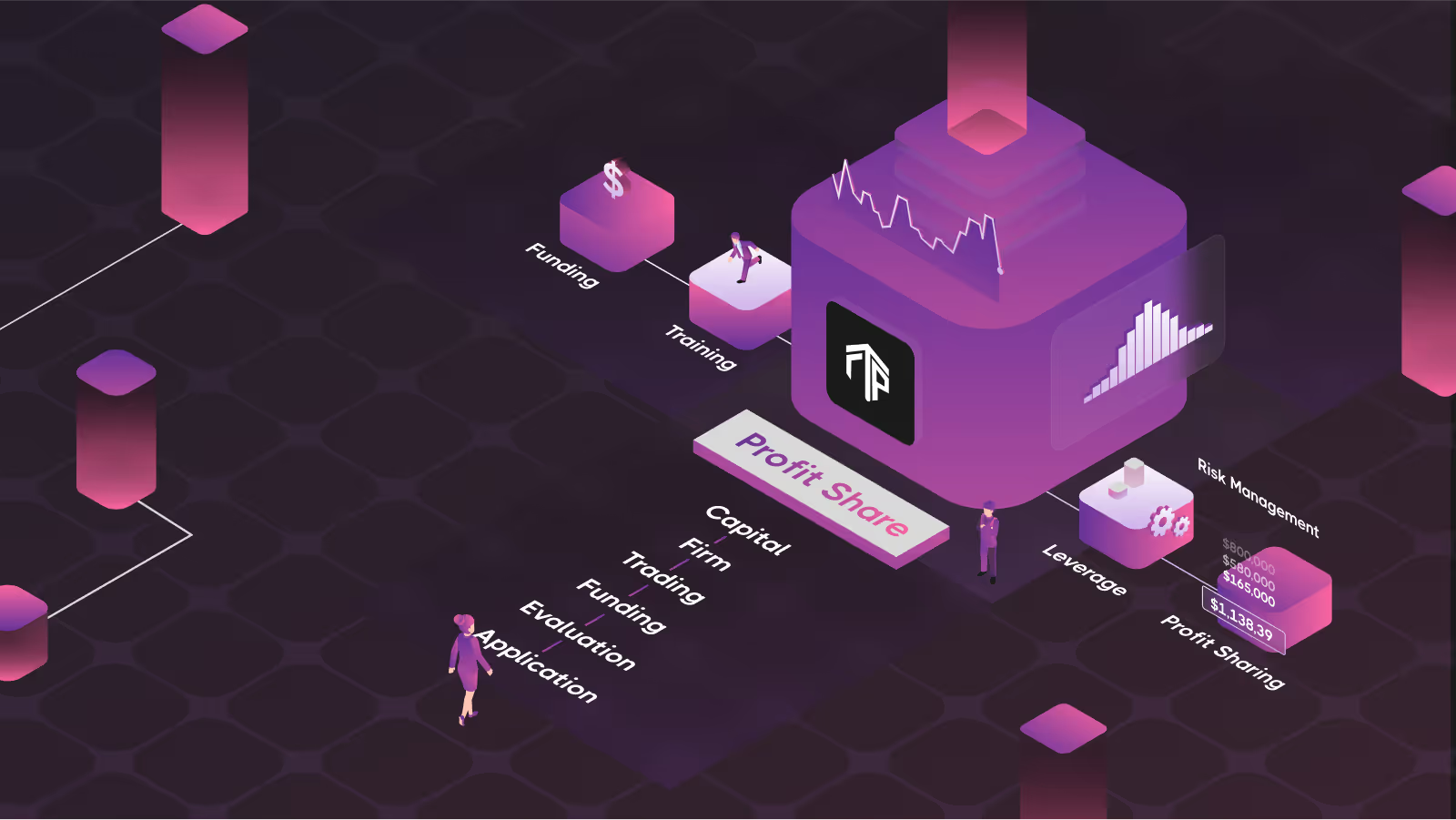
Consider having the capital to trade without risking your own money. That's the core appeal of understanding what a funded account is and why traders at every skill level are seeking these opportunities. Whether you're a beginner looking to prove your strategy or an experienced trader wanting access to larger positions, getting a funded trading account opens doors that would otherwise remain closed. This guide walks you through the practical steps to secure funding, from choosing the right evaluation program to passing your assessment and scaling your account.
AquaFunded's funded trading program provides traders with a clear path to access substantial capital without traditional barriers. Their evaluation process focuses on consistent risk management and disciplined trading rather than impossible profit targets, making it accessible for traders who understand proper position sizing and strategy execution. By providing transparent rules and flexible account options, Aqua Funded helps you move from trading with limited personal funds to managing professional-level capital.
Summary
- Funded trading accounts fail 90% of evaluation participants not because traders lack skill, but because they violate drawdown limits before hitting profit targets. Internal reviews from multiple prop firms show that 70-80% of terminated accounts breached maximum drawdown rules while pursuing 8-10% profit targets that require only 8-15 solid trades over two to four weeks. The math proves that protecting capital matters more than generating extraordinary returns.
- Successfully funded traders maintain 45-55% win rates using 0.25-0.75% risk per trade while executing just 1-2 setups daily. Their edge comes from 1:2 or 1:3 risk-reward ratios that transform mediocre win rates into consistent profitability, not from exceptional market timing or complex strategies. Case studies across platforms like TradingView show that most passing traders take 2-4 weeks to complete evaluations, treating the process as a job rather than a lottery ticket.
- Leverage destroys more accounts than any other single factor. A 2% adverse move at 50:1 leverage with 5% position sizing triggers a 10% account loss that terminates most evaluation programs immediately. Conservative leverage between 10:1 and 20:1, with 1% risk per trade, creates a buffer that requires 10 consecutive losses to approach termination thresholds, which is why disciplined position sizing outperforms aggressive capital deployment every time.
- The capital problem disappears without creating debt when funded accounts provide $25,000 to $500,000 in trading capital, and a 2% winning trade generates $2,000 rather than $40. Research shows that 80% of traders report faster profitability with instant funding, as adequate capital from day one eliminates the months or years spent building personal accounts large enough to produce meaningful returns. Profit splits favor traders at 70-100%, meaning a 5% return on a $100,000 account yields $4,000 to $5,000 while risking no personal capital.
- Overtrading during unfavorable market conditions accounts for a significant portion of the 90% failure rate in evaluations. Markets cycle through trending, ranging, volatile, and quiet phases, and most strategies maintain only a statistical advantage under one or two of these conditions. Traders who limit execution to 1-3 setups per day during optimal sessions force selectivity, eliminating marginal trades that slowly bleed accounts through broker fees and increased exposure during periods with no edge.
- An emotional tilt after losses triggers revenge trading, in which frustrated traders abandon proven position-sizing, override strategy rules, and violate drawdown limits within hours. The gap between understanding that 1% risk per trade is mathematically correct and actually following that rule after three consecutive losses separates funded traders from everyone else. Systems that remove decision-making during tilt (fixed position sizing, daily trade limits, mandatory breaks after two losses) aren't beginner suggestions; they're practices professional traders use because emotions intensify rather than diminish with experience.
- AquaFunded's funded trading program addresses this by removing time pressure and offering realistic evaluation targets with flexible daily drawdown rules, allowing traders to execute 0.25-1% risk per setup without forcing trades, while allowing access to accounts up to $400,000, with profit shares reaching 100%.
What is a Funded Account

A funded trading account gives you access to simulated capital provided by a proprietary trading firm, allowing you to trade forex, crypto, or futures without risking your own money. You keep a share of the profits you generate (typically 70-100%), while the firm absorbs the risk. It's a partnership built on one premise: your skill, their capital. The process works like this: you complete an evaluation challenge that demonstrates your ability to trade consistently and adhere to risk management rules. Pass that challenge, and you receive a funded account with simulated capital ranging from $10,000 to $4,000,000, depending on the firm and account tier. From that point forward, you're trading with the firm's backing, splitting profits in accordance with your agreement.
The Evaluation Challenge: Proving Consistency, Not Genius
Most traders believe they need extraordinary returns to pass a funded account challenge. The reality contradicts that assumption entirely. According to Prop Firm Statistics 2026: Pass Rates, Payouts & Industry Data, only 5-10% of traders who purchase evaluation accounts successfully pass and receive funded accounts. That failure rate isn't due to insufficient profit generation. It comes from rule violations, primarily drawdown breaches. Typical profit targets sit around 8-10% for Phase 1 and 4-5% for Phase 2 across major prop firms. If you risk 0.5-1% per trade with a proper risk-to-reward ratio of 1:2 or better, you need roughly 8-15 solid trades to hit those targets. That's not hero trading. That's disciplined execution over two to four weeks.
The math reveals why consistency beats aggression. A trader with a 50% win rate who risks 1% to make 2% per trade nets +5% after 10 trades, even with half those trades losing. That simple expectancy model works because the wins are twice the size of the losses. Scale that approach across 20-30 trades, and you clear most Phase 1 targets without ever touching your maximum drawdown limit.
Why Most Traders Fail (And It's Not What You Think)
Drawdown rules eliminate more traders than profit targets ever will. Internal reviews from multiple prop firms consistently show that 70-80% of failed accounts violate drawdown limits before violating profit requirements. The pattern repeats itself: a trader strings together several winning trades, builds confidence, increases position size to "speed things up," then hits a losing streak that breaches the maximum daily or total drawdown. The account gets terminated not because the trader couldn't make money, but because they couldn't protect capital during inevitable losing periods.
Traders targeting returns above 15% in compressed timeframes statistically increase their likelihood of hitting their maximum drawdown first. Doubling position size to accelerate progress also doubles the likelihood of catastrophic loss. The firms know this. The evaluation structure rewards traders who understand it.
What Successful Funded Traders Actually Do
Case studies from funded traders on platforms like TradingView and X document a remarkably consistent approach. These traders manage risk at 0.25-0.75% per trade, execute 1-2 trades per day at most, and avoid overtrading or revenge trading. Their win rates often sit between 45-55%. Not exceptional. Just slightly better than a coin flip. The difference lies in their risk-reward ratios and their ability to cut losses quickly while letting winners run. A 1:2 or 1:3 risk-reward ratio transforms a mediocre win rate into consistent profitability. Many funded traders take 2-4 weeks to pass their evaluations, not a single "lucky" week. They treat the challenge like a job, not a lottery ticket. They show up, execute their strategy, manage their risk, and compound small edges over dozens of trades. The firms reward that behavior because it's replicable and sustainable.
The Structure Behind Simulated Funding
Prop firms provide the simulated capital, the trading platform, and the infrastructure. You provide the strategy and execution. The firm assumes the financial risk on your trades, which is why it maintains strict entry criteria and ongoing performance requirements. Once you pass the evaluation, you receive a funded account with clear rules: maximum daily loss limits, maximum total drawdown limits, and sometimes restrictions on holding trades over weekends or news events. These rules are in place to protect the firm's capital and ensure you trade within acceptable risk parameters. Payouts typically occur bi-weekly or monthly, depending on the firm. Prop Firm Statistics 2026: Pass Rates, Payouts & Industry Datareports that average payouts to funded traders range from $500 to $5,000 per month. Top performers who earn higher amounts usually manage larger account sizes or have scaled up through consistency bonuses that increase their capital allocation over time.
Programs such as a funded trading program further compress this timeline by providing instant funding that bypasses the traditional evaluation period. You pay a one-time fee, receive immediate access to simulated capital, and start trading under the same profit-split and risk management structure. Profit targets remain achievable (2-10%), rules remain transparent, and the payout process takes 24 hours after you request a withdrawal.
The Real Barrier Isn't Skill
The misconception that only elite traders can access funded accounts keeps thousands of capable traders stuck trading small personal accounts. The data contradicts this belief. The structure contradicts it. The actual pass rates and payout statistics contradict it. The barrier isn't your win rate or your years of experience. It's your ability to follow a plan, manage risk consistently, and avoid the emotional decisions that breach drawdown limits. Firms don't need traders who can generate 30% monthly returns. They need traders who can generate 5-8% monthly returns without blowing up accounts. That's a completely different skill set, and it's far more accessible than most traders realize. But understanding what a funded account is only scratches the surface of why this model changes everything for traders stuck between ambition and capital constraints.
Related Reading
- What is a Funded Account
- How to Grow a Small Trading Account
- What is Trading Commodities
- Long Term Trading Strategy
- Capital Growth Strategy
- What is a Cash Account in Trading
- What is Compound Trading
- How Much Money Do You Need to Start Trading Stocks
- Scale Trading
- Small Account Trading
- How to Evaluate Investment Opportunities
- Blown Trading Account
- What is PNL in Trading
- Do Prop Firms Use Real Money
- Prop Firm Account Management
- Borrowing on Margin
- Trading Leverage
- Does FTMO Offer Instant Funding
- Prop Firm Static Drawdown
- Funding Traders Rules
- What Is Prop Firm Account
- Synthetic Funded Account
- What Is Funded Firm
- Trading Challenges
- Prop Firm IP Address Rule
- Instant Funding Rules
- Do Prop Firms Use Real Money
- How to Get a Funded Trading Account
- FTMO vs The5ers Comparison
- FTMO vs The5ers Comparison
- My Forex Funds vs FTMO
- Best Automated Crypto Trading Platform
- How to Pass a Prop Firm Challenge
Benefits of a Funded Account
Funded accounts solve the capital problem without creating a debt problem. You get access to substantial trading capital (often $25,000 to $500,000), keep 70-100% of your profits, and risk nothing from your personal savings. The firm absorbs losses up to its drawdown limits, you execute your strategy within those boundaries, and both parties benefit when you trade consistently. This arrangement transforms how traders approach the markets. Small personal accounts force you to overtrade, chase unrealistic returns, or avoid certain strategies entirely. Funded accounts remove those constraints while adding structure that most traders need anyway.
Trade With Capital That Amplifies Your Edge
A 2% winning trade on a $2,000 account nets you $40. The same trade on a $100,000 funded account generates $2,000. Your strategy hasn't changed. Your risk management hasn't changed. Your win rate stays identical. Only the capital behind each trade has scaled. This isn't about taking bigger risks. Position sizing remains proportional to account size. If you risk 1% per trade on your personal $2,000 account ($20 risk), you risk 1% on a $100,000 funded account ($1,000 risk). The risk-to-reward ratio stays constant. What changes is the absolute dollar value of each percentage point. Larger capital also enables portfolio diversification that smaller accounts can't support. Instead of concentrating everything into one or two positions, you can spread risk across multiple currency pairs, commodities, or index futures. A losing trade on EUR/USD doesn't devastate your account when you're simultaneously holding positions in gold, crude oil, and the S&P 500. The impact of any single loss shrinks proportionally. According to Funded Squad, 80% of traders report faster profitability with instant funding. That acceleration comes from trading with sufficient capital from day one, rather than spending months or years building a personal account large enough to generate meaningful returns.
Your Money Stays in Your Pocket
Traditional trading demands you risk personal capital. Every loss comes from savings you've accumulated through work, time, and discipline. That creates emotional weight that distorts decision-making. Fear of losing your own money can lead you to exit winning trades too early. Desperation to recover losses makes you double down on bad positions. Funded accounts eliminate that psychological burden. The capital comes from the firm. Losses within the drawdown limits don't touch your bank account. You still feel the sting of a losing trade because it affects your performance metrics, but that's professional disappointment, not financial devastation.
The profit split favors you heavily. Most programs offer 70-80% profit shares, with top performers earning up to 100% on certain account tiers. You generate a 5% return on a $100,000 account, that's $5,000 in profits. At an 80% split, you keep $4,000. The firm risked $100,000 of capital. You risked nothing but time and execution. Programs like a funded trading program further compress this timeline by eliminating evaluation periods entirely. You pay a one-time fee, receive immediate access to simulated capital with profit targets between 2-10%, and start earning within days rather than weeks. Payouts are processed within 24 hours of request; if they aren't, you receive an additional $1,000. That structure eliminates the waiting, uncertainty, and gatekeeping imposed by traditional evaluation models.
Feedback That Actually Improves Your Trading
Most traders operate in isolation. They execute trades, review results, and independently attempt to identify patterns. That works until it doesn't. Blind spots remain blind because you can't see what you can't see. Prop firms provide performance analytics that surface those blind spots. They track your win rate by time of day, showing you that your morning trades consistently outperform afternoon sessions. They analyze your average hold time and find that trades held longer than four hours have a 20% lower success rate. They measure your risk-reward ratios across different market conditions, demonstrating that you're more disciplined during trending markets than ranging ones.
This feedback isn't generic advice. It's data-driven insight specific to your actual trading behavior. You're not guessing what needs improvement. The metrics tell you exactly where your edge exists and where it deteriorates. Some firms offer direct coaching from experienced traders who've already achieved consistent profitability. They review your trade history, identify recurring mistakes, and suggest adjustments to your strategy or risk management. That guidance accelerates learning in ways that solo trading never can. Mistakes that might take you months to recognize get flagged within weeks.
Emotion Becomes Information, Not Interference
Trading with personal capital creates a conflict between your strategy and your survival instinct. Your plan says hold this position for a 3:1 risk-reward setup. Your amygdala screams that you're about to lose money you need for rent. The amygdala usually wins. Funded accounts separate your financial security from your trading performance. A losing trade doesn't threaten your ability to pay bills or fund your life. That emotional distance allows you to execute your strategy as designed, without the interference of fear-based decision-making. You still experience emotions. Losing trades still frustrate you. Winning streaks still generate confidence. The difference is that those emotions carry information about your performance, not warnings about your financial survival. You can observe them, learn from them, and adjust without the panic that comes from risking money you can't afford to lose.
Drawdown Limits That Teach Better Habits
Daily drawdown rules feel restrictive until you realize they're teaching you the discipline that separates consistent traders from gamblers. Hit your daily loss limit, and trading stops. No revenge trading. No doubling position size to recover losses. No emotional spiral that turns a bad day into a catastrophic week. That forced pause creates space for reflection. You review what went wrong. You identify whether you violated your strategy, misread market conditions, or simply hit a string of probabilistic losses that any edge experiences. Then you return the next day with a clear head and a reset risk budget. Maximum drawdown limits work the same way at a broader scale. They prevent the slow bleed that kills accounts. You can't lose more than 8-10% of your account value before the firm closes your access. That ceiling protects you from the compounding damage of unchecked losses. A 10% loss requires an 11% gain to break even. A 50% loss requires a 100% gain. Drawdown limits keep you in the first category, where recovery remains mathematically feasible. These rules don't restrict good trading. They restrict bad trading. If you're following proper position sizing and risk management, you'll never approach these limits. They only activate when your discipline breaks down, which is exactly when you need an external circuit breaker most.
Performance-Based Rewards That Align Incentives
Your earnings correlate directly to your trading results. Generate consistent profits, and your income grows. Blow up accounts, and you earn nothing. That clarity eliminates the ambiguity that plagues traditional employment, where effort and results often disconnect. The structure creates natural motivation. You're not trading to hit arbitrary targets set by someone else. You're trading to increase your own earnings. The firm benefits when you succeed, so it is incentivized to provide resources, tools, and support that improve your performance. Your success is their success. That alignment matters more than most traders realize.
Many programs offer scaling plans that increase your capital allocation as you demonstrate consistency. Start with a $50,000 account, trade it profitably for three months, and you might scale to $100,000 or $200,000. Your profit share percentage can also increase with sustained performance. That progression rewards long-term consistency over short-term heroics, which is exactly the behavior that produces durable trading careers. Despite these advantages, most traders still fail their funded account challenges. The reasons why reveal more about trading psychology than trading skill.
Mistakes to Avoid for Getting a Funded Account

The mistakes that kill funded account attempts aren't technical. They're behavioral. According to Home Business Magazine, 90% of traders fail their evaluation. That failure rate doesn't reflect the inability to read charts or execute trades. It reflects an inability to control position sizing, manage emotions, and follow rules when money (even simulated money) is at stake. The difference between passing and failing often comes down to five specific errors. Each one seems minor in isolation. Combined, they create a pattern that guarantees account termination.
1. Overleveraging Positions Beyond Your Risk Parameters
Leverage amplifies everything. A 2% move in your favor with 10:1 leverage generates a 20% account gain. The same 2% move against you erases 20% of your capital. That mathematical reality doesn't change based on your confidence level or how "obvious" the setup appears. Traders blow evaluations by using maximum available leverage rather than appropriate leverage. The platform offers 100:1, so they use it. That decision transforms a minor pullback into a drawdown violation. A single trade risking 5% of your account needs only a 2% adverse move at 50:1 leverage to trigger a 10% loss. Most evaluation programs terminate accounts at 10% total drawdown.
Conservative leverage (10:1 to 20:1 maximum) keeps individual trade risk manageable. If you're risking 1% per trade at 10:1 leverage, you need ten consecutive losses to approach termination thresholds. That buffer matters more than the potential for outsized gains. Funded accounts reward traders who protect capital first and generate returns second. The temptation intensifies after a string of wins. You've made 4% in three days. Doubling your position size could get you to the profit target by Friday. That logic ignores the asymmetry of loss. Gaining 4%, then losing 4%, doesn't return you to breakeven when you've increased your position size. The larger loss on the bigger position creates a net deficit that compounds with each cycle.
2. Chasing Trades Without Defined Entry Criteria
Pattern recognition happens in real time. You see what appears to be a breakout forming. Price is moving. You don't want to miss it. You enter without waiting for confirmation, without checking whether your strategy's conditions are met, and without verifying that the risk-reward justifies the trade. That impulse destroys more accounts than any single market move ever could. Traders who've blown multiple evaluations describe the same experience: they knew the trade didn't meet their criteria, entered anyway, watched it move against them immediately, then either took a full stop-loss or held, hoping for a recovery. Both outcomes violate the discipline that evaluations are designed to test.
Your strategy exists to filter randomness from opportunity. Entry criteria (specific price levels, confirmation signals, volume patterns, whatever your method requires) separate trades with positive expectancy from trades that simply look appealing. Abandoning those criteria because you fear missing a move transforms trading into gambling. A clear plan specifies exactly what must happen before you risk capital. Price must break above the resistance and close above it. Volume must confirm the move. Your indicator must signal in the same direction. Whatever your conditions are, they're non-negotiable. The market will provide thousands of setups over the evaluation period. You only need 10-20 good ones. Missing a trade that didn't meet your criteria isn't a loss. It's discipline.
3. Overtrading When Market Conditions Deteriorate
Trading all day guarantees overtrading. Markets move through distinct phases: trending, ranging, volatile, and quiet. Your strategy probably works well in one or two of those conditions and poorly in the others. Trading indiscriminately across all conditions means you're executing your edge during favorable periods and giving back profits during unfavorable ones. According to FunderPro, only 10% of traders pass evaluations. A significant portion of that failure rate stems from traders who can't stop trading when conditions don't align with their approach. They hit their daily trade limit (if one exists), incur broker fees, and increase exposure precisely when their strategy has no statistical advantage.
Limiting trading to specific sessions (e.g., New York open, London session, or any time frame that aligns with your strategy) immediately addresses this problem. If your edge appears during high-volume breakouts, trading during low-volume Asian session hours just exposes you to whipsaw moves that trigger stops without follow-through. Those losses aren't bad luck. They're predictable outcomes of trading outside your optimal conditions.
The 1-3 trades-per-day maximum consistently cited by funded traders isn't arbitrary. It forces selectivity. You can't take mediocre setups when you're limited to three trades. You wait for A-grade opportunities that meet all your criteria, offer favorable risk-reward, and occur under conditions where your strategy has historically performed well. That constraint improves results by eliminating the marginal trades that slowly bleed accounts. Programs like funded trading programs structure their evaluations with achievable profit targets (2-10%) specifically because they recognize that quality matters more than quantity. You don't need 50 trades to hit a 5% target. You need 8-12 solid trades with proper risk-reward ratios. The firms that process payouts within 24 hours (or add $1,000 if they don't) understand that speed and clarity matter more than complexity. That same philosophy applies to trade execution. Fewer, better trades beat high-frequency mediocrity every time.
4. Ignoring Stop Losses or Using Hope-Based Risk Management
Stop losses exist to define the price point at which your trade thesis is wrong. Setting a stop at a level that "feels comfortable" rather than one that invalidates your setup turns risk management into wishful thinking. The market doesn't care about your comfort. It cares about supply and demand at specific price levels. Wide stops based on how much heat you're willing to take guarantee larger losses when trades go wrong. A 100-pip stop on EUR/USD might feel safer than a 30-pip stop because it gives the trade "room to breathe." What it actually does is triple your loss when the price moves against you and hits that stop anyway. The trade was wrong at the 30-pip level. Holding through that point, hoping for a reversal, doesn't change the outcome. It just makes the loss bigger.
Proper stop placement uses market structure. Support and resistance levels, recent swing points, volatility-based distances (like ATR multiples). These aren't arbitrary. They represent price levels at which other traders make decisions. A stop just below recent support makes sense because if the price breaks support, your long thesis is invalidated. A stop placed randomly 50 pips away, because that's your "maximum risk tolerance," ignores what the market is actually telling you. Not using stops at all (mental stops, planning to "watch the trade") fails even faster. Every trader who's blown an account has a story about the trade they were "just monitoring" that got away from them. You stepped away for ten minutes. You got distracted. You convinced yourself it would turn around. By the time you closed it, the loss exceeded your daily drawdown limit. Account terminated.
5. Trading Through Emotional Tilt After Losses
Revenge trading appears after a losing streak triggers the belief that you're "due" for a win. The market took your money, and you're going to take it back. That emotional state produces the exact opposite behavior that funded accounts reward. You increase position size to recover faster. You take marginal setups you'd normally skip. You are overriding your strategy because it "isn't working right now." Traders on their tenth failed evaluation describe the same pattern. They were following their plan, hit a normal losing streak (every strategy has them), got frustrated, abandoned their rules, and violated drawdown limits within hours. The evaluation didn't fail because their strategy stopped working. It failed because they stopped following their strategy.
The gap between knowing the rules intellectually and following them under emotional pressure sets funded traders apart from everyone else. You understand that risking 1% per trade is correct. You've calculated the math. You've seen the research. Then you take three losses in a row, feel the pressure to make up ground, and risk 3% on the next trade to accelerate recovery. That single decision often determines whether you pass or fail.
Managing emotions requires systems that remove decision-making during tilt. Fixed position sizing (always 1% risk, no exceptions) eliminates the temptation to increase size after losses. Daily trade limits (maximum of three trades per day) prevent a spiral in which one bad trade leads to five more. Mandatory breaks after two consecutive losses provide time to reset before continuing. These aren't suggestions for beginners. They're practices that professional traders use specifically because emotions don't disappear with experience. The real test isn't whether you can make 8% in a month. It's whether you can make 8% while following rules that protect you from yourself during the inevitable periods when nothing works and frustration peaks. But knowing what not to do only gets you halfway there.
How to Get a Funded Trading Account in 5 Easy Steps
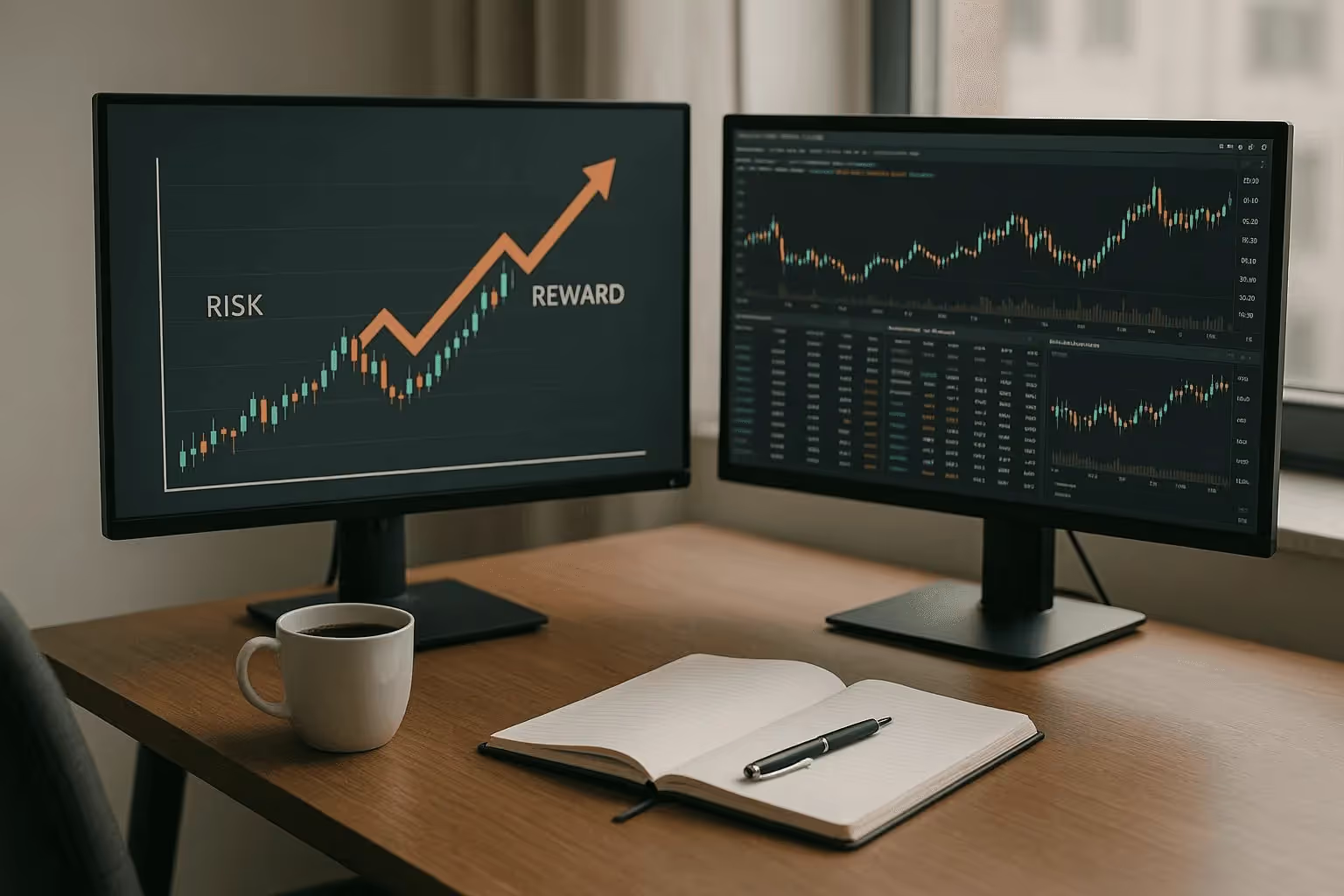
You research providers, meet their requirements, submit an application, pass an evaluation, and sign an agreement. The process can be completed in a few weeks if you approach it systematically. Some programs skip the evaluation entirely and fund you immediately. The steps sound simple because they are. Complexity arises when traders treat this as a job application rather than a performance test. You're not convincing someone to hire you. You're demonstrating you can follow rules while generating returns.
1. Research Providers Based on Your Trading Style, Not Marketing Claims
Different prop firms structure their programs for different trading approaches. Scalpers need firms that allow high-frequency trading without restrictions on holding periods. Swing traders need firms that permit weekend holds and don't impose daily trade minimums. News traders need clarity on whether trading during major economic releases violates rules. Start by listing your non-negotiables. What markets do you trade (forex, crypto, futures)? What's your typical hold time (minutes, hours, days)? Do you trade only during specific sessions? How much capital do you actually need to execute your strategy effectively?
Then filter providers against those criteria. A firm offering $200,000 accounts sounds impressive until you realize they prohibit holding trades overnight, which kills your entire swing trading approach. Another firm might offer smaller account sizes but allows the exact trading style you've already proven works for you. According to ForTraders, some programs offer 20% off for New Customers, reducing your initial cost. That discount matters less than whether the program's rules align with how you actually trade. Paying full price for a structure that fits your approach beats getting a discount on a program that forces you to trade differently.
Read the fine print on profit splits, payout schedules, and scaling opportunities. Some firms advertise 80% profit splits but bury clauses that reduce your share after certain thresholds. Others process payouts monthly, which creates cash-flow gaps if you're treating them as income. Scaling terms matter if you plan to grow beyond your initial account size. A firm that caps you at $100,000, regardless of performance, limits your long-term earning potential.
2. Meet Eligibility Requirements Without Overthinking Them
Most providers set minimal barriers. You need to be 18 or older. You need basic trading knowledge (which you already have if you're reading this). Some require you to pass a simple quiz about risk management and trading rules. That's not a test of expertise. It's confirmation you've read their terms. The trading experience requirement varies. Some firms want proof of six months of active trading. Others accept three months. A few skip this entirely in favor of instant funding programs. If you've been trading consistently, even on a demo account, you likely qualify.
A clean trading record means no history of fraud, no pattern of chargebacks with previous prop firms, and no violations of industry regulations. Unless you've been banned from a platform or have unresolved disputes, you won't be prevented from accessing it. Profitability in simulated environments is evaluated using traditional evaluation models. They want evidence that you can generate returns without blowing up accounts. If you've never traded profitably, even in demo conditions, passing their evaluation becomes significantly harder. That's not gatekeeping. That's reality. The evaluation tests the same skills you'd need anyway.
Programs like the funded trading program remove the simulated profitability requirement by offering instant funding. You pay a fee, receive immediate capital access, and start trading under their rules. Profit targets remain achievable (2-10%), drawdown limits remain protective, and payouts are processed within 24 hours. That structure works for traders who've already developed an edge and just need capital to scale it.
Submit Your Application With Accurate Information
The application requests identification, contact details, and, in some cases, trading history. Use your legal name exactly as it appears on your ID. Mismatches between your application and verification documents create delays or rejections. Proof of address typically means a utility bill, bank statement, or government document showing your current residence. It needs to be recent (within 90 days) and match the address you listed. Firms require this for regulatory compliance, not because they're invasive.
Trading records, if requested, should show your actual performance. Don't fabricate results or cherry-pick your best trades while hiding losses. Evaluators spot inconsistencies quickly. A track record showing 60% win rate with controlled losses looks more credible than a claimed 95% accuracy with no supporting data. Upload clear, readable documents. Blurry photos of your ID or cropped bank statements that cut off key information force the review team to request resubmissions. That adds days to a process that should take hours.
Double-check everything before submitting. Wrong email addresses mean you miss communication about your application status. Typos in your legal name can cause issues when you try to withdraw profits later. These aren't minor details. They're friction points that slow or stop your progress.
Pass the Evaluation by Trading Your Plan, Not Theirs
Traditional evaluations assess whether you can meet profit targets while adhering to drawdown limits. The targets sit around 8-10% for Phase 1. Your strategy, your timeframe, your approach, as long as you stay within their risk parameters. Trade the setups you've already proven work. If your edge appears during the London open breakouts, trade those. If you're profitable swing trading daily timeframes, do that. The evaluation isn't asking you to learn a new style. It's asking you to execute your existing edge under their risk management structure.
Position sizing determines whether you pass or violate drawdown limits. Risk 0.5-1% per trade, and you need a catastrophic losing streak to hit maximum drawdown. Risk 3-5% per trade, and three bad trades in a row terminate your account. The math doesn't care about your confidence level. Track your performance daily. Know exactly where you stand relative to profit targets and drawdown limits. If you're at 6% profit with 2% drawdown remaining, you have room for two more 1% risk trades before hitting limits. That awareness prevents the emotional decision to "push for the target," which can lead to oversized positions. Some traders pass Phase 1 in a week. Others take three weeks. Speed doesn't matter. Consistency does. The evaluation measures whether you can protect capital while generating returns, not whether you can do it quickly.
Sign the Agreement After Reading Every Section
The contract defines your relationship with the firm. Profit split percentages, payout schedules, drawdown limits, prohibited trading practices, scaling criteria, and termination conditions all live in this document. Profit splits may be 70%, 80%, or even 100%, depending on the account tier and performance. Understand exactly what percentage you keep and whether that changes based on account size or consistency bonuses. Payout schedules tell you when you can access your earnings. Some firms process requests within 24 hours. Others batch payouts weekly or monthly. If you need a regular income, monthly payouts create cash flow problems. According to ForTraders, some competitions offer a $5,000 first prize in the Euro Trading Cup, but your regular trading income depends on payout frequency, not occasional bonuses.
Drawdown limits in the live funded account might differ from evaluation limits. Some firms tighten restrictions once you're trading real capital. Others maintain the same parameters. Know what rules apply before you start trading. Prohibited practices usually include holding trades through major news events, trading during restricted hours, or using certain automated strategies. Violating these terms will result in termination of your account, regardless of profitability. If you trade news releases as part of your strategy, and the firm prohibits it, you're signing up for failure. Scaling criteria explain how you access larger capital allocations. Some firms review performance quarterly and increase account size for consistent traders. Others require you to request scaling and demonstrate specific metrics. Understanding this path matters if you plan to grow beyond your initial capital.
Read the termination section carefully. What happens if you violate the rules? Do you lose access to all profits, or just future funding? Can you reapply after a violation, or are you banned permanently? These aren't theoretical questions. They're scenarios that occur in real trading. Once you've read and understood everything, sign and start trading. The agreement protects both parties. The firm gets assurance that you'll follow their risk parameters. You get clarity on exactly what you're entitled to when you perform. The hard part isn't getting funded.
Related Reading
- Sources of Capital
- Cash Reserve Account
- Short Term Stock Trading
- Investment Performance Analysis
- Managed Account vs Brokerage Account
- Systematic Trading
- How to Analyze a Stock Before Buying
- Forex Capital Trading
- What is a Retracement in Trading
- How is Risk Involved in Calculating Profit?
- Convergence Trading
- Liquidity Trading
- Futures Trading Minimum Account Size
- What is Drawdown in Trading
- Best Prop Firms in UAE
- Forex Prop Firms With Instant Funding
- Regulated Prop Firms
- Prop Challenge
Pass the Funded Account Challenge Without Rushing Trades or Blowing Drawdown
The hard part isn't getting funded. It's staying funded. That requires trading the same way after you pass as you did during the evaluation. Same position sizing. Same risk management. Same patience waiting for setups that meet your criteria. The challenge tests whether you can execute that discipline when it matters, not just when it's convenient.
Failing to fund trading challenges because you hit max drawdown before reaching the 8–10% target? The problem isn't your strategy. It's the pressure to perform quickly that makes you abandon what works. AquaFunded is built for traders who pass risk control and avoid over-leveraging. With no time pressure, realistic evaluation targets, and flexible daily drawdown rules, you can trade 0.25–1% risk per setup and still clear the challenge without forcing trades. Get evaluated for accounts up to $400K, keep up to 100% of profits, and follow the same slow, rule-based approach used by consistently funded traders. AquaFunded doesn't reward speed. It rewards discipline.
Your skill brought you this far. The capital you receive amplifies that skill across larger position sizes, more diversified portfolios, and setups that actually move the needle on your income. But only if you protect that capital first. The firms funding you aren't betting on your ability to generate 30% monthly returns. They're betting you can generate 5–8% returns without violating the boundaries that keep accounts alive. That's the entire deal. Execute your edge within their risk parameters, and both parties win. Violate those parameters, chasing faster results, and you're back to square one regardless of how profitable your last three trades were.
Related Reading
- How To Take Profits From Stocks
- Accumulation Distribution
- Short-Term Capital Gain Tax On Shares
- What Is Reit Dividends
- Cash Available To Trade Vs Settled Cash
- Best Pairs To Trade Forex
- Can You Day Trade In A Roth Ira
- What Is A Conditional Order
- Orb Strategy Trading
- Stop Loss Vs Stop Limit
- Flag Pattern Trading
- Characteristics of Growth Stocks
- Forex Compounding Plan
