




10 Best Cheapest Futures Prop Firms for Beginners
Cheapest Futures Prop Firm options explained for beginners. Discover low-cost evaluations, transparent rules, and 24-hour payouts with AquaFunded & top firms.

Many traders seek a cost-effective path into futures trading without the burden of high evaluation fees or hidden costs. What is a funded account? It is an arrangement in which a firm provides capital, allowing traders to access markets and share in profits without risking their personal funds. This model removes financial barriers and facilitates trading in popular contracts such as ES and NQ. AquaFunded offers a funded trading program that emphasizes straightforward pricing and supportive policies, providing traders with a practical route to professional opportunities.
Summary
- Futures prop firms operate on a subscription model that makes low evaluation fees financially viable without resorting to predatory practices. Firms like Topstep and Apex Trader Funding charge between $49 and $167 per month, depending on account size, yet Apex alone has publicly reported over $300 million in payouts since inception. The business model generates revenue from scale and recurring subscriptions rather than from denying payouts, similar to SaaS platforms where volume drives profitability.
- The advertised minimum capital requirement tells you almost nothing about sustainable futures trading. According to EuroTrader, realistic starting ranges for commodity and futures trading in 2025 range from $500 to $5,000, but margin requirements are only part of the equation. Undercapitalized traders face margin calls within days because normal market volatility becomes an existential threat. A single overnight gap can move $200 or more against a micro contract, and if your entire account is $300, that gap wipes out two-thirds of your capital before you even wake up.
- Commissions and fees drain small accounts through slow erosion rather than dramatic losses. If you pay $2 to $4 per round-trip on each contract and take 10 trades per week, that amounts to $20 to $40 in fees. On a $500 account, you're losing 4% to 8% of capital just to participate, before covering data, platform, and exchange fees, which can add another $50 to $100 per month. Larger accounts absorb these costs as background noise, but smaller accounts get bled dry by a thousand small cuts that never appear in trade journals.
- Evaluation structure reveals whether a firm wants you to succeed or just wants your fee. Realistic profit targets sit between 8% and 10%, while trailing drawdown rules create minefields where winning streaks followed by normal pullbacks violate limits even when you're net positive. Some firms require 30 active trading days in 60 calendar days, forcing you into the market even when conditions don't suit your strategy. Static drawdown limits prove fairer because they don't move, and you know exactly how much room you have from day one.
- Payout frequency and withdrawal flexibility matter as much as profit split percentages. A 90% profit split sounds better than 80% until you realize the 90% firm only pays monthly and requires a $1,000 minimum withdrawal, while the 80% firm pays weekly with no minimum. Firms that process payouts within 24 to 48 hours and provide tracking or confirmation aren't doing favors; they're operating like functional businesses rather than inventing administrative delays to stall withdrawals.
- Aqua Funded's instant funding program addresses capital barriers by eliminating evaluation periods, offering transparent profit targets between 2% and 10%, 24-hour payouts, and no restrictive stop-loss or lot-size rules that impose artificial constraints.
Can You Trade Futures With Less Money

Yes, you can trade futures with less money than most traders think, but the real answer depends on what you're trading, how you're trading it, and whether you're using your own money or accessing funded accounts. Some micro contracts require only a few hundred dollars in day-trading margin, while standard contracts like ES or NQ require several thousand dollars. The barrier isn't just the margin requirement; it's whether you have enough cushion to handle normal market swings, cover fees, and avoid emotional decisions when your account balance declines. Additionally, you might find that our funded trading program provides a great option to start trading with reduced financial risk.
The practical minimum is always higher than the stated minimum. Opening an account with $500 seems easy until you see that a single bad trade can wipe out 30% of your capital, leaving you underfunded and mentally shaken. According to NinjaTrader's 2024 analysis, traders often need two to three times the stated margin requirement to trade sustainably, accounting for drawdowns, commissions, and the mental bandwidth required to make sound decisions under pressure.
Many futures prop firms operate on a subscription model, allowing them to charge evaluation fees much lower than what traders believe is required for a full program. Firms like Topstep and Apex Trader charge between $49 and $167 per month, depending on the account size. Yet, they have paid out hundreds of millions to traders. Apex alone has reported over $300 million in payouts since it launched, with tens of thousands of active evaluation accounts running concurrently.
How do low pricing structures work for prop firms?
Low pricing works because most traders fail to evaluate it. Subscriptions renew monthly, allowing the firm to earn from scale rather than denying payouts. This model is similar to a high-volume fintech approach, such as SaaS platforms, where revenue comes from recurring user fees rather than individual transaction markups. The idea that cheap equals scam doesn't hold up when you understand the business structure, volume, and that profitability isn't driven by deception. More details are available in the article on volume, not deception.
Topstep has historically reported paying out over $100 million to traders. Yet, its smallest evaluation tier has been under $100 per month. If "cheap" meant no payouts, verified payout totals wouldn't exist. Firms that last do so because they pay traders who pass evaluations and follow the rules. On the other hand, those that don’t pay disappear quickly, often buried under negative reviews and regulatory scrutiny.
The real filter isn't price; it's consistency. Firms with low fees attract many traders, most of whom lack the discipline to pass evaluations. The traders who do pass are often those who have already failed multiple times. They learn from their failures, gaining the emotional control needed to follow rules under pressure. Ultimately, the fee structure does not predict payout reliability; the firm's track record and transparency are what truly matter. To gain an edge, consider options beyond a funded trading program.
What does behavioral finance say about trading pressure?
For a beginner futures trader, a $49 evaluation represents controlled downside. In contrast, a $500 evaluation creates psychological pressure and heightens sunk cost bias. Research in behavioral finance shows that traders perform worse under high financial pressure because they overtrade, increase position sizes too quickly, and break rules to "recover the fee." Lower-cost challenges significantly reduce emotional stress and allow for repeated attempts at skill development without catastrophic financial consequences.
When paying $500 upfront, every losing trade feels like it’s losing money you can't afford to lose. Consequently, traders start forcing trades that aren’t there. They hold losing positions longer than they should, as cutting losses feels like admitting they've wasted the entry fee. This emotional spiral often leads to account failures, rather than just market conditions. Cheaper evaluations allow traders to accept failures without the burden of financial regret affecting their decisions.
What benefits does regulated futures trading have?
Unlike unregulated CFD models, futures trading occurs on exchanges such as the CME Group. This central clearing setup reduces the risk of pricing manipulation, standardizes contract terms, and enhances transparency into how trades are executed. This system helps large companies operate efficiently at scale, enabling lower pricing models. The exchange handles the complex tasks of trade settlement and risk management, so trading firms do not have to build these systems from the ground up.
Central clearing also ensures that traders are dealing with real contracts, not fake ones that brokers can alter secretly. The price shown is the same price available to everyone. How well your order is executed depends on the broker's technology, not on hidden agendas against you. This clear structure allows futures prop firms to offer low-cost evaluations without using unfair methods. The exchange maintains fairness, while the firm focuses on managing trader risk and payment processing.
How can Aqua Funded help in trading?
Most traders face capital barriers. They often save for months or risk their personal funds, which they cannot afford to lose. As account balances grow and emotional stakes rise, making clear decisions becomes harder. Losses feel personal, and wins can seem delicate. Platforms like AquaFunded help ease this pressure by providing instant funding without strict stop-loss rules or lot size limits. This lets traders use real capital from day one. Profit targets range from 2% to 10%, and payouts are processed within 24 hours, backed by financial guarantees. You're not gambling with rent money; you're showing your skill with capital meant specifically for that. However, knowing that you can trade with less money doesn't answer the more complicated question: how much capital do you really need to trade futures steadily without always worrying about margin calls?
How Much Money Do You Need for Trading Futures

You can open a futures account with $500 or less, especially for micro contracts. However, this amount doesn't indicate whether you can make it through your first month as a trader. The important question isn't what brokers allow: it's what the market needs during times of high volatility. This includes situations such as three consecutive losing trades or the need for enough flexibility to stick to your risk rules without panicking about closing positions that may still have potential.
According to EuroTrader, the realistic starting range for commodity and futures trading in 2025 is between $500 and $5,000 based on contract size and risk tolerance. This range exists because margin requirements are only part of the picture. The rest depends on having a cushion for drawdowns, being able to cover fees, and your mental readiness. If your account drops 15% in a week because the market turned against you, do you have enough left to follow your trading system, or are you pushed into desperation mode?
Brokers advertise low minimums to get more clients; you can technically start trading micro E-mini contracts with $100 to $500 in your account. Even though the margin requirement might only be $50 per contract, margin does not equal risk. A single overnight gap can cost you $200 or more on a micro contract. If your entire account balance is $300, that gap can wipe out two-thirds of your money by the time you wake up. Traders with insufficient capital often receive margin calls within days, not months. Normal market ups and downs can then feel like a serious threat. It may be difficult to let a trade settle, making it hard to handle temporary losses. Every tick against you can seem like a countdown to losing your account.
The mental strain of trading with money you can't afford to lose creates a bad cycle: you overtrade to get back losses, ignore your stop-loss rules since hitting them means your trading is over, and start chasing movements that have already happened because staying inactive feels like missing your last chance. Consider exploring our funded trading program to help manage risk effectively.
How much should you start with?
The gap between what brokers allow and what the market requires is very important. The minimum amount shown gives access but does not guarantee success. For micro futures such as MES or MNQ, experienced traders recommend starting with at least $2,000 to $5,000. This amount is not random; it is based on risk management calculations and the probability of losing streaks. If a trader risks 1% to 2% per trade, a common approach for anyone aiming to last longer than a few months, a $2,000 account allows $20 to $40 of risk per trade. This amount helps set reasonable stop losses without being triggered by normal daily fluctuations.
What are the risks of low capital?
With $500, risking 2% yields $10 per trade. On a micro contract, that's about two to three points of movement on MES. The market can move that fast, sometimes in just seconds. Your stop might get hit, not because your analysis was wrong, but because you didn't have enough room for the trade to develop. You're not just trading your edge; you're trading your account size. The difference between $500 and $2,000 isn't just about having more money. It means way more decisions, with increased room to be wrong and still recover. It lets you follow a system rather than reacting to every price swing as if it's a crisis. When traders lose their accounts, it's rarely because they don't understand technical analysis; it's often because they lack sufficient capital to execute what they already know.
What about the capital requirements for standard contracts?
If you want to trade standard E-mini contracts like ES or NQ, you need a lot more money in your account. Many experienced traders won't touch these contracts with less than $10,000 to $25,000. The margin requirement can range from $500 to $1,200 per contract, depending on the broker and market conditions. But the main issue isn't just the margin; it's how much the market moves. One point on ES is worth $50. On a bad day, you might see the market swing 30 to 50 points.
If you're trading one contract with a $10,000 account and the market moves 20 points against you, that's $1,000 lost, which is 10% of your money, before even thinking about whether the trade could get better. With $25,000, that same move results in a 4% loss; it hurts, but you can recover. On the other hand, if you have $5,000, that move would result in a 20% loss, which could take you weeks to recover from.
How do commissions and fees impact trading?
Traders who do well with standard contracts aren't always better at reading charts. They have enough money so that a typical losing trade doesn’t force them to change everything they do. They can accept the loss, reset, and move on to the next trade without feeling the pressure of trying to recover from a big loss. Commissions and fees might not seem like much at first, but they add up when you're trading a $500 account. If you're paying $2 to $4 per round-trip on each contract and you take 10 trades a week, that adds up to $20 to $40 in fees. On a $500 account, that's about 4% to 8% of your money gone just to trade. You have to win enough to cover those costs before you can start making a profit.
What happens with larger accounts?
Data, platform, and exchange fees can add up quickly. Some brokers charge between $50 and $100 per month for real-time data and advanced charting. If you're starting with only $500, you're already down 10% to 20% before your first trade. The math just doesn't add up. You're not trading against the market; you're trading against the cost structure of being undercapitalized. On the other hand, larger accounts can cover these costs, making them feel like background noise. Smaller accounts, however, are impacted by these charges. The effect is not always dramatic and does not stem from a single bad trade. Instead, it is the slow loss of funds from a thousand small cuts that never appear in the trade journal.
How does emotional pressure affect trading?
When traders use money they can't afford to lose, every decision becomes harder. They hesitate at entry points because they fear being wrong. Winners are often sold too early as they try to secure profits before they disappear. Losses may be held too long because cutting them means admitting a loss of money that is urgently needed for rent or groceries. This reaction isn't a character flaw; it's a common outcome of financial stress. Behavioral finance research consistently shows that traders perform worse under high financial pressure. Risk tolerance declines, and time horizons shorten. Traders are increasingly focused on survival rather than probabilities. The strategies that worked in demo accounts often fail when real money is at stake because the emotional burden of real money significantly affects execution.
What do most traders do?
Most traders handle this challenge by saving for months or even years to build an account big enough to trade without fear. As the balance gets bigger, the emotional burden also increases. Every win feels fragile, while every loss feels personal. They are not just risking money; they are also risking the time and effort that went into building that money in the first place. Platforms like AquaFunded remove that pressure entirely by offering instant funding with no evaluation period and no strict stop-loss or lot-size rules. Traders can use real capital from day one, allowing them to focus on achieving profit targets of 2%-10% rather than worrying about margin calls or account survival. Payouts are processed within 24 hours, guaranteed by financial backing, and fees are 100% refundable. This setup allows traders to demonstrate their skills with funds designated solely for that purpose, rather than betting with money they can't afford to lose.
Are you prepared for the next challenge?
The question isn't whether you have enough money to open an account; it's whether you have enough to trade without fear, follow your rules, and get through the losing streaks that happen with any edge. For most traders using their own money, that number is often higher than they want to admit. Knowing the right amount of capital does not fully prepare you for the next issue: how can you tell real low-cost prop firms from those that are just trying to take your money and disappear?
Related Reading
- What is a Funded Account
- How to Grow a Small Trading Account
- What is Trading Commodities
- Long Term Trading Strategy
- Capital Growth Strategy
- What is a Cash Account in Trading
- What is Compound Trading
- How Much Money Do You Need to Start Trading Stocks
- Scale Trading
- Small Account Trading
- How to Evaluate Investment Opportunities
- Blown Trading Account
- What is PNL in Trading
- Do Prop Firms Use Real Money
- Prop Firm Account Management
- Borrowing on Margin
- Trading Leverage
- Does FTMO Offer Instant Funding
- Prop Firm Static Drawdown
- Funding Traders Rules
- What Is Prop Firm Account
- Synthetic Funded Account
- What Is Funded Firm
- Trading Challenges
- Prop Firm IP Address Rule
- Instant Funding Rules
- Do Prop Firms Use Real Money
- How to Get a Funded Trading Account
- FTMO vs The5ers Comparison
- Best Forex Pairs to Trade
- Best Automated Crypto Trading Platform
How to Choose the Cheapest Futures Prop Firms
You choose the cheapest futures prop firm by looking beyond the entry fee and checking the total cost of participation. Think about things like profit splits, payout speed, rule structure, platform quality, and how often traders actually get funded. A $35 evaluation that traps you with restrictive rules or delays payouts for weeks ultimately costs more than a $150 challenge that pays within 24 hours and lets you grow without random barriers. Price matters only when it's compared with execution quality and clear terms.
Firms that advertise 80% off sales, lowering $50,000 evaluations to $35, as per QuantCrawler, do not always give you value. They often think you will fail the challenge, have to restart many times, and make a steady income through resets. This business plan relies on high customer volume to offset the low price. While this approach isn't necessarily bad, it's vital to understand what you're buying. A cheap evaluation with a 10% profit target and a trailing drawdown that gets tighter each day isn't easier than a moderately priced one with an 8% target and fixed risk limits.
During the evaluation phase, you find out if a firm genuinely wants you to succeed or just wants your fee. Realistic profit targets typically range from 8% to 10%. Anything higher pushes you toward overtrading, while anything lower might seem easy until you see that drawdown limits are so tight that they don't allow your trades to work out properly. Some firms set daily loss limits so strict that a single bad entry in a volatile session can disqualify you, even if your overall week would have been profitable.
Why do trading days matter?
Trading days are important for a few reasons. Companies that require 30 active trading days within a 60-day period pressure traders to enter the market, even when market conditions are unfavorable to their strategy. This often leads them to take trades they would otherwise avoid to meet the activity requirement. This situation does not really test a trader's skill; instead, it checks how willing a trader is to break their own rules under artificial pressure.
How does trailing drawdown affect you?
Watch for firms that use a trailing drawdown. It sounds fair in theory: as your equity rises, your maximum loss limit also rises, which helps protect your profits. However, in real life, a winning streak followed by a normal pullback can hit your drawdown limit, even if you're still making a profit. Static drawdown limits are harder to reach because they do not change. You know exactly how much room you have from day one.
What risk limits do firms impose?
Every futures prop firm has risk limits. The main difference is whether those limits align with how real traders operate or are simply used to disqualify you for minor details. A 5% total drawdown with no daily limit gives you flexibility to manage risk over several days. On the other hand, a 3% daily loss limit with a 6% total drawdown creates a tough situation where one bad morning could end your evaluation, even if you could have recovered by the end of the week.
How do firms handle rule violations?
Some firms punish people for small rule mistakes that don't really relate to trading skill. Examples are forgetting to take a screenshot of trades, logging in from a different IP address, or keeping a position five minutes past the daily cutoff. These actions are not real risk-management rules; instead, they are administrative traps that allow firms to cancel payouts without considering the underlying reasons.
Why is transparency important?
Reputable firms clearly document their risk rules and apply them consistently. If the terms are unclear, hidden in fine print, or change after the evaluation has started, it suggests the firm prioritizes profit over your success. Transparency is not an extra feature; it is the basic requirement for trust.
How do payout structures vary?
A 90% profit split may seem preferable to an 80% split, but several key factors affect that view. The firm that offers a 90% split pays out only once a month and has a $1,000 minimum withdrawal, while the 80% firm pays weekly with no minimum. How often you get paid and how easily you can withdraw your money are just as important as the split percentage. Traders who rely on steady income can't afford to wait 30 days between payouts, especially since a single rule error can restart the wait.
What scales your profit split over time?
Some firms adjust your profit split based on how consistent you are. You start at 80%, reach 85% after three profitable months, and 90% after six. This system rewards staying power and aligns the firm's goals with yours. On the other hand, other firms keep you at 80% forever, no matter how well you do. This method does not create a partnership; it is a fixed-commission arrangement where your skill improvement does not result in better terms.
What should you expect from payout procedures?
Clear payout procedures distinguish legitimate firms from those that stall. If the withdrawal process requires multiple forms and approvals from three departments and causes delays without explanation, timely payment is unlikely. Firms that can pay out within 24 to 48 hours and provide tracking or confirmation are not doing you a favor; they are just operating like a normal business.
How does platform reliability impact your trading?
The lowest evaluation fee is meaningless if the platform can't process your orders reliably. Futures trading depends a lot on speed. A two-second delay between your click and order confirmation can turn a winning scalp into a breakeven or losing trade. Firms that offer direct market access through platforms such as NinjaTrader, Rithmic, or MetaTrader 5 provide the necessary infrastructure to compete effectively. On the other hand, firms that route through their own platforms, with slower fills and wider spreads, impose a hidden cost on every trade.
What markets does the firm cover?
Market access is crucial for traders. If you trade crude oil, gold, and equity indices, you need a firm that provides all three with competitive margin requirements. Some firms focus on specific markets and offer better terms in those areas. Others may try to cover too many markets, resulting in limited access across them. Specialization is not a weakness; it often indicates a firm's strong understanding of its markets.
What are the hidden costs of data feeds?
Data feeds and charting tools can add up to high costs. Real-time data for CME futures usually costs between $50 and $100 per month. Some companies include this cost in the evaluation fee, while others bill it separately. If participants are paying for data in addition to the challenge cost, it's important to include that in the total expense. For example, a $49 evaluation that requires an additional $75 in platform fees isn't cheaper than a $99 all-inclusive option.
What do payout records reveal?
Marketing copy often shows a one-sided view of what a company wants you to think. On the other hand, verified payout records provide a clearer picture of what actually happens. Companies that share payout totals, along with trader testimonials that include real account numbers and independent reviews, have less to hide. In contrast, companies that don't share payout information or claim that it is proprietary might be hiding something; it's probably not your privacy.
How can reviews guide your decision?
Platforms such as Trustpilot, Reddit, and futures trading forums reveal important patterns. One negative review might be an exception, but fifty reviews highlighting the same payout delay, rule change, or support issue suggest a systemic issue. It's important to look for consistency in complaints. If traders keep mentioning the same problem, it's not just bad luck; it shows how the firm runs.
Why does support responsiveness matter?
Support responsiveness is more important than many traders think until they actually need it. A firm that responds within hours and resolves issues without requiring many escalations respects your time. On the other hand, a firm that takes three days to respond to a payout question or blames you for breaking rules without giving an explanation does not.
How can you evaluate instant funding options?
Most traders compare firms by reviewing pricing tables, trying to determine which $49 option offers the best theoretical advantage. They often focus on entry costs but overlook the key structure that determines whether they will ever make a payout. Platforms like AquaFunded make this evaluation easier by offering instant funding with no hidden drawdowns or strict stop-loss rules. Traders can start using firm capital immediately, with profit targets ranging from 2% to 10%. Payouts are processed within 24 hours, and financial guarantees are in place. Fees are 100% refundable, meaning traders are not paying to prove themselves; they pay only to access capital that allows them to trade without the difficulties that typically accompany most funded accounts.
Which firms deliver on their promises?
Knowing how to evaluate firms leaves an important question unresolved: which specific firms actually deliver on their promises without hiding important information in fine print?
Related Reading
- Sources of Capital
- Cash Reserve Account
- Short Term Stock Trading
- Investment Performance Analysis
- Managed Account vs Brokerage Account
- Systematic Trading
- How to Analyze a Stock Before Buying
- Forex Capital Trading
- What is a Retracement in Trading
- How is Risk Involved in Calculating Profit?
- Convergence Trading
- Liquidity Trading
- Futures Trading Minimum Account Size
- What is Drawdown in Trading
- Best Prop Firms in UAE
- Forex Prop Firms With Instant Funding
- Regulated Prop Firms
- Prop Challenge
10 Best Cheapest Futures Prop Firms for Beginners

The best cheap futures prop firms for beginners combine low entry costs with flexible evaluation structures, transparent risk rules, and verified payout histories. While price matters, it needs to be matched with realistic profit targets, static drawdown limits that remain constant while you trade, and a platform that executes orders without slippage or delays. A $35 evaluation that forces traders into trailing drawdown traps will end up costing more than a $150 challenge that allows room to trade your actual strategy.
What differentiates beginner-friendly firms from volume traps is whether the rules align with how real traders build skill or simply exist to generate reset fees. According to MarketMates, funding ranges from $25,000 to $200,000 in most beginner-level programs, with profit splits reaching 90% for traders who pass evaluations and stay consistent. Those numbers only matter if the firm actually pays, processes withdrawals without fake delays, and doesn't disqualify you for administrative issues that have nothing to do with trading performance.
1. AquaFunded

AquaFunded eliminates the evaluation phase, offering instant funding with no time pressure or required trading days. Traders start with firm capital and face profit targets of 2%-10%, depending on their plan. The drawdown rules remain unchanged, ensuring that a winning streak doesn't tighten risk limits and turn normal pullbacks into violations. Payouts are processed within 24 hours, backed by financial guarantees that prevent the delays other firms use to withhold withdrawals. Fees are 100% refundable if targets are met, aligning the cost structure with traders' success instead of working against them. Traders face no restrictions on mandatory stop-loss placements or on lot size, allowing them to trade according to their strategies. The platform gives the flexibility to execute their edge without the friction that can hurt consistency.
For beginners, the lack of evaluation pressure changes the trading experience. There is no race against a 30-day clock, and there is no need to force trades to meet activity requirements. Traders can wait for setups that match their systems, handle losses without the stress of resetting a challenge, and develop skills with capital designed to show how profitable traders usually operate.
2. FundedNext

FundedNext offers evaluations in one-step, two-step, and three-step formats, allowing traders to choose the complexity level based on their experience. The one-step challenge is well-suited for beginners who want fewer obstacles from start to funding. In contrast, the two-step model has slightly lower profit targets but gives traders more time to demonstrate consistency. Profit splits range from 90% to 95%, with accounts growing up to $300,000 as traders demonstrate continued performance.
Platform flexibility is critical to the evaluation process. Traders can use MT5 or cTrader, which offer institutional-grade execution and charting tools with no platform-specific restrictions. The firm supports multiple asset classes, allowing traders to trade both futures and forex without being limited to a single market structure. However, there is a downside to rule density. Additional features, such as no time limits or higher leverage, can increase costs. Furthermore, the evaluation structure, which includes consistency rules, is limiting for some traders. Just hitting the profit target in a few big winning days isn't enough; the firm stresses the need for steady performance over several trading sessions. This method guards against luck but makes it more complex for traders still refining their strategies.
3. My Funded Futures
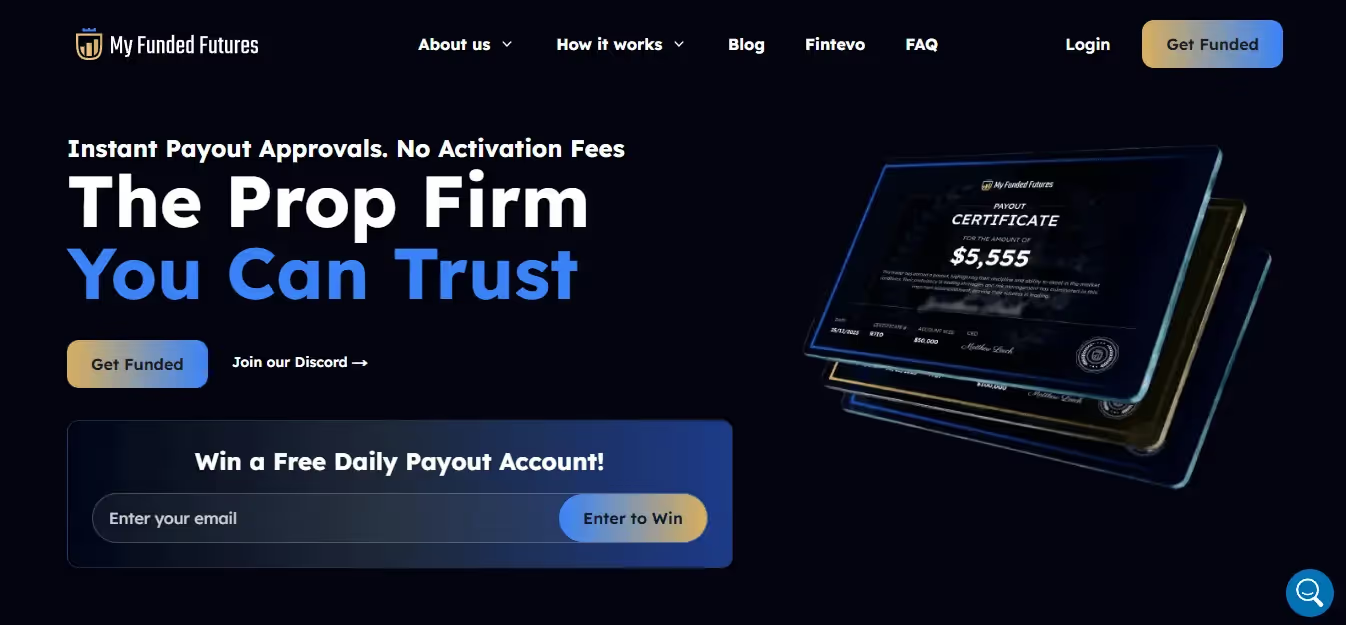
My Funded Futures specializes in futures-only trading, using a static drawdown model that locks in once you're funded. During evaluation, the drawdown is calculated at the end of the day, reducing stress from daily price changes and allowing you to exit positions that would have ended profitably by the close of trading. Once funded, there’s no consistency rule, so you can take your profits as they come without needing to spread wins across random time periods.
The Core and Scale plans prioritize stability over speed, allowing you to build equity gradually without the pressure to meet ambitious goals in short timeframes. On the other hand, the Rapid plan provides daily payouts but uses intraday trailing stop-loss, which reintroduces the risk of being stopped out during normal market moves. This tradeoff is important; getting cash faster comes with stricter risk limits that may not fit every trading style.
Rules vary across plans, which can cause confusion for beginners trying to compare options. What works on the Core plan may not work on the Rapid plan. Recognizing these differences requires careful review of documents that many traders overlook. For those who are careful about understanding the rules, the static drawdown structure after funding is among the cleanest in the industry.
4. The 5%ers

The 5%ers operates on a low-drawdown, controlled-growth model that appeals to traders who prioritize risk management over chasing big profits. The profit target is set at 6%, with a maximum drawdown of 4%, and there is no time limit to achieve it. Traders can take up to three months or even six months, and the firm is flexible as long as the risk limits are followed. The scaling potential reaches $4 million across multiple accounts, and profit shares increase to 100% as traders demonstrate they can stay. Entry starts at about $39, making it one of the most affordable ways to get into the industry.
This setup rewards patience. Traders who focus on small, steady gains without exceeding drawdown limits can eventually build a substantial capital allocation. The firm doesn't specialize in futures, so the platform options and market access mainly focus on forex and CFDs. Those committed to trading futures only might find the infrastructure less suitable than that of firms designed specifically for CME contracts. Additionally, the rule set is more organized than that of some competitors. There are specific requirements for how often to trade and how to size positions, which beginners might find tough and could lead to accidental rule violations.
5. Topstep

Topstep has been funding futures traders longer than most of its competitors have been around. The firm offers a monthly subscription plan that typically starts at around $89, depending on the account size. It places significant emphasis on trader education. You're not just buying access to funds; you're becoming part of a coaching system that includes performance analytics, live mentorship, and structured feedback meant to improve discipline.
The Topstep platform offers commission-free trading, eliminating a hidden cost that can hurt small accounts. The quality of execution is at an institutional level, giving you direct market access to CME contracts with tight spreads that don’t widen during busy trading times. The firm's long history adds credibility, as it has paid out tens of millions to traders who pass evaluations and maintain funded status.
The subscription model entails an ongoing cost for traders. If you do not pass an evaluation, you will continue to pay monthly until you pass or cancel. This can be helpful for traders who view it as an educational expense rather than a one-time challenge fee. Topstep's discipline requirements are stricter than those of newer firms. They have daily loss limits, rules for consistency, and minimum trading days that encourage you to behave like a professional from the very start. While this is helpful if you need external structure, it may feel limiting if you want greater flexibility.
6. Hola Prime

Hola Prime provides direct funding options that skip evaluation entirely. However, these plans have stricter risk rules than challenge-based paths. Entry starts around $48 for evaluation models, with profit splits reaching 95% and scaling potential up to $4 million in demo capital. The firm offers both one-step and two-step challenges, allowing traders to choose between speed and difficulty. The direct funding model is appealing to experienced traders who prefer not to prove themselves again. They can handle stricter drawdown limits and faster disqualification thresholds.
On the other hand, for beginners, the evaluation path makes more sense as it allows them room to learn the platform. This path helps new traders adjust to the firm's risk parameters without the pressure of immediate capital at stake. Platform access covers multiple asset classes, meaning you're not locked into futures if your strategy is better suited to forex or commodities. While this flexibility may be less significant for those focused on the future, it offers options as skills develop. Additionally, the firm's transparency regarding payout processing and rule enforcement exceeds the industry average. However, it may not be sufficiently specialized to compete with firms that specialize in CME contracts.
7. Apex Trader Funding

Apex runs frequent promotions that reduce evaluation costs to $35 or less, making it one of the most affordable entry points. The company allows copy trading across up to 20 accounts. This means that once a trader creates a successful strategy, they can increase their volume without needing to prove themselves again through multiple evaluations. This system rewards consistent performance at scale, rather than requiring traders to face new challenges each time they seek more capital. However, there are activation fees to consider. When a trader passes the evaluation, a fee is charged that is often higher than the initial challenge cost, which increases the total expense.
Also, trailing drawdown rules are strict, and automation restrictions can limit certain trading methods that rely on fast execution or high-frequency scalping. If a trader's advantage depends on speed or automation, Apex's rules will put limits on their trading style. For manual traders willing to handle activation costs and strict risk guidelines, the copy trading feature offers advantages that other firms do not. Traders are not limited to the profit potential of a single account. Instead, they can create a portfolio of funded accounts that use the same strategy simultaneously, effectively increasing returns with minimal additional effort.
8. SabioTrade
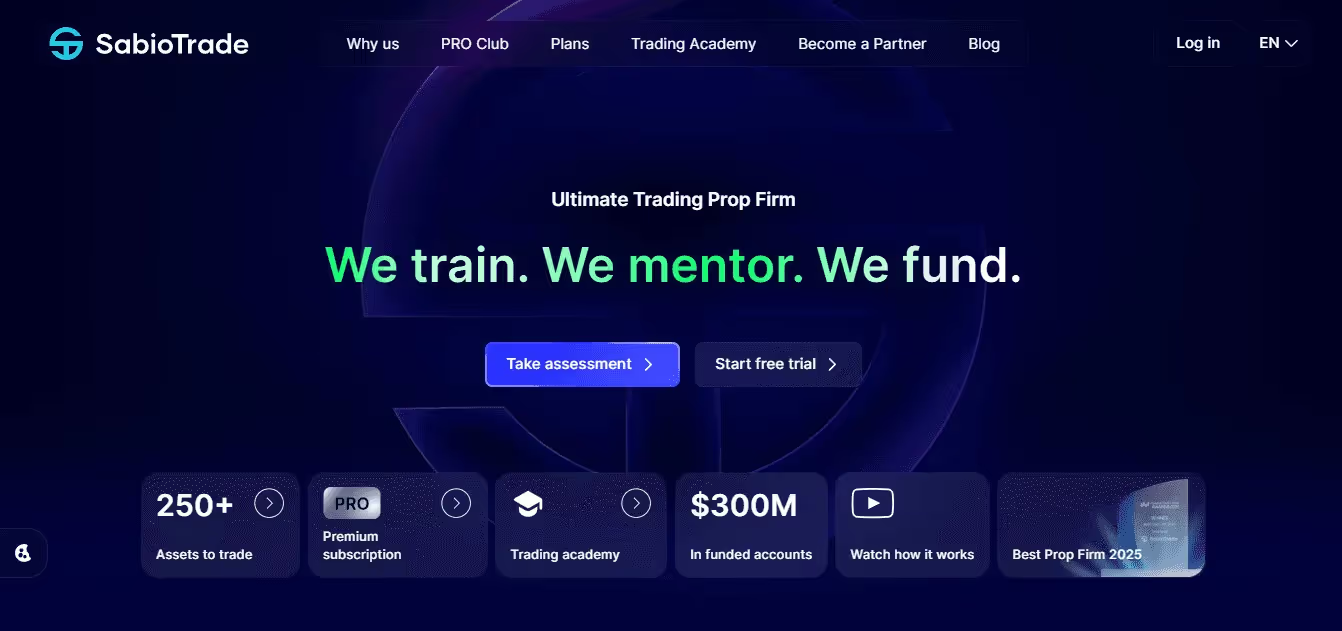
SabioTrade offers a one-step evaluation with no time limit, reducing the pressure to meet targets quickly. Entry costs start at around $99, and the profit split is 90%. The company offers a risk-free trial that lets users try the platform and evaluation process before paying. This trial period is important for beginners who want to learn how the platform works and if the interface fits their needs. The firm supports multiple asset classes, which provides flexibility but can reduce specialization. For traders focused solely on futures, the platform might not be as good as those designed specifically for CME contracts. Although the upfront cost is higher than some competitors' promotions, such as Apex or The 5%ers, the no-time-limit setup helps reduce trading pressure.
SabioTrade's payout structure is clear. There are no strange minimum withdrawal limits or long processing times to deal with. Once users reach their target, they can request a payout and receive their funds within the promised timeframe. This dependability is more important than many traders think until they wait for a withdrawal from a firm that has added new approval steps after they completed the challenge.
9. Take Profit Trader
Take Profit Trader focuses on fast withdrawals and simplified payout eligibility. Once you clear the buffer zone, which typically requires a small profit cushion above your starting balance, there's no minimum trading day requirement. You can request payouts as soon as you're profitable without waiting for arbitrary activity thresholds. That structure suits traders who generate income in bursts rather than steady daily gains.
The buffer zone requirement adds a step that pure instant-funding models skip, but it protects the firm from traders who pass evaluations through luck rather than skill. If you can maintain profitability beyond the buffer, you've demonstrated sufficient consistency to justify continued funding. The firm is futures-focused, with platform access optimized for CME contracts and execution speeds critical to scalping and day-trading strategies. Take Profit Trader is better suited to experienced traders than to absolute beginners. The buffer zone and payout mechanics assume you understand how to manage equity curves and won't panic when a small drawdown delays your first withdrawal. If you're still learning position sizing and risk management, the added complexity might create confusion that simpler models avoid.
10. FXIFY

FXIFY offers instant funding that bypasses evaluation, allowing traders to access live capital immediately. Entry costs start around $69, with a 90% profit split and flexible pricing models that change based on account size and risk tolerance. This instant-funding model appeals to traders who have already demonstrated their skills elsewhere and want to avoid repeating evaluation processes that test patience more than skill. The trailing drawdown is set at 8%, which is tighter than static models but looser than some competitors that use 5% or 6% thresholds. This balance works well for disciplined traders who quickly cut losses and avoid letting positions run into deep drawdowns while hoping for reversals.
However, the maximum capital is lower than for firms offering $200,000 or $300,000 accounts, which limits growth potential for traders who achieve rapid success. FXIFY's platform flexibility and instant access create speed advantages. However, the tighter drawdown rules and smaller capital ceiling mean traders work within narrower limits than those at evaluation-based firms. These firms often reward successful candidates with looser risk guidelines. For beginners, this trade-off depends on whether they prefer immediate access or long-term scalability.
What are the important factors for choosing a prop firm?
Most traders select firms based on entry fees in a spreadsheet. They believe choosing the cheapest option will save them the most money. However, they often overlook key factors such as payout speed, rule clarity, and whether the evaluation actually tests trading skills or simply confirms whether someone will keep paying reset fees. Platforms like AquaFunded take away this problem by removing evaluations. They provide instant funding with clear profit goals, 24-hour payouts, and 100% refundable fees. Traders should focus on securing capital that makes trading easier, rather than just seeking the lowest entry cost. Even the best firm structure doesn't solve a key issue: what happens when someone can't afford the $5,000 to $25,000 margin that most brokers require before allowing safe futures trading?
Can't Afford the $5,000–$25,000 Margin Typically Needed to Trade Futures Safely?
Start with a low-cost evaluation from a futures prop firm instead of having to save for years or risk personal money you can't afford to lose. Affordable challenges from firms like AquaFunded, starting under $200, give you quick access to firm capital without needing to keep thousands in margin. You avoid the slow process of building an account and can trade with proper position sizing from day one. This lets you focus on how well you execute trades rather than just trying to survive.
Most traders address capital constraints by underfunding a broker account, telling themselves they'll "start small and scale up." This method fails because the market's volatility doesn't adjust to your account size. For example, a $2,000 account trading standard ES contracts puts you one bad session away from a margin call, forcing you to exit positions at the worst possible time. As a result, you’re not really learning to trade; instead, you’re managing fear while the market punishes you for not having a good cushion.
Platforms like AquaFunded remove that pressure by providing instant funding with clear profit targets, 24-hour payouts, and 100% refundable fees. Here, you’re not just looking for the lowest entry cost; you're getting capital that lets you trade without the issues most funded accounts create to protect themselves at your expense. The alternative path costs less up front and helps you build skills faster because you're trading at a size that matches the capital backing your positions. Risk management becomes a skill you practice, not a desperate effort to avoid losing your account.
Related Reading
- How To Take Profits From Stocks
- Accumulation Distribution
- Short-Term Capital Gain Tax On Shares
- What Is Reit Dividends
- Cash Available To Trade Vs Settled Cash
- Best Pairs To Trade Forex
- Can You Day Trade In A Roth Ira
- What Is A Conditional Order
- Orb Strategy Trading
- Stop Loss Vs Stop Limit
- Flag Pattern Trading
- Characteristics of Growth Stocks
- Forex Compounding Plan
