




FTMO vs. Topstep: Which One is Better for Beginners?
Discover the key differences in FTMO vs. Topstep and find out which prop firm is better suited for beginner traders.

You've spent months mastering chart patterns, perfecting your risk management, and developing a trading strategy that actually works. But there's one problem: your personal capital is limited, and risking your own money feels like walking a tightrope without a net. This is where understanding what a funded account is becomes essential, and why comparing prop firms like FTMO vs Topstep matters for traders ready to access substantial capital without putting their savings on the line.
If you're exploring options beyond FTMO and Topstep, AquaFunded offers a funded trading program designed to get skilled traders behind real capital faster. With flexible evaluation processes, competitive profit splits, and trader-friendly rules, AquaFunded helps you trade with a funded account while keeping more of what you earn. Whether you're comparing challenge costs, drawdown limits, or payout speeds across different prop firms, having alternatives helps you find the right fit for your trading style and goals.
Summary
- Topstep's single-phase evaluation with trailing drawdowns and no fixed deadlines offers a more forgiving structure for beginners than FTMO's two-phase system, which has strict time limits and daily loss caps. The trailing drawdown mechanism moves upward as traders build profits, meaning a $2,000 gain raises the safety threshold by $2,000 rather than keeping it fixed. This design accommodates the uneven learning curve most new traders experience, where moderate mistakes don't immediately trigger elimination or require a complete restart.
- Most funded account failures stem from rule violations rather than flawed trading strategies. According to Topstep data, even experienced traders with eight-figure track records emphasize that discipline around operational boundaries matters more than win rates. FTMO's 5% daily loss limit catches traders during emotional recovery attempts after losing trades, while the 10% maximum drawdown punishes position-sizing errors that beginners often make while still learning to calculate appropriate lot sizes across correlated currency pairs.
- Cost structures shape trader behavior in ways that extend beyond simple financial calculation. FTMO's substantial upfront fee (though refundable after first payout) creates psychological urgency that conflicts with patient skill development, while Topstep's monthly subscription model functions more like tuition for ongoing access to coaching resources and unlimited evaluation attempts. Traders who need three to six months to develop genuine consistency accumulate higher costs with Topstep, but avoid the acute financial loss and confidence damage that comes from losing large one-time fees on failed FTMO attempts.
- The unregulated nature of the funded trading industry creates information asymmetry that disproportionately affects beginners. Most prop firms operate without meaningful regulatory oversight, which enables exploitative terms, ambiguous rule changes mid-evaluation, and limited recourse when disputes arise over account terminations or delayed payouts. Marketing materials emphasize capital access, while the fine print contains restrictions that only become apparent after traders have incurred fees and spent time evaluating.
- Evaluation structures often test skills in artificial conditions that don't align with actual funded-trading requirements. Minimum trading-day requirements force activity during suboptimal market conditions, while consistency rules can flag profitable swing-trading strategies that concentrate gains across fewer sessions or use high-win-rate approaches with occasional larger losses. These aren't failed strategies; they're approaches that work in live markets but don't fit the narrow assumptions evaluation programs make about what repeatable performance looks like.
- AquaFunded's instant funding option and removal of time-based evaluation constraints address the specific pressure points that cause beginners to fail due to rule violations rather than strategy weaknesses, offering flexible evaluation paths with transparent profit splits up to 100% and guaranteed 24-hour payouts.
What is FTMO and TopStep

FTMO and Topstep are prop trading firms that fund skilled traders, but they operate in different markets with different rules. FTMO focuses on forex, indices, and crypto with high leverage and strict daily loss limits. Topstep specializes in futures trading, with trailing drawdowns and no fixed daily profit targets. Both require passing evaluation phases, but the structure of those challenges reflects fundamentally different philosophies about how beginners should learn to trade.
Market Structure Shapes Beginner Experience
FTMO operates in decentralized forex markets where leverage can amplify both gains and mistakes. You're trading currency pairs, indices, and crypto with lot sizes that beginners often miscalculate. One oversized position can trigger a daily loss violation before you realize what happened. The 5% daily loss limit sounds reasonable until you're managing multiple pairs across different sessions, each with its own volatility profile. Topstep trades centralized futures markets with standardized contracts. Position sizing becomes concrete: one ES contract, two NQ contracts, three crude oil contracts. The math stays visible. The trailing drawdown model moves upward as you profit, so your worst day doesn't define your overall evaluation. That difference matters when you're still learning to manage emotional reactions to losing trades.
Time Pressure vs. Consistency Pressure
FTMO evaluation phases come with calendars and profit targets. You need a minimum number of trading days plus a percentage gain within a set timeframe. That structure encourages beginners to trade more frequently than their strategy warrants. I've watched traders force setups that weren't there to meet minimum trading days before time expired. The urgency creates psychological pressure that conflicts with disciplined execution. Topstep removes the daily profit target. You're measured on net consistency over time, not hitting specific gains by specific dates. The evaluation asks: Can you survive and slowly grow capital without blowing up? That question is better suited to beginners because it prioritizes risk management over aggressive gain-seeking. You learn to wait for high-quality setups rather than chasing manufacturing trades to meet artificial deadlines.
Rule Violations End More Accounts Than Bad Trades
Most FTMO failures happen because traders breach rules, not because their strategy failed. The daily loss limit catches emotional revenge trading. The maximum drawdown penalizes position-sizing errors. According to Topstep, even 8-figure traders emphasize that discipline around rules matters more than win rate. FTMO's structure assumes you already understand how to stay within boundaries under pressure. Beginners rarely do. Topstep's trailing drawdown gives you room to recover from mistakes. If you increase your account balance from $50,000 to $52,000, your drawdown limit will increase accordingly. A bad day doesn't reset your progress to zero. That forgiveness allows beginners to correct course rather than start over. The learning curve becomes iterative rather than binary.
Education and Support Infrastructure
Topstep builds coaching sessions, community feedback loops, and educational components into its program. They assume you're still learning how markets work and how your psychology responds to risk. The infrastructure supports skill development through the evaluation process.FTMO assumes you arrive with complete knowledge of risk management, execution, and emotional control. Their materials focus on rules and technical requirements rather than foundational trading education. If you don't already know how to calculate proper lot sizes or manage correlated pairs, you're expected to figure that out before attempting their challenge. Many profitable demo traders pass Topstep evaluations before they ever pass FTMO because Topstep accommodates the learning process while FTMO tests whether you've already learned.
Why the Difference Matters for Your First Funded Account
Choosing between FTMO and Topstep isn't about which firm is better. It's about which evaluation structure matches where you are right now. If you're still figuring out how to size positions correctly, avoid revenge trading after losses, or stay patient during slow market conditions, Topstep's structure provides space to develop those skills. If you already trade profitably with strict discipline and want access to high-leverage forex markets, FTMO's challenge tests whether you can maintain that discipline under their specific constraints. The wrong choice doesn't just cost you the evaluation fee. It costs you confidence. Failing an FTMO challenge because you miscalculated lot size feels different than failing because your strategy didn't work. One teaches you about markets. The other just punishes inexperience with rules you didn't fully understand yet.
When prop firms emerged, the assumption was that any disciplined trader could adapt to any set of rules. That assumption ignores how much beginners are already managing: strategy development, emotional control, technical execution, and market understanding. Adding complex rule structures on top of that learning curve creates failure points unrelated to trading skill. Programs like funded trading program recognize this by offering flexible evaluation paths with transparent rules and no hidden restrictions, letting traders focus on developing skills rather than navigating bureaucratic constraints. But here's what most beginners miss when comparing these firms: the evaluation is only the beginning.
FTMO vs. Topstep: Which Is Better for Beginners?

Topstep offers gentler onboarding for beginners by removing time pressure, providing structured coaching, and using a trailing drawdown that forgives early mistakes. FTMO demands stricter discipline from day one, with fixed profit targets, calendar deadlines, and daily loss limits that penalize inexperience more quickly. Your choice depends on whether you need space to learn or you're ready to prove existing skills under tight constraints.
Evaluation Structure and Learning Pressure
FTMO splits the evaluation into two distinct phases: the Challenge and Verification. Each phase requires hitting specific profit targets within calendar limits while adhering to a 10% maximum drawdown and a 5% daily loss cap. You need a minimum number of trading days in each phase, which forces activity even when high-quality setups aren't available. That structure works if you already trade with consistent discipline. It punishes beginners who haven't yet learned to sit on their hands during low-probability conditions.
The two-phase model also means starting over costs time and money. Fail the Challenge, and you're back to square one with a new fee. Fail Verification after passing the Challenge, and the psychological toll compounds. You were close enough to taste success, then lost it due to a single miscalculated position or an emotional reaction you couldn't control yet.
Topstep uses a single-phase Trading Combine with no firm deadline. You're measured on net performance over time, not hitting percentage gains by specific dates. The trailing drawdown moves upward as you profit, so a $2,000 gain raises your safety threshold by $2,000. Bad days don't erase progress. That forgiveness matters when you're still learning how your psychology responds to losing streaks or how position sizing shifts across different contract types.
The Combine structure assumes you're developing skills during evaluation, not just demonstrating them. Topstep layers in coaching calls, live webinars, and community feedback loops that treat evaluation as education. FTMO assumes you arrive fully formed. Their materials explain rules rather than foundational risk-management or emotional-control techniques. If you don't already know how to calculate proper lot sizes across correlated pairs or manage overnight risk in crypto markets, you're expected to figure that out before attempting their challenge.
Cost Models and Financial Risk
FTMO charges a one-time evaluation fee, which is refunded upon passing and receipt of your first payout. According to Benzinga's comparison of FTMO and Topstep, profit splits reach 90% once the account is funded. No recurring costs exist after you pass. That structure reduces long-term expense if you can pass quickly. The risk is concentrated up front: pay the fee, pass or fail, then decide whether to try again.
Topstep operates on a monthly subscription during the Combine. The fee continues until you pass, so slow progress incurs costs. If you need three months to develop consistency, you've paid three times. If you need six months, the total exceeds FTMO's one-time fee. But here's what that subscription buys: unlimited attempts within your active period, ongoing access to coaching resources, and no psychological reset from losing a large upfront payment.
For beginners with limited capital, the financial structure shapes behavior. FTMO's refundable but substantial upfront fee creates urgency. You feel pressure to pass quickly before considering another attempt. That urgency conflicts with patient skill development. Topstep's subscription feels more like tuition. You're paying for access to learning infrastructure, not just an evaluation. The monthly cost hurts less acutely, which paradoxically reduces the emotional desperation that causes rule violations.
Some traders pass FTMO on their first attempt and never look back. Others burn through multiple fees trying to force consistency they haven't developed yet. The cost model affects your bottom line. It affects your decision-making under pressure, and beginners make worse decisions when they're worried about wasted money.
Profit Sharing and Payout Mechanics
Both firms offer competitive profit splits, but payout timing differs in ways that matter for cash flow. FTMO typically processes payouts monthly or bi-weekly once you're funded. Topstep offers daily payouts once certain criteria are met. That daily access helps beginners who need to see tangible rewards quickly, either for motivation or because they're trading with tight personal budgets.
The profit split percentages sound similar on paper, but maximum account sizes and scaling paths diverge. FTMO offers larger capital allocations at higher tiers, which benefits long-term growth if you can maintain consistency at scale. Topstep's daily payout structure prioritizes immediate access over maximum ceiling, which suits traders who value liquidity over eventual account size.
Neither model is objectively better. The question is whether you need frequent small wins to maintain confidence, or if you're comfortable waiting for larger, periodic payouts. Beginners often underestimate the psychological momentum of seeing real money hit their account regularly, even in small amounts. That feedback loop reinforces discipline faster than waiting 30 days to learn whether your month was profitable enough to withdraw.
Market Access and Platform Flexibility
FTMO supports multiple asset classes: forex pairs, stock indices, commodities, cryptocurrencies, and individual stocks. You can trade through MT4, MT5, or cTrader, all familiar platforms with extensive community support and third-party tools. That breadth matters if you want to explore different markets or if your strategy works better in specific conditions across asset types.
Topstep focuses exclusively on futures contracts. You're trading ES, NQ, crude oil, gold, bonds, and other standardized instruments through platforms like TopstepX, NinjaTrader, or Tradovate. A narrower focus isn't a limitation if futures align with your interests. It's a feature. Futures markets operate with transparent order flow, centralized exchanges, and standardized contract specifications, which make position sizing mathematically simpler than calculating lot sizes for leveraged forex pairs.
For beginners still figuring out which markets suit their temperament, FTMO's variety of markets offers a way to explore. For beginners who already know they want to trade futures, Topstep's specialization provides depth. The wrong choice here isn't about quality. It's about fit. Learning forex risk management doesn't translate directly to futures margin requirements, and vice versa. Pick the market you want to master, then choose the firm that specializes in it.
Support Infrastructure and Educational Resources
Topstep builds mentorship into the evaluation process. You get access to live coaching calls where experienced traders review your performance, answer questions about specific trades, and help you identify patterns in your decision-making. The community forums stay active with traders at similar skill levels sharing what's working and what's failing. That peer feedback loop accelerates learning because you see your mistakes reflected in others before you make them yourself.
FTMO provides self-paced educational content and performance analytics. You can review your trading history, analyze metrics, and refine your strategy based on data. The resources assume independence. You're expected to diagnose your own problems and implement solutions without hand-holding. That approach works for self-directed learners who prefer autonomy over structure.
The difference becomes most apparent when you hit a rough patch. Topstep's infrastructure provides a point of contact to discuss what's going wrong and why. FTMO provides data and expects you to interpret it. Neither approach is wrong, but beginners often need an external perspective to spot blind spots they can't see on their own. Overtrading feels like persistence until someone points out you're forcing setups that don't exist. Undersizing positions feels like caution until someone shows you're leaving edge on the table.
Programs like funded trading program recognize that beginners need both structure and flexibility. Transparent rules, free of hidden restrictions, let you focus on skill development rather than memorizing bureaucratic constraints, while 24/7 support and community resources provide guidance without micromanagement. The balance between autonomy and assistance matters more than most beginners realize when comparing evaluation models.
Rule Complexity and Hidden Failure Points
FTMO's daily loss limit catches more beginners than any other rule. The FTMO Trader's Community on Facebook frequently discusses the 10% maximum loss limit, but the 5% daily threshold closes accounts faster. One bad morning, one news event you didn't anticipate, one position sized slightly too large, and you're done. The rule exists for a good reason: to protect both traders and firms from catastrophic losses. But it doesn't forgive the learning curve around emotional control after losses.
Topstep's trailing drawdown moves with your progress. If you increase the account from $50,000 to $53,000, your maximum loss threshold rises to $47,000 rather than remaining fixed at $46,000. That trailing mechanism rewards progress and gives you room to recover from mistakes without resetting to zero. You can have a legitimately bad trading day, lose $1,500, and still remain in the evaluation if your previous gains cushioned the drawdown.
The psychological difference is significant. FTMO's fixed limits create binary outcomes: stay within boundaries or start over. Topstep's trailing model creates gradual consequences: lose too much too fast, and you'll still fail, but moderate mistakes don't compound into immediate elimination. Beginners make moderate mistakes constantly. That's what learning looks like. The question is whether the evaluation structure accommodates learning or only tests whether you've already learned. But even the most forgiving evaluation structure can't solve the deeper problem most beginners face: knowing which rules actually matter and why.
Related Reading
- What is a Funded Account
- How to Grow a Small Trading Account
- What is Trading Commodities
- Long Term Trading Strategy
- Capital Growth Strategy
- What is a Cash Account in Trading
- What is Compound Trading
- How Much Money Do You Need to Start Trading Stocks
- Scale Trading
- Small Account Trading
- How to Evaluate Investment Opportunities
- Blown Trading Account
- What is PNL in Trading
- Do Prop Firms Use Real Money
- Prop Firm Account Management
- Borrowing on Margin
- Trading Leverage
- Does FTMO Offer Instant Funding
- Prop Firm Static Drawdown
- Funding Traders Rules
- What Is Prop Firm Account
- Synthetic Funded Account
- What Is Funded Firm
- Trading Challenges
- Prop Firm IP Address Rule
- Instant Funding Rules
- Do Prop Firms Use Real Money
- How to Get a Funded Trading Account
- FTMO vs The5ers Comparison
- Best Automated Crypto Trading Platform
- How to Pass a Prop Firm Challenge
Limitations of FTMO vs Topstep

FTMO's rigid drawdown structure and limited asset selection restrict how beginners can learn, while Topstep's training-focused business model and unregulated industry positioning create financial exposure that disproportionately affects newer traders. Both firms operate under constraints that prioritize risk management over trader development, so understanding these limitations before committing capital matters more than comparing profit splits or platform features.
FTMO's Structural Constraints
The FTMO Trader's Community on Facebook consistently reports frustration with the 10 percent maximum loss limit during evaluation. That threshold sounds reasonable until you realize it applies to your entire assessment period, not just individual trades. One week of solid gains followed by two bad days can trigger elimination if those losses push you past the cumulative threshold. The rule protects FTMO from catastrophic account damage but penalizes the uneven learning curve most beginners experience.
FTMO's asset coverage skews heavily toward forex, with less access to equities and futures than at specialized firms. If your strategy depends on trading specific futures contracts or individual stocks, you'll find the instrument list restrictive. The platform selection (MT4, MT5, cTrader) is well-suited for forex execution but lacks the order-flow tools and market-depth visualization that futures traders rely on. You're not getting a bad platform. You're getting one optimized for a specific market structure that may not align with where you need to develop skills.
The absence of promotional incentives or welcome bonuses reflects FTMO's value proposition. They're selling access to their evaluation process, not subsidizing your entry. That clarity helps, but it also means every attempt costs full price with no trial period or discounted first challenge. The refundable fee structure only returns money after you pass and receive your first payout, which means capital stays locked until you prove consistency. Beginners with limited funds feel that opportunity cost acutely.
Topstep's Revenue Model and Trader Exposure
Topstep generates substantial income through training packages that prepare traders for evaluation. The business model works because training fees are paid upfront, while maximum-loss criteria limit the firm's downside once it's funded. That structure creates misaligned incentives. The firm profits whether you succeed or fail in evaluation, as long as you purchase training. You bear the financial risk of both the training cost and potential evaluation failures.
The 200 minimum trading day requirement before monthly payouts forces activity on suboptimal market days. Quiet trading sessions, holiday-thinned volume, or periods when your strategy lacks edge all still count toward that quota. Beginners often adopt marginal setups just to meet the activity threshold, increasing the likelihood of rule violations or drawdown breaches. The requirement to verify consistency conflates patience with inactivity, penalizing disciplined waiting.
Topstep's profit split cap is 50 percent, regardless of account size or performance duration. That structure makes sense for the firm's risk exposure, but it limits earning potential compared to competitors offering 70, 80, or 90 percent splits after proving consistency. The difference compounds over time. A trader generating $10,000 monthly keeps $5,000 with Topstep versus $8,000 or $9,000 elsewhere. That gap matters when you're building capital for eventual independent trading.
Industry-Wide Regulatory Gaps
Most funded account providers operate without meaningful regulatory oversight. That absence creates space for firms with exploitative terms, delayed payouts, or outright fraudulent operations. Due diligence becomes your responsibility, but the information asymmetry makes evaluation difficult. Marketing materials promise opportunity. Fine print contains restrictions. Online reviews get gamed by affiliates or competitors. You're left trying to triangulate the truth from incomplete and potentially biased sources.
Training-focused firms like Topstep generate revenue primarily from course fees rather than from trader success. The maximum loss criteria protect the firm while you absorb the cost of training that may not translate into funded account approvals. That model isn't inherently fraudulent, but it shifts risk disproportionately onto traders who can least afford it. Beginners repeatedly pay for training and evaluation attempts, while the firm's income remains stable regardless of outcome.
The unregulated environment also means recourse options stay limited when disputes arise. If a firm changes rules mid-evaluation, delays payouts without explanation, or terminates accounts for ambiguous violations, you have few paths to challenge those decisions. The power imbalance isn't unique to FTMO or Topstep specifically. It defines the entire funded account industry. Choosing a firm becomes an exercise in trust without the institutional safeguards that regulated brokers must maintain.
The Beginner Suitability Problem
Funded trading accounts work best for traders who already possess refined skills and proven consistency. Both FTMO and Topstep target aspiring traders, but their evaluation structures assume competencies that most beginners haven't yet developed. Position sizing discipline, emotional control after losses, strategy adaptation across market conditions, these capabilities take time to build. Evaluation programs test for their presence without necessarily teaching them.
Programs that claim to train complete beginners before funded evaluation often prioritize enrollment over education quality. The economic incentive favors volume (more students paying fees) over outcomes (students successfully funded). That doesn't mean quality training programs don't exist within funded account firms. It means you need to distinguish between firms that happen to offer education and firms whose core business model depends on continuous student enrollment regardless of success rates.
The marketing language around funded accounts often emphasizes access to capital without sufficient emphasis on prerequisite skills. Phrases like "trade our money, keep the profits" sound appealing but obscure the difficulty of passing the evaluation and maintaining funded status. Beginners attracted by that messaging often lack the experience to assess whether they're ready for evaluation or still need foundational development. The result is predictable: repeated failures, accumulated costs, and eroded confidence.
Firms like funded trading program address some of these limitations by removing hidden restrictions, offering transparent profit splits up to 100 percent, and guaranteeing 24-hour payouts with financial penalties for delays. That structure shifts accountability back toward the firm and reduces the information asymmetry that makes due diligence so difficult in unregulated markets. Instant funding options eliminate the evaluation gatekeeping that punishes learning curves, while refundable fees and scaling paths to $4M provide both downside protection and upside potential.
Consistency Requirements and Hidden Costs
Both FTMO and Topstep enforce consistency rules that extend beyond simple profit targets. You might hit your gain threshold but still fail evaluation if profits concentrate in too few trading days or if your win rate falls below minimum thresholds. Those requirements serve legitimate purposes, filtering out luck-based results and ensuring repeatable skill. But they also create failure modes invisible during strategy development on demo accounts.
A trader might develop a swing-trading approach that generates solid returns over weeks or months but violates minimum trading-day requirements because positions remain open across multiple sessions. Another might use a high-win-rate strategy with occasional larger losses that technically stay within drawdown limits but trigger consistency flags because the loss distribution looks uneven. These aren't bad strategies. They're strategies that don't fit the evaluation structure's assumptions about what consistent trading looks like.
The hidden cost isn't just the evaluation fee. It's the time spent developing a strategy that works in markets but fails in evaluation. Beginners rarely understand this distinction until after they've invested significant effort. The realization that your profitable approach doesn't qualify for funding feels different than discovering your strategy doesn't work. One teaches you about markets. The other teaches you that evaluation programs impose constraints beyond market performance. But knowing these limitations matters only if better alternatives exist.
8 Best Alternatives to FTMO and TopStep for Beginners
The best alternatives remove the specific pressure points that break beginners. FTMO's daily loss limits and time constraints punish learning curves, while TopStep's futures-only focus and trailing drawdown mechanics add complexity before you've mastered basics. Eight firms address these friction points differently, each solving for a specific failure mode that costs beginners both money and confidence.
1. AquaFunded
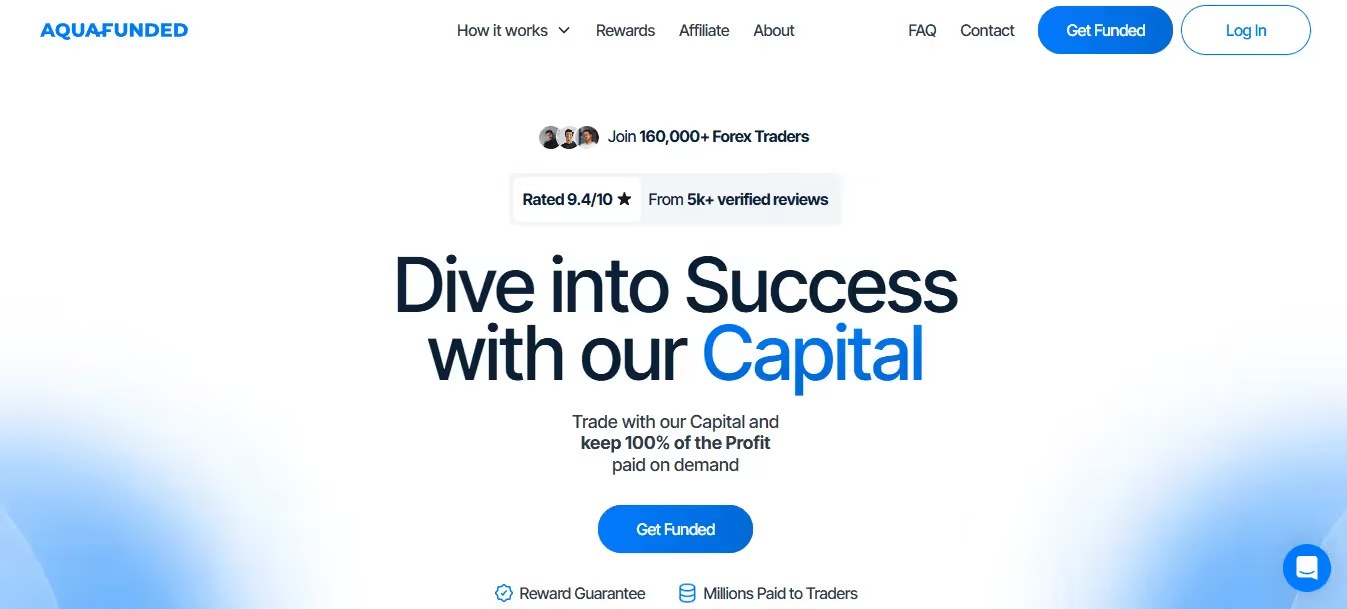
Beginners who repeatedly fail FTMO due to rule violations rather than strategy flaws need structure without micromanagement. AquaFunded removes time limits entirely, which eliminates the rush-to-hit-targets behavior that causes forced trades on suboptimal setups. The drawdown logic stays clearer than FTMO's daily loss calculations, and you avoid TopStep's futures contract sizing complexity altogether. The instant funding option works for traders who already manage risk but struggle with evaluation psychology. You're trading your actual strategy for challenge-specific constraints that disappear once funding is secured. The model assumes competence exists but needs space to execute without artificial urgency.
No calendar deadlines mean you can wait up to three days for quality setups without worrying about minimum trading-day requirements. That patience matters when you're still learning to distinguish between genuine edge and manufactured opportunity. The 0.25 to 1 percent risk-per-trade approach better suits beginners than the aggressive scaling often encouraged by evaluation targets. The tradeoff: smaller brand recognition than FTMO and fewer advanced analytics than TopStep's coaching infrastructure. You gain psychological breathing room but lose some of the institutional credibility and data visualization tools that larger firms provide. The rules still exist. This isn't permission to trade recklessly. It's permission to learn at human speed instead of evaluation speed.
2. The Funded Trader

Multiple challenge types (Standard, Rapid, Royal) let you choose difficulty instead of forcing one evaluation model. That flexibility helps when you're still figuring out whether you need more time or tighter constraints to perform well. The drawdown rules feel more forgiving than FTMO's fixed limits, and you're not locked into futures-only markets like TopStep requires. According to Topstep, its 100% profit-split structure rewards consistency once funded. The Funded Trader approaches similar territory with transparent splits that don't penalize you for choosing easier evaluation paths. The 4.7 Trustpilot rating reflects consistent payout execution, which matters more than marketing promises when you're trusting a firm with your trading capital.
The Rapid challenge option reintroduces time pressure, which in turn creates the same psychological traps FTMO creates. Gamification elements can encourage overtrading if not used carefully. The flexibility becomes a liability when you choose the wrong difficulty level for your actual skill stage. Beginners often overestimate readiness and select aggressive timelines that recreate the pressure they were trying to escape.
3. SurgeTrader
Instant funding removes evaluation phases entirely. You skip the combine grind, the trailing drawdown confusion, and the multi-month psychological toll of proving consistency before accessing capital. The rules remain straightforward: respect drawdown limits, manage risk appropriately, and you're trading with funded capital from day one. News trading and overnight holds stay allowed, which matters if your strategy depends on holding through announcements or capturing moves that develop outside active session hours. FTMO restricts some of these approaches. TopStep's futures focus makes overnight exposure more complex due to margin requirements and gap risk. SurgeTrader treats you like a funded trader immediately because that's what you are.
The upfront cost runs higher than evaluation fees at other firms. You're paying for immediate capital access instead of proving yourself first. The profit split caps around 80 percent, and scaling potential stays limited compared to FTMO's larger account tiers. You trade convenience for ceiling. That exchange makes sense if evaluation psychology destroys your performance, but it costs you upside-down if you could have passed a traditional challenge.
4. Funded Trading Plus
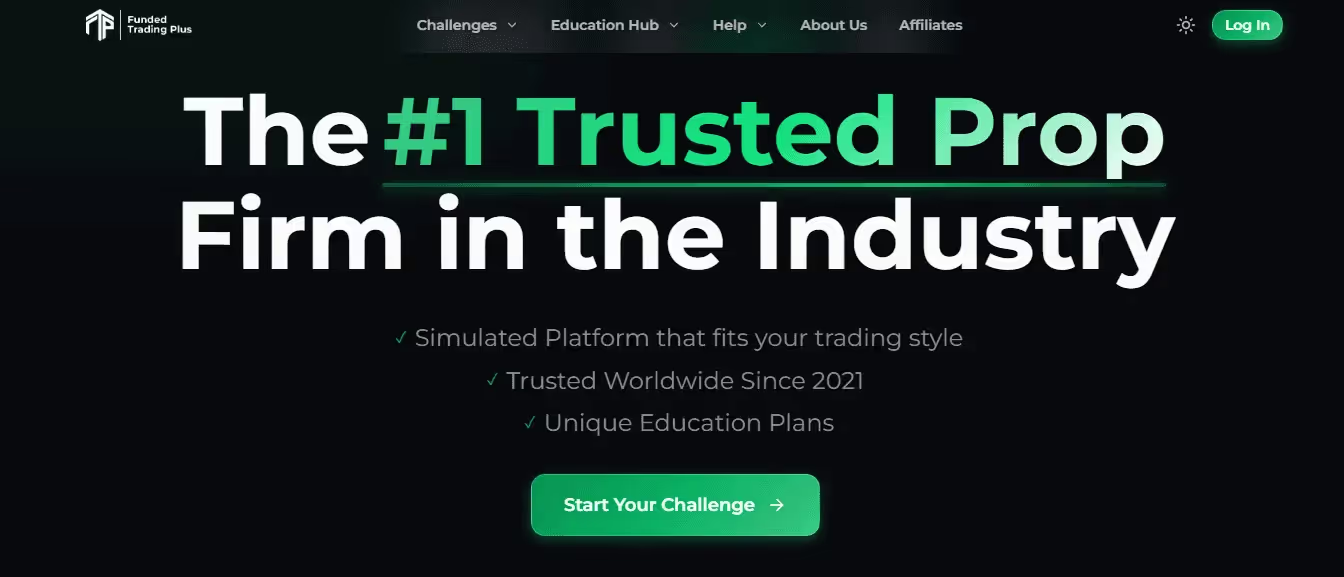
Weekly payouts compress the feedback loop between performance and reward. You see money from winning weeks within days, not months. That immediacy helps maintain discipline because consequences (both positive and negative) arrive quickly enough to reinforce behavior patterns before they calcify into habits. The profit share reaches 100 percent at higher performance tiers, matching the best structures in the industry. No minimum trading days means you're not forcing activity to meet arbitrary quotas. You can trade twice in a week if those are the only quality setups that appear, then wait five days for the next opportunity without penalty.
The targets run high relative to account size, which reintroduces pressure if you're trying to hit percentage gains quickly. Leverage stays capped below what some strategies require for proper position sizing across multiple instruments. Demo trading does not reflect real market liquidity, which affects execution quality and slippage compared to live conditions.
5. BluFX

No challenges. No deadlines. No evaluation phases that test performance under artificial pressure. You're trading a subscription-based funded account from the start, which removes gatekeeping that penalizes slow learners or traders whose psychology breaks down during assessments. Expert Advisors stay fully allowed, which matters if your edge comes from automated execution rather than discretionary decision-making. The low entry cost makes repeated attempts financially viable if the early months go poorly. You're paying for access, not gambling on a one-shot evaluation that costs hundreds upfront.
The monthly subscription erodes profits over time. Three months of development costs accumulate into evaluation fee territory. Six months exceeds it. The scaling potential stays limited compared to firms offering $100K, $200K, or larger accounts. The maximum funding caps are lower, which constrains earning potential once you develop consistency.
Most traders who struggle with evaluation stress discover that trading itself wasn't the problem. The performance anxiety was. BluFX solves that specific issue but doesn't accelerate skill development. You still need to learn position sizing, risk management, and emotional control. You're just learning without a countdown timer.
6. The Forex Funder
The profit split is 95 percent, according to FundedNext, placing it among the highest in the industry. That percentage matters when you're generating consistent returns and want to keep maximum value from your edge. No time limits remove the calendar pressure that causes rushed decisions. One-step and two-step evaluation options let you choose between faster access (greater difficulty) and more gradual progression (lower pressure). EA and news trading permissions mean your strategy doesn't need to be modified to fit platform restrictions. You're trading your actual approach, not a sanitized version that meets arbitrary rule sets.
Higher entry costs concentrate risk upfront. Equity drawdown calculations can surprise beginners who expect balance-based math and don't realize that open position fluctuations count against their limits. Demo accounts mean execution quality differs from live trading, particularly around high-impact news releases, where slippage and requotes become significant factors. The higher payout percentage only matters if you pass the evaluation and maintain funded status long enough to withdraw profits repeatedly. Beginners drawn to the 95 percent split sometimes overlook the difficulty of consistently achieving it.
7. FundedNext

Balance-based drawdown simplifies the math compared to trailing or equity-based calculations. Your maximum loss threshold remains fixed relative to the starting balance, making risk management more predictable. No time limits mean you're not manufacturing trades to meet minimum day requirements before the evaluation expires. Fast payout processing reduces the gap between earning profits and accessing them. That speed matters for cash flow management and psychological reinforcement. The 95 percent profit split matches top-tier industry standards once you're funded and performing consistently.
Model complexity increases with the number of account types and rule variations. Beginners sometimes choose the wrong structure for their trading style and later discover restrictions they didn't fully understand during signup. The shorter track record relative to established firms means less historical data on payout reliability and rule-enforcement consistency. Rule-aware traders who read fine print carefully and don't rush through evaluation stages find FundedNext's structure accommodating. Traders who skim terms or push boundaries discover violations they didn't anticipate. The difference between these outcomes comes down to diligence, not firm quality.
8. E8 Markets
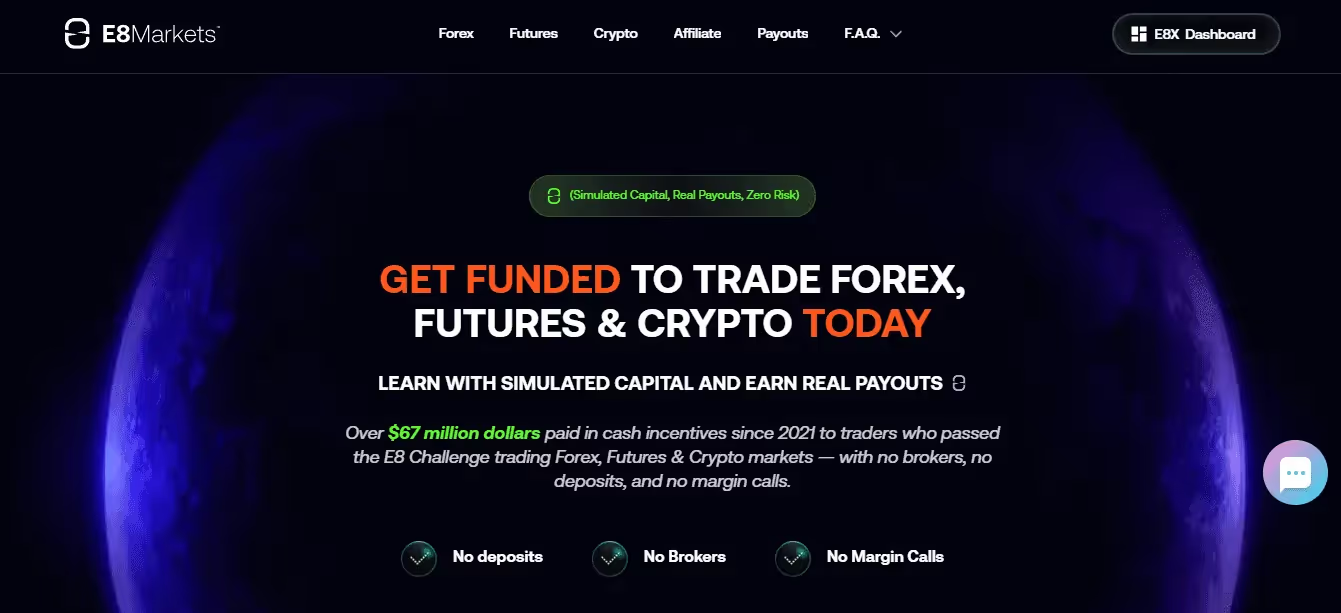
Conservative targets reduce the pressure to generate aggressive returns quickly. Lower percentage requirements mean you can build consistency through smaller, more reliable gains instead of swinging for home runs that increase risk exposure. No time limits allow defensive strategies to play out over whatever timeframe the market requires. Custom evaluation options accommodate trading styles that don't fit standardized challenge structures. If your edge is evident under specific market conditions or requires longer holding periods, customization eliminates the mismatch between your approach and evaluation constraints. That flexibility matters when your strategy works in live markets but fails cookie-cutter assessments.
The profit split runs lower than competitors, which means you're keeping less of what you generate, even after proving consistency. Tight drawdown limits relative to conservative targets create a narrow operating range. One bad trade can trigger violations even when overall performance stays positive. The newer firm status means a less established reputation and fewer trader reviews to assess payout reliability. Risk-averse beginners who trade infrequently and prioritize capital preservation over growth find E8's structure compatible with their temperament. Aggressive traders or those seeking maximum profit share look elsewhere. The fit matters more than the firm's absolute quality.
Programs like funded trading program recognize that beginners need both structure and flexibility. Transparent rules without hidden restrictions, profit splits up to 100 percent, and 24-hour payout guarantees with penalties for delays shift accountability toward the firm rather than creating evaluation mazes that punish learning curves. Instant funding options remove gatekeeping entirely for traders confident in their risk management, while refundable fees and scaling to $4M provide both downside protection and upside potential that traditional evaluation models often cap artificially.
The pattern across these alternatives reveals something most beginners miss when comparing firms: the evaluation structure matters more than the profit-split percentage or the maximum account size. You can't benefit from a 95 percent split if you never pass the challenge. You can't scale to $200K if the daily loss limit keeps eliminating your account during normal learning volatility. The question isn't which firm offers the best terms on paper, but which structure accommodates the specific way you fail right now. But choosing the right alternative only solves half the problem if you don't know why you're failing in the first place.
Related Reading
- Sources of Capital
- Cash Reserve Account
- Short Term Stock Trading
- Investment Performance Analysis
- Managed Account vs Brokerage Account
- Systematic Trading
- How to Analyze a Stock Before Buying
- Forex Capital Trading
- What is a Retracement in Trading
- How is Risk Involved in Calculating Profit?
- Convergence Trading
- Liquidity Trading
- Futures Trading Minimum Account Size
- What is Drawdown in Trading
- Best Prop Firms in UAE
- Forex Prop Firms With Instant Funding
- Regulated Prop Firms
- Prop Challenge
Failing FTMO on daily loss rules but not ready for TopStep’s futures-only pressure?
AquaFunded is built for beginners stuck between the two. No trailing drawdowns, no futures contracts to learn, and no rush to hit targets. Trade forex at your own pace, follow clean risk rules, and get funded without the psychological traps that wipe out most FTMO and TopStep beginners. Your skill matters more than the evaluation structure used to test it. FTMO's daily loss limit penalizes attempts to recover emotionally after bad trades. TopStep's futures specialization requires you to learn contract specifications, margin calculations, and order-flow mechanics before you can assess whether your strategy works. AquaFunded removes both barriers. You're trading familiar forex pairs with straightforward drawdown logic and zero calendar pressure, forcing trades that don't exist. The instant funding path skips evaluation entirely if you already manage risk properly but can't perform under assessment conditions. That's not lowering standards. That's recognizing that evaluation psychology differs from trading psychology, and conflating the two costs beginner accounts.
Related Reading
- How To Take Profits From Stocks
- Accumulation Distribution
- Short-Term Capital Gain Tax On Shares
- What Is Reit Dividends
- Cash Available To Trade Vs Settled Cash
- Best Pairs To Trade Forex
- Can You Day Trade In A Roth Ira
- What Is A Conditional Order
- Orb Strategy Trading
- Stop Loss Vs Stop Limit
- Flag Pattern Trading
- Characteristics of Growth Stocks
- Forex Compounding Plan
