




Top 10 Prop Firms in 2026 for Beginners
Explore the Top 10 Prop Firms 2025 for beginners, compare fees, funding models, and profit splits to choose the right firm in 2026.

Trading your own money comes with real risk, and for many aspiring traders, the challenge isn't skill but capital. What is a funded account? It's an opportunity where proprietary trading firms provide you with their capital to trade, letting you keep a significant share of the profits without risking your personal savings. This guide breaks down the top 10 prop firms in 2025, helping you find the right partner to trade with a funded account and turn your trading abilities into consistent income.
If you're ready to access substantial buying power and professional trading conditions, AquaFunded's funded trading program offers a clear path forward. Their evaluation process connects skilled traders with the resources needed to trade with a funded account, providing the capital backing and support that transforms potential into performance. Whether you're looking for flexibility in trading rules, competitive profit splits, or reliable payouts, choosing the right funded trading program can be the difference between staying on the sidelines and building a real trading career.
Summary
- Prop firms provide traders with capital to trade financial markets in exchange for a share of profits, typically keeping 80% and the firm taking 20%. The model shifts risk away from individual traders by requiring them to pass a structured evaluation process in a simulated environment before accessing real firm capital. According to FunderPro, only about 10% of traders pass the initial evaluation phase, making the challenge both a filter and a revenue source for firms. That low pass rate reflects the genuine difficulty of meeting profit targets while adhering to strict risk parameters, but it also explains why traders who pass often find capital access transformative.
- The prop firm model creates mutual benefit when structured correctly: traders access capital they couldn't afford to obtain independently, while firms profit from identifying skilled performers without bearing employment costs. However, the 10% pass rate raises questions about whether evaluation criteria are calibrated to identify skill or designed to maximize fee collection from repeated attempts. Over $1 billion was paid out by top prop firms in 2024, according to TradeMatchPro, demonstrating that substantial capital is genuinely flowing to traders who meet performance standards. The tension between genuine partnership and evaluation fee dependence shows up in how firms structure their programs, with high-quality firms offering refundable fees and transparent profit splits rather than creating barriers that generate recurring friction costs.
- The fee structure reveals the firm's intentions more clearly than marketing claims. A firm charging full price for challenge retakes generates substantial revenue from repeated failures, while those offering discounted or free resets demonstrate investment in trader development. Withdrawal fees and minimum thresholds create hidden costs that effectively reduce advertised profit splits. Some firms charge $50 per withdrawal with $500 minimums, preventing traders from generating $300 in monthly earnings until they exceed the threshold. The complete financial picture, including reset charges, platform fees, and withdrawal minimums, often costs far more than the advertised entry price suggests.
- Drawdown rules and violation mechanics determine whether evaluation tests trading skill or structural technicalities. Equity-based daily loss calculations trigger violations from floating losses before stop losses execute, creating failures unrelated to risk management decisions, while closed balance calculations respect planned exits by measuring only realized losses. Trailing drawdowns punish profitability by reducing risk buffers as traders gain, making subsequent survival harder after profitable periods, whereas static drawdowns maintain consistent risk parameters regardless of profit accumulation. Time limits amplify psychological pressure without testing trading ability, forcing position-taking during unfavorable conditions because arbitrary deadlines matter more than market structure.
- The gap between earning profits and accessing them reveals whether a firm operates as a genuine partner or capital gatekeeper. Weekly payouts with next-day processing demonstrate confidence in traders and the business model, while monthly schedules with 14-day processing windows suggest cash-flow management that prioritizes firm liquidity over trader access to earned income. Minimum payout guarantees provide security for beginners concerned about withdrawal approvals, shifting risk from the trader to the firm, and aligning incentives toward genuine partnership rather than evaluation-fee dependence.
- AquaFunded's funded trading program addresses these structural problems by offering flexible timelines without strict deadlines, static drawdown limits that don't penalize profitability, 24-hour payouts with a $1,000 guaranteed minimum, and 100% refundable evaluation fees that shift the revenue model toward trader success rather than penalizing profitability.
How Do Prop Firms Work

Prop firms provide traders with capital to trade financial markets in exchange for a share of the profits generated. The model centers on a structured evaluation process in which traders demonstrate their skills in a simulated environment before accessing real capital from the firm. Once funded, traders keep the majority of profits (typically 80%) while the firm takes a percentage (usually 20%) as revenue. The arrangement shifts risk away from individual traders while creating a performance-based partnership that rewards consistent profitability.
The appeal is straightforward: skilled traders gain access to substantial capital without depleting their personal savings, while firms identify and back performers who can generate returns. According to FunderPro, only about 10% of traders pass the initial evaluation phase, making the challenge both a filter and a revenue source for firms. That low pass rate reflects the genuine difficulty of meeting profit targets while adhering to strict risk parameters, but it also explains why traders who pass often find capital access transformative.
The Evaluation Phase
The evaluation process requires traders to demonstrate profitability within defined risk limits before receiving funded accounts. Most firms structure this as a challenge in which traders must hit a specific profit target (e.g., $4,000 on a $50,000 account) without exceeding maximum loss thresholds. The simulated environment mirrors live market conditions but protects the firm's capital during the vetting period.
Traders face rules on daily drawdown limits, maximum overall loss, position sizing, and, in some cases, trading consistency requirements. These constraints test whether someone can generate returns without exposing the firm to catastrophic risk. The challenge phase typically costs $100 to $500, depending on account size, and traders may attempt it multiple times if they fail. That fee structure creates a business model where firms profit from both challenge fees and the eventual profit splits with successful traders.
Many traders struggle with the psychological pressure of evaluation requirements. The need to hit profit targets while respecting loss limits creates tension between aggression and caution. Traders who pass often describe the experience as requiring patience to wait for high-probability setups rather than forcing trades to meet deadlines. The evaluation reveals not just technical skill but emotional discipline under performance pressure.
Funded Account Access and Profit Sharing
Once traders pass the evaluation, they receive access to firm capital ranging from $25,000 to $100,000 or more per account. The funded account operates under the same risk management rules established during the challenge, ensuring consistency between evaluation and live trading. Traders execute their strategies using the firm's capital across markets such as forex, futures, commodities, indices, and, in some cases, crypto.
The profit-sharing arrangement typically allocates 80% of gains to the trader and 20% to the firm. Some programs offer higher splits (up to 90% or even 100% in certain structures) as traders demonstrate consistent performance. Payouts occur on regular schedules, with leading firms processing withdrawals weekly or even daily. The speed and reliability of payouts often distinguish quality firms from those that create unnecessary friction around accessing earned profits.
Traders must comply with drawdown limits and position-sizing rules to maintain their funded status. Violating these parameters can result in account termination, which means the discipline required during evaluation must continue indefinitely. The best performers treat the funded account with the same caution they applied during the challenge, recognizing that access to capital is a privilege that requires ongoing risk management.
Scaling and Multi-Account Management
Consistent traders can scale their earning potential by managing multiple funded accounts simultaneously. Some firms allow traders to control up to 15 accounts, effectively multiplying their capital access and profit potential. This scaling opportunity rewards those who can replicate their strategy across multiple positions without compromising risk management or performance quality.
The path to multi-account access typically requires demonstrating profitability over several months and maintaining strict adherence to firm rules. Traders who reach this level often transition from viewing prop trading as a side opportunity to treating it as a primary source of income. The compounding effect of profit splits across multiple accounts can generate substantial monthly earnings for top performers.
A few firms offer transitions to live accounts with unrestricted daily payouts for traders who consistently perform at the highest level. These elite programs remove some of the constraints present in standard funded accounts, giving proven traders more flexibility in their approach. The progression from evaluation to funded account to scaled multi-account management creates a clear advancement path for those who master both strategy execution and risk discipline.
The Win-Win Model and Its Tensions
The prop firm model creates mutual benefit when it works correctly. Traders access capital they couldn't afford on their own, while firms profit from identifying skilled performers without bearing the cost of training or employing them as traditional employees. The structure eliminates the need for traders to risk their own capital while learning or refining strategies, lowering the barrier to entry for those with proven skills but limited capital.
The model faces skepticism around whether firms genuinely want traders to succeed or primarily profit from evaluation fees. The 10% pass rate suggests that most revenue comes from challenge attempts rather than profit sharing with funded traders. This tension raises questions about whether the evaluation criteria are calibrated to identify skill or designed to maximize fee collection from repeated attempts.
Programs like the funded trading program address these concerns by offering 100% refundable evaluation fees and profit splits up to 100%, shifting the revenue model toward a genuine partnership rather than a challenge-fee model. When firms structure their programs around trader success rather than evaluation failure, the win-win model becomes more credible. The difference lies in whether the firm's incentives align with helping traders pass and profit, or with creating barriers that generate recurring challenge fees. But understanding how the model works only matters if the benefits justify the effort required to pass evaluation and maintain funded status.
Related Reading
- What is a Funded Account
- How to Grow a Small Trading Account
- What is Trading Commodities
- Long Term Trading Strategy
- Capital Growth Strategy
- What is a Cash Account in Trading
- What is Compound Trading
- How Much Money Do You Need to Start Trading Stocks
- Scale Trading
- Small Account Trading
- How to Evaluate Investment Opportunities
- Blown Trading Account
- What is PNL in Trading
- Do Prop Firms Use Real Money
- Prop Firm Account Management
- Borrowing on Margin
- Trading Leverage
- Does FTMO Offer Instant Funding
- Prop Firm Static Drawdown
- Funding Traders Rules
- What Is Prop Firm Account
- Synthetic Funded Account
- What Is Funded Firm
- Trading Challenges
- Prop Firm IP Address Rule
- Instant Funding Rules
- Do Prop Firms Use Real Money
- How to Get a Funded Trading Account
- FTMO vs The5ers Comparison
- Best Forex Pairs to Trade
- Best Automated Crypto Trading Platform
Benefits of Prop Firms

Prop firms offer traders a path to professional-level capital access without the traditional barriers of wealth accumulation or institutional employment. The core benefits center on capital leverage, risk mitigation, professional development resources, and performance-based earning potential that scales with consistency. For traders with proven strategies but limited personal funds, these advantages transform what's possible in their trading careers.
The value proposition extends beyond simple capital access. Traders gain exposure to institutional-grade tools, mentorship from experienced professionals, and structured accountability systems that accelerate skill development. The profit-sharing model aligns incentives between the trader and the firm when structured transparently, creating partnerships in which both parties benefit from consistent performance.
Capital Access Without Personal Risk Exposure
The most immediate advantage is access to trading capital that would take years to accumulate on your own. Traders can manage accounts ranging from $25,000 to $100,000 or more without depleting their savings or taking on debt. This capital leverage amplifies profit potential on successful trades while keeping personal finances separate from market exposure. The psychological freedom this creates matters as much as the financial access. When you trade your own money, every losing position feels like a personal failure that threatens your security. That emotional weight distorts decision-making, pushing traders toward either excessive caution that misses opportunities or desperate aggression that compounds losses. Trading firm capital removes that personal attachment, allowing you to execute your strategy with the emotional distance required for disciplined risk management.
According to TradeMatchPro, over $1 billion was paid out by top prop firms in 2024, demonstrating that substantial capital is genuinely flowing to traders who meet performance standards. The scale of these payouts confirms that the model works for those who pass the evaluation and remain funded. The challenge lies in reaching that threshold, but the capital access for those who do is transformative.
Structured Training and Professional Development
Quality prop firms invest in trader education through comprehensive training programs, mentorship arrangements, and access to experienced professionals. These resources help traders refine their technical analysis skills, develop robust risk management frameworks, and build the psychological discipline required for consistent performance. The structured learning environment accelerates development compared to solitary trial and error.
The mentorship component provides something money can't easily buy: direct feedback from traders who've navigated the same challenges you're facing. They've experienced the emotional pressure of drawdown limits, the frustration of missed profit targets, and the discipline required to wait for high-probability setups. That experiential knowledge, when shared generously, compresses your learning curve and helps you avoid common failure patterns.
Training programs typically cover market dynamics, technical indicators, position sizing strategies, and psychological frameworks for managing stress during volatile periods. The best programs don't just teach theory; they also provide simulated practice environments where traders can test strategies without financial consequences. This combination of education, mentorship, and safe practice space creates a development path that independent traders rarely access.
Advanced Technology and Market Infrastructure
Prop firms provide access to sophisticated trading platforms, real-time data feeds, advanced charting tools, and analytical software that would cost thousands of dollars monthly for individual traders to license. These technologies enable faster trade execution, more accurate market analysis, and better risk monitoring than retail platforms typically offer.
The infrastructure advantage extends to execution speed and order routing. Institutional-grade platforms connect directly with liquidity providers, reducing slippage and improving fill quality for entry and exit orders. When you're trading volatile instruments like futures or forex, those microseconds and fractional pip improvements compound into meaningful profit differences over hundreds of trades.
Some firms offer proprietary algorithms, automated risk management systems, and backtesting environments that let traders validate strategies against historical data before risking capital. This technological edge helps traders identify market opportunities faster and execute with precision that retail infrastructure can't match. The tools don't guarantee success, but they remove technological limitations as an excuse for underperformance.
Performance-Based Earnings and Scaling Potential
The profit-sharing model rewards consistent performance with substantial income potential. Traders typically keep 80% of profits, with top performers earning splits of up to 90% or even 100% in certain programs. This structure means your earning potential scales directly with your skill and consistency rather than being capped by a fixed salary.
The scaling opportunity through multi-account management multiplies this earning potential. Traders who demonstrate consistent profitability can manage multiple funded accounts simultaneously, effectively controlling hundreds of thousands or even millions in capital. This progression creates a clear path from entry-level funded trader to a professional-level income that rivals or exceeds that of traditional finance careers.
Programs like the funded trading program advance this model by offering up to 100% profit splits and 24-hour payouts with guaranteed minimums, reducing friction in accessing earned profits. When firms structure their revenue around trader success rather than evaluation fees, the performance-based earnings become genuinely attractive. The difference between a quality firm and a challenge-fee mill often shows up in how quickly and reliably they process payouts.
Risk Management Education Through Real Constraints
The evaluation and funded account rules teach risk management in ways that theory alone never could. When you face daily drawdown limits, maximum loss thresholds, and position-sizing requirements, you learn to view risk not as an abstract concept but as a practical constraint that determines whether you maintain your funded status. This forced discipline eliminates the common beginner mistake of overleveraging positions or holding losers too long, hoping for reversals. The rules create immediate consequences for poor risk management, which accelerates the learning process. Traders who internalize these constraints develop the systematic approach required for long-term survival in markets that ruthlessly punish carelessness.
The accountability structure also prevents the emotional trading patterns that destroy retail accounts. You can't revenge trade after a loss or double down on losing positions when clear rules govern your maximum daily risk. The constraints initially feel restrictive, but they build muscle memory for disciplined execution that sets professional traders apart from gamblers. But knowing these advantages exist doesn't answer the harder question: how do you identify which firms actually deliver these benefits versus those that are primarily designed to collect evaluation fees?
How to Choose the Best Prop Firm for Beginners in 2026

The firms that actually help beginners succeed share three structural characteristics: transparent fee models with no hidden reset charges, evaluation rules that test skill rather than create technical traps, and payout systems that prioritize speed over friction. Everything else is secondary. The difference between a firm designed to develop traders and one engineered to collect evaluation fees shows up in how they handle drawdown calculations, time pressure, and withdrawal processes. Phidias Propfirm reports you can start with just $55, which sounds accessible until you examine what happens after beginners pay that entry fee. The real cost is revealed by reset charges, platform fees, and withdrawal minimums that weren't prominently displayed during signup. Beginners often focus on the lowest entry price without accounting for the total cost of three or four failed attempts, plus the ongoing charges that accumulate before the first payout.
Fee Structure and Total Cost Analysis
Compare the complete financial picture, not just the challenge entry price. A $100 evaluation that refunds upon passing costs less than a $55 challenge with $75 resets and $25 monthly platform fees. Calculate what four attempts would cost at each firm, including all recurring charges. Firms confident in their structure offer full refunds because they profit from successful traders, not from failed attempts.
Reset pricing reveals intentions. Firms charging full price for retakes generate substantial revenue from repeated failures. Those offering discounted or free resets after near-misses demonstrate investment in trader development rather than fee extraction. Check whether partial progress (reaching 80% of profit target, for example) earns any consideration or if every failure resets to zero regardless of how close you came.
Withdrawal fees and minimum thresholds create another layer of hidden costs. A firm that advertises 90% profit splits but charges $50 per withdrawal with a $500 minimum effectively reduces your take-home percentage on smaller accounts. Beginners generating $300 in monthly profits can't access their earnings until they exceed the threshold, creating cash-flow problems that force some to abandon profitable accounts.
Drawdown Rules and Violation Mechanics
The technical specifications around loss limits determine whether you're evaluated on trading skill or structural technicalities. Equity-based daily loss calculations trigger violations from floating losses before your stop loss executes, creating failures unrelated to your risk management decisions. Closed balance calculations respect your planned exits, measuring only realized losses after positions close.
Trailing drawdowns punish profitability by reducing your risk buffer as you gain. You start with a $5,000 maximum loss on a $50,000 account, but after earning $3,000 in profits, your buffer drops to $2,000 because the trailing mechanism follows your high watermark. Every profitable period makes subsequent survival harder, which is why traders often feel trapped after good weeks. Static drawdowns maintain consistent risk parameters regardless of profit accumulation.
Time limits amplify psychological pressure without testing trading ability. A 30-day deadline forces position-taking during unfavorable conditions because the calendar matters more than market structure. Traders describe the stress of watching days expire while waiting for setups that align with their strategy, which ultimately forces trades to meet arbitrary deadlines. Firms without time constraints or offering extended periods (90+ days) acknowledge that market opportunities don't arrive on predictable schedules.
Payout Speed and Withdrawal Friction
The gap between earning profits and accessing them reveals whether a firm operates as a genuine partner or a capital gatekeeper. Weekly payouts with next-day processing demonstrate confidence in their traders and business model. Monthly schedules with 14-day processing windows suggest cash flow management that prioritizes firm liquidity over trader access to earned income.
Payout consistency matters more than advertised frequency. Traders report firms that technically offer weekly withdrawals but routinely delay processing with verification requests, document requirements, or unexplained holds. The pattern suggests intentional friction designed to keep capital in firm accounts rather than trader bank accounts. Community feedback on Reddit and Discord channels surfaces these patterns faster than official marketing claims.
Minimum payout guarantees provide security for beginners concerned about withdrawal approval. Programs like a funded trading program, which offer $1,000 guaranteed first payouts, remove the uncertainty about whether firms will actually release funds. That guarantee shifts risk from the trader to the firm, aligning incentives toward a genuine partnership rather than dependence on evaluation fees.
Trading Restrictions and Strategy Flexibility
Prohibited trading styles limit who can succeed regardless of skill level. Firms that ban news trading, scalping, or hedging eliminate entire categories of profitable strategies without justification beyond convenience for risk management. Beginners developing approaches in these styles face automatic disqualification, not from poor performance but from arbitrary restrictions.
Mandatory stop losses sound reasonable until you consider strategies that manage risk through position sizing and correlation rather than hard stops. Algorithmic traders and options-based approaches often avoid traditional stop-loss orders, yet they still demonstrate consistent risk management through alternative mechanisms. Firms that require stops on every position exclude methodologies that operate differently but manage risk equally well.
Lot size restrictions and maximum position limits constrain how you execute your edge. A firm capping positions at 2% account risk might align with your natural approach, but one limiting you to 0.5% forces position sizing that doesn't match your tested strategy. The mismatch between your proven method and their arbitrary constraints creates underperformance unrelated to market skill.
Scaling Pathways and Capital Growth
The progression from initial funding to larger accounts determines long-term earning potential. Firms that offer clear scaling criteria (e.g., achieving 10% profit with a maximum 3% drawdown over 90 days) provide actionable targets. Those with vague "consistent profitability" requirements leave beginners guessing what performance actually triggers advancement.
Maximum funding potential varies from $100,000 caps to $2 million+ ceilings. Beginners might not immediately care about seven-figure accounts, but the ceiling reveals firm confidence in their traders. Low caps suggest limited infrastructure or unwillingness to back successful performers at scale. High limits indicate systems built to support genuine professional development.
Multiple account permissions accelerate growth for consistent traders. Managing three $50,000 accounts simultaneously provides $150,000 in effective capital and triples profit potential. Firms that restrict traders to a single account limit earning capacity regardless of demonstrated skill. Check whether additional accounts require separate evaluations or if proven performance grants automatic access.
Regulatory Standing and Operational Transparency
Company longevity provides crude but useful filtering. Firms operating five-plus years have survived market cycles and reputation tests that eliminate scams and poorly structured programs. New entrants might offer innovative terms, but they lack an operational track record that demonstrates they'll be ready to scale in 18 months, when you're ready to scale. Public disclosure of business model and risk management demonstrates confidence. Firms that explain how they hedge trader positions, manage aggregate exposure, and generate revenue beyond evaluation fees demonstrate operational sophistication. Those deflecting questions about their backend operations or offering vague explanations about "proprietary systems" raise concerns about sustainability.
Tradeify notes that 90% of beginners fail within their first three months, underscoring the importance of the firm's reputation for supporting new traders. Community feedback reveals whether firms offer genuine assistance during struggles or disappear until the next reset fee arrives. Active Discord servers, responsive support tickets, and educational resources indicate investment in trader success beyond initial signup. Dispute resolution processes matter when disagreements arise over rule violations or payout delays. Firms with clear escalation procedures and third-party mediation options demonstrate fairness. Those with opaque appeals processes or "all decisions final" policies signal an unwillingness to acknowledge their own errors or ambiguous interpretations of the rules.
Support Infrastructure and Learning Resources
Response time during urgent issues separates quality operations from fee collectors. When you're approaching daily loss limits or experiencing platform technical issues, waiting 48 hours for email responses creates unnecessary stress and risks potential violations. Live chat during market hours with knowledgeable representatives indicates operational investment in trader success. Educational content quality reveals firm priorities. Comprehensive strategy guides, risk management frameworks, and psychological training demonstrate commitment to development. Minimal resources or generic trading advice copied from public sources suggest that education serves marketing purposes rather than genuine skill-building.
Performance analytics and tracking tools help beginners understand their patterns. Detailed dashboards showing win rates by session, average risk-reward ratios, and drawdown patterns enable self-assessment that accelerates improvement. Basic profit/loss summaries without behavioral insights miss opportunities to help traders identify and correct systematic errors. The firms worth your attention treat evaluation as a genuine assessment rather than revenue optimization, but identifying them requires looking past marketing claims to structural realities. But which specific firms actually meet these criteria, and how do they compare when you examine their complete offerings side by side?
Top 10 Prop Firms in 2026 for Beginners
The firms that actually support beginners prioritize accessible entry points, transparent evaluation structures, and educational resources over aggressive profit extraction through reset fees. Your first prop firm should provide clear rules without technical traps, reasonable profit targets that don't require perfect market timing, and support infrastructure that answers questions before violations occur. The right choice depends on whether you're trading forex, futures, or crypto, your typical holding period, and how much capital you're willing to risk on evaluation attempts.
1. AquaFunded

AquaFunded removes the friction points that cause most beginners to fail before demonstrating their actual trading ability. The structure centers on flexibility rather than rigid timelines, offering both standard evaluations and instant funding options, allowing traders to choose their entry method. Drawdown calculations use static limits rather than trailing mechanisms, which means your risk buffer stays consistent even after profitable periods instead of shrinking as you succeed.
The profit split reaches 100% for top performers, and payouts are processed within 24 hours with a $1,000 minimum guarantee on first withdrawals. That guarantee eliminates uncertainty about whether firms will release funds, shifting risk from traders to firms and aligning incentives toward genuine partnership. Evaluation fees are fully refunded, signaling confidence in the assessment process rather than dependence on repeated challenge purchases.
Funding scales to $400,000 initially, with opportunities beyond that threshold for consistent performers. The platform supports MT5, cTrader, MatchTrader, and TradeLocker, giving traders flexibility in their execution environment rather than forcing them to adapt to unfamiliar interfaces. No mandatory stop-losses or prohibited trading styles means your strategy either works or doesn't based on results, not on arbitrary restrictions. Maximum drawdown typically ranges from 5-8%, depending on plan selection, and there is no time pressure on many programs. Beginners describe the relief of waiting for genuine setups rather than forcing trades to meet artificial deadlines. The evaluation structure tests whether you can manage risk and generate returns, not whether you can perform under arbitrary calendar constraints.
Key Features
- Funding up to $400,000 with scaling opportunities
- Standard evaluation and instant funding models
- Profit split up to 100%
- Operates on MT5, cTrader, MatchTrader, TradeLocker
- No strict time limits on most plans
- Maximum drawdown 5-8% (plan dependent)
- 24-hour payouts with a $1,000 guarantee
- 100% refundable evaluation fees
Pros
Flexible timelines remove deadline pressure. High profit splits reward performance. Lower entry cost than legacy firms. Instant funding option available. Fast payout processing builds trust.
2. Funded Trading Plus

Funded Trading Plus structures evaluation around accessibility rather than complexity. The choice between 1-step and 2-step challenges lets beginners select their comfort level with assessment length. Pricing starts at $119, making multiple attempts financially feasible while you refine your approach. The firm accepts traders from over 165 countries, including the U.S., removing geographic barriers that exclude many from other programs. EAs receive explicit permission, particularly via cTrader integration. Weekend and news trading are unrestricted in most programs, eliminating the common violation trigger that catches beginners off guard during high-impact releases. Rule clarity means you know exactly what's prohibited, rather than discovering restrictions through account termination.
Funding starts at $200,000, scaling to $2.5 million for proven performers. The profit split climbs to 100% as you demonstrate consistency. PropIQ analytics provide performance insights that help identify patterns in your trading behavior, showing win rates by session time, average hold duration, and risk-reward distribution across different market conditions. The instant funding feature bypasses evaluation entirely for traders willing to accept different fee structures. This option suits experienced traders transitioning from other firms who don't want to prove themselves again through standard challenges. Platform support includes MT5 and cTrader, covering the tools most beginners already use.
Key Features
- Funding up to $200,000, scaling to $2.5 million
- 1-step or 2-step evaluation options
- Profit split up to 100%
- Entry from $119
- EAs and news trading allowed
- Platforms: MT5, cTrader
- Instant funding available
- PropIQ analytics initiative
Pros
Flexible evaluation formats accommodate different skill levels. Affordable for beginners with limited capital. Simple rules without hidden conditions. News and weekend trading permitted. Educational focus through analytics.
Cons
The scaling plan is less aggressive than some competitors. Limited to two accounts per user maximum. Some instant-funding tiers carry higher fees.
3. Sabio Trade

Sabio Trade organizes programs into Single, PRO, and Intraday categories, each designed for different trading approaches and capital goals. The Single accounts suit beginner testing strategies, PRO tiers offer larger capital with multiple assessment attempts built in (PRO 3, PRO 12), and Intraday plans accommodate scalpers with higher leverage at 1:100 versus 1:30 on other tiers. The Sabio Academy provides free education that goes beyond generic trading advice. Course content covers technical analysis frameworks, risk management calculations, and psychological preparation for evaluation pressure. Daily trading signals and trade analysis help beginners understand what experienced traders see in market structure, compressing the learning curve through pattern recognition training.
Mobile trading access through a custom traderoom and dashboard separates Sabio from competitors that restrict trading to desktop platforms. This flexibility matters for traders who monitor positions during commutes or manage risk away from home setups. The synchronized ecosystem keeps your data consistent across devices without manual reconciliation. Funding reaches $1 million with 90% profit splits on top tiers. Zero spreads on key assets reduce execution costs, which matters more for beginners taking smaller profits per trade. Regular promotional codes and giveaways further lower entry costs, though you need to actively search for current offers rather than relying on standard pricing.
Key Features
- Up to $1 million funding
- 90% profit split on top tiers
- 1:30 leverage (Single/PRO), 1:100 (Intraday)
- Free Sabio Academy access
- Multiple assessment attempts (PRO 3, PRO 12)
- Daily trading signals and analysis
- Zero spreads on key assets
- Mobile traderoom
- Custom platform and dashboard
Pros
Transparent rules with extensive learning resources. Institutional-level education is included. Multiple account options for different strategies. Entry from $119. Zero hidden fees. Mobile trading capability.
Cons
Evaluation fees are higher for top-tier accounts. Learning curve for the custom platform interface.
4. FTMO

FTMO established the two-step evaluation model that most firms now copy. Founded in 2015, they have a track record of surviving multiple market cycles and maintaining payout consistency. The Challenge phase tests profit generation, the Verification phase confirms you can replicate results, and funded status requires ongoing adherence to both profit targets and drawdown limits. The transparency around rules, fee structures, and payout schedules sets the standard that other firms struggle to match. FTMO publishes detailed statistics on pass rates, average trader performance, and scaling progression. This data visibility helps beginners understand realistic expectations rather than inflated marketing claims about easy profits.
The Academy offers courses on strategy development, risk management, and trading psychology with progress-based rewards. Top performers can transition to contracts with fixed salaries, performance coaching, and mindset training that treats trading as a professional skill rather than gambling. This career path appeals to beginners viewing prop trading as a long-term profession rather than a side income. Funding caps at $200,000 per trader initially, with scaling plans that add 25% account balance every four months for eligible traders. The growth path extends to $2 million in account size for those meeting the consistency requirements. The refund structure returns evaluation fees with your first reward withdrawal, reducing net cost for successful traders.
Key Features
- Up to $200,000 funding per trader
- 90% profit split after verification
- Two-step evaluation: Challenge and Verification
- Scaling: +25% balance every 4 months to $2 million
- An academy with progress-based rewards
- Top trader contracts with a fixed salary and coaching
- Free trial available
Pros
Transparent, well-documented structure with a global reputation. High-quality analytics and trader tools. Clear and consistent rules set. Refund possible with first reward withdrawal. Free trial option.
Cons
Strict rules and high consistency requirements. Evaluation and scaling require time and planning. Scaling conditions may not fit every trading style. Higher-than-average assessment pricing.
5. FXIFY

FXIFY structures evaluation around speed and flexibility. The 1-, 2-, and 3-phase options let you choose the assessment length based on your confidence level. The Lightning Challenge condenses evaluation to seven days for experienced traders who prefer shorter timelines. Crypto-focused traders can opt for specialized challenges built around cryptocurrency volatility patterns. Futures traders access separate programs with funding of up to $450,000 on monthly subscription models starting at $89. This recurring fee structure differs from one-time evaluation payments, suiting traders who prefer predictable monthly costs over large upfront charges. The futures focus serves day traders in indices, commodities, and bonds who don't trade forex or crypto.
Asset coverage spans forex, stocks, crypto, commodities, and indices. Minimal restrictions on EAs, hedging, and news trading remove common triggers for violations. The platform flexibility across MT4, MT5, and DXTrade (U.S. region) accommodates different trader preferences without forcing platform migration. Funding starts at $5,000 and scales to $400,000+ initially, with growth paths to approximately $4 million. Profit splits begin at 75% but increase to 90% with consistent performance. Entry fees start at $39, making multiple attempts accessible. The 100% refund policy refunds fees in full, not just partially.
Key Features
- Challenge types: 1/2/3-Phase, Instant Funding, Lightning Challenge, Crypto
- Funding from $5,000 to $400,000+, scaling to ~$4 million
- Profit split 75-90%
- Trading across forex, stocks, crypto, commodities, and indices
- Futures challenge available
- EAs, hedging, and news trading permitted
- Platforms: MT4, MT5, DXTrade (U.S.)
- Entry from $39
Pros
Fast evaluation paths. Minimal trading restrictions. Low entry cost. Strong community support. 100% refunds. Customizable account features at checkout.
Cons
Limited educational support compared to academy-focused firms. Strict consistency rules apply despite the flexible structure.
6. E8 Funding
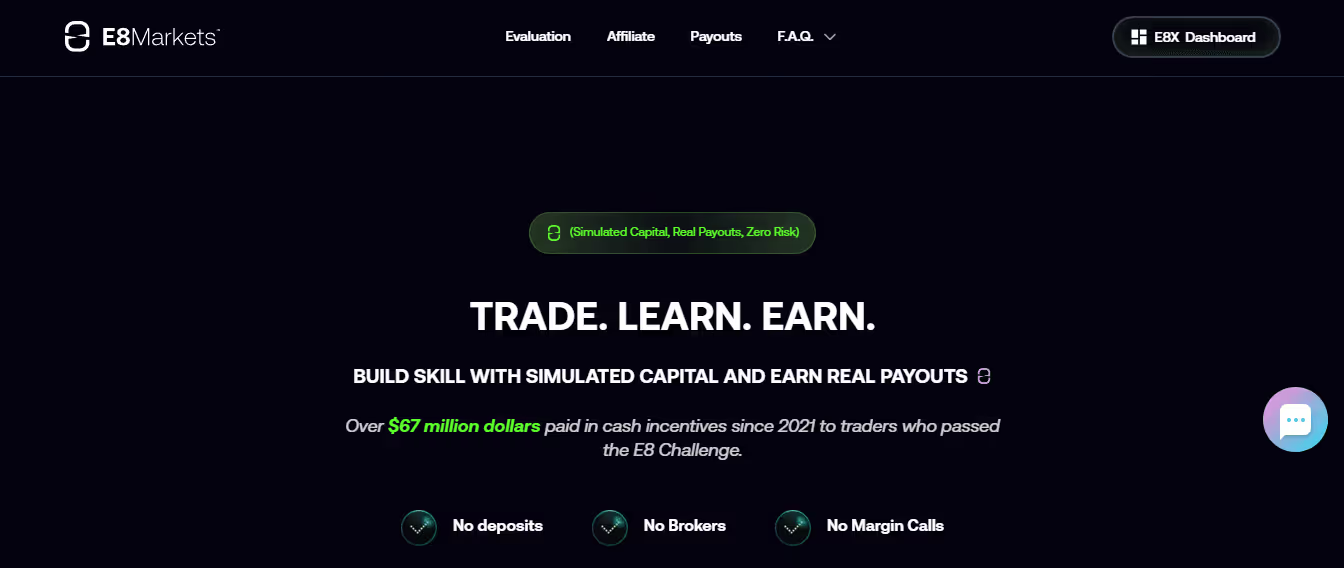
E8 Funding targets serious traders seeking detailed performance analytics and robust scalability. The customization options let you choose market focus (Forex, Futures, Crypto), assessment type (1-, 2-, or 3-step), drawdown percentage, and profit split percentage. This configurability allows you to align evaluation parameters with your risk tolerance and strategy requirements, rather than accepting one-size-fits-all terms. The user dashboard provides institutional-grade performance tracking. Metrics include win rate by asset class, average hold time, profit factor, and drawdown patterns across different market conditions. These analytics help identify systematic errors in your approach, like overtrading during low-volatility periods or holding losers too long during trend reversals.
Funding reaches $500,000 with 80-90% profit splits. Scaling extends to $1 million for traders meeting consistency thresholds. Free trial accounts let you test the platform and evaluation environment before paying fees. Weekend, news, and EA trading are unrestricted, removing common beginner violation triggers. The E8X Dashboard consolidates position monitoring, risk tracking, and performance analytics into a single interface. On-demand payouts process is quick once you meet the withdrawal requirements. The platform runs on MT5 and integrates fully with the proprietary dashboard for comprehensive trade management.
Key Features
- Up to $500,000 funding
- 80-90% profit split
- 2-step evaluation model
- Leverage 1:100
- Scaling to $1 million
- Free trial accounts
- Advanced performance analytics
- Platforms: MT5, E8X Dashboard
Pros
High-quality interface and detailed analytics. Legitimate growth potential. Entry from $40. Weekend, news, and EA trading allowed. Free trial option. On-demand payouts.
Cons
No instant funding path. Higher spreads and commissions on trades. Higher evaluation difficulty than beginner-focused firms.
7. TopStep

TopStep pioneered futures prop trading with CFTC compliance and U.S. regulatory oversight. The Trading Combine evaluation uses simulated futures accounts where traders prove consistency before accessing real capital. This structure suits traders whose expertise centers on futures contracts rather than forex or crypto markets. Funding typically caps at $150,000 for live accounts, lower than for multi-asset firms but appropriate for futures trading, where position sizes and margin requirements differ from forex. The profit-sharing model gives you 100% of the first $10,000 earned, then 90% thereafter. This structure front-loads earnings to your benefit rather than splitting everything from dollar one.
Weekly payouts provide faster access to earnings than monthly schedules. The subscription-based evaluation structure charges monthly fees rather than one-time payments, which affects the cost calculation for traders who need more time to pass. Platform support includes NinjaTrader, Tradovate, and TopstepX, covering the tools that futures traders already use. Free group coaching and educational courses provide ongoing development support. TradingView-powered charts integrate directly into the platform. The Tilt Indicator combines psychology and performance awareness to alert you when trading behavior deviates from your normal patterns. This psychological monitoring helps prevent emotional trading that violates risk parameters.
Key Features
- Trading Combine evaluation for futures
- Funding is typically up to $150,000
- 100% of the first $10,000, then 90% profit share
- Subscription-based evaluation
- Weekly payouts
- Platforms: NinjaTrader, Tradovate, TopstepX
- Free group coaching
- TradingView charts
- Tilt Indicator for psychology tracking
- Built-in Trade Copier
- Livestream content in platform
Pros
Regulated U.S.-based firm. Ideal for futures traders. High profit share after initial earnings. Live phone and chat support. News trading allowed.
Cons
Lower funding size than multi-asset firms. Higher cost than some forex-focused competitors. Futures-only trading limits asset diversification.
8. Goat Funded Trader

Goat Funded Trader launched in 2022 with aggressive pricing and flexible evaluation structures. Entry fees start around $17 with promotional codes, among the lowest in the industry. The Pay Later model charges just $5 upfront, with full challenge fees due only after passing the evaluation. This structure removes financial barriers for beginners and tests whether prop trading suits them. Account sizes reach $400,000, with scaling to $2 million for consistent performers. The mobile app for iOS and Android provides full trading functionality, allowing users to trade from their devices. Profit splits range from 90% to 100%, depending on the account type and add-ons selected at purchase.
Evaluation options include 1-step, 2-step, 3-step, and Goat Blitz formats plus instant funding. The variety accommodates different confidence levels and timeline preferences. Payouts are processed within 7 days, faster than many competitors, who require 14-30-day waiting periods. Zero commissions on indices and crypto reduce execution costs on those assets. Leverage reaches 1:100, providing position-sizing flexibility for strategies that require larger exposures. No restrictions on EAs or news trading eliminate common violation triggers. The 100% refundable fee structure returns costs completely rather than offering partial refunds.
Key Features
- Funding up to $400,000, scaling to $2 million
- Mobile app for iOS and Android
- 90-100% profit split
- 1/2/3-step, Goat Blitz, instant funding options
- Payouts after 7 days
- Zero commissions on indices and crypto
- Leverage up to 1:100
- No restrictions on EAs or news trading
Pros
Mobile trading capability. 100% refundable fees. News and weekend trading allowed. Entry from $17 with codes. The pay-later model is available.
Cons
Limited trading asset selection. Still establishing market reputation. Rule clarity and plan transparency need improvement.
9. Funding Pips

Funding Pips focuses on forex and CFD trading with a Zero Payout Denial commitment that addresses the common complaint about firms creating friction around withdrawals. The FP Score system evaluates traders holistically on a 0-100 scale, using multiple KPIs beyond profit to assess risk management consistency, drawdown control, and trading frequency patterns. The Hot Seat Program rewards top performers with Elite Trader status after 16 consecutive rewards and a total profit of 40%. Elite benefits include double initial balance, on-demand rewards, 100% profit splits, up to $2 million in capital, customized trading conditions, and monthly bonuses. This progression path provides clear targets for advancement beyond basic funded status.
Funding starts at $100,000, with the potential to manage up to $300,000 across multiple accounts, scaling to $2 million with Elite status. Profit splits range from 80% to 100%, depending on performance tier. Entry costs $29 for a $5,000 account, making initial attempts affordable. Evaluation fees are refunded after the fourth successful payout, reducing net cost for consistent traders. Monthly competitions offer $5,000 cash prizes and $575,000 worth of evaluations, providing additional earning opportunities beyond standard profit splits. A 1:100 leverage provides adequate position-sizing flexibility. The transparent conditions and Zero Payout Denial commitment address trust concerns that plague the industry.
Key Features
- Funding up to $100,000
- Manage up to $300,000, scale to $2 million (Elite)
- 80-100% profit split
- 1/2-step evaluation
- Leverage up to 1:100
- Monthly competitions ($5,000 cash, $575,000 evaluations)
- FP Score holistic evaluation
- Hot Seat Program for top performers
Pros
Transparent conditions throughout. Excellent for disciplined swing traders. Affordable from $29. Zero Payout Denial commitment. Evaluation refund after the fourth payout. Leverage to 1:100.
Cons
Smaller funding compared to competitors. Certain strategies are prohibited (including hedging, EAs, and weekend holding).
10. The 5%ers

The 5%ers offers three distinct evaluation types (Hyper Growth, High Stakes, Bootcamp), each with unique conditions and scaling paths. This structure offers flexibility across experience levels but requires further research to determine which program best fits your trading style. The complexity trades simplicity for customization, suiting traders who want tailored paths rather than one-size-fits-all evaluation. Payouts start during the evaluation stage, a rare advantage that lets you earn while proving consistency. This feature reduces the financial burden of evaluation periods by allowing you to begin generating income even before funded status. However, the requirement of at least three profitable days per evaluation cycle adds complexity that simpler programs avoid.
Funding starts at $250,000, scaling to $4 million for top performers. Profit splits range from 50% to 100%, depending on the program and performance tier. The balance-based trailing drawdown requires careful monitoring since your risk buffer adjusts with account balance changes. Extensive educational content includes webinars, live trading room access, and free resources covering strategy development and risk management. The dashboard tracks performance against rule requirements, helping you monitor compliance in real-time. Platform support covers MetaTrader 4 and MT5, the industry standards most traders already use.
Key Features
- Funding up to $250,000, scaling to $4 million
- Three evaluation models: Hyper Growth, High Stakes, Bootcamp
- Profit split 50-100%
- Operates on MT4 and MT5
- Minimum 3 profitable days per cycle
- Leverage 1:10 to 1:100 (program dependent)
- Balance-based trailing drawdown
- Extensive educational content
- Performance tracking dashboard
Pros
Flexible evaluation structures for different skill levels. Earn payouts during the evaluation phase. Affordable entry from $39. Comprehensive educational support.
Cons
More complex rules than most competitors. The minimum profitable days requirement adds pressure. Payout structures require careful study to be fully understood. But even the best-structured firm won't help you if the rules themselves create impossible conditions that have nothing to do with trading skill.
Related Reading
- Sources of Capital
- Cash Reserve Account
- Short Term Stock Trading
- Investment Performance Analysis
- Managed Account vs Brokerage Account
- Systematic Trading
- How to Analyze a Stock Before Buying
- Forex Capital Trading
- What is a Retracement in Trading
- How is Risk Involved in Calculating Profit?
- Convergence Trading
- Liquidity Trading
- Futures Trading Minimum Account Size
- What is Drawdown in Trading
- Best Prop Firms in UAE
- Forex Prop Firms With Instant Funding
- Regulated Prop Firms
- Prop Challenge
Struggling With Strict Time Limits and Complex Rules in Most Prop Firms?
If you keep failing challenges because deadlines force trades before your setups appear, or because minimum trading day requirements push you into positions you'd normally avoid, the problem isn't your skill. The structure itself creates conditions in which success depends as much on luck as on ability. When evaluation rules measure calendar compliance instead of risk management, you're being tested on your ability to navigate arbitrary constraints rather than your capacity to read markets and execute profitably.
The frustration compounds when you realize the same strategy that works in your demo account fails in evaluation, not because of market conditions, but because the firm's rules conflict with how you actually trade. You wait for confirmation signals that arrive on day 28 of a 30-day challenge, then face the choice between forcing a suboptimal entry or letting the deadline expire. Neither option tests your trading ability, but both determine whether you pass.
When Rules Contradict Strategy Requirements
Scalpers need dozens of small trades to generate meaningful profits, but firms requiring a minimum three-day hold period eliminate that approach entirely. Swing traders who hold positions for weeks can't demonstrate their edge in 30-day evaluations where one or two setups might appear total. The mismatch between the evaluation timeframe and the strategy requirements leads to systematic failure, regardless of whether your method actually works.
The minimum profitable days requirement adds another layer of incompatibility. If your strategy generates returns from infrequent, high-probability setups, you might trade five times per month with a 70% win rate and excellent risk-reward ratios. But firms that require 10 profitable days force you into 10+ trades, regardless of whether quality setups exist. You either abandon your tested approach or fail the evaluation despite having a genuinely profitable method.
Position sizing rules compound the problem. Your strategy might use a 3% risk per trade based on backtesting and live results, but the evaluation caps it at 1%. The reduced position sizing means you need three times as many winning trades to hit the same profit target, which extends the timeline required and increases exposure to random market noise that wouldn't affect your normal approach.
The Psychological Cost of Artificial Urgency
Time pressure creates emotional trading that runs counter to everything you know about disciplined execution. You watch the calendar more than price action, calculating how many days remain and whether you can still hit targets if you start now. That mental energy drains focus from actual market analysis, turning evaluation into a stress management test rather than a trading assessment.
The urgency pushes you toward higher-risk setups you'd normally skip. A marginal pattern that offers 60% probability instead of your usual 75% threshold suddenly looks acceptable when you're on day 25 with half the profit target remaining. You know you're compromising standards, but the deadline leaves no room for patience. The resulting losses come from rule-induced desperation, not trading incompetence.
When you fail these evaluations repeatedly despite profitable live trading results, the disconnect erodes confidence in your actual ability. You begin to question whether your strategy works at all, even though the only variable that changed was the evaluation framework's artificial constraints. The psychological damage extends beyond the failed attempt, affecting how you approach subsequent challenges and even your personal trading.
Finding Structure That Tests Skill Instead of Calendar Compliance
Programs that remove time limits or extend them to 90+ days acknowledge that market opportunities don't arrive on predictable schedules. You demonstrate profitability when genuine setups present themselves rather than forcing trades to meet arbitrary deadlines. The evaluation centers on whether you can execute your strategy successfully, not on manufacturing trades to meet a calendar. Flexible minimum trading-day requirements recognize that different strategies have different trade frequencies. A firm that prioritizes consistency over a specific number of daily trades allows swing traders, position traders, and scalpers to demonstrate their edges using their actual methods. The assessment focuses on risk management and profitability, rather than on activity levels that are unrelated to returns.
Most traders stuck in this cycle need breathing room more than they need additional capital. Programs like a funded trading program that offer flexible timelines, no mandatory minimum number of trading days, and profit targets calibrated to realistic market conditions (2-10% instead of 10%+) remove the structural barriers that lead to failure despite genuine skill. When the rules test your ability to manage risk and generate returns rather than your tolerance for artificial pressure, evaluation becomes what it should be: a legitimate assessment of trading capability.
The difference between struggling with impossible conditions and succeeding with reasonable ones often has nothing to do with your trading ability and everything to do with whether the firm's structure was designed to develop traders or extract evaluation fees. If you've failed multiple challenges at firms with 30-day limits and complex consistency requirements, but you're profitable in your personal account, the evaluation structure is the problem. You don't need to become a different trader. You need a firm whose rules align with how profitable trading actually works.
Related Reading
- How To Take Profits From Stocks
- Accumulation Distribution
- Short-Term Capital Gain Tax On Shares
- What Is Reit Dividends
- Cash Available To Trade Vs Settled Cash
- Best Pairs To Trade Forex
- Can You Day Trade In A Roth Ira
- What Is A Conditional Order
- Orb Strategy Trading
- Stop Loss Vs Stop Limit
- Flag Pattern Trading
- Characteristics of Growth Stocks
- Forex Compounding Plan
