




7 Best Currency Pairs to Trade for Beginners + How to Choose One
Best Currency Pairs to Trade for Beginners: Learn which 7 pairs match your style and risk control. AquaFunded shows clear setups and live execution benefits.
.avif)
Forex trading success stories often start with a disciplined strategy that balances liquidity, spreads, and risk management. Successful traders analyze market cues and volatility to craft plans that adapt to fast-moving conditions. An emphasis on major currency pairs provides a clear framework for testing strategies and refining techniques.
In-depth backtesting and careful evaluation help pinpoint the best currency pairs for beginners to trade, paving the way for steady progress. This focused approach builds the foundation for confident decision-making during key market sessions. AquaFunded offers a funded trading program that provides practical tools and support to ease the transition from demo accounts to live trading.
Summary
- Abundant liquidity makes execution predictable for beginners. The global FX market handles about $7.8 trillion in daily volume, which explains why majors typically fill at market prices with minimal slippage.
- Focusing on the majors reduces hidden costs: roughly 80% of forex trading volume is in major pairs, and EUR/USD alone accounts for about 30% of total volume, so spreads and fill quality tend to be most consistent there.
- The reality of risk is stark: 80% of forex traders lose money, and only about 20% are consistently profitable, underscoring that strict risk control and disciplined record-keeping are non-negotiable.
- Turn practice into evidence by running structured experiments, for example, execute at least 100 live-demo trades or one month of focused forward testing while logging spreads, slippage, and expectancy to judge a setup objectively.
- Match pair selection to style with measurable thresholds: for instance, scalpers should require average spreads of under about 0.7 pips during London/New York overlap and treat any session where spreads jump by more than 50 percent as effectively unusable.
- Treat correlations and session fit as dynamic inputs, maintain a rolling 30-day correlation matrix updated weekly, and run live-fill tests across three consecutive weeks to expose spread spikes and execution quirks before scaling.
- This is where AquaFunded's funded trading program fits in; it addresses the gap between demo practice and live capital by offering realistic execution and structured challenge paths so traders can validate setups under live spreads before risking personal funds.
Benefits of Trading Currency Pairs for Beginners
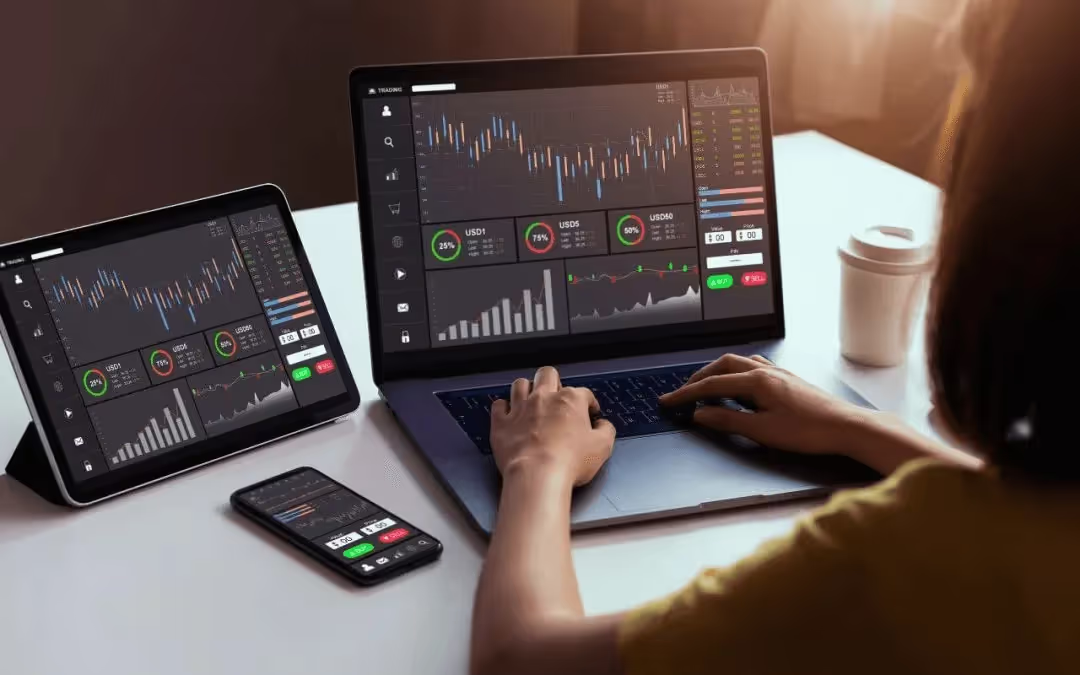
Trading currency pairs is one of the most straightforward and practical places for a new trader to start. The market’s size and structure make it easy to execute trades, learn quickly, and keep mistakes from costing you too much. When you pick major pairs and stick to simple position-sizing and risk rules, you trade in a way that rewards being clear instead of being clever. Many beginners may benefit from exploring a funded trading program to enhance their trading experience.
1. What does abundant liquidity mean?
Abundant liquidity means that orders can move when you want them to. The global FX market is large, with daily FX volume of around $7.8 trillion, according to the Bank for International Settlements (2025), as explained further in a report by the House Committee on Financial Services. This high volume is why major pairs usually fill at market prices with minimal slippage. For someone just starting, this means tighter fills help keep costs easier to predict, reduce the risk of surprise losses when entering or exiting, and allow testing strategies without dealing with market execution issues. Think of it like trading on a multi-lane motorway instead of a single-track road; you can change lanes without getting stuck.
2. How does round-the-clock flexibility benefit traders?
Round-the-clock flexibility allows traders to work on their own schedules, trading when it fits their day instead of following someone else's timeline. Forex operates across multiple global sessions that overlap, allowing analysis during quieter periods and execution during busy periods, such as when both London and New York are active. This scheduling flexibility supports staggered learning and live practice. Traders can run repeated demo sessions, practice the identical setups across sessions, and improve their timing without the stress of losing sleep. Over time, they learn which sessions have the volatility they like. This understanding enhances decision-making and lowers emotional mistakes.
3. What is the low barrier to starting in Forex trading?
There is a low barrier to entry in Forex trading. One does not need a large bank account to begin. Options like micro lots, fractional position sizing, and commission-light pricing allow traders to practice risk-managed trades with modest capital. Moreover, demo accounts enable users to rehearse strategy and trade management without risking real funds. For beginners, this means two essential things: first, they can convert abstract rules into muscle memory through repetition; second, they can scale position size slowly as their competence grows. This approach helps avoid the common trap of overexposing before fully understanding spreads and execution.
4. How does diversification and hedging capability help traders?
Diversification and hedging capability are essential for managing risk. Forex trading introduces a different type of risk exposure to a portfolio. Macroeconomic flows, interest rate differentials, and market interdependencies influence currency movements. Focusing on major pairs is a smart strategy. Pairs such as EUR/USD and USD/JPY dominate volume, as noted by EBC Financial Group in 2025. This dominance explains why these pairs typically offer the most predictable spreads and the best correlation for hedging. By using a select set of major pairs, traders can practice reading macroeconomic cues while avoiding the sudden swings and hidden costs associated with small, exotic pairs.
What challenges arise from picking currency pairs?
Many teams learn the hard way that choosing any random pair seems fine at first; it feels familiar and doesn't need a special setup. However, as trading volume increases or frequency rises, inconsistent spreads, thin liquidity, and unpredictable volatility can hurt performance and raise costs. Platforms like AquaFunded offer easy demo accounts, low-cost execution on major pairs, and simple tools for position sizing. These resources help traders shorten that learning curve and keep execution costs low as they gain confidence.
What is the practical payoff of trading currency pairs?
The practical payoff shows up fast. Tighter spreads, repeatable setups, and demo-to-live routines change how you pick pairs from guesswork to a repeatable skill that you can get better at with practice. However, one major challenge remains that many guides often overlook.
What is the next obstacle to Forex trading success?
This next obstacle is quieter than fees, yet it plays a critical role in determining whether practice translates into durable wins.
Related Reading
- Forex Trading Success Stories
- Pros and Cons of Forex Trading
- Is Forex Trading Profitable
- How Many Forex Trading Days in a Year
- Forex Secrets
- How to Trade Forex With $100
- Day Trading vs Forex
- Forex Tax Rate
- Is Forex Closed on Christmas
- How to Use ADX Indicator for Day Trading
- Best Time Frame to Trade Forex for Beginners
- Is Forex Trading Hard
- Risk Management in Forex Trading
- Scalp Trading Forex
- Forex Trading Account Types
10 Currency Pair Trading Tips for Beginners

Start with a clear plan, steady practice, and strict risk controls. Using tools that let you demonstrate your skills without putting your own money at risk is essential. Follow the numbered tips below as a practical roadmap that you can act on today, and consider our funded trading program to enhance your learning experience.
1. What is Aqua Funded?
Use AquaFunded. AquaFunded gives you a way to scale trading skills into real money without having to deposit your own funds. They offer funded accounts of up to $400K, instant funding options, flexible challenge paths, and you can keep up to 100% of the profit. They also guarantee payment within 48 hours. Think of it as a way to train and turn your skills into capital: you can test your strategies with real spreads and execution while feeling less emotional stress than if you were losing your own money.
2. Why is market knowledge essential?
Know the markets: What drives each pair and why is more important than just chasing setups. Learn about interest rate changes, trade movements, and the specific economic news that affects your chosen pairs. This will help you avoid reacting to distractions. When news breaks, you will already know whether it supports or contradicts your view.
3. How to develop a trading plan?
Make a plan and stick to it. Write down rules for entry, position size, stop placement, and how you’ll measure success; then follow them closely. Use measurable criteria, such as target risk-to-reward ratios, and a regular review schedule. Treat your plan like a checklist a pilot uses before every flight, rather than a suggestion to ignore when emotions run high.
4. Why is practice essential in trading?
Practice. Start by moving slowly from backtests to demo trading, and then to small live trades. Use a demo account to try at least one setup until it feels normal repeatedly. Once you feel ready, test that setup on a live micro account. Keep a log of every trade, including why you entered and what you learned. This way, your progress will translate into actionable data rather than just hope. Consider how a funded trading program can provide the support you need for your trading journey.
5. How to combine fundamentals and technical analysis?
Forecast the market weather by combining a news-driven bias with a simple chart structure. If fundamentals provide a directional edge, wait for technical confirmation at the required support or resistance levels. Use the average true range to figure out stop sizes. Treat indicators as tools for context rather than commands; ultimately, price structure decides, while indicators help explain.
6. How to manage trading emotions?
Know your limits. Set a firm percentage of account risk for any single trade and never exceed it. Trading without strict caps is how accounts disappear. According to the TMGM Trading Academy, "80% of forex traders lose." This leads to an important conclusion: risk control is not optional; it is foundational.
7. What are effective stopping strategies?
Know where to stop along the way. Use stop and limit orders to follow your plan. It is better to use stops aligned with market structure rather than random pip counts. For trades that are doing well, think about using ATR-based trailing stops to protect your profits while still giving the market some space. Keep in mind that contingent orders can make it harder to execute your trades. So, keep your exits simple and strong.
8. How to avoid emotional trading pitfalls?
Check your emotions at the door. When trades do not go well for traders, the urge to recover losses can be a big trap. This behavior often shows up in beginners, as sudden changes and stress from losing can lead to hasty decisions that increase trade size. To prevent this, it is essential to have pre-trade rules that require a break after several consecutive losses. Also, maintaining a steady trade size helps ensure that emotions do not unduly affect how much you risk.
9. What is the key to consistency in trading?
Keep it slow and steady. Focus on a reproducible edge rather than chasing big wins that happen once in a while. Build small advantages through consistency. According to TMGM Trading Academy, "Only 20% of traders are consistently profitable." The difference between those who experiment and professional traders lies in discipline, record-keeping, and patience. Concentrate on expectancy and managing your trades, not on making big hero trades.
10. When should you adjust your trading plan?
Don’t be afraid to explore. If your plan isn’t working, change it deliberately, not emotionally. Test different ideas and practice them through paper trades for a set period. Only make changes that improve measurable results, such as expectancy and drawdown. Think of this process as iterative product development: suggest ideas, run tests, review the results, and then apply successful strategies. Additionally, consider how our funded trading program can provide valuable insights during this iterative process.
How to choose currency pairs for practice?
This approach sounds practical, but the real test comes when choosing the right currency pairs to practice with.
7 Best Currency Pairs to Trade for Beginners
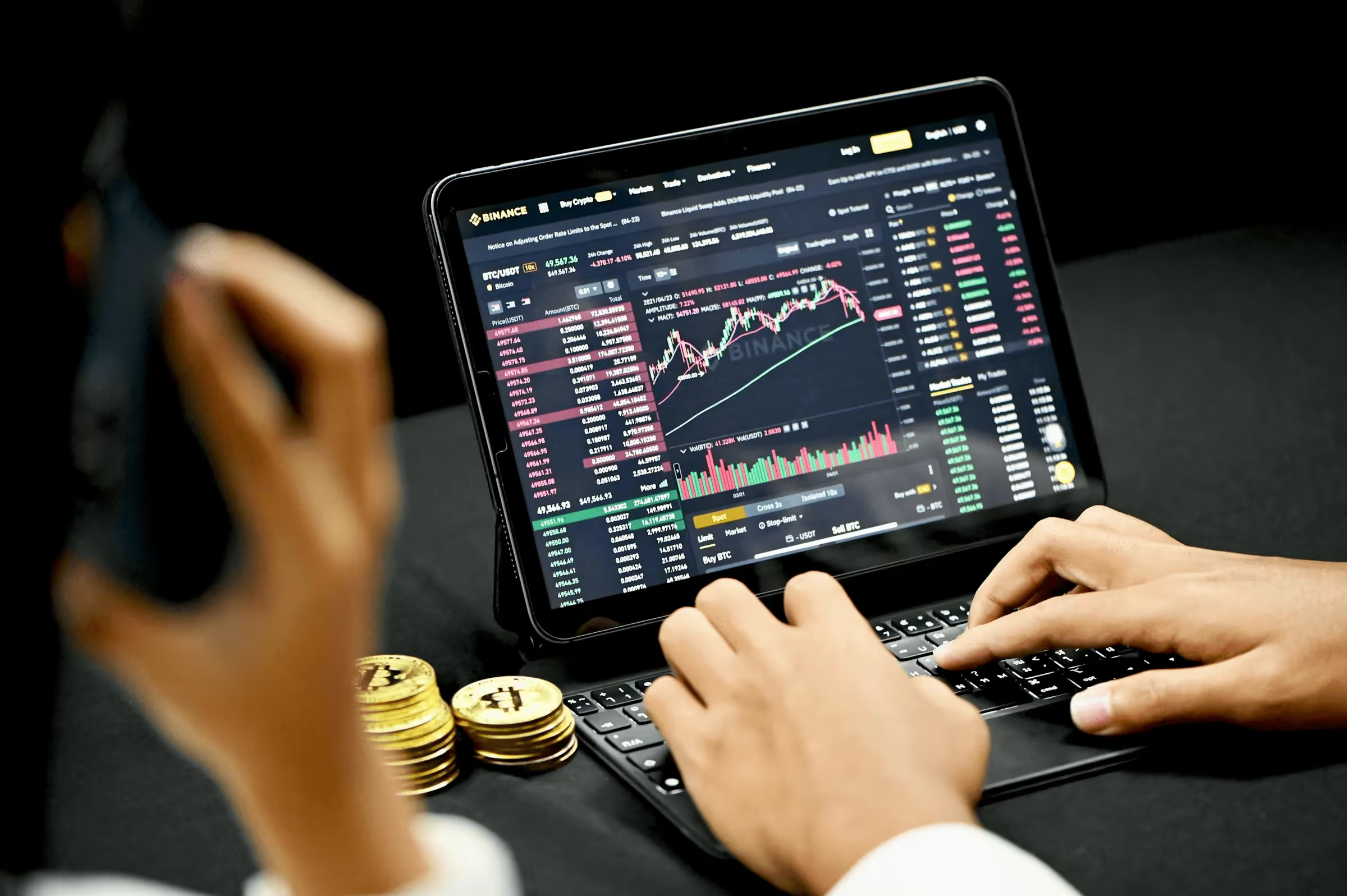
Choosing a few major pairs and using the same setup for each can simplify trading. These seven pairs provide the cleanest trade signals and the simplest cost dynamics for beginners. Below is a list of each pair, highlighting what makes it special for newcomers, along with the practical upsides and downsides traders may face in real trading.
1. What is EUR/USD, and its pros and cons?
EUR/USD (Euro/US Dollar) is the largest forex market. Price changes often reflect macro shifts rather than random noise. This feature makes the pair ideal for learning to interpret chart patterns and for creating repeatable strategies without the interference of unpredictable spikes.
- Very low spreads, which keep execution costs predictable.
- Liquid markets that reliably fill limit and market orders.
- A tendency to behave well with standard technical patterns, allowing you to learn technical analysis without any unusual quirks.
- Extensive coverage from analysts and learning resources, which allows for comparison of notes and testing of ideas.
- Movements can be slow, resulting in small profits on short-term trades.
- The pair is susceptible to macroeconomic events in the US and the Eurozone, which can suddenly shorten or lengthen trends.
- There is a tendency to trade in ranges, making patience and confirmation important.
2. What is USD/JPY and its pros and cons?
USD/JPY (US Dollar / Japanese Yen) shows how many Japanese Yen you need to buy one US Dollar. The dollar-yen pair reacts strongly to interest rate signals and changes in risk appetite.
After coaching traders for six months, I found that flow-based patterns around specific monthly dates offered repeatable edges, provided entry rules were disciplined and position sizes were carefully controlled.
- Tight spreads and frequent trends during session overlaps.
- Clear relationships to interest-rate differences make fundamentals easier to understand.
- It often exhibits consistent, testable behavior that can be incorporated into trading rules.
- The pair can gap or spike when risk sentiment changes, potentially testing naive stop placements.
- Although central bank interventions are rare, they can add tail risk.
- Short-term reversals may be sharp, so traders should use conservative position sizing.
3. What is GBP/USD, and its pros and cons?
GBP/USD, the British Pound against the US Dollar, is commonly referred to as 'Cable.' It shows larger swings than many other major currency pairs, which can reward patient traders with a higher single-trade expectancy when they manage risk well. The pair reacts strongly to political and economic surprises, showing traders how headlines can quickly move prices.
- Bigger price moves that create clear breakouts and trend opportunities.
- High turnover, making execution mistakes visible and correctable in real-time.
- A valuable learning environment for sizing trades during times of increased volatility.
- Wider spreads can happen around major news events, raising costs for smaller accounts.
- Political surprises may lead to erratic intraday behavior.
- Increased volatility needs tighter risk controls to avoid large drawdowns.
4. What is USD/CHF and its pros and cons?
USD/CHF (US Dollar / Swiss Franc) is a currency pair that tends to be steadier than many others. It often acts as a refuge during times of uncertainty. This stability makes it useful for practicing trade management, especially when markets pause or change direction, without the volatility of more volatile pairs.
- Generally moderate volatility, which helps traders practice managed exits.
- Correlation patterns that often provide natural hedge opportunities with other major currencies.
- The perceived safety of the Swiss Franc can reduce whipsaw effects on some setups.
- The pair can spend long periods trading sideways, reducing trade opportunities.
- Occasional surprises from Swiss authorities can move the pair unexpectedly.
- Fewer big moves can slow account growth for high-risk strategies.
5. What Is AUD/USD and Its Pros and Cons?
AUD/USD (Australian Dollar/US Dollar) is closely linked to commodity markets and Chinese demand. This connection creates a dynamic environment for understanding how external markets influence currency movements. For those interested in trading momentum driven by economic cycles and shifts in commodity prices, AUD/USD provides a clear context.
- Strong trending potential during commodity-driven cycles.
- Plenty of movement for learning to ride sustained trends.
- Active during Asian hours, catering to traders who prefer that session.
- Higher volatility increases the chance of quick retracements.
- Sensitivity to China and commodity headlines necessitates close monitoring of external markets.
- Sharp reversals require disciplined stop placement to manage risk.
6. What is USD/CAD and its pros and cons?
USD/CAD (US Dollar / Canadian Dollar) is a currency pair that shows how the two currencies relate to each other. The dollar-loonie responds to energy prices, especially crude oil, making it a good pair for seeing how one significant economic factor can influence trading behavior. This understanding helps create rules that link trading logic to visible external signals.
- Strong correlation with oil makes it easier to analyze situations clearly.
- Moderate moves help practice timing entries based on market momentum.
- Handy for learning commodity-driven trade logic.
- Requires watching commodity markets to prevent unexpected changes.
- Unpredictable behavior can undermine small-edge strategies during periods of oil market volatility.
- News-driven spikes often happen around energy reports.
7. What is NZD/USD and its Pros and Cons?
NZD/USD (New Zealand Dollar/US Dollar) behaves similarly to AUD/USD but has lower trading volume. This means there are fewer competitors on setups, which can lead to smoother trend movements during Asian sessions. It’s a good choice for traders looking for movement with a bit less competition.
- Clear ties to agricultural exports and risk sentiment, which makes it easier to build hypotheses.
- Less crowded than major pairs, allowing some setups to last longer before reversing.
- Helpful for technical traders who like to follow trends during Asian hours.
- Lower liquidity causes wider spreads, especially outside major trading sessions.
- Sensitive to agricultural data and demand from China, which raises event risk.
- Faster reversals can hurt oversized positions.
What common mistakes do beginners make?
A common mistake among beginners is changing trading pairs based on what appears active on a given day. While this might seem sensible and familiar, it hides a high cost. By frequently switching between pairs, beginners do not provide any single setup enough opportunities to assess how well it works. This inconsistency spreads out learning opportunities and increases emotional sizing mistakes.
How does structured repetition affect trading skills?
Most new traders stick with ad hoc pair selection because it is easy and feels productive. This approach works at first when learning is slow and forgiving. However, as trade volume or frequency increases, the lack of structured repetition disrupts skill development. This fragmentation leads to unpredictable equity swings and unclear performance signals. Platforms like the funded trading program provide a more straightforward path by offering real execution and repeatable challenge formats. This allows traders to test the same setup across the correct pairs, tighten risk rules, and measure progress without the noise that random pair-hopping creates. Our funded trading program helps traders focus on consistent strategies for better results.
Why focus on major currency pairs?
Two market facts explain why focusing on the major currency pairs is essential. According to FBS Academy, "80% of forex trading volume is concentrated in the major currency pairs." This concentration shows why the major pairs provide the most consistent spreads and fill quality for practice. Additionally, FBS Academy, 2025, "The EUR/USD pair accounts for 30% of the total forex trading volume." This dominance is why many traders begin their journey here, where they can improve their execution and risk management.
What practical rules can beginners apply?
Two quick, practical rules can be applied across these pairs:
- Trade the same trigger and stop rules across at least three pairs for a month, then compare outcomes by expectancy and drawdown; this approach transforms opinions into data.
- Use session-based sizing by shrinking lots during lower-liquidity windows and expanding slightly when overlapping sessions confirm your setup. This strategy maintains consistent risk while exploiting higher-probability hours.
How can AquaFunded help you?
Turn your trading skills into substantial profits without risking your own money. AquaFunded gives you access to accounts up to $400K with flexible conditions and instant funding options through a funded trading program. This program lets you test your strategies under realistic spreads. Join over 42,000 traders who have earned more than $2.9 million in rewards and enjoy a 48-hour payment guarantee.
What’s the next step after finding a solution?
That solution may sound good, but the next choice will decide if you scale skill or just repeat lucky wins.
Related Reading
- Forex Algo Trading
- Types of Forex Trading
- Forex Trading Spreads
- Forex Market Liquidity
- Forex Mini Account
- Forex Price Action Trading
- Forex Hedging Strategies
- Forex Trend Indicators
- Advanced Forex Trading
- Best Forex Pairs for Scalping
- London Session Forex Pairs
- Minor Currency Pairs
- Best Time to Trade USDJPY
- Forex Swing Trading Signals
How to Choose the Best Currency Pairs to Trade for Beginners

Choosing the best currency pairs starts with a simple rule: select pairs whose trading characteristics match your trading style and risk management strategies. Focus on pairs that can be traded regularly, measured objectively, and practiced repeatedly until the process becomes routine. According to Religare Broking, "Over 90% of beginners find trading currency pairs easier compared to other financial instruments." This accessibility is essential. When selecting pairs, focus on learnability and reproducibility.
1. What should you learn about currency pairs?
Learn about the different types of currency pairs and check the details of the instrument you will trade. It’s important to know not only what a currency pair is but also what you need to look for. After determining whether a pair is major, minor, or exotic, check three key broker details before using it regularly: the average live spread during sessions, tick size and decimal precision, and whether the pair has regular liquidity gaps at certain times or during holidays. Think of these details like a product label. If the spread increases by more than 50 percent during your preferred session, that pair may not be suitable for that trading style. Create a short checklist that includes swap rates for overnight positions and any rules or access limits your platform may have.
2. How to match currency pairs to your trading style?
Match the pair to a trading style using measurable filters. It is essential to understand which pairs work best for your trading rhythm. For scalpers and high-frequency intraday traders, you need average spreads that are under a threshold you can manage, like 0.7 pips or less during the London/New York overlap. Consistent order-book depth is also significant. For swing traders, choose pairs with a clear median daily range that fits well with your stop-loss plan. You can measure this with a 20-day Average True Range (ATR). Position traders should check for swap or rollover costs and monitor macro drivers that can create directional trends over several months. By converting these checks into pass/fail rules, traders can select pairs mechanically rather than emotionally.
3. How to measure volatility for your trades?
Measure volatility in a way that fits your trading style. Use volatility as a sizing tool. Instead of just talking about it, quantify volatility by calculating ATR(14) and the 20-day realized volatility. Then convert these numbers into a position-sizing multiplier so your stop-loss is a fixed percentage of the account risk. This method makes volatility a controllable input rather than an unexpected factor. Also, compare realized volatility with implied or options-based measures when they are available. If implied volatility is much higher than realized volatility, expect news to cause a larger price move; in these situations, consider widening your stops or not trading.
4. What should you test in live conditions?
Test liquidity and spreads under live conditions. Run live micro-tests to see execution costs in real time. A simple method is to place a series of small market and limit orders over several sessions. You should track the average fill slippage, the worst-case spread, and any rejected orders for three consecutive weeks. This method highlights hidden costs, such as sudden spread increases and slow fills, which can frustrate traders and erode their advantage. Delays in execution or rising spreads during important events can quickly turn a good strategy into a losing one. In practice, this test assesses whether a pair is worth trading given your risk tolerance.
How do platforms help with trade selection?
Most traders choose pairs by habit because this approach feels familiar and doesn't need extra steps. While this method can work at first, trading across multiple pairs can spread learning and increase unexpected costs. Platforms like the funded trading program provide consistent demo-to-live execution, precise historical spread data, and easy tools for measuring fill quality. These features shorten the feedback loop and reduce hidden issues that can impede strategy development.
5. How to watch correlations effectively?
Watch correlations like a living chart, not a fixed fact. Create a rolling 30-day correlation matrix and update it every week; use this tool to limit unintended exposure. Correlations change when risk sentiment shifts. This means a portfolio that looks spread out on Monday can become closely linked by Thursday. When correlations rise significantly, it's prudent to reduce position sizes or stagger entries to avoid taking on more of the same macro risk. After a three-month coaching block, we observed that traders who tracked weekly correlations successfully avoided compounded drawdowns during sudden risk-off moves. This preparation helped them to hedge or decrease their positions quickly.
6. How to choose session timing for trading?
Choose session timing like you would pick the right tool for a job. When selecting pairs, think about how well they fit the session. Instead of trying to remember which pairs are active at certain times, look at the pair's median hourly range and spread profile based on your trading window. If you can only trade in the evenings, pick pairs that show their most significant and most precise movements during that time; don’t try to use a London-session pair during a different time for quick trades. Also, be aware of daylight saving time shifts, which can slightly alter session overlaps and affect spread behavior for a few weeks each year.
7. What is the importance of practice before starting?
Practice with a structured experiment before using real money. Create a testing plan and stick to it. Complete at least 100 live-demo trades for each setup, or run one month of focused forward testing, whichever occurs first. It's important to record details like entry trigger, stop logic, realized spread, slippage, and post-trade notes. Evaluate a setup based on expected returns and maximum drawdown, not just a few lucky wins. By treating demos like experiments, people can turn noise into data and avoid the common mistake of making choices based on a feeling of "that felt right."
What practical steps can you implement today?
Here are some practical steps that you can start using today:
- Create a three-point tradeability score for each pair. This score should include spread stability, fill reliability, and average range compatibility with your stop-sizing rules.
- Keep a weekly watchlist of five pairs and change them every two weeks. This strategy helps you build repeatability without overfitting.
- Use ATR and realized volatility to set your stops and size consistently. Also, measure slippage separately for market and limit orders.
Why Does the Forex Market’s Scale Matter for Beginners?
The scale of the forex market is significant for beginners because it directly affects their trading decisions. With a daily trading volume of over $6 trillion, liquidity patterns are large and vary by trading session. This large volume explains why some currency pairs stay close together while others do not. According to Religare Broking, "The forex market has a daily trading volume of over $6 trillion, providing ample opportunities for beginners." Several pairs give unique opportunities that can help traders.
What should you consider for adaptability in trading?
A key variable that is often overlooked is adaptability. It is essential to select pairs that can be measured accurately and to be prepared to adjust strategies when the data indicates a need for change.
What is a common misconception in pair selection?
The surprising part is that a choice that looks safe right now may hide the very limitation that could stop progress later.
Join Our Funded Trading Program Today - Trade with our Capital and Keep up to 100% of the Profit.
You can practice with the best currency pairs for beginners until your charts look perfect. However, you may still lack the live capital and emotional buffer needed to grow your trading. This situation often leads many traders to take dangerous risks and get stuck in their progress. The standard approach is understandable, but platforms like AquaFunded offer instant funding, customizable challenge paths, accounts up to $400K, flexible trading conditions, no time limits, and up to 100% profit split. With these features, you can work on pair selection, position sizing, and trade management in real trading situations without putting your own savings at risk. Check out the funded trading program for more details.
Related Reading
- Best Forex Pairs to Trade During Asian Session
- Best Forex Funded Account
- Top Prop Firms
- Best Prop Firm
- Forex Prop Firms
- Best Forex Pairs to Trade During New York Session
- Best Forex Trading Platform
- Forex Trading for Beginners
- Forex Trading Hours
- Forex Trading Brokers
- Forex Trading Course
- What Is Forex Trading and How Does It Work
- Forex Currency Trading
- Forex Online Trading
- How Does Forex Trading Work
- Online Forex Trading
