




7 Common Types of Forex Trading
Types of Forex Trading: Discover 7 styles with practical risk controls and entry tips. AquaFunded funds your trades to build a proven track record.

Foreign exchange trading demands precision and discipline, as even a single misstep can erase hard-earned gains. Many traders build Forex Trading Success Stories by aligning strategies such as scalping, day trading, swing trading, and algorithmic approaches with timely market analysis and strict risk management. Matching a trading style to one’s schedule, risk tolerance, and overall objectives is key to achieving consistent performance.
A clear understanding of the different types of forex trading and essential market indicators drives a more measured approach to the market. Consistent practice, adherence to defined rules, and proper trade sizing can translate planning into profitable action. AquaFunded’s funded trading program provides an opportunity to apply these skills in live conditions while managing risk effectively.
Summary
- Forex offers near-constant access and deep liquidity, operating 24 hours a day, five days a week, and supporting over $6 trillion in daily turnover, which keeps spreads tight and execution reliable for major pairs.
- Structured practice materially improves readiness, for example, a six-week demo with a 70 percent plan-adherence benchmark before moving to real funds helps convert the study into repeatable behavior.
- The absence of a compact decision engine is a leading failure mode, as shown by Forex.com’s finding that about 90 percent of new traders lose money; codified entry, position-size, and exit checks are essential.
- Risk frameworks and emotion control are non-negotiable, with over 70 percent of traders losing money due to poor risk management, and emotional trading accounting for roughly 30 percent of trading errors.
- Individual traders are a small slice of the market, representing about 5.5 percent of total forex volume, which means edge comes from execution quality and process consistency rather than trying to out-trade institutional flows.
- Scaling without operational controls fragments results, so centralizing execution and risk rules cuts reconciliation from days to hours and supports mechanical limits like risking 0.5 to 1 percent per trade or pausing after a 6 percent drawdown.
- This is where AquaFunded's funded trading program fits in; it addresses this by offering live-funded capital and defined risk controls so traders can validate execution and risk management in real conditions without risking their own savings.
Benefits of Forex Trading
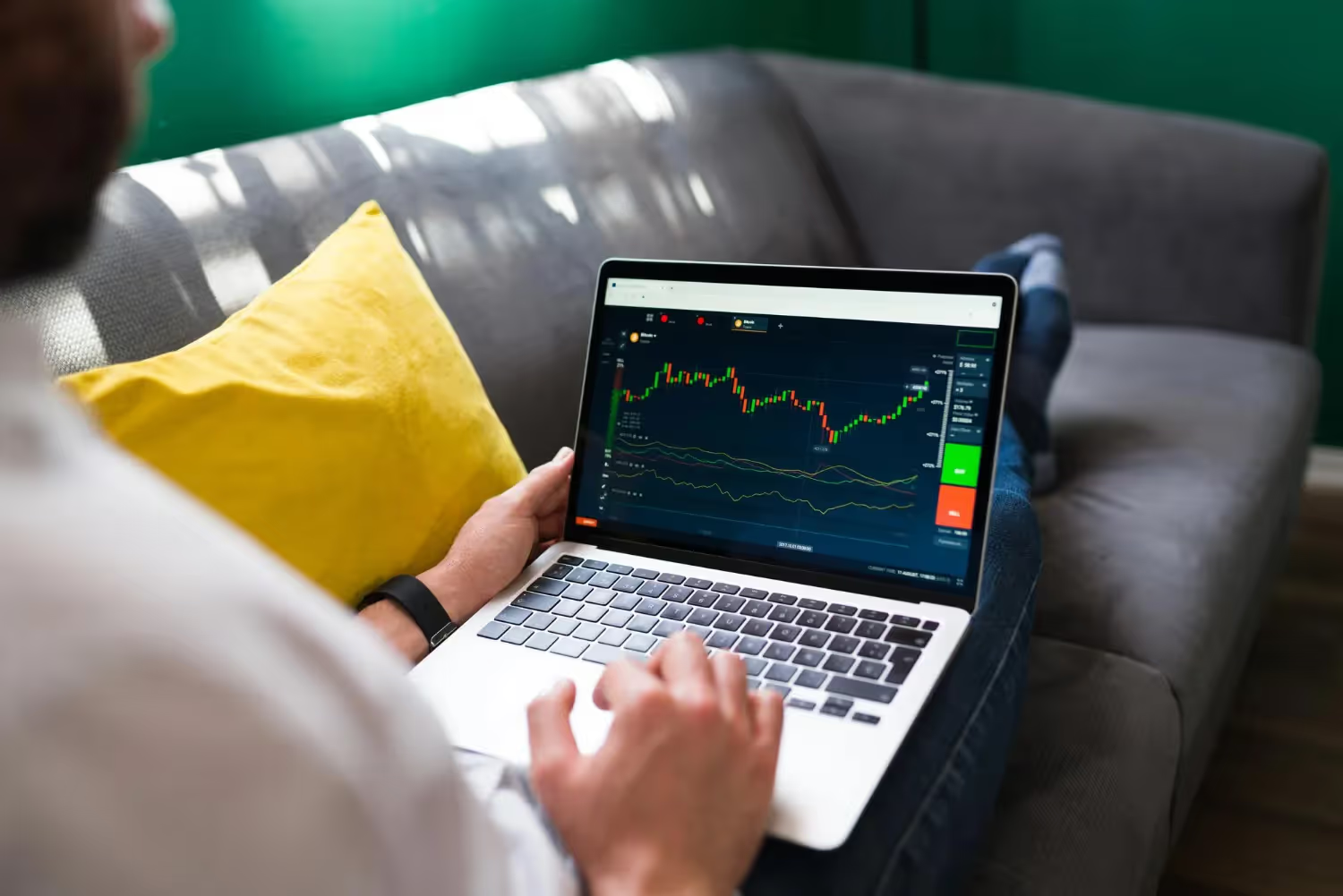
Beginners should trade forex because it combines real opportunity with easy access. You can learn at a low cost, practice safely, and trade in the world's biggest, most active market, which makes trading quick and reliable. The size of the market and its advanced technology allow for small accounts, low fees, and 24/5 access, so you can fit trading around your job and life while you improve your skills. Consider exploring our funded trading program to maximize your opportunities.
1. What are the benefits of always-on market access?
Always-on market access. When day jobs or family responsibilities take up certain hours, traders still need chances to make trades, and the forex market offers that flexibility. It spans global time zones, ensuring that a major trading session is almost always underway. This lets traders join the US, European, or Asian sessions when volatility aligns with their strategies. According to DailyForex, the Forex market operates 24 hours a day, five days a week, across major financial centers in different time zones. A key tip is to align the currency pairs you trade with the sessions you watch; for example, trading EUR/USD during the overlapping hours of London and New York often leads to clearer market moves.
2. How can I access free and practical learning resources?
Learning opportunities are widely available and mostly free. Most barriers to entry are about access to information, and the internet has significantly reduced these challenges. From beginner webinars and introductory courses to intermediate lessons on technical analysis and risk management, you can make a study plan without spending money on expensive degrees. It is a good idea to follow a structured path: start with how to use the platform, include basic chart patterns, and then add macro news and rules for sizing your positions. A helpful tip is to use a curriculum that can be finished in 30 to 60 days, which helps turn studying into actual practice.
3. Why should I use demo accounts for risk-free practice?
Risk-free practice with demo accounts. If you want to get good before risking money, practice accounts let you trade like it's real, but with virtual cash. Think of a demo as a flight simulator for trading, where you can practice takeoffs, stalls, and emergency procedures without crashing the plane. Use demos to test entries, exits, and trade-size rules; don't just chase performance.
Top tip: Set personal rules during a demo, then start small live trades after reaching a performance goal and time period.
4. What does deep liquidity mean for traders?
Deep liquidity is significant for making clean entries and exits. It ensures tight spreads and low slippage, which allows orders to fill close to expected prices, even for larger amounts. The market’s significant daily turnover helps keep prices tight, reducing the risk of getting stuck in a trade when trying to exit. According to DailyForex, the global Forex market is the largest financial market, with daily trading volume exceeding $6 trillion. A good tip for traders is to concentrate on major pairs for the tightest spreads and the most dependable price action during the early stages of their trading journey.
5. How can I start small and scale my trading?
Start small and grow slowly. You do not need much money to start trading. Many brokers allow small deposits and offer micro lots. This helps you learn how to size your positions and manage risk without risking your savings. Being disciplined early on is often more important than having a lot of money to start; when you trade small, you learn both the skills and the mindset needed before your choices get more serious. A great tip is to risk a small fixed percentage, like 0.5% to 1% of your account for each trade, while you work on your trading history.
What should I use as a trading tool?
Most traders start by using spreadsheets, chats, and bookmarked news pages because these tools are familiar and free. This technique may work for a few trades. However, as trading increases, it can lead to bad habits: signals might be missed, trade logs can become confusing, and learning slows down. Platforms like AquaFunded bring together performance tracking, execution rules, and funded program workflows, which help traders stay disciplined while growing. Teams find that automated P&L tracking and precise risk controls reduce reconciliation time from days to hours.
6. What are the costs of trading?
Low explicit transaction costs. What you pay to trade is mostly the spread and sometimes a small commission, not recurring fees or account maintenance. This means that active practice does not have high fixed costs. That low-cost structure lets you iterate strategies without the overhead that larger retail investors face in other markets. Top tip: Compare spread tables and commission models across brokers before opening an account, and prefer transparent pricing during your learning phase.
7. How can I trade from anywhere?
You can trade from anywhere using basic technology. You only need a smartphone or laptop and a stable internet connection to place trades, receive alerts, and review charts. This makes forex a mobile-friendly skill that can be developed during commutes or in between meetings. Additionally, modern apps closely mirror desktop platforms, making learning smooth across devices. A top tip: Use on-the-go alerts sparingly; constant monitoring can erode discipline and invite overtrading.
8. What technology can support strategy diversity?
Technology that supports strategy diversity includes charting suites, Expert Advisors (EAs), and API access for algorithmic systems. Forex offers tools for beginners to test mechanical systems, practice scalping, or use swing and positional strategies. This technical flexibility allows you to explore methods such as scalping, day trading, swing trading, carry trades, and automated strategies, all without switching markets. Top tip: If you are testing algorithms, keep a clear separation between developing your plan and live execution until you have validated its behavior across different market conditions.
9. What should I know about leverage in trading?
Leverage makes bigger outcomes, both good and bad. It's a tricky tool that lets small accounts manage larger positions, speeding up both profits and losses. It's essential to think of leverage as a tool, not a shortcut to making money. Use conservative ratios and establish clear stop losses while you learn. A good suggestion is to begin with no leverage or very little leverage until your winning rate and risk-reward ratio are steady over many trades.
10. What are the advantages of choosing regulated brokers?
Regulated brokers and consumer protections. You can choose brokers that are regulated by strong authorities. These brokers have rules requiring them to keep client funds separate, undergo regular audits, and have dispute-resolution procedures. This provides you with legal protection and clarifies their operations. Because of the different regulations, you should pick a broker whose rules fit what you want. For instance, brokers overseen by the FCA, ASIC, or NFA offer better protections for consumers. Top tip: Make sure to check a broker’s registration, read the latest audit results when you can, and make small, frequent withdrawals while you build trust.
Why is measured learning important in trading?
A quick image to hold: learning to trade with small, measured steps is like learning to sail in safe waters before taking on open seas. The skills of position sizing, session selection, and journal discipline are what help traders stay afloat when conditions change. If you're interested in exploring a funded trading program, consider how our offerings can support your development on this journey.
What Habit Can Destroy Trading Progress?
This simple advantage seems straightforward until you discover the habit that quietly destroys progress.
Related Reading
- Pros and Cons of Forex Trading
- Is Forex Trading Profitable
- How Many Forex Trading Days in a Year
- Forex Secrets
- How to Trade Forex With $100
- Day Trading vs Forex
- Forex Tax Rate
- Is Forex Closed on Christmas
- How to Use ADX Indicator for Day Trading
- Best Time Frame to Trade Forex for Beginners
- Is Forex Trading Hard
- Risk Management in Forex Trading
- Scalp Trading Forex
- Forex Trading Account Types
10 Forex Trading Tips for Beginners

Think of these ten practical starter rules as a handy playbook you can follow today, each designed to stop the common mistakes new traders make and to help you build habits that work well. Read them as clear actions, not just vague advice.
1. Use AquaFunded.
AquaFunded gives you quick access to accounts with up to $400,000, with flexible terms, no strict time limits, profit targets you can really achieve, and up to a 100 percent split on profits. The program supports instant funding or a skill-proof challenge path, and it guarantees payouts within 48 hours. More than 42,000 traders have earned rewards through this system. Think of it as a way to go for bigger trades and professional-style risk management without using your own money. Consider exploring our funded trading program to see how it can support your trading journey.
2. Know the markets
Currency changes are always a mix of policy, macro flows, and market structure. Learn how central bank guidance, interest rate differences, and liquidity levels affect the pairs you trade. When we trained newer traders over several weeks, a common problem was trying to trade every news event, rather than focusing on the few that actually move rates. Learn to from the critical events that happen each month.
3. Make a plan and stick to it.
A trading plan must act like a decision engine. It should include rules for entering trades, the maximum you can risk per setup, exit rules, and an easy way to review each trade afterward. Keep your plan short so you can follow it even when under pressure. Coaches suggest three essential checks before any order: setup confirmation, position-size math, and pre-set stop and take levels. Remember, Forex.com reports that 90% of new traders lose money, underscoring how undisciplined decisions can quickly erode capital.
4. Practice with intention.
Use practice accounts not as a game, but as a tool to measure yourself. Set goals for consistency, such as a six-week demo period in which you follow your plan on at least 70 percent of trades and maintain a stable risk profile. Only start using real money after showing that you can control your behavior, not just because you had a lucky winning streak. Track how often you stick to your stop-losses and how your timing on entries changes when real money is on the line.
5. Forecast the market’s conditions.
Combine a macro calendar checklist with technical checks so you only trade when both match. For example, look for a momentum breakout during a session overlap, away from major news. This blended approach helps reduce false signals and keeps you focused on opportunities that fit your strengths. The critical part is a pre-trade checklist that makes you connect your method with current market conditions.
How do you use tools effectively?
Most traders use spreadsheets and informal notes because they are familiar. This method works well when you're starting, but it can cause problems as you trade more and the trades become more complex. As trading activity increases, methods can become scattered, important context can get lost, and errors can occur in sizing and journal entries. Platforms like funded trading programs centralize performance, apply consistent risk controls, and automatically track P&L. This helps save time on reconciliation and keeps behavioral signals intact as you grow.
6. Know your limits.
Decide in advance how much of your account you will risk per trade and what drawdown will make you pause for a review. Stick to those numbers strictly. This isn't just about being careful; you should pick a specific drawdown rule, like pausing trading after you lose a certain percentage over a week. This method helps calm your emotions and lets you rethink your plan.
7. Know where to stop.
Use stop orders and pre-defined exit rules to take away the guesswork after you enter a trade. Think of trailing stops as a profit-protection tool related to market ups and downs, not a response to panic. A good guideline is to size stops based on market structure and put your trailing stop at a multiple of the average true range. This gives the market space to move while still safeguarding your profits.
8. Check your emotions at the door.
New traders often exhibit this pattern: a bad sequence triggers anxiety, which leads to revenge trades that worsen losses. When pressure gets high, switch immediately to the smallest allowed size or stop trading until you can follow your checklist. The skill of controlling emotions is trainable, just like any technical pattern, but it requires disciplined breaks, such as a 24-hour cooling-off period after two losing trades.
9. Keep it slow and steady.
Being consistent is better than having quick wins. Set growth targets that you can check every month and focus on keeping track of the proper process goals instead of just looking good on paper. It’s better to count how many trades you made following your plan rather than just focusing on your overall gains. Over time, minor improvements in how you execute, manage risks, and journal add up much more than occasional big wins.
10. Don’t be afraid to re-evaluate
Your plan should change as your skills and life change. If your returns stop improving or your win rate falls, try a short experiment: change one part of your plan for 30 trades, check the result, and then decide to either keep or remove the change. Think of developing your strategy like product iteration: use small tests and clear acceptance criteria.
What is the mindset for successful trading?
A quick image: think of trading as tuning a precision instrument, not flipping a switch. Small, careful changes give much more dependable results than significant, awkward adjustments. The following section will examine how different trading methods require distinct habits and trade-offs. It will point out the critical detail that makes the difference between successful strategies and losing ones.
7 Common Types of Forex Trading
There are seven common forex trading styles. Each one requires a different mix of time, tools, and temperament; so pick the one that matches your schedule, how much stress you can handle, and your strengths. Don't just choose the one that seems to promise the fastest way to earn money. Below, I will list each style, including what it looks like in practice, how it behaves day to day, who it is suitable for, and the realistic downsides you need to manage.
1. What is scalping?
- What it is: Scalping means making very short trades to get many tiny wins in one session, usually lasting seconds to a few minutes.
- Key features: Scalping involves trading very frequently, aiming for small targets, and depending on quick order execution and very low spreads. Scalpers focus on gaining milliseconds of advantage and often use higher leverage to make small moves count. It’s usually easier to excel in this strategy with a funded trading program that provides ample resources.
- Who it fits: This strategy is suitable for traders who can constantly monitor prices, handle intense adrenaline, and use fast platforms with fast connections.
- Risks and realities: Transaction costs can wipe out any profit unless you find the best execution price. The emotional stress is real, and after working with a group of scalpers for six weeks, the main issues they faced were high costs and fatigue, which can overwhelm even good strategies. Scalping can be successful until fees and attention limits become a problem.
2. What is day trading?
- Day trading means buying and selling on the same day to take advantage of intraday swings. This uses technical setups and looks for market changes during specific times.
- Key parts of day trading include holding trades for minutes to a few hours, making several careful trades each day, and closing out trades before the day ends so that you don’t keep positions overnight.
- This method is suitable for traders who have available hours during the day and want a shorter commitment than swing trading, but more leeway than scalping.
- However, there are risks; sudden market shifts can wipe out profits if discipline is lost. Timing is critical, and the actual skill is in sticking to exit rules when the market goes against a trade.
3. What is swing trading?
- What it is: Swing trading involves capturing medium-term moves that happen over days to a few weeks. It balances technical analysis with selective fundamentals.
- Key features: There are fewer trades, larger profit targets per trade, and you hold positions through several market sessions to catch broader momentum.
- Who it fits: This style is suitable for traders who can check markets regularly and prefer making fewer, more thoughtful decisions.
- Risks and realities: You need to accept overnight and weekend gaps, and you must manage stops automatically. If not, a headline can change a winning trade into a loss before you react. Expect to wait anxiously sometimes; this is part of the tradeoff for making larger swings.
4. What is Position Trading?
- Position trading is a long-term approach that focuses on major trends. Positions can last for months or even years, with significant economic factors driving when to enter.
- Key features include a firm reliance on fundamental analysis, low turnover, and a focus on significant price movements rather than daily fluctuations.
- This style is best for traders who have patience, the capital to handle losses, and an interest in big topics like interest rates and trade flows.
- However, there are risks and realities to think about. Position traders might miss opportunities and face significant losses when market conditions change. It's important to understand that maintaining long-term beliefs may require conviction tests, which could involve strategies such as staged scaling rules and regular evaluations.
5. What is carry trading?
- Carry trading involves holding currency pairs to profit from interest-rate differentials while hoping for changes in currency values.
- Key features include longer holding periods to earn interest credits, paying close attention to central bank announcements, and a good understanding of rollover mechanics.
- This strategy is for traders who focus on macroeconomics and can handle term exposure and the slow growth of returns.
- However, there are risks and realities to consider: if the funding currency's value changes or the higher-yield currency fails, the trade can go the other way.
- Also, the hidden costs of rollovers and swaps can reduce returns if not taken into account.
6. What is algorithmic and automated trading?
- What it is: These are systems that follow specific rules to trade on their own. They can range from simple signals to very complex high-frequency trading engines.
- Key features: Automation helps remove emotional biases, allows for larger trades, and requires careful back-testing and constant monitoring.
- Who it fits: This is suitable for traders who know how to code or have access to automation tools and want to repeat their strategies and run many tests quickly.
- Risks and realities: Many people think that just setting up a strategy is enough. However, focusing too much on past data without testing it under different market conditions can lead to problems when trading live. When we tested automated systems in three distinct market conditions, the ones that didn't do well lacked proper out-of-sample tests and backup plans.
7. What is event-driven and news trading?
- What it is: Trading around scheduled or unscheduled events that significantly change prices, like policy announcements, employment reports, or geopolitical shocks
- Key features: Short times of increased volatility, the need for quick decision-making, and a focus on liquidity and widening spreads
- Who it fits: Traders who can act fast and who understand the likely direction of essential releases
- Risks and realities: Slippage, wider spreads, and sudden reversals are common. You need to plan your entry, trade size, and exit before the event, because executing at that moment can be confusing.
How much of the market do retail traders actually represent?
How much of the market do retail traders actually represent, and why does that matter? Retail activity accounts for a small share of the overall market. According to DailyForex, retail forex trading accounts for about 5.5% of the total Forex market volume. This means that much larger institutional flows usually take over individual moves. This scale shows that a trader's edge lies in execution and consistency, not in competing with macro players.
Why does matching style to infrastructure matter?
Matching style to infrastructure is crucial. If your approach requires low latency, but your setup consists of a basic laptop and consumer internet, this mismatch becomes a failure point. Conversely, position traders often waste time obsessing over intraday noise. It is essential to choose your tech stack and trading rules to fit your style. Then, enforce these with measurable checks, such as maximum slippage thresholds or a rule that prohibits trading unless your platform latency is below a specific number.
What is the status quo friction and a better path?
Most traders manage risk and growth using spreadsheets and rules they make up themselves because these tools are familiar and free. However, as the number of trades and trading complexity increase, mistakes and missed signals can accumulate, leading to a lost edge. Platforms like the funded trading program make trading easier, automatically enforce risk limits, and keep performance logs that can be checked. This change reduces the time needed for checks from hours to minutes while maintaining consistent risk controls.
Why is the vehicle analogy important in trading?
Consider each trading style as a vehicle, from fast sprint bikes to big long-haul trucks. Pick the one whose fuel, tires, and maintenance you can actually handle, not just the shiniest ride you wish you could have. Turn your trading skills into real profits without risking your own money with AquaFunded’s funded trading program. This program gives you access to accounts up to $400K, with no time limits, easy profit targets, and up to a 100% profit split. AquaFunded allows for instant funding or challenge paths, guarantees payouts within 48 hours, and has helped over 42,000 traders earn more than $2.9 million in rewards.
What hidden habits can destroy returns?
The choice of style may seem straightforward, but one hidden habit can quietly hurt returns.
Related Reading
- Forex Algo Trading
- Forex Trading Spreads
- Forex Market Liquidity
- Forex Mini Account
- Forex Price Action Trading
- Forex Hedging Strategies
- Forex Trend Indicators
- Advanced Forex Trading
- Best Forex Pairs for Scalping
- London Session Forex Pairs
- Best Currency Pairs to Trade for Beginners
- Minor Currency Pairs
- Best Time to Trade USDJPY
- Forex Swing Trading Signals
Mistakes to Avoid While Trading Forex

Mistakes can drain capital and morale. However, seeing them as design flaws to be fixed instead of personal failures can help you improve. Below are seven main errors and practical fixes that you can use right away.
1. What is the first mistake to avoid?
No formal trading roadmap. Most traders often think of a plan as just a to-do list. However, this way of thinking usually falls apart when under pressure. Instead, create a simple decision-making process with three checks before any order: setup confirmation, position-size math, and predefined stop and target. Set a clear expectancy goal for the strategy and make a rule to run 50 simulated trades with a consistent win rate and positive expectancy before increasing size. Keep track of how well you stick to the plan as a key performance indicator (KPI) rather than just looking at profit and loss. Regularly checking this KPI each week can show any gaps between what you intended to do and what actually happened.
2. How does overtrading affect trading?
Chasing volume through overtrading often stems from emotional triggers, such as boredom or the desire to recover losses. It's essential to set clear limits, such as maximum trades per session, maximum open positions per pair, and a trade-rate cap based on actual market volatility, to avoid making trades when the market conditions are not right. Adding a fatigue guard can also be helpful; for instance, you might stop trading after two plan violations or after a set time without taking a proper break. This method helps you stay disciplined and keeps the edge that your setup offers.
3. Why are volatility-calibrated stops important?
Trading without volatility-calibrated stops can lead to significant losses. It's essential to set stops based on market structure and volatility. For example, you place stops at 1.5 to 3.0 times the 14-period ATR, depending on your time frame. After that, calculate position sizes so the risk per trade fits your risk budget. It's a good idea to automate stop placement in your trading platform. Treat any manual adjustment as a warning sign and review it after the trade, rather than changing the rules on the spot.
4. How to manage losses effectively?
Letting losers grow beyond your risk budget can be harmful. The real cost is behavioral, not just numeric. It's essential to set a risk budget for each session and week. For example, consider a maximum of 2 percent per trade and a 6 percent account drawdown. If your losses hit this drawdown, it should trigger a two-day trading pause and a review of the root cause. If sticking to these triggers is hard, consider reducing your trade size or using only indicator alerts until you can reliably take the pause. This way, you can avoid a single emotion-driven mistake from wiping out months of progress.
5. What is the value of a structured learning path?
Skipping a structured learning path leads to brittle skills that come from watching random videos and using scattered indicators. Instead, it is essential to follow a curriculum with clear milestones. These should include becoming fluent with the platform, mastering three chart patterns, applying trade management rules, and completing a six-week demo that meets the 70 percent plan-adherence threshold. Studying with a mentor who reviews your work every 30 trades can help you find blind spots much faster than just trying things on your own.
6. How to avoid analysis paralysis?
Freezing under too much information can lead to analysis paralysis. This happens when you try to understand every signal. To fight this, use a two-layer filter: First, use a macro checklist to eliminate trading during unsuitable conditions. Second, apply a microfilter that requires three technical confirmations for each entry. When changing any variable, test it with a fixed sample of 30 trades before using it widely. This method helps prevent chasing performance noise while keeping confidence in a small, tested set of rules.
7. What should a good trade journal include?
Neglecting a clear, helpful trade journal can slow your progress. A journal should be a useful tool, not a burden. Use a one-page template for each trade that includes: a timestamp, trading pair, time frame, a setup checklist with pass/fail indicators, entry point, stop loss, target, position size, an emotion rating on a scale of 1 to 5, and a short lesson learned. Do a weekly review of those entries and set two goals for improvement next week, such as improving stop placement or reducing entry mistakes. Small, consistent changes often lead to faster improvement than big revelations that happen now and then.
Why do these errors persist?
A note about the persistence of these errors: risk and emotion are the two main factors that ruin accounts. This is why over 70% of forex traders lose money due to bad risk management, according to IG International. Also, emotional trading accounts for 30% of trading errors, according to IG International. The numbers clearly show that risk frameworks and emotion controls are necessary.
How can traders scale effectively?
Most traders manage scaling using spreadsheets and informal rules because this approach feels familiar and is simple to use. While this method works at first, as the number of trades increases and things get more complex, it can lead to mixed information. As a result, some rules might be overlooked, and mistakes can pile up, resulting in losses that could have been avoided. Solutions like the funded trading program help by centralizing performance, automatically enforcing risk rules, and keeping clear records. This lets traders stay disciplined and grow effectively without relying on manual checks.
What is the broader pattern in trading mistakes?
When stepping back, the pattern becomes clear: technical skills are cheap, while behavioral systems are rare. By treating each mistake as an operational failure that can be measured, watched, and corrected, traders can change the odds in their favor.
What happens with proper fixes and capital?
That sounds like an ending, but the real intrigue arises when these fixes are paired with outside capital and professional risk rules.
Join Our Funded Trading Program Today - Trade with our Capital and Keep up to 100% of the Profit.
When coaching traders who switch between scalping, day trading, swing setups, and algorithmic systems, the main issue is not usually their technique. Instead, it is their ability to demonstrate an advantage at larger sizes without risking their own money. Platforms like AquaFunded provide that vital connection. They offer funded capital and a structured program, allowing your execution and risk management to determine the results, not just the amount you brought to the table. Explore our funded trading program.
Related Reading
- Best Forex Pairs to Trade During Asian Session
- Best Forex Funded Account
- Top Prop Firms
- Best Prop Firm
- Forex Prop Firms
- Best Forex Pairs to Trade During New York Session
- Best Forex Trading Platform
- Forex Trading for Beginners
- Forex Trading Hours
- Forex Trading Brokers
- Forex Trading Course
- What Is Forex Trading and How Does It Work
- Forex Currency Trading
- Forex Online Trading
- How Does Forex Trading Work
- Online Forex Trading
