




4 Best Forex Pairs to Trade During the Asian Session
Best Forex Pairs to Trade During Asian Session: Discover strategic pair selection, risk management, and proven trade setups with AquaFunded’s expert insights.

Successful trading begins with an informed understanding of market dynamics during specific sessions. In the Asian session, liquidity and volatility patterns help pinpoint the best forex pairs to trade, enabling traders to identify promising opportunities in yen crosses and key commodity pairs.
A focused approach to intraday setups and risk management can drive continuous progress and consistent decision-making. Blending analytical insights with disciplined strategy, AquaFunded’s funded trading program equips traders with essential tools to evaluate markets effectively and safeguard capital.
Summary
- The Asian trading session has thinner order books and higher execution risk, accounting for about 21% of total daily forex volume. Traders should plan for wider spreads and slippage when executing routine scalps.
- Yen and commodity pairs dominate session flow, with USD/JPY making roughly 20% of Asian-session turnover and AUD/USD showing about $200 billion in daily flow, which means JPY, AUD, and NZD crosses typically offer the cleanest signals.
- Regional economic prints from Japan, China, and Australia can produce decisive moves that last two to three hours, so treating each scheduled release as a potential session pivot improves sizing and stop placement.
- The late overlap with Europe lasts about three hours. It often converts quiet Asian ranges into impulsive legs, a predictable volatility window that both creates opportunity and raises the risk of overnight position blowouts.
- Conservative risk rules pay off in this window: for example, risk 0.25-0.5 percent of account equity per trade and cut size by about 33 percent when ATR expands 1.5x, preserving runway through noisy periods.
- Execution matters more than strategy in Asia, as evidenced by USD/JPY averaging about 30 pips of Asian-session volatility and the rule of thumb to switch to limit orders or pull size when broker spreads widen by more than 50 percent relative to the London open.
- This is where AquaFunded's funded trading account addresses the issue by providing allocated capital and session-specific execution analytics, enabling traders to match position size to live liquidity and reduce slippage.
Key Features of the Asian Trading Session
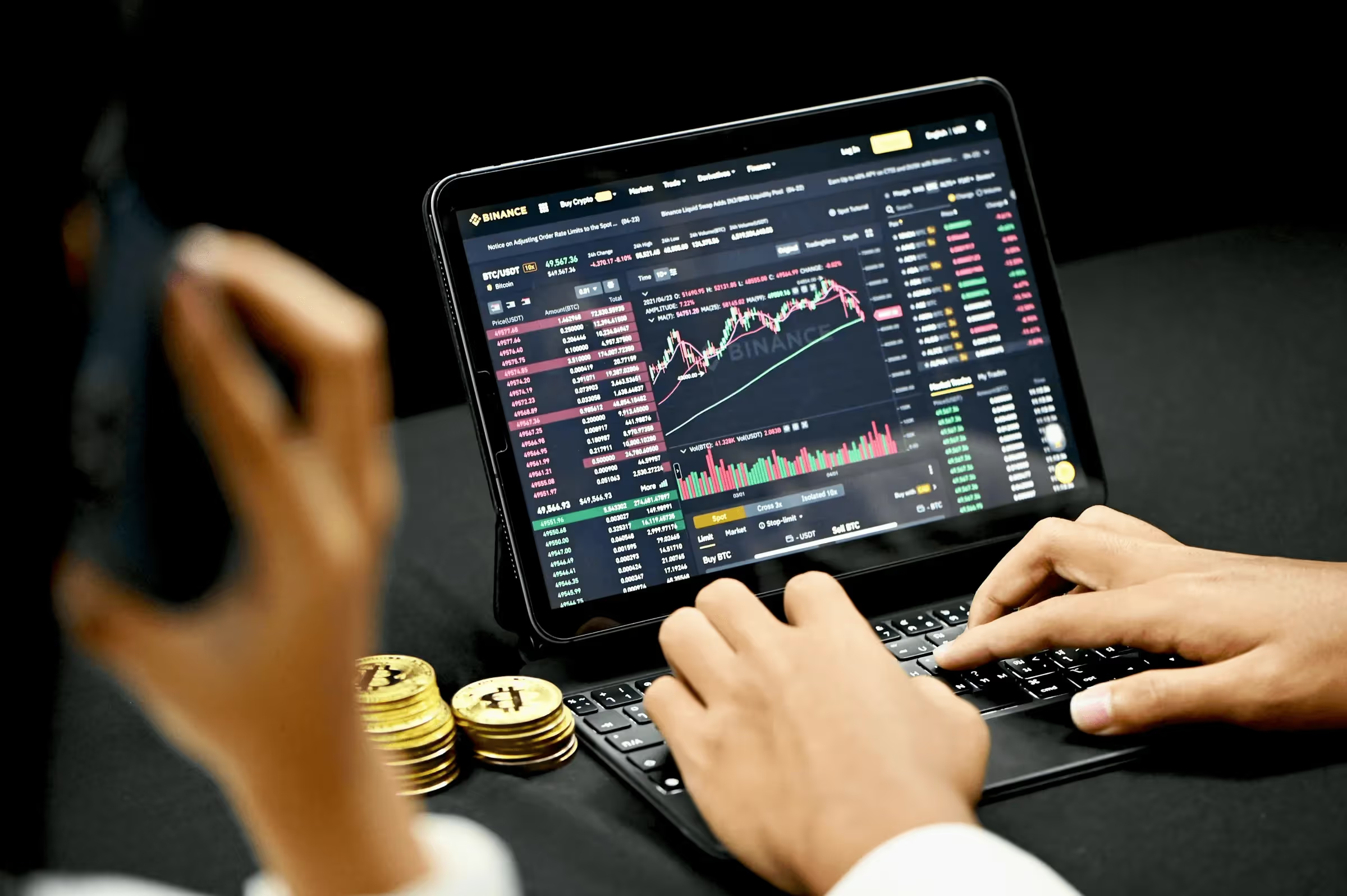
The Asian session is typically a quieter period in the 24-hour forex cycle. During this session, liquidity is lower, and opportunities focus on JPY, AUD, and NZD pairs. Local economic reports and the late overlap with Europe create moments of activity in this session. Here, trade size, entry style, and news awareness are more important than in busier sessions because price movements can be shallow one moment and sharp the next. To enhance your trading journey, consider evaluating our funded trading program for tailored support.
1. Market activity and liquidity profile
Market activity and liquidity profiles vary significantly by time zone. Trading volume during Asian hours is lighter compared to London or New York. This results in thinner order books, which can lead to unpredictably wider spreads. According to Dukascopy Bank SA, the Asian trading session accounts for 21% of total daily forex trading volume. This indicates that most large flows and deep liquidity occur in other sessions, so traders should consider execution risk. This pattern is similar across retail brokers and prop desks, where lower volume can make straightforward scalps challenging to execute. As a result, traders often feel drained after dealing with slippage.
2. Currency pairs that show the most movement
Currency pairs that have the most movement are linked to the Japanese yen, Australian dollar, and New Zealand dollar. These pairs control session activity, with USD/JPY often leading in both turnover and daily range. According to ACY, on, USD/JPY accounted for 20% total forex turnover during the Asian session. This shows that yen pairs set the pace, while commodity currencies like AUD and NZD follow with moves connected to local markets. In practice, this means AUD/USD, NZD/USD, AUD/JPY, and NZD/JPY are the best targets for session-specific setups. Traders should expect a mix of range trades and sudden breakouts instead of steady trending across all pairs.
3. How regional economic prints shape price action
Scheduled releases from Japan, China, and Australia significantly affect short-term prospects, as local liquidity amplifies immediate reactions. When Japan shares unexpected GDP or Tankan data, or when Australia shares surprising employment numbers, the market's response can be crucial for two to three hours as local banks and hedge desks adjust their positions. Treating each report as a potential session pivot helps. Sizing and setting stops for thinner depth can reduce emotional stress when a surprise turns a clear win into a scramble.
4. The overlap with Europe and why it matters
The latter part of the Asian session overlaps with early European hours. This period is crucial because it often signals a market shift. During this period, the market may exhibit increased depth and volatility. Quiet ranges can quickly turn into strong moves as London orders enter a thinner liquidity pool. This can create either momentum or sharp reversals that can trap traders who are not paying attention. The overlap often surprises traders, especially those who think the entire session is always calm. It can be exhausting to wake up to find overnight positions lost due to a late surge.
How do platforms assist traders during this session?
Platforms like AquaFunded understand the struggle between low baseline liquidity and sudden, overlap-driven spikes. Most traders handle this by trading smaller sizes or skipping the session entirely. While this method keeps their capital safe, it means they miss out on consistent advantages. This kind of comfortable avoidance also leads to missed chances and uneven returns. AquaFunded offers solutions such as session-specific analytics, execution-depth indicators, and low-latency routing. These tools help traders select appropriate position sizes and time their entries more effectively. This approach reduces slippage and improves consistency without needing a complete strategy change.
What is the one concern for pro traders?
The primary concern keeping pro traders up at night is the risk of missing the period when the Asian session transitions to the most profitable part of the day.
Benefits of the Asian Trading Session

Trading the Asian session sharpens specific edges. You get calmer intraday action that rewards measured entries. You also gain clearer session-based ranges you can map out. This session is scheduled to suit people who need time to plan or sleep through larger market surges. If you're interested in enhancing your trading experience, consider exploring our funded trading program for additional support. Below, I break down each benefit into practical, trade-ready advantages and show how to use them without going over previous high-level points.
1. Lower Volatility (More Predictable Moves)
Calm price action allows traders to time their entries more effectively, layer positions, and use limit orders rather than merely reacting to market movements. In practice, this means smaller, repeatable position sizes, straightforward scaling rules, and a focus on trade management rather than heroic entry attempts. When traders with full-time jobs adjust to this environment, a clear pattern emerges: they trade fewer times but with higher decision quality. Each swing develops slowly enough to plan stops and implement partial exits.
2. Tighter and Cleaner Ranges.
Mark the Asian session's high and low, then observe how the price moves around those levels during the session. Use short-term structures such as recent highs and lows, along with the 20-EMA on a 15-minute chart, to set potential range edges. This cleaner setup supports technical strategies such as range fades and mean reversion while managing risk tightly. It also allows for precise stop placements, keeping risk predictable when sizing positions.
3. Best Time to Trade JPY, AUD & NZD Pairs.
Focus on pairs connected to local liquidity and markets, because trade signals for these pairs are usually clearer during Asian hours. This focus is reflected in specific numbers: during the Asian session, the USD/JPY pair accounts for about 16% of its daily average trading volume. Traders in New Zealand and eastern Australia often create steady routines around these pairs. This helps them develop detailed plans for trading JPY, AUD, and NZD instruments rather than reacting to market noise.
4. Lower Risk for Beginners
Lower risk for beginners starts with lower leverage, fixed fractional sizing, and OCO orders, so traders do not have to constantly monitor the screen. The slower pace of the session gives new traders time to confirm a setup and step away if the trade plan does not work, which helps limit panic-based mistakes. For people with 9-to-5 jobs, swing-oriented entries during this time enable durable learning without needing to be on the screen constantly.
5. Good for Overnight Traders
Suitable for overnight trading. Positions opened during this session usually have fewer surprises from news events than those opened in other major markets. This helps traders manage overnight risk with clearer stop levels and set loss budgets. Many traders from Australasia see the Asian hours as their main trading time, allowing them to balance life outside the market while still taking advantage of steady opportunities.
6. Asian Range Breakout Setup
Define the Asian session box, then wait for a clean break and a confirming candle on higher volume near the European open. Enter with a smaller size into the breakout, and scale in if momentum continues. Place the stop just inside the opposite side of the box to protect the capital. This method works exceptionally well when a candle closes beyond the range, following a short time-based confirmation. The overlap into Europe can either validate a genuine breakout or quickly reject a fake one. This overlap is significant: the Asian session overlaps with the European session for about 3 hours, which can increase volatility. To enhance your trading journey, consider how our funded trading program can support your strategies.
What are some common challenges traders face?
Most traders handle account growth by risking personal capital or by following strict challenge rules since these options are familiar and easy to understand. Over time, this familiar path creates avoidable friction, leading to limited position sizing and emotional pressure to meet short-term goals. Additionally, it often encourages closing trades early to protect a small account. Platforms like AquaFunded offer an excellent alternative by providing funded accounts, more buying power, flexible challenge conditions, and quick payouts. This setup allows traders to size positions correctly for Asian-session setups, hold through scheduled overlap periods, and treat each plan as a repeatable edge instead of a high-stress gamble.
How can traders make steadier progress?
When teaching this approach, a common human truth becomes clear: traders who align the Asian session with their daily schedule and follow a strict sizing plan make steadier progress than those chasing quick profits.
What Actually Changes When You Pick the Best Pairs?
That quiet confidence is helpful; it prompts us to ask what truly changes when a trader selects the best pairs under these trading rules.
Related Reading
- Forex Trading Success Stories
- Pros and Cons of Forex Trading
- Is Forex Trading Profitable
- How Many Forex Trading Days in a Year
- Forex Secrets
- How to Trade Forex With $100
- Day Trading vs Forex
- Forex Tax Rate
- Is Forex Closed on Christmas
- How to Use ADX Indicator for Day Trading
- Best Time Frame to Trade Forex for Beginners
- Is Forex Trading Hard
- Risk Management in Forex Trading
- Scalp Trading Forex
- Forex Trading Account Types
4 Best Forex Pairs to Trade During the Asian Session

Focus on a small set of pairs that reflect local flows and policy sensitivity: USD/JPY, AUD/USD, EUR/JPY, and a few emerging-market crosses. Each pair acts like its own little market, so you should trade them with different timing, sizing, and execution rules instead of using one standard method.
1. USD/JPY
The pair leads because large Tokyo and Tokyo-linked flows concentrate there, so order-book depth and options positioning matter as much as headline news. Watch Bank of Japan communications, corporate yen hedging around quarter-ends, and short-term options skew for clues about one-sided risk. Typical session moves are generally strong enough for intraday strategies, with an average Asian-session range close to what active traders expect; size carefully when Japanese liquidity is low. Per Defcofx, "The USD/JPY pair accounts for 17% of daily forex trading volume." That concentration explains why execution quality and slippage control have a bigger impact here than on many other pairs.
2. AUD/USD
This is a session-native pair because Australia’s economic calendar and commodity pricing drive reactions during Asian hours. Key trade catalysts include employment data, Reserve Bank of Australia (RBA) comments, and changes in iron ore prices. These factors often lead to momentum bursts rather than sustained trends. Traders should expect a narrower typical Asian range, so precision is very important. This includes limiting entries, defining stop rules, and keeping small position sizes during news releases. The AUD/USD pair has unusually high baseline flow, as Defcofx reported in 2025: "The AUD/USD pair has a daily trading volume of approximately $200 billion." This liquidity allows skilled traders to enter and exit without the depth-related slippage seen on thinner crosses.
3. EUR/JPY
Serves as a link between trading sessions, influenced by both late Asian activity and early European trading. This means that the times when both sessions overlap see more reactions. Volatility often increases when Eurozone news matches with Japanese data, creating opportunities for traders. The pair rewards traders who map intraday correlation to EUR/USD and JPY basis moves. It is very important to use correlation checks instead of making guesses. If EUR/USD and JPY futures do not move in lockstep, EUR/JPY will usually follow the easier path, which can lead to quick trades or trends driven by order flow.
4. Emerging-market pairs (USD/SGD, USD/HKD, and similar).
These pairs trade with steadier trends and fewer sudden jumps, making them helpful when you want to invest in a specific direction without sharp daily fluctuations. They respond to regional funding conditions, central banks' statements in Singapore and Hong Kong, and liquidity from local banks. It's best to use time-based entries and keep a tighter risk for each trade. Also, pay attention to local market holidays, as slower trading sessions can lead to larger moves. This is where patience matters: smaller, repeatable wins add up when you avoid large traps caused by events.
How to approach practical tradecraft?
Practical tradecraft varies widely across pairs. Pattern recognition is critical: among Asia-focused traders, pairs with local cash flows respond to local microstructure, whereas pairs that cross different trading sessions are affected by shifts in correlation and options positioning. Mapping trade outcomes by hour shows that execution slippage and one-sided fills tend to happen in predictable time frames. This understanding helps schedule risk windows and protect capital by avoiding known thin pockets. It is a good idea to use limit orders in known-depth corridors and to choose smaller sizes during overlapping hours unless momentum indicates otherwise.
What is the psychology behind trading choices?
A final, human insight about choice and discipline: traders crave liquidity and predictable responses. They also seek a time when the volume boosts signals into tradable momentum. This want explains why many traders choose just a few pairs and develop rules for each. They treat the trading session like a set of practiced plays instead of an improv show. The real tension lies in the fact that what looks like a simple pair choice turns into a test of execution, psychology, and timing. One small detail can easily ruin a well-thought-out plan. The following section will show how to turn those choices into repeatable trades. First, think about this: the gap between seeing an edge and actually using it is often not about strategy; it is about execution.
How to Trade in the Asian Session
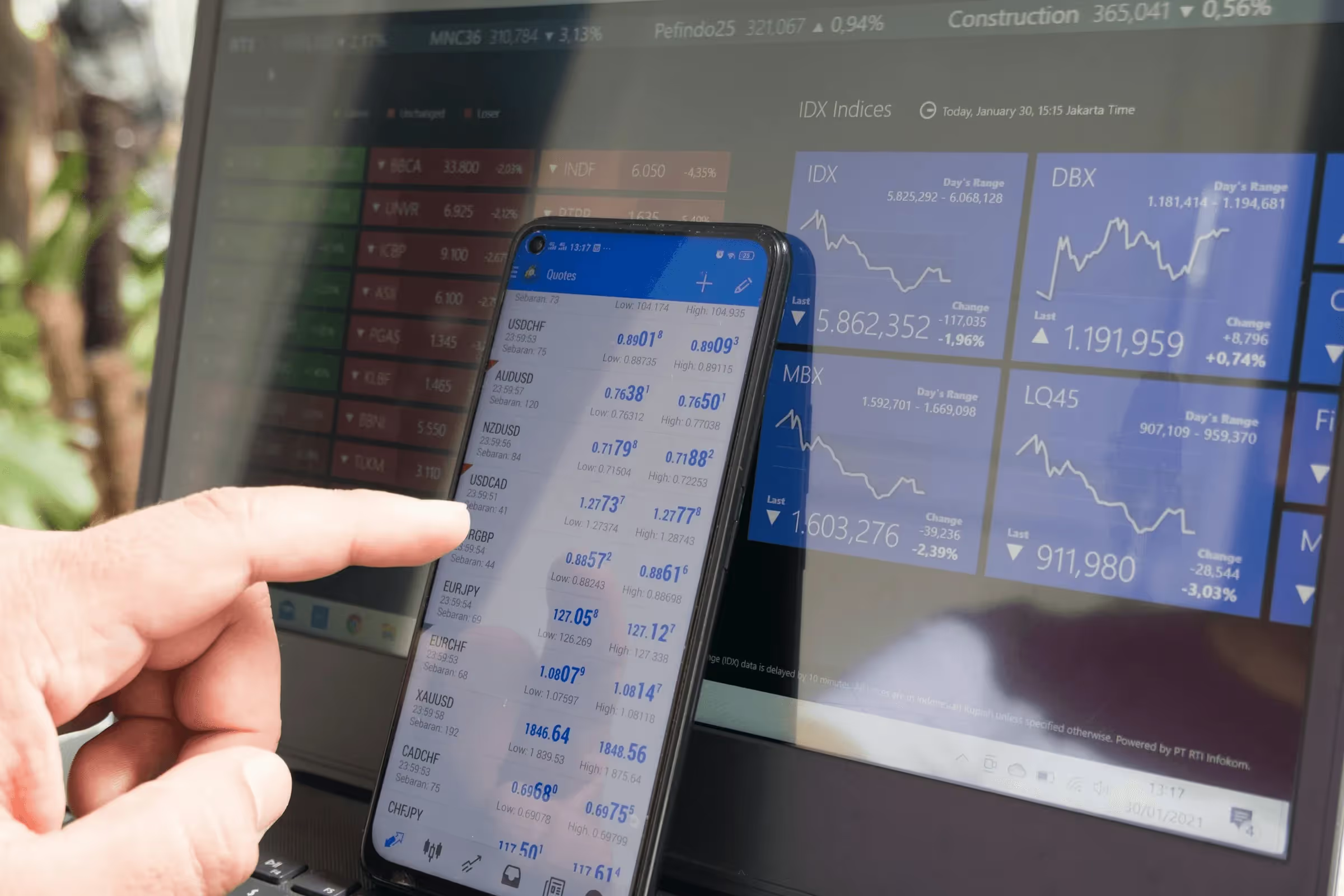
Treat Asian hours as a precision window: trade smaller, plan entries, and choose setups where careful execution is better than overconfidence. Focus on range plays, careful breakouts, and news-related quick trades. Use funding ways that allow you to make trades without putting your own money at risk, such as our funded trading program, which helps traders leverage their skills without personal financial risk.
1. Use AquaFunded
Use AquaFunded to convert skill into capital. This allows you to trade up to $400K in accounts without using your own money. You can choose instant-funded accounts or demonstrate your skills through challenge tracks with flexible rules, no strict time limits, achievable profit targets, and payouts of up to 100% of profits. There is also a 48-hour payment guarantee. This setup helps reduce emotional pressure that can lead traders to shrink their position sizes and exit positions prematurely. When traders move from small personal accounts to a funded allocation, they often stop over-leveraging. They start following repeatable plans as the math of position sizing becomes practical rather than punitive.
2. Range Trading
Use band and channel tools to define session edges and fade into them. I prefer Bollinger Bands set to 20 periods with 2 standard deviations on a 15-minute chart. I also use a 20-period Donchian channel on the same timeframe to mark the session's high and low. Enter limit fades near the upper or lower band when the price shows a rejection wick along with a volume increase on the next 5-minute bar. Then, place your stop just beyond the channel extreme. This method enforces discipline: you trade only when the price adheres to the defined geometry, prioritizing precision over guesswork.
3. Breakout Trading
Place pending orders just outside the overnight or early-session range. However, wait for a price retest or a confirming candle on a higher timeframe before adding size. Instead of chasing the first big move, use a two-step entry strategy: start with a smaller initial order on the breakout, then add more if momentum continues and volume or relative tick prints confirm follow-through. For placement, use a spread-aware buffer based on average tick size. It's better to use limit-with-good-until-cancel orders to reduce slippage in thin liquidity.
4. News Trading
Traders should focus on regional economic reports that are reliably predictable. Each release should be seen as a temporary event, not a lasting change in trends. Use one hour before and after the event, and consider reducing your position size by 30 to 50 percent during the first 30 minutes after a significant release, until you understand how the market reacts. Insights from working with Asia-based traders over a three-month coaching period showed a clear pattern: those who reduced their positions during initial volatility kept their equity curves steady, then re-entered positions based on measured continuations or explicit rejections.
5. Risk Management Tips for Trading the Asian Session
Favor ATR-based stops and a max-per-trade risk that reflects session rhythm. For example, consider allocating 0.25-0.5 percent of account equity to typical setups, and even less around overlap windows. Utilize one-click OCO orders to pair profit targets with stop-losses. Additionally, set a daily loss limit that triggers a stop-loss after a sequence of losses. This strategy helps maintain emotional control and protects capital when the market shifts unexpectedly.
6. Use Stop-Loss Orders.
Place stops where the structure fails, not where there is a chance of a price reversal. A rule-based approach to stop placement is practical: for range trades, set the stop just beyond the opposite Donchian boundary; for breakout trades, place stops behind the breakout retest low or high by a multiple of the 5-minute ATR. Think of stops as your price-based insurance premium, paid in small, controlled amounts to avoid catastrophic drawdowns.
7. Be Mindful of Spreads.
Account for wider spreads by adding a spread buffer to your entries and timing them around sessions when your broker's quotes tighten. If your broker's raw spread widens by more than 50 percent relative to the London open, consider switching to limit orders or reducing size until the quotes return to normal. Treat spreads like a recurring cost, not just something to think about later; this way, you keep your edge calculations accurate.
8. Adjust Position Size.
Scale position size using realized volatility, not fixed lots. Convert Average True Range (ATR) to pips, and size your trades so the dollar risk per trade remains the same. For example, if ATR increases by 1.5x in the first two hours of the session, reduce position size by about 33% to keep total dollar risk steady. This easy math helps maintain runway and reduces the pressure to recover quickly after a loss.
What challenges do traders face during the Asian session?
Most traders manage the Asian session using informal rules and small accounts because this way feels safe and familiar. As they try to grow, however, this method creates adverse incentives. It leads to very tight stops, inconsistent sizing, and emotional decisions to exit during market ups and downs. Platforms like AquaFunded provide traders with funded allocations, session analytics, and execution metrics. These tools help traders match their position size to real liquidity, reduce slippage, and treat each trade as a process they can repeat rather than a risky guess.
What practical tactics can be applied?
Here are some useful micro-tactics to try tonight: use limit entries at band edges, trade only one pair for 30 days to build muscle memory, and keep a short trade journal that records the time, entry type, and spread to measure execution loss. One straightforward way to understand this is to think of your trading as photography rather than fishing: you wait for the frame to come together before taking a careful shot, rather than casting wildly and hoping for success.
Why does the Asian session matter?
The Asian session matters in volume terms because it accounts for 21% total forex trading volume. Also, remember that some specific pairs can show small but tradable swings. For example, USD/JPY experiences an average volatility of 30 pips during the Asian session.
How does funding impact trading decisions?
This simple truth changes how traders size positions, set stops, and plan entries. It also shows why proper funding and execution tools are essential.
What happens when personal capital is removed?
This approach works well, but the surprising part comes when personal capital is removed from the decision-making process.
Related Reading
- Forex Algo Trading
- Types of Forex Trading
- Forex Trading Spreads
- Forex Market Liquidity
- Forex Mini Account
- Forex Price Action Trading
- Forex Hedging Strategies
- Forex Trend Indicators
- Advanced Forex Trading
- Best Forex Pairs for Scalping
- London Session Forex Pairs
- Best Currency Pairs to Trade for Beginners
- Minor Currency Pairs
- Best Time to Trade USDJPY
- Forex Swing Trading Signals
Join Our Funded Trading Program Today - Trade with our Capital and Keep up to 100% of the Profit.
Trading during the Asian session can be profitable when traders can manage their positions and trade calmly. Unfortunately, small personal accounts often lead to compromises that hurt consistency. To increase your advantage without risking your own money, think about Aqua Funded. They offer a funded trading account that provides capital and tools to execute trades, helping you focus on entries, sizing, and repeatable profits. Join our funded trading program.
Related Reading
- Best Forex Funded Account
- Top Prop Firms
- Best Prop Firm
- Forex Prop Firms
- Best Forex Pairs to Trade During New York Session
- Best Forex Trading Platform
- Forex Trading for Beginners
- Forex Trading Hours
- Forex Trading Brokers
- Forex Trading Course
- What Is Forex Trading and How Does It Work
- Forex Currency Trading
- Forex Online Trading
- How Does Forex Trading Work
- Online Forex Trading
