




9 Tips on How to Use a Forex Mini Account
Forex Mini Account: 9 tactical tips to manage risk, size positions, and trade live markets. AquaFunded shows a clear path from demo to funded success.

Traders often learn that a minor miscalculation when trading micro lots can erase days of hard work. Common patterns in Forex Trading Success Stories reveal that a Forex Mini Account offers a controlled setting to understand live order flow, pip and spread behavior, and position sizing. Practical strategies for managing leverage and selecting low-spread brokers pave the way for a smooth transition from demo practice to live trading.
A well-defined evaluation process builds confidence and sharpens risk management while gradually increasing trading capital. AquaFunded’s funded trading program combines a structured skill assessment with direct access to trading funds, allowing traders to move confidently from cautious beginnings to larger market engagements.
Summary
- Mini accounts let traders get real-market feedback with lower dollar exposure while keeping execution tools intact, typically trading a mini lot of 10,000 units and with minimum deposits commonly around $100, which shortens the demo-to-live learning loop without large capital outlay.
- Conservative position-sizing is critical, for example risking 1 to 2 percent per trade preserved capital in coaching cycles, and consistency should be measured over at least 30 trades or six weeks to separate true skill from short-term variance.
- Leverage magnifies errors, with mini account gearing reported as high as 400:1, meaning a single misjudged position can trigger a margin event within hours if sizing and stop discipline are not enforced.
- Spreads and fees hit small accounts harder, so avoid pair-time combinations where realized cost exceeds your edge by more than 25 percent, otherwise the break-even threshold moves substantially farther from profitability.
- Behavioral traps like overtrading and skipping pre-entry checks erode edge, which is why measurable experiments such as A/B tests of 60 trades per variant and tracking expectancy and R multiples are recommended.
- Follow a staged scaling plan to avoid friction, for example Phase A aims for a 3 percent monthly edge over 90 days, Phase B increases lot size by 50 percent while keeping max drawdown under 8 percent, and Phase C only scales capital after those benchmarks are met.
- AquaFunded's funded trading program addresses this by offering a structured evaluation and funded accounts so traders can validate execution and risk controls on live capital without increasing personal funding pressure.
9 Types of Forex Accounts

Forex accounts come in different types, made for specific purposes. This helps traders find the right mix of cost, control, and learning. Below is a list of nine common account types. It explains what each one offers and when you might want to use them, including options available through a funded trading program.
1. What is a Demo Forex Account?
A Demo Forex account provides a simulated trading environment that is funded with virtual money, which reflects live prices and order execution. It lets traders test strategies, practice using the platform, and build routines without risking any real money. Think of a demo account like a flight simulator, where you practice emergency drills and improve your timing; it takes away the money pressure so you can focus on your process and execution. This is why many teachers and beginners start here before they use real funds.
2. How does a Cent Forex Account work?
Cent (NANO) Forex Account cent accounts reduces real-money exposure by 1,000 times. This allows you to trade with very small amounts of money while still seeing larger position sizes on the screen. They serve as a practical bridge between demo trading and real risk. With cent accounts, you can experience your emotional responses to gains and losses without risking too much money. Use a cent account when you want real-market feedback but cannot handle the financial stress of trading full-size lots.
3. What Are Micro Forex Accounts?
Micro Forex accounts let traders work with very small positions, which helps them learn about position sizing and stop placement without needing a lot of money. For example, according to Tokenist, 2025, micro forex accounts allow trading of, up to 1,000 units of currency. These accounts encourage traders to think in terms of fractional lots and the amount of risk for each trade; this is where durable habits start to develop. For those who want real results with low dollar risk, micro accounts are a smart option.
4. What do Mini Forex Accounts offer?
Mini Forex accounts are between micro and standard sizes. They let traders take more meaningful positions without needing as much money as full lots. For example, a report by Tokenist, 2025, says that mini Forex accounts allow trading of up to 10,000 units of currency. Traders often use mini accounts to help them move from trying things out to finding ways to make consistent profits. These accounts show how small slippage and spread costs can affect overall performance.
5. What is a Standard Forex Account?
Standard Forex Account is a full-size account designed for active traders and professionals. It usually has fixed spreads or classic pricing and larger lot sizes. You take on higher capital requirements and more risk in return for better liquidity and a deeper order-book. This type of account is important for using institutional-style risk management. Without strict size rules, losses can grow quicker than your skills can keep up.
What should traders consider when choosing accounts?
Most traders start with the familiar path of a demo account, then move to a standard or mini account. While this may seem easy at first, the hidden costs can be high. Inconsistent position sizing and unclear risk rules often cause problems and lead to early failures. Platforms like AquaFunded provide an alternative way forward. They offer controlled funded environments, standardized risk controls, and guided onboarding. This lets traders practice live execution without the same pressure from capital. As a result, the learning curve is shorter while accountability is preserved.
6. What are PAMM and MAM Forex Accounts?
A PAMM Forex Account is a pooled investment structure where a manager trades for multiple investors and profits or losses are shared by percentage. Investors let the manager make decisions and get performance reports, but they give up control over daily activities. This setup is useful for people wanting to benefit from professional strategies, as long as they carefully check the manager’s track record and ensure transparency. On the other hand, a MAM Forex Account uses Multi Account Manager setups that allow one trader to manage many sub-accounts. This gives investors more choices, like custom lot sizes or partial control. MAMs are made for money managers who need flexible operations and for investors wanting personalized exposure instead of a standard allocation.
7. How do Swap-Free Forex Accounts work?
A Swap-Free (Islamic) Forex Account is an option for traders who need to avoid interest because of religious beliefs. These accounts remove overnight interest charges and replace them with compliant fee structures. They keep the trading process the same while following ethical rules. However, it is important to check how brokers manage rollover and commission changes.
8. What are Copy Trading Accounts?
Copy trading, also called social trading, lets investors automatically copy another trader’s positions. This makes choosing a strategy mostly passive. It is especially appealing for investors who don't have the time or skills to trade by themselves. However, it also puts the responsibility for research on the copier, who must check signal consistency, drawdown behavior, and trading style. Copying can increase both success and mistakes, so careful selection and monitoring are very important.
9. What essential insights should traders remember?
This list is practical, not theoretical. Patterns show that traders like low-barrier ways to learn and often worry about scams or losing money quickly. Because of this, it's smart to choose account types that have simple, clear rules about risk and encourage you to repeat good habits instead of offering flashy promises. That choice may seem simple, but it can be a challenge. The real problem is how traders move from practicing to taking real risks. Most programs ignore this important change, and it can have big effects on traders.
Related Reading
- Pros and Cons of Forex Trading
- Is Forex Trading Profitable
- How Many Forex Trading Days in a Year
- Forex Secrets
- How to Trade Forex With $100
- Day Trading vs Forex
- Forex Tax Rate
- Is Forex Closed on Christmas
- How to Use ADX Indicator for Day Trading
- Best Time Frame to Trade Forex for Beginners
- Is Forex Trading Hard
- Risk Management in Forex Trading
- Scalp Trading Forex
- Forex Trading Account Types
What is a Forex Mini Account
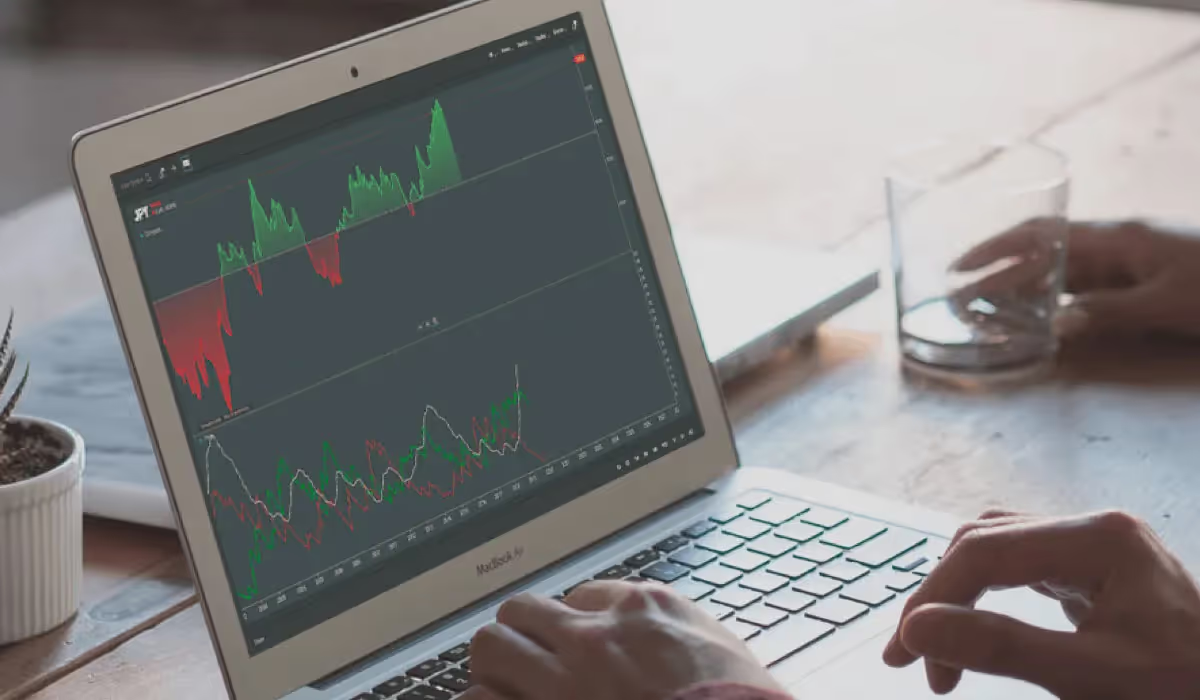
A forex mini account is a live trading account that uses smaller position increments so you can trade real markets with less dollar risk while you improve your skills and manage risk. It has the same trading tools and market access as larger accounts, but changes how much each trade affects your equity. If you're looking to take your trading to the next level, our funded trading program can provide you with the support and resources you need.
How does lot sizing impact trading?
Lot sizing has a big effect on how the market works. Mini accounts trade in smaller contract sizes than full-size accounts, which means each trade can change the balance more gently. A typical mini lot is equal to 10,000 units of the base currency, according to Investopedia, "a forex mini account allows traders to trade in 10,000 currency units." Because of this, pricing, margin calculations, and position sizing are all less than what they are for standard lots.
What is the capital required to start?
Brokers are making it easier for traders to start with small amounts of money. The minimum deposit for a mini account is usually about $100, as noted by Investopedia: "The minimum deposit for a forex mini account is typically $100." This amount allows traders to feel real emotional stakes without putting a lot of money at risk. If you're interested in capitalizing on a funded trading program, our offerings can provide the support you need to get started.
Who benefits most from this account type?
This account type is perfect for traders who are moving on from simulated practice but are not ready for full-scale risk. It also suits experienced traders who want to spread their capital across different pairs. The goal is to learn how to execute trades and practice discipline in the market while reducing the risk of losing too much from any single trade.
How does risk control play a role?
Risk control in practice mini-sizing means thinking in smaller percentages. This approach is very important because beginners often risk big parts of a small balance, which can lead to losing money fast. When coaching new traders in short cycles, I noticed a clear pattern: those who used conservative position-sizing rules, like risking 1 to 2 percent per trade, were able to keep their money safe and stayed in the game long enough to learn repeatable edges. Engaging in a funded trading program can also provide the necessary support and guidelines for effective risk management.
What platform access and tools are available?
Platform access and tools will not be lessened with a mini account. All features, including charts, order types, stop and limit mechanics, and execution options, stay fully available. This lets users create the same processes on a smaller financial scale, confirming entries, exits, and slippage in real time.
How do practical order increments affect trading?
Practical order increments and pip impact. Since the contract size is smaller, each pip movement has a smaller effect on your cash balance. This lowers the stress of managing stops and allows you to test multi-timeframe confirmations without facing big account swings. You can think of it like practicing driving maneuvers in a small vehicle. Mistakes are less expensive, but they still teach you the same skills for handling.
How to size positions and diversify effectively?
Mini accounts let users split a small bankroll into many smaller bets, which promotes portfolio thinking. By using fixed-risk sizing, you can change pip risk into dollar risk. After that, divide the allowed dollar risk among different pairs. This approach trades concentration for careful exposure, helping to create durable trading habits.
What common operational mistakes should be avoided?
Traders often see a mini account as permission to overtrade because the dollar losses seem small. This behavior can be harmful: making many trades without focus can hurt a trader's advantage because of spreads, commissions, and poor entries. To avoid losing ground, it is important to keep track of trade counts, set clear entry rules, and create a daily loss limit.
When does scaled learning meet platform limits?
When scaled learning meets platform limits, mini accounts work well until more advanced trading needs come up. These needs include institutional-like execution, deeper liquidity, or extremely tight spreads. At that point, the math changes, and traders have to decide whether to scale position sizes, switch to a standard account, or use execution tools that help reduce slippage.
What are the common challenges faced by traders?
Most traders begin by managing their early live practice with small accounts because it feels safe and familiar. While this may work at first, losing streaks and inconsistent sizes can lead to costly problems and frustration. Platforms like AquaFunded offer a different option. They provide controlled funded environments and clear risk rules, which let traders practice live execution while having accountability. This setup helps traders improve more quickly without the same financial pressure. This seemingly simple safety can create a hidden trap, one that often goes unnoticed until it starts to affect both confidence and cash.
Pros and Cons of a Forex Mini Account

A forex mini account provides a useful, low-cost way to trade in live markets while improving risk management. However, it compresses trade economics and can increase leverage risk if traders are not careful. Traders receive live feedback and have lower dollar exposure, but they lose some features, deal with different pricing situations, and face scaling friction as their advantages and balances increase.
1. What are the pros of a Forex Mini Account?
Pros: Accessibility and real-money onboarding mini accounts let traders gain real execution experience without large capital commitments. This makes the learning process shorter between practice on a demo account and making real decisions. For many learners, starting real trades is more important than waiting another month of simulated scores. Emotional reactions to profits and losses provide lessons that teach discipline.
Practical risk training, not theory
Traders can try out stop placement, position-sizing rules, and trade timing against real spreads and slippage while keeping losses manageable. This method speeds up the habit formation process, as it allows traders to practice the exact steps they will repeat at a larger scale: setup, size, entry, and exit. With focused practice over weeks, this sequence becomes second nature instead of just a checklist.
Low barrier to start. Brokers often advertise small minimums, letting more people start trading with real stakes. Platforms such as MTrading: "Mini accounts allow trading with as little as $100" highlight this, opening live-market practice to learners who cannot or will not risk large amounts. Greater accessibility expands the group of serious students and lets individuals see if trading fits their temperament before taking larger risks. Controlled diversification and testing ground. Because each position affects equity less, traders can run small, side-by-side experiments across different currency pairs and timeframes without risking their entire account. This ability allows for comparing strategy variations, measuring expectancy, and isolating what really gives an edge, rather than guessing based on a few big bets.
Lower psychological friction. Trading smaller amounts of real money reduces the fight-or-flight response that often disturbs decision-making. This helps traders concentrate on the process and keep a journal. A calmer approach makes it easier to assess performance honestly and promotes continuous improvement instead of giving up on rules after facing a bad drawdown.
2. What are the cons of a Forex Mini Account?
Cons: Leverage makes mistakes bigger. Mini accounts often let you use high leverage, which can make both your gains and losses much larger. For example, according to MTrading, "leverage in mini accounts can be as high as 400:1". This level of gearing can turn a small position into a margin issue in just hours if you misjudge your risk per trade. High leverage is helpful only when it is paired with strict sizing rules, stop discipline, and realistic margin management. Diminished features and support. Smaller accounts often get less service, which means you have limited access to top-quality research, faster execution times, or VIP pricing. Over time, this small disadvantage can hurt your performance because better analytics and slightly tighter spreads add up to big benefits when trading larger amounts.
Higher relative costs. Spreads, commissions, and platform fees seem bigger for small accounts. A spread that is small on a standard lot can become a steady cost on a tiny balance, making it harder to break even and move closer to making a profit. This ongoing drag is easy to overlook when trading with small amounts. Scaling problems when you grow. When a trading strategy works well, moving more money or increasing lot sizes does not happen easily. Traders face different liquidity, more slippage, and different feelings when trading larger amounts, and many do not take the time to rebuild risk rules as they scale up. This change needs careful planning, new execution checks, and sometimes a new broker or account tier.
Behavioral traps, especially overtrading. Since losses seem small, traders often think it is fine to trade too often, which can hurt their edge due to poor entry points and spread costs. The pattern is clear: more trades lead to lower quality per trade, creating a false sense of progress that can fall apart with a few larger losses.
3. What issues arise from the status quo?
Most traders start with mini accounts because they are easy to understand and cheap. While this method works at first, hidden costs slowly appear. These costs can lead to a gradual loss of both money and confidence, often caused by overtrading, using too much leverage, and service limits that quietly reduce returns. Platforms like AquaFunded offer a different option by mixing controlled funding environments, clear risk rules, and straightforward ways to scale up. This method helps traders keep the learning benefits of small accounts while lowering the obstacles that can slow real progress.
4. What practical tradeoffs should you consider?
Practical tradeoffs to consider before opening one. If the plan is to learn, it is essential to insist on strict, measurable rules: a fixed percent risk per trade, a daily loss limit, and a limit on the number of trades. If the goal is to grow capital quickly, understand that mini sizing can slow down compounding. This situation may force a choice between increasing lot sizes, adding more capital, or moving to a different account when an edge is proven. Thus, it is valuable to treat the mini account as a training platform instead of a permanent solution.
5. How can you visualize the mini account experience?
A vivid way to think about it: Think of a mini account like a small sailboat in a large harbor.
It is great for learning about wind, tacking, and working with a crew.
However, when the coast gets rough and speed or space is important, a bigger boat with stronger rigging and a deeper keel is needed. The boat helped you learn seamanship, but it did not replace the engineering skills needed to cross open water. This simple practice works until one risky trade or a scaling mistake takes away the cushion you depended on, leading to a big change in circumstances.
9 Tips on How to Use a Forex Mini Account

A mini account should be used as a training and scaling tool, not just as a cheap way to make trades. Think of it as a controlled lab where you test execution, position-sizing formulas, and behavioral rules before moving on to bigger investments.
1. What is a funded challenge's role?
A funded challenge serves as an important step. It helps traders distinguish between proving their skills and risking their own money. Start by creating a simple checklist: do a one-week demo of your live setup, finish three funded challenge passes one after the other to show you can do it repeatedly, and then make a plan for gradually increasing your trading size. Be ready to measure your performance over at least 30 trades or six weeks, whichever happens first. This process makes sure that your win rate and expectancy show real results instead of just luck.
2. How should I start trading?
Start with the smallest tradable increments. Plan every position around the account’s minimum trade unit, and convert pip risk into dollar risk before clicking buy. According to The Forex Trading Coach, 2023: "With a mini account, you can trade with as little as $100." This means you can practice live execution with real stakes while keeping your capital exposure small, which is great for disciplined iteration. Using a position-size calculator spreadsheet that considers stop distance in pips, pip value, and your percent risk helps to output lot size automatically.
3. What is the importance of strict trade math?
Apply strict per-trade math, not guesswork. Define a one-line rule: risk per trade equals account balance times risk percent divided by stop-loss dollar value. For example, if you use a 2 percent rule and have a $500 balance, your maximum dollar risk is $10 per trade. If your stop is 20 pips, your target lot size must make 20 pips equal $10. You should automate that calculation in your platform or a timer-based spreadsheet and make sure not to trade without it.
4. How can a pre-entry checklist help?
Building a pre-entry checklist can help find only high-probability setups. Create a six-point checklist that must be completed before entering: trend confirmation, higher-timeframe structure, lower-timeframe trigger, acceptable spread, reward-to-risk of at least 1 to 2, and position size computed. Track the checklist pass rate and export the results weekly to see which criteria often prevent bad trades. Over a period of 90 days, this approach focuses on quality over quantity and improves pattern recognition.
5. What are the dynamics of funded programs?
Recognizing how funded programs change scaling dynamics is important. Most traders start with small accounts to try different strategies, which can be effective at first. However, this familiarity often hides challenges when trying to scale as traders move forward. The usual way of self-funding keeps autonomy, but it can slow down the process because each test of scaling risks personal money, which can lead to emotional overheating. Platforms like AquaFunded offer instant funded accounts or challenge options. These choices let traders prove their skills, stick to performance limits, and keep a big share of profits. This makes it quicker and cheaper to validate strategies with larger amounts of money.
6. What trading hours and pairs should I choose?
Choosing the right hours and currency pairs can really minimize costs and lower execution slippage. Along with picking major currency pairs, focus on time windows that have the tightest spreads, like the London opening and the New York overlap. Important times include major economic releases, which offer volatility you can measure. Check the average spread and slippage for your broker during these times over a 30-day period. If the realized cost is more than 25 percent above your edge, think about avoiding that specific pair-time combination.
7. How can I improve my journaling process?
Convert journaling into measurable experiments. Next to basic logs, add fields for important metrics: setup type, pre-entry checklist pass/fail, expected expectancy, actual R multiple, and emotional state at entry. Run A/B tests on two strategy options for 60 trades each, then look at expectancy and drawdowns. Use these results to choose which rule to keep, change, or stop using.
8. What are effective scaling and profit goals?
Set disciplined scaling and profit goals by replacing vague targets with a clear plan. In Phase A, show a 3% monthly edge over 90 days on your starting capital. In Phase B, increase the allowed lot size by 50% while keeping the maximum drawdown below 8%. In Phase C, move to a larger account or funded allocation. These milestones require measuring real skill instead of depending on luck and support scaling decisions based on recorded outcomes.
9. What behavioral guards should I enforce?
Enforce behavioral guards to keep your options open. Set non-negotiable rules: a daily loss stop that pauses trading for 24 hours once it is hit, a maximum number of trades you can make each day, and a rule that says you can't add to a losing position. Whenever you can, make these rules hard settings on your trading platform. Think of them like insurance; they don't cost you anything until you actually need them.
What does the structural change mean?
That training path looks complete. However, one structural change makes funded capital feel unexpectedly different.
Related Reading
- Forex Algo Trading
- Types of Forex Trading
- Forex Trading Spreads
- Forex Market Liquidity
- Forex Price Action Trading
- Forex Hedging Strategies
- Forex Trend Indicators
- Advanced Forex Trading
- Best Forex Pairs for Scalping
- London Session Forex Pairs
- Best Currency Pairs to Trade for Beginners
- Minor Currency Pairs
- Best Time to Trade USDJPY
- Forex Swing Trading Signals
Join Our Funded Trading Program Today - Trade with our Capital and Keep up to 100% of the Profit
Consider AquaFunded as a way to turn your trading skills into real profit without risking your own money. Participants can choose between instant funding or a customizable challenge path to access accounts up to $400,000. They can trade with no time limits and clear profit goals while keeping up to 100 percent of what they earn, with a 48-hour payment guarantee. Join over 42,000 traders who have earned more than $2.9 million in rewards together. Shift your focus from funding headaches to position sizing, mini lots, and execution that sharpens your edge.
Related Reading
- Best Forex Pairs to Trade During Asian Session
- Best Forex Funded Account
- Top Prop Firms
- Best Prop Firm
- Forex Prop Firms
- Best Forex Pairs to Trade During New York Session
- Best Forex Trading Platform
- Forex Trading for Beginners
- Forex Trading Hours
- Forex Trading Brokers
- Forex Trading Course
- What Is Forex Trading and How Does It Work
- Forex Currency Trading
- Forex Online Trading
- How Does Forex Trading Work
- Online Forex Trading
