




6 Tips on How to Use the ADX Indicator for Day Trading
How to Use the ADX Indicator for Day Trading: Discover 6 actionable tips to filter breakouts, manage risk, and improve consistency with AquaFunded.

Traders seeking consistent profitability often grapple with whipsaws and false breakouts, even when inspired by Forex Trading Success Stories. The ADX indicator clarifies market momentum by measuring trend strength through directional indices, enabling more precise entries and exits. Insights on using the ADX indicator for day trading highlight the importance of integrating technical signals with disciplined risk management.
Practical strategies, such as tailored stop-loss placement and careful selection of timeframes, can enhance intraday performance. Strong risk control and confirmation techniques help traders refine their approach amid shifting market conditions. AquaFunded’s funded trading program provides structured guidelines and capital to help traders prove their edge without risking personal funds.
Summary
- ADX measures trend intensity, not direction, using a default 14-bar smoothing window that controls responsiveness so traders can avoid entries that lack real momentum.
- Standard thresholds make ADX actionable; for example, values above 25 are widely used to indicate a strong trend and to favor trend-following setups over trading in ranges.
- As a breakout filter, requiring ADX confirmation reduces failed follow-throughs, as illustrated by an EUR/USD breakout that saw ADX rise from 22 to 28, signaling a higher-probability continuation.
- Pair ADX with a directional moving average for bias, for instance, many traders use a 50-period EMA and treat ADX as the permission to scale size or widen stops.
- Missed tactic shifts are a frequent leak: about 30% of traders fail to adjust their strategies when the ADX falls below 20, which often leads to trend-rule whipsaws and losses.
- Quantify ADX slope by measuring its delta over five bars and treating changes greater than 2 points as meaningful acceleration or weakening, since roughly 75% of traders misinterpret ADX without concrete slope rules.
- AquaFunded's funded trading program addresses this by providing centralized funded accounts, standardized rule enforcement, and scalable capital access, so traders can test ADX-based filters and maintain consistent execution.
What is the ADX Indicator
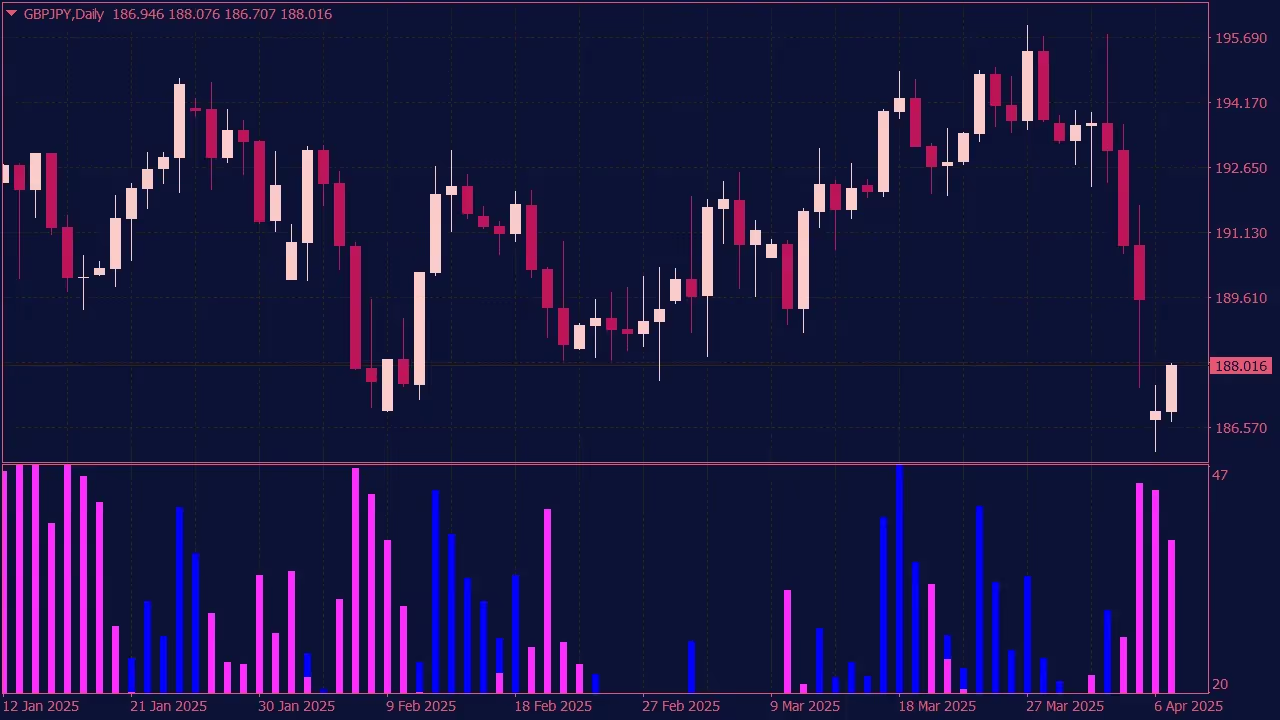
The ADX is a measure of trend strength. It tells us whether price changes have a clear direction or are just sideways noise. Traders often like to make decisions based on trends when the market is strong, and they may choose not to trade when conditions are weak. This indicator puts directional movement into one single value, based on smooth measures of how much prices expand and contract. By using the ADX, traders can reduce their risk by avoiding trades without real momentum. Additionally, if you're considering a more structured approach to trading, our funded trading program can provide the support and resources you need to enhance your strategy.
1. What exactly does the ADX measure?
When using the ADX, traders measure the strength of directional price movement, not the direction itself. You can think of it like a strain gauge on a bridge, showing how much stress the structure is under without showing which way traffic is moving. This clarity is why many traders call ADX the ultimate trend gauge. It effectively highlights trend strength and prevents confusion between a calm market and a weak trend.
2. How is the ADX calculated, and why does that matter?
The ADX is calculated by smoothing a set of directional movement readings with a moving average. This process shows whether price ranges are getting bigger or smaller over time and produces a single banded value. The usual smoothing and lookback period are covered in Investopedia: The ADX is calculated over a 14-bar period. This default setting controls how fast the indicator reacts; shorter windows make the ADX jumpy, while longer windows create a slower but cleaner response.
3. How do traders actually use ADX in their decision process?
Traders consistently use ADX as a confirmation filter to help with their decision-making, whether they use discretionary or systematic methods. This approach allows traders to avoid buying into consolidation and boosts their confidence when entry signals match. During the creation of confirmation toolkits, it became clear that practitioners depended on ADX to stop premature entries. By combining ADX with trend direction and volume signals, traders can effectively reduce whipsaws and improve their win-rate consistency over weeks of real-world testing.
4. What values mean the market is trending or not?
Interpretation relies on simple thresholds that most traders use to separate noise from a real trend. These cutoffs guide traders in deciding whether to swing for trend-following setups or stay flat. For example, values above 25 on the ADX indicate a strong trend, as noted by Investopedia: "ADX values above 25 indicate a strong trend." This kind of rule of thumb helps avoid forcing trades when momentum is weak.
5. On which instruments and timeframes does ADX work best?
ADX is versatile and can be used with stocks, ETFs, futures, and FX across intraday, swing, or longer-term charts. It's important to remember that smoothing results in a lagging read. Because of this, ADX works best with rules that allow a slight delay for fewer false signals. This makes it a good choice for trend-following entries or filters that stop trading during choppy ranges.
6. What are the ADX’s practical limits and standard failure modes?
The ADX indicator often fails to give good insights when prices are range-bound. In these situations, low directional movement results in a low ADX, which can create a false sense of safety. A common problem seen in many scripting projects is automation friction. This happens when threshold filters are miswired, leading to errors that can waste hours of tuning and testing. The main tradeoff is always between responsiveness and noise: if settings are adjusted to catch earlier moves, it leads to more whipsaws. On the other hand, slowing down the parameters risks missing early trend extensions.
7. How does automation change the way traders use ADX?
Status quo disruption, in simple terms, creates challenges for traders. Most traders confirm strength by using different tools and manual checks because this method feels comfortable and gives them direct control. However, this approach breaks down when automation and scaling are introduced: signals can be missed, filters can be applied inconsistently, and a few scripting errors may wipe out a day's work. Platforms like AquaFunded centralize ADX-based filters and multi-indicator confirmations. This allows teams to standardize rules, reduce manual screener time, and maintain auditability and version control.
What are the actionable steps for day trading with ADX?
A short, straightforward question follows: What specific steps make ADX useful in a day-trading routine?
Why does the choice of ADX matter?
The real reason this choice matters goes deeper than just a number on a chart.
Related Reading
- Pros and Cons of Forex Trading
- Is Forex Trading Profitable
- How Many Forex Trading Days in a Year
- Forex Secrets
- How to Trade Forex With $100
- Day Trading vs Forex
- Forex Tax Rate
- Is Forex Closed on Christmas
- Best Time Frame to Trade Forex for Beginners
- Is Forex Trading Hard
- Risk Management in Forex Trading
- Scalp Trading Forex
6 Tips on How to Use the ADX Indicator for Day Trading
ADX works as a practical, rule-driven filter for intraday entries: use it to choose when to trade, how to size risk, and when to scale or exit. Below are six operational items you can use right away, each rewritten as a rule that you can follow instead of just theory. If you are interested in exploring opportunities, consider our funded trading program for support in your trading journey.
1. Use AquaFunded
Use Aquafunded to get instant access to funded accounts up to $400K with flexible trading conditions. Benefits include no strict time limits, reasonable profit targets, and profit splits up to 100%. Join over 42,000 active traders who have earned more than $2.9 million together, with a 48-hour payment guarantee. Traders can start with instant funding or show their skills through customizable challenges, keeping up to 100% of their earnings.
2. Use ADX to filter breakouts.
How should you choose which breakout to follow? Wait for confirmation beyond just price action: you need ADX to show increasing strength before jumping in, and prefer to enter after a clear retest of the broken level.
According to EBC Financial Group, "If EUR/USD breaks above resistance on a 5-minute chart and ADX rises from 22 to 28, it confirms the strength of the breakout." When coaching active day desks, the pattern was clear: trades that passed a strength filter and retested the breakout had significantly fewer failed follow-throughs, even during slow periods. As a practical rule, wait for the candle to close beyond resistance, watch for ADX momentum on the next one to two bars, and then enter on a retest or a scaled-in continuation.
3. Combine ADX with moving averages.
Which moving average should you use with ADX, and how should you apply it? Use a 50-period EMA on your working timeframe to define the directional bias, then treat ADX as the go-ahead. If the price stays on the EMA side that aligns with your bias and the directional indicator lines confirm momentum, you can increase your position. Preferred entry methods include entering on a clean pullback toward the EMA that holds for two bars, confirming +DI or -DI alignment with price, and only adding if ADX is trending up. For targets, use ATR multiples and scale out as the EMA slope gets steeper.
4. Spot trend exhaustion early.
What signs show that a strong move is fading? Watch the ADX slope and directional divergence, not just the absolute level. If the price hits a new high while ADX does not rise, mark this as a warning sign and tighten your stops. For example, when ADX drops from high levels to noticeably lower values, scale out and shorten stop distances to lock in profits. Also, use a short momentum oscillator with ADX to confirm the weakening, so you do not exit during normal pullbacks.
How does AquaFunded improve trading execution?
Most teams handle breakout trading with checklist confirmations and manual record-keeping because it feels familiar. This approach works until the number of signals, rule variations, and funding sources increases. As a result, confirmations can scatter, rules may drift, and execution becomes inconsistent. Platforms like AquaFunded centralize funding workflows, standardize rule sets, and provide instant account access. This allows traders to test ADX-based filters and scale strategies without the hassle of juggling multiple accounts or re-entering rules each time.
6. Avoid low-ADX markets.
When should you sit out? Treat the low-strength period as a time to change your approach. Low directional readings indicate breakouts often fail, while mean-reversion strategies tend to work better. According to StockGro Blogs, "The ADX indicator is most effective when it is above 25, indicating a strong trend." If ADX is in the soft zone, reduce your position size, shift to range strategies, or wait for an apparent rise before going after trend entries. This method results in fewer forced entries and higher-quality trades.
7. Set stop-losses based on trend strength.
How wide should your stops be? Let ADX help decide where to place your stops using ATR multipliers. A higher ADX allows for wider stops to handle regular trend changes, while a lower ADX needs tighter protection. Use a rule table that fits your instrument and timeframe.
For example, set larger stops with bigger ATR multiples when the ADX shows strong trending conditions, and make them smaller as the ADX weakens. If simple pip examples work for you, widen your range when the trend gauge is strong and tighten it when it is weak. Adjust your target-to-risk ratio so you don’t end up with negative expectations on trend fade.
What Subtle Mistakes Can Occur When Using ADX?
Curiosity loop: That approach catches clear moves, but what subtle mistakes can quietly diminish your edge when ADX is in play?
Common Mistakes to Avoid With ADX
Avoid the four classic ADX traps by treating ADX as a signal amplifier, not a decision engine. Translate its readings into clear rules that you follow all the time. Below, each common mistake is listed with specific, actionable ways to fix it. This includes practical checks, measurable rules, and different actions you can take.
1. What goes wrong with overreliance on ADX as your entry signal?
Relying too much on ADX as your entry signal can cause big problems. Traders often rely solely on the ADX and wonder why their entries fail when the price goes against them. Instead of seeing ADX as a buy-or-sell button, it should be viewed as a permission light. A good rule to follow is to get two confirmations before increasing your trade size: for example, the ADX must be rising for two bars, along with either a +DI/−DI alignment during those two bars or an explicit price structure confirmation, such as a higher high that stays above the breakout candle.
Also, a size discipline rule states that when the ADX is positive but there is no directional agreement, traders should reduce their position size by at least 50 percent and use a tighter ATR-based stop. This simple checklist changes a confusing reading into a repeatable process.
2. How do trend rules fail during low-ADX regimes?
Using trend rules during low-ADX conditions presents unique challenges. When ADX is low, trend-following entries can turn into whipsaws, slowly eroding account equity. If the ADX drops into the soft zone, traders should adjust their tactics immediately. This includes reducing position size, tightening stops to a smaller ATR multiplier, and focusing on mean-reversion setups or micro-range scalps until momentum comes back. This failure mode is transparent among day traders and scalpers, where the pain is both emotional and financial; it often feels like they are consistently a few bars too late.
According to the Comprehensive Glossary of Telecom, 30% of traders fail to adjust their strategies when ADX falls below 20, leading to potential losses. Therefore, having a rule to change approach when ADX drops is not optional; it is a critical part of risk management.
Why do traders stick to familiar strategies?
Many traders keep using the same strategies because they know them well and don’t need extra rules. This comfort hides a real cost: inconsistent rule application, missed opportunities to scale, and more mistakes as the number of signals increases. Platforms such as the funded trading program help by centralizing rule enforcement and having parameters that can be backtested. This lets traders use consistent ADX decision rules across different accounts while reducing mistakes from manual checklists and redoing work.
3. What should you do when ADX is falling?
Treating a falling ADX as proof of a reversal requires a confident approach. A downtrending ADX usually shows momentum loss, not a trend reversal. So, the correct response is patience, not panic. A solid approach is to wait for a price structure break and a DI crossover before changing your viewpoint. Also, keep an eye on volume for confirmation. If volume stays flat or declines, treat these moves as consolidations rather than reversals.
One practical measure is that if the ADX falls by less than a set delta over N bars, it can be assumed the market is consolidating. On the other hand, if it drops faster than that delta and the DI lines start to cross, you need to strengthen your defensive rules and tighten your targets. The overall result of these strategies is fewer premature exits and a lower chance of missing continuation profits.
4. How does ignoring ADX slope affect trading?
Ignoring the ADX's slope and rate of change can significantly affect trading decisions. A single ADX reading misses important momentum dynamics. The hill shows whether the strength is growing or fading. To measure the slope, look at the change in ADX over a set period; for example, calculate the ADX delta over five bars.
Consider an increase of more than 2 points as acceleration, while a decrease of more than 2 points indicates significant weakening. Use this delta to manage risk: add to winning trades when the slope is strongly positive and reduce when the slope turns negative, even if the ADX number is still high. This method helps fix a common mistake: 75% of traders make errors when using ADX due to incorrect signal interpretation, according to the Comprehensive Glossary of Telecom. It highlights the need to include slope rules in your trading plan.
What quick operational checklist can traders follow?
A quick operational checklist you can adopt right now:
- Confirm that everyone agrees on the direction, then trade.
- Change your tactics when the ADX is low; do not force trades based on trends.
- Make sure there is structure and DI confirmation before saying a reversal is happening.
- Measure the slope with a fixed delta and use that delta to adjust stops and sizing.
What is the benefit of AquaFunded's program?
AquaFunded’s funded trading program gives traders access to accounts up to $400K with the most flexible trading conditions in the industry. There are no time limits, easy-to-achieve profit targets, and traders can enjoy up to a 100% profit split. Join over 42,000 traders who have collected more than $2.9 million in rewards. Participants enjoy instant funding or customizable challenge paths and benefit from a 48-hour payment guarantee, all while keeping up to 100% of what you earn.
What oversight could affect your ADX rules?
One grave mistake in your ADX rules could decide whether your next set of trades succeeds or fails.
Related Reading
- Forex Algo Trading
- Types of Forex Trading
- Forex Trading Spreads
- Forex Market Liquidity
- Forex Mini Account
- Forex Price Action Trading
- Forex Hedging Strategies
- Forex Trend Indicators
- Advanced Forex Trading
- Best Forex Pairs for Scalping
- London Session Forex Pairs
- Best Currency Pairs to Trade for Beginners
- Minor Currency Pairs
- Best Time to Trade USDJPY
- Forex Swing Trading Signals
7 Best Indicators for Day Trading
The best day-trading indicators answer several questions at once: where volume is moving, if momentum is stretched, and where price has natural reference points for entries and exits. By combining these indicators, traders can make repeatable decisions rather than guesswork. Trading relies heavily on these tools, as noted in the OpoFinance Blog, "over 70% of day traders rely on technical indicators for decision making."
1. On-Balance Volume (OBV)
Connects volume flow to price moves, helping traders see if a breakout has backing or is happening with little participation. Use OBV as a confirmation filter: require OBV to make a higher low when the price does, or to slope upward while the price rises slowly before increasing your position size. This approach reduces entries that may seem reasonable on candles but fail because of low buying activity. Such a pattern was seen when reworking a five-person intraday FX desk over six weeks, where needing OBV alignment cut out unclear breakouts and improved trade clarity. Treat OBV as a measure of participation, not a timing tool.
2. The Accumulation/Distribution Line (ADL)
Compares price to the range and combines it with volume to give a clearer idea of whether moves are accumulation- or distribution-driven. It helps identify hidden strength: if the price drops while ADL stays steady or rises, it favors a bounce; if both fall together, the trend likely has depth. ADL works best when used with short-term price checks to avoid confusing intraday noise for fundamental supply-demand shifts.
3. The Volume Weighted Average Price (VWAP)
Shows the actual average price paid during the session, making it a helpful reference for trade fairness and intraday bias. Traders should align with the session: look to buy near VWAP when the price shows support, and sell when the price rejects a VWAP retest. Use VWAP to time entries, avoiding getting in too early on a move. Also, VWAP serves as a standard for trade cost control, especially when combined with a rule that limits slippage compared to it.
Why disrupt the status quo in trading?
Status quo disruption happens because most traders depend on manual, checklist-based confirmations. This method gives them a sense of control. It may work well when the signal flow is light. However, as accounts, strategies, and signal sources grow, these checklists become scattered. As a result, execution rules become misaligned, and consistency suffers. Platforms like funded trading programs bring together rules, enforce multi-indicator confirmations, and give traders one place to test ADL, VWAP, and OBV filters in a repeatable way. This centralization significantly reduces maintenance costs, which often erodes a trader's advantage.
4. Average Directional Index (ADX)
Average Directional Index (ADX): Use ADX as a risk-scaling tool, not just as a way to decide when to enter a trade. It shows you whether to widen your stops and hold on during market ups and downs, or to tighten your stops and look for quick reversals. You can think of ADX readings as bands for sizing your positions: increase your risk when strength measures are going up on the timeframe you are trading, and decrease your size when ADX levels out, even if the price keeps moving in a trend. This method stops you from using a high ADX as an excuse to take on too much risk, and it also helps you avoid selling winners too soon when short-term strength drops while the larger trend remains strong.
5. Relative Strength Index (RSI) measures
The Relative Strength Index (RSI) measures internal momentum and helps identify overbought, oversold, and exhaustion points. Because the RSI is so common and familiar, it is used by OpoFinance Blog: "The RSI indicator is used by 85% of traders to identify overbought or oversold conditions." Traders should treat their signals with rules that avoid crowd traps. It is best to prefer RSI divergences confirmed by higher volume, or to wait for a break of short-term structure after an extreme reading before acting. Practically, use the RSI to time entries within a confirmed bias rather than to flip bias based on a single overbought or oversold print.
6. Fibonacci Retracement
Fibonacci retracement levels are essential points that many people watch for support and resistance. This makes them helpful for finding entry points, setting targets, and placing stops. They should not be seen as definite, but instead as probability zones. Combining a Fibonacci shelf with a price reaction, like a two-bar hold or wick rejection, and an increase in volume can make a trade decision more reliable. The 38.2% and 61.8% levels are ideal for scaled entries. It's a good idea to keep stop-loss orders just beyond the next structural level to ensure risk is measurable.
7. Ichimoku Cloud
The Ichimoku Cloud provides multiple pieces of information in a single overlay: trend bias, momentum, and dynamic support and resistance. It is helpful to use individual Ichimoku elements separately. For instance, the conversion line can be used for short-term momentum, while the cloud edges act as support and resistance for daily sessions. By breaking the indicator down into simple rules, it becomes a quick, high-signal filter for trade alignment rather than a confusing mass of lines.
How to avoid skepticism towards new trading tools?
Traders are understandably cautious about new tools and headline systems. This caution is justified because many indicators are released without sufficient testing or clear guidelines for their use. The hidden cost is not just theory; it includes time and money wasted on adjusting settings that only work once and on chasing small signals across different platforms. Solutions like funded trading programs help reduce that problem. They let traders set standard rules for indicators, test them under real market conditions, and maintain consistent execution as they grow.
How to effectively use indicators for trading?
Think about indicators as instruments in a control room. Each one answers a specific question. The trick is wiring them together so they support the same decision rather than competing for it. The real test happens when you try to turn these signals into funded, repeatable trades. This is where the process becomes exciting.
Join Our Funded Trading Program Today - Trade with our Capital and Keep up to 100% of the Profit.
Small account sizes and strict rules often change perfect setups into compromises. This ongoing problem reduces both trading advantage and confidence. AquaFunded solves this issue by offering funded accounts and flexible challenge paths. With these options, traders can work with meaningful sizes, stick to their rules, and collect their earnings as they grow. Join our funded trading program today!
Related Reading
- Best Forex Pairs to Trade During Asian Session
- Best Forex Funded Account
- Top Prop Firms
- Best Prop Firm
- Forex Prop Firms
- Best Forex Pairs to Trade During New York Session
- Best Forex Trading Platform
- Forex Trading for Beginners
- Forex Trading Hours
- Forex Trading Brokers
- Forex Trading Course
- What Is Forex Trading and How Does It Work
- Forex Currency Trading
- Forex Online Trading
- How Does Forex Trading Work
- Online Forex Trading
