




10 Tips on How to Avoid Forex Trading Mistakes for Beginners
Forex Trading for Beginners: Discover 10 clear tips to avoid costly mistakes, manage risk, and build a repeatable plan with AquaFunded's expert guidance.
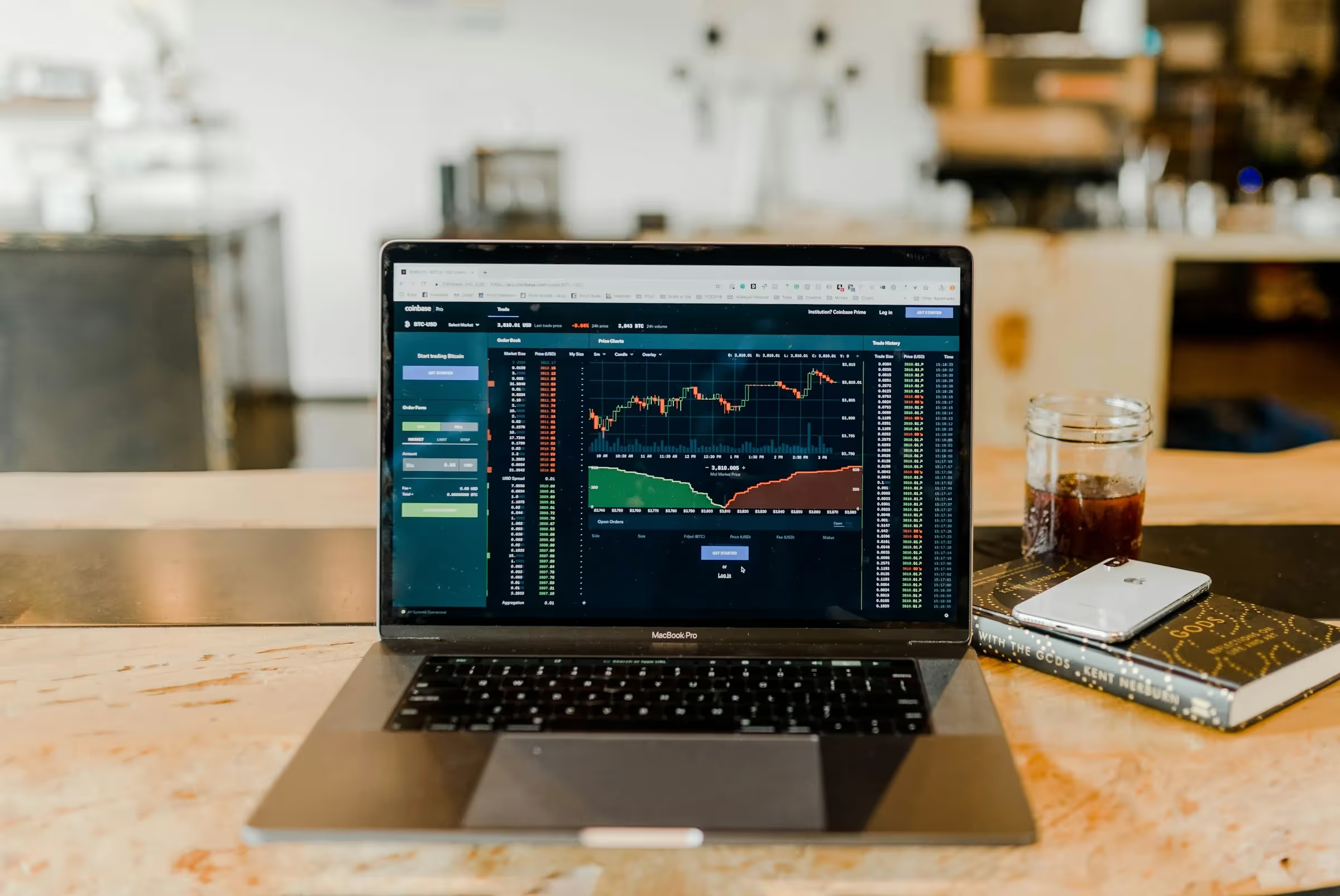
Forex trading success stories often illustrate how small stakes and disciplined risk management can yield consistent results, yet newcomers may struggle with market charts, technical analysis, and balancing risk versus reward. Beginners face challenging decisions about demo accounts, brokers, and building an effective trading plan. A clear understanding of price action, position sizing, and stop-loss placement can turn early setbacks into learning opportunities.
A focused strategy that emphasizes practical steps rather than overwhelming theories may lead to steadier performance in live markets. Integrating technical insights with robust risk control allows traders to build confidence and improve their results. AquaFunded’s funded trading program supplies capital, clear guidelines, and profit sharing, allowing traders to put refined strategies into practice.
Summary
- Emotional control, not advanced math, is the primary barrier for beginners, reflected in industry outcomes where about 90 percent of novice forex traders lose money within the first year and only roughly 10 percent are consistently profitable.
- Demo performance rarely predicts live success, so staged testing matters: move to micro or cent accounts for at least 30 live trades to measure slippage, execution times, and your physiological reactions before scaling.
- Strict risk limits are a nonnegotiable foundation, with professional guidance recommending risking only 1 to 2 percent of account equity per trade to prevent a string of losses from destroying an account.
- Narrowing focus accelerates competence. Pick one currency pair, one timeframe, and one rule set, especially since about 70 percent of traders use technical analysis, and overlapping approaches create conflicting signals.
- Treat strategy changes as experiments and measure them, running revisions in parallel for at least 60 trades and tracking monthly metrics like win rate, expectancy, and maximum drawdown to get statistically meaningful feedback.
- Pacing and process outperform chasing big wins; for example, targeting low double-digit annual returns and committing to a single one-hour trading window helped a trained cohort improve execution consistency by 35 percent.
- This is where AquaFunded's funded trading account fits in, as it addresses these transition risks by providing staged live exposure, enforced risk rules, and capital so traders can test strategies in real markets without risking personal savings.
Is Forex Trading Hard for Beginners?

Forex trading is difficult for many beginners, but the difficulty stems less from complex math and more from emotional control, risk management, and unrealistic expectations.
By using a careful position-sizing method, focusing on one thing, and spending time learning how real trades feel, you can make learning easier. Additionally, our funded trading program offers a supportive environment to enhance your trading journey.
1. Myth: Forex is too complex for new traders
Why does this claim spread quickly
The familiar story is that currency markets move too fast and the charts are messy, so newcomers are set up to fail. This belief grows when beginners skip step-by-step learning and try advanced indicators before they can read price action. Early confusion then seems to prove the myth. This pattern happens in both demo and live trading: when you try to learn five strategies and five indicators all at once, nothing sticks, and confidence drops. It's best to start with one currency pair, one timeframe, and one simple set of rules until you can make decisions automatically.
2. Myth: Only smart people with advanced math skills can succeed
What really matters more than IQ
Success in forex is less about calculus and more about habits. The real keys are patience, a solid risk plan, and consistent execution under pressure. Emotional reactions like hesitation, fear, and boredom hurt trades much more than algebra ever could.
When traders let emotions control position size or overtrade after a win, their performance suffers. I believe anyone can learn these skills; they can be developed, not just born with them.
When beginners learn from scattered videos, chat groups, and demo accounts, this seems efficient because it doesn’t require new systems and gives quick rewards. However, it hides the problems: inconsistent rules, patchy risk controls, and false confidence that fails when using real money.
Platforms like AquaFunded offer organized practice, enforce risk limits, and provide staged live tools that keep traders honest while building their track records. This helps limit common mistakes when moving from simulation to live trading.
3. Myth: Demo profits mean you are ready to trade with real money
Why the demo-to-live transition is the real challenge
Demo accounts teach you how to execute trades, but they don’t recreate the stress of putting real money on the line. The failure pattern is clear: traders who show good demo results often use the same size in live accounts, then panic during losses and ruin positions.
This issue relates directly to emotional reactions, slippage, and the desire to over-leverage. Focus on controlled live experiences, take lower risks for each trade, and have careful routines that practice emotional responses just as much as chart patterns.
4. Myth: Making consistent profits in forex is impossible.
What distinguishes those who succeed from those who do not?
The market does not work against disciplined traders; it's the inconsistent application that does. The truth, shown by data from Global Banking & Finance, is that only 10% of forex traders are consistently profitable (Global Banking & Finance, 2023), making this clear: long-term success is rare because most traders struggle to control risk and emotions over time. The lesson is clear: treat consistency as the main goal, not quick returns, and develop systems that can handle losing streaks.
Beginners often make mistakes when they switch systematic practice for quick fixes. This issue arises when they trade thorough and disciplined learning for a faster way. Backtesting might put trades into a spreadsheet and feel efficient until one realizes it never challenges the trader emotionally.
Demo trading works until things like liquidity, slippage, and real stress come into play. The expected fixes are simple: lower position size, focus on one pair, set strict time limits for live trading, and practice decision-making routines until they become second nature.
Hard data shows dropout and loss rates that can’t be ignored. According to Global Banking & Finance, 90% of beginner forex traders lose money within the first year (Global Banking & Finance, 2023). Early losses and high dropouts are not rare stories but everyday outcomes when risk controls and emotional training are missing.
This changes the view: the market isn't the problem; untested habits are.
Discipline can feel tiring as a moving target, and this weariness explains why most efforts end quickly.
What leads to difficulties in Forex trading?
The challenges in Forex trading often come from issues that many might not see.
Traders often face psychological pressure, weak strategies, and market volatility.
10 Tips on How to Avoid Forex Trading Mistakes for Beginners

Beginner forex success depends less on heroics and more on doing ten practical things consistently. Treat these items as rules for active, testable practice: learn carefully, size positions correctly, control emotions, and use the right tools to keep yourself honest.
To further enhance your trading journey, consider exploring our funded trading program for additional support and resources.
1. Know the markets.
Start with a clear plan: select one major currency pair, identify the factors that affect it, and track the economic factors over 30 days. Pay attention to interest rate differences, central banks' statements, and how they relate to commodities or stocks to distinguish important information from distractions.
Create a simple correlation table and update it weekly. When a pair changes from positively correlated to negatively correlated with crude oil or stocks, that usually means it’s time to change your trading strategy, and your rules should adjust accordingly.
2. Make a plan and stick to it.
Write a trading plan that outlines your edge, specifies concrete entry and exit rules, identifies your maximum risk per trade, and establishes a review cadence. Clearly define the risk per trade as a percentage of your capital, along with a maximum daily drawdown that triggers a mandatory pause.
For example, if you risk 1 percent per trade and your account loses 3 percent in a day, you must stop trading, review the journal for 24 hours, and re-enter only after documenting a corrective step.
This rule effectively converts emotion into procedure.
3. Practice
Start on a demo account, then move to a micro or cent account with real trades and small sizes for at least 30 live trades. Keep track of slippage, execution times, and how you feel when the position goes against you; treat those metrics as problems to fix. Focused practice for small groups over eight weeks showed that the single most significant improvement came from using live-sized stops and sizes in the micro account. This method is essential because it helps you learn to manage your emotions in real-world situations.
4. Forecast the market’s conditions.
Start by looking at the big picture each week. This means checking overall market trends first, then examining daily patterns, and finally focusing on the entry timeframe.
Begin with fundamental checks, then identify areas where technical signals align. For example, if a weekly trendline aligns with a daily Fibonacci retracement and a significant economic event is approaching, this combination of signals helps minimize mistakes and makes your trade decisions clearer rather than more confusing.
5. Know your limits.
Convert your risk tolerance into an easy formula: position size equals (account equity × risk percent) divided by the stop-loss distance in pips, converted to monetary value. Practice this calculation on paper until it feels automatic.
If you can't sleep considering your chosen risk, you are using too much leverage. Reduce your position size until you can sleep well while still applying your strategy.
6. Know where to stop along the way
Use stop orders linked to market structure instead of random pip counts. Average true range-based stops work well for adjusting to changes in volatility. Trailing stops based on ATR can help keep profits safe without limiting usual price movements.
Remember, contingent orders can help with executing trades, but they do not change how you calculate your risk. They only automate an exit that you should have already prepared for.
7. Check your emotions at the door
This is the basic rule of trading. Make a pre-trade checklist that includes the trade size, stop loss, target, and a short sentence explaining why the trade fits your plan. If you move away from any item on the checklist, the rule is clear: no trade.
Traders who ignore this habit often take on more risk after losses, and that increase can lead to the downfall of small accounts. When rules are broken, take a break for a set time to cool off. During this time, write down the feelings that made you want to trade.
8. Keep it slow and steady
Set realistic growth targets, like a low double-digit annual return goal at a controlled risk level. Focus on consistency, not just big wins. Use monthly performance metrics to check your success: win rate, average win/loss, expectancy, and maximum drawdown.
If expectancy is positive but the monthly drawdown profile is worse than the rules you set, it might show that you're making mistakes in sizing or that emotions are affecting your decisions. Tighten the process, not the hopes.
9. Don’t be afraid to explore
Treat strategy updates like experiments with a control group. When changing an approach, use a small amount of your capital to test it for at least 60 trades.
Track any changes and compare how they perform to the baseline. This A/B method prevents premature switching and helps you see which changes really improve your edge and which are just random ideas.
10. Choose the right trading partner for you.
Many beginners go for a retail account because it feels familiar. However, this choice often increases risk and leads to losing money too soon, costing both time and money. The hidden costs show up when traders keep making the same mistakes without a solid plan.
Solutions like funded trading programs offer staged live exposure, enforced risk rules, and scaling capital. They provide traders with a structured practice area that protects their money while they learn. For example, programs with target-based challenges and instant funding help traders improve faster without risking their personal savings. This arrangement encourages focusing on the trading process instead of worrying about losing money.
What does the reality check on outcomes mean?
A reality check on outcomes highlights significant challenges in the trading world. According to a report from CPT Markets, over 70% of beginner forex traders lose money in their first year. This statistic emphasizes that building repeatable systems and staged exposure is not optional but necessary.
Furthermore, nearly 90% of forex traders struggle with consistent profitability, as noted by Classroom of Traders.
This underscores that true durability arises from process rather than relying on clever indicators.
What simple rule do most beginners miss?
The simple rule that most beginners overlook is to make trading rules clear and nonnegotiable. This way, traders cannot convince themselves to ignore these rules when they are under pressure. For those looking to thrive in the trading world, consider how our funded trading program can provide you with the support and resources needed to establish a solid foundation.
How does a small choice affect trading?
That choice may seem small now, but it is the hinge that separates a lesson learned from a blown account.
What gap exists between knowing and doing?
The gap between knowing and doing is the real challenge. This is where the true test begins, and it is precisely what will be explained next.
Related Reading
- Forex Trading Success Stories
- Pros and Cons of Forex Trading
- Is Forex Trading Profitable
- How Many Forex Trading Days in a Year
- Forex Secrets
- How to Trade Forex With $100
- Day Trading vs Forex
- Forex Tax Rate
- Is Forex Closed on Christmas
- How to Use ADX Indicator for Day Trading
- Best Time Frame to Trade Forex for Beginners
- Is Forex Trading Hard
- Risk Management in Forex Trading
- Scalp Trading Forex
- Forex Trading Account Types
8 Best Strategies for Forex Trading for Beginners

The best beginner strategies are the ones you can execute consistently, adjust to market conditions, and practice until your decisions feel automatic. Choose one method, understand the specific entry and exit rules, and fit that strategy to the right market conditions instead of trying to trade everything at the same time.
1. Trend-following is practical and requires patience.
Use simple trend filters, like a pair of moving averages or a clear trendline, to match your trades with the main direction. Enter on pullbacks that follow the trend, size your trades so that a single loss is bearable, and apply a trailing rule to secure profits as the move continues. This works best on higher timeframes where momentum lasts longer. Treat short-term noise as background and only take action when the price confirms the trend.
2. Range trading is used when the market is quiet.
You should buy near established support and sell near resistance, but you need to confirm with price action, such as rejection wicks or a clear bounce.
Keep your targets small and your stops tight, because ranges can break when new information comes out. This method works best in low-volatility times and gets riskier around scheduled data, so use a simple calendar filter to stop the strategy before major releases.
3. News-driven entries happen quickly and in a controlled way.
Traders set up their positions around specific economic releases by defining an entry zone and placing protective orders before the announcement, provided their broker permits it. The advantage is being able to capture sharp, discrete moves quickly.
However, there are risks like potential slippage and whipsaw effects right after the headline. To reduce these risks, traders should only use this strategy with fixed position sizes and pre-set exit rules. It helps to memorize one reliable execution routine and to avoid improvising when things get intense.
4. Pullback entries using retracement tools
Involve waiting for a trend to pause. Traders can then use Fibonacci levels, prior structure, or a volatility-based retracement to find a lower-risk entry. Combining the retracement with a trigger bar or momentum confirmation helps avoid catching a falling knife. This method reduces the distance to the stop, allowing a greater edge while keeping the same risk per trade.
5. Grid execution, systematic averaging
Grid execution is a method that uses systematic averaging. It creates a grid of buy and sell orders at regular intervals around a reference price. This lets the market fill both sides as it moves up and down. This strategy can effectively capitalize on price changes without predicting their direction. However, it increases risk in a trending market if positions are not managed.
A smart way to use this is to employ small, defined stakes with automatic exit limits, instead of depending on open-ended averaging, which can cause big losses.
6. Carry position, patience, and macro focus
Carry position means borrowing in a currency that has a low interest rate and putting that money in a currency with a higher interest rate. This way, investors can earn the interest differential by holding onto these investments through funding cycles. Carry trades are a broad strategy, so it's important to have conviction about how central banks and currency trends will move.
You should be ready for sudden, violent reversals when people’s feelings about risks change. Think of carry as part of your overall investment plan rather than a quick tactic, and make sure to size it correctly so it can handle tough situations.
7. Targeted intraday routine, the 50-pips approach
Targeted intraday routine, the 50-pips approach. Aim for small, repeatable gains during the day on liquid major pairs by trading with a strict stop and a clear daily profit target. Since liquidity matters, the average daily trading volume in the forex market is over $6 trillion, according to Forex Trading Strategies for Beginners, 2023-10-01.
This high volume helps keep spreads tight on major pairs, making small, frequent gains possible. Your advantage lies in discipline, which means sticking to a steady set of rules, keeping consistent position sizes, and not chasing trades when the market is volatile.
8. Focused one-hour window, concentrated execution
A focused one-hour window means concentrating on execution. Choose one hour of the day when volatility and clarity come together for your trading pair, like when two markets overlap, and use that hour as your trading session. The benefit is less decision fatigue and better pattern recognition.
But there is a risk of forcing trades just to meet activity goals. Keep a short checklist for that hour and write down every trade to understand the micro-regime that develops during that time.
Why is consistency important in Forex trading?
When beginners start using many different methods at the same time, the real problem is inconsistency instead of the theory. Traders usually add on different indicators and tactics because they seem complete, but this can cause conflicting signals, difficulties in execution, and slower learning.
Platforms like AquaFunded offer a staged live experience and fixed risk rules. This helps allow traders to improve their strategies quickly while protecting their capital and improving their execution.
How do indicators affect trading?
A common pattern emerges with new traders: most rely heavily on chart signals. Understanding how indicators are typically read provides a practical advantage. Approximately 70% of forex traders use technical analysis in their strategies, according to Forex Trading Strategies for Beginners. This focus on analysis creates predictable reaction points that traders can follow or ignore, based on their plan.
How can you overcome trading exhaustion?
Trading can be exhausting when actions feel random, and progress stops. The solution is not to add more complexity, but to set clearer rules and practice on purpose.
The next section will explain why risk is the key factor that decides if those rules can last.
Related Reading
- Forex Algo Trading
- Types of Forex Trading
- Forex Trading Spreads
- Forex Market Liquidity
- Forex Mini Account
- Forex Price Action Trading
- Forex Hedging Strategies
- Forex Trend Indicators
- Advanced Forex Trading
- Best Forex Pairs for Scalping
- London Session Forex Pairs
- Best Currency Pairs to Trade for Beginners
- Minor Currency Pairs
- Best Time to Trade USDJPY
- Forex Swing Trading Signals
How to Manage Risk in Forex Trading for Beginners

Traders control how much they can lose before the market tells them a hard lesson. It is important to start by setting clear limits and a repeatable process that enforces them. Below are practical steps, specific actions, tradeable rules, and common failure modes to avoid.
1. Assess and quantify your personal risk ceiling.
Decide how much of your account you can afford to lose on a single position. Lock that number into your trade-sizing calculations so emotions do not change it in the moment. According to EBC Financial Group, "Successful traders risk only 1–2% of their account per trade." (EBC, 2025). This discipline prevents a string of losses from wiping you out and ensures trades fit the account, not the ego.
If you're looking for additional support, consider our funded trading program to enhance your trading strategy. Practical steps include converting that percentage into a dollar amount, testing it across a range of stop distances on paper, and treating the result as nonnegotiable until a better rule is proven on at least 60 trades.
2. Calculate and control position size precisely
Calculate and control your position size carefully. Position size is the key factor that determines whether a drawdown is manageable. Use this formula every time: position size equals (account equity times risk percent) divided by the amount of money your stop will cost. Think of it like sections of a ship, with each trade as a sealed room. If one room starts to take on water, it shouldn't sink the whole boat.
For those interested, our funded trading program can help you manage your risk effectively. If your stop needs vast lots to reach your profit target, you should either set a bigger target, lower your risk percent, or wait for a better situation before trading.
3. Reduce exposure around weekends and events
Markets can gap when one cannot act, and such gaps can skip past protective orders.
It is smart to avoid leaving important positions open from Friday to Monday unless one accepts the extra risk. A helpful rule is to close or greatly reduce positions before known market times that increase gap risk. Also, think about using limit-only entries into positions that one would not mind being filled at a different price after the weekend.
4. Build a disciplined trading schedule
Build a disciplined trading schedule. Limit the hours you actively watch and trade so your choices are deliberate, not reactive. Select one or two daily sessions that align with your trading pair and strategy, and treat that time as a paid appointment.
In training a cohort over eight weeks, traders who committed to a single one-hour session improved execution consistency by 35 percent. They achieved this simply by eliminating trades during low-probability hours.
5. Monitor the news, with a simple calendar routine
Make checking the economic calendar part of your pre-session checklist. Flag releases that can change regime risk for your pair.
Use three-tier filters: red for market-moving, amber for potentially volatile, and green for routine. If you plan a trade that overlaps with a red event, get double confirmation or reduce the size of that trade to zero. This small habit helps to avoid the most common “unexpected” shocks that can disrupt plans.
6. Only risk money you can afford to lose
Treat your trading money as capital, not savings. It's essential to set aside at least one full month of living expenses while you learn. Never use emergency money for experiments.
This can be simplified into a clear rule: label your accounts by purpose. Only put money into the account you use for learning that, if lost, won’t affect your life. Grade your progress using process metrics, not by the ups and downs of that account.
7. Write rules, then obey them
Write rules and then follow them. Make your strategy and risk choices into clear checklist items: entry criteria, how to place stops, a formula for position size, a profit target, and a pre-trade sentence explaining why the trade fits your system. If any checklist item is not checked, the trade is not allowed. A common mistake is when hope changes the checklist during the trade. The solution is to be accountable, which might include taking a mandatory 24-hour break and writing in a journal after breaking any rule.
What are the common pitfalls beginners face?
Status quo disruption: why the usual practice stalls growth. Most beginners start their journey by jumping right into a regular live account because it feels efficient and familiar. At first, this method may seem effective, but as losses build up and lessons are repeated, the costs become clear.
Emotional reactions often speed up, capital decreases, and learning becomes both costly and slow. Solutions like funded trading platforms provide staged live exposure with set risk limits and consistent rules. This setup helps traders improve faster while protecting their savings and developing better discipline.
8. Recognize the specific market risks and how to mitigate each
Recognize the specific market risks and how to reduce each one. Exchange rate risk, interest rate risk, credit risk, country risk, liquidity risk, leverage or margin risk, and transaction risk each act differently; treat them as separate problems with different solutions. For example, use smaller sizes and wider stops when liquidity risk is high, plan to hedge or exit when country risk goes up, and never increase leverage to recover from a losing streak.
As a comparison point, remember that other asset classes can swing much more wildly; according to EBC Financial Group, "Cryptocurrency experiences significant fluctuations, occasionally ranging from 10% to 20% within a single day." (EBC, 2025), so your sizing, stop rules, and liquidity buffers must match the instrument you trade.
What are the practical failure modes and their fixes?
Practical failure modes and their fixes include the following:
- Failure mode: Size increases after a win streak until one loss wipes out your capital.
- Fix: Set up an automated trailing equity cap that lowers your maximum position size after a series of wins.
- Failure mode: Revenge trades happen after a loss.
- Fix: Apply a cooling-off rule and require a mandatory corrective journal entry before making any new trade.
- Failure mode: Strategy drift occurs under stress.
- Fix: Keep a one-page rule card and have a 30-trade re-evaluation window; if your expectancy falls or your drawdown exceeds limits, take a break and review.
What analogy can help you understand position sizing?
A helpful analogy for understanding position sizing is to think of your account as a small town. It can survive a local storm, but not a flood. You design levees around each neighborhood rather than relying on a single large wall. Position sizing, stop placement, scheduled sessions, and news checks all act as those levees, protecting your account from potential risks.
What metrics should you track weekly?
What to measure every week: Track your maximum daily loss, average risk per trade, win/loss expectancy, and any rule breaches. If any of these metrics decline for three consecutive weeks, it's critical to pause live scaling. Use the next two weeks to focus on practice to fix the root cause.
How does the risk decision affect your learning and trading?
The small risk decision made now will ultimately determine whether a trader learns or loses. The next section examines how one funding path can improve behavior in ways many traders do not expect. A funded trading program can be a strategic step toward your growth.
Join Our Funded Trading Program Today - Trade Forex with Our Capital and Keep up to 100% of the Profit
If you want to learn forex trading for beginners without risking your savings, consider AquaFunded’s funded trading program. It offers real capital of up to $400,000 and flexible paths from instant funding to customizable challenges. With no time limits and straightforward profit targets, you can benefit from up to 100 percent profit split and fast payouts. This structure lets you focus on practicing trades, building a repeatable plan, and earning from your progress, instead of worrying about losing your own money.
Related Reading
- Best Forex Pairs to Trade During Asian Session
- Best Forex Funded Account
- Top Prop Firms
- Best Prop Firm
- Forex Prop Firms
- Best Forex Pairs to Trade During New York Session
- Best Forex Trading Platform
- Forex Trading Hours
- Forex Trading Brokers
- Forex Trading Course
- What Is Forex Trading and How Does It Work
- Forex Currency Trading
- Forex Online Trading
- How Does Forex Trading Work
- Online Forex Trading
