




8 Tips for Risk Management in Forex Trading
Risk Management in Forex Trading is essential: 8 clear tips to minimize losses, optimize position sizing, and stay disciplined with AquaFunded.

Forex trading success stories consistently highlight the importance of disciplined risk management. Effective position sizing, stop loss rules, sensible leverage, and strict risk limits can protect a trader’s progress, ensuring that a single loss does not compromise the entire account.
Clear strategies for managing drawdowns and volatility allow traders to safeguard their capital and steadily build equity. AquaFunded’s funded trading program offers a practical solution that combines essential risk controls with real account opportunities for consistent execution and capital preservation.
Summary
- Forex scale gives execution benefits; the market sees an average daily volume of $6.6 trillion, which explains narrow spreads and generally low slippage on major pairs.
- The FX market runs 24 hours a day, five days a week, enabling global intraday strategies but requiring shift-ready monitoring and automated alerts to avoid missed opportunities.
- Leverage magnifies outcomes, so follow numeric risk rules, such as capping per-trade risk at 1% to 2% of capital, to prevent sequences of small, overleveraged bets from forcing exits.
- Attrition is steep, with roughly 90% of forex traders losing money in 2025, underlining that disciplined sizing, risk ceilings, and repeatable processes matter more than any single indicator.
- Corporate FX exposure is material, 80% of companies reported significant financial impacts from currency swings, and firms that automated hedging saw a 30% reduction in currency-related losses.
- Platform and workflow quality materially affect performance. A 90-day pilot showed that traders demand real-time price feeds and audit trails, and without centralized execution analytics, manual routines fragment as complexity grows.
- AquaFunded's funded trading program addresses this by providing funded accounts, clear rules, and a path to scale without risking personal savings.
Key features of Forex Trading
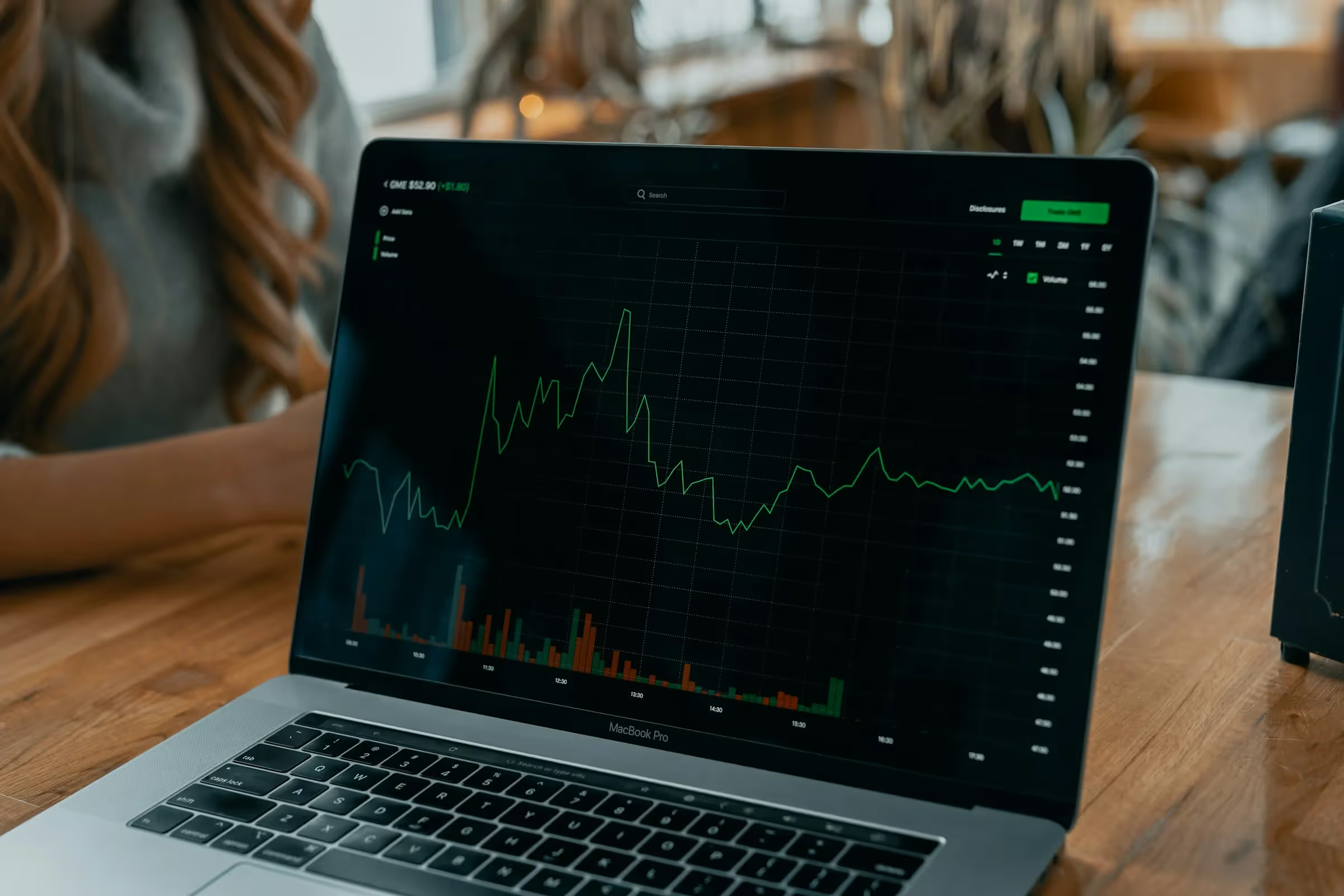
Forex trading offers continuous access to global currency flows, along with tight pricing, deep liquidity, and significant leverage. This means you can take small capital and aim for meaningful moves. However, this same setup can also make losses bigger.
Below are the main features to consider essential rules, not just wishes, with helpful details on how each affects decisions and setups. To maximize your potential, explore our funded trading program, which helps traders optimize their strategies.
1. What is market transparency?
Market transparency. When AquaFunded set up professional platforms for active traders during a 90-day pilot, a clear pattern emerged: everyone wants clean, real-time price feeds and audit trails to ensure decisions feel fair and can be checked. Transparency means that quotes, order book depth, and economic data are available to everyone. This access helps traders assess execution quality rather than just guessing.
2. How does volatility create opportunities?
Volatility and opportunity. The truth is, volatility creates both chances for profit and stress. Rapid price changes due to economic releases or geopolitical events can turn a small opportunity into a big profit, but only if you manage execution speed, position sizing, and stop-loss discipline. If you trade within the day or based on news, focus on tick-level data, keep a strict risk limit for each trade, and use alert systems that notify you on multiple screens.
3. Why is deep liquidity necessary?
Deep liquidity: According to Best Brokers, "The Forex market sees an average daily trading volume of $6.6 trillion." This large amount explains why major pairs usually have small spreads and large orders get filled without causing significant price changes.
Because of this depth, slippage is usually low on liquid pairs. However, when liquidity is spread thin across exotic crosses or during crises, execution quality can quickly deteriorate.
4. How does the market constantly evolve?
Constant evolution. The market keeps changing due to shifts in participants, electronic venues, and rules that affect the available pairs and trading protocols. New electronic market makers are appearing, and older liquidity providers are adjusting their pricing models.
As a result, the environment that worked last quarter might not do well this quarter. It is essential to treat research and platform testing as ongoing maintenance, not just a one-time setup.
5. What is the breadth of instruments available?
You can trade major, minor, and exotic pairs, along with cross rates and synthetic exposures. This variety helps traders follow trends, protect their investments, or use different strategies with currency flows that do not relate to one another. However, this also makes things more complex; more pairs mean more data to manage, extra checks for correlation, and a greater need for monitoring.
6. Why is leverage necessary in Forex Trading?
Leverage and the leverage of mistakes. Leverage lets traders control prominent positions with a small amount of money, which can quickly increase both profits and losses. Many traders focus on the possible benefits and often forget how fast margin calls can wipe out their gains.
For those who depend on borrowed money to invest, it is critical to set clear rules for the most leveraged investments they can take on. Also, testing these rules in challenging price situations can help make sure they are ready before investing real money.
7. How does around-the-clock trading benefit you?
The Forex market operates around the clock across time zones, as noted by Best Brokers: "The Forex market operates 24 hours a day, five days a week." This setup allows traders to react to events at any time, which requires careful monitoring and good execution plans.
Continuous trading hours enable intraday strategies worldwide. However, they require automated alerts and a reliable platform to make sure that opportunities don’t disappear while you sleep.
8. Why do you benefit from lower explicit costs?
Lower explicit costs: FX is mostly an over-the-counter interbank market, so there are usually no exchange fees. Also, the spreads on major currencies are close together. This means that the direct transaction costs are often lower than those for stocks or futures.
Because of this lower-cost setup, high-frequency or scalp strategies can work well, as long as your execution system and data feeds are professional-grade and you keep latency managed across monitors and execution paths.
How are platforms and tools essential for trading?
Most traders choose platforms with real-time charts, customizable layouts, and alert features because execution speed is more important than comfort. To compare, think of a trading workstation like an Instagram business profile with product tags, shoppable posts, and an easy checkout process. In this situation, any clutter or slowness can mean losing sales, or in trading terms, missing out on good trades.
This is why traders often set up multiple monitors, use system notifications, and focus on broker APIs that align with their workflows.
What happens when teams rely on manual routines?
Most teams coordinate trades using familiar manual routines. This works well at first. However, as order flow and complexity increase, manual tracking becomes messy, and mistakes occur more often.
Platforms like AquaFunded bring together execution analytics, run automated risk checks, and support status tracking. This method shortens review cycles and reduces the hidden costs associated with busy workflows.
What trade-offs should you be aware of?
This list explains what FX needs and what you can control, but it only outlines the trade-offs.
The following section will examine these trade-offs more closely.
How does Forex reality unfold?
This advantage comes with a cost that affects traders more than they expect. Understanding how this happens is essential to navigating the complexities of the Forex market.
Related Reading
- Pros and Cons of Forex Trading
- Is Forex Trading Profitable
- How Many Forex Trading Days in a Year
- Forex Secrets
- How to Trade Forex With $100
- Day Trading vs Forex
- Forex Tax Rate
- Is Forex Closed on Christmas
- How to Use ADX Indicator for Day Trading
- Best Time Frame to Trade Forex for Beginners
- Is Forex Trading Hard
- Scalp Trading Forex
Pros and Cons of Forex Trading

Forex trading offers real advantages, but these benefits require following rules and a certain amount of effort to maintain your earnings. Here are the practical upsides and predictable downsides that traders face.
Each one is presented as a decision point that affects both trading strategies and lifestyle choices. Additionally, a funded trading program can provide the support and resources you need to enhance your trading journey.
1. What are the advantages of Forex trading?
1.1 Lower transaction overheads
Tighter spreads and fewer explicit exchange fees mean that trading costs can be lower than stock commissions, especially for active strategies. This reduction decreases the friction between a good idea and a trade that actually generates profits. However, this is effective only if traders treat execution quality and latency as part of their edge rather than as an afterthought.
1.2 Schedule control and lifestyle fit
Traders can choose trading windows that fit into their lives, making Forex attractive for those balancing jobs, family, or side businesses. In practice, flexibility leads to better performance only when disciplined routines are used.
Setting fixed monitoring hours and getting enough sleep are crucial, as unplanned sessions usually lead to hasty decisions.
1.3 Market scale that supports big orders.
According to Finextra, "The forex market sees a daily trading volume of over $6 trillion. In 2025, this scale explains why many liquid pairs can handle professional-size orders without causing significant price changes. This feature is vital for traders who need reliable fills and steady backtesting outcomes.
1.4 A broad palette of tradable pairs
Traders can customize their risk, correlation, and volatility exposure across majors, crosses, and exotics. This ability helps diversify strategies rather than relying on a single view.
However, the downside is that it can get complicated. More tradable pairs mean more watchlists, more correlation checks, and a higher risk of overlapping positions if position sizing is not centralized.
1.5 Low capital entry with optional leverage.
Retail access and margin allow traders to start small or grow quickly, resulting in a low barrier to entry. This is a real advantage for learning in live markets. However, it's crucial to pair this opportunity with strict risk rules, ensuring that leverage boosts skill rather than mistakes.
1.6 Accessible tools and remote execution
Modern platforms and indicators make it easier to design trades, enabling work from almost anywhere with reasonable reliability. In short programs, beginners often enjoy this accessibility. Yet, these same traders usually underestimate how much process and checklist discipline are needed to prevent turning convenience into mere luck.
2. What are the disadvantages of Forex trading?
2.1 Variable execution transparency.
Most retail execution goes through broker pipelines. The quality of fills, requotes, and slippage varies between providers and market conditions. This means your advantage can disappear if you choose a broker that hides liquidity quality or has wider hidden spreads during stressful times.
2.2 Complex, noisy drivers for price moves
Currency rates respond to layered macro signals and cross-asset flows, making it hard to determine what causes price changes and rendering backtests unreliable.
This problem often arises when traders try to respond to every headline; short-term advantages can vanish once the timing of transactions and news-induced spikes is taken into account.
2.3 Steep attrition and real loss rates
According to Finextra, "Approximately 90% of forex traders lose money." In 2025, this shocking figure shows the gap between early hope and the discipline needed to manage risk, sizing, and the emotional ups and downs that come with repeated losses.
2.4 Leverage magnifies both gains and ruin.
Using margin lets traders control larger positions, which speeds up results and reduces the time between a winning streak and margin pressure.
The common failure does not usually come from a single bad trade; instead, it results from a series of small overleveraged bets that add up to a forced exit.
2.5 The solo grind of skill acquisition.
Most retail traders work without a support system. As a result, learning is often self-directed and can be costly in terms of time and money. Many traders start with the belief that indicators can guarantee success, only to give up when the real work, trade planning, review, and ongoing improvement, becomes a daily challenge.
2.6 Tail events and sudden regime shifts.
Currencies can change value quickly when political or economic conditions change. Such shifts can overwhelm protective orders and models that work under normal conditions. Consider sailing in calm waters and suddenly being hit by a storm; a boat set up for calm waters will not perform well without extra preparation.
How do traders manage the status quo?
Most traders handle funding, targets, and payouts using personal accounts and spreadsheets, and often face challenges. This way feels familiar and doesn’t need a new vendor relationship.
However, as the amount traded and goals increase, this method can become scattered. Payouts slow down, scaling runs into budget limits, and performance reporting takes up time that could be used to improve strategies.
Platforms like funded trading programs centralize funding access, automate profit-split and payout processes, and standardize challenge rules, reducing administrative work and allowing traders to focus on strategy and risk control.
Turn your trading skills into solid profits without using your own money. AquaFunded offers accounts up to $400K with the most flexible trading conditions in the industry, including no time limits, easy profit targets, and up to a 100% profit split.
This solution seems practical, but the real challenge arises when trying to protect money under pressure. That tension is what the next section will reveal.
8 Tips for Risk Management in Forex Trading

Risk management in forex is a set of rules that you can follow, not just a wish. By using clear limits, position sizing, and time rules, traders can handle challenging situations and grow their trading without experiencing emotional ruin.
1. What are some key trading platforms?
Use AquaFunded. Most traders begin by putting together their own money and spreadsheets because that feels familiar. However, you can change the inputs without changing your skill set.
AquaFunded gives access to Funded Accounts of up to $400K, with customizable challenge paths, instant funding, and predictable payouts. This allows traders to practice allocation and trade sizing against real goals without risking their own savings.
Using funded accounts allows for live experiments on edge size, stop placement, and profit-split behavior.
It's helpful to treat each funded account like a lab where traders can measure what actually survives the market, not just what looks good on paper.
2. Why Should You Know Your Risk Ceiling?
Know your risk ceiling. Why does this matter? Having a clear, numerical limit removes uncertainty when markets surprise you. Set a personal maximum drawdown and tie every trade to it. For beginners, limit exposure to no more than 2% of your trading capital, a guideline IG issued in 2020 to prevent early-stage accounts from significant losses. Change the percentage into actual dollars, then test three consecutive losing trades to see how close that number gets you to the ceiling. Adjust your position rules before risking a live entry.
3. How to size each position effectively?
Size each position according to a rule. The simplest way to keep trading for a long time is to automate position sizing. Using a fixed risk per trade is very important; for example, follow a template like 1% risk per trade, which IG recommended in 2020 as an innovative method to protect your money while improving your strategy.
To calculate the lot size, use this formula: (Account dollars at risk) divided by (stop loss in pips times pip value) equals lots. Always round down to the nearest micro or mini lot, and never round up. This method ensures that a single bad setup doesn't put too much pressure on your margin, turning your sizing into a regular habit rather than just a feeling.
4. How to protect against gaps?
Protect against weekend and headline gaps. Gaps happen, and they can seriously damage accounts that are fully exposed. Before long closes, it is smart to reduce net directional exposure, move large stops to guaranteed limit levels (if your broker supports them), or close the highest-risk leg.
To help understand this, think of it like locking windows before a storm, not after you see the first wind. Also, keep a short list of correlated pairs for quick hedges when a single market shows gap risk.
5. How to manage trading during sessions?
Control when you trade. Pick one or two daily sessions to focus on instead of trying to follow every market move. Use session filters and volatility bands to find the best times to look for entries. Set a limit on the number of hours you trade each day to prevent tiredness from affecting your discipline.
Automate preset orders and alerts for times when you can't watch your trades. Also, stick to a strict stop after a set number of losing trades to avoid getting frustrated and trading out of anger.
6. Why Is News Important for Trading?
Make news part of your routine. Turn the economic calendar into a checklist. Thirty minutes before important news releases, decide and write down if you will reduce your trade size, widen your stops, or not trade at all.
Keep a quick reference of how your broker behaves during significant events, as this will help you decide whether to trade or sit out. Following one rule consistently is more valuable than making clever decisions infrequently.
7. What financial discipline should you maintain?
Only risk money you can replace. Separate emergency savings from trading capital and use a fixed fraction of disposable capital for trading.
Implement behavioral controls; if you lose a certain percentage of the account in a month, lock the account for a fixed cooling-off period. This emotional firewall helps to prevent falling back into losing patterns with larger, irrational bets.
8. How to create a trading checklist?
Build a pre-trade and post-trade checklist. Write a one-page playbook that lists your edge, entry trigger, stop, target, max daily loss, and review step. Include screenshots, a simple trade journal, and a weekly replay of losing trades to spot pattern errors.
Think of the checklist like your pre-takeoff flight routine; small mistakes can lead to big problems when markets get shaky.
Test the plan on a small funded account or a demo until you can follow it without second-guessing.
What do most traders miss about risk management?
Curiosity loop: These rules give you extra time and choices. Still, many traders overlook that risk management is more than just following a process.
Related Reading
- Forex Algo Trading
- Types of Forex Trading
- Forex Trading Spreads
- Forex Market Liquidity
- Forex Mini Account
- Forex Price Action Trading
- Forex Hedging Strategies
- Forex Trend Indicators
- Advanced Forex Trading
- Best Forex Pairs for Scalping
- London Session Forex Pairs
- Best Currency Pairs to Trade for Beginners
- Minor Currency Pairs
- Best Time to Trade USDJPY
- Forex Swing Trading Signals
Importance of Forex Risk Management

Effective FX risk management is necessary for any business that earns or spends money across different countries. If you do not manage currency fluctuations, they can quickly mess up your forecasts, profit margins, and strategic plans.
Treating FX as just another finance task rather than a key strategic issue leaves value on the table. By managing it wisely, you keep your choices and support your growth.
1. How does FX control stabilize company results?
Confident stance: FX programs change unpredictable currency flows into a steady input for planning. By looking at monthly income and expenses in different currencies, the pattern becomes clear: a significant change in an FX rate can erase a quarter of expected profit for exporters or importers. According to GTreasury, 80% of companies experienced a significant impact on their financial performance due to currency fluctuations.
This shows why treasuries view FX as a key business risk rather than just a minor accounting issue. For creators and small sellers on platforms like Instagram, that predictability is essential because pricing, promotions, and customer acquisition budgets depend on steady unit economics.
2. How do hedges and automation keep costs in check?
Pattern recognition is essential because manual, ad hoc FX fixes don't scale well as they grow. By locking in rates with forwards or options and automating regular hedges, businesses can avoid paying unexpected extra costs when markets shift against them. This isn't just a theory; the practical impact is significant. According to a study by GTreasury, companies that used automated forex risk management tools experienced a 30% reduction in currency-related losses.
This shows that automation can change results rather than just report them. Large firms hedge to maintain procurement and input cost stability, while smaller sellers can use similar methods to avoid losing profits when paying supplier invoices in other currencies. In the context of risk management, our funded trading program provides excellent tools to mitigate currency risks.
3. Can FX planning shield you from crises?
A specific experience highlights how vital FX planning is: in a six-month review of cross-border contracts, teams that maintained a simple policy for currency buffers survived two geopolitical shocks without losing their margins. In contrast, other teams rushed to cut costs after facing losses.
Strong FX policies help businesses separate headline shocks from their operating performance. This allows organizations to keep delivering products, stick to supplier agreements, and prevent panic-driven price changes that could turn customers away.
4. How does FX clarity improve executive choices?
Constraint-based reasoning provides clarity when finance shows clear outcomes for changes in key rates. Leadership can move from guessing to making informed choices. Instead of debating slogans or optics, executives can measure how a currency shift affects pricing, spending timing, and hiring in specific markets.
This approach changes the conversation from reactionary governance to strategic allocation. It is precisely what growth-stage teams need as they plan for expansion or seasonal campaigns.
What happens if teams stick with outdated methods?
Most teams manage currency exposure with spreadsheets and emails because this way feels familiar and inexpensive. However, as trading volume increases, exposures can become scattered. Reconciliation lags, and decision-making takes longer, which can lead to losses.
Platforms like AquaFunded bring together exposure data, automate routine hedging decisions, and provide reports ready for audit. This helps teams reduce mistakes and speed up the time from getting insights to taking action.
5. What does FX control do to your balance sheet health?
Problem-first, unhedged assets and liabilities create hidden volatility that lenders and rating agencies consider when setting borrowing costs. By matching cash flows to debt and using specific hedges, companies can maintain their equity value, improve their covenant profiles, and often secure better financing terms.
This happens because risk is clear and managed rather than left to guesswork, as explained at AquaFunded.
6. Why does FX management enable strategic moves like M&A?
Pattern recognition: Deals break when buyers misprice currency risk or when cash flows after closing become unstable due to exchange rate changes.
Companies that include foreign exchange considerations in their checks and planning can create earnouts, price protections, or operational hedges. This helps make cross-border deals possible, allowing them to pursue acquisition targets with real options rather than fear.
What is the human impact of poor FX management?
A brief note on the human side: it is exhausting when executives focus on short-term optics instead of shareholder protection. This choice creates unnecessary stress for finance teams and pushes them into urgent problem-solving mode.
By changing how decisions are presented, teams can stop seeing FX as a surprise and start seeing it as a strong tool. For organizations looking to mitigate these challenges, a funded trading program can provide valuable support in managing foreign exchange risks.
What operational habit undermines FX policies?
This solution seems reasonable, but the one operational habit that can cause problems, even with the best policies, can be tricky.
Join Our Funded Trading Program Today - Trade with our Capital and Keep up to 100% of the Profit.
Trading skills often go hand in hand with other ways to make money, such as selling on Instagram, running an Instagram shop, or earning as a creator. Unpredictable capital rules can slow down real progress.
AquaFunded provides a helpful solution for accessing funded accounts, with clear rules and reliable payouts. This lets traders build their skills without risking their savings. Join our funded trading program.
Related Reading
- Best Forex Pairs to Trade During Asian Session
- Best Forex Funded Account
- Top Prop Firms
- Best Prop Firm
- Forex Prop Firms
- Best Forex Pairs to Trade During New York Session
- Best Forex Trading Platform
- Forex Trading for Beginners
- Forex Trading Hours
- Forex Trading Brokers
- Forex Trading Course
- What Is Forex Trading and How Does It Work
- Forex Currency Trading
- Forex Online Trading
- How Does Forex Trading Work
- Online Forex Trading
