




Pros and Cons of Forex Trading
Discover the real pros and cons of forex trading so you can manage risk, spot opportunities, and decide if the market is right for you.

You have probably seen Forex Trading Success Stories where traders turn small stakes into steady income, but the same market can swing hard and fast. Leverage, round-the-clock trading, tight spreads, and deep liquidity open real chances.
At the same time, volatility, margin calls, commissions, regulation, and emotional strain can wipe out gains in a few trades. Want a clear view of the pros and cons so you can sharpen trading strategies, manage risk, test ideas on demo accounts, limit drawdowns, and trade professionally with funded accounts?
To reach that goal, Aqua Funded offers a funded trader program that pairs a clear evaluation with firm capital and simple rules so you can focus on performance and build a professional trading career.
Summary
- Forex is massive and growing, with global daily turnover reaching $9.6 trillion in April 2025, up 28% from 2022, which means liquidity compresses spreads and supports larger, cleaner executions for traders who plan for realistic transaction costs.
- Dollar dominance concentrates liquidity and pricing, as the US dollar was on one side of 89% of FX trades in April 2025, so dollar pairs typically offer the tightest spreads, while exotic crosses tend to be costlier and more volatile.
- Retail attrition is severe, with roughly 90% of forex traders losing money and quitting within their first year, and only about 5 to 10% consistently profitable, which shows that repeatable gains require more than occasional wins.
- Execution quality and hidden costs matter as scale increases, because while the market sees over $6 trillion in daily trading volume, slippage, spreads, and fees can compound across many trades and turn a theoretical edge into a losing plan.
- Skill development is time-intensive, with traders expected to complete roughly 300 to 800 hours of deliberate practice and journaling to reliably advance beyond beginner plateaus and avoid common cognitive failure modes.
- Robust validation and risk rules are nonnegotiable, for example, proving a positive expectancy across at least 50 trades and across three distinct market regimes before scaling, plus fixed max-risk limits to prevent margin-driven blowups.
- This is where Aqua Funded's funded traded program fits in, providing a structured evaluation with firm capital and clear rules so traders can test execution and risk management under live conditions.
What is Forex Trading?
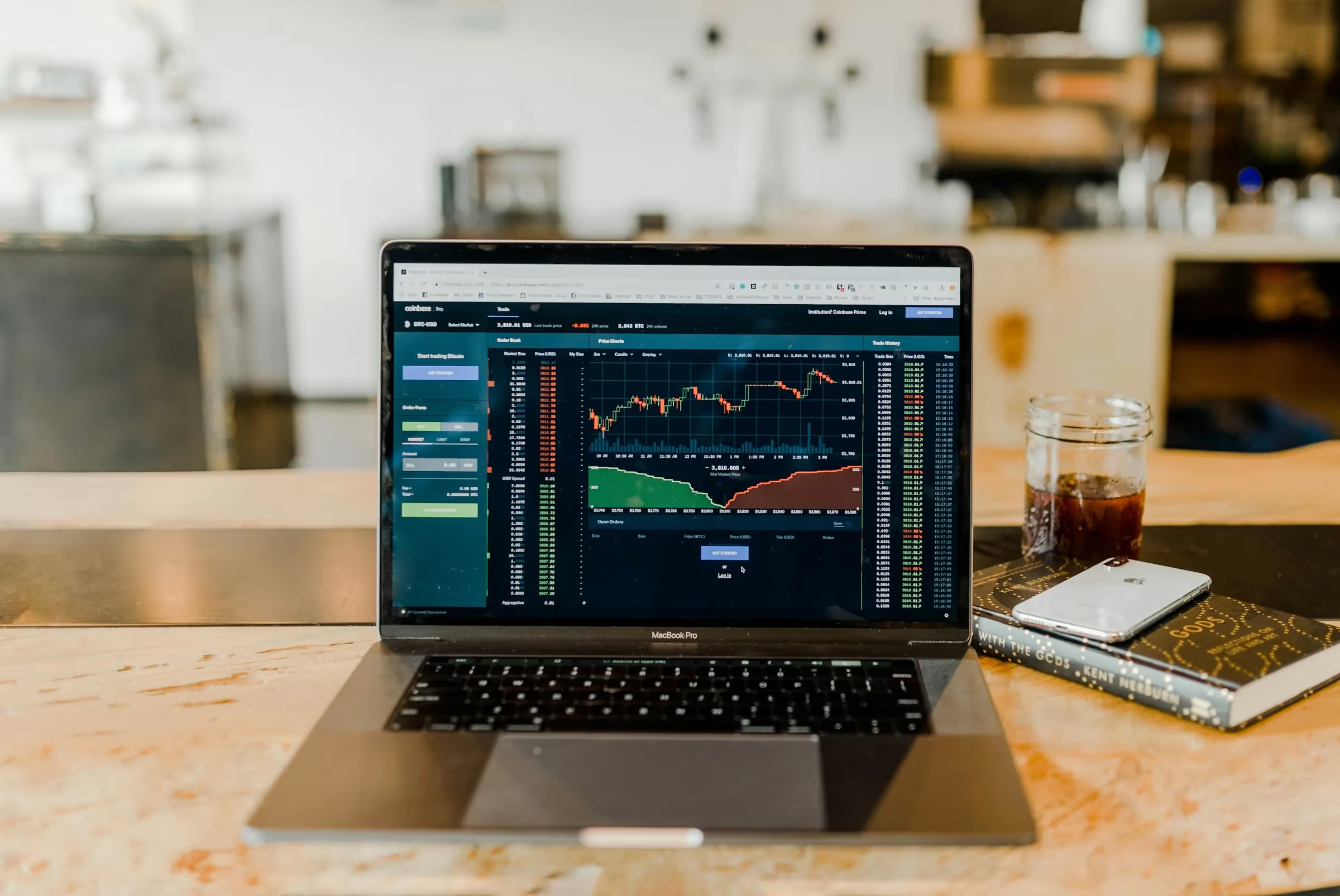
Forex trading is the act of exchanging one national currency for another to capture price differences, settle cross-border payments, or hedge exposure. It happens around the clock on weekdays, between banks, firms, and retail traders, and relies on deep liquidity and rapid execution to turn small price moves into tradable opportunities.
1. Definition and purpose
Forex trading means converting one currency into another to profit from shifts in exchange rates, to pay or receive foreign invoices, or to protect a balance sheet from currency swings. Traders buy and sell currency pairs, treating one currency as the asset and the other as the funding or quote currency, so every trade has both market and financing implications.
2. How big and liquid is the market
Global turnover is enormous and growing, reflecting intense participation across regions and instruments, as shown by the 2025 Triennial Central Bank Survey. Global FX trading reached $9.6 trillion per day in April 2025, up 28% from 2022. That scale matters because liquidity compresses spreads, lets larger positions enter and exit cleanly, and allows traders to plan for realistic execution costs.
3. Who dominates trading and why that matters
Most trading routes through major currencies and offshore centers, which concentrate influence and price-making power. In fact, the US dollar accounted for 89% of all FX trades in April 2025. That dominance means dollar pairs typically offer the tightest spreads and the deepest liquidity, while exotic crosses can be far less predictable and costlier to trade.
4. How the market actually operates
The foreign exchange market is decentralized, with prices formed by an interplay of banks, ECNs, brokers, and algorithmic participants rather than a single exchange. Price discovery happens continuously as orders match across venues, and settlement follows standard time conventions, which is why execution speed and transparent pricing are essential to capture intended outcomes.
5. Structural advantages traders can use
Liquidity, leverage, and near-continuous market hours are concrete advantages: liquidity allows scale, leverage amplifies capital efficiency, and 24/5 access lets you react to news across time zones. Those benefits are only real when paired with disciplined position sizing, clear entry rules, and tools that expose actual transaction costs.
6. Common failure modes and the human side
This challenge appears across novice and intermediate traders: they often chase market lore or complex “systems” and equate long hours with guaranteed success, which breeds frustration when results lag. The typical failure mode is not the strategy itself, but inconsistent risk control, emotional overtrading, and underestimating slippage and margin exposure.
7. What changes when you pair discipline with the right platform
Most traders stick with manual workarounds because they are familiar and require no new systems, and that choice is understandable. Yet as position size or frequency grows, execution delays, opaque fees, and fragmented education create preventable losses. Platforms like Aqua Funded provide faster execution, more transparent pricing, and integrated risk-management and learning tools, giving traders a practical bridge from amateur habits to disciplined trading, reducing unexpected costs while preserving control and transparency.
A straightforward analogy helps: trading without a disciplined plan and reliable execution is like sailing a fast boat with a frayed rope and no chart. You may move quickly, but you are exposed to sudden storms and costly missteps.
That solution looks solid, but there is one uncomfortable truth most traders avoid confronting.
Pros and Cons of Forex Trading

Forex trading offers concrete operational advantages, round-the-clock access, deep order books, and low entry barriers. Still, those same features become liabilities without strict risk control and a learning plan. Below, I list the significant advantages and the corresponding downsides, with practical notes about how disciplined traders turn strengths into repeatable outcomes.
1. Trade Anytime
What practical benefit does 24/5 access give you?
You can react to events outside regular market hours, split trading into short evening sessions, and test intraday ideas without reshuffling a day job. That flexibility is real, but it changes how you must manage time and attention: session overlaps create concentrated volume and overnight gaps create risk, so you either schedule focused sessions or use automation to guard positions when you step away.
2. Accessibility
Why do so many people get started so quickly?
Opening an account and accessing live prices is fast, which lowers the psychological barrier to starting to learn with small stakes. The flip side is a false confidence problem: easy access to real money accelerates poor habits; beginners often skip structured learning and treat real money like demo money. The pattern is predictable: rapid onboarding, quick exposure, then emotional trading once losses appear.
3. Low Capital Requirements
How can small accounts participate?
Tight relative spreads and leverage let small traders test strategies without significant capital outlays, so that you can prototype methods with modest sums. That benefit depends on disciplined sizing, because margin amplifies both wins and losses; the cost of being undercapitalised shows up as frequent stop-outs and a short learning runway.
4. Technical Strategy
What makes technical analysis so valuable here?
Price charts compress order flow and sentiment into visible patterns, so traders who master trend structure, order flow cues, and execution timing can find repeatable edges. The failure mode is overfitting: systems that look perfect on historical charts collapse under slight regime shifts, which is why robust risk rules and out-of-sample testing matter more than curve fitting.
5. High Liquidity
How does market depth change execution and risk?
Deep order books reduce slippage and let larger orders fill cleanly, which preserves the edge of tight entries and exits; according to Finextra, Forex trading is growing fast, and for good reason. It’s more accessible than ever, offers traders significant flexibility, and has a daily trading volume of over $6 trillion. That scale means execution quality matters less for tiny retail lots but matters a great deal as size or frequency increases.
6. No Central Exchange or Regulator
Why does decentralisation matter to execution and cost?
Without a single exchange, prices form across venues and counterparties, so traders benefit when they choose brokers with transparent pricing and direct routing. The tradeoff is complexity: selecting a trustworthy counterparty and understanding venue fragmentation becomes part of your operational checklist as you scale.
7. Relative Transparency, Lower Insider Risk
Is forex less prone to insider shocks?
Currencies are driven by macro drivers and central bank statements that are public, which reduces the chance of company-style insider surprises. Still, policy moves and scheduled announcements can produce violent moves, so transparency does not eliminate sharp, news-driven volatility.
8. High Risk
How big is the downside for casual participants?
Retail attrition is stark, which explains why many accounts fail before trading becomes a skill. The Pocket Option blog reports that approximately 90% of forex traders lose money and quit trading within the first year. That statistic highlights a predictable failure pattern: inadequate risk controls, misuse of leverage, and trading driven by emotion rather than rules.
9. Complexity
Why do new traders struggle to learn?
Success requires mastering multiple disciplines at once, technical and fundamental analysis, position sizing, and execution nuances. This cluster of skills creates steep friction; traders who treat learning as a checklist often plateau, while those who structure 300 to 800 hours of deliberate practice and journaling advance predictably.
10. Volatility
When is volatility an ally and when is it a threat?
Volatility creates opportunity and sudden drawdowns. Traders who rely on fixed-size positions without volatility-adjusted stops will either fail fast or repeatedly stop out, eroding learning capital and confidence. The practical approach is volatility-adjusted sizing and scheduled unwinds before high-impact events.
11. No Additional Returns
Why don't forex positions yield passive income like stocks or bonds?
Most currency trades target price movement, although overnight financing can create carry, positive or negative, depending on interest rate differentials. That means long-term wealth building requires an active strategy or integration of carry and trend methods, since you generally do not get scheduled dividends or coupons.
12. Counterparty Risks
What operational risks come from the market’s structure?
OTC trading introduces counterparty exposure, varying settlement practices, and jurisdictional complexity. Traders who ignore broker solvency, regulatory status, and execution audits expose themselves to settlement failure or widened spreads during stress, so due diligence is part of risk control.
13. Leverage Risks
How does leverage break traders?
Leverage magnifies minor errors into large losses and turns normal intraday noise into account-ruining moves when stops are ignored. The predictable failure is cognitive: traders rationalise larger size after a win streak, then the next adverse move wipes them out. Strict max-risk rules and pre-checked margin buffers prevent that cascade.
14. Hard to Manage
What operational burden grows with active trading?
Running positions across time zones demands monitoring, alerts, and sometimes automation. Manual-only workflows scale poorly: as trade frequency or size rises, execution delays, missed stops, and emotional fatigue become the limiting factor. Platforms that provide reliable execution, transparent pricing, and on-platform risk controls enable scaling.
Most traders begin with familiar, manual methods because they work on a small scale, but those same habits create hidden costs as ambition rises, fragmenting performance and wasting time. Platforms like Aqua Funded provide faster execution, clearer fee visibility, and built-in risk and learning tools, which help traders preserve execution quality and avoid avoidable mistakes as they scale.
This pattern appears consistently: beginners are drawn by access and low capital, excitement turns to stress when losses arrive, and the failure point is usually not strategy but inconsistent risk discipline and execution. That humbling arc is why structured practice, clear daily routines, and disciplined position sizing are nonnegotiable.
The frustrating part? This still leaves the single biggest question unresolved: can trading convert those advantages into consistent profit over time?
Related Reading
- Is Forex Trading Profitable
- How Many Forex Trading Days in a Year
- Forex Secrets
- How to Trade Forex With $100
- Day Trading vs Forex
- Forex Tax Rate
- Is Forex Closed on Christmas
- How to Use ADX Indicator for Day Trading
- Best Time Frame to Trade Forex for Beginners
- Is Forex Trading Hard
- Risk Management in Forex Trading
- Scalp Trading Forex
Is Forex Trading Profitable?

Yes, forex can be profitable for a small, disciplined minority, but most retail participants do not achieve sustainable gains. Success is less about one lucky trade and more about building a repeatable edge, tight risk rules, and the operational discipline to execute over months and years. That reality is stark: Benzinga reports that 90% of forex traders lose money, and only 10% are consistently profitable, indicating that consistent profit is rare and requires deliberate work.
1. What does a realistic path to profit look like?
You should expect stages, not a straight climb. Beginners commonly trade reactively for weeks, then test rules for months, and only after disciplined iteration across many market conditions do they begin to compound gains reliably. Think in timelines measured in quarters and years, not days. A practical benchmark is proving a positive expectancy strategy over at least three distinct market regimes and clearly defined risk limits before you scale size.
2. How do you know you actually have an edge?
Measure trading by expectancy, drawdown behavior, and execution sensitivity. A genuine edge shows a positive expectancy per trade, a manageable worst-case drawdown, and robustness when you shift timeframes slightly. If your system collapses under small changes in spread, entry timing, or news, it has been curve-fitted. Use out-of-sample tests and forward paper trading long enough to reveal brittleness before you commit real capital.
3. What role does psychology play in turning profits into repeatable income?
The failure point is almost always human: overtrading after a win, double-downs after a loss, or abandoning rules under pressure. It’s exhausting when traders chase quick fixes or guru signals, then blame the market. The honest skill is enforcing your stop-loss plan even when it stings, and treating wins as data, not permission to increase size recklessly.
4. When does automation help, and when does it hurt?
Automation removes emotion if the rules are robust and straightforward, but it amplifies hidden flaws if your backtesting was overfit. Automated systems work best when they are low-parameter, stress-tested across varied volatility, and monitored with clear operational alerts. If you cannot explain why the trade is taken in plain language, automation will multiply your failures, not your wins.
5. How should you size positions to protect a trading runway?
Sizing is the instrument that determines survival. Use fixed-percent risk per trade tied to realized volatility, and design rules that keep required margin well below your account equity so a series of losses won’t end your program. Underfunded accounts force behavior that destroys learning, so growing skills with a small, protected runway beats guessing with maximum leverage.
6. What operational frictions silently kill profitability?
Execution delays, hidden fees, slippage, and slow fills gradually turn a viable edge into a losing plan. Those costs compound over many trades. The familiar approach is to tolerate cheap, slow execution because it is easy. Still, as trade frequency or size increases, that tolerance becomes a measurable performance leak that compounds into missed growth.
7. Most teams handle execution and education with piecemeal tools. What’s the unseen cost of that habit?
When traders stitch together multiple providers to get prices, execution, and learning, context is lost, and response time lengthens. As complexity grows, errors multiply, and learning slows. Platforms like AquaFunded provide faster execution, transparent fees, and built-in risk and training tools, reducing operational drag, preserving execution quality, and shortening the time it takes for disciplined traders to test and validate an edge.
8. How do you track progress without getting misled by lucky streaks?
Track risk-adjusted metrics, not just gross profits. Use metrics such as profit factor, maximum drawdown, and a rolling expectancy over a minimum sample of trades. Treat streaks as information to refine sizing, never as permission to scale blindly. The metaphor I use: growing consistent returns is like tending an orchard, you prune, you irrigate, and only after seasons of care does the harvest become reliable.
Turn your trading skills into substantial profits without risking your own capital. AquaFunded gives you access to accounts up to $400K with the most flexible trading conditions in the industry, no time limits, easy-to-achieve profit targets, and up to 100% profit split through a funded trading program.
Join over 42,000 traders worldwide who've already collected more than $2.9 million in rewards, all backed by our 48-hour payment guarantee. Start trading today with instant funding options or prove your skills through customizable challenge paths and keep up to 100% of what you earn.
That simple truth about how profit is actually earned is only the beginning of what you need to master next.
Related Reading
- Forex Algo Trading
- Types of Forex Trading
- Forex Trading Spreads
- Forex Market Liquidity
- Forex Mini Account
- Forex Price Action Trading
- Forex Hedging Strategies
- Forex Trend Indicators
- Advanced Forex Trading
- Best Forex Pairs for Scalping
- London Session Forex Pairs
- Best Currency Pairs to Trade for Beginners
- Minor Currency Pairs
- Best Time to Trade USDJPY
- Forex Swing Trading Signals
10 Tips for Forex Trading
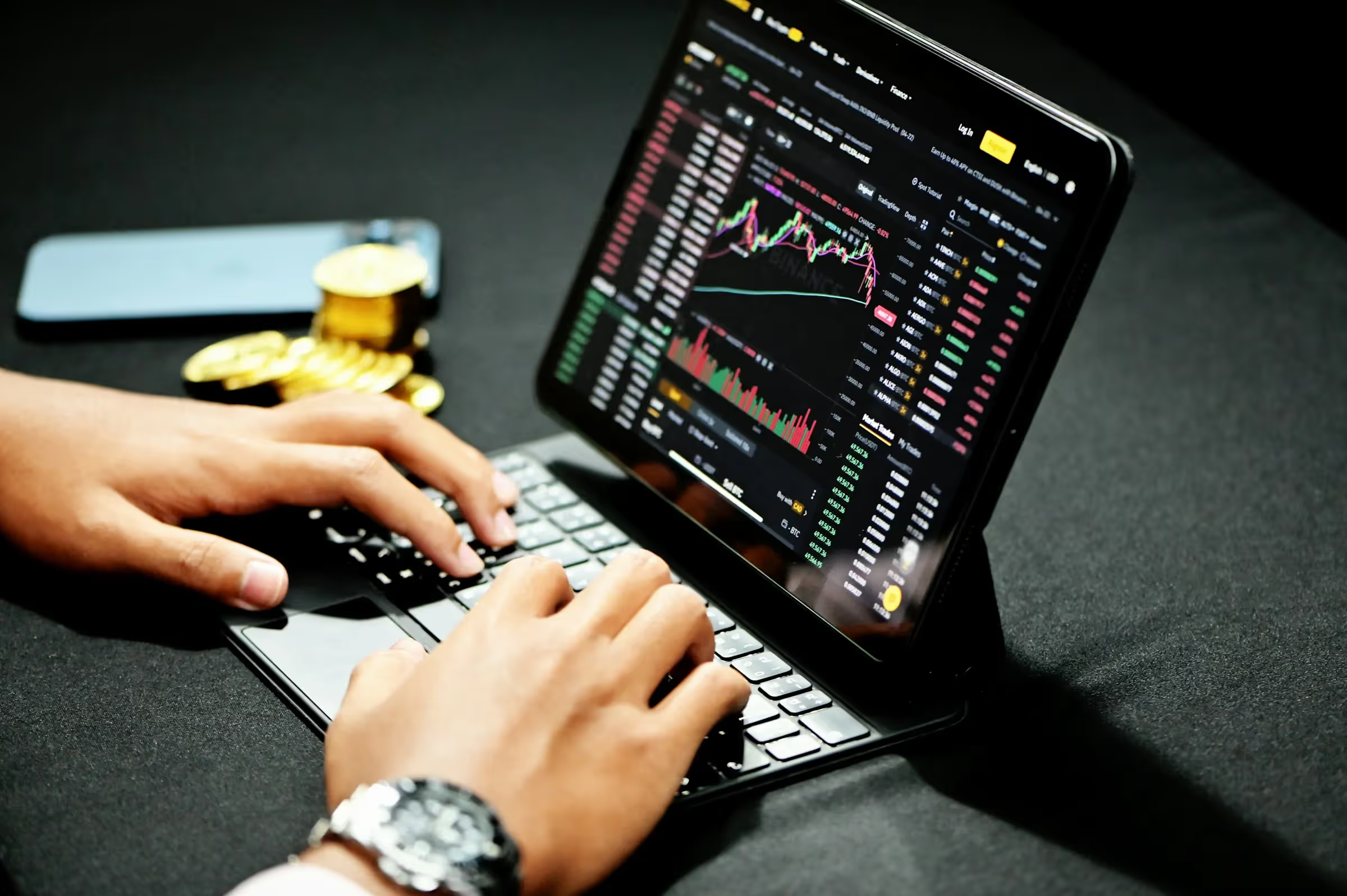
Treat these ten points as a playbook you can act on immediately: fund selectively, learn deliberately, trade by rule, rehearse in real time, and tune your risk controls until your edge shows up consistently. Each item below rephrases the original tips and adds practical steps you can implement this week.
1. Use Aqua Funded strategically
How should you use a funded program to scale skill, not luck? Briefly acknowledging earlier coverage of Aqua Funded, treat the platform as an operational lever rather than a shortcut. Start by choosing a challenge path that matches your time horizon and preferred pair, then run that challenge as an extended test, using the funded account only after you prove consistent expectancy across at least 50 trades. When you trade the funded account, keep risk per trade small relative to the account size so you preserve the program runway while you learn to handle larger fills and tighter execution.
2. Commit to market education that pays off
Which knowledge actually saves you money? Learn how central-bank guidance, rate differentials, and liquidity cycles change pair behavior, then practice reading the economic calendar for probability, not headlines. Focus on the handful of pairs that show stable spread and depth for your time frame, and learn how correlation and market regime shifts alter your setup selection. Treat study time as a capital investment: schedule blocks for reading releases, watching trade replays, and annotating why each trade did or did not work.
3. Build a trade plan that enforces discipline
What belongs in a plan and why each piece matters. Your plan should state a per-trade risk limit, target win rate range, edge definition, explicit entry and exit rules, and measurable evaluation windows, for example, 50 trades or three months. Add a decision checklist you read aloud before placing a position, so you commit to rational criteria when you are calm, and remove subjective justifications after the trade goes live.
4. Validate the plan with realistic practice
How to make demo time meaningful. Use a live-sim account that copies the spreads and execution latency you will face when funded. Force yourself to hit the same profit and drawdown rules on demo as you will on live accounts, and log every trade with the reason it was taken, the signal strength, and the emotional state at entry. Don’t graduate from demo until your rolling expectancy is positive across changing volatility conditions.
5. Forecast market conditions like a weather report
How to read market “weather” and choose the right tools. Combine a simple economic-event filter with a volatility gauge, such as ATR, and decide ahead of time whether you will trade through announcements or step aside. Blend fundamental context, such as interest-rate divergence, with trend confirmation from price structure, and prefer setups where both line up. That hybrid approach narrows your focus and reduces noisy, low-probability trades.
6. Set hard operational limits
What limits protect your learning capital? Define max daily loss, max consecutive losers before stopping, and a fixed percent of equity you never risk on a single trade. Use these limits as nonnegotiable rules; they preserve your runway to learn and prevent tilt-driven size escalation when you feel compelled to “make back” losses.
7. Use stop and limit orders as automatic discipline
How to structure exits so you do not need to watch the screen constantly. Use volatility-adjusted stops, such as ATR-based multiple stops, and place profit targets that reflect realistic reward-to-risk ratios. Employ trailing stops to lock in gains as a position moves in your favor, and test how order types execute at different liquidity times so you avoid surprises when spreads widen.
8. Control emotion with process fixes
How to prevent revenge trading and impulsive scaling. This problem affects retail beginners and part-timers alike: when a loss occurs, traders often chase size or abandon stops, which typically doubles drawdowns and erodes confidence. Use concrete countermeasures: pre-trade checklists, mandatory 24-hour cool-off after a stop-hit that exceeds your threshold, and a rule that you cannot increase size after a loss until you log three consecutive trades that meet your plan.
9. Prioritize slow, repeatable growth
Why patience and consistency beat hero trades, focus on maintaining a positive edge and stable position sizing over months, not hitting a target in weeks. Scale only when your metrics improve, for example, a rising profit factor, lower realized volatility per trade, and shrinking maximum drawdown relative to equity. Treat compounding as a long game, not an excuse to jack up leverage.
10. Reassess and iterate without abandoning the process
When should you change your plan, and how to do it without breaking discipline? If a setup stops working across multiple volatility regimes, isolate variables and run a controlled A/B test rather than scrapping the whole system. Set a cadence for review, for example, monthly sessions where you adjust entry filters, sizing rules, or session timing based on specific performance metrics, and document each change so you can trace cause and effect.
Most teams manage growth by stitching together separate tools and manual checks because that feels familiar and requires no new workflow. Over time, that familiarity creates invisible costs: execution slips, fragmented learning, and longer feedback loops that hide whether a rule change helped or hurt. Solutions like funded trading platforms centralize execution, transparent pricing, and on-platform risk and training features, compressing the testing cycle and letting disciplined traders iterate faster while preserving execution quality.
Keep at least one realistic performance perspective front and center, because the numbers are unforgiving, as recorded by Forex Trading Insights, only 5% of forex traders are consistently profitable; that rarity should change how you approach time, sizing, and platform choices. Also, remember the market is unforgiving to undisciplined accounts, with Forex Trading Insights noting that over 90% of forex traders lose money, underscoring why operational protections matter more than flashy tactics.
A vivid image to hold: treat trading like building a precision instrument, not lighting a firework, and you will measure performance before you celebrate.
That promising path reveals a final, uncomfortable choice most traders are not yet ready to make.
Join Our Funded Trading Program Today - Trade with our Capital and Keep up to 100% of the Profit.
If you want to scale without risking your own capital, consider AquaFunded, a funded trading program that lets you prove your edge under live conditions. I recommend treating it like a disciplined training ground, where we rehearse position sizing, absorb real execution and margin feedback, and build the emotional control to handle volatility and drawdown so profits become repeatable.
Related Reading
- Best Forex Pairs to Trade During Asian Session
- Best Forex Funded Account
- Top Prop Firms
- Best Prop Firm
- Forex Prop Firms
- Best Forex Pairs to Trade During New York Session
- Best Forex Trading Platform
- Forex Trading for Beginners
- Forex Trading Hours
- Forex Trading Brokers
- Forex Trading Course
- What Is Forex Trading and How Does It Work
- Forex Currency Trading
- Forex Online Trading
- How Does Forex Trading Work
- Online Forex Trading
