




8 Best Forex Trend Indicators
Forex Trend Indicators guide you to better trading accuracy with clear, testable rules. Learn practical strategies and trade with AquaFunded.

A missed signal can become a valuable lesson when traders learn to use trendlines, moving averages, and momentum oscillators. Many Forex trading success stories begin with a critical moment that shifts into strategic action through the practical use of forex trend indicators and clear price action rules. Recognizing how timeframes influence momentum enables traders to refine entries and improve overall consistency.
A systematic approach fosters the discipline needed to convert indicator insights into reliable strategies. Defined risk controls and steady evaluation transform fleeting opportunities into measurable performance gains. AquaFunded’s funded trading program provides a clear path to capital with structured risk management and practical feedback.
Summary
- Trend indicators provide a repeatable framework for reading direction and timing, and over 70% of traders use them to reduce noise and clarify momentum across timeframes.
- When converted into explicit rules, trend tools can improve trading accuracy by up to 30% and reduce trading risk by about 20%, showing gains only appear when indicators are paired with disciplined stops and sizing.
- Treat demo testing like a clinical trial, running at least 30 to 50 statistically independent trades and a 30-trade live-sim before scaling, because realistic slippage and fills often erode demo edges.
- Assign each indicator a single job and enforce a three-role stack, keeping the chart to three or fewer elements, since many tools are ubiquitous in the market, for example, 60% of traders use Fibonacci retracement levels.
- Match indicator speed to your style with concrete parameters, for example, a 9-period RSI for sub-hour scalps versus a 21- or 50-period EMA for multi-day bias, and use ATR-based or volatility-adjusted lookbacks to keep sensitivity stable.
- Centralize signal outputs, keep an auditable rule log, and track three KPIs: entry hit rate, average reward to risk, and realized slippage, because automated checks and review data expose whether indicators truly improve execution.
- This is where AquaFunded's funded trading program fits in: it provides access to accounts up to $400K, clear evaluation rules, and auditable execution, so traders can validate indicator-driven rules under real slippage and fill conditions.
Benefits of Forex Trend Indicators
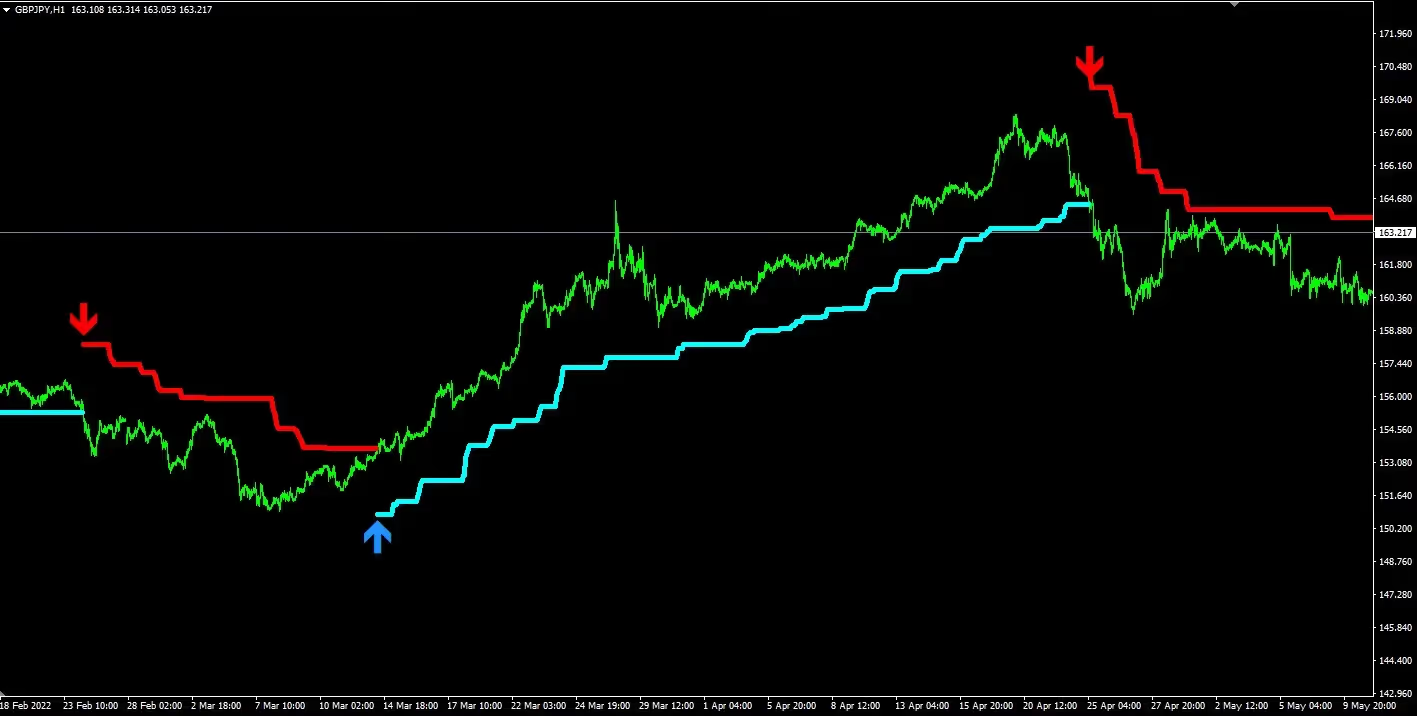
Trend indicators provide a steady way to read market direction, the time when to buy or sell, and make risk-adjusted decisions across different timeframes. While they aren't a magic solution, when used correctly, they help cut through the noise, clarify momentum, and make trading decisions repeatable even in stressful situations.
According to Radex Markets in 2023, over 70% of traders use trend indicators to improve their trading strategies. For those looking to enhance their trading experience, consider exploring our funded trading program to aid your strategy development.
1. How do they help identify market direction and condition?
You get a clear view of whether the market is drifting, trending, or staying within a range; this understanding significantly affects position sizing and trade decisions. Moving averages and trend filters turn price changes into directional signals. As a result, you can view price movements as either confirmations or warnings, rather than random noise.
This difference is significant when momentum shifts are slight. During long trends, you can take advantage of trend-following setups, while flattened trend lines indicate a need to switch to mean-reversion strategies or shorter timeframes. This pattern is often seen in both retail trading desks and institutional flows during global events. Quick policy changes or yuan fluctuations can cause unpredictable sessions that upset simple timing ideas.
2. How do indicators generate entry and exit cues you can trust?
Good trend tools provide objective triggers rather than relying on gut feelings. They provide rules for entries, stops, and profit targets that you can test. Oscillators, such as RSI, indicate overbought and oversold extremes relative to the underlying trend.
Moving average crossovers or trendline breaks give you clearer, time-tested entry signals. When you turn those signals into written rules, you remove hesitation. This reduces the risk of entering late or exiting too early, helping consistent advantages translate into reliable performance.
Despite the benefits, many teams revert to manual signal spotting because it's familiar and they lack new systems. This approach can work for a short time, but as markets become noisier and more connected, manual checks risk compromising decision quality. This can lead to false trades and longer review times.
Platforms like AquaFunded aggregate indicator outputs, reducing signal noise through statistical smoothing. This change gives you consistent, auditable signals. It allows teams to move from relying on personal instincts to making measurable, repeatable trade decisions.
3. How do trend indicators reduce downside and manage risk?
Indicators serve as a second set of eyes, often spotting market changes before a sudden price drop. Volatility bands and trend filters help you adjust stop widths, avoid chasing breakouts during confusion, and identify when market liquidity is weak.
This way of reducing risk is practical: by treating an indicator cross or band squeeze as a special condition, you can skip low-probability setups and reduce your position size when the market signal is weak, keeping losses smaller and recovery easier.
For those interested in further enhancing their strategies, consider our funded trading program for expert guidance.
4. How do indicators improve the edge and the bottom line?
How do indicators improve your advantage and profits? When you use indicator signals as clear rules and mix them with position sizing, your success rate and trade expectation improve. Research shows that trend indicators can increase trading accuracy by up to 30%. This increase is not just a number; it reflects fewer mistakes, more explicit exit rules, and stronger long-term gains. Use indicators to create a framework for your strategy, then test that framework under different market conditions so small gains in accuracy translate into consistent profits.
What many people overlook is this: indicators are tools for decision quality, not for guaranteed outcomes, and their actual value is evident when markets react to careless actions; that is precisely when clear signals are most important.
What are the practical tradeoffs of using indicators?
That solution sounds promising, but the next step reveals the real trade-offs and habits that determine whether these tools are helpful or harmful.
Related Reading
- Pros and Cons of Forex Trading
- Is Forex Trading Profitable
- How Many Forex Trading Days in a Year
- Forex Secrets
- How to Trade Forex With $100
- Day Trading vs Forex
- Forex Tax Rate
- Is Forex Closed on Christmas
- How to Use ADX Indicator for Day Trading
- Best Time Frame to Trade Forex for Beginners
- Is Forex Trading Hard
- Risk Management in Forex Trading
- Scalp Trading Forex
- Forex Trading Account Types
How to Use Forex Trend Indicators

Trend indicators should guide a pre-trade checklist. First, determine the market's primary direction. Next, check for any change in market bias and find a strict entry trigger. Turn that trigger into a strategy rule.
Each indicator should have a single, clear purpose and align with the price structure. This method ensures that signals are accompanied by context rather than confusion. If you're interested in maximizing your trading potential, consider looking into our funded trading program.
1. How do you set trend direction reliably for the trading session?
Begin by selecting one timeframe as your directional anchor and a second, shorter timeframe for entries.
Choose a smoothing length that matches market volatility; for example, use a longer moving average on the daily chart and a shorter exponential moving average on the 1-hour chart.
Both timeframes must align before you start trading. During a three-month study with a group of FX traders, a clear pattern emerged: aligning two timeframes significantly reduced false starts.
This method lessened the effects of small spikes that could distort the directional readout.
It's essential to record the anchor timeframe, the smoothing parameter, and the specific rule that defines 'in trend.' This will help remove guesswork when the markets get noisy.
2. How can you detect a fundamental shift in trend without chasing noise?
Treat a trend change as a regime event, not just a single crossover.
Use at least two confirming conditions; for example, a moving average cross plus a break of a structurally important swing low or high.
Additionally, there is a requirement for volume or volatility to support the move. Implement a timeout rule: if the confirming conditions do not persist for N bars, ignore the signal.
This approach reduces whipsaws and encourages trading only when conviction exists, rather than reacting to a transient spike.
3. Where should you look for objective entry signals?
Translate indicator behavior into binary, testable rules. For example, a price closing above the trend filter, an oscillator leaving an extreme zone, or a volatility band compressing and then expanding are key signals.
Define exact stop placement tied to structural levels—size positions based on the distance to that stop instead of making a percentage guess.
When discretionary entries were turned into clear written rules, execution became faster and easier to review.
Traders also stopped blaming issues on 'lag' when the real problems were inconsistent sizing and unclear stops.
4. How do trend indicators function inside a complete trading plan?
Assign each indicator a single job: trend direction, volatility filter, entry trigger, or exit signal. Chain them together with conditional logic so the trade engine stops when any needed condition is not met.
Backtest these chains under different market conditions and record slippage; this helps distinguish between a strategy failure and execution issues. Track three essential performance indicators (KPIs) for each set of rules: entry hit rate, average reward to risk, and realized slippage.
These metrics indicate whether an indicator supports decision-making or simply produces more visually appealing charts. If you're considering a funded trading program, it can provide the support and resources you need to enhance your trading strategies.
5. How do you manage the smoothing versus delay tradeoff practically?
To manage the balance between smoothing and delay, connect smoothing to your goal. Longer averages produce cleaner trends but provide slower signals, while shorter smoothing allows faster responses but can lead to more false alarms.
Use adaptive filters when market conditions change frequently; for instance, use volatility-adjusted lookbacks that shorten when Average True Range (ATR) is high and lengthen when the market is calmer.
Also, set up a 'grace period' rule to avoid quick trade reversals when a smoother indicator changes. This method helps to confirm the price before making changes to exposure.
What practical habits make trend indicators usable?
- Clean charts that limit overlays to two helpful tools, with each tool clearly explained. Many traders feel overwhelmed by too many indicators; this can be reduced by ensuring that each added tool answers one question in the trade plan.
- Backtest rules using out-of-sample periods and do walk-forward checks. After that, run a small live simulation for at least 30 trades before thinking about scaling.
- Keep a trade journal that records the indicator state, price structure, and execution details for every trade. Regular weekly reviews can help spot pattern failures.
What are the challenges with manual signal handling?
Most teams handle signals manually because they know how to do it, and it doesn't require new systems. While this way can work at first, it can cause problems as signal volume grows. Decisions are often split, which delays reviews.
Platforms like funded trading programs aggregate indicator outputs, automate checks for specific conditions, and maintain a log of every time a rule is triggered. This method reduces review time and ensures consistent execution as the trading plan grows.
What evidence and tradeoffs should you bear in mind?
- Trend indicators can improve trading accuracy by up to 30% — Radex Markets. This finding shows higher hit rates when indicators are used as clear rules rather than as ambiguous signals.
- Using trend indicators can reduce trading risk by 20% — Radex Markets shows the risk reduction you can achieve when indicators are combined with strict stops and position sizing.
How can you ensure indicators don't become outdated?
It’s tiring when indicators feel old news or signal too late. The answer is to connect them to specific rules, test them repeatedly, and only trade when all the rules align.
What options do you have for funded trading?
Turn your trading skills into substantial profits without risking your own money. AquaFunded gives you access to accounts up to $400K. They provide the most flexible trading conditions in the industry through a funded trading program that fits different styles and experience levels.
Join over 42,000 traders around the world who have already earned more than $2.9 million in rewards. A 48-hour payment guarantee backs all of this.
What limitations do testing reveal?
That solution seems solid until it is tested in fundamental markets. At that point, a single limiter can appear that changes everything.
8 Best Forex Trend Indicators

Choose tools designed for a specific job, and then demonstrate their value by using clear rules and context.
Below are eight useful trend tools, each described with what it shows, how to use it effectively, and the exact trade-offs you should expect.
1. What is AquaFunded?
AquaFunded allows traders to access funded accounts of up to $400K. This helps them turn their skills into real profits without using their own money. It offers instant funding or challenge-based options, with no strict time limits and reasonable success targets.
Traders can also enjoy profit splits of up to 100 percent. AquaFunded has paid out more than $2.9 million to over 42,000 traders and guarantees payments within 48 hours. Using AquaFunded is excellent for providing a live edge at scale because trading at real sizes according to the program rules shows execution friction and psychological costs that you can't see in a demo setting.
2. How do moving averages work?
Moving Averages (SMA, EMA): Why it matters: Moving averages help reduce price noise and show the market’s bias over different timeframes. How each behaves: Simple moving averages (SMA) average older data and smooth out the long-term trend; they are slower but provide a cleaner context. In contrast, exponential moving averages (EMAs) give greater weight to recent prices, allowing them to pick up shifts sooner, but this can lead to more false signals.
Practical rule: Pick one moving average as your main guide on a higher timeframe and a faster one for making entries on a lower timeframe. Adjust lookbacks based on market volatility, and track the exact time a crossover counts as confirmation to avoid second-guessing your chart. Moving averages are used everywhere for a reason. Research from Trading Critique reports that over 70% of forex traders use moving averages as a key trend indicator, so your edge lies not in the tool itself but in how you use it.
3. What does MACD provide?
MACD (Moving Average Convergence Divergence) provides a compact view of trend and momentum through two lines and a histogram that shows directional pressure. To use it effectively, treat the MACD crossover as a momentum confirmation after you have already checked your trend filter to decide on the trade.
Monitor histogram expansion for signs of acceleration, and watch for divergences, which serve as early warnings that the current trend may lose strength. It is important to remember not to use MACD alone; it is a timing filter, not a trend judge.
4. What insights does ADX offer?
What to expect: ADX measures the strength of a trend, not if it is going up or down.
When to use it: Set a limit for ADX to avoid jumping into trades in weak conditions. Decrease your position size when ADX falls; trend-following signals can get worse quickly when prices are stuck in a range.
The real benefit is controlling entries, which helps you turn confusing signals into higher-probability trades.
5. Why is RSI essential for traders?
Why traders keep it: The RSI is a momentum oscillator that indicates whether a move is strong and helps identify divergence patterns before price changes.
How to use it practically: Use a midline rule to confirm your view. Only see extremes as possible exhaustion zones when they match with structural levels. Use short RSI crossbacks for better exits.
When traders say indicators seem unnecessary compared to price action, it's usually because they used RSI as a standalone trigger rather than a confirming signal.
6. How do Bollinger Bands function?
Bollinger Bands consist of a moving average and volatility bands. They help us see both compression and directional bias simultaneously. When trading with them, look for bandwidth compression as a signal that a price move in a specific direction might happen.
If the price is approaching the upper band, it suggests ongoing bullish pressure. Use the bands to determine stop widths that account for current volatility, rather than relying on a random pip count.
7. What are the benefits of Parabolic SAR?
Why it is useful: It shows clear, visual dots that shift position, making trailing stops easy to see.
Best practice: Use Parabolic SAR for mechanical trailing stops when trends are strong.
However, don't rely solely on it to decide when to enter, as its sensitivity varies significantly with the settings you choose. In choppy markets, it can cause many false flips.
8. Why are trendlines important?
Trendlines are the simplest way to show price structure. They are drawn by connecting the lowest points in price rises or the highest points in price drops. They are essential references for traders.
Here’s how to use them: Trendline breaks can give early signals of a new trend, but it’s necessary to wait for confirmation.
This can include a retest or a period of high trading volume before increasing your investment. Trendlines are most effective when used with moving averages and momentum tools. This combination gives you a better understanding, which indicators on their own do not provide.
How can teams improve trading execution?
Most teams manage signals by piling indicators on charts because this approach feels thorough and requires no new workflow. However, this method can lead to problems as the number of signals and execution issues may hurt trading advantages.
Over time, too many overlapping signals weaken decision quality, trailing stops become inconsistent, and review cycles drag on, leading to analysis paralysis.
Solutions such as the funded trading program centralize indicator outputs, apply statistical smoothing to reduce duplicate triggers, and provide signal logs for review. This allows teams to move from noisy guesses to repeatable rule-based trades.
What should you remember about using indicators?
This collection is not exhaustive, but each tool works best when assigned one clear job and paired with a price structure and a written rule set.
They should be combined sparingly, backtested with specific condition chains, and their execution details logged for at least 30 live trades before scaling.
In practice, this is how you turn indicators from mere chart decoration into measurable process improvements.
Small gains add up when discipline is enforced, and noise is removed.
Research from Radex Markets found that trend indicators can improve trading accuracy by up to 30%. Still, this benefit is realized only when signals are translated into strict entry and stop rules.
How to maintain clarity amidst complexity?
It can be exhausting when the chart becomes crowded, leaving one unsure. This is precisely why disciplined selection, clear roles, and consistent record-keeping are essential for long-term success.
What does the next indicator choice reveal?
That fix sounds neat. But the next choice about which indicator to trust will show if the process has truly improved or just changed the noise.
Related Reading
- Forex Algo Trading
- Types of Forex Trading
- Forex Trading Spreads
- Forex Market Liquidity
- Forex Mini Account
- Forex Price Action Trading
- Forex Hedging Strategies
- Advanced Forex Trading
- Best Forex Pairs for Scalping
- London Session Forex Pairs
- Best Currency Pairs to Trade for Beginners
- Minor Currency Pairs
- Best Time to Trade USDJPY
- Forex Swing Trading Signals
How to Choose a Forex Trend Indicator

Choose indicators that match your trading style, the market conditions you face, and the tools available on your platform. It's essential to test their effectiveness on a demo account before using real money.
Concentrate on a small group of helpful indicators, give specific jobs to each one, and create clear rules that can handle pressure and slippage.
1. What trading style should my indicators match?
Match indicator speed and smoothing to your timeframe and execution plan. If you are scalping, use fast oscillators and short lookbacks for quick readings. If you are swinging, choose medium-term filters and reversal tools that respect the structure over several days. For positions held for months, lean toward long moving averages and macro signals.
Specify exact parameters from the start; for example, a 9-period RSI for trades under an hour versus a 21- or 50-period EMA for multi-day trends. Record those numbers in your trading plan to ensure your decisions remain mechanical when the market is busy.
2. Which market condition should change my toolkit?
Decide in advance how to switch toolsets between trending and range periods. When momentum is strong, prefer trend-following overlays and momentum confirmations. In contrast, when the market moves sideways, switch to oscillators and structural retracement levels that identify mean reversion.
Building a simple regime gate, such as an ATR or ADX threshold, can automatically activate trend tools. This helps to eliminate guesswork when price behavior changes.
3. How do I combine indicators without cluttering the chart?
Assign each indicator a clear job and limit how often they repeat the same function. Use a stack of three roles: trend filter, momentum confirm, and volatility or structure validator. Keep the stack to three or fewer elements, and prioritize signal strength over requiring every indicator to agree.
For swing setups, include price structure and specific levels. Many traders rely on retracement tools; in fact, 60% of traders use Fibonacci retracement levels to identify potential reversal points, according to the XS Blog.
When stacking, use conditional logic: trade only if the trend filter shows a bias, the momentum indicator supports the direction, and the volatility tool does not indicate a squeeze that would invalidate your stop.
4. How should I tune the parameters to reflect real-world volatility?
Tune lookbacks based on realized volatility rather than calendar time. A practical method is to set the moving average length or oscillator smoothing using the Average True Range (ATR). For example, you can calculate the length like this: length = round(baseLength (currentATR / longTermATR)). This method helps keep sensitivity during both quiet and stormy* market times.
It's also essential to test parameter strength using walk-forward windows rather than relying on a single in-sample fit.
If minor changes to the lookback period remove the edge, the setting is considered overfit and should be rejected.
5. Do my platform and data feed limit what I can do?
It's essential to check whether your platform offers custom scripting, backtesting libraries, tick-level data, or only minute bars. Consider alerting latency as well, because execution issues can disrupt otherwise clear signals.
Make sure to confirm these capabilities before committing: features such as real-time alert webhooks, built-in walk-forward testing, and the option to export raw indicator values for offline analysis are valuable extras. These features help to shorten the iteration cycle.
6. How deeply should I test on a demo before going live?
Treat the demo like a clinical trial. Run at least 30 to 50 statistically independent trades across different levels of market volatility. Simulate realistic slippage and execution costs, and track key metrics such as hit rate, average reward-to-risk, and realized slippage for each timeframe.
It’s essential to include a loss-cooldown rule in your plan; for example, you should take a mandatory pause after two consecutive stop-outs. Emotional erosion can turn minor setbacks into revenge trading, which is a common problem for beginners. This can quickly destroy your trading advantage.
7. What standard failure modes must I watch for?
Expect four common problems: indicator overfitting to a specific situation, hidden correlations between tools that lead to false confirmations, delayed signals that miss the best entry times, and platform latency that turns a sound signal into a bad trade.
Define automatic checks for each problem, such as rolling out-of-sample testing, correlation matrices of indicator outputs, entry slippage logging, and latency thresholds that trigger a fail-safe.
8. Why keep the system auditable and rule-driven?
It is essential to have signals that perform well under pressure, rather than stories that seem believable only after something happens. Every indicator decision should be clear-cut and time-stamped, with the pre-trade indicator state recorded.
Each rule must be held to objective KPIs during review. This discipline assesses whether an indicator actually improves decision quality or merely makes the chart look better.
How can I avoid piling on indicators?
Most teams handle indicator selection by adding multiple tools to a chart because it feels thorough and requires no new workflow. This familiar approach may work at first, but as the number of signals increases, it can generate conflicting alerts and lengthen review times.
Platforms like AquaFunded centralize indicator outputs, apply statistical smoothing to reduce redundant alerts, and provide audit logs. As a result, teams can transform chart clutter into a reproducible signal pipeline.
What should I focus on during practice?
A successful trading strategy relies on several key components: pattern checks, trade rules, and platform capability. The final piece is practice. It is essential to run parameter sensitivity checks and to test your rules under simulated slippage. Maintain a concise trade log focused on indicator states rather than justifications to ensure feedback is prompt and honest.
Why do constraints show up when scaling capital?
This improvement may seem important, but as soon as a company tries to increase its capital, the real constraints become apparent.
Join Our Funded Trading Program Today - Trade with our Capital and Keep up to 100% of the Profit.
Traders often adjust moving averages, trend filters, and momentum rules, and then test these strategies using backtesting. However, they typically notice that demo gains decline when they encounter slippage, fills, and real-time volatility in live markets. AquaFunded lets you check entry signals without risking your capital.
We provide funded accounts up to $400K, instant funding or customizable challenge paths, no time limits, easy profit targets, an up to 100% profit split, and a 48-hour payment guarantee. This is all supported by more than 42,000 traders who have earned over $2.9 million. If you want to switch to more precise trend detection and careful signal validation for profits and losses, you can scale by trading with AquaFunded and keep up to 100% of your earnings.
Related Reading
- Best Forex Pairs to Trade During Asian Session
- Best Forex Funded Account
- Top Prop Firms
- Best Prop Firm
- Forex Prop Firms
- Best Forex Pairs to Trade During New York Session
- Best Forex Trading Platform
- Forex Trading for Beginners
- Forex Trading Hours
- Forex Trading Brokers
- Forex Trading Course
- What Is Forex Trading and How Does It Work
- Forex Currency Trading
- Forex Online Trading
- How Does Forex Trading Work
- Online Forex Trading
