




Is Forex Trading Hard + Tips for Forex Trading
Is Forex Trading Hard? Get 10 actionable tips to manage risk, build discipline, and shift from demo to live trading with AquaFunded’s funded program.
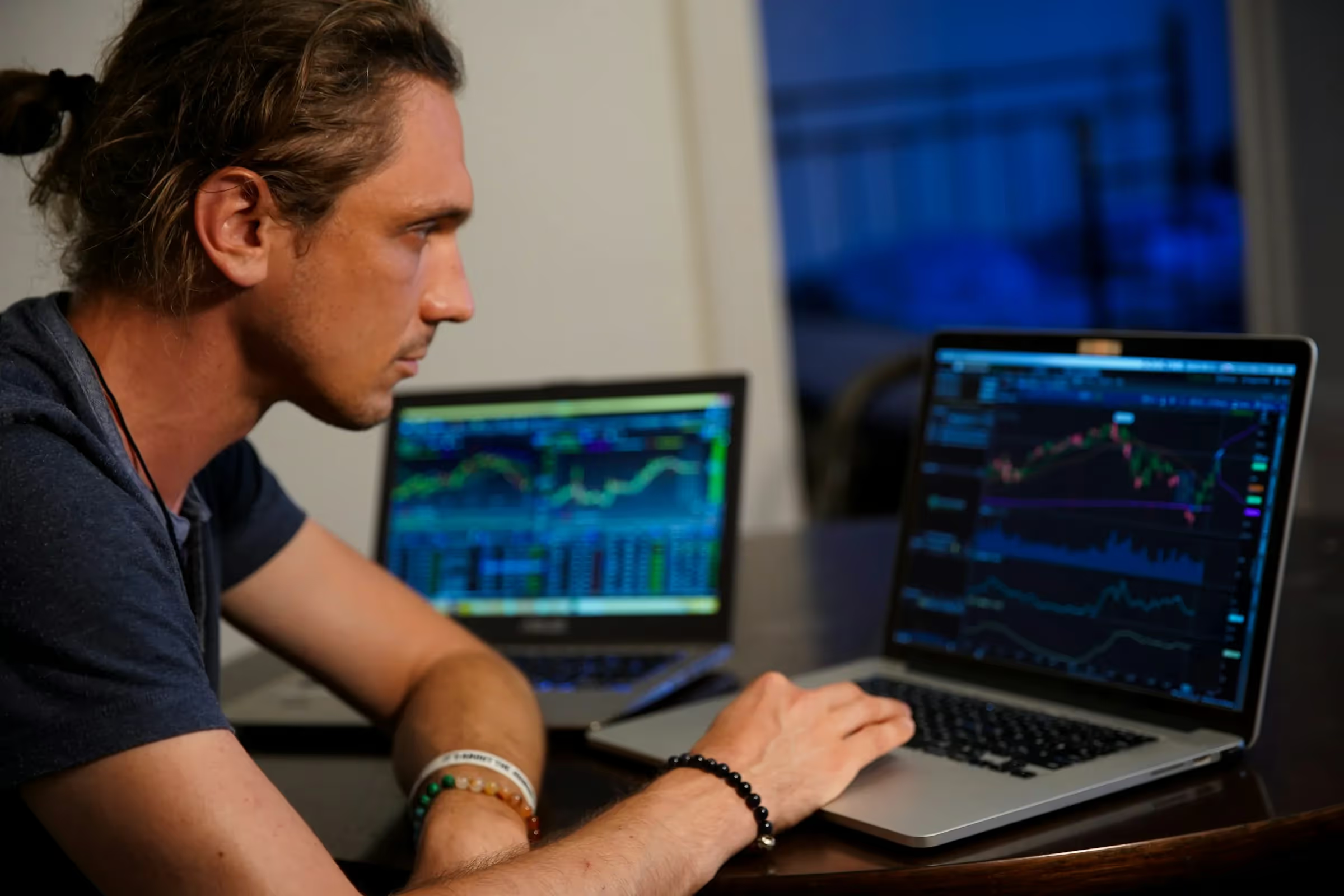
Observing a friend convert demo wins into real cash raises a natural question: Is Forex trading hard? While Forex trading success stories can inspire rapid expectations, real trading demands a well-tested strategy, sound risk management, and the discipline to overcome volatile market conditions. These challenges highlight the importance of realistic planning and readiness for extended trading hours.
Efforts to master these skills can often seem daunting, but steady progress is achievable through disciplined practice and clear benchmarks. Real capital, defined trading guidelines, and targeted feedback can provide a supportive framework for growth, as demonstrated by AquaFunded’s funded trading program that helps traders build consistency without risking personal savings.
Summary
- Forex trading is hard in practice because human psychology and market structure punish shortcuts; 90% of Forex traders lose money, according to DailyForex, suggesting that access alone does not guarantee consistent profitability.
- Demo accounts create a false sense of readiness, since simulated wins remove slippage and emotional pressure. The article recommends a staged demo regimen of at least 3 months and 50+ real-time trades before moving to live capital.
- Deliberate practice matters: a 2023 study found that about 1000 hours of practice are needed to reach proficiency, underscoring why surface-level learning and quick hacks rarely yield a reliable edge.
- Risk management is crucial, with guidance that successful traders risk less than 2% of capital per trade and enforce per-trade caps, along with daily or weekly drawdown limits, to prevent minor setbacks from becoming account-ending losses.
- Forex offers structural advantages such as 24 hours a day, 5 days a week access and deep liquidity across eight core currencies. Yet those same features create execution variance, spread widening, and tail risk during significant events, which can erode small edges.
- Behavioral breakdowns drive most failures, with impatience and overtrading often appearing within a month or two after simulator wins, so strict checklists, time-based practice plans, and thresholds like 100 logged trades help align live behavior with practiced rules.
- This is where AquaFunded's funded trading program fits in, addressing these challenges by providing real capital, clear rules, and staged exposure so traders can test processes under consistent live conditions without risking personal savings.
Is Forex Trading Hard

Forex trading is hard in practice because the market punishes shortcuts, not talent. You can learn indicators and read books, but without disciplined time, emotional control, and a framework for why price moves, you will struggle to turn practice into consistent profits. The difficulty comes from a mix of human psychology, market forces, and simply not being prepared enough. If you're looking for support, our funded trading program offers resources that can help you navigate these challenges effectively.
1. What causes traders to be impatient?
Impatience and the rush to profits. Most retail traders think they can learn everything in just a few weekends. This rush to “make money now” leads to quick decisions, taking on too much risk, and revenge trading when they face losses. This pattern often occurs with beginners and part-time traders, usually appearing within a month or two after they have small wins in a simulator, when confidence exceeds capability.
2. How does marketing mislead traders?
False marketing and unrealistic promises create confusion among traders. Free tutorials and flashy success videos tell a story where forex leads to fast riches. This story changes what traders focus on: instead of thinking about the real advantages and risks, they chase setups that look good in videos.
The result is often emotional overreach; traders might act to prove the ads right rather than keep their money safe. It's important to understand that our funded trading program can provide guidance and support to navigate these challenges effectively.
3. Why is practice so important?
Not investing enough time in practice and skill can hold back your ability. To get good at trading, you need structured hours, not just quick tricks. This is why many traders never find a consistent advantage.
Research shows that forex trading requires a minimum of 1000 hours of practice to become proficient, as noted in the Trading Skills Study. This 2023 finding emphasizes why shallow learning often does not work. Traders must have repeated exposure to different setups, losses, and market details before their actions and decision-making rules become firm.
4. What are the risks of demo accounts?
Demo accounts create a false sense of readiness. Most brokers let traders practice without risking real money, which can be helpful. However, simulation wins often do not predict how someone will perform in real trading. Using a demo account means you don't use real money.
Because of this, starting with a funded account can feel like jumping into a cold ocean after practicing in a bathtub. Traders who move from demo to live accounts after a short time often find that their rules fail under pressure.
5. Why are indicators not enough?
Many beginners make the mistake of relying too much on indicators and rule-of-thumb systems. They often think that just mastering moving averages or an RSI strategy will make them successful traders. In fact, indicators are tools that help us understand market behavior, but they do not guarantee results. They can lose effectiveness when market leaders change their strategies or when major events make technical signals noisy.
Because of this, systems that do not consider the full context may fail, especially during changes in liquidity or sudden increases in volatility.
6. How do institutions influence markets?
Big institutions and broader economic forces influence markets. If prices reacted only to basic buy-and-sell signals, trading would be easy. However, large banks, hedge funds, and central banks handle vast amounts of money that can overshadow retail trading. It is crucial to assess economic health, fiscal signals, and central banks' expected moves. Ignoring these factors means you will be trading small signals against much bigger forces.
7. How do emotions affect trading?
Emotional reactions to real money and possible earnings can significantly affect trading behavior. When real money is involved, psychology changes; fear, regret, and the urge to “make it back” can cloud judgment. Traders who find it hard to handle losses often set tighter stops, sell winning trades too soon, and invest more in losing positions. This emotional shift shows the single most enormous behavioral gap between success in demo accounts and failure in real trading.
8. What separates successful traders from others?
Weak risk management and poor position-sizing habits can significantly hurt trading success. Good setups might fail sometimes. What really makes winners different from others is how they size risk and handle losses.
Many retail traders either risk too much on individual trades or don’t have clear rules for when to accept being wrong. This often turns minor setbacks into catastrophic drawdowns.
9. What mistakes do traders make?
The hidden cost of thinking speed equals skill. People often mix up being busy with making progress. Doing more trades, using more indicators, and watching more markets will give better results.
But without a clear advantage and a good review process, that busyness is just noise. The real work is in improving a few key rules, tracking results, and stopping actions that don't work well.
10. How can traders improve their performance?
The standard failure mode is behavior, not knowledge. Traders know the correct answers but often fail to implement them under stress. A practical fix is to create a strict, time-based practice plan. Start small with live capital while following tight risk rules.
Keeping a trading journal focused on decisions and emotions can help in this process. Over months, this discipline helps reduce impulsive choices and aligns behavior with the edge one has practiced.
What challenges do new traders face?
Many new traders follow a familiar status quo pattern, relying on scattered video lessons and demo sessions. While this approach is suitable for learning the basics, it often breaks down once volatility and real-money stress start. In these situations, rules that worked in theory tend to fail, decision-making gets worse, and missing context can remove small edges.
Solutions like structured funded trading programs and coached practice paths have several advantages: staged exposure, objective performance metrics, and controlled scaling. These features help traders turn their simulated skills into live consistency without using up their capital.
What is the analogy for new traders?
A short, honest analogy is this: trading live after a brief demo is like driving cross-country after only passing a parking lot test. The vehicle may act the same, but everything else becomes much harder.
What is the next challenge for traders?
This simple truth is only half the story. The following information shows the trade-offs that traders have not yet faced.
Pros and Cons of Forex Trading

Forex trading has clear strengths and some noticeable downsides. Traders can trade at low costs and at any time. However, the market’s openness and leverage significantly increase both opportunity and risk. Below are the benefits and drawbacks, presented with practical details so you can compare them to your goals.
If you're considering a more structured approach, our funded trading program can help you manage risks effectively.
1. How much will trading cost you?
Low transaction costs and narrow spreads are common in FX. Most brokers make money from the bid/ask gap rather than fixed commissions. This setup allows for frequent, small-sized strategies to work well.
Micro-lots let traders adjust their exposure accurately. Traders can expect to pay lower fees per trade than with regular equity brokers. However, they should consider how spreads can change, especially during important news events.
2. Why can you trade almost any time?
The market’s continuous access is an absolute convenience: DailyForex states that "The Forex market is open 24 hours a day, 5 days a week." This information from 2020 helps explain why you can respond to events from Tokyo to New York without waiting for an exchange to open. This is great for side gigs, shift workers, and short-term strategies.
3. What makes execution reliable at scale?
FX is the deepest liquid market available for most retail players. This means that large orders can fill with far less price impact than they would in many small-cap stocks. Such liquidity reduces the chance of execution distortion when managing position sizes carefully. Additionally, it allows for tighter intraday ranges for strategies like high-frequency trading or scalping.
4. How does the market structure benefit retail traders?
The market structure provides significant benefits for retail traders. Because FX is over-the-counter and global, traders can access multiple liquidity pools and price feeds rather than relying on a single centralized exchange. This environment encourages competitive pricing among brokers and platforms. It also offers a wide variety of execution choices, from ECN routing to straight-through processing.
5. Where do quick profit opportunities come from?
Major currency pairs can change quickly due to macro updates, leading to strong moves that active traders can take advantage of in short time frames. These changes, combined with clear rules and quick execution, provide asymmetric reward opportunities compared to many slower assets.
6. What variety can you trade?
You can choose from majors, minors, and crosses across eight main currencies, plus exotic pairs if you want to take on more risk. This choice allows traders to create hedged portfolios, use carry strategies, or switch to pairs that better align with their time zone and risk appetite.
7. How little capital do you need to start?
Micro-lots and margin let traders start with modest capital while keeping tight control on their positions.
For those who want to grow their trading strategy slowly, this means they can begin with a low risk per trade and increase their exposure as their method shows success, rather than putting in a large amount right away.
8. What tools are available to help you?
There are many technical indicators, automated platforms, and data feeds for FX, as well as backtesting environments that simulate real execution. This variety of tools helps both discretionary traders and systematic strategies. Traders can improve their edge and clearly measure their performance.
9. Where do costs and opacity bite back?
Not all brokers quote the same prices or execute trades in the same way. Factors like order routing, internalization, and different liquidity providers can cause the final fill you receive to differ significantly from the quoted prices. This opacity creates an implementation gap between a strategy’s theoretical returns and the actual returns that appear in your account.
10. How Complicated Are Price Drivers?
Currency rates react to a mix of central bank policy, trade flows, cross-market hedging, and global news. These many influences can quickly change how the market behaves, making simple models weak when the patterns of money flow change.
11. What are the less obvious financial frictions?
Beyond spreads, there are overnight financing costs, swap charges, and occasional margin interest, all of which eat away at small edges. When trading often, these ongoing costs can change a setup that looks profitable into either a small win or a loss.
12. How does regulation affect your trading?
Regulatory regimes differ across areas, which changes the leverage, protections, and options you have when resolving issues. This means that two brokers might have similar interfaces, but they can offer very different legal protections and ways to fix the problems if something goes wrong.
13. Why can execution fail at the worst times?
When there are sudden withdrawals of funds, spreads widen, and slippage worsens, especially for pairs traded less or during significant events. This can create tail risk because execution and stop orders might not work the same way they do during regular trading hours.
These moments often decide the results for real accounts.
14. Is FX the right choice for a long-term buy-and-hold plan?
Currencies do not pay dividends. Holding leveraged FX positions also comes with financing costs and rollover exposures. For long-term investors looking for yield, other asset classes might be a better choice.
15. How does information overload harm new traders?
There is a flood of conflicting strategies, free indicators, and promotional content that makes learning confusing. This creates a discovery problem: traders spend more time testing different systems than working on a single reliable method, which slows the development of real skill.
Status quo disruption?
Status quo disruption occurs when most retail traders open accounts with low friction, treating capital access as the final hurdle. This approach may seem practical at first; however, it carries a hidden cost: translation failure.
Execution variance, recurring fees, and unclear scaling rules can significantly erode any potential edge. Platforms like the funded trading program provide predictable funding pathways and standardized conditions, which significantly reduce execution and scaling friction. This allows traders to focus on refining their edge rather than dealing with infrastructure differences.
A blunt reality check?
A blunt reality check: DailyForex reports that "90% of Forex traders lose money." This figure from 2020 shows that just having access and a good market structure does not guarantee success.
To make consistent profits, you need careful implementation, cost control, and effective process design.
How to turn your trading skills into substantial profits?
Turn your trading skills into big profits without risking your own money. AquaFunded gives you access to accounts up to $400K with the most flexible trading conditions in the industry through a funded trading program. This program has no time limits, easy-to-achieve profit goals, and up to a 100% profit split. Start trading today with instant funding options or show your skills through customizable challenge paths and keep up to 100% of what you earn.
What oversight do most traders never correct?
This advantage may sound appealing, but it becomes concerning when we consider the single oversight most traders fail to address.
Related Reading
- Pros and Cons of Forex Trading
- Is Forex Trading Profitable
- How Many Forex Trading Days in a Year
- Forex Secrets
- How to Trade Forex With $100
- Day Trading vs Forex
- Forex Tax Rate
- Is Forex Closed on Christmas
- How to Use ADX Indicator for Day Trading
- Best Time Frame to Trade Forex for Beginners
- Risk Management in Forex Trading
- Scalp Trading Forex
10 Forex Trading Tips for Beginners
You can learn forex in a controlled and careful way. This can help you avoid many early mistakes if you treat trading like a skill: practice on purpose, limit risk, and keep track of your progress with clear goals.
Below, I share ten practical steps that guide you from practice to funded accounts while focusing on behavior, metrics, and routines.
1. Use AquaFunded
How should you handle funded programs when you're just starting? Mentioning AquaFunded acknowledges a common way to grow without risking your own money. Use it wisely: think of a funded account as money for stages, not as unrestricted cash. Write a clear plan for scaling before you pass any challenge.
For example, trade one micro-lot and keep a log of 30 trades with your entry plan, stop, target, and feelings. Only increase your lot size after you've improved your 2:1 reward-to-drawdown ratio across 100 logged trades. This shifts your thinking from win now to proving the process and helps you avoid the common mistake of increasing size impulsively during a winning streak.
2. Know the markets
What should you learn first about how currencies behave? Focus on one major pair for 60 to 90 days and track how it reacts to six repeating events, like central bank rate decisions, payroll reports, and regional holidays. Observe which trading sessions have the smallest spreads and which have significant price jumps, and note the usual time-of-day price ranges. Focusing on one pair minimizes distractions and helps you understand how liquidity and big events affect prices.
This way, you learn the context before introducing more complexity.
3. Make a plan and stick to it
What should you include in a good trading plan? Clearly state your goals in measurable terms: target monthly percentage, maximum monthly loss, risk per trade, allowed instruments, and a rule for when to stop trading after losing streaks. Add a decision checklist: does the trade match your setup, have you checked the volatility, and is the stop logically placed?
Treat this checklist as a must-follow; when emotions are high, it keeps you focused and mechanical.
4. Practice
How can you train under real pressure without risking money? Create a staged demo routine with performance standards: run a demo for at least 3 months, meet a minimum number of real-time trades (e.g., 50 or more), and score your demo based on three metrics, such as average risk-reward, percentage of profitable trades, and maximum consecutive losses. Only move to a small live account when you meet your goals. This establishes a clear path from practice to live trading and avoids the false confidence that demo results alone can create.
5. What tools should you combine to forecast movements?
Forecast the 'weather conditions' of the market. Use a layered approach that includes macro checklists for upcoming events and order-flow cues, like large candlestick clusters. Also, add two complementary indicators on your chart, such as a volatility filter and a momentum confirmation. When these layers work together, the trading edge is clearer. When they disagree, consider the setup as low-probability and stand aside.
6. How much should you risk per trade and across an account?
Know your limits. Establish clear limits and automate them where possible. One key habit that separates patient traders from fast losers is that successful traders risk less than 2% of their capital per trade, as highlighted in 10 Forex Trading Tips for Beginners.
Use this as a maximum and convert it into dollar amounts for each account size. Combine a per-trade limit with a weekly loss stop that requires a full review if triggered. This method helps stop bad decisions from turning into harmful losing streaks.
7. What order types protect you without babysitting screens?
Know where to stop along the way. Use stop and limit orders regularly, and consider trailing stops on winning trades. This way, you can secure your profits as the price goes up.
When you place an order, make sure to write down why you picked that stop level based on how the market is doing, not based on your feelings. This habit helps you avoid the need to monitor your positions late at night closely and keeps the gains you worked hard for. Our funded trading program can also help you create strategies that minimize the need for constant screen time.
8. How do you neutralize revenge trading impulses?
Check your emotions at the door. Build a mandatory cooling rule: after any trade that hits your weekly loss trigger or a string of three losses, take at least 24 hours off and conduct a focused review of the journal entries tied to those trades.
After supervising new traders for six months, a consistent pattern emerged. Those who enforced cooling periods stopped doubling down on losses, and their recovery rate improved through behavioral measures, not luck.
9. What does consistency actually look like in practice?
Keep it slow and steady. Define micro-goals that will build up into long-term results: Aim to improve one measurable aspect each month, like average reward to risk, execution speed, or journal completeness.
Focus on incremental changes. Small, repeatable improvements outperform sporadic big wins because they lower variation and keep losses manageable.
10. When should you change your plan?
Don’t be afraid to explore. If a rule does not perform well relative to tracked benchmarks over 90 days or 200 trades, consider changing your approach. Use controlled experiments by changing only one thing at a time.
Test it back over 500 sample trades or the same amount in ticks, and keep a record of the results. This careful curiosity stops random-strategy sampling that wastes time and money.
Why Do Most Traders Manage Progression by Trial and Error?
Most traders manage their growth by trial and error because it's what they are used to and doesn't require extra planning. This way works until problems like inconsistency and scaling friction arise, which can break results and lower confidence. Platforms like AquaFunded offer structured growth paths, quick funding options, and clear conditions. Many traders think these features help track performance with consistent rules while also eliminating the challenge of finding larger amounts of money.
What is the reality check for beginners?
The reality check for beginners is clear. The numbers show this, and this truth should shape how you proceed. Research from 10 Forex Trading Tips for Beginners reports show that 90% of beginner traders lose money in the forex market.
What mistakes do beginners make in the face of stark reality?
That last point only scratches the surface. The mistakes that often follow show why numbers alone rarely tell the whole story.
Related Reading
- Forex Algo Trading
- Types of Forex Trading
- Forex Trading Spreads
- Forex Market Liquidity
- Forex Mini Account
- Forex Price Action Trading
- Forex Hedging Strategies
- Forex Trend Indicators
- Advanced Forex Trading
- Best Forex Pairs for Scalping
- London Session Forex Pairs
- Best Currency Pairs to Trade for Beginners
- Minor Currency Pairs
- Best Time to Trade USDJPY
- Forex Swing Trading Signals
Mistakes to Avoid in Forex Trading
Trading mistakes can be avoided when we see them as steps that can be measured and fixed. Below, each common mistake is turned into a rule that you can act on.
Each rule is paired with clear, specific solutions you can apply in just a few days, rather than waiting months.
1. What should a usable trading plan actually enforce?
Most plans are vague. Build one that reads like an operations manual. It should include a short mission statement, the exact instruments you trade, and a clear edge definition with entry conditions written as Boolean rules.
Include a precise method for stop and target placement, a position-sizing formula tied to volatility, and objective criteria for scaling or pausing.
Before any live trade, three operational gates should be required: (a) Does the setup meet the Boolean entry test? (b) Is the portfolio exposure under the session cap? (c) Does the trade still fit this week’s market regime tag?
Automate one gate where possible, such as using platform orders that reject sizes outside your preset limits. Treat the plan as code you can test, not a manifesto you hope to follow.
2. How do you stop overtrading before it costs you?
Overtrading is not a moral failure; it shows a problem with control systems. To fix this, limit your trades with complex rules: set a session quota, cap the number of open positions, and set a cap on the percentage of your equity that can be actively exposed. Also, use friction to help you by setting a programmable cool-down that prevents new orders for several hours after three losing trades.
Adding a small execution tax on discretionary trades, like routing through a different account with a small fee, can also work well. These frictions make the cost of mindless activity clear and help reduce impulsive trading.
3. Why single-order stop rules fail, and what to use instead?
A stop-loss is only effective when it is placed in relation to market structure and recent volatility.
It is a good idea to replace flat percent stops with a volatility-adjusted method, like an ATR multiple that matches the time frame of your setup.
Additionally, stops should be placed beyond the nearest market structure level. Using an account-level buffer can be helpful: when today's volatility is twice your average, position sizes should be reduced automatically, and stops widened proportionally. When needed, use guaranteed stop orders for events that are likely to have gap risk. Keeping track of slippage helps adjust stop spacing empirically.
4. How to cap losses so one bad day does not become an account crisis?
Individual trade stops save you from single mistakes, but you also need account-level circuit breakers. Set and enforce daily and weekly drawdown limits expressed in dollars and as a percentage of peak equity. Plus, have a rule that pauses trading for a fixed review period after the limit triggers. Hand enforcement to an accountability partner or a third-party tool so emotion cannot overrule the rule.
This shifts the decision from “I must recover now” to “I must analyze and fix,” helping keep your capital safe and your thinking clear. Remember that most retail capital gets erased not by a single trade but by repeatedly failing to stop trading into losses, a behavior pattern you can prevent with pre-committed brakes.
5. What Meaningful Education Looks Like After the Basics?
Meaningful education must lead to measurable behavior change. Create a syllabus that includes modules ending in graded, repeatable tasks: backtest a setup on a minimum sample of trade-like events, run a micro-live sequence with fixed risk and documented outcomes, and pass a coach-reviewed checklist before scaling. Incorporate cross-training in cognitive techniques, such as brief cognitive behavioral exercises to break revenge-trading loops.
Also, conduct regular calibration sessions in which expected outcomes are compared with actual outcomes. Education that ends with videos and watchlists leaves individuals untested; structured practice with checkpoints leads to significant improvement.
6. How to defeat analysis paralysis without becoming reckless?
The trick is constrained decision-making. Use a three-filter rule for every trade: structural context, confirmation signal, and liquidity/volatility check. Time-box the analysis window to a fixed length before the session, and keep a 'no new analysis' rule once price action has entered your trade band.
When signals are unclear, use a probabilistic threshold that you can measure and track. For example, only take setups that have an estimated edge above your baseline. By measuring how often you miss opportunities and the quality of trades you take over 90 days, you can adjust the threshold instead of just guessing.
7. What does a journal must do actually to improve results?
A journal is not a diary; it is like a notebook for experiments. Write down, in organized sections, the setup type, entry logic, stop and target rules, position size logic, pre-trade probability estimate, execution quality metrics, and emotion tags.
Think of the journal as data, using monthly analyses to find out the expectancy per setup, performance time-of-day heatmaps, and slippage-adjusted profit curves. Use what you discover to stop using setups that don't perform well and put more money into strategies with an intense, statistically backed expectancy.
How does routine affect forex trading performance?
Most traders stick to familiar routines. They spend more time on their screens, use more indicators, and increase their position sizes during a winning streak.
However, this method does not adapt well to changing market conditions. It can lead to inconsistent testing and random size changes, resulting in losses and frustration.
Platforms like funded trading programs offer traders clear rules and standardized conditions. This makes it easier to transition from practice trading to live trading. In these platforms, results are based on the process rather than luck or unpredictable issues with the trading setup.
What concrete habit can you try this week?
A concrete habit to try this week is to pick one checklist gate and automate it now. Measure how your impulse rate changes over the course of 14 trading days.
What is the key to learning from drawdowns?
The part that often goes unacknowledged is this: the choice made between enforcement and education determines whether the next drawdown means the end of someone's account or a lesson learned.
How does funding change everything?
What happens when you add funding, different rules, and real capital to the enforcement system?
This shift can significantly change everything a person thinks is necessary for future actions.
Join Our Funded Trading Program Today - Trade with our Capital and Keep up to 100% of the Profit
The trading journey can be a tough learning curve and can put a lot of emotional pressure on you. If you want to turn your trading skills into real payouts without risking your own money, consider AquaFunded. They give you access to accounts of up to $400K, with flexible rules and no time limits, easy profit targets, up to 100% profit split, instant funding, and customizable challenge paths.
This is all backed by a 48-hour payment guarantee. For those looking to grow with consistent rules, protect their bankroll, and keep what they earn, AquaFunded offers a funded path that fits your pace and rewards your discipline. Check out their funded trading program.
Related Reading
- Best Forex Pairs to Trade During Asian Session
- Best Forex Funded Account
- Top Prop Firms
- Best Prop Firm
- Forex Prop Firms
- Best Forex Pairs to Trade During New York Session
- Best Forex Trading Platform
- Forex Trading for Beginners
- Forex Trading Hours
- Forex Trading Brokers
- Forex Trading Course
- What Is Forex Trading and How Does It Work
- Forex Currency Trading
- Forex Online Trading
- How Does Forex Trading Work
- Online Forex Trading
