




9 Tips for Forex Price Action Trading
Forex Price Action Trading offers 9 clear tips for precise entries and risk control. See how AquaFunded’s funded program boosts real trading performance.

Price action trading reveals market moves that highlight trends, support levels, and reversal points. It simplifies spotting reliable entries and exits while managing risk effectively. Many Forex Trading Success Stories demonstrate the power of focusing on market structure and order flow cues.
Aqua Funded pairs real capital with straightforward rules and an evaluation framework that aligns with a price action approach. This method allows traders to build consistency through clear entry, exit, and momentum readings. The strategy supports growth and precision with Aqua Funded's funded trading program.
Summary
- Price action trading cuts analysis time and noise. Dukascopy found that it reduces analysis time by 50% compared with indicator-based strategies, which explains why traders can enter nearer structural levels and tighten stops.
- Over 70% of traders use price action as a primary decision tool, a widespread adoption that signals that raw price readings are seen as more reliable than layered indicator systems.
- Sharpening entry rules measurably improves accuracy, with Quantified Strategies reporting a 15% increase in trading accuracy when price action methods and numeric filters are applied.
- Risk rule breakdowns are a central failure point. Binance Square reports that only 10% of traders use stop-loss strategies effectively, which directly contributes to account wipeouts.
- Emotional trading remains the most significant structural leak, with Binance Square estimating over 70% of traders fail to make consistent profits due to emotion-driven decisions rather than disciplined rules.
- Structured, rules-based price action practice delivers real performance gains, as Quantified Strategies notes a 25% increase in profitability for traders who adopt disciplined price action methods.
- This is where AquaFunded's funded trading program fits in: it addresses this by pairing real capital with straightforward rules and an evaluation framework that lets traders apply price-action rules under objective constraints.
What is Price Action Trading

Price action trading is a method that bases every entry, exit, and risk decision on the raw movement of price, visible directly on the chart rather than through secondary, lagging signals. Traders use market structure, candle context, and tested patterns to make consistent rules that scale with discipline and risk control. If you're looking to enhance your trading experience, consider our funded trading program, which provides valuable resources and support.
1. What is naked-chart decision-making?
Naked-chart decision-making means that price action traders simplify the chart to only the most essential parts. They usually use just a few moving averages to show changing support and resistance, steering clear of anything that smooths out or delays the current market data. This method offers clarity, encouraging traders to understand what people actually did recently rather than relying on slow, averaged indicators.
2. How is market behaviour encoded on charts?
Market behavior is shown on charts. Every candle and swing shows what both humans and algorithms believe and do during that time. When read as a sequence, a chart becomes a story of confidence and uncertainty. Traders learn to turn those sequences into trades by watching how the price tests, rejects, or accepts important areas.
3. Why is news reflected on the chart?
News is reflected, not always looked at separately. Big economic reports and headlines can shift expectations, and their overall impact shows up right away on the price chart. Since price incorporates all known information, traders do not need to consider every detail to trade well. Instead, they learn to respond to the market's overall picture rather than searching for explanations.
4. What causes lagging indicators to fail?
Indicators like MACD, RSI, and stochastics make past movements easier to understand, but this means they usually show winners and losers late. In price-action systems, if you wait for an indicator to confirm, you might miss the high-probability part of the move. This way of trading adds extra noise, while simple structure and candle context can give a clearer advantage.
5. How do price action signals form setups?
Price action signals create systematic setups. The patterns you trade become a toolkit of high-probability setups, like failed breakouts, rejection wicks, and structural retests. When you combine these with clear risk rules, they help you understand expectancy and drawdown behavior. Over time, this process makes your choices more repeatable and measurable.
6. What is required for skill and practice?
Skill, practice, and adoption across traders. This is not a shortcut; mastering pattern recognition and context takes time and careful practice. This is shown by Tyler Corvin’s 12 years of trading experience (Tyler Corvin, 2023), which highlights how long it can take to understand market rhythms. The method’s popularity also appears in adoption statistics, as over 70% of traders use price action as a primary tool for decision-making. (Investopedia, 2023). This shows that many traders trust raw price information to guide their decisions.
7. What are the practical advantages for retail traders?
Practical advantages for retail traders include reduced complexity through price action. This simplification helps traders maintain discipline and consistent risk control. By removing competing indicator signals, traders lower the chances of receiving conflicting signals that can lead to overtrading. This clarity contributes to smaller drawdowns and more predictable performance when rules are followed.
Why do new traders get frustrated?
When looking at why new traders get frustrated, a clear pattern shows up: they often follow signal groups that claim to offer quick wins. These groups only give buy and sell alerts, and they do not teach about market structure or the important trade context. This missing education weakens both trust and capital. As a result, the tiredness new traders feel is expected and highlights the hidden cost of depending on others to make important decisions. Instead, consider exploring a funded trading program that can provide the necessary support and resources to boost your trading journey.
What habits do traders develop by copying signals?
Most traders use copying signals to learn because it feels faster and less risky, especially when they start. But this habit can make them rely on others and not manage risk well when market conditions change. Platforms like funded trading programs focus on annotated trade walkthroughs, rules-based setups, and risk mechanics. These methods help traders understand market structure, allowing them to make better trades. In the end, this strategy makes it quicker to go from just copying others to having a disciplined edge, while ensuring the results can be repeated.
What is the critical difference in trading approaches?
The critical difference between guessing and trading is having a steady, rule-based way to understand prices. Once traders develop this skill, they no longer depend on other people's predictions. Instead, they start to shape their positions based on noticeable, repeatable actions.
How does the market behavior test your approach?
This simple shift changes everything about how traders approach the next trade. The real test comes when markets stop acting the way they did yesterday.
Related Reading
- Pros and Cons of Forex Trading
- Is Forex Trading Profitable
- How Many Forex Trading Days in a Year
- Forex Secrets
- How to Trade Forex With $100
- Day Trading vs Forex
- Forex Tax Rate
- Is Forex Closed on Christmas
- How to Use ADX Indicator for Day Trading
- Best Time Frame to Trade Forex for Beginners
- Is Forex Trading Hard
- Risk Management in Forex Trading
- Scalp Trading Forex
- Forex Trading Account Types
Benefits of Forex Price Action Trading

Price action enables cleaner, faster decisions and tighter risk control because it lets you trade what the price is actually doing now rather than relying on averaged signals that reflect past movements. This approach aligns well with a funded trading program that provides traders with the resources and support they need. Key points include the practical advantages for discretionary traders who seek repeatable setups, reduced noise, and clearer risk-and-reward expectations.
1. Why does timing matter?
Real-time signal generation: When price action signals show up, they reflect the current battle between buyers and sellers in the market. This gives entry hints at the high-probability portion of a move. Because of this immediacy, traders can take positions nearer to critical levels, tighten their stop placements, and manage their size confidently. By concentrating on raw price, traders no longer wait for confirmation from lagging indicators. Instead, they design their entries based on real-time order flow clues, which reduces hesitation and minimizes missed opportunities.
2. How does reading price change your intuition?
Enhanced market comprehension. By focusing on swing patterns, rejection candles, and changes in market structure, you improve your ability to recognize them. This helps you understand the market's momentum better than any single indicator. It's not just a vague feeling; it's a skill you can learn. You start to see when liquidity will be pulled in or when a trend is running out. This pattern recognition is a common trait among traders who consistently replay trades and review their notes. This explains why Dukascopy Bank SA (2025) found that over 70% of traders find price action trading more effective than using indicators. The emotional rewards are quick: you have fewer doubts and more confidence when it's time to make a trade.
3. Where will these rules actually work?
Universal application. Price action rules work across different forex pairs, indices, commodities, and timeframes because they are based on how participants behave, not just on adjusting parameters. A rejection pattern on a 5-minute EURUSD chart and a structural retest on a daily crude oil chart both show the same information: who gave in and who stayed strong. This ability to use the same ideas means traders can apply the same entry strategy whether they are trading quick trades, longer swings, or hedging their portfolio. This consistency makes it easier and less confusing to move between markets.
4. Can you speed up your workflow without losing quality?
A streamlined analysis process can significantly improve workflow efficiency. By focusing on market structure and candle context, we can eliminate unnecessary cross-checks and conflicting indicator signals. This leads to faster completion of pre-trade checks with more precise results. This efficiency isn't just a theory; it shows in measured workflows. According to Dukascopy Bank SA (2025): "Price action trading reduces analysis time by 50% compared to indicator-based strategies." The real outcome is more time for execution, review, and continuous improvement, rather than spending too much time on the screen trying to fix mismatched indicators.
5. How does price action make stops and targets cleaner?
A superior risk management framework uses market structure to identify natural places to place stops. This happens because risk is based on the same highs and lows that create the trade idea. Risk is then compared to a clear invalidation level so that traders can size their positions correctly. Targets can be set based on nearby structural pivots. This connection reduces guesswork and helps keep capital safe amid market changes. In AquaFunded's experience, this clarity also reduces emotional stress, allowing traders to stick to their planned exits rather than changing the rules under pressure.
What is the impact of using multiple indicators?
Most traders analyze by adding many indicators because it seems complete and safe. However, as more signals are added, more contradictions arise, and execution becomes slower. While this common approach might work in the short term, it eventually breaks down decision-making and wastes hours that could be spent improving entry points. Platforms like funded trading programs change this by combining clear, annotated trade walkthroughs with simulated or real funded accounts. This lets traders practice setups under funding rules while keeping clear risk limits. As a result, the learning cycle speeds up, making it easier to measure progress.
How can you notice practical shifts in trading?
You will notice practical changes quickly, but mastery requires careful review, replay, and practice based on rules. The surprising part is how much your advantage improves once you stop hesitating; the chart clearly shows the market's intent.
What opportunities exist in funded trading?
Turn your trading skills into big profits without risking your own money. AquaFunded gives you access to accounts up to $400K with flexible trading conditions, no time limits, and easy profit targets. You can also enjoy a profit split of up to 100%. Join over 42,000 traders who have earned more than $2.9 million in rewards, all supported by a 48-hour payment guarantee. You can start with instant funding or show your skills through our customizable challenge paths in our funded trading program.
What is the next step in your trading journey?
This clarity feels like progress. However, the next question is often much more complex and more practical than most traders expect.
9 Tips for Forex Price Action Trading

Price action wins come from disciplined routines, clear entry rules, and the need to protect capital before looking for profits. Below are focused and practical tactics that build on these foundations. They will help transition a discretionary price-action trader from being merely hopeful to consistently successful.
1. How can Aqua Funded help traders?
Use AquaFunded. The standard way for traders is to self-fund small accounts or switch between brokers, as this method seems easy and quick. While it may work at first, growing can show problems like limited money and different rules everywhere. These problems often lead to taking significant risks, making decisions based on feelings, and a higher chance of getting stopped out, which can slow down progress. Platforms like AquaFunded offer instant or challenge-based funded accounts of up to $400K, along with flexible rules and configurable paths. This helps traders grow their capital while maintaining the risk discipline they’ve built, which can close the gap between skill and real profits and losses (P&L).
2. What is the importance of reading price action?
Read price action like a probability map. What should you actually study beyond pattern names? Treat each candle and swing as a probability signal, not a verdict. Use session replay to mark how the price reacts to the same level across different days. Then, record whether rejections led to follow-through, choppy consolidation, or breakouts. This focused calibration helps you turn raw observations into repeatable insights. According to Quantified Strategies, price-action trading can improve trading accuracy by 15%. This is why sharpening your entries is essential for your win rate.
3. How to create measurable pattern rules?
Layer pattern rules with measurable filters. It's essential not to take a candlestick pattern at face value. Instead, set measurable rules, such as a minimum wick-to-body ratio for rejection bars and a required range relative to the previous three candles. Use a context rule to ensure the pattern occurs within a defined area. To practice, look for patterns that meet these numerical filters across three pairs for a week and then compare the results. Over time, these filters will help you see clearly, allowing you to trade with conviction.
4. How to use S/R zones and trendlines effectively?
Treat S/R zones and trendlines as trade architecture: draw zones, not lines. Measure the width of each support or resistance zone, and use the zone’s depth to size risk. You should have at least three critical touches or a high-volume session fixation before you let a trendline affect your trade decisions. Think of a trendline like a mountain rail: it can guide you as long as it stays strong. When it breaks, have a clear plan for where you will exit.
5. How can market state classification help traders?
Classify market state with rules, then adapt your edge. A simple framework prevents confusion: define a trending state when a higher timeframe creates a new structure, and the Average True Range (ATR) expands. Conversely, define a ranging market when swings compress,s and price repeatedly fails to make new highs or lows. This pattern is typical among novice and intermediate traders, who often treat every breakout as a potential trend start. The failure mode typically results from low volatility and a lack of confirmation. Therefore, it is essential to adapt position sizing and time in the market based on the state you objectively measure.
6. What is a multi-timeframe sequencing checklist?
Use multi-timeframe sequencing as a checklist. Start with the higher timeframe to identify the main direction, then mark the closest acceptance or rejection zone. Then, switch down to find an entry window. Follow this strict workflow:
- bias,
- zone,
- entry timeframe, and
- execution plan with stop and target.
Make a two-line trade card for each setup, and don’t trade without it. This discipline reduces impulsive trading and supports post-trade review.
7. How to create a scoring system for setups?
Require confluence and score setups by creating a simple scoring system to eliminate guesswork. For example, trend alignment (2 points), valid zone (2 points), pattern with size filter (2 points), retest acceptance (1 point), and volatility confirmation (1 point). Only take trade setups that score six or more. This rule helps to reduce the urge to trade based on feelings. When traders use this method, they report having fewer impulse entries and clearer journaling, which helps them learn skills faster.
8. What are the controlled retest plans for breakouts?
Enter breakouts with controlled retest plans. Instead of buying the first break, create two playbooks: the retest play and the fade play. For retest entries, place a limit order at the rechecked level, a stop just beyond the invalidation wick, and a target at the measured move. On the other hand, for fade entries, wait for an early failure candle and use a smaller position size. Both methods encourage traders to deal with less noise and ensure clearer risk-reward tradeoffs in their funded trading program.
9. How to lock in risk management rules?
Lock risk rules into your session rituals. Make risk management procedural: fixed risk per trade as a percentage of equity, a daily loss limit that freezes trading for the day, and a cooldown after three consecutive losses. Use ATR-based stops so your position size reflects absolute volatility. Traders who make these rules unchanging avoid revenge trading and significant losses. This discipline is why Quantified Strategies, Traders using price action strategies see a 25% increase in profitability, which shows the benefit of using disciplined methods.
What routine helps develop a measurable edge?
A brief, practical routine can really improve performance. For example, during a six-week coaching sprint, the top performers followed a 15-minute pre-session scan, did two scored setups each day, and stuck to a strict daily risk limit. This limit encouraged patience and reduced noise. By copying this pattern, small daily habits can build up to a measurable edge.
How can drills improve pattern recognition?
A vivid drill helps sharpen recognition. Pattern recognition works faster with contrast. In each session, pick two levels where the price reacted differently in the past. Label the reaction type and replay those sequences at 2x speed for thirty minutes. The brain learns contrasts faster than just repetition, and this helps you make better judgments during live trades.
What does this phrase mean for traders?
A short phrase to keep you honest: it’s tiring when traders feel too much. Following set rules can change that tiredness into consistent progress.
What are the most costly trading mistakes?
The most costly mistakes are not usually about technical issues. Once people notice them, it becomes hard to trade in the same way again.
6 Mistakes to Avoid for Price Action Trading
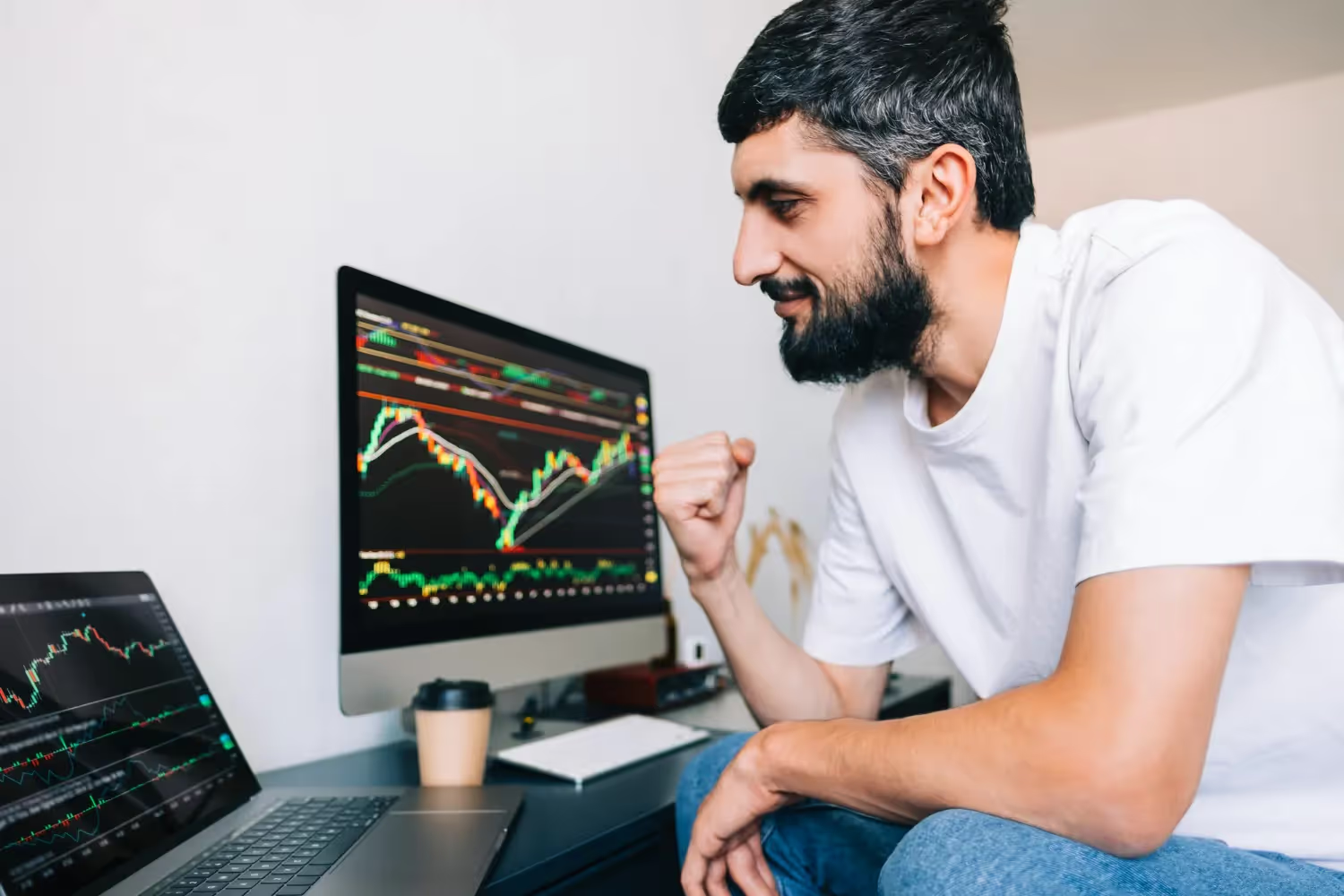
Career‑ending mistakes can be avoided by treating the chart like a decision filter. It's important to set clear risk rules before you make any moves and to follow a trading routine that takes emotion out of the process. Below are common traps and specific, practical solutions to help you stop making the same mistakes and start trading with a measurable edge.
1. Why does piling indicators break you?
Piling indicators until the chart stops speaking. Why this breaks you: When oscillators, moving averages, and custom widgets are stacked together, signals clash and decision-making slows down. This leads to doubt, mixed entries, and backtests that look better than live trading. What to do instead: Limit visual clutter to only the necessary items, then set up a binary decision tree: Is market structure aligned, yes or no? If yes, does candle context confirm, yes or no? Use one or two extra tools only as filters, not as entry signals. A simple rule I share with trainees is to keep a two‑indicator cap and to follow a pre‑trade checklist that takes less than 30 seconds. This method makes sure that limits improve choices.
2. How does ignoring the bigger picture affect you?
Letting short-term wiggles take over the bigger picture can lead to big problems. Reacting to noise that lasts just five minutes while ignoring the longer timeframe removes the trend advantage and turns a trader into someone who trades against the larger market flows. That’s the definition of fighting the market. To fix this, follow a clear plan: the higher timeframe shows the overall trend, the mid timeframe identifies the closest structural zone, and the lower timeframe is used to time your entry. If the higher timeframe structure goes against a short-term view, it's smart to either trade smaller or not trade at all. This plan ensures everything lines up, which helps lower the chance of false breakouts.
3. Why Do Patterns Fail Without Context?
Trading patterns without context can fail. A clean candlestick reversal might be a good setup or just a quick spike, depending on where it is compared to volatility, liquidity clusters, and session behavior. Looking at patterns by themselves often leads to many near-wins, which can eventually bleed account value. To improve the approach, objective filters should be added. Ensure a pattern forms within a marked zone, meets a minimum wick-to-range ratio, and is supported by session volume or ATR expansion. Change these checks into a single-line rule, making acceptance easier and less subjective.
4. Why Must You Treat Risk Rules as Non-Negotiable?
Treating risk rules as negotiable, problem, and human cost stops are not suggestions; however, most traders treat them like draft notes and move them when they feel scared. According to Binance Square, "Only 10% of traders use a stop-loss strategy effectively" (2025). The misuse of stops is a direct driver of wipeouts, rather than market randomness. Practical defenses: Establish stops and position size before submission; lock them mentally by writing them on your trade card. Enforce a daily loss cap that ends the session. Consider using volatility-based stops and ensure position size reflects market behavior. Additionally, ritualize a cooldown after three losses to prevent revenge trading.
5. How to manage fear of missing out?
Forcing trades to silence the fear of missing out. How it plays out: Overtrading is usually a sign of broken selection rules, not just bullish ambition. When trades are based on chance rather than solid strategies, expectancy collapses, and risk per trade quietly increases.
Repair strategy: Score setups using a simple rubric, then trade only those that exceed a certain threshold. To improve selection quality, reduce the number of markets watched to 3 per session. Set small goals, like two scored setups per day, to change behavior from frantic to disciplined.
Why should you control your emotions in trading?
Letting emotions run the desk can lead to big problems in trading. Emotional reactions turn set rules into simple suggestions, making your profit and loss (P&L) depend on the next candle. This is not subtle; according to Binance Square, "Over 70% of traders fail to consistently make profits due to emotional trading" (2025). Emotions are the single most significant structural leak for retail performance.
To fight these effects, tactical responses are essential. Automate as much as you can, from alerts to placing orders. Use set rituals like a pre-session scan, a two-line trade card, and a fixed post-trade review checklist. During a four-week coaching run, traders who stuck to these rituals significantly reduced impulsive entries. This led to clear behavioral changes, resulting in fewer mid-trade stop moves and calmer sizing decisions.
Why is a written trading plan crucial?
Trading without a written, enforceable plan is hazardous. Random rules only work as long as you are lucky. Without explicit written rules for when to enter, when to exit, and which risks to take, it becomes hard to measure expectancy or make improvements. Because of this, you're likely to keep making the same mistakes. To create a proper plan, start with three essential parts: entry conditions, explicit invalidation, and a scaling or exit rule. Try to keep it on one page. After that, backtest your plan with ten setups using a replay. Then raise your standards: make sure to use the plan for 20 consecutive sessions before you change any rules. This way, you encourage learning that you can measure, rather than just gut-driven tinkering.
What should you do in practice for change?
Most traders use small capital and simple methods because these approaches feel familiar and immediate. While this can work at first, as position size increases and losses add up, those habits start to show their downsides: inconsistent sizing, emotional overrides, and stalled progress. Platforms like AquaFunded provide structured capital and configurable risk rules. This allows traders to practice scaled execution within fixed limits, helping them maintain discipline while gaining real-money experience more quickly.
To help change behavior, try this quick, practical exercise: for one week, limit yourself to one trading pair and two indicators. Use the multi-timeframe bias checklist before each trading session and write one sentence in your journal for each trade, explaining why you entered. This contrast will show where emotion or clutter is affecting your judgment. There is one stubborn question left that most traders avoid, and it changes everything about how you view scaling your edge.
Related Reading
- Forex Algo Trading
- Types of Forex Trading
- Forex Trading Spreads
- Forex Market Liquidity
- Forex Mini Account
- Forex Hedging Strategies
- Forex Trend Indicators
- Advanced Forex Trading
- Best Forex Pairs for Scalping
- London Session Forex Pairs
- Best Currency Pairs to Trade for Beginners
- Minor Currency Pairs
- Best Time to Trade USDJPY
- Forex Swing Trading Signals
Join Our Funded Trading Program Today - Trade with our Capital and Keep up to 100% of the Profit.
Suppose you're ready to show your forex price-action trading edge on a larger scale without taking personal risks. In that case, it’s time to test your rules on a funded account that simulates professional conditions. Most traders push small accounts until their discipline breaks. Platforms like Aqua Funded help you keep a strict market structure and candlestick context while working on trade entries, retests, and rejections with significant capital. You can earn what you make while continuing to improve your repeatable edge.
Related Reading
- Best Forex Pairs to Trade During Asian Session
- Best Forex Funded Account
- Top Prop Firms
- Best Prop Firm
- Forex Prop Firms
- Best Forex Pairs to Trade During New York Session
- Best Forex Trading Platform
- Forex Trading for Beginners
- Forex Trading Hours
- Forex Trading Brokers
- Forex Trading Course
- What Is Forex Trading and How Does It Work
- Forex Currency Trading
- Forex Online Trading
- How Does Forex Trading Work
- Online Forex Trading
