




Day Trading vs Forex Trading: Detailed Comparison
Day Trading vs Forex Trading: Compare trading strategies, risk management, and execution details in our guide. AquaFunded helps you trade smart.
Traders often face a pivotal choice: does the rapid decision-making inherent in day trading suit their style better, or does a broader forex strategy offer the stability they need? Each approach demands a clear grasp of market volatility, leverage, and risk management, along with the technical skill required for precise chart analysis and backtesting. Evaluating these factors helps in aligning one’s routine with a method that supports consistent profitability.
Practical differences between strategies emerge through comparisons of spreads, broker performance, and the steps necessary to qualify for trading capital. Insights from Forex Trading Success Stories illustrate how these approaches yield diverse risks and rewards, guiding traders toward the best fit for their goals. Combining strategic clarity with measured execution can enhance overall trading performance, while AquaFunded’s funded trading program provides a structured pathway to test and refine profitable strategies.
Summary
- Day trading has a steep failure rate, with roughly 90% of day traders losing money and only about 10% consistently profitable, highlighting that repeatable systems and discipline, not luck, determine long-term success.
- Forex liquidity is enormous, reaching $9.6 trillion per day in April 2025, a 28% increase since 2022, which supports tight spreads on major pairs but raises the importance of execution cost control.
- The US dollar dominates the market, appearing on one side of 89% of FX trades in April 2025, so pair selection and dollar-driven flows materially shape volatility and opportunity.
- Interbank funding and hedging activity remain central, with FX swaps averaging $4 trillion in daily turnover in April 2025, up 5%, a dynamic that influences intraday price mechanics and session overlaps.
- Top intraday traders target small, repeatable wins, often aiming for 1% to 2% return per day, which makes strict per-trade risk controls and stop discipline essential for scaling.
- Execution and timeframe choices are operationally decisive, since intraday trades commonly last minutes to hours, and professional toolkits focus on low-latency routing and depth-of-book data to limit slippage.
- AquaFunded's funded trading program addresses this by standardizing evaluation paths, consolidating risk rules and performance reporting, and providing access to real capital so traders can validate repeatable intraday or FX strategies under realistic execution constraints.
What is Day Trading?
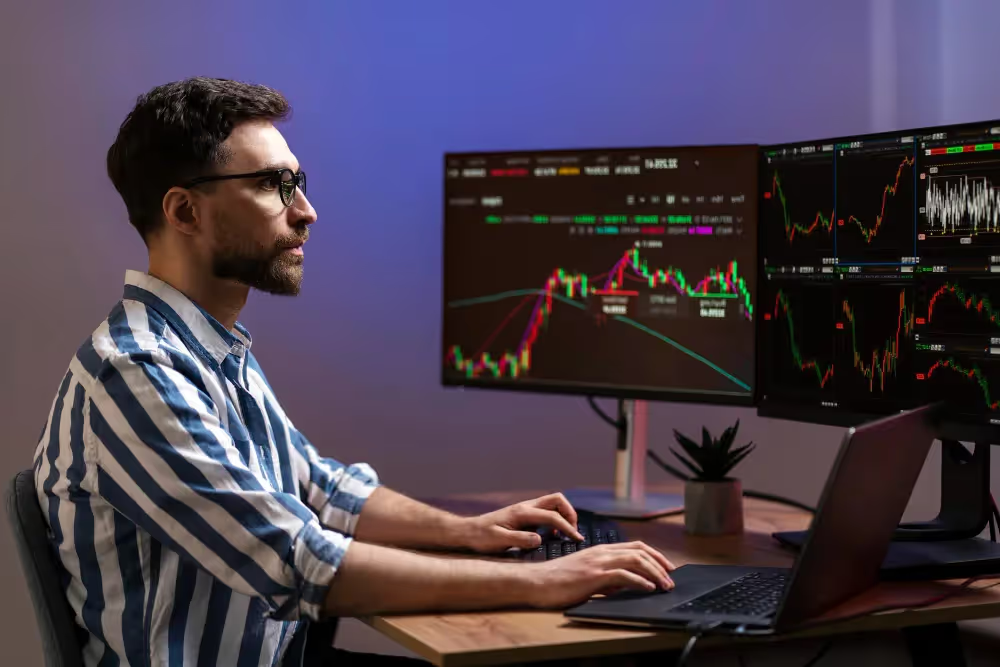
Day trading is a type of trading where you buy and sell quickly during the same day. The goal is to capture short-lived price moves in liquid instruments, as explained in this article. Traders open and close their positions on the same market day.
This method depends on making fast decisions, recognising patterns, and following strict rules to manage risk, which helps you cut losses quickly and allow reliable setups to grow. If you're interested in this approach, you might want to consider our funded trading program to enhance your trading potential.
1. What do traders actually do and why?
Definition and objective, what traders actually do, and why they do it.
Day traders look for small, repeatable advantages within a trading day. They use quick entries and exits to turn small price differences into bigger gains. The goal is not to find the 'right' long-term value. Instead, they want to spot times when supply and demand change enough to make a quick trade profitable.
2. Which markets do traders prefer and why?
Instruments commonly traded include various assets that traders favour for their high liquidity and quick execution. Traders prefer markets where spreads are tight and orders execute reliably, such as major stocks, index futures, options, currency pairs, and sometimes commodity futures.
Liquidity is crucial because it ensures clean fills, low transaction costs, and the ability to scale position sizes without affecting market movement.
3. How are short-term decisions informed?
Technical analysis involves pattern-based decision-making using price, volume, and indicators to predict what might happen next. Instead of looking at how a company will do over many years, traders find support and resistance levels, check how strong the trends are, and look at order flow.
This method helps them figure out entry points, where to place stops, and how to take profits.
4. What is momentum trading?
Momentum trading, reworded: The strategy that follows quick bursts of activity.
Momentum trading focuses on fast price changes that happen because of news, breakouts, or sudden shifts in feelings. It tries to benefit from these swings until the momentum slows down. You’re not betting on a big change in the basics; you’re timing when a crowd is speeding up and when it will calm down.
5. What is a quick operational sketch?
A quick operational sketch outlines the basic mechanics involved. You scan for candidates, define a clear entry signal, size the position based on your capital and the stop distance, and execute with pre-planned exits. Trades often last from minutes to hours. Most successful traders close every position before the session ends to avoid overnight gap risk.
6. What Does Every Active Trader Need?
The toolkit that every active trader needs has some important parts. These key elements include real-time market data, low-latency order routing, reliable charting software, economic calendars, and a fast internet connection.
These are the basics for trading success. Professional traders add to their toolkit with direct market access, level 2 or depth-of-book feeds, and execution algorithms that cut fill times by milliseconds.
7. What Are Concrete Rules That Preserve Capital?
Risk management practices are concrete rules that help keep your money safe. Top traders limit their losses for each trade by regularly using stop orders and sticking to strict position sizes. They often risk no more than a small percentage of their account equity on any specific idea.
This discipline is important because the math behind many small losses can eat away at your capital faster than a few wins can bring it back. This is a reality highlighted by Moneyzine, approximately 90% of day traders lose money, which shows why having strict controls is essential.
8. What are the win conditions for success?
Who succeeds and why? The win conditions for trading success depend on edge, consistency, and emotional control. Sadly, only a small number of traders consistently develop these three important traits. Research from Unbiased.com indicates that only about 10% of day traders are consistently profitable. This statistic reminds us that making a profit is uncommon and usually comes from well-structured systems, not just luck.
9. What breaks most traders, and how does it feel?
Emotional and practical barriers. What breaks most traders and how it feels.
The same frustration appears in self-taught traders and classroom students: attractive courses promise shortcuts, leaving learners confused and impatient when results lag.
It is exhausting to watch algorithms and institutional desks execute faster and at scale. That pressure wears down discipline; traders hesitate, overtrade, or widen stops until small losses add up.
10. How do institutions differ from individuals?
Institutions and individuals work differently in trading. Firms use detailed research, large amounts of money, advanced tools for executing trades, and teams that handle risks across many positions. On the other hand, individual traders usually deal with smaller profits and have to compete with automated systems.
This difference makes retail traders simplify their methods and become experts in specific areas. They concentrate on turning one reliable strategy into repeated trades instead of trying to cover all possible trading options.
How do traders prepare effectively?
Many teams manage trader preparation using different spreadsheets, recorded webinars, and ad hoc coaching because these methods are familiar and inexpensive. Over time, this familiarity can cause inconsistent rules, misaligned performance tracking, and emotional shortcuts. These issues often lead to repeated account drawdowns.
Platforms like AquaFunded help by centralising practice accounts, setting standard risk rules, and offering performance analytics. This way, traders can improve their skills faster while keeping discipline and creating replicable outcomes.
What is the significance of conditioning in day trading?
Think of day trading like sprinting in a marathon. Speed is important, but it only matters if you have the right conditioning, form, and a solid recovery plan.
What will the next topic reveal?
The next topic will uncover the crucial element that many newcomers miss, which can completely change their understanding of the game.
Related Reading
- Pros and Cons of Forex Trading
- Is Forex Trading Profitable
- How Many Forex Trading Days in a Year
- Forex Secrets
- How to Trade Forex With $100
- Forex Tax Rate
- Is Forex Closed on Christmas
- How to Use ADX Indicator for Day Trading
- Best Time Frame to Trade Forex for Beginners
- Is Forex Trading Hard
- Risk Management in Forex Trading
- Scalp Trading Forex
What is Forex Trading?

Forex is the global market where currencies are exchanged and priced against each other. Traders try to make money by predicting these changes. You do not buy a currency alone; you buy one while selling another, sizing risk and managing timeframes to turn your views into profits.
1. Forex, in simple terms
Forex, short for foreign exchange, is the market for swapping one nation’s money for another’s. It is used by travellers, companies, banks, and speculators. Think of it as a marketplace that never closes, where value is shown as a relationship between two currencies.
2. How traders try to profit
A forex trader decides if one currency will get stronger or weaker compared to another currency. Then, they take a position based on how much risk they are willing to take. The goal is not necessarily to hold onto currency for a long time, but to take advantage of predictable moves where the chances are in their favour. Joining a funded trading program can provide valuable support and resources for aspiring traders.
3. Why the market’s size is important
This market is huge and liquid, so orders fill quickly, and price changes can be traded on a large scale; the 2025 Triennial Central Bank Survey shows that global FX trading reached $9.6 trillion per day in April 2025, which is 28% higher than 2022 (2025 Triennial Central Bank Survey, showing more activity and depth across different venues).
This depth helps keep tight spreads on major pairs and allows for consistent trading for people who manage costs.
4. Where the US dollar fits in.
The US dollar is the most important currency in global trades and often acts as the centre of the market; it affects cross rates and volatility.
The same 2025 Triennial Central Bank Survey shows that the US dollar was involved in 89% of all FX trades in April 2025, highlighting how the dollar impacts other pairs. This dominance is important when deciding which pairs to study first.
5. What practical examples illustrate Forex trading?
Everyday FX transactions you already use include converting cash for a trip or paying an overseas vendor. These actions represent the same processes traders use; they just add direction, timing, and leverage to turn operational exchanges into tradable opportunities.
6. Currency pairs are the central part of Forex trading.
Each quote, like EUR/USD or USD/CAD, shows which currency you are buying and which one you are selling. These pairs have different features: majors change based on big economic trends and news, crosses respond to local factors, and exotics can see bigger spreads when there is less liquidity.
7. Why Do Traders See Constant Opportunities?
High liquidity leads to many small mistakes and repeated patterns that traders can take advantage of, whether they are trading within the day or for longer periods. Since prices keep changing based on major news and the market's structure, opportunities show up regularly for those who watch for trends, correlations, and order-flow signals.
8. There is not one single global exchange
Instead, there is a network of banks, ECNs, and brokers that match orders across different areas. This system prevents failures at one point, but makes it more challenging to execute trades consistently because prices and rules can differ from one venue to another.
FX trading occurs almost continuously, from Sunday evening to Friday evening, across major time zones. This long trading period lets traders work throughout sessions and choose times that fit their strategies, liquidity needs, and sleep schedules.
9. What common challenges do beginner traders face?
Beginner traders usually face problems because of pair selection paralysis. They often get stuck on leverage, pips, and spreads instead of concentrating on developing repeatable pattern recognition and risk rules. This focus can cause them to overtrade or hold onto positions longer than their stop-loss, as they haven't practised sizing, entry, and exit strategies under real conditions.
Many traders begin with different demo accounts and spreadsheet logs because this method seems easy and free. But, as time goes on, fragmentation happens due to inconsistent risk rules, a lack of standard performance metrics, and time lost in matching results.
Platforms like the funded trading program bring together practice accounts, standardise risk and reporting, and offer quick funding options. This method speeds up the feedback loop, allowing traders to improve quickly and protect their capital while enhancing their skills.
How can you effectively learn Forex trading?
A quick, simple analogy: treat learning Forex like learning to drive a manual car. You have to coordinate the clutch, throttle, and gear choice over and over until it feels automatic. If you don’t, a good idea could lead to stalls, and stalls cost more than just lost time.
You can turn your trading skills into real profits without putting your own money at risk. AquaFunded gives you access to accounts up to $400K with the most flexible trading conditions in the industry: no time limits, easy-to-achieve profit targets, and up to 100% profit split.
Join our funded trading programme to get instant funding options or prove your skills through customisable challenge paths.
That practical advantage may seem clear, but one important decision still confuses many traders.
This decision explains half of the mistakes they keep making.
Day Trading vs Forex Trading

Day trading and forex trading exist in different areas of the financial market. Day trading refers to a specific time frame used to gain short-term benefits, while forex is an asset class with its own liquidity mechanics, counterparties, and macroeconomic factors.
Choosing between day trading and forex can greatly affect the systems needed, the possible mistakes that may cause losses, and how to grow capital.
1. What does each one require operationally?
Day trading needs a tight setup for speed and repeatability. This includes clear entry and exit rules, dependable order types, and an execution method that reduces slippage. On the other hand, Forex trading needs more things to think about, like macro filters, being aware of trading sessions, and knowing about counterparts. This is important because spreads and liquidity change based on time zones and what central banks do.
Think of day trading as sprint training, where refining your technique and practising over and over is key; consider Forex as piloting a craft that must be adjusted for changing winds and tides.
2. How do execution and market plumbing differ?
Execution in stocks usually goes through a few exchanges that have visible order books. On the other hand, the forex market works as a network of liquidity providers, banks, and ECNs, where prices can be different depending on the venue. This difference greatly affects the management of slippage, partial fills, and order types.
Importantly, the 2025 triennial central bank survey showed that FX swaps continued to be the most traded instrument. The average daily turnover grew to $4 trillion in April 2025, showing a 5% increase from April 2022. This information from the BIS highlights how much interbank funding and hedging activities affect intraday price mechanics in FX. Understanding this situation is vital when deciding on the size and holding of positions during session overlaps.
3. What behavior and risk patterns separate successful traders?
Successful day traders value consistency and small per-trade risk, and they set up a schedule that includes recovery and review routines. Successful forex traders use macro discipline, make sure their position sizes are good even with overnight changes, and keep an appetite for correlation management between different pairs.
After coaching funded traders for a year, a clear pattern appeared: as accounts become larger, operational friction shows up. Firms and brokers add extra checks and payout rules that many traders did not expect. These surprising issues can turn a good run into a long process filled with paperwork and delays.
4. Why do people mix them up so often?
Marketing and shorthand create confusion. Vendors often sell "day trading FX", while educators teach intraday FX setups. Because of this, beginners often confuse a trading style with the market itself.
A common mistake happens when traders choose an asset that sounds flexible. They then try to use a stock-based workflow for FX without changing for the 24/5 session structure, broker counterparty risk, or swap and funding behaviors. This mismatch helps explain why traders feel stuck and overleveraged, even when the setups seem correct.
5. How should you choose between them for your goals?
Set a constraint-first test: if you have limited hours and need flexible sessions, forex day trading fits better because you can choose low-stress overlap windows and smaller account minimums.
On the other hand, if you need tight regulatory oversight and company-level catalysts, stock day trading rewards event-driven plays.
Choose based on capital, available hours, and tolerance for broker and regulatory risk, not on the hope that one market is inherently easier.
A practical rule: pick the market where your routine and information edge align; then build one repeatable setup and scale it before adding more variables.
6. What pragmatic rule ties this all together?
Treat the choice as orthogonal: master a timeframe and master a market separately, then combine them carefully. This intentional connection, rather than just a guess, leads to consistent performance.
What should traders underrate?
That solution sounds neat, but the part that traders often underestimate the most is the order they need to follow to make it work. This order is where the real differences become important, especially if you consider a funded trading programme.
How to Day Trade Forex

Yes, you can day trade forex, but only if you treat it like a careful skill, not a way to make quick money. The truth is clear: Obside reports over 90% of day traders lose money in the forex market", a 2025 report that shows how weak retail intraday strategies are.
The practical targets that successful traders set are close together, with Obside noting, "Successful day traders often aim for a 1% to 2% return on their capital per day", which demonstrates the small, repeatable gains that add up to bigger results. Below, I list what is essential for each item you asked about, with practical changes and risk-aware steps you can use right away.
1. What should you do first, practically?
Use AquaFunded. Start by treating funded accounts like a controlled ramp, not a quick way to leverage. While looking over the experiences from funded accounts during a 12-month coaching cycle, a pattern showed up: traders want to use other people’s money, but they worry about poor support and payout delays, which can hurt trust and focus. The common way is to handle several demo accounts and spreadsheets, thinking it's low-cost.
But as things get more complex, this method breaks up performance data and slows down learning. Platforms like AquaFunded offer quick funding options and customisable challenge paths that bring together risk rules, performance metrics, and payouts. This setup helps traders work faster while keeping their capital safe. Use the platform to increase position size only after showing consistent P/L over a specific sample, noting execution quality, and confirming the provider’s verified payout history before relying on it.
2. How should you run trend setups intraday?
To effectively run trend setups during the day, first set your bias from the higher timeframe; then trade with the local structure. Start by figuring out the direction using a 1‑hour bias. Then, enter during a 5‑ or 15‑minute pullback that creates a higher low in an uptrend or a lower high in a downtrend.
It helps to split your entry into two pieces as you get into the move. Use a trailing stop that moves to break‑even after you capture one target unit. Measure target distances using ATR multiples to avoid fixed pip expectations. Always size your positions carefully so that a single stop‑loss never goes over your per‑trade risk budget. Lastly, close most of your positions before the low‑liquidity session edges to reduce gap exposure.
3. When will mean reversion actually pay off intraday?
Mean reversion works best within contracting ranges that show clear statistical overshoots, rather than during trending sessions. Use a 20-period moving average as your starting point and mix it with a volatility filter.
For example, think about taking reversion setups only when the price goes beyond 1.5 ATR the nd session volume is going down. Confirm your strategy with a momentum oscillator that crosses back towards neutral.
It's important to keep stops tight because mean reversion can fail badly during breakouts.
View these strategies as countertrend trades with a skewed reward-to-risk ratio. This means you should trade smaller sizes and limit how long you stay in the market.
4. How do you manage event risk without getting steamrolled?
Managing event risk requires a smart plan. Start by making a simple news checklist and a plan before you commit. Decide which releases to trade, set an acceptable slippage level, and determine the maximum spread you will allow. It's important to avoid setting your position size based on the headlines; instead, adjust your position depending on how the market reacts.
Wait for the price to accept a new range with one or two 1-minute closes before you enter. If a release causes a strong move that stays stable, you can join in with a smaller size. If not, it's better to stay out. Prepare for execution slippage and include it in your stop distances and position size; this will help prevent one event from damaging a small account. For further insights, see our post on trading on news.
5. How to use Fibonacci without falling into wishful thinking?
Fibonacci retracement trading: How to use Fibonacci without falling into wishful thinking. Treat those ratio lines as possible zones where prices may reverse, not promises. Apply this tool across two different timeframes.
Align a 38.2 or 50 retracement level with a past support or resistance area, and use a reliable price-action signal, like a rejection wick or engulfing candle. Place your stop-loss a little beyond the next structural level, and adjust your trade size for the extra distance. Use Fibonacci to help plan layered entries and staged exits, and avoid setups where the ratio level is inside a messy consolidation with no volume confirmation.
6. How to separate real breakouts from traps?
Breakout trading means learning how to tell the difference between real breakouts and traps. Choose breakouts that happen along with volatility expansion and a momentum surge on a higher timeframe. It’s a good idea to wait for either an immediate retest of the broken level or a strong follow-through candle with above-average volume before you commit.
Use an ATR-based stop to handle market noise, and scale out of the position as you reach successive targets related to measured moves. If a breakout fails the retest, quickly accept the loss; false breakouts are the biggest problem for intraday accounts, turning small advantages into large drawdowns.
Why does the status quo cost you time and money?
The status quo can cost traders both time and money because of inefficient practices. Most traders start with scattered demo sessions and a few broker accounts, mainly because this approach is familiar and free. While this may work at first, as traders add rules, risk limits, and growth targets, the fragmentation leads to misaligned metrics, slow feedback loops, and too much paperwork that delays payouts and verification.
Platforms like AquaFunded centralise challenge paths, set uniform risk rules, and simplify verified payout processes. This consolidation shortens the iteration cycle, helping traders focus on execution and edge refinement instead of dealing with administrative tasks.
What execution checks should you adopt now?
- Keep a daily journal that records entry reasons, execution quality, slippage, and outcomes, then review only trades sized at or above the minimum consistency threshold.
- Use fixed per-trade risk percentages tied to account equity to ensure consistent sizing when moving between demo, funded challenge, and a live funded account.
- Run capacity tests by increasing size in controlled steps. Monitor for execution slippage, spread widening, or changes in how stops are managed.
What is a short analogy to make this visceral?
A short analogy can help make this concept clearer. Think of building a funded trading record like tuning a race car on the track. You change one setting and run a timed lap.
Only after you get consistent lap times do you boost the engine power. Most traders lose money by trying to increase power without timing data.
What is the operational pitfall most traders do not anticipate?
This simple truth may seem easy to understand on paper. However, there is one problem most traders do not see coming, and it can change everything if ignored.
Related Reading
- Forex Algo Trading
- Types of Forex Trading
- Forex Trading Spreads
- Forex Market Liquidity
- Forex Mini Account
- Forex Price Action Trading
- Forex Hedging Strategies
- Forex Trend Indicators
- Advanced Forex Trading
- Best Forex Pairs for Scalping
- London Session Forex Pairs
- Best Currency Pairs to Trade for Beginners
- Minor Currency Pairs
- Best Time to Trade USDJPY
- Forex Swing Trading Signals
Join Our Funded Trading Program Today - Trade with our Capital and Keep up to 100% of the Profit.
Prove your intraday edge on currency pairs without risking your own cash by trying AquaFunded’s tailored challenge routes or rapid funding options. These options let you see how your setups work at a larger scale. The program acts as a disciplined bridge to help you grow your trading size, keep a bigger share of profits, and avoid funding issues.
This way, you can concentrate on executing trades and growing your account with managed risks. Check out the funded trading program today!
Related Reading
- Best Forex Pairs to Trade During Asian Session
- Best Forex Funded Account
- Top Prop Firms
- Best Prop Firm
- Forex Prop Firms
- Best Forex Pairs to Trade During New York Session
- Best Forex Trading Platform
- Forex Trading for Beginners
- Forex Trading Hours
- Forex Trading Brokers
- Forex Trading Course
- What Is Forex Trading and How Does It Work
- Forex Currency Trading
- Forex Online Trading
- How Does Forex Trading Work
- Online Forex Trading
