




How to Trade the London Session Forex Pairs in 6 Steps
London Session Forex Pairs strategies in 6 steps: learn liquidity insights, orderflow tips, and execution rules. Get expert guidance with AquaFunded.
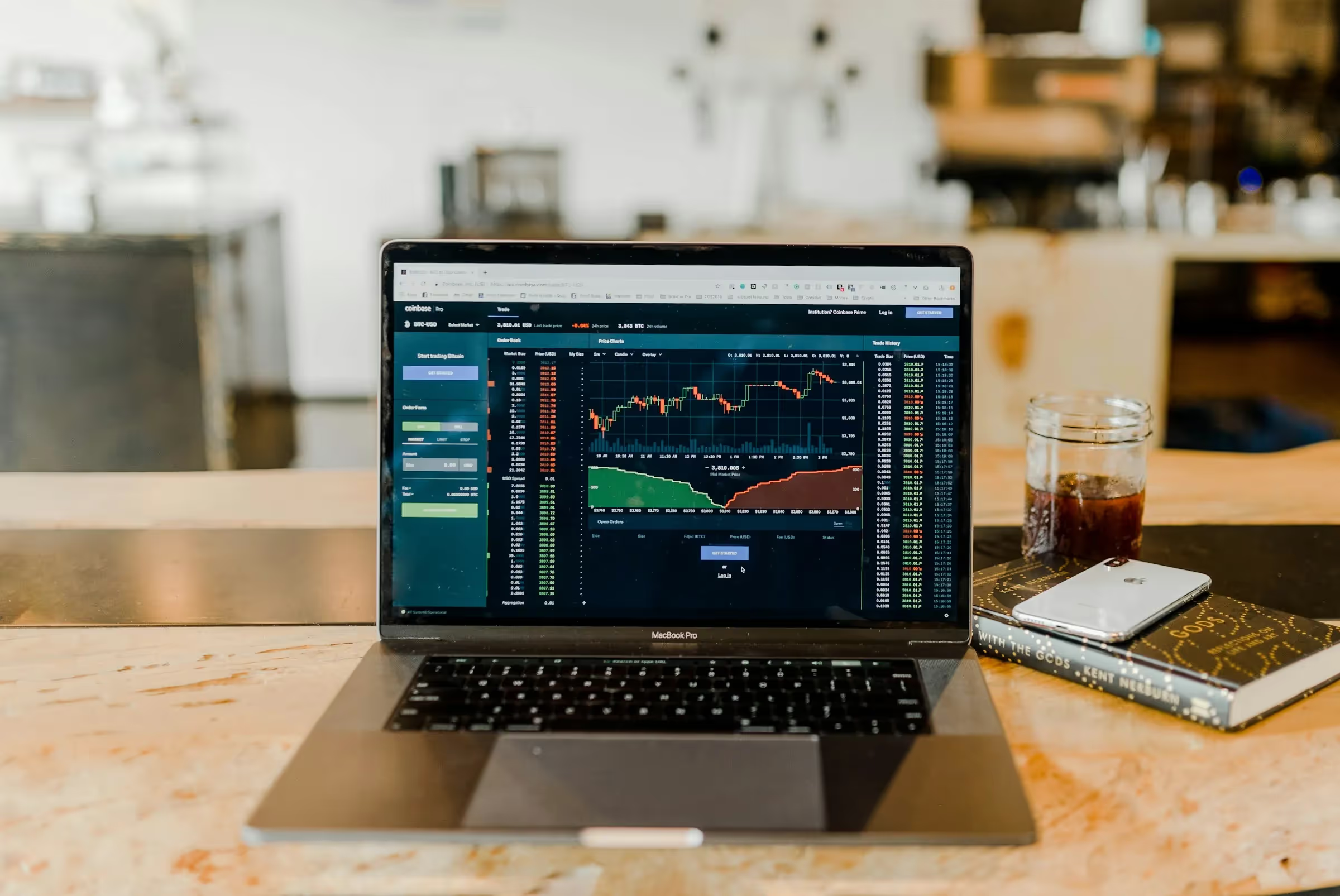
Skilled traders capitalize on volatility by analyzing price shifts and liquidity changes during dynamic market sessions. Many successful market strategies emerge when experts learn to analyze London Session Forex Pairs to catch sharp breakouts and pip movements. Observing Forex Trading Success Stories, spreads and volume in real time provides clear insights for confident market entries.
Strategic timing and accurate reading of market cues help transform analysis into actionable trades. Thorough observation of session dynamics sharpens a trader’s ability to make informed decisions. AquaFunded’s funded trading program delivers real capital and clear guidelines, allowing traders to turn insights into live trading success.
Summary
- The London session accounts for roughly 35% of daily forex volume, resulting in tighter effective spreads, cleaner fills, and more repeatable intraday entry points.
- Volatility is predictably higher in London, with surveys showing 70% of traders prefer the session for its volatility and EUR/USD often exhibiting about 70 pips of intraday movement, making structured momentum and mean-reversion setups more reliable.
- The four-hour London and New York overlap compresses bid-ask buffers and accelerates price discovery, creating persistent directional legs that are suitable for layered entries and rapid execution experiments.
- Pair choice matters at scale: EUR/USD, GBP/USD, EUR/GBP, and USD/JPY are recommended because EUR/USD typically sees about a 20% volume bump during London hours, and GBP/USD shows roughly a 15% increase in volatility. Hence, these pairs more consistently support larger orders.
- Low-liquidity mistakes cost traders; more than 50% report losses during thin periods. Sustainable scaling requires rules such as a two-stage plan that starts with lower risk for 10 to 20 trades and mandatory execution audits every 20 trades.
- AquaFunded addresses this by offering a funded trading program that provides real capital, clear rules, and session-level analytics, enabling traders to validate pair selection and execution under live London liquidity.
Benefits of London Sessions

The London session focuses on market movement and liquidity over a short time frame. This leads to cleaner fills, narrower effective spreads, and more repeatable entry points.
Trading with time and order-book awareness during London hours significantly improves execution quality and enhances the signal-to-noise ratio. To maximize your potential, consider exploring our funded trading program for greater financial flexibility.
1. Why does high trading volume matter for execution?
High trading volume is critical to execution, as liquidity reduces slippage and makes limit orders more reliable. London has a large number of banks, hedge funds, and interdealer flows, which means orders can find trading partners more quickly and price gaps are smaller. This concentration is clear in published reports: the Volatility Indices in South Africa | First London Session Analysis of the week, shows that the London session accounts for 35% of daily forex volume. This scale leads to cleaner fills on major pairs and crosses during busy trading hours.
2. How can increased volatility be advantageous?
Increased volatility that traders can use offers unique advantages. It is usually higher during London hours, creating the momentum needed for intraday setups and systematic entries. Short, controlled volatility allows traders to connect higher-quality signals. Larger market moves mean that stop sizes can be used without being affected by spread costs.
This is one reason many participants prefer these hours. A recent analysis noted that 70% of traders like the London session for its high volatility, turning that volatility into known risk-reward profiles rather than treating it as random noise, as highlighted in Volatility Indices in South Africa | First London Session Analysis of the week.
3. What opportunities does the London and New York overlap create?
The overlap between London and New York creates concentrated opportunities. When both markets are open simultaneously, price discovery accelerates as two liquidity engines interact. This overlap narrows bid-ask spreads and creates strong beliefs about breakout moves and mean-reversion bounces.
Traders can use this time like a laboratory: they can try a trade adjustment one day and see how their orders and slippage change the next. This quick testing is possible because the same basic influences happen across sessions, as explained in the resource on algorithmic trading risk management.
How does pair selection improve with better data?
Most traders still pick pairs by habit, favoring a few majors because they are familiar and always liquid. That approach works early on, but as position sizes or frequency increase, it hides execution costs and missed opportunities. Platforms like AquaFunded expose session-level spreads and live depth, showing teams where slippage eats returns and where liquidity actually supports larger orders, helping traders move from guesswork to data-driven pair selection.
4. Why Are Major Data Releases Concentrated During London Hours?
Major data releases are concentrated and tradable. Why do economic releases matter most during London hours? Because several key reports are released when European markets are open, market reactions are quick and decisive. This creates fast, directional moves that you can trade using predefined execution plans or use as catalysts to confirm a longer intraday bias. When you plan around the release schedule, you reduce surprises and turn headline volatility into an execution opportunity rather than a risk.
5. How do trends start or get confirmed in London?
Trends often begin or get confirmed in London. A significant portion of daily directional structure either starts or gains validation during London hours. If traders want to capture longer intraday swings, watching which pairs attract meaningful order flow in London increases the chances of predicting whether a move will last.
Think of London as the engine room that checks if a breakout is real or just a false move. Therefore, trade rules should reflect this difference, ensuring that entries are cleaner and exits are clearer.
What analogy can clarify liquidity behavior in London?
A brief analogy illustrates this idea: liquidity in London is like a river that narrows as it passes through a gorge. As the river narrows, velocity increases, and objects either move smoothly downstream or strike the rocks. When bets are placed in the correct channel, risk is controlled, and outcomes become more predictable.
What is a common question about trading in London?
This advantage seems straightforward until you ask the question that many people think they already know the answer to.
What is the Best time to trade in the London Session?
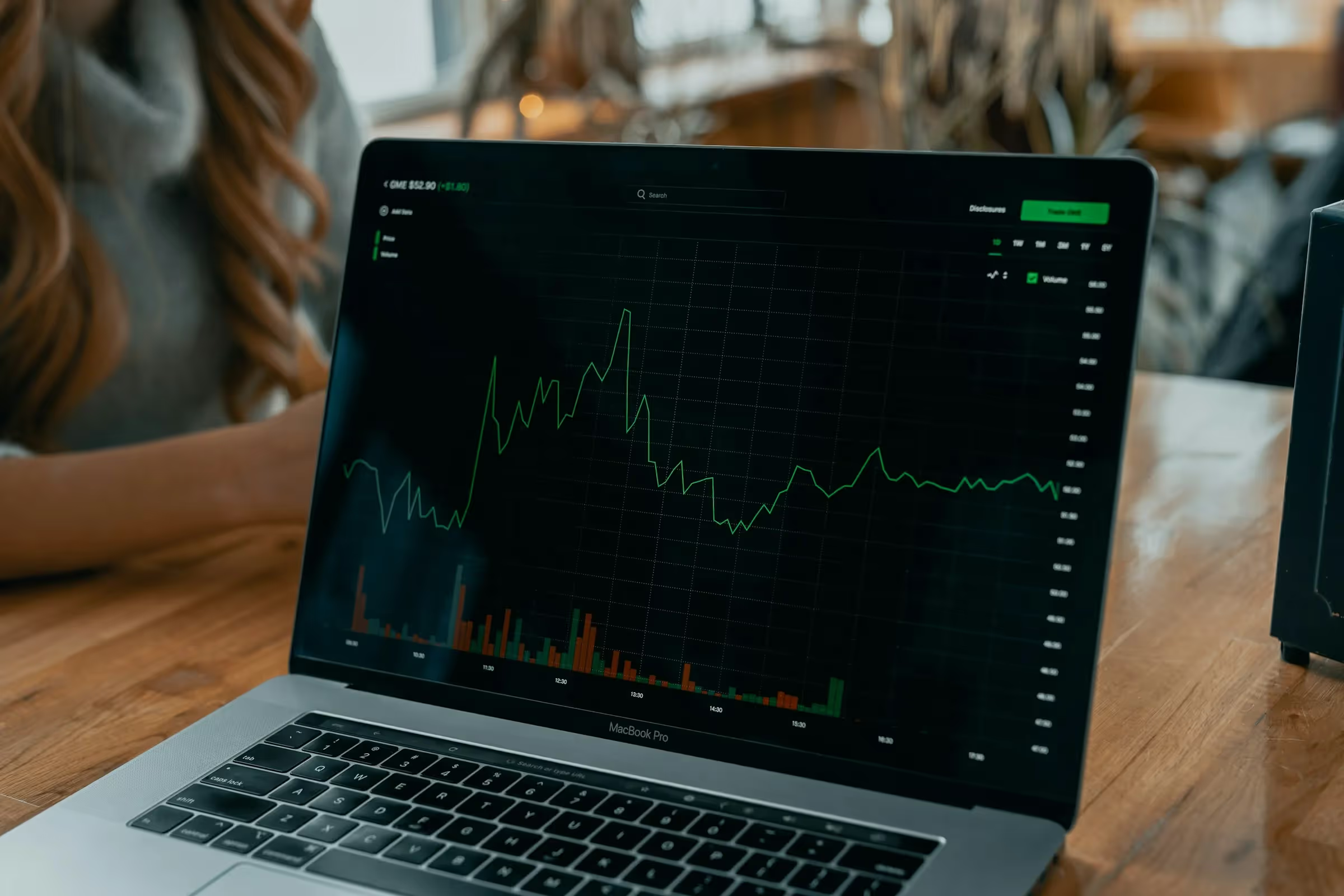
EUR/USD, GBP/USD, EUR/GBP, and USD/JPY are the pairs to focus on during London hours. These pairs usually have the deepest order flow, the most reliable intraday structure, and the clearest execution signals for trading-session strategies. The London session, which ACY Securities reports on, accounts for approximately 35% daily forex trading volume.
This ample liquidity makes these pairs highly tradable. If you're looking to maximize your trading potential, our funded trading program provides the resources you need.
1. EUR/USD (Euro / US Dollar)
The EUR/USD pair acts as the primary focus of the session. It responds to ECB structure, European macroeconomic factors, and cross-asset risk sentiment with rapid, tradable movements. During London hours, ACY Securities reports that the EUR/USD pair often sees a volatility of around 70 pips.
This allows for both short-range mean-reversion setups and clear breakout opportunities if traders wait for the session to settle before entering a trade. Important trade notes include favoring limit entries into short-term value zones around Euro-zone releases, sizing stops to daily implied movement, and monitoring USD correlation to avoid being overly exposed to directional risk.
2. GBP/USD (British Pound / US Dollar)
Since London is the UK's financial center, GBP/USD attracts significant order flow and often shows frequent directional changes in response to Bank of England comments and surprises in UK data.
Traders should expect a wider day-to-day range than EUR/USD and quicker, stop-driven moves at the start of the session and during significant political news.
How can traders benefit from session analytics?
Most traders stick to a short list of major currencies because it is easy and familiar. This habit can remain effective until trading more frequently or changing position sizes reveals inconsistent pair behavior, fragmented P and L attribution, and slower strategy iteration.
Teams find that platforms such as the funded trading program offer session-level analytics and access to financed capital. This helps traders confirm their pair selections under consistent funding conditions and accelerates learning without requiring repeated execution tests.
3. What are the characteristics of EUR/GBP?
EUR/GBP (Euro / British Pound) is a precise tool, not a rough one. It focuses on the differences between the eurozone and the UK without directly involving the USD. This makes it well-suited for relative-value plays, fade-the-extreme setups when central banks act differently, and intraday mean-reversion when one economy surprises us.
Think of it like tuning two instruments, as small changes in yield differences or trade flows cause sharp, predictable changes in pitch. Trade notes: prefer to re-enter with limits near liquidity points during the session and use smaller stop sizes, as the cross often moves smoothly but with less raw range than USD-based major pairs.
4. How does USD/JPY behave during trading?
USD/JPY (US Dollar / Japanese Yen) tends to gain activity from both Asian and European participants. This currency pair offers runs that are easier to time when accounting for session overlaps and carry dynamics.
It is responsive to US macro surprises, Japanese policy adjustments, and cross-margin flows; as a result, volatility often appears in sustained legs rather than erratic movements.
When traders seek higher-beta alternatives, many add GBP/JPY or EUR/JPY to capture larger intraday swings.
Others rotate into USD/CAD during the London-New York overlap to capture moves driven by commodity and U.S. data, a pattern that consistently emerges when testing intraday portfolios.
What are execution-focused tips for trading these pairs?
Execution-focused tips across these pairs emphasize that it is essential to consider factors beyond pair selection. How one trades these pairs throughout the session is crucial.
Treat entries as experiments; log fills and slippage by pair and hour. Let these micro-tests determine which pair becomes your core engine for the day.
If a pair consistently impacts execution quality or yields inconsistent returns on your sizing, it is better to replace it than to force frequent trades.
How can AquaFunded help forex traders?
Turn your trading skills into big profits without putting your own money at risk. AquaFunded gives you access to accounts worth up to $400K with the most flexible trading conditions in the industry. There are no time limits, easy-to-reach profit goals, and you can get up to a 100% profit split.
More than 42,000 traders around the world have already earned over $2.9 million in rewards, all supported by a 48-hour payment guarantee. Start trading today with instant funding options, or show your skills through our customizable challenge paths and keep up to 100% of what you earn in AquaFunded’s funded trading program.
How do you convert pair behaviors into repeatable trades?
While that practical clarity is helpful, a more complex question is: how can someone turn these pair behaviors into repeatable, session-aligned trades? This process requires careful analysis and application.
Consider how our funded trading program can help you develop a structured trading approach.
Related Reading
- Pros and Cons of Forex Trading
- Is Forex Trading Profitable
- How Many Forex Trading Days in a Year
- Forex Secrets
- How to Trade Forex With $100
- Day Trading vs Forex
- Forex Tax Rate
- Is Forex Closed on Christmas
- How to Use ADX Indicator for Day Trading
- Best Time Frame to Trade Forex for Beginners
- Is Forex Trading Hard
- Risk Management in Forex Trading
- Scalp Trading Forex
- Forex Trading Account Types
How to Trade the London Session Forex Pairs

To trade the London session successfully, think of it as a time to execute trades, not just to get signals. It is essential to focus on orders during institutional flow, size your trades based on available liquidity, and ensure your trading plan aligns with the session's microstructure and psychology. Use live market depth, monitor volume, and maintain strict risk controls to improve entry execution and better understand slippage.
1. Use AquaFunded wisely and intentionally.
Most traders approach funded capital the same way they did with small retail accounts, which might work until the different execution scales show new failure types. Many traders tend to increase their trade size right after funding because it feels like a confirmation of their skills. However, this can lead to hidden costs, greater emotional volatility, and a higher risk of violating trading rules as losses begin to mount.
Many teams find that platforms like AquaFunded, which provide quick access to funded accounts and customizable challenge paths, enable traders to run careful scaling tests in real trading conditions. This helps maintain discipline while checking if a strategy can handle live fills and payout schedules. Treat funded capital as a test bed: start with a two-stage plan, begin with lower risk on 10 to 20 trades, track fills and realized slippage, and only increase risk once your execution metrics are stable.
2. How should you interpret the session’s speed and order flow?
The London open is not just louder; it also changes who is trading and how. Market-making inventory becomes more concentrated, leading to larger resting block orders. This means your limit orders can be matched quickly, but it also means your stops might be targeted during short squeezes. Using orderbook heatmaps and a VWAP reference helps distinguish genuine directional conviction from temporary liquidity grabs.
When AquaFunded trained traders over a six-week live-session program, a clear pattern appeared: traders who set their entry points to match session volume peaks and tracked slippage daily had many fewer false breakouts than those who depended on single-candle signals.
3. What does the London/New York overlap actually change in execution?
During the four-hour overlap, flows from two major time zones come together. This overlap changes the correlation and creates bigger opportunities. It often leads to lasting movements because one group of institutional desks takes the opposite side of the trade. As a result, traders can use layered entries timed to the overlap.
For example, they might gradually enter after the first confirmed 15-minute follow-through. It's also important to pay attention to cross-asset signals, especially short-term moves in Eurozone rates and US Treasury futures, as these often indicate FX direction.
4. How to exploit high liquidity without getting crushed by size?
High liquidity lowers quoted spreads, but it also leads to larger passive orders. Ignoring execution shape can make your market exit messy. For scalps or short intraday holds, it’s better to use passive limit entries around pooled liquidity zones. Use IOC (immediate-or-cancel) or immediate-volume-aggressive fills when you need certainty.
If you must execute larger sizes, break the orders into TWAP (time-weighted average price) slices or use a volume-participation algorithm to avoid moving the market. Track realized spread per pair and hour for at least 20 sessions. After that, rotate away from pairs that consistently take away your edge.
5. How to pick pairs during London, in a way that adapts?
Instead of relying on a fixed list, create a daily watchlist ranked by live-session liquidity score, news sensitivity, and realized slippage. Focus on the pair with the most significant volume surge and the lowest execution cost that day, and keep two alternatives ready in case that pair's price rises. During the London session, one or two major pairs often lead, so let real-time depth and spread behavior guide your trades rather than your habits.
According to ACY Securities, the EUR/USD typically sees a 20% increase in trading volume during London hours, making it a common choice for volume-confirmed setups. Use real-time changes like this to adjust your watchlist instead of sticking to favorites that you planned.
6. How to trade breakouts more reliably in these hours?
Breakouts become tradable when volume and depth confirm the direction, not just when the price breaks through a level. Look for a surge in trading volume alongside a decrease in opposing limit liquidity. Enter using a laddered approach: start with a small primary entry, set a tighter stop based on recent order-book gaps, and include one or two scale-in orders if the move accelerates. Use trailing stops linked to VWAP or the session midrange instead of fixed pip distances.
It's better to use limit-profit-take or partial-managed exits to protect against reversals. Keep your stops close enough to maintain your edge, but wide enough to account for the typical size of the session's moves. Our funded trading program offers an excellent opportunity for you to leverage your strategies effectively.
7. What psychological and risk rules should you follow?
Psychological and risk rules that keep funded gains real. It is exhausting when traders pathetically evaluate and then abandon the risk rules that helped them get funded. In a six-week mentoring group, a common issue was increasing position sizes without rechecking execution metrics. Those who stayed disciplined by maintaining their position size, stop-loss size, and a daily trade count limit grew sustainably.
A simple rule set should include: a maximum daily risk, a maximum consecutive-loss limit before taking a break, and a required execution review every 20 trades. These limits protect both capital and the trader’s discipline.
8. What tactical checklist should you follow for trading?
- Confirm volume spike and order book thinning before committing.
- Use passive limit orders in pooled liquidity, and switch to IOC once confirmed momentum.
- Size to depth, not to confidence; allow live liquidity to measure your acceptable size.
- Keep track of fills, slippage, and realized spread each session; rotate pairs when weekly averages decline.
- After funding, treat the account like a laboratory: apply controlled scaling, keep strict logs, and enforce cooldowns after emotional trades.
What is the analogy for executing trades during London liquidity?
A short analogy to make the execution idea concrete: trading during London liquidity is like driving through a busy shipping channel. If you stay close to the channel where the current is strongest and read the buoys carefully, your passage will be fast and smooth. However, if you rush across without checking the currents, you risk a collision.
How can funded access be validated through disciplined experiments?
Traders often develop harmful habits as their size and speed increase. The real advantage comes from changing funded access into disciplined experiments checked by execution metrics, not by overconfidence.
It is also essential to note that GBP/USD typically exhibits larger short-term swings during this period. Research from ACY Securities indicates a 15% increase in volatility during London hours. Treating pound movements as higher-beta opportunities is crucial; traders should adjust their stops and position sizes as needed.
What common mistakes should traders avoid?
This solution sounds good until the trader opens the live trade log and sees the same mistake happening again.
Related Reading
- Forex Algo Trading
- Types of Forex Trading
- Forex Trading Spreads
- Forex Market Liquidity
- Forex Mini Account
- Forex Price Action Trading
- Forex Hedging Strategies
- Forex Trend Indicators
- Advanced Forex Trading
- Best Forex Pairs for Scalping
- Best Currency Pairs to Trade for Beginners
- Minor Currency Pairs
- Best Time to Trade USDJPY
- Forex Swing Trading Signals
Forex Trading Session Mistakes to Avoid

You need a short list of concrete session mistakes to avoid. These mistakes come with clear, actionable fixes you can use right away. Below are six common errors.
Each is reworded and explained, along with an alternative action. This way, your entries, sizing, and exits will respect time-of-day liquidity and news risk.
1. What is the mistake with trading GBP/USD into the New York-only window?
Trading GBP/USD into the New York-only window. Most traders choose to exchange the pound for convenience rather than liquidity. Since GBP liquidity is highest when London is active, trading during New York-only hours can lead to wider effective spreads and choppy fills.
Think of this as a sizing and verification problem: reduce your ticket size when there are fewer UK orders, wait for apparent demand before committing, and make limit entries during the London overlap or immediately after the first confirmed 15-minute follow-through.
A key takeaway is that this mismatch between trading habits and session structure often occurs across retail accounts and small teams and typically erodes profit and loss before traders realize why.
2. Why should you avoid chasing breakouts during the Sydney session?
Chasing breakouts during the Sydney session poses significant risks due to thin depth in the market. Problematic breakout rules assume that counterparties will always be there. Still, in Sydney, they often are not—low resting liquidity results in frequent false breakouts and increased slippage on market orders.
According to CPT Markets, "More than 50% of traders experience losses due to trading during low liquidity periods." This statistic, published in 2025, illustrates why breakouts during thin Asian hours often result in losing trades for those who ignore order book depth.
A practical solution is to wait for a volume confirmation or a follow-through candle from Tokyo or London before scaling in. It's also a good idea to prefer passive limit entries around pooled liquidity and to lower position sizes to what the visible depth can realistically take.
3. How do daylight saving shifts affect trading?
Ignoring daylight saving shifts and local clock quirks poses significant challenges. Your backtests and trade alerts work well until the clocks change. When daylight saving time (DST) changes overlap windows by an hour, correlation patterns and optimal entry times also change. This shift may cause you to mistime or miss trades.
To reduce these issues, use UTC-timestamped strategy triggers, set your economic calendar to display UTC times, and perform a quick weekly check after each DST change. This helps you adjust your session filters and effectively stop placements. The emotional cost of ignoring these shifts is significant. Traders often feel frustrated by missed setups and rushed trades after adapting to a new schedule; this stress can lead to more rule-breaking.
4. What problems arise from overtrading in quiet periods?
Overtrading during quiet periods, such as Friday evenings and before weekends, can be risky. People often feel bored and want to recover small losses, which leads many to take low-quality trades when there’s less market activity. In quiet markets, widen effective spreads and amplify slippage, turning small, routine trades into a series of slow-bleed losses.
To avoid this, set strict limits: stop trading two hours before the key market closes, cap the number of trades you make each day, and put a minimum position size based on current market depth. By following these rules, you avoid unnecessary trading and keep your money and focus safe.
5. Why is holding or entering EUR/USD ahead of NFP risky?
Holding or entering EUR/USD before the Non-Farm Payroll (NFP) report can be risky for several reasons. First, NFP causes a rapid and significant change in liquidity, making EUR/USD one of the most affected pairs given its sensitivity to the USD. Executions can widen, stop-loss orders may trigger in a chain reaction, and market reversals can occur within seconds.
If you need exposure, it's better to reduce the position size to a smaller portion of your normal risk or use predefined, balanced hedges. Otherwise, it's smarter to close positions before the report comes out and reopen them only after there is a clear return to the session's usual pattern. The main risk comes more from emotions than from technical aspects; traders often keep their positions until the NFP announcement, hoping for a breakout, only to find that their execution wipes out any gains.
6. How do major holidays affect trading positions?
Leaving positions open during major local holidays, like the Japanese Golden Week, can be risky. It requires a confident stance because holiday periods shift activity on both sides of a trade. This structural thinning creates directional gaps and unpredictable liquidity. For Asian markets, this can result in larger overnight gaps and wider bid-ask spreads.
To handle these issues, adjust how long you keep positions by linking your maximum holding time to an active liquidity indicator. Use smaller stops with less notional exposure or exit completely before known closures that last several days. Think of holidays as shallow pools that can't take larger orders, so make sure to plan your exits and re-entry rules carefully.
What are common trading pitfalls and solutions?
Most teams manage session timing using local calendar habits because it is familiar and straightforward. This method works well when the team is small, but as the team grows in size, frequency, or funding needs, those habits can degrade execution quality. They can also hide additional costs such as slippage, missed fills, and inconsistent drawdowns.
Solutions like AquaFunded provide session-level analytics, live depth views, and execution metrics that make these problems easier to understand. Teams can then replace guesswork with data-driven pair rankings and controlled scaling experiments.
A quick operational checklist to prevent further damage includes several vital points: require a visible depth before any size increase, timestamp everything in UTC, set clear hold/no-hold rules for NFP and holidays, and enforce a trade count and time cutoff for calm markets. These steps make sure that emotions don’t affect entries.
That solution seems neat until one finds the single operational gap that nobody talks about.
Join Our Funded Trading Program Today - Trade with our Capital and Keep up to 100% of the Profit.
The temptation to treat funding as an opportunity to increase your trading size significantly is common. However, this rush can often turn small mistakes into significant losses, putting your ability to trade successfully at risk.
To sharpen your edge on the London session forex pairs without losing control, consider AquaFunded. AquaFunded brings together tools that understand trading sessions with funding options to help you monitor your trades, maintain discipline, and grow steadily, like a dress rehearsal before opening night.
Related Reading
- Best Forex Pairs to Trade During Asian Session
- Best Forex Funded Account
- Top Prop Firms
- Best Prop Firm
- Forex Prop Firms
- Best Forex Pairs to Trade During New York Session
- Best Forex Trading Platform
- Forex Trading for Beginners
- Forex Trading Hours
- Forex Trading Brokers
- Forex Trading Course
- What Is Forex Trading and How Does It Work
- Forex Currency Trading
- Forex Online Trading
- How Does Forex Trading Work
- Online Forex Trading
