




6 Tips for Forex Algo Trading
Forex Algo Trading delivers step-by-step guidance on backtesting, risk management, and strategy execution. Learn best practices with AquaFunded.

Many traders face challenges like late nights, slow manual execution, and inconsistent wins before they discover a better path. Shifting to automated strategies can transform trading by enhancing order execution and risk management, with techniques such as Forex algo trading often at the core of Forex Trading Success Stories. The practical use of quantitative models and rigorous backtesting enables traders to fine-tune systems and improve efficiency.
Building trading bots with clear rules and robust testing can lead to more reliable performance and controlled risks. A systematic approach to automation uncovers opportunities to streamline decision-making and execution. AquaFunded’s solution provides capital support, clear performance guidelines, and strategic feedback to help scale proven automated strategies.
Summary
- Algorithmic execution cuts measurable costs and execution errors, with studies showing transaction costs can fall by 10 to 15 percent when deterministic order routing and millisecond fills are used. Instrumenting median fill latency, jitter, and the percent of fills in band is critical.
- Market structure is now driven by automation, with over 70 percent of U.S. trading volume generated by algorithms and roughly 70 percent of forex trades executed by automated flow, which means liquidity behavior and venue microstructure must be part of strategy design.
- Validation failures are a leading source of operational losses, accounting for approximately 40 percent of algorithmic trading errors. Tick-level replays, walk-forward tests, and realistic slippage models are nonnegotiable.
- Enforced risk gates and conservative micro-deployments materially reduce tail risk; for example, teams that combined machine-enforced limits and daily exception reviews experienced drawdowns 40 to 60 percent smaller during volatility spikes.
- Scaling automation without capacity planning is dangerous because market impact and routing constraints bite quickly. Yet, research shows algorithmic users can reduce transaction costs by about 30 percent as they scale, making capacity analysis and adaptive execution essential.
- Practical observability and repeatable deployment workflows pay off in returns and incident response, with a Market Watch analysis reporting a 25 percent increase in profitability for algorithm users who aligned validation, execution quality metrics, and governance.
- This is where AquaFunded's funded trading program fits in; it addresses funding and production parity by providing capital, deterministic backtesting logs, and low-latency execution connectors so teams can mirror production risk controls while scaling automated Forex strategies.
Key Features of Algo Trading
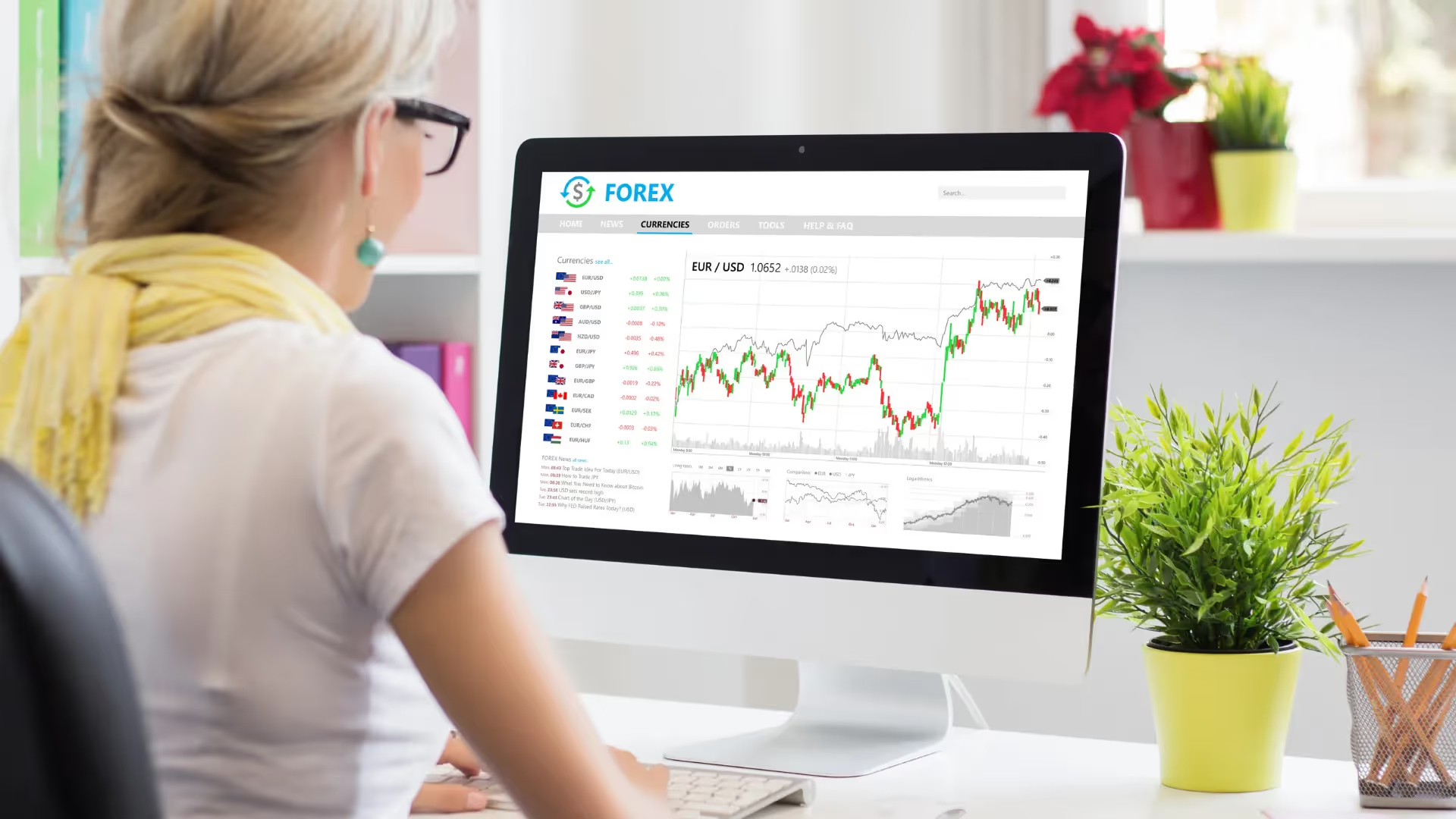
Algorithmic trading comprises six practical abilities that work together to enable automation in Forex. It works more quickly than humans, handles much more data, guarantees execution precision, allows for stress-testing strategies before putting capital at risk, adapts continuously to market changes, and scales well across different markets and volumes. Below are the details of each feature, along with practical advice, workflow changes, and common problems to watch out for.
1. What is speed and low-latency execution?
Speed and low-latency execution are critical because every millisecond matters. Speed is what makes a difference. Algorithms monitor price feeds and automatically route orders. They can open and close positions in milliseconds while matching orders at expected latencies. This quick execution reduces slippage and helps traders capitalize on short-lived pricing mistakes that manual trading can't catch. However, it also increases operational risk; a slow feed, a queuing issue, or a misconfigured gateway can turn a structural benefit into an expensive outage. In practice, execution is handled as firmware rather than a philosophy. This means measuring latency, checking jitter, and setting up automatic alerts, so that fixes can be made before they affect profits and losses. Our funded trading program is designed to enhance performance in such environments.
2. How does large-scale data processing work?
Large-scale data processing algorithms can ingest price ticks, level 2 liquidity, macro releases, and alternative signals at a speed that would overwhelm traders trying to analyze them manually. Through proper feature engineering, raw streams can be changed into signals that spot microstructure edges and cross-market arbitrage opportunities. However, there are trade-offs, which include complexity, data cleanliness, and backfill bias. Relying on bad historical feeds can lead to false confidence. Therefore, expect to spend as much time checking datasets and pipeline integrity as you do improving model logic.
3. What is precision and reduced human error?
Precision and reduced human error. Algorithmic execution follows strict entry and exit rules, position sizing rules, and order types. This helps mitigate common mistakes in manual trading. It also reduces transaction costs, with studies showing that algorithmic trading cuts them by 10% to 15% compared to traditional methods. However, deterministic rules do not eliminate all risk; they just shift it. You swap behavioral errors for model and operational risks, so it's essential to have real-time risk controls, automatic kill-switches, and pre-trade checks. For traders looking to minimize errors further, our funded trading program provides structured support and guidance.
4. How can deterministic backtesting and simulation help?
Deterministic backtesting and simulation. You can test a strategy against past data, ticks, and simulated slippage before using real money. This turns trading into a cycle: hypothesis, simulate, fix, repeat. Good backtests need tick-level fills, realistic latency modeling, and walk-forward validation to avoid overfitting. Common mistakes include survivorship bias and overly optimistic fill assumptions; think of backtesting as a record of what happened, not a prediction, and use deterministic seed conditions so results are the same each time. Most teams handle strategy testing with random scripts and spreadsheets because it's familiar. However, this broken approach masks model drift and allows incorrect assumptions to persist in production. As backtests grow, auditability collapses, leading to hidden losses over time.
Platforms like AquaFunded offer teams deterministic backtesting engines, built-in risk controls, and low-latency execution connectors. This setup ensures that strategy validation, risk gating, and live deployment use the same recorded logic, speeding up iteration time while maintaining consistent results.
5. What is continuous market reactivity?
Continuous market reactivity: Algorithms watch the market without getting tired. They can spot and respond to changes in market conditions, widening spreads, or sudden liquidity drops right away. This constant attention increases the chance of seizing quick opportunities and lowers the delay in reacting to news-driven FX moves.
However, automation requires careful management; when markets change, strategies designed for one condition can worsen losses. Create systems to detect market conditions, have emergency routines to respond, and keep logs of what happened so you understand why the system acted that way and how to make changes. Additionally, our funded trading program can provide you with the support you need to optimize your trading strategies.
6. How does scalability across instruments and volume work?
Automation enables the execution of many strategies across currency pairs, timeframes, and venues without increasing headcount. This capability supports portfolio diversification and capacity growth. Operational scale is crucial since algorithmic trading dominates modern markets. In fact, over 70% of all trading volume in the United States is generated through algorithmic trading, as noted in The Future of Trading Algorithms: Trends and Predictions for 2025 and Beyond. This market-level signal highlights the importance of capacity and connectivity. As scaling occurs, new constraints arise, including order routing logic, rate limits, and correlation risk. To mitigate these issues, it is essential to plan capacity, stagger executions, and set portfolio-level limits, ensuring that growth does not outpace governance. Our funded trading program can help navigate these complexities effectively.
Why treat algo portfolios like factory lines?
A short analogy can illustrate this concept: treat a live algorithm portfolio like a factory line, where every sensor, PLC, and safety interlock must be tested and logged. Otherwise, a tiny upstream fault may cascade into the entire system. Next, the outcomes will show the unexpected ways these features lead to measurable advantages and reveal various hidden tradeoffs.
Related Reading
- Pros and Cons of Forex Trading
- Is Forex Trading Profitable
- How Many Forex Trading Days in a Year
- Forex Secrets
- How to Trade Forex With $100
- Day Trading vs Forex
- Forex Tax Rate
- Is Forex Closed on Christmas
- How to Use ADX Indicator for Day Trading
- Best Time Frame to Trade Forex for Beginners
- Is Forex Trading Hard
- Risk Management in Forex Trading
- Scalp Trading Forex
- Forex Trading Account Types
Benefits of Forex Algo Trading
Algorithmic forex trading gives you evident advantages. These include faster, more repeatable execution, with choices based on rules rather than feelings. Continuous testing changes how strategies are developed into a cycle, like engineering. When automation is seen as essential to maintain, the benefits include lower costs, steadier returns, and systems that can be monitored and improved over time.
1. What are the advantages of millisecond execution?
Millisecond execution and timing precision. This concept revolves around predictable timing rather than heroics. In practice, execution performance is measured using three key metrics: median fill latency, jitter range, and the percentage of fills within expected slippage bands. It is essential to keep an eye on these numbers at all times. Changes in routing or broker queuing can significantly affect them, especially during times of low liquidity or breaking news. A common mistake is treating latency as a one-time improvement rather than a metric that needs to be monitored regularly. This misunderstanding can cause occasional spikes that gradually weaken your competitive advantage.
2. How does rule-based execution improve trading?
Rule-based, emotionless execution is appealing because it aims to keep feelings out of decisions about how much to trade and when to exit. This pattern shows up in both individual and institutional trading. Making exceptions when losses happen usually raises risk and leads to larger losses. By using enforceable gating, unchangeable stop rules, and automatic cooldown times, we can turn behavioral risks into engineering problems that can be recorded, alerted to, and solved. This way, trading becomes repeatable rather than based solely on stories. Our funded trading program helps traders manage their strategies effectively, free from emotional interference.
3. Why is robust backtesting essential?
Robust backtesting depends on reproducible validation. When we treat it as audits instead of hopeful proofs, our approach changes. It’s essential to include walk-forward windows, realistic slippage profiles, and the same seed conditions to ensure reproducibility. Key practical signals to track are out-of-sample decay and feature drift. Models that seem adequate on fixed historical data often fail when input distributions change. To reduce this risk, create automated retraining triggers and post-deploy forensic logs. These tools will help determine when a model stops working, as it did during backtesting.
How can teams improve operational deployment?
Most teams handle deployment with scripts and quick checks because this method feels familiar and is low-cost. While this can work when the project is small, it can become a maintenance tax as strategies start to go live. Alerts increase, manual updates cause configuration drift, and incident response takes much longer. Platforms like the funded trading program help by centralizing risk management, providing clear backtesting logs, and offering fast connectors. As a result, teams can shorten incident resolution time from hours to minutes while maintaining a complete audit trail.
4. What benefits come from increased diversification?
Increased diversification provides operational benefits by allowing simultaneous market coverage. Running the same systematic rules across multiple pairs and timeframes smooths portfolio variance and increases capacity without multiplying headcount. The market structure supports this point; a report on forex trading insights, due by January 15, 2025, indicates that algorithms execute 70% of forex trades. This reliance on automation means that liquidity dynamics and venue behavior are primarily driven by automated flow. Therefore, your risk design must address key factors such as cross-instrument correlation, venue-specific slippage, and pooled exposure limits to ensure that diversification does not lead to concentrated fragility. Our funded trading program is designed to help traders manage these complexities effectively.
5. How does nonstop market coverage affect trading?
Nonstop market coverage and continuous reactivity. You gain uptime and responsiveness, but you also take on the responsibility to manage a constant state. Continuous trading reveals problems you usually don't see in manual workflows, such as execution drift during maintenance windows or model decay over several weeks. To help manage this, some operational controls you can use include automated flattening rules for holidays, heartbeat monitors for market feeds, and capacity throttles that activate when latency or fill quality gets worse. Our funded trading program provides the support you need to navigate these complexities effectively.
What practical signals should traders monitor?
Traders should watch practical signals in all five areas, including pre-trade sanity checks, per-strategy P&L attribution, real-time slippage dashboards, and automated incident runbooks. They focus on speed and calm execution. However, the hardest part is establishing reliable observability so that speed does not outpace control. Our funding program can help traders access the resources they need to improve their monitoring capabilities.
What systemic benefits does algorithmic trading provide?
Research shows that algorithmic trading provides larger systemic benefits. According to Trading Economics, algorithmic trading can cut transaction costs by 30%. This cost reduction affects how much capacity strategies can handle before market impact lowers returns. So, viewing algo trading as an engineering discipline instead of just guesswork brings durable advantages.
How can AquaFunded help traders?
Turn your trading skills into profitable opportunities without risking your own money. AquaFunded gives you access to accounts of up to $400K with the most flexible trading conditions in the industry. There are no time limits or easy profit targets, and traders can enjoy up to a 100% profit split. Join over 42,000 traders worldwide who have earned more than $2.9 million in rewards, all ensured by a 48-hour payment guarantee. Start trading today with instant funding options, or prove your skills through our customizable challenge paths. By enrolling in the funded trading program, traders can keep up to 100% of their earnings.
What should teams watch for in operational wins?
An operational win may feel decisive at the moment, but the next technical hurdle can quietly expose the assumptions that most teams never stress-test.
6 Tips for Forex Algo Trading

Treat algorithmic forex trading like a production system by planning for failure, measuring capacity, and making every change traceable. Below are six practical tips, provided with operational detail for immediate action.
1. What is Aqua Funded?
Aqua Funded can be a fast way to trade with real money without using your own account. They offer funded accounts up to $400K, flexible challenge paths, instant funding, and a payout guarantee. Funded accounts should be seen as a helpful tool, not an easy shortcut. It's essential to create a checklist that aligns with real trading rules, test strategies on a shadow account to demonstrate how the funded account’s size and margin work, and embed profit-split rules into your trading process so that accounting and payout triggers occur automatically. By treating the funded account like a real trading environment, traders can reduce the likelihood of mistakes that often cost them money as they grow their trading activities.
2. How to structure learning for competence?
Build a learning pipeline that teaches engineering, not just signals. How can curiosity be turned into competence? Structure learning as a series of small, clear projects. Start with a unit-tested signal module, then add a simulated execution layer that records fills and slippage. Next, use the same code on a paper account for 30 calendar days of live ticks. Pair each module with one metric to improve, like median fill latency or out-of-sample Sharpe. Use code review and version control to ensure that strategy changes are documented. Sign up for focused workshops that include tick-level backtests and live demo debugging sessions. Finally, practice incident postmortems after every failed trade set to learn faster; our funded trading program can provide valuable support as you refine your strategies.
3. How to vet third-party signals?
Vet third-party signals and preserve independent judgment. How can one avoid blindly copying advice? Treat any external algorithm like external code: ask for a provenance file listing data sources, feature changes, and backtest seeds. Then run a falsification test by changing a single input and checking how performance changes. Implement shadowing by using the third-party strategy on a small scale for at least 90 trading days to collect real execution data. Always require a transparent stop mode, such as a worst-day drawdown limit, plus a maximum consecutive loss count. This method changes trust into verification, allowing decisions to be based on evidence rather than hype.
What are the downsides of copying strategies?
Most teams handle strategy deployment by copying config files or sharing scripts through chat. This method is fast and familiar. While it works well at first, it can lead to hidden assumptions as live positions grow. Response times slow down, and it becomes hard to reconstruct incident logs. Platforms like AquaFunded centralize deployment controls, provide deterministic backtesting records, support role-based access, and offer low-latency connectivity. This centralization helps reduce the time it takes to detect issues, effectively closing the gap between a strategy change and its operational audit.
4. How to extract signal from sentiment data?
Extracting a signal from sentiment data needs practical steps to make news and social feeds useful. Treat sentiment as a high-noise feature set and use three essential controls: a source confidence weight, an event lag window, and an ensemble of scorers. Create a daily measure that assesses how well each source predicts price moves over set time frames, and reduce the weight of sources that change direction during stressful times.
Named entity recognition can help focus on currency-specific comments, while aggregated indicators are better than single-article triggers. This method lowers the risk of being misled by breaking news. Lastly, conducting event studies on major announcements provides insights into how sentiment features behave around both planned and unplanned announcements.
5. How to improve mean reversion?
Improve mean reversion by using statistical checks and capacity checks. To make mean reversion stronger on a larger scale, replace makeshift thresholds with statistical tests. Use cointegration tests to select pairs and estimate the half-life of mean reversion using exponential fits. Turn that half-life into a time-based exit rule to prevent holding positions for too long when market conditions change.
Backtest with rolling windows to detect parameter decay, and perform capacity analysis by simulating market impact based on notional values and the venue's liquidity. Lastly, add a time stop and a liquidity stop to each trade rule; for example, exit if the realized spread doubles or if cumulative slippage exceeds a set fraction of expected returns. Our funded trading program can help traders implement these strategies effectively.
What is iceberg-style execution?
Implement iceberg-style execution with adaptive slicing and surveillance. How should large FX orders be split without leaving a footprint? Use adaptive slicing that reacts to measured market liquidity rather than relying on fixed child sizes. Integrate a liquidity estimator that tracks depth at the top of the book, adjusting child order sizes as depth contracts. Our funded trading program can help you manage these strategies effectively.
Alternate between limit and immediate-or-cancel child orders based on current queue dynamics. To ensure execution quality, monitor real-time metrics such as the percentage of child orders filled, average time to fill, and realized market impact per lot. Additionally, maintain a surveillance routine that detects unusual fill patterns and automatically flattens positions if slippage or fill variance exceeds a predefined threshold, helping protect capital when market liquidity disappears.
What do recent analyses indicate about trading?
Practical proof points matter because adoption has measurable effects. A 2025 Market Watch analysis shows a 25% increase in profitability, indicating that algorithm users improved their returns. Also, a 2025 industry review, Forex Trading Insights, found that 70% of forex trades are executed by algorithms, highlighting how standard automated flows have become, which changes liquidity behavior you need to design around.
What is a critical operational rule?
One clear rule is to instrument everything you change. Additionally, attach an operational rollback plan to every tweak. This way, you can make sure that one bad parameter does not cause a big problem in a live system.
What mistakes do traders keep repeating?
That fix sounds final until you notice that the mistakes traders keep making can quietly ruin their trading edge.
Related Reading
- Types of Forex Trading
- Forex Trading Spreads
- Forex Market Liquidity
- Forex Mini Account
- Forex Price Action Trading
- Forex Hedging Strategies
- Forex Trend Indicators
- Advanced Forex Trading
- Best Forex Pairs for Scalping
- London Session Forex Pairs
- Best Currency Pairs to Trade for Beginners
- Minor Currency Pairs
- Best Time to Trade USDJPY
- Forex Swing Trading Signals
Mistakes to Avoid in Algorithmic Trading

Algorithms fail when the fundamentals are ignored. If you fix the seven common mistakes listed below with clear practices you can start using immediately, you will stop turning predictable mistakes into permanent losses.
1. What breaks when you treat risk as an afterthought?
Overlooking risk controls can lead to serious problems. When risk is treated like an afterthought, a recoverable drawdown can quickly turn into a loss of all your money. To lessen these risks, it's important to set strict limits that machines can enforce: set stop-losses for each trade, have a daily loss limit for each strategy, and define a maximum drawdown for your entire portfolio that automatically pauses trading.
Position sizing should be based on notional values, with volatility factored in rather than a fixed percentage. It's also essential to track three live signals: your current exposure as a percentage of usable margin, the number of consecutive losing trades, and how long the longest open trade has been active.
In a 90-day test, adding a daily loss limit cut tail losses in half while keeping strategy returns the same, as these limits successfully stopped losing streaks before they got worse. Think of risk controls as watertight compartments on a ship; you can't steer just by hoping the storm will be kind. For those considering structured opportunities, our funded trading program provides tailored support to help manage risk effectively.
2. Why do rules that worked last month fail this month?
Ignoring changes in market conditions can explain why rules that worked last month often do not work this month. Markets can change their behavior while your thinking stays the same. Instrument regime detectors should notice changes in liquidity, volatility, and correlation, which can then signal behavior changes such as smaller order sizes, wider price ranges, or a complete pause in putting strategies. Create simple tests to run every morning: compare the actual spread, top-of-book depth, and cross-pair correlation to a 30-day rolling baseline.
If any measure goes beyond a set limit, put that strategy into shadow-only mode until an operator checks it. This way of operating isn't just theory; it’s about keeping things running smoothly. You want predefined responses rather than panic reactions to news events.
3. What happens when you deploy a black-box rule?
Eradicating human checkpoints. Automation is efficient, but it is not perfect. If we rely solely on code, we can face catastrophic failure during rare events. Most teams manage live deployments with automated pipelines since this method speeds up their work. However, there is a hidden cost: complex outages and unclear P&L attribution can accumulate over time. Platforms like AquaFunded provide deterministic deployment logs, role-based approvals, and automated rollback triggers. These features help teams shorten review cycles from days to hours while keeping an audit trail.
A two-layer control model should be used: automated execution for routine work and human involvement when safety thresholds are breached. It is essential to keep a daily human review of exceptions that the system flags. This review looks at every unusual metric crossing, not just every trade.
4. What happens when you trust a black-box rule?
Not fully understanding the algorithm can lead to unexpected problems. Using a black-box rule means you might face surprises without clear explanations. It's essential to ask for the source of every strategy document. Key documents include: annotated code, timestamped data sources, parameter seeds, and a one-page behavioral spec listing expected edge cases and possible failure modes.
Before starting live funds, run a 30-day micro-portfolio test using 1 to 5 percent of the target size. This helps gather data on real fills and slippage. Also, the strategy should pass specific tests, such as having less than 2x historical realized slippage and not showing unexplained overnight position growth. Treating the spec and micro-test as necessary documentation, rather than optional paperwork, is essential.
5. Why is trusting flimsy tests a costly blind spot?
- Data freshness
- Survivorship bias removal
- Realistic commission models
6. What happens when you tailor rules to past quirks?
Overfitting to history can significantly hurt future performance. Tailoring rules to past quirks often causes this problem. To avoid overfitting, switch from using a single set of optimized parameters to a set of nearly optimal parameter sets. Also, choose rules that perform steadily across different samples.
A helpful method is to measure decay by training on multiple non-overlapping periods and calculating the variance of out-of-sample returns; high variance shows that the parameters are too fragile. Adding capacity limits and simulating market impact into the selection score ensures that a high backtest return, which relies on unrealistic tight fills, does not pass the evaluation. In the end, prefer more straightforward rules that show consistent, small advantages over complex systems that only succeed during one historical period.
7. How do small fees compound into significant performance leaks?
Ignoring transaction and execution costs can lead to significant performance problems. Small fees, especially, can hurt tight-margin FX strategies a lot. Instrument execution quality metrics include realized spread per trade, percent of child orders filled, average time-to-fill, and slippage per lot. Using these live metrics helps guide scaling decisions; each scaling step should show neutral or positive execution impact before increasing size.
Running cost-sensitivity tests during backtesting is very important. These tests should model both fixed fees and variable market impact, helping you record the break-even notional where impact cancels out the edge. For thin pairs or high-frequency entries, it's best to use adaptive slicing and limit orders until you can prove consistent child-fill quality.
What is the recurring pattern observed during rollouts?
Practical observations of patterns during rollouts are essential. In a 12-month rollout across three retail FX desks, a clear recurring pattern emerged: teams that combined enforced risk gates, daily exception reviews, and conservative micro-deployment experienced drawdowns that were 40-60% smaller during volatility spikes. This was in stark contrast to teams that relied solely on automation. This pattern highlights the crucial difference between a recoverable incident and a systemic failure.
How should you treat your algo portfolio?
Treat your algo portfolio like a chemical plant, not a trading hobby. You should not depend on intuition when a reactor overheats; instead, you have sensors, automatic shutoffs, and clear escalation paths. The same discipline should guide your position sizing, backtests, and execution.
What choice do you make about funding?
The curiosity loop helps to stop routine failures. However, the choice you make about funding and how much you decide to use changes the rules in ways that many traders do not expect.
Join Our Funded Trading Program Today - Trade with our Capital and Keep up to 100% of the Profit.
You can spend months perfecting deterministic backtests and execution logic, only to see growth stall because of funding hoops, scattered broker setups, and slow approvals that slow you down. Think about AquaFunded, a funded trading program that links your systematic forex algo trading efforts to live, low-latency automated execution. With built-in risk controls and easy funding paths, you can grow with discipline, improve your strategy faster, and keep your focus on algorithmic trading, your advantage. If you’re interested in making the most out of your trading journey, consider our funded trading program for the support and capital you need.
Related Reading
- Best Forex Pairs to Trade During Asian Session
- Best Forex Funded Account
- Top Prop Firms
- Best Prop Firm
- Forex Prop Firms
- Best Forex Pairs to Trade During New York Session
- Best Forex Trading Platform
- Forex Trading for Beginners
- Forex Trading Hours
- Forex Trading Brokers
- Forex Trading Course
- What Is Forex Trading and How Does It Work
- Forex Currency Trading
- Forex Online Trading
- How Does Forex Trading Work
- Online Forex Trading
