




How Does Forex Trading Work (Detailed Guide)
How Does Forex Trading Work: Explore proven strategies, common pitfalls, and risk control techniques with AquaFunded’s guide for effective forex trading.

Success with forex trading stems from a deep understanding of market dynamics and disciplined practices. Observing detailed forex trading success stories often inspires the question: how does forex trading work? A closer look at currency movement, technical signals, and fundamental trends reveals that strategic entries, exits, and risk management are critical distinctions between steady performers and casual traders. Consistent application of proven methods transforms theoretical insights into measurable gains.
Mastering currency exchange requires translating technical principles into practical skills while adapting to market challenges. A thorough study of trading techniques and money management underscores that sustained success is built on informed decisions and ongoing learning. Focus on strategy and disciplined performance paves the way to overcoming uncertainty and achieving results. AquaFunded’s funded trading program offers the necessary capital and tools to support reliable trading practices.
Summary
- Forex is massive and accelerating, with global FX trading at $9.6 trillion per day in April 2025, up 28 percent since 2022, and the US dollar on one side of 89 percent of trades, meaning macro dollar moves often drive correlated price action.
- Retail participants face different liquidity dynamics, accounting for roughly 5.5 percent of daily forex volume in earlier industry counts, which helps explain wider spreads and execution gaps compared with institutional flow.
- The trouble is mostly process, not mystery: over 90 percent of beginner traders fail within the first year, and only about 10 percent are consistently profitable, according to CPT Markets. TradingView reports roughly 95 percent of retail traders lose money, highlighting failures in sizing and routine.
- Skill and time matter: the average forex trader spends about 10 hours a week trading, according to TradingView, and repeated, concentrated single-pair practice for 60 to 90 days consistently shows measurable improvements in decision speed and consistency.
- Operational friction scales poorly because many traders rely on spreadsheets and manual checks, which the article notes can take hours each day to reconcile and can lead to sizing errors and missed rules as positions multiply.
- A phased, rules-first approach works: 30/60/90 day stepwise plans, mandatory stop placement, and percent-of-equity sizing were linked to faster behavioral change in coached programs, with 60-day interventions producing the most consistent improvement.
- AquaFunded's funded trading program addresses this by providing access to capital once traders demonstrate consistent adherence to rules and risk controls, enabling them to focus on execution, sizing, and steady performance without risking their personal savings.
How Does Forex Trading Work

Forex trading is the act of exchanging one currency for another in a market where price moves create gains or losses. You always buy one side of a pair and sell the other, and profit comes when the market moves in the direction of your chosen position compared to your entry and position size.
1. Currency pairs
Base and quote are explained simply. The pair tells you which currency you buy and which you sell. For example, EUR/USD means one euro priced in US dollars. Pairs are split into majors, minors, and exotics. Your choice matters because volatility, spreads, and liquidity vary significantly across them. Think of the pair like a seesaw: you push up one side by buying it, and the other side moves down.
2. Exchange rates
How price shows value. The exchange rate is the number of units of the quote currency required to exchange one unit of the base currency. Every pip movement changes your unrealized profit or loss. Rates change for reasons you can track, from interest rate differences to capital flows, and those underlying factors determine how fast and how long a move lasts.
3. Market orders and order types
How do you tell the market what you want? A market order executes right away at the best available price, while limit and stop orders let you choose prices to enter or exit later. Good traders match order types to their goals: use limits to pick exact entries, use stops to limit losses, and use market orders when execution speed matters more than price.
4. Execution and trading platforms
Where plans become trades, execution quality depends on platform routing, current liquidity, and whether the broker hedges or internalizes flow. Execution problems can cause slippage, partial fills, and unexpected fills during news events. Those are operational risks you need to measure and manage before you increase position size. In this context, a funded trading program can provide the resources you need to navigate these complexities effectively.
5. Leverage and margin
Leveraging and margin, how small capital controls larger exposure, helps you trade more than your actual cash. Margin allows you to open positions that are much larger than the money you have, which means you can have bigger gains but also bigger losses. This tool is most effective when used carefully. A common mistake is failing to account for volatility, which can quickly turn a slight loss into a margin call in a single session.
6. Technical analysis
Technical analysis uses price history to assess probability. Traders review charts, structure, and indicators to identify entry zones, momentum, and support or resistance levels. Patterns and indicators give you probabilities, not guarantees, so it is essential to mix them with strict risk rules. If you don't, the same signal could cost you repeatedly.
7. Fundamental Analysis
Fundamental analysis examines how economic factors affect price movements. Events such as inflation, employment reports, and central bank decisions can affect the expected future value of currencies. These changes often cause sudden shifts in pricing across currency pairs. By applying fundamental analysis, traders can determine their directional bias and risk appetite. Then they can apply execution and sizing rules to manage typical short-term fluctuations.
How can new traders avoid common pitfalls?
When teaching new traders, a clear pattern emerges: low-cost courses and quick-win promises often lead learners to use leverage before they really understand how to manage execution and risks. This can make predictable market moves turn into avoidable losses. Many beginners hit a wall quickly because of this issue. When condition A is "limited preparation," traders should use smaller position sizes and focus on execution drills. However, in condition B, where there is a "repeatable process," traders can increase their position sizes without risking their entire accounts.
What tools help track trading performance?
Most traders rely on spreadsheets and manual checks to track open trades and risk because this approach is familiar and requires no new tools. However, as positions grow and time zones overlap, managing everything becomes complex, mistakes can occur, and daily check-ins can take hours. Platforms like AquaFunded centralize position monitoring, automate sizing rules, and provide real-time alerts. This innovation reduces manual check time from hours to minutes while maintaining complete audit trails.
What is the scale of the forex market?
Keep perspective on scale, because market structure matters: The global forex market is the largest financial market in the world, with a daily trading volume of over $6 trillion, as noted by DailyForex on September 1, 2020. In contrast, retail forex trading accounts for about 5.5% of the total daily trading volume in the forex market, according to DailyForex. This difference explains why retail participants face different liquidity and execution dynamics compared to large institutions.
What Other Insights Should Traders Consider?
The surface-level picture of how forex works may seem complete, but a deeper challenge awaits the next question.
Related Reading
- Forex Trading Success Stories
- Pros and Cons of Forex Trading
- Is Forex Trading Profitable
- How Many Forex Trading Days in a Year
- Forex Secrets
- How to Trade Forex With $100
- Day Trading vs Forex
- Forex Tax Rate
- Is Forex Closed on Christmas
- How to Use ADX Indicator for Day Trading
- Best Time Frame to Trade Forex for Beginners
- Is Forex Trading Hard
- Risk Management in Forex Trading
- Scalp Trading Forex
- Forex Trading Account Types
Is Forex Trading Hard
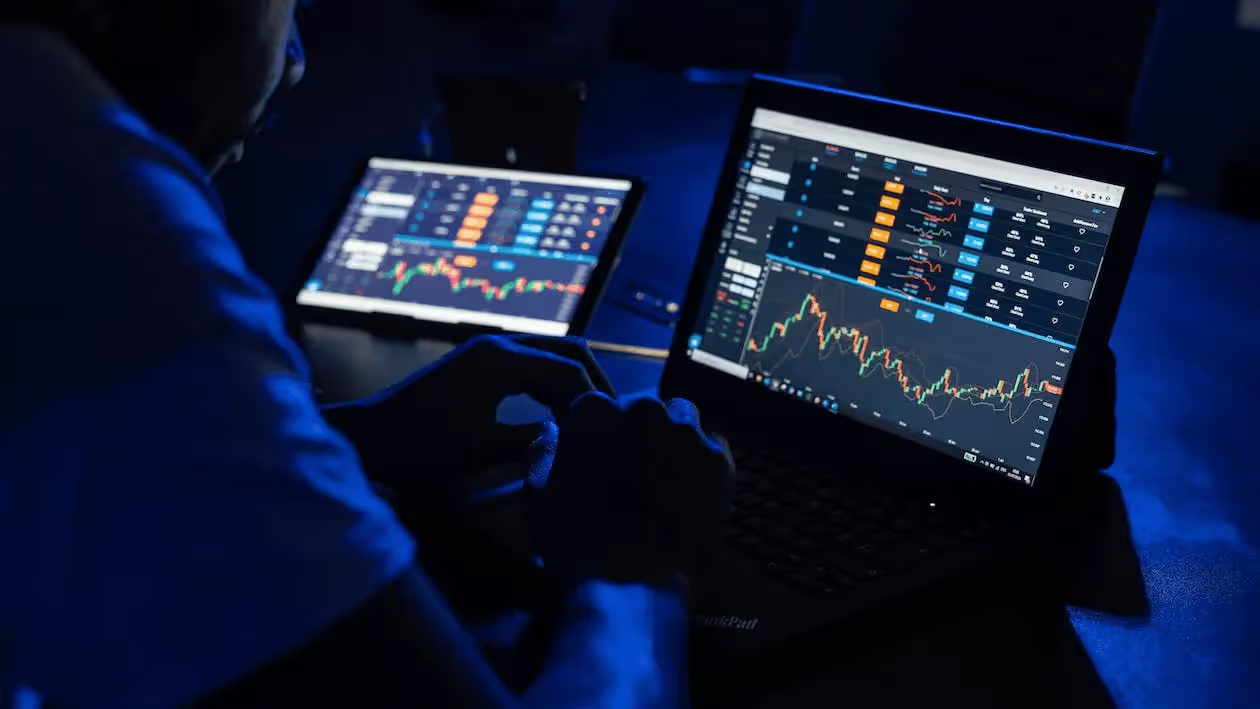
Forex trading can be tough in some areas, but it’s not due to needing genius-level math or secret insights. The main challenges stem from managing emotions, breaking bad habits, and developing the right skills, which you can improve with practice and the right tools. To facilitate this process, consider our funded trading program, which provides valuable resources and support.
The markets are large and move quickly, making execution and discipline important. According to the 2025 Triennial Central Bank Survey, global FX trading reached $9.6 trillion per day in April 2025, a 28 percent increase from 2022. This means that liquidity and flows can overwhelm weak processes. Also, the dollar is a key driver of price movements; the US dollar accounted for 89% of all FX trades in April 2025, so significant dollar moves often show up as quick, related changes across many currency pairs.
Myth 1: “Forex is just too hard for beginners.”
Reality, rephrased: The basics are simple, but people trip up when they try to go too fast too soon. The real issue is skipping the fundamentals and trading with real money before they’ve learned how to enter, exit, and manage risk. This leads to a sharp early loss, making people think the market is too complex rather than recognizing that their process isn’t fully developed.
Myth 2: “You must be a math whiz or hyper-intelligent to make it.”
Reality, rephrased: Success relies more on attitude and process than on being super bright. Patience, emotional control, and consistent habits are far more critical than complex math. I’ve seen a trend: traders who work on building good habits, like simple position-sizing rules and a regular review process, do better than those who chase complicated strategies without discipline.
Myth 3: “Demo profits mean you’re ready for live trading.”
Reality, rephrased: Demo accounts help with recognizing patterns and understanding order flow, but they don’t teach you how to respond to real money situations. A common mistake is that traders make money in demo accounts, increase their stakes, and then struggle when real trades go poorly. The crucial step is to gradually transition, using small, timed live sessions that encourage emotional learning while keeping losses small.
Myth 4: “Consistent profit in forex is impossible.”
Reality, rephrased: It is possible to earn consistently, but only when your strategy, execution, and risk management are in sync. The market doesn’t work against you; inconsistent outcomes usually come from rules or sizing that don’t consider volatility. Sticking to discipline and a solid process turns possible gains into steady earnings over time.
Why does it feel hard at first?
This challenge is common among new traders: unrealistic expectations collide with high emotional stakes. Beginners often expect quick wins and become frustrated when they encounter typical losses. The failure point is not in the concepts of pips or pairs, but in the mismatch between ambition and the deliberate practice required to internalize execution and sizing.
What role do emotions play in trading?
Impatience and emotional reactions can exacerbate trading errors. Fear and greed influence how traders set stops, size their positions, and decide whether to exit early or hold on. This shows why practicing without stress is not enough. A gradual transition from demo to small live size is essential. Not practicing on purpose makes these problems even worse. While backtesting and watching strategic videos help set up a basic understanding, they can't replace valuable time in the market. When traders spend more time at their screens and focus on a single pair for 60 to 90 days, they see significant improvements in their decision-making speed and consistency. This happens because they reduce information overload and improve consistency.
How to manage trades effectively?
The familiar method of managing trades creates hidden costs, but there is a better path. Most traders manage risk and position sizing manually since it feels familiar and low-cost. This approach may work when there are only a few positions. However, as activity grows, manual checks can become problematic: sizing errors occur, rule exceptions slip through, and stress increases. Platforms like AquaFunded centralize rule enforcement and automate sizing, which is part of our funded trading program. This helps traders maintain discipline as volume increases while reducing operational errors that can compound losses.
What is a learning analogy for Forex?
A concrete image to hold onto is helpful. Think of learning Forex like learning to ride a motorcycle on a busy expressway. You can study manuals and practice in a parking lot, but real skill develops when you navigate traffic at high speeds and learn to smooth your reactions. This friction is uncomfortable; however, it is also trainable. With the correct sequence of drills, panic can change into control.
How to start refining your trading process?
Start by treating your edge as a process to improve, not a secret to find. Pick one currency pair and set strict sizing rules. Run a 60-day test where you document the reason for every trade and your feelings. This rule helps you be clear, reduces risk, and speeds up your learning. As a result, emotional control grows alongside your technical abilities.This simple idea changes how you view trading.
10 Mistakes Beginners Make While Trading Forex
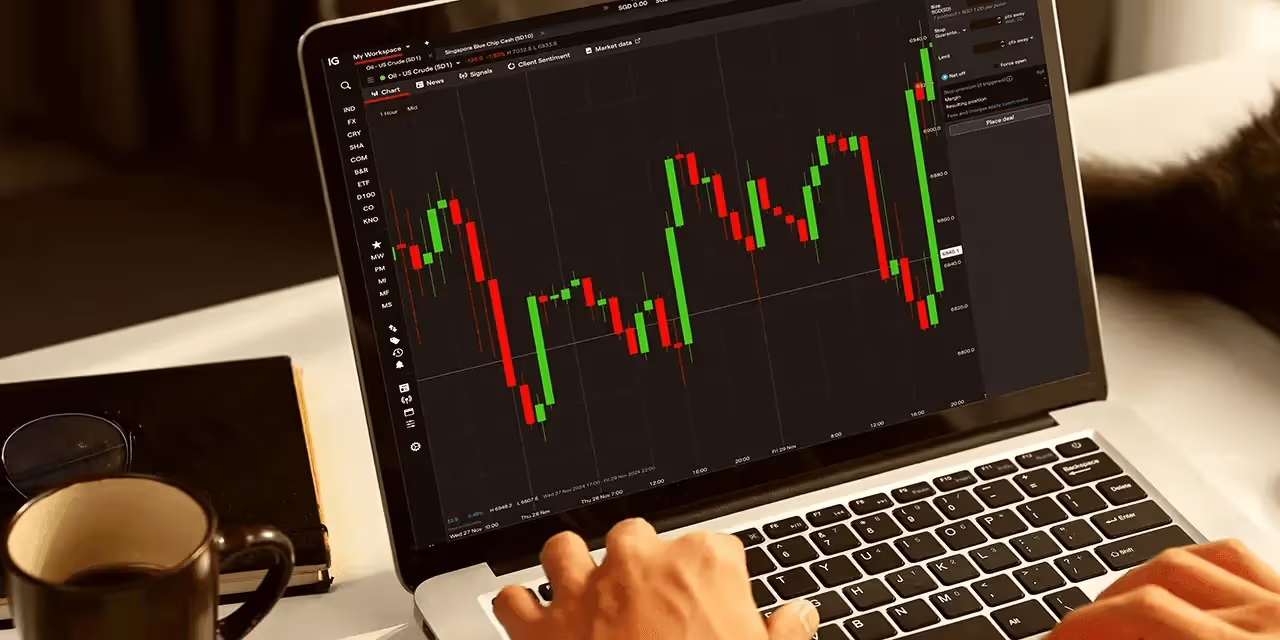
Beginners fail for predictable reasons; they trade without rules, misprice risk, and let feelings dictate decisions. Addressing these ten everyday habits is the fastest way to stop losing money and rebuild confidence. The scale of the problem is clear. According to CPT Markets, “Over 90% of beginner traders fail within the first year,” and, in 2025, “only 10% of traders are consistently profitable.” These numbers indicate that failures stem from habits and processes rather than market complexity.
1. Trading Without a Clear Plan
What happens
You jump into trades because a chart looks nice, someone gives you a tip, or a signal lights up, without any written rules for when to enter, exit, or what your loss limit is.
Why does this break you
Your decisions become random instead of repeatable, so you can't tell if you have an advantage. Results can vary widely, and you may attribute them to the market rather than your trading process.
How to change it
Write a one-page trade plan that explains the setup, the goal, where to place your stop, your target, and a rule for sizing. Treat that plan as a contract you must follow before you start trading with real money.
2. Poor Risk Management.
What happens
You choose position sizes based on your feelings or preferences rather than using math. This puts a significant portion of your account at risk for one outcome.
Why does this break you
If something goes wrong, you could lose a lot, which makes it hard to recover. This can lead to slow recovery and more emotional choices.
Practical fix
Use percent-of-equity sizing and set a maximum per-trade loss cap so that each loss is small enough to protect your mindset and funds.
3. Not using stop-loss orders
What happens
You hope the price reverses and leaves losing trades open, thinking an exit will come if you wait longer.
Why does this break you
Losses become unpredictable and personal, causing you to hold onto bad positions until the account bleeds out.
Better approach
Define stop placement by structure or volatility and accept that stops are protection, not punishment. If you want to learn the discipline, run small, time-boxed live sessions where stops are mandatory.
4. Overleveraging.
What happens
A trader uses leverage to increase profits, but does not consider market ups and downs or follow position sizing rules.
Why does this break you
Minor price changes can lead to significant losses.
Margin calls can occur quickly, shifting focus from improving strategy to simply preventing the account from failing.
Fix it
Limit leverage by setting a maximum notional cap, and size positions to achieve a consistent fractional risk per trade rather than a fixed lot size.
5. Overtrading
What happens
You trade more often to cure boredom, chase the next signal, or recover after losses.
Why does this break you
Costs add up, attention fragments, and the quality of setups erodes because quantity replaces selection.
How to stop it
Set a maximum number of trades per day or per week, and require a documented setup checklist for every execution. This forces discipline and reduces friction from endless churn.
6. Emotional Trading
What happens
Fear and impulse change your stops, your size, and your execution after the fact.
Why does this break you
Rules are abandoned, losses compound, and confidence drains away because every decision feels reactive rather than reasoned.
What helps
Build a short behavioral protocol, for example, a 30-minute cooling period after any loss greater than X percent, and keep a trade journal noting emotions alongside technical reasons.
7. Ignoring Economic News and Market Events
What happens
You run technical setups on Windows that, when scheduled data or unexpected headlines appear, can blow up.
Why does this break you
Volatility spikes create slippage and invalidated entries, causing otherwise sound strategies to fail for reasons unrelated to the setup.
Practical guard
Maintain a simple economic calendar with a risk filter, and reduce the size or avoid new entries during high-impact releases.
8. Trading Too Many Currency Pairs
What happens
You try to trade everything that moves and cannot keep up with the differing behavior across pairs.
Why does this break you
Analysis quality declines, signals are missed, and cognitive overload leads to sloppy decisions.
A better path
Limit yourself to two or three pairs, study their typical ranges and correlations for 60 to 90 days, and master execution in that narrow set before expanding.
9. Unrealistic Expectations
What happens
You expect steady daily profits and rapid account growth, then react wildly when reality delivers drawdowns and volatility.
Why does this break you
Ambition without a plan creates impatience, pushes you toward higher risk, and accelerates burnout.
Reality check
Treat trading as a skill that compounds slowly, set realistic performance checkpoints, and reward process adherence over short-term PnL.
10. Not Reviewing or Learning From Trades
What happens
You move from trade to trade without dissecting what worked, what failed, and why.
Why does this break you
The same mistakes repeat, learning slows, and improvements stall because feedback loops are missing.
How to fix it
Run weekly reviews of trades by setup, entry discipline, and emotional state, then change one variable at a time to see which improves outcomes.
What key behaviors improve trading success?
During a 60-day single-pair discipline program, traders showed the most consistent improvement in their behavior. By limiting the types of trades and requiring notes after each trade, they learned faster and could see precise results, while significantly reducing random losses. Most traders follow familiar routines: spreadsheets, manual sizing, and ad hoc checks because they feel simple and low cost. That approach works early, but as positions and time zones multiply, errors, missed rules, and emotional exceptions compound, turning avoidable mistakes into large drawdowns. Platforms like AquaFunded centralize sizing rules, automate stop enforcement, and provide audit trails, enabling traders to maintain discipline as activity grows while reducing operational errors that would otherwise amplify losses.
What are practical habit suggestions for traders?
Concrete habit suggestions that work in practice include focusing on one specific constraint. Traders should select one pair, set predetermined size limits, and conduct a mandatory weekly review for 90 days. This combination encourages repetition, shortens the feedback loop, and helps develop emotional control in high-stakes situations.
Why is improving processes and habits challenging?
The frustrating part is clear, but often ignored: fixing processes and habits is more challenging than learning indicators. Many people quit before the real work starts. It's essential to keep pushing through because the following steps will show how to turn these corrections into effective professional habits.
10 Tips for Forex Trading Like a Pro

Trading success in forex relies on disciplined routines that can be repeated under pressure, rather than on lucky runs or clever hacks. Below are actionable tips to convert ideas into measurable behaviors and enhance trading performance: disciplined routines you can repeat and insights on margin vs. leverage.
1. Trade from a written, tested plan.
A trading plan should clearly outline the precise entry trigger, the exact stop-loss placement, the take-profit rule, the trading sessions you will use, and the maximum risk you are willing to take per day or week. Treat the plan like a contract: before increasing your position size, run the setup on a 60 to 90-day trial and record every decision. This trial period forces you to determine whether the setup offers a real edge or is simply noise.
2. Protect capital before chasing returns
Protecting your money is essential before seeking returns. Making loss control the main goal is key. Allocate a fixed percentage of your equity risk to each trade, and determine your position size based on how much the market moves. Set a daily loss limit that triggers a stop-loss when your losses reach that level. This method helps keep your mindset steady, enabling you to assess your performance more effectively without getting caught up in revenge trading.
3. Keep leverage low until your process is repeatable
Use low effective leverage as a training tool, not as a way to make quick profits. Start with position sizes that can withstand a week of higher-than-normal market volatility. Only increase your exposure once you have a consistent record of following your trading plan and making positive expectations in your trades. This method helps prevent minor execution errors from leading to significant losses that could wipe out your account.
4. Trade less, choose better
Trade less, choose better. Quality beats quantity. Create a strict checklist that a setup must pass before you make a trade; if the setup does not meet even one requirement, do not proceed. Limit how many trades you do each day or week, and write down the reasons for each trade you make. This method transforms ‘I’m bored’ into a prompt to make better choices, improving decision-making.
5. Outsource emotional limits to rules and tools
Outsource emotional limits to rules and tools. Instead of trying to push away fear or greed, automate your responses. Use mandatory stop orders, pre-set take-profit levels, and set a cooling-off rule if you have any losses that go beyond your limit. If you feel the need to change a life, stop and see that feeling as necessary information. Write it down and think of it as a behavior you need to work on, not as something unusual.
6. Build a stepwise education plan before scaling
A stepwise education plan is essential before scaling trading efforts. It outlines the learning path in three stages: 30 days of backtesting, 60 days of small live trades on a single pair, and 90 days of improved execution under varying session conditions. Set specific practice hours each week, and use those sessions to track execution errors, not just profit and loss (PnL). The average trader’s time commitment is substantial. According to TradingView, "the average forex trader spends 10 hours a week on trading," and in 2025, this time investment helps build skills.
7. Respect news and volatility with predefined filters
Stay informed about news and market changes with preset filters. Set a basic news filter: reduce your position size or avoid trading for certain minutes before and after big economic data is released. Identify which economic reports have historically disrupted your strategies and include them in your routine. Think of news exposure as something you can change, not just as random events you have to deal with.
8. Narrow your instrument list and learn the behavior deeply
Narrowing your instrument list helps you learn more and understand behavior better. Pick two or three pairs and study their usual range, how they relate to each other, and when they are most liquid for at least 60 days. This focused practice accelerates feedback, improves order timing, and reduces cognitive load. When you expand your selection later, add one pair at a time while keeping the same testing discipline.
9. Set realistic performance milestones and measure process metrics
Set realistic performance milestones and measure process metrics. Replace headline profit targets with specific process targets, such as the percentage of trades that follow the checklist, the average loser size as a percentage of equity, and slippage per trade. These metrics show whether improvement is happening as a trader. Raw returns alone may conceal the behavioral drift that can negatively affect accounts.
10) Choose a platform that enforces discipline, not pressure
Most traders manage their growth using spreadsheets and hope because this method is easy and cheap. While this approach works at first, as more rules are added, manually checking everything can create confusion, introduce errors, and increase stress. Platforms like AquaFunded offer clear funding paths, set risk rules, and standard targets. This helps traders focus on executing their plans and learning, rather than worrying about personal funding. By reducing administrative tasks, traders can maintain discipline and shorten the time between practice and real skill gains.
What is the impact of discipline on trading success?
A hard truth is that most retail accounts fail because the trading process breaks down before the market does. This highlights why TradingView states, "95% of forex traders lose money." 2025, points out that the problem is more about the cost of skipping discipline than about market conditions. After a 90-day focus on one trader pair, a clear pattern emerged: repetition significantly reduced decision errors and emotional responses. As a result, measurable execution got better, even when prices changed quickly.
How does planning improve trading outcomes?
A concrete image to hold: trading without a plan is like driving a car without mirrors, expecting to navigate traffic purely by intuition. Adding a plan, including risk limits and selected instruments, replaces risky guesswork with a controllable process. This simple constraint also shows something else that you’ll want to see next.
Related Reading
- Forex Algo Trading
- Types of Forex Trading
- Forex Trading Spreads
- Forex Market Liquidity
- Forex Mini Account
- Forex Price Action Trading
- Forex Hedging Strategies
- Forex Trend Indicators
- Advanced Forex Trading
- Best Forex Pairs for Scalping
- London Session Forex Pairs
- Best Currency Pairs to Trade for Beginners
- Minor Currency Pairs
- Best Time to Trade USDJPY
- Forex Swing Trading Signals
Join Our Funded Trading Program Today - Trade with our Capital and Keep up to 100% of the Profit.
To showcase your forex edge under real pressure while safeguarding your own capital, consider AquaFunded's funded program. This program replaces manual risk checks with clear rules. This allows you to focus on execution, position sizing, and leverage control across currency pairs. You can also maintain a fair profit split once you have proven your process. Join our funded trading program today!
Related Reading
- Best Forex Pairs to Trade During Asian Session
- Best Forex Funded Account
- Top Prop Firms
- Best Prop Firm
- Forex Prop Firms
- Best Forex Pairs to Trade During New York Session
- Best Forex Trading Platform
- Forex Trading for Beginners
- Forex Trading Hours
- Forex Trading Brokers
- Forex Trading Course
- What Is Forex Trading and How Does It Work
- Forex Currency Trading
- Forex Online Trading
- Online Forex Trading
