




10 Best Prop Firms That Allow Trade Copiers
Discover prop firms that allow trade copiers with AquaFunded's expert guide. Compare the top 10 platforms, fees, and copy trading rules.
Traders with profitable strategies often face a common limitation: insufficient capital to maximize their earning potential. What is a funded account offers a solution by providing access to substantial trading capital without risking personal funds. Many successful traders leverage trade copiers to replicate winning strategies across multiple accounts, but prop firms that allow trade copiers have specific rules and requirements that traders must understand.
Finding the right proprietary trading firm requires careful consideration of its automation policies and trading restrictions. The best-funded firms provide clear guidelines on third-party tools while offering the flexibility that serious traders need to scale their strategies effectively. For traders ready to access significant capital with automation support, AquaFunded's funded trading program provides the tools and flexibility needed to grow a trading career.
Table of Contents
- What is a Trade Copier?
- Benefits of Trade Copiers in Trading
- How to Trade With Trade Copiers
- 10 Best Prop Firms That Allow Trade Copiers
- Scale Your Trading Safely With Personal Trade Copiers
Summary
- Trade copiers eliminate manual execution across multiple accounts, compressing hours of repetitive order entry into a single-action deployment. Research shows that 78% of copy traders report positive returns, and user ratings average 4.5 out of 5 stars for these automation systems. The efficiency matters most when managing five or more accounts, where manual replication introduces timing delays and execution variance that corrupts strategy integrity.
- Prop firms distinguish between personal multi-account management and prohibited group trading, though most traders discover this boundary only after payout requests trigger compliance reviews. Firms use pattern-detection algorithms that analyze entry timing correlations, lot-size ratios, stop-loss placement, and holding duration across thousands of accounts. When trades correlate at 0.95 or higher with supposedly unrelated accounts, systems flag this as coordinated replication regardless of profitability.
- Synchronized trading creates correlated exposure, collapsing the diversification that prop firms depend on for risk management. When one thousand accounts execute identical breakout trades and hit stop-loss levels simultaneously, firms face multiplied losses across their entire trader network. This concentration violates the fundamental assumption that funded traders make independent decisions based on individual analysis.
- Most compliance scrutiny happens during the first withdrawal requests, not during the evaluation phases. Firms collect challenge fees whether traders pass or fail, reserving detailed reviews for funded accounts requesting payouts. Traders who pass evaluations fairly and trade profitably for weeks often face account termination and the forfeiture of earnings when retroactive analysis reveals patterns that violate buried terms governing independent trading.
- Execution delays between follower accounts and varied lot size multipliers reduce the algorithmic fingerprint of perfect synchronization. Introducing thirty-second stagger windows or adjusting position sizes based on recent drawdown levels creates variance that makes trading appear more independent while maintaining strategic integrity. Identical millisecond timing and mathematical consistency across all accounts signal automated copying that compliance systems identify immediately.
- AquaFunded's program clarifies which copier configurations align with its risk framework, granting explicit permission for personal trade copier use across your own accounts and providing transparent rules on what constitutes prohibited coordination.
What is a Trade Copier?
A trade copier is specialized software that copies trades from one trading account to another in real time. When you execute a buy order in your primary account, the copier automatically mirrors that position in your secondary accounts, adjusting lot sizes and risk parameters based on your custom settings.

🎯 Key Point: Trade copiers eliminate the need for manual execution across multiple accounts, ensuring instant synchronization of your trading strategy.
💡 Example: If you buy 0.1 lots of EUR/USD in your master account, the copier might automatically execute 0.05 lots in Account A and 0.02 lots in Account B based on your predetermined risk ratios.
"Trade copying technology has transformed portfolio management by enabling simultaneous execution across multiple accounts with zero delay." — Trading Technology Review, 2024
How does trade copier technology integrate with trading platforms?
The technology connects directly to trading platforms like MetaTrader 4 and MetaTrader 5. You set up a master account to run your strategy, then set up follower accounts that automatically execute those trades. Modern systems let you customise each follower account with different lot size multipliers, maximum position limits, and risk filters. According to Benzinga, this setup lets traders copy one master account to multiple follower accounts simultaneously, even when those accounts are on different servers or in different locations worldwide.
How does the trade copying process begin?
The process starts when you place a trade in your master account. The copier software detects this execution and sends the order details to your follower accounts. You control which trades get copied through customizable filters: copy only EUR/USD positions, limit risk exposure per account, or set maximum lot size limits. The system applies these settings while keeping your portfolio synchronised across all accounts.
How do modern copiers maintain synchronization across locations?
Modern trade copiers work remotely using an internet connection. Your main account can run on a server in New York while follower accounts operate on servers in London. The software synchronises everything across locations in milliseconds, preserving the timing and quality of your strategy's execution.
The Promise That Attracts Traders
Traders are drawn to copiers for one clear reason: they save time and effort. If you've created a profitable strategy, why not use it across multiple funded accounts? Pass one evaluation, prove your strategy works, then increase returns by deploying that same approach across five, ten, or twenty accounts without spending more time watching screens or making manual order entry mistakes.
The automation reduces the mental burden of managing multiple positions simultaneously. You study the markets once, execute once, and your entire portfolio moves together. Research from ARN Fintech Blog shows that 78% of copy traders report positive returns, explaining the appeal of copying proven strategies.
Why do prop firms reject accounts despite working technology?
The technical capability exists, and the software works as advertised. However, prop firms don't evaluate trade copiers based on whether the technology functions; they assess them based on risk concentration and pattern detection.
How does correlated exposure create amplified risk?
When you copy trades across multiple prop firm accounts, you create correlated exposure. If your master account enters a leveraged gold position at 10:47:23 AM and 15 follower accounts execute identical orders within the same second, the firm's risk management system treats the event as a single, amplified risk rather than 15 independent trading decisions.
If that trade moves against you, the firm faces multiplied losses across every synchronized account simultaneously.
What patterns do detection algorithms identify?
Prop firms use advanced detection algorithms that analyse lot size ratios, stop-loss placement patterns, take-profit distances, trade duration, and trade sequences across sessions. When hundreds of accounts exhibit algorithmically identical behaviour, firms recognise automated replication rather than independent skill.
What rules do most traders overlook when using copiers?
Most prop firms don't ban trade copiers in their terms of service. They restrict copying trades between accounts, third-party signal replication, and group trading arrangements.
Using a copier to manage your own personal accounts within a single firm's system is often allowed. Using a copier to copy trades from a Telegram signal group across twenty different prop firms will result in account termination and denied payouts.
How do prop firms detect unauthorized trade copying?
Enforcement happens after the fact. You pass the evaluation, trade profitably for weeks, then request a withdrawal. Compliance reviews your trade history against their database, looking for correlation patterns.
Positions matching thousands of other accounts with suspicious precision trigger flags for "strategy pooling" or "non-independent trading." The payout gets rejected, the account is suspended, and appeals reveal clauses you missed during signup.
Why do profitable traders still face account suspension?
Traders who grow their business using copiers without understanding these details discover restrictions only after investing significant time. The violation wasn't intentional; the software functioned as designed.
But firms treat synchronized trading as an existential threat to their capital allocation model, regardless of profitability.
How do prop firms structure their business model?
Prop firms operate using a specific business model: they provide capital to independent traders whose different strategies create a diverse risk portfolio. When thousands of accounts make the same trades simultaneously, that variety disappears. The firm backs a single strategy with excessive leverage, exposing it in ways their risk management cannot handle.
If one thousand accounts copy the same breakout trade on crude oil futures and hit stop-loss levels, the firm faces synchronized losses across its entire trader network. This undermines the premise that funded traders make independent decisions. Trade copiers collapse the statistical distribution of wins and losses into correlated outcomes.
Why do firms allow personal accounts but prohibit cross-trader copying?
This explains why firms allow personal multi-account management but prohibit cross-trader copying. When you copy your own strategy across your own accounts, you're scaling your individual edge. When you copy someone else's strategy or participate in signal groups, you create systemic correlation that threatens the firm's risk model. The distinction is mathematical, not about fairness.
Programs like funded trading programs structure their rules to clarify which automation tools align with their risk framework and which create compliance issues. Our approach recognises that traders want to scale proven strategies while maintaining the independent decision-making that keeps risk manageable across their capital.
Why do trade copiers remain popular despite these risks?
But if trade copiers create such obvious risks, why do they remain popular among traders seeking sustainable income?
Related Reading
- What is a Funded Account
- How to Grow a Small Trading Account
- What is Trading Commodities
- Long Term Trading Strategy
- Capital Growth Strategy
- What is a Cash Account in Trading
- What is Compound Trading
- How Much Money Do You Need to Start Trading Stocks
- Scale Trading
- Small Account Trading
- How to Evaluate Investment Opportunities
- Blown Trading Account
- What is PNL in Trading
- Do Prop Firms Use Real Money
- Prop Firm Account Management
- Borrowing on Margin
- Trading Leverage
- Does FTMO Offer Instant Funding
- Prop Firm Static Drawdown
- Funding Traders Rules
- What Is Prop Firm Account
- Synthetic Funded Account
- What Is Funded Firm
- Trading Challenges
- Prop Firm IP Address Rule
- Instant Funding Rules
- Do Prop Firms Use Real Money
- How to Get a Funded Trading Account
- FTMO vs The5ers Comparison
- Best Forex Pairs to Trade
- Best Automated Crypto Trading Platform
- Prop Firms in USA
Benefits of Trade Copiers in Trading
Trade copiers offer three clear advantages: they reduce execution time across multiple accounts, eliminate manual entry errors in parallel positions, and let you copy strategies exactly without monitoring every chart simultaneously. These benefits explain why traders continue exploring copier solutions despite unclear prop firm policies.

Benefit
- Faster Execution
- Error Reduction
- Strategy Replication
Impact
- Reduced time across multiple accounts
- Eliminates manual entry mistakes
- Exact copying without monitoring
Key Advantage
- Simultaneous order placement
- Automated position copying
- Hands-free trade management
🎯 Key Point: Trade copiers transform manual trading inefficiencies into automated advantages, making them particularly valuable for traders managing multiple accounts simultaneously.

💡 Tip: The elimination of manual entry errors is often the most significant benefit for traders, as even small mistakes can compound into substantial losses across multiple positions.
"Trade copiers address the fundamental challenge of managing multiple accounts by automating what would otherwise require constant manual attention and perfect execution." — Trading Technology Analysis, 2024
How does time compression benefit traders using multiple accounts?
Managing multiple trading accounts manually requires repeating the same analysis and order-entry process for each account. You find a setup on EUR/USD, place your trade in Account A, then repeat the exact same process in Accounts B, C, and D. By the time you finish entering position four, market conditions may have shifted enough that your entry prices differ by several pips. A trade copier consolidates this step-by-step process into one action.
What do users say about automated trading systems?
According to Tradesyncer, users rate these systems at 4.5 out of 5 stars because automation removes repetitive execution tasks, consuming hours weekly. You analyse once, execute once, and the system handles distribution across your portfolio. This preserves mental energy for decisions requiring judgment: reading price action or managing risk, rather than mechanical order entry.
How do time savings compound with multiple trading strategies?
The time savings add up when you trade multiple instruments or run strategies requiring frequent adjustments. Scalpers entering 20 positions daily across 5 accounts would need 100 manual orders; with a copier, that drops to 20. This fundamental shift changes what's operationally feasible for a single trader.
How does automated execution eliminate trading inconsistencies?
Manual copying introduces differences you cannot fully control. You might enter Account A at 1.0850, but by the time you switch platforms and execute Account B, the price ticks to 1.0853. Your stop-loss placement shifts between accounts because you're eyeballing levels rather than copying precise pip distances. These small inconsistencies accumulate into meaningful performance differences across accounts that should, in theory, mirror each other.
Trade copiers eliminate this drift. When your master account executes at a specific price with defined stop-loss and take-profit levels, follower accounts receive identical parameters, adjusted only by your predetermined lot-size multipliers. If you set a 50-pip stop across all accounts, every position respects that exact distance. The system avoids misclicks and human errors that create tracking headaches when analysing account performance.
Why does execution speed matter during volatile markets?
This precision matters most when market conditions change quickly. When news events cause prices to move fast, manual traders face a choice: execute quickly with less accuracy, or maintain precision while accepting slippage on later entries. Copiers synchronize execution across all accounts within milliseconds, preserving both speed and consistency.
Why does managing multiple accounts create exponential complexity?
Running different strategies across multiple accounts creates exponential complexity. Managing five accounts isn't five times harder than managing one: you're juggling multiple decision threads simultaneously, tracking which setup applies to each account, remembering open positions across accounts, and switching between different risk parameters.
How do trade copiers cleanly segment their strategies?
Trade copiers organize strategies clearly. Your main account runs your primary strategy, while follower accounts receive filtered trades. Want Account B to copy only gold trades while Account C focuses on forex majors? Set symbol filters. Need to adjust position sizes based on account balance? Configure lot multipliers. The system automatically maintains these differences, eliminating the mental burden of tracking which rules apply where.
Why does this clarity become critical when scaling proven approaches?
This clarity becomes critical as you scale proven approaches. Programs like the funded trading program recognize that traders develop specific edges within defined parameters. Flexible account structures allow you to deploy copiers that respect those boundaries, replicating only setups matching your documented strategy rather than forcing manual filtering across multiple platforms.
How do advanced copiers manage risk beyond simple trade mirroring?
Advanced copiers include features beyond simple trade mirroring: maximum drawdown limits per follower account, automatic pause if equity drops below thresholds, and instrument blacklists for specific risk profiles. These controls transform copiers into risk distribution systems that manage exposure across a portfolio rather than treating each account in isolation.
Why shouldn't all funded accounts receive identical position sizes?
Not all funded accounts have the same risk parameters. Your $10,000 evaluation account shouldn't receive the same position sizes as your $100,000 funded account, even when copying the same strategy. Copiers let you establish these relationships using multipliers and filters, ensuring each account grows appropriately based on its capital and drawdown limits. You're spreading a strategy across different risk situations in ways that manual execution cannot reliably maintain.
What's the difference between correctly configuring and using copiers?
Knowing how to set up a copier and knowing how to use one while following prop firm rules are different skills.
How to Trade With Trade Copiers
Set up a master account to execute your strategy, connect follower accounts through the copier software, then configure risk parameters that determine how trades replicate across your portfolio. The technical setup takes about thirty minutes, but deciding which accounts to link, what multipliers to apply, and how to stay compliant with prop firm rules requires considerably more thought.
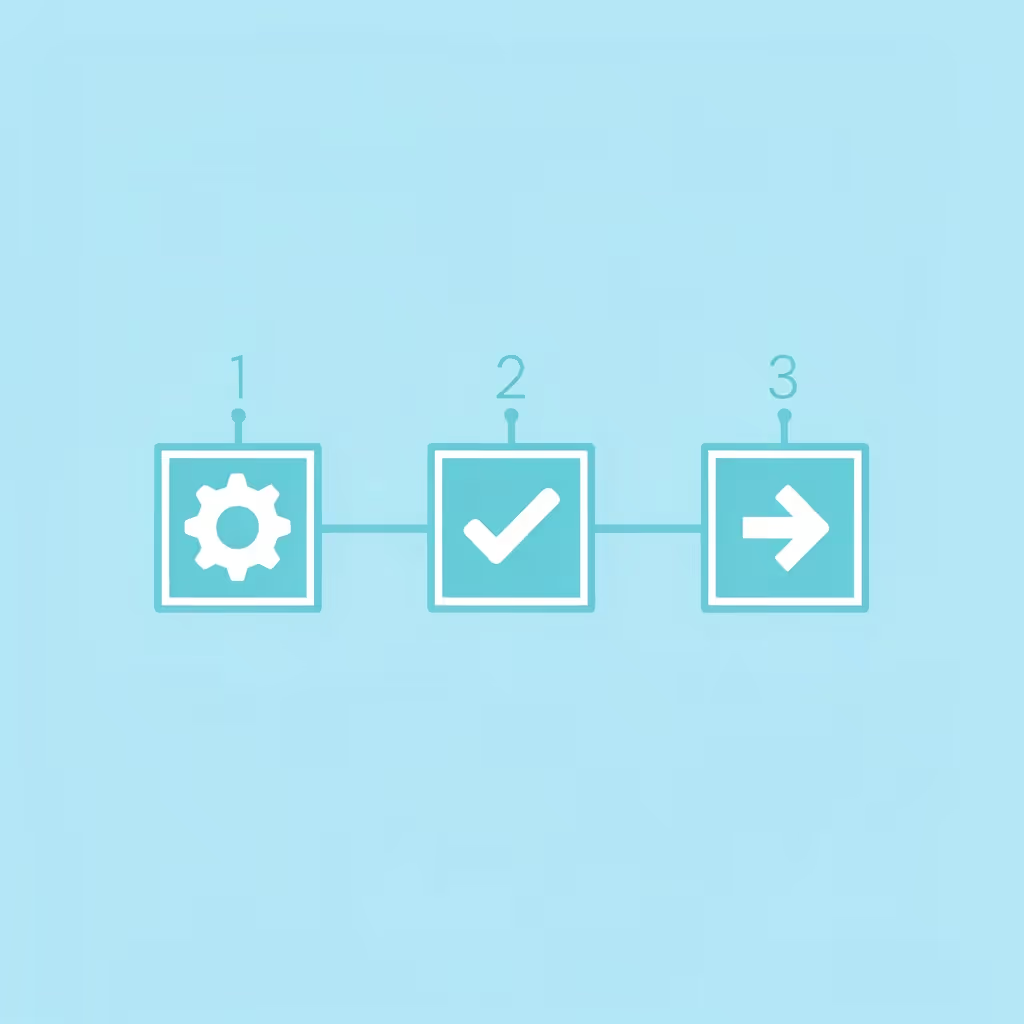
Setup Step
Master Account Setup
- Time Required: 10 minutes
- Complexity Level: Low
Connect Follower Accounts
- Time Required: 15 minutes
- Complexity Level: Medium
Configure Risk Parameters
- Time Required: 5 minutes
- Complexity Level: High
Compliance Review
- Time Required: Variable
- Complexity Level: High
🎯 Key Point: The actual software configuration is quick and straightforward – it's the strategic decisions about risk management and compliance that require careful planning and consideration.

⚠️ Warning: Prop firm rules can be complex and vary significantly between providers. Always verify compliance requirements before connecting multiple accounts to avoid rule violations that could result in account termination.
Two Distinct Use Cases That Shape Everything
Experienced traders use copiers to scale their proven strategies. You've spent months developing a strategy that makes consistent money with clear entry rules, risk management plans, and position sizing logic. Your master account becomes the decision-making hub. Every analysis, trade execution, and adjustment happens once. Follower accounts receive those decisions immediately, scaled according to their capital allocation and risk limits.
How do trade copiers eliminate execution friction for experienced traders?
When you trade manually across five accounts, you're doing the same thing five times, creating timing delays and execution differences that can hurt your strategy's results. The copier eliminates this problem, letting you focus your mental energy on reading markets instead of handling the details.
What calculations do newer traders face with trade copying?
New traders face a different calculation. You lack pattern recognition from years of screen time and haven't stress-tested your risk-management instincts through drawdowns. You connect your trading account to a master trader whose performance history you've studied, and their trades appear in your account automatically.
You watch how they manage positions during volatile sessions, note their stop placement relative to support levels, and observe how they scale out of winners versus cut losers quickly.
How does learning through observation compare to theoretical courses?
Learning happens by watching how real money is used, not by taking theory classes. You can track win rates, average hold times, maximum drawdown periods, and recovery patterns. This data shows whether the strategy matches your risk tolerance before committing significant capital.
How do lot size multipliers work with different account balances?
Setting lot size multipliers requires accounting for balance differences and constraints. Your master account holds $10,000. Follower Account A has $25,000. Follower Account B carries $100,000. A 0.1 lot position in the master could scale to 0.25 lots for Account A and 1.0 lots for Account B, maintaining proportional risk. However, if Account B operates under stricter drawdown rules that limit position sizes regardless of capital, your multiplier must respect both mathematical proportion and regulatory constraints.
What advanced filtering options do trade copiers provide?
Advanced copiers let you set maximum position limits per follower account. Even if the multiplier calculates to 1.5 lots, you can cap execution at 1.0 lot based on the account's risk parameters. You can blacklist specific currency pairs that don't fit your evaluation requirements and pause copying during news events if some accounts prohibit trading around economic releases. These filters transform the copier into a sophisticated distribution system that respects each account's unique constraints.
How should you manage stop-loss and take-profit across multiple accounts?
Control extends to stop-loss and take-profit management. Some traders copy entry signals but manage exits independently per account, while others want complete synchronization, where closing the master position triggers immediate closure across all followers. The choice depends on whether you're scaling a fully systematic strategy or distributing discretionary setups that you'll manage in real time based on price action.
How does platform compatibility create execution delays?
Most copiers work within MetaTrader systems, connecting MT4 to MT4 or MT5 to MT5. However, traders often analyse charts on TradingView while executing through prop firm MT4 accounts. Since the platforms don't integrate natively, the copier must bridge that gap by running a master account on your preferred charting software and follower accounts on the required prop firm platform.
This introduces latency: every trade passes through an additional software layer, adding milliseconds to execution time that can matter during fast-moving markets.
What technical setup challenges do traders face?
The technical setup requires running multiple platform instances simultaneously: TradingView for analysis, MT4 for your master account, and multiple MT4 instances for follower accounts across different prop firms. Each platform consumes system resources, and processing load issues compound execution delays.
Traders report frustration when their preferred workflow collides with the technical requirements of reliable trade copying. The software functions perfectly in isolation, but integrating it into existing trading infrastructure reveals compatibility issues that marketing materials omit.
How do prop firm restrictions affect copier software?
Some prop firms limit which expert advisors you can install on their platforms. The copier software typically works as an EA attached to your MT4 terminal. If the firm maintains a whitelist of approved EAs and your copier isn't on it, you're in a grey area: the account might work fine for weeks, then get flagged during a compliance review.
Programs like a funded trading program clarify which automation tools integrate smoothly with their infrastructure, eliminating uncertainty about whether your copier setup will pass compliance scrutiny.
How does trade copying concentrate risk across multiple accounts?
Copying trades across multiple accounts concentrates risk rather than multiplying it linearly. When your master account enters a position, every follower account mirrors that exposure simultaneously. If the trade moves against you, drawdown builds across your entire portfolio at once, amplifying the impact of each decision rather than diversifying risk.
This concentration is most dangerous during unexpected volatility. A single trade hitting your stop-loss triggers a synchronized loss across all connected accounts, potentially violating drawdown limits on multiple evaluations simultaneously. The correlated exposure creates consequences that manual trading would have distributed across different timeframes and decision points.
What strategies help mitigate the losses from synchronized trading?
Experienced traders reduce this risk by spreading out trade entries or varying position sizes. You might wait thirty seconds before copying a trade to a follower account so you can cancel it if the price moves unfavourably, or use smaller multipliers that keep follower positions smaller than the mathematics would suggest. These changes reduce potential profits but prevent large, synchronized losses that can shut down multiple accounts simultaneously.
The real question isn't whether trade copiers work, but whether the firms you're targeting will permit their use as intended.
Related Reading
- Sources of Capital
- Cash Reserve Account
- Short Term Stock Trading
- Investment Performance Analysis
- Managed Account vs Brokerage Account
- Systematic Trading
- How to Analyze a Stock Before Buying
- Forex Capital Trading
- What is a Retracement in Trading
- How is Risk Involved in Calculating Profit?
- Convergence Trading
- Liquidity Trading
- Futures Trading Minimum Account Size
- What is Drawdown in Trading
- No Activation Fee Prop Firm
- Best Prop Firms in UAE
- Forex Prop Firms With Instant Funding
- Regulated Prop Firms
- Prop Challenge
10 Best Prop Firms That Allow Trade Copiers
Twelve prop firms allow personal trade copier usage under specific conditions. Policies range from clear permission to restrictive frameworks requiring careful interpretation. These firms distinguish between personal multi-account management (allowed) and third-party signal distribution or group trading (which triggers immediate termination). Your ability to scale using copiers depends on understanding where each firm draws these critical lines.

🎯 Key Point: The difference between personal multi-account management and third-party signal services is the make-or-break factor for copier approval.
"Personal multi-account management is typically permitted, while third-party signal distribution consistently triggers account termination across prop firms." — Industry Analysis, 2024

⚠️ Warning: Even permitted copier usage requires strict adherence to each firm's specific guidelines - violations can result in instant disqualification and forfeited profits.
1. AquaFunded
AquaFunded operates with clear trade copier rules: you can copy trades between your own accounts without restrictions, provided you don't share signals outside the company or collaborate with unrelated accounts. Our funded trading program offers funding of up to $400,000 per account, with growth potential, and supports both MetaTrader 4 and MetaTrader 5 platforms that integrate smoothly with professional copier tools.
What makes their instant funding option attractive?
Our instant funding option skips evaluation risk entirely: you can access capital right away and use your copier strategy without proving it makes money first. This matters when you've already tested your advantage and want to grow quickly. AquaFunded structures offer profit splits up to 100% with add-ons, eliminating profit-sharing friction that reduces returns elsewhere.
How do their compliance rules work for trade copiers?
Their rule framework addresses specific compliance scenarios: trade management software for execution is permitted, managing multiple funded accounts simultaneously is explicitly allowed, but copying external signals or coordinated group strategies is restricted. This clarity prevents discovering violations after building your workflow around a specific configuration.
The 48-hour payout guarantee, with no activation fees after evaluations, reinforces a trader-first positioning. You won't wait weeks to access earnings or pay recurring fees that erode profitability. Our AquaFunded program recognizes that traders want to leverage proven strategies across multiple accounts without artificial barriers.
2. Lark Funding
Lark Funding offers four evaluation pathways (one-step, two-step, three-step, and instant funding) with profit splits climbing to 90% and explicit permission for Expert Advisors and trade copiers. With no time limits or minimum trading day requirements, you can test your strategy at your own pace before scaling across accounts once you've confirmed the approach works within their risk parameters.
How does Lark Funding's payout speed benefit trade copier users?
Their payout processing in under 6 hours eliminates cash flow problems caused by slow withdrawal cycles. When managing multiple accounts through a copier, matching profitability creates matching withdrawal requests—delayed payouts limit your ability to grow returns or move capital efficiently. Lark's fast processing lets you access earnings and redeploy them without the administrative delays that hamper your capital allocation strategy.
What makes Lark Funding's rule structure trader-friendly?
The clear rule structure eliminates vague clauses about "coordinated trading" or "strategy pooling." They state which automation tools work with their infrastructure and which create compliance issues, removing the retroactive enforcement problem in which accounts are terminated after weeks of profitable trading because a compliance review flags patterns that violate buried terms.
3. FXIFY
FXIFY emerged from FXPIG's multi-asset broker infrastructure, providing traders access to over 300 assets with capital scaling to $400,000 based on consistency metrics. The firm offers instant funding that eliminates evaluation requirements, enabling immediate capital use. According to Benzinga, traders can access up to 90% profit-sharing arrangements that scale returns across multiple copier-linked accounts.
Which platforms does FXIFY support for trade copying?
Our platform support includes MetaTrader 4, MT5, and DXTrade, all of which feature built-in trade copier functionality or seamless third-party integration. This native compatibility eliminates technical friction and execution latency. Your master account executes on the same infrastructure as follower accounts, preserving millisecond-level synchronization during volatile sessions.
How does FXIFY help you monitor copier-linked portfolios?
FXIFY's real-time analytics dashboard lets you monitor performance across your copier-linked portfolio from a single interface, tracking drawdown levels and stop-loss execution without logging into separate accounts. This centralized visibility helps you identify when synchronized losses approach danger zones before triggering violations.
4. FundedPrime
FundedPrime works with Eightcap to provide professional-level trading through the DX Trade and TradeLocker platforms. Evaluation challenges have no time limits and require a 10% profit target, allowing you to test copier strategies without artificial pressure. The firm supports stocks, forex, commodities, indices, ETFs, and crypto, enabling you to diversify across multiple asset types and reduce risk.
How does FundedPrime help track copier performance?
The Australian firm offers advanced trader dashboards with real-time analytics to track copier strategy performance across market conditions. You can identify which currency pairs generate consistent profits, which timeframes produce the highest win rates, and how drawdown patterns shift during volatility. This data proves critical when refining copier configurations to maximise returns within risk parameters.
What are FundedPrime's payout terms for traders?
Their 80% profit split with fortnightly payments creates a predictable cash flow as you scale across accounts. You know exactly when you can access earnings for transfers or withdrawals, without waiting for compliance reviews or payment processing delays.
5. Trade the Pool
Trade the Pool gives you access to more than 12,000 stocks and ETFs through their Trader Evolution platform. They offer two evaluation paths: Flex Evaluation with unlimited time and minimal rules, or Max Evaluation with higher rewards for 60-day consistency. Account sizes range from $5,000 to $200,000, with profit splits from 50% on Mini Buying Power to 80% on Ultimate Buying Power tiers.
What trading strategies does Trade the Pool support?
The firm allows penny stock trading and supports a range of strategies, including small-cap momentum plays and sector rotation. Most prop firms restrict penny stocks due to liquidity and manipulation risks, but Trade the Pool's rules permit them, expanding the setups your copier can replicate.
How does their evaluation process work?
Their one-step evaluation eliminates multiple challenge phases before accessing funded capital. Pass once, fund the account, and start copying trades at a larger scale. This proves valuable when testing whether a copier setup meets compliance standards before committing to the evaluation process across multiple accounts.
6. Starter Prop Trader
Starter Prop Trader provides a $200,000 practice account with a two-step evaluation process and no time limits, though you must trade for at least four days in each step. Upon passing the challenge phase, you earn a 15% profit share. The firm permits Expert Advisors, automated trading bots, scalping, hedging, martingale, and grid trading strategies—approaches many competitors prohibit.
How does their transparency system work?
Their Rewards Page shows exactly what is happening with all reward requests and statuses. You can see where each withdrawal is in the processing line, whether compliance reviews are pending, and when your funds will arrive. This eliminates the confusion and extra work of tracking payments across multiple copier-linked accounts.
What happens if you fail the first attempt?
The funded account retry privilege gives you a second chance without extra fees if your first attempt breaks risk rules. You can try bold settings, learn where the limits are, then make changes and try again without repurchasing the challenge, making it cheaper to learn.
7. My Funded Futures
My Funded Futures specializes in futures trading with a single-phase evaluation that accelerates access to capital. They offer four funding programs (Starter, Starter Plus, Expert, and Milestone) with account sizes reaching $150,000. You keep 100% of your first $10,000 in profits, then split 90% thereafter. The firm imposes no minimum or maximum number of trading days during the evaluation, giving you complete flexibility to use copier strategies without artificial timing constraints.
How does their fee structure benefit trade copier users?
The monthly fee structure on Starter, Starter Plus, and Expert programs creates predictable costs when scaling across multiple accounts. The Milestone program's one-time fee eliminates recurring charges entirely, which becomes important when managing ten or fifteen copier-linked accounts, as monthly fees accumulate into substantial overhead.
Why do futures markets improve copier execution quality?
Their focus on the future means you're trading with tools that offer deep liquidity and tight spreads, improving copier execution. Slippage becomes less problematic when copying trades across accounts, as the underlying market can handle larger position sizes without significant price changes. This execution advantage is particularly valuable for strategies that require frequent entries and exits, where even small slippage can reduce profits.
8. Blueberry Funded
Blueberry Funded enables account copy trading on all funded accounts. Their broker-backed infrastructure through Blueberry Markets provides ultra-low spreads and commission-free trading on indices and cryptocurrencies, reducing transaction costs that accumulate when running synchronized trades across multiple accounts. Account sizes can grow to $2,000,000 with quarterly growth opportunities, creating long-term scaling potential beyond initial funding levels.
How do their evaluation types match different trading strategies?
The firm offers five evaluation types (one-step, two-step, rapid, stock, and synthetic challenges) that align with the characteristics of your copier strategy. Short-term scalping approaches work well with rapid challenges, while swing trading strategies align better with standard two-step evaluations. This flexibility prevents forcing your copier configuration into an evaluation framework misaligned with your trading timeframe or position duration.
What makes their payout structure beneficial for scaling?
Their 80% profit split with payments every two weeks and average processing in under two business days creates a predictable cash flow for managing multiple accounts. You can plan withdrawals around evaluation milestones or capital reallocation without payment delays disrupting your growth timeline.
9. Lionheart Funding
Lionheart Funding offers four challenge types, including the Roar challenge for Expert Advisors and high-frequency trading professionals. Their 90% profit split, bi-weekly payouts, and absence of time restrictions or minimum trading days during evaluation make them valuable for copier strategies that rely on algorithmic execution or rapid-fire trade sequences that trigger violations on discretionary-focused platforms.
What trading strategies does Lionheart Funding support?
The firm clearly supports news trading and algorithmic strategies that many competitors prohibit, including trading during economic releases and using automated systems that create dozens of positions daily. This allows you to employ more copier approaches without compliance concerns.
How can you segment strategies across different assets?
DX Trade and TradeLocker platform support gives you access to over 500 tradable assets. You can organize strategies by asset class, copying only forex trades to certain accounts while copying commodity positions to others, using the platform's filtering tools to keep these differences automatic.
10. Blue Guardian
Blue Guardian offers profit splits between 35% and 50% across all challenges, which is below industry standards. However, evaluations have no time limits, and you can access funding up to $400,000. Payouts are processed within 7 days, and the platform uses MT5, a popular trading platform. Flexible trading rules permit any trading strategy provided you stay within daily loss limits and meet equity requirements.
How does unlimited challenge duration benefit trade copier validation?
You can use the copier for as long as needed to test your settings across different market conditions: calm periods, sideways markets, and volatile price movements from news events. This testing phase ensures your settings perform well before full launch, preventing the discovery that your copier only works during calm markets but fails when volatility triggers drawdown limits.
What makes Blue Guardian's risk management rules transparent?
Their clear risk management rules explain daily loss limits and equity requirements in simple language. You know exactly what drawdown percentage triggers violations, the maximum position sizes allowed, and how equity calculations determine compliance, eliminating surprise enforcement issues later.
11. FTMO
FTMO started the modern prop firm evaluation model in 2015, creating the two-step challenge structure (FTMO Challenge and Verification) that most competitors now copy. They provide up to $200,000 in simulated capital, with profit splits up to 90%, supporting forex, indices, commodities, stocks, and cryptocurrencies. Their partnership with Quantlane for advanced data analysis gives traders institutional-grade performance tools that optimise copier strategies through statistical validation.
How does FTMO support trader education and skill development?
The firm's educational resources and coaching support help you understand why specific setups work, how to identify high-probability entries, and how to manage risk during drawdown periods. This knowledge transfer matters when building long-term trading skills rather than pursuing short-term profits through signal replication.
What advantages does FTMO's trader community provide?
FTMO's strong reputation and large trader community let you learn how successful traders plan their approaches, what risk parameters they use, and how they grow across multiple accounts. This community knowledge streamlines the configuration of copier settings or the resolution of compliance issues during evaluation phases.
12. FundedNext
FundedNext operates from Ajman, UAE, offering one-step, two-step, and Express Challenge evaluation plans. Profit splits reach 95% with a 15% profit share during the challenge phase. They support MetaTrader 4, MT5, cTrader, and TradingView integration, accommodating diverse copier configurations.
How fast are FundedNext's payout processing times?
The company guarantees payouts within 24 hours and offers compensation if it misses the deadline. Withdrawals clear within one business day, or you receive compensation for delays. This eliminates uncertainty that can disrupt your capital allocation planning.
What scaling opportunities does FundedNext provide?
Account sizes range from $66,000 to $200,000, with opportunities to grow as you demonstrate consistent trading. Prove your copier strategy works reliably, and our funded trading program increases your capital access without requiring additional evaluations or challenge fees.
But knowing which firms permit copiers doesn't prepare you for strategic decisions about how to set them up without triggering the pattern-detection systems that flag coordinated trading.
Scale Your Trading Safely With Personal Trade Copiers
Managing multiple funded accounts through trade copiers creates efficiency, but compliance boundaries often emerge only after violations trigger account reviews. Understanding where firms draw lines between permitted personal account management and prohibited group trading determines whether you scale successfully or lose profitable trading to retroactive enforcement.
🎯 Key Point: Compliance violations are often discovered after you've built your entire scaling strategy around a configuration that violates terms.

Most prop firms use vague language about "independent trading decisions" and "non-coordinated strategies," leaving interpretation to traders. As your copier network expands, pattern detection algorithms identify execution signatures that appear identical to prohibited signal distribution. Withdrawal requests are denied and accounts are suspended, revealing thatyour configuration violated terms you interpreted differently than compliance teams did.
⚠️ Warning: Pattern detection algorithms can flag your copier setup as prohibited signal distribution, even when you believe you're operating within guidelines.
Programs like the funded trading program clarify which copier configurations align with their risk framework and which create violations. Explicit permission for personal trade copier usage across your own accounts, combined with transparent rules about prohibited coordination, eliminates uncertainty. You configure your setup knowing whether it complies, rather than discovering restrictions after building your scaling strategy around an impermissible configuration.

The Compliance Framework That Actually Matters
Companies distinguish between copying their own trading choices across accounts versus copying signals from external sources or collaborating with other traders. The former supports personal skill development, while the latter creates linked exposure that jeopardises their risk model. Your choice depends on whether you control the primary signal-generating account or receive trades from external sources beyond your direct management.
When you analyse in your main account and copy those choices to follower accounts you own, you scale your individual strategy. When you connect to a Telegram signal group or copy trades from another trader's main account, you become part of a coordinated network where dozens or hundreds of accounts execute identical positions. The company's diversification model breaks down because your accounts no longer represent independent decision-making.
This difference explains why companies allow Expert Advisors and automated trading systems while limiting group trading arrangements. An EA applies your coded logic to market conditions based on your strategy parameters. A signal copier applies someone else's logic, creating dependency that concentrates risk across unrelated accounts. The source of trading choices determines compliance.
Configuration Choices That Trigger Flags
Matching entry timing across multiple accounts with millisecond precision creates patterns that detection algorithms spot immediately. When fifteen accounts execute EUR/USD long positions at 14:23:47.392, compliance systems recognize this as coordinated copying. Add execution delays between follower accounts, spreading entries across a thirty-second window to reduce the algorithmic fingerprint of perfect synchronization while maintaining strategic integrity.
Identical lot sizing ratios across accounts create a detection pattern. If every follower account maintains exactly 2.5x the master account's position size regardless of market conditions or instrument volatility, the mathematical consistency suggests automated copying. Vary multipliers slightly across accounts, or adjust position sizes based on recent drawdown levels, to introduce more independent-looking trading.
Stop-loss and take-profit placement with identical pip distances across all positions signals copier usage. When compliance reviews reveal that every account places stops exactly 50 pips below entry across hundreds of trades, the pattern confirms automated replication. Adjust these levels by a few pips between accounts or use percentage-based stops that vary with instrument volatility to create the natural variance that discretionary trading produces.
The Payout Review That Changes Everything
Companies conduct minimal compliance checks during the evaluation phase and collect challenge fees regardless of the outcome. The real analysis occurs when you submit your first payout request, as compliance teams compare your trade history against their entire database to identify correlation patterns indicative of prohibited coordination.
The review examines correlations in entry timing across accounts, lot-size relationships, stop-loss placement patterns, instrument selection overlap, and holding-duration similarities. Advanced systems calculate correlation coefficients between your trading and thousands of other accounts, identifying matches that suggest signal copying or group participation. If your trades correlate at 0.95 or higher with accounts you don't control, the system flags this for manual review regardless of profitability.
This retroactive enforcement creates significant frustration. You followed the rules as you understood them. Your copier operated exactly as configured. But the firm's interpretation of "independent trading" differed from yours, and you're discovering this difference only after weeks of profitable trading that now won't generate payouts. The accounts get terminated, earnings forfeited, and the appeal process clarifies restrictions that weren't obvious in the initial terms.
Building Copier Networks That Survive Scrutiny
Start with two or three follower accounts before scaling to ten or fifteen. This limited deployment confirms your setup produces expected performance while staying within compliance boundaries. If payout requests clear without issues, you've proven your configuration works. If they trigger reviews, you've learned this with minimal capital at risk rather than after building a large network that gets terminated simultaneously.
Divide your copier network across multiple prop firms rather than concentrating all accounts with a single provider. When copying trades across fifteen accounts at one firm, their systems detect a clear correlation. When managing three accounts each at five different firms, the pattern becomes less obvious because each firm's database contains fewer correlated positions. This diversification also protects you from firm-specific policy changes that could terminate your entire network.
Document your strategy and maintain records proving you control all accounts receiving copied trades. Account registration details, IP addresses, funding sources, and withdrawal destinations should trace back to you individually. This documentation supports appeals when firms question whether your setup violates coordination restrictions.
Keep up to 100% of profits with transparent payout policies. Access accounts up to $400K with scaling opportunities that let you grow capital allocation as you demonstrate consistency. Our funded trading program offers flexible challenge models or instant funding to remove evaluation risk once you've validated your edge.
Related Reading
- How To Take Profits From Stocks
- Accumulation Distribution
- Short-Term Capital Gain Tax On Shares
- What Is Reit Dividends
- Cash Available To Trade Vs Settled Cash
- Best Pairs To Trade Forex
- Can You Day Trade In A Roth Ira
- What Is A Conditional Order
- Orb Strategy Trading
- Stop Loss Vs Stop Limit
- Flag Pattern Trading
- Characteristics of Growth Stocks
- Forex Compounding Plan
