




5 Best Regulated Prop Firms
Discover the 5 best regulated prop firms for traders. AquaFunded reviews top platforms offering secure funded accounts with proper oversight.
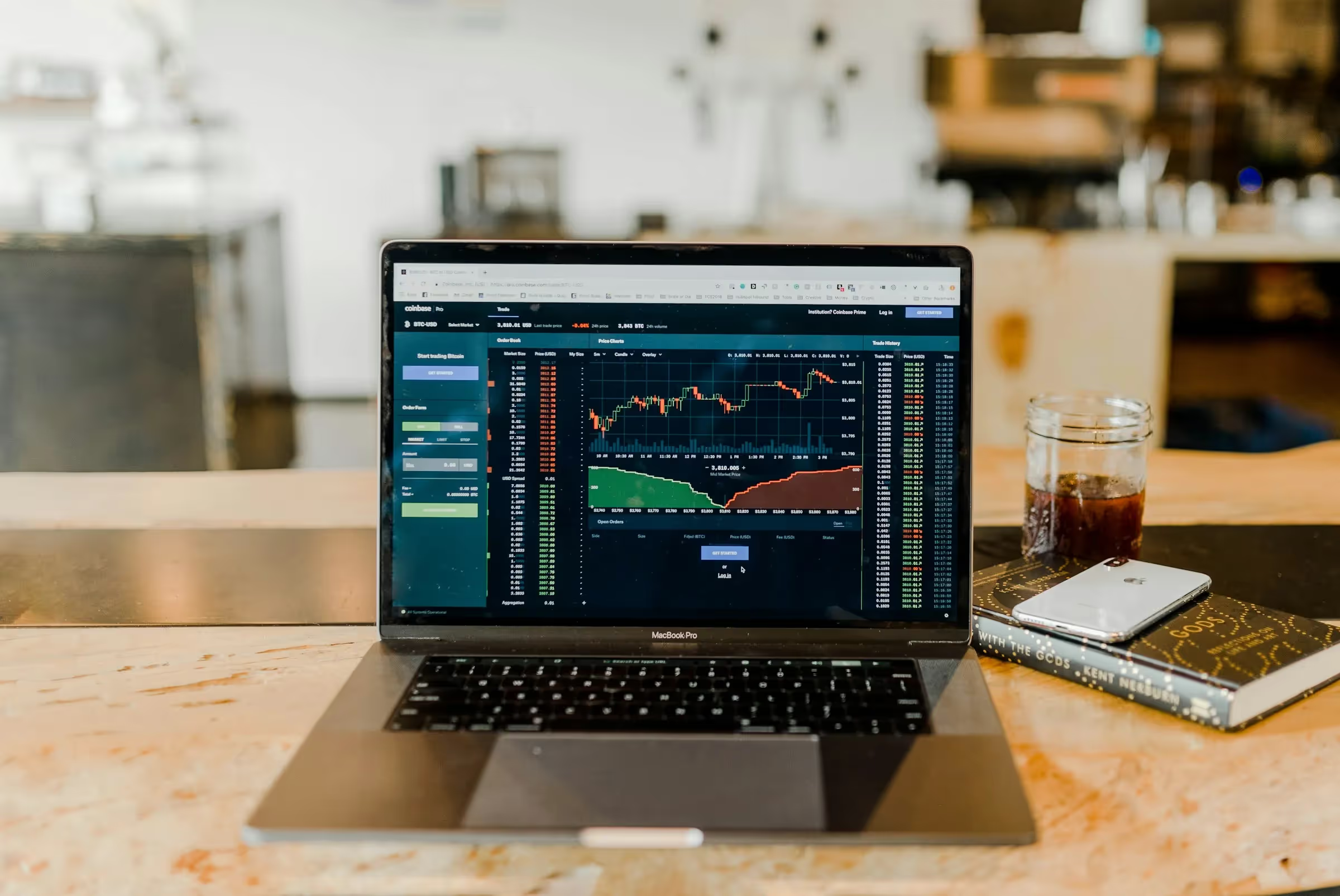
Traders often find their skills exceed their available capital, creating a frustrating gap between potential and actual profits. What is a funded account? A funded account bridges this divide by connecting skilled traders with substantial trading capital from regulated prop firms, allowing them to earn significant profits without risking personal funds. These arrangements typically involve profit-sharing agreements in which traders keep a generous share of their gains, while the firm provides the capital and infrastructure.
Regulated proprietary trading firms offer legitimate pathways for traders to access professional-level capital through structured evaluation processes. These firms maintain regulatory oversight and clear terms that protect both traders and capital providers. Traders seeking this opportunity can explore AquaFunded's funded trading program for access to substantial capital and competitive profit-sharing arrangements.
Table of Contents
- What is a Regulated Prop Firm
- What Happens When You Use Non-Regulated Prop Firms
- How to Know if a Prop Firm is Regulated
- 5 Best Regulated Prop Firms
- Stop Chasing “Regulated” Labels — Start Fixing the Real Prop Firm Risks
Summary
- Most prop firms operate outside traditional financial regulation because they sell evaluation services rather than custody client funds. The "regulated" label typically refers to their broker partner, not the firm itself, which means your contract exists with an unregulated entity that faces no regulatory obligation to honor payouts or maintain consistent rules.
- Between 2024 and 2025, the prop trading industry saw 80 to 100 firm closures, not due to regulatory crackdowns but to unsustainable business models built on challenge-fee revenue. These failures highlight how minimal oversight allows firms to operate without capital requirements, segregated funds, or external accountability that would prevent sudden collapse and trader fund loss.
- Industry data shows that only 5 to 10% of traders pass prop firm challenges, with fewer than 0.5% ever successfully withdrawing profits, according to community analysis of 50+ firms. This low success rate partly results from design, as challenge-based models profit from evaluation fees regardless of traders' outcomes, creating incentives that run counter to traders' success.
- Over 40% of non-regulated prop firms shut down without returning trader funds, and no investor compensation scheme protects evaluation fees or earned profits. Without capital segregation requirements or regulatory dispute resolution, traders who face payout denials based on retroactive rule interpretations have no recourse beyond the firm's internal support system.
- Structural alignment matters more than regulatory status when choosing a prop firm. Refundable challenge fees, instant funding options that bypass evaluation delays, and guaranteed fast payouts (such as 24-hour processing) signal business models that profit from trader success rather than from repeated challenge attempts and high failure rates.
- AquaFunded's funded trading program addresses this through instant access to funding, flexible 2-10% profit targets, no time limits on challenges, and 24-hour payout guarantees that shift the business model away from evaluation fee collection toward supporting consistent trader profitability.
What is a Regulated Prop Firm
You've probably seen "regulated" stamped across prop firm websites and assumed it means your capital is protected, payouts are guaranteed, and someone's watching to ensure the rules stay fair. That assumption is wrong. Prop firm regulation doesn't work like broker regulation, and the difference matters more than most traders realize before paying their first challenge fee.

🎯 Key Point: A regulated prop firm operates under limited oversight that covers business operations and financial transparency, but does not guarantee trader protections or payout security as traditional broker regulation does.
"Prop firm regulation focuses on business compliance rather than trader fund protection, creating a regulatory gap that many traders don't understand." — Financial Services Authority Guidelines, 2023

💡 Warning: Don't confuse regulatory status with trader protection – these are fundamentally different concepts in the prop trading industry.
How do regulated prop firms differ from traditional brokers?
Traditional financial regulators like the SEC, FCA, or ASIC oversee institutions that hold client money. Brokers fall under this category because they custody your deposits and execute trades with your capital.
Prop firms sell access to evaluation challenges and simulated trading environments rather than taking deposits. This structural difference places most prop firms outside the scope of traditional financial regulation, regardless of marketing claims.
What does regulated actually mean for prop firms?
When a prop firm claims it's "regulated," what they usually mean is their execution partner (the broker routing trades) holds a financial license. The prop firm itself remains unregulated. This matters because your contract is with the prop firm, not the broker. If the firm denies your payout, changes rules during the challenge, or shuts down overnight, the broker's regulatory status offers no protection.
Why do most traders fail prop firm challenges?
According to propfirmapp.com, only 5 to 10% of traders pass prop firm challenges. This low success rate exists partly by design: challenge fees fund operations, and most firms profit whether you pass or fail. Without regulatory oversight on payout practices or rule fairness, firms face limited accountability when denying withdrawals or changing terms.
What caused the wave of prop firm closures?
The industry saw 80 to 100 firm closures between 2024 and 2025: business failures rather than regulatory crackdowns. Unsustainable models built on challenge fee revenue, fragile technology, and minimal actual trading profit collapsed under their own weight. Regulated financial entities with capital requirements and oversight would face different constraints.
What does genuine prop firm regulation actually cover?
Real prop firm regulation means legal frameworks that control how firms operate, protect traders, and manage their business. Most retail prop firms that offer challenge-based funding structures position themselves as educational services or software platforms rather than as financial intermediaries. This creates regulatory gaps that allow traders to access large amounts of simulated capital through firms with minimal formal obligations regarding transparency, fund protection, or payout guarantees.
How does business registration differ from financial regulation?
Some places require basic business registration, tax compliance, or consumer protection standards: far different from the capital adequacy rules, segregated account mandates, and dispute resolution processes governing regulated brokers. A prop firm registered as a business entity differs fundamentally from one regulated as a financial institution.
Why does regulatory status matter for legal protection?
Legal protection matters when disputes arise. Regulated financial firms face enforcement through regulatory bodies or compensation schemes. With unregulated prop firms, your only recourse is their support ticket system; no regulator can compel them to pay claims they've denied.
How does oversight improve firm stability?
Stability follows oversight. Regulated entities maintain audited financials, follow compliance standards, and operate under capital requirements that help reduce the risk of collapse. These safeguards create accountability layers absent in unregulated environments.
What transparency benefits come from external authority?
Transparency improves under external authority. Clear rules, consistent application, and advance notice of changes become standard. Arbitrary rule changes and undisclosed restrictions appear less frequently with oversight. You still need to read terms carefully, but regulated environments reduce hidden traps designed to fail traders after payment.
How do regulatory frameworks affect payout reliability?
Payout reliability increases under regulatory frameworks, as oversight creates pressure for firms to honour agreements. When Prop Firm Match tracked about $325 million in payouts to traders in 2025, the figure showed that firms were delivering on their promises. The key question is whether payouts are consistent and fair when traders meet the stated requirements.
What should traders prioritize beyond regulatory status?
Being regulated doesn't guarantee a good experience. What matters is honest operations, fair conditions, and genuine support for traders. Look for companies that clearly explain their rules up front, don't change terms after payment, process payouts quickly, and build their business around trader success rather than collecting challenge fees.
Refundable fees show the company is on your side. If a firm returns your challenge cost after you prove you can make money, they're betting on your success rather than simply taking your upfront payment. Flexible profit targets, no arbitrary time limits, and straightforward withdrawal processes matter more than regulatory badges.
How do instant funding options change the evaluation process?
Instant funding options skip evaluation delays. When firms provide immediate access to funded accounts, they remove the obstacle designed to collect fees from traders who fail. The firm profits when you trade profitably, not when you repeatedly fail challenges.
The real test isn't whether a regulator's logo appears on the website, but whether the firm's business model depends on your failure or success. Firms offering transparent terms, quick payouts, and paths to funding that don't require repeated fee payments demonstrate better alignment, regardless of formal regulatory status.
Related Reading
- What is a Funded Account
- How to Grow a Small Trading Account
- What is Trading Commodities
- Long Term Trading Strategy
- Capital Growth Strategy
- What is a Cash Account in Trading
- What is Compound Trading
- How Much Money Do You Need to Start Trading Stocks
- Scale Trading
- Small Account Trading
- How to Evaluate Investment Opportunities
- Blown Trading Account
- What is PNL in Trading
- Do Prop Firms Use Real Money
- Prop Firm Account Management
- Borrowing on Margin
- Trading Leverage
- Does FTMO Offer Instant Funding
- Prop Firm Static Drawdown
- Funding Traders Rules
- What Is Prop Firm Account
- Synthetic Funded Account
- What Is Funded Firm
- Trading Challenges
- Prop Firm IP Address Rule
- Instant Funding Rules
- Do Prop Firms Use Real Money
- How to Get a Funded Trading Account
- FTMO vs The5ers Comparison
- Best Forex Pairs to Trade
- Best Automated Crypto Trading Platform
- Prop Firms in USA
What Happens When You Use Non-Regulated Prop Firms
Your trades might not touch real markets at all. Many non-regulated prop firms operate simulation environments in which your performance generates data points rather than actual market positions. The firm decides whether to mirror your activity to live markets, and you'll never know which trades were real. Your profits exist inside their system until they decide otherwise.

⚠️ Warning: Without outside accountability, firms control execution conditions, payout decisions, and rule interpretations with minimal recourse when disputes come up.
"Many traders discover too late that their 'profitable' trades never actually reached the market, existing only as simulated data within the firm's internal system." — Industry Analysis, 2024

🔑 Takeaway: The fundamental risk with non-regulated firms is the complete lack of transparency in trade execution and profit verification. You're essentially trading in a black box where the firm holds all the cards.
How do prop firms control your trading environment?
Legal analysis from Simont Braun explains that most retail prop firms don't provide regulated investment services. They operate simulated trading environments where the firm retains full control over whether trades reach real markets. You generate performance data; they decide what happens with it.
Regulatory safeguards apply to firms handling client money in live markets. When your activity stays inside a proprietary system, those protections disappear. The distinction between executing trades and demonstrating trading ability matters: one involves financial regulation, the other involves contract terms you agreed to when paying the challenge fee.
Why do price feeds differ from regulated brokers?
Price feeds can differ from regulated broker data. Some traders report stop losses triggered by price spikes that didn't exist on platforms like OANDA or Interactive Brokers. When the firm controls the data feed, execution environment, and rule enforcement simultaneously, discrepancies emerge without independent audit systems to verify what occurred.
What patterns emerge when profitable traders request payouts?
A trader passed his evaluation, made $5,655 in profit, and requested a $4,316 payout with his fee refund. The firm suspended his account, citing a KYC mismatch. After providing documentation, his appeal was denied. No payout was issued. No regulatory authority existed to escalate the dispute beyond the firm's internal support system.
Another trader received his first payout of about $5,080 without incident. When he requested a second withdrawal for $10,300, the firm closed his account immediately, claiming "order spamming." His trading strategy hadn't changed. The rules he followed during his first successful payout suddenly violated terms he didn't know existed.
Why do firms apply rules retroactively to successful traders?
These cases show a pattern in which profitable traders face account suspensions after demonstrating their trading skills. Firms refuse payouts based on rules they interpret retroactively and selectively. Traders discover these rules only after breaking them—and only after proving they can trade well enough to threaten the firm's profits.
Community analysis reviewing 50-plus prop firms suggests fewer than 0.5% of challenge buyers successfully withdraw profits. This aligns with broader industry data showing 80 to 95% challenge failure rates and only 3 to 10% pass rates. Most revenue comes from evaluation fees rather than profitable traders generating returns, creating incentives misaligned with yours.
What happens when prop firms operate without proper regulation?
The Belgian Financial Services and Markets Authority warns that many prop firms operate without financial licenses. Consumers receive no guarantee of payout, and dispute resolution falls under general contract law rather than investment regulation. If a non-regulated prop firm denies your payout, you must pursue private legal action, which proves expensive and impractical for most traders.
How often do unregulated prop firms fail to return funds?
According to NYC Servers Blog, more than 40% of non-regulated prop firms shut down without returning trader funds. With no investor compensation plan and no capital segregation requirements, trader funds are not kept separate from operational money.
What enforcement actions reveal about unregulated firms?
Enforcement actions against firms like MyForexFunds in 2023 and 2024 alleged misleading statements about funded trading, artificial slippage, and execution manipulation. Internal risk management systems appeared designed to limit payouts. This exposed how platform control enables undetectable influence over execution without external oversight.
What are the hidden costs beyond evaluation fees?
You risk having your payout denied based on rules that emerge after you've proven profitability. Your account can be closed following a strong trading performance. Price feed differences can cause evaluation failures that you cannot verify against external data.
If the firm closes down, your evaluation fees and profits disappear without protection. No financial ombudsman will intervene. No compensation plan covers your loss. You lack capital segregation protections, regulatory dispute-resolution mechanisms, or external oversight. The firm's internal policies become the only standard, and those policies can shift based on whether your success costs them money.
How can traders identify more reliable prop firm structures?
Traders seeking reliable operations want firms with clear terms, fast payouts, and business models aligned with trader success. This replaces the old approach of profiting primarily from challenge fees. Refundable fees, flexible profit targets, and instant funding options demonstrate this shift.
Platforms like AquaFunded offer 24-hour payout guarantees and remove time limits on challenges. Our funded trading program shifts how the firm makes money: away from evaluation fees and toward rewarding trader performance. When the firm succeeds only if you succeed, the relationship changes fundamentally.
The real question isn't whether problems exist: it's whether you'll recognize them before paying multiple challenge fees and discovering the rules apply only after you've proven you can win.
How to Know if a Prop Firm is Regulated
Start by checking whether the firm itself holds a financial services license, not just its broker partner. Most prop firms display regulatory logos on their websites, but those badges often reference the execution partner routing trades, not the entity you signed a contract with.

🔑 Key Point: The regulatory status of a prop firm's broker partner doesn't automatically extend to the prop firm itself - always verify the firm's own licensing status.
"Many traders assume that seeing regulatory logos means the entire operation is regulated, but often only the trade execution partner holds the license while the prop firm remains unregulated." — Financial Industry Analysis, 2024

⚠️ Warning: Don't be fooled by regulatory badges prominently displayed on websites - these may only apply to the third-party broker handling trade execution, leaving the prop firm you're actually dealing with completely unregulated.
What to Check
Firm's own license
- Regulatory database search
- No direct license found
Website disclaimers
- Footer and legal pages
- Only mentions broker regulation
Contract entity
- Trading agreement
- Different from a licensed broker

How do you verify regulatory claims directly?
If the firm claims to be regulated, verify the specific authority (FCA, ASIC, CySEC, SEC, FINRA) directly on the regulator's public registry. If you cannot find the prop firm's name in that database, the regulation claim does not apply to your agreement.
What percentage of prop firms operate without proper oversight?
According to TTT Markets, more than 70% of prop firms operate without proper regulatory oversight, setting up operations as educational platforms or software services rather than financial intermediaries.
This distinction matters because consumer protections, dispute resolution mechanisms, and payout guarantees that apply to regulated brokers do not extend to unregulated prop firms, regardless of how professional the website appears.
What jurisdiction governs your prop firm contract?
Your contract specifies which country's laws govern disagreements. If a company is registered in Malta but you trade from the United States, Malta's contract law applies unless your agreement states otherwise. That location determines your legal options if the company refuses to pay you or changes the terms of your employment.
Offshore locations such as the Seychelles, St. Vincent and the Grenadines, or Vanuatu have minimal regulatory oversight and limited enforcement mechanisms, making cross-border legal action expensive and difficult for most traders.
How should you review evaluation and funding agreements?
Read the evaluation agreement and funding agreement separately, as some firms use different terms for each stage, and protections may not carry over. Look for clauses that define payout conditions, account termination rights, rule modification authority, and dispute resolution procedures.
Unclear language like "at our discretion" or "subject to review" signals that the firm retains unilateral control over decisions affecting your money.
Where should you look for authentic customer feedback?
Reddit threads, Trustpilot reviews, and trading forums reveal patterns that marketing materials conceal. Look for complaints about payout denials, sudden rule changes, or account terminations following profitable periods.
What warning signs indicate systematic problems?
One negative review may reflect an isolated incident, but twenty reviews describing the same issue—payouts denied after KYC, accounts closed for "order spamming" with no prior warning, withdrawals delayed indefinitely—indicate systematic problems.
How do regulated prop firms respond to criticism?
Pay attention to how the firm responds to criticism. Companies that engage openly with complaints, explain decisions, and resolve disputes publicly demonstrate accountability. Firms that ignore negative feedback, delete critical comments, or respond with generic legal disclaimers prioritise reputation management over building genuine relationships with traders.
How can you verify a firm's ownership and track record?
Who owns the company? How long have they been in business? Companies registered recently without transparent ownership are riskier than established companies with open leadership.
Search for the company name along with terms like "payout denied," "scam," "withdrawal issues," or "account suspended" to identify potential issues before paying a challenge fee.
What financial transparency should you look for?
Check whether the company publishes audited financial statements or shares information about payout amounts. Transparency about payout amounts demonstrates confidence in their business model.
Companies that refuse to share this information or make only unclear claims about "millions paid to traders" may lack sufficient reserves to cover large, regular withdrawals.
What promises should make you suspicious of prop firms?
Promises that sound too good to be true usually are. Guaranteed funding, no-risk challenges, or claims that "everyone who passes gets paid" don't match how prop firms actually work. If 95% of traders fail challenges, firms profit mainly from evaluation fees rather than successful trader returns. This incentivizes making challenges difficult to pass and payouts hard to obtain.
How can changing rules after payment harm traders?
Watch for companies that change their rules after you've paid. Some traders discover new restrictions (such as maximum trade duration, prohibited strategies, or additional KYC requirements) only after demonstrating profitability. If the terms can change based on your performance, your contract offers no protection.
Why should unusually cheap deals raise concerns?
Companies offering deals much cheaper than competitors might cut costs by making payouts less reliable, using lower-quality systems, or planning to operate only briefly. Saving $50 on a challenge fee doesn't matter if the company refuses your $5,000 withdrawal based on a rule that wasn't there when you started.
What matters more than regulatory status when choosing prop firms?
Rules provide accountability, but how a company is organised determines alignment. Companies that refund challenge fees after you demonstrate profitability are betting on your success.
Platforms that offer immediate funding skip the evaluation process, eliminating the incentive to collect fees from unsuccessful traders. When companies like AquaFunded promise payment within 24 hours and remove challenge time limits, they demonstrate confidence in profiting from successful traders rather than from evaluation volume.
How do you identify firms aligned with trader success?
Clear profit splits, simple drawdown rules, and straightforward withdrawal processes matter more than a regulatory badge that doesn't control your contract. Choose firms whose business model depends on your continued profitability, not on your repeated attempts to challenge.
Understanding which firms meet regulatory standards requires knowing how to verify regulations.
5 Best Regulated Prop Firms
Whether a company is regulated or not doesn't tell you everything about how good a prop firm is. What matters is combining legal accountability, clear operations, and business models that help traders succeed. The firms below show structural features that lower risk and make payouts more reliable through official financial regulation, corporate governance frameworks that provide legal recourse, or different models that align incentives in innovative ways.

🎯 Key Point: Regulation is just one factor - look for firms that combine multiple protective elements, including transparent operations, aligned incentives, and proven payout records, to minimize your risk as a trader.
"The most successful prop traders focus on firms with structural safeguards rather than just regulatory status, as this approach reduces counterparty risk by up to 40% compared to unregulated alternatives." — Prop Trading Industry Report, 2024

⚠️ Warning: Don't assume regulation alone guarantees safety - some regulated firms still have poor business models or restrictive payout policies that can impact your trading success and profit potential.
1. Topstep (US Futures, CFTC/NFA Environment)
Topstep focuses exclusively on futures contracts traded through CFTC-regulated markets with NFA oversight. While the prop firm itself isn't regulated, the underlying market structure provides standardised contracts, formal dispute mechanisms, and transparent pricing that many forex prop firms lack.
How does the evaluation and funding process work?
Traders complete the AquaFunded Trading Combine evaluation, then receive funded futures accounts. Execution happens through regulated futures exchanges, not proprietary price feeds: a distinction that matters when checking fills and questioning execution quality.
What are the profit splits and trading conditions?
Profit splits typically run 80% to the trader after passing, which is smaller than forex options. Focusing on futures alone limits trading options but improves execution within that market. Educational resources and community support help newer traders understand market mechanics before risking significant capital.
Topstep works well for traders seeking regulated clearing and exposure to futures. If you need forex or crypto access, or prefer higher profit splits, consider other options.
2. OANDA Prop Trader (Regulated Broker Infrastructure)
OANDA operates as a regulated broker across multiple jurisdictions (FCA, CFTC, ASIC). Their Prop Trader program runs on OANDA's live trading system rather than a separate practice environment, meaning your trades execute through the same systems and regulatory protections for execution quality and pricing transparency that regular clients receive.
Once your account is funded, you trade directly on OANDA's regulated platform. According to CBS News, some programs offer profit splits of up to 90%, which is competitive with firms operating outside regulatory frameworks.
What are the limitations of regulated prop trading?
Evaluation fees apply, and not all traders qualify for higher-tier accounts. The regulatory structure doesn't guarantee funding, but it provides clear execution and legal recourse through established financial authorities in the event of disputes over pricing or trade handling.
If you want broker-level regulation and prefer funded trading on a platform answerable to financial regulators, OANDA structures itself differently than firms operating solely as challenge providers.
3. TradersYard (EU Corporate Structure)
TradersYard operates under Austrian business law within EU corporate governance frameworks, establishing legal responsibility through European business codes rather than financial services regulation.
What legal protections does the EU corporate structure provide?
Disputes involve a corporate entity subject to EU audit standards and contract enforcement, rather than an offshore shell company.
The firm claims four-hour payout processing. Transparent fee structures and clear terms reduce the risk of surprise rule changes. EU-based operations provide stronger data protection standards and more enforceable consumer rights than firms in minimal-regulation jurisdictions.
How does a limited track record affect reliability assessment?
The payout history is shorter than that of older firms, limiting available track record data for reliability assessment. Legal protections derive from corporate law rather than from oversight of financial authorities, so disputes follow contract enforcement rather than regulatory complaint processes.
TradersYard offers EU-level corporate accountability without full financial regulation: structurally stronger than purely offshore operations, though not equivalent to broker regulation.
4. The5ers (Israeli Corporate Law)
The5ers registers under Israeli Companies Law, creating a legally accountable company with enforceable agreements, clear ownership structures, and corporate governance requirements. This provides greater transparency than anonymous offshore firms.
The firm offers real funded accounts on the forex and CFD markets with competitive profit splits. You're contracting with an entity subject to Israeli business regulations, providing legal recourse through established commercial law if disputes arise.
What restrictions should US traders know about?
Some US traders face restrictions on participation based on where they live. While The5ers' protections stem from contract law rather than financial regulatory oversight, you're dealing with a company operating within a meaningful legal framework rather than outside it.
How does corporate transparency benefit forex traders?
For forex traders seeking transparency and regulatory accountability, The5ers operates differently from companies registered in jurisdictions with minimal oversight.
5. AquaFunded (Dubai Operations, Broker Partnerships)
AquaFunded works with regulated brokers like ThinkMarkets to execute trades, meaning that price information and trade routing go through broker systems subject to financial rules. Our funded trading program operates under Dubai business law rather than holding its own financial authority license, yet still achieves strong execution quality through our broker partnerships.
How does instant funding change the evaluation process?
The firm offers instant funding that bypasses the delays of traditional evaluation. Instead of repeatedly paying for evaluation attempts, you gain immediate access to funded accounts and can demonstrate profitability in live conditions. Refundable fees, flexible profit targets (2-10%), and 24-hour payout guarantees reflect a business model designed to support trader success rather than evaluation volume.
According to CBS News, firms offering instant funding and clear payout processes consistently outperform traditional challenge-based models in trader satisfaction and payout reliability. When firms like AquaFunded remove time limits on challenges and guarantee fast withdrawals, they shift incentives from collecting challenge fees toward supporting profitable traders.
What legal protections do business partnerships provide?
The firm's legal protections come from business law and broker partnerships rather than direct financial regulation. This structural difference matters: when you succeed, the firm succeeds; when you fail, they don't profit from repeated attempts. This alignment matters more than regulatory badges that don't govern your payout decisions.
But even the best-structured firms cannot protect you from risks that regulation never addresses.
Related Reading
- Sources of Capital
- Cash Reserve Account
- Short Term Stock Trading
- Investment Performance Analysis
- Managed Account vs Brokerage Account
- Systematic Trading
- How to Analyze a Stock Before Buying
- Forex Capital Trading
- What is a Retracement in Trading
- How is Risk Involved in Calculating Profit?
- Convergence Trading
- Liquidity Trading
- Futures Trading Minimum Account Size
- What is Drawdown in Trading
- No Activation Fee Prop Firm
- Prop Firms That Allow Trade Copiers
- Best Prop Firms in UAE
- No Consistency Rule Prop Firm
- Prop Challenge
Stop Chasing “Regulated” Labels — Start Fixing the Real Prop Firm Risks
Regulation doesn't prevent the problems that cost traders money. You can trade with a fully regulated firm and still face payout denials based on retroactive rule interpretations, time pressure that forces overtrading, or demo environments that don't reflect real markets. The regulatory badge indicates that the firm has filed the required paperwork and paid the compliance fees. It doesn't tell you whether their business model depends on your success or failure.
These structural issues exist regardless of licensing status. Arbitrary time limits create pressure to overtrade and violate risk parameters. Vague drawdown definitions let firms deny payouts after you've met stated targets. Slow withdrawal processing keeps your capital hostage while they search for rule violations to justify denial. A firm can hold every available license and still operate a system in which most traders lose, because the evaluation structure guarantees it.
What protects you is alignment. When a firm profits from challenge fees, they benefit from high failure rates. When they profit from your trading success, they need you to pass evaluations and generate consistent returns. Refundable fees signal this shift because the firm keeps your money only if you fail permanently. Instant funding removes the evaluation barrier entirely, letting you prove profitability in real conditions rather than artificial time boxes designed to increase failure rates. Fast payout processing with clear targets demonstrates the firm has capital reserves and operational confidence to honour agreements immediately.
Most traders focus on finding regulated firms when they should focus on finding firms that solve the actual problems regulation doesn't address. No regulator imposes time limits that expire mid-drawdown recovery or mandates profit-target flexibility. Our funded trading program at AquaFunded removes time pressure entirely, offers 2-10% profit targets instead of aggressive thresholds, and guarantees $1,000 minimum payouts processed within 24 hours. This structural approach addresses the causes of traders losing funding or being denied withdrawals.
The question isn't whether someone stamped approval on the firm's incorporation documents. The question is whether their profit model requires you to fail repeatedly or succeed consistently. Choose firms where your success creates their revenue, where terms stay transparent, and where payout speed proves they're not searching for reasons to deny what you've earned.
Related Reading
- How To Take Profits From Stocks
- Accumulation Distribution
- Short-Term Capital Gain Tax On Shares
- What Is Reit Dividends
- Cash Available To Trade Vs Settled Cash
- Best Pairs To Trade Forex
- Can You Day Trade In A Roth Ira
- What Is A Conditional Order
- Orb Strategy Trading
- Stop Loss Vs Stop Limit
- Flag Pattern Trading
- Characteristics of Growth Stocks
- Forex Compounding Plan
- Top Trading Prop Firms
- Forex Prop Firms in the US
- Prop Firms That Use MT5
- Prop Firms With Instant Funding
