




6 Best Prop Firms for Forex in 2026
Discover the 6 best prop firms for forex trading in 2026. AquaFunded reveals top-rated firms offering funded accounts with proven track records.

The forex market offers incredible opportunities, but most traders face a critical limitation: insufficient capital. Even skilled traders with proven strategies struggle to generate meaningful returns when working with small personal accounts. What is a funded account? It's a solution that provides access to substantial trading capital from proprietary trading firms without risking personal funds, enabling talented traders to scale their operations and maximize their potential.
Successful forex traders need more than just skill and strategy to thrive in today's competitive markets. They require adequate capital backing, fair profit-sharing arrangements, and flexible trading conditions that align with professional market operations. AquaFunded's funded trading program addresses these needs through comprehensive evaluation processes and competitive terms designed specifically for serious currency traders.
Summary
- Forex prop trading remains fully operational across hundreds of legitimate firms worldwide despite recent regulatory changes and high-profile shutdowns. The confusion stems from social media amplifying isolated failures into industry-wide panic. What actually changed wasn't the legality or availability of funded forex trading, but rather the need for traders to choose firms based on operational transparency, regulatory compliance, and sustainable business models instead of marketing promises.
- Only about 10% of traders pass prop firm evaluations according to industry data, with most failures stemming from poor risk management rather than lack of market knowledge. Firms that survived regulatory tightening share common characteristics, such as clearly defined drawdown limits (typically 4-5% daily maximum and 8-10% total maximum loss), transparent profit targets, verifiable payout histories, and structured evaluation processes. The industry didn't collapse; it matured into a landscape where due diligence separates firms that deliver from firms that profit primarily from evaluation fees.
- Capital access matters less than operational infrastructure when choosing a prop firm. A $200,000 account with a 60% profit split and unreliable payouts delivers worse results than a $100,000 account with a 90% split and guaranteed 24-hour withdrawals. Traders should verify payout histories on community forums, confirm that firms use third-party brokers with regulated liquidity providers, and read the complete rule sets before paying evaluation fees. Platform stability, support responsiveness, and rule clarity reveal whether a firm treats traders as partners or revenue sources.
- Profit split structures ranging from 70% to 90% directly impact take-home earnings more than headline capital numbers. Top firms in 2025 offer 90% splits, reflecting confidence in traders' success rather than reliance on evaluation fees as their primary source of revenue. Monthly platform fees destroy profitability by requiring consistent returns just to break even before earning anything. Firms charging one-time evaluation fees with refund policies on first payout eliminate upfront risk entirely and align incentives toward trader success.
- Evaluation design determines whether the challenges test skill or manufacturing failure. Firms requiring 10% profit in 30 days with a 5% maximum drawdown force aggressive position sizing, which increases failure probability by design. Reasonable evaluations maintain 8-10% total drawdown limits with 4-5% daily maximum loss rules, allowing traders to execute actual strategies without abandoning risk management. Some firms eliminate multi-phase evaluations entirely by offering instant funding options that verify basic risk understanding without lengthy review periods.
- AquaFunded's funded trading program addresses payout reliability concerns through guaranteed 48-hour payment processing with compensation for missed deadlines, offers 100% refundable evaluation fees that remove upfront financial risk, and provides instant funding paths that bypass multi-phase challenges while maintaining transparent drawdown limits and scaling mechanisms up to $4 million in capital allocation.
Can You Trade Forex With Prop Firms
Yes. Forex prop trading is alive and accessible worldwide. Although some trading firms have closed and rules have changed in certain areas, hundreds of real proprietary trading firms still offer funded accounts for currency traders. What changed is that traders must select firms carefully based on their structure, transparency, and regulatory compliance.

🎯 Key Point: The forex prop trading industry remains robust despite recent changes, with legitimate opportunities still available for skilled traders who do their due diligence.
⚠️ Warning: Not all prop firms are created equal - thorough research into a firm's regulatory status and business model is essential before committing your time and evaluation fees.

"The proprietary trading industry has evolved significantly, with legitimate firms now emphasizing transparency and regulatory compliance as key differentiators in the market." — Industry Analysis, 2024
How does social media amplify prop firm fears?
Social media amplifies fear when prop firms close. A single company shuts down, and forums fill with claims that "forex prop trading is dead" or "regulators banned everything." The reality is more nuanced. Some firms failed due to poor internal risk management, not because forex trading through prop firms became illegal. Others faced regional compliance issues that didn't affect firms operating in different jurisdictions or under different structures.
What platform access issues create confusion?
Platform access issues added to the confusion. When certain brokers restricted MT4 or MT5 access for specific prop firms, traders interpreted this as a blanket ban rather than broker-specific policy adjustments. Legitimate prop firms adapted by partnering with third-party brokers, securing regulated liquidity providers, and implementing clearer evaluation frameworks. According to FunderPro, only about 10% of traders pass prop firm evaluations. That failure rate, combined with occasional firm closures, creates a narrative of impossibility that doesn't reflect reality.
What regulatory changes actually occurred?
Rules got stricter in some countries, forcing certain companies to reorganize or leave those markets. Forex remains legal and can be traded through prop firms in most places. What disappeared were companies that operated without proper risk frameworks, clear rules, or sustainable business models. Companies that made it through share the same key features: clearly defined drawdown limits (4-5% daily maximum and 8-10% total maximum loss), transparent profit targets, reliable payout histories, and organized evaluation processes.
How has the industry matured for traders?
The industry matured rather than collapsed. Traders now face a market where due diligence is essential. Verify that the firm uses third-party brokers, maintains regulated liquidity relationships, and has a track record of paying successful traders. The one-time evaluation fee you pay at the start is your only financial risk, as most firms use practice capital during the challenge phase before granting access to live funded accounts.
What questions should you ask when evaluating prop firms?
Stop asking if you can trade forex with prop firms. Start asking which firms work with stability, transparency, and proper structure. Look for firms that publish clear rules about drawdown limits, profit targets, and payout schedules. Verify that they support standard platforms such as MT4, MT5, or cTrader. Check whether they offer reasonable evaluation models—one-phase or two-phase challenges—that test your skills without impossible hurdles.
How do modern platforms address common friction points?
Platforms like a funded trading program address friction points by offering instant funding that bypasses lengthy evaluation periods, transparent fee structures with 100% refundable policies, and guaranteed 24-hour payout processing. These improvements matter because they eliminate uncertainty about whether prop firms will deliver. When you know exactly what the rules are, how payouts work, and what happens if you succeed, the path from evaluation to funded trading becomes predictable rather than anxiety-inducing.
What makes a prop firm worth your attention?
The firms worth your attention treat forex prop trading as a professional partnership. They maintain competitive profit splits (70-90% to the trader), enforce strict but fair risk management rules, and operate with transparency that lets you verify their legitimacy before paying an evaluation fee. They don't promise unrealistic returns or obscure drawdown calculations in fine print. They recognise that your skill represents value, back it with capital, and limit downside through clear risk parameters. But choosing wisely only gets you to the starting line. What happens after you're funded determines whether this path works for you.
Benefits of Forex Prop Firms
Prop firms remove the biggest obstacle to professional-scale trading: capital. They provide simulated or real trading capital ranging from $5,000 to over $4 million without requiring you to risk your own savings. You prove your skill through a structured evaluation, and if you pass, you trade their capital while keeping the majority of profits. This transforms trading from a capital-intensive barrier into a skill-based opportunity.

🎯 Key Point: Most traders focus exclusively on capital size when evaluating firms, ignoring the infrastructure, support systems, and operational advantages that determine success once funded. Capital alone doesn't make you profitable. The right environment does.
💡 Tip: The real value of prop firms extends far beyond just providing trading capital - it's about accessing professional-grade resources and risk management systems that would otherwise be impossible for individual traders to obtain.

How do prop firms provide capital access without personal risk?
You can control six-figure positions without depositing six figures. Prop firms provide capital based on demonstrated skill during evaluation phases, not personal savings. This matters because retail traders often exhaust personal savings building trading capital, only to find that risking their own money impairs their trading ability. Trading firm capital removes this problem: you use the same strategy you practised without the emotional weight of mortgage payments or tuition bills on every trade.
What challenges do traders face in finding legitimate prop firms?
The frustration with finding real opportunities runs deep. Traders waste hours searching for working discount codes and verifiable firm benefits, only to discover expired offers or misleading claims. Many firms advertise aggressive capital allocations while hiding restrictive conditions in fine print or promising refunds that never materialise. The firms worth your attention operate transparently: clear evaluation criteria, published payout histories, and capital allocations that match their advertising.
What trading platforms do professional prop firms provide?
Prop firms provide access to professional-level platforms like MT5, cTrader, and Match-Trader without platform fees or broker management. These platforms offer execution speeds, charting tools, and algorithmic capabilities that retail accounts cannot match.
How does execution quality impact your trading profitability?
When trading large amounts of money, slippage and execution quality directly impact your profits. Firms that maintain partnerships with regulated liquidity providers ensure your orders get filled at expected prices, not prices that benefit the broker. When certain brokers restricted access for specific firms, traders misinterpreted this as a systemic problem rather than individual firms failing to maintain proper broker relationships. The firms that survived had already established backup liquidity sources and third-party broker integrations. Choose a firm that treats platform stability as infrastructure, not an afterthought.
What training resources do prop firms provide?
Most prop firms provide educational content, mentorship programmes, and risk management tools to help you pass evaluations and remain profitable once funded. Since firms profit when you succeed, they invest in resources that improve pass rates and reduce trader blowouts. You get access to drawdown calculators, position sizing tools, and trading journals that track your performance against firm rules in real time. Some firms offer community forums where funded traders share strategies and address common mistakes.
How much do resource quality differences impact success rates?
The quality of these resources varies considerably. Some firms offer basic webinars that repeat ideas available for free on YouTube, while others build proprietary risk dashboards that alert you when you approach daily or total drawdown limits, preventing rule violations before they occur. According to FunderPro, only about 10% of traders pass prop firm evaluations, with most failures stemming from poor risk management rather than a lack of market knowledge. Firms that actively help you manage risk improve your chances of joining the small group that gets funded.
How does capital leverage affect the viability of a trading strategy?
Trading $100,000 instead of $5,000 changes which strategies can work. Scalping tight ranges, capturing small percentage moves on high-value positions, and spreading money across multiple currency pairs all require capital density that retail accounts cannot support. When you can risk 1% of $100,000 per trade instead of 1% of $5,000, you can absorb normal market fluctuations without being stopped out of positions that would have been profitable with greater breathing room.
Why do profit splits matter more than capital size?
Profit splits matter more than capital size. A firm offering $200,000 with a 60% split gives you less earning potential than a firm offering $100,000 with up to 90% profit split. A 5% monthly return on $100,000 at 90% split nets $4,500. The same return on $200,000 at 60% split nets $6,000 but requires managing twice the capital with proportionally higher drawdown risk.
How do collaborative communities accelerate trading development?
Funded traders access private forums, Discord channels, or Slack groups where they discuss market conditions, share trade ideas, and learn from peers managing similar capital. This network accelerates pattern recognition by exposing you to how other traders navigate losing periods, adjust strategies during low volatility, or scale positions around major news events—lessons that would take far longer to learn through trial and error alone.
Why does emotional support matter for funded traders?
Emotional support matters equally. Trading funded accounts creates psychological pressure: you're managing someone else's capital under strict rules, where a mistake could end your funding. Connecting with traders who've survived evaluation failures and rebuilt their approach normalizes setbacks that otherwise feel catastrophic. Most successful funded traders failed multiple evaluations before finding what worked.
How do evaluation phases replicate real trading conditions?
Evaluation phases use live market data and real execution environments, not backtested scenarios or delayed feeds. You experience actual spreads, slippage, and liquidity conditions identical to live trading. Strategies that work in demo accounts often fail in live markets due to execution differences. Our evaluation process forces you to prove your edge under real conditions before accessing funded capital.
What happens when you transition from evaluation to funded trading?
Moving from evaluation to a funded account feels smooth when you work with well-organized firms. Your strategy doesn't need to change because market conditions remain consistent. You keep using the same approach that passed the evaluation, with profits now being paid out to your payout account. Platforms like AquaFunded's funded trading program offer quick funding options, letting you skip multi-phase evaluations and start trading with real money after a single assessment, while maintaining risk parameters that protect both trader and firm.
What markets can you access with funded accounts?
Funded accounts typically support trading across major, minor, and exotic forex pairs, as well as indices, commodities, and, sometimes, crypto. This diversification lets you capitalize on opportunities across correlated and uncorrelated markets, rather than limiting yourself to the handful of pairs your personal capital could support. When EUR/USD enters low-volatility consolidation, you can shift focus to GBP/JPY volatility or gold momentum without forcing suboptimal setups.
How does multi-market access improve risk management?
Having access to multiple markets helps better manage risk. Spreading your money across forex, metals, and indices reduces concentration risk compared to holding multiple currency pairs that move together. If dollar strength affects USD pairs, exposure to commodities or equity indices provides returns that don't move in tandem, smoothing out your gains and losses.
How do funded accounts enable career scaling opportunities?
Successfully funded traders gain access to larger amounts of capital as they demonstrate consistent profitability. Firms increase accounts from $50,000 to $100,000, then $200,000 and beyond, sometimes reaching $300,000 or more for traders who maintain strong performance over multiple months.
What professional opportunities do prop firms provide?
Some firms offer pathways to proprietary trading desks or introduce top performers to institutional capital allocators. Your track record with a prop firm becomes verifiable proof of skill, a credential that opens doors to professional trading roles inaccessible from a retail account alone.
What factors determine scaling success?
Scaling works only if you choose a company that delivers on payout promises and maintains operational stability long enough for you to build a track record.
Related Reading
- What is a Funded Account
- How to Grow a Small Trading Account
- What is Trading Commodities
- Long Term Trading Strategy
- Capital Growth Strategy
- What is a Cash Account in Trading
- What is Compound Trading
- How Much Money Do You Need to Start Trading Stocks
- Scale Trading
- Small Account Trading
- How to Evaluate Investment Opportunities
- Blown Trading Account
- What is PNL in Trading
- Do Prop Firms Use Real Money
- Prop Firm Account Management
- Borrowing on Margin
- Trading Leverage
- Does FTMO Offer Instant Funding
- Prop Firm Static Drawdown
- Funding Traders Rules
- What Is Prop Firm Account
- Synthetic Funded Account
- What Is Funded Firm
- Trading Challenges
- Prop Firm IP Address Rule
- Instant Funding Rules
- Do Prop Firms Use Real Money
- How to Get a Funded Trading Account
- FTMO vs The5ers Comparison
- Best Forex Pairs to Trade
- Best Automated Crypto Trading Platform
- Prop Firms in USA
How to Choose the Best Forex Prop Firm
Six factors separate firms that help you succeed from firms that profit when you fail: funding structure, profit split, payout reliability, evaluation design, platform quality, and support responsiveness. These elements reveal whether a firm treats you as a true partner or a revenue source. Most traders focus on capital size and ignore the operational details that determine whether they'll ever get a withdrawal.
"The difference between a legitimate prop firm and a profit center disguised as opportunity lies in the operational details most traders never examine." — Industry Analysis, 2024

🎯 Key Point: Capital size means nothing if the firm's payout structure is designed to keep your profits. Focus on operational transparency before funding amounts.
⚠️ Warning: Firms that emphasize massive capital while being vague about withdrawal processes are often designed to collect evaluation fees rather than create successful traders.

What funding amounts do prop firms typically offer?
Starting amounts typically range from $5,000 to $200,000, with some firms offering paths to $4 million for consistently profitable traders. How the firm scales your capital matters more than your initial amount: do they increase your allocation after you hit profit goals, or keep you at the same level? Firms that stop your growth expect you to fail; firms that grow with you expect a long-term partnership.
How should scaling rules work in practice?
Look for clear rules about when and how scaling happens. Some firms add $25,000 after every 10% gain; others require manual scaling requests, which delay growth. The best structures automate scaling based on objective performance metrics, eliminating subjective approval processes that give firms excuses to deny increases.
What profit split should you expect from top prop firms?
Most legitimate firms offer 70% to 90% to the trader. According to World Business Outlook, top firms in 2025 provide 90% profit splits, demonstrating confidence in trader success rather than relying on evaluation fees as their primary revenue source. Anything below 70% means the firm profits more from your trading than you do, misaligning your goals with theirs. Some firms start at 80% but increase to 90% after your first payout, rewarding consistency with better terms.
How do monthly fees impact your trading profitability?
Monthly fees destroy profitability faster than low splits. A $150 monthly platform fee on a $50,000 account means you need 0.3% monthly returns to break even. Firms charging monthly fees on top of evaluation costs and low splits extract value from multiple angles. Look for firms with one-time evaluation fees and no recurring charges, or firms that refund evaluation fees upon your first payout.
How reliable are prop firm payout speeds?
Some firms add delays to verify withdrawals, request excessive paperwork, or impose lengthy review periods that stretch payouts from days to weeks. Others pay within 24 hours with minimal hassle. Firms that delay payouts either lack sufficient funds to cover withdrawals or use administrative friction to discourage traders from withdrawing money.
Where can you verify actual payout experiences?
Check payout histories in community forums, not on the firm's marketing site. Traders share real experiences with withdrawal speeds, declined requests, and support responsiveness during payout disputes. If you see patterns of delayed payments, requests for additional trading before withdrawal approval, or sudden rule changes that disqualify profits, walk away. Platforms like the funded trading program guarantee 24-hour payout processing with 100% refundable evaluation fees. Transparent, consistently enforced payout terms let you focus on trading without worrying about whether your profits will be paid out.
How do evaluation structures affect your success probability?
Does the challenge test your skill or set you up to fail? Evaluation structures vary from single-phase assessments to multi-step challenges with escalating targets. If a firm requires 10% profit in 30 days with a 5% maximum drawdown, the mathematics forces aggressive position sizing, which increases the failure probability. That's intentional: the firm profits more from evaluation fees than from funded trader success.
What evaluation parameters should you look for?
Look for evaluations with 8-10% total drawdown limits and 4-5% daily maximum loss rules. These parameters let you trade your actual strategy without forcing unnatural risk. Profit targets should be 8-10% for the evaluation phase, achievable within 30-60 days without abandoning risk management. Some firms eliminate evaluation phases entirely, offering instant funding after a single assessment that verifies you understand basic risk parameters, thereby removing the multi-phase friction that causes traders to pay evaluation fees repeatedly.
What makes a trading platform reliable and professional
A good trading platform should be simple, reliable, and easy to understand. MT4, MT5, and cTrader remain industry standards because they provide the charting tools, execution speeds, and order types professional traders need. Firms that force proprietary platforms with limited functionality or unstable connections create unnecessary obstacles. Choose a firm that partners with regulated brokers and provides transparent spreads, minimal slippage, and execution speeds matching what you'd achieve trading your own capital.
How do platform disruptions affect your trading evaluation
Problems with platform access have hurt traders at firms without stable broker relationships. When a firm loses platform access during a challenge, your evaluation is reset or cancelled completely, wasting both your time and the evaluation fee. Firms with multiple broker partnerships and third-party liquidity providers can survive these problems without affecting your trading. Verify that the firm discloses which brokers they use and whether those brokers operate under recognised regulatory frameworks.
What kind of support should you expect from quality prop firms?
If something goes wrong or isn't clear, can you get help from a real person? Automated chatbots and templated responses don't solve account issues, questions about rules, or technical problems requiring human judgment. Quality firms have real support teams that respond within hours and provide specific answers rather than repeating general policies.
Why does rule clarity matter as much as support responsiveness?
Clear rules matter as much as good customer service. Traders get frustrated when companies enforce unclear policies inconsistently or create "zero-tolerance traps" that remove accounts for minor technical mistakes unrelated to actual trading risk. You want to work with companies that share their complete rule sets upfront, explain exactly how they calculate drawdowns, and clarify which trading styles or tools are off-limits before you pay an evaluation fee. When rules change during the challenge without warning, or companies apply new policies retroactively to take away your profits, you're dealing with a company that prioritises profit over trader success.
6 Best Prop Firms for Forex in 2026
The companies that survived regulatory pressure and market consolidation focus on helping traders succeed rather than profiting from evaluation fees. According to FXEmpire, the best prop firms in 2026 stand out through clear payout histories, flexible trader evaluation methods, and stable operations. Here are six firms that meet these standards, each offering different advantages based on your trading style, capital requirements, and risk tolerance.
💡 Tip: The most successful prop firms have shifted from evaluation-fee focused to trader-success focused models, creating more sustainable partnerships.
🔑 Takeaway: When choosing a prop firm in 2026, prioritise firms with proven payout records and transparent evaluation processes over those offering unrealistic profit splits or instant funding promises.

1. AquaFunded

Dubai-based AquaFunded operates with a dual-scaling system that few firms can match. Traders can grow accounts to $4 million through two parallel paths: a 25% balance increase after achieving 12% profit within three months, and progression through Bronze, Silver, and Gold tiers in the AquaFunded Elite program.
What evaluation options and profit splits does Aqua Funded offer?
AquaFunded offers four evaluation routes (1-Step, 2-Step, 3-Step, and Instant Funding) with profit splits reaching 95%, bi-weekly payouts, and first withdrawal available in seven days. The platform supports cTrader, Match Trader, MT5, and TradeLocker without locking traders into a single ecosystem.
How does Aqua Funded protect traders and ensure payments?
AquaFunded guarantees payment within 48 hours and compensates you if we miss this window. Our Wave Stop feature automatically closes trades at a 2% loss, preventing rule breaks from sudden price changes. Evaluations have no time limits, Expert Advisors and copy trading are explicitly allowed, and our 24/7 support responds within hours.
What are the drawbacks of trading with Aqua Funded?
The tradeoff: strict adherence to published rules. AquaFunded enforces drawdown limits and trading restrictions consistently, requiring precise risk management. Traders who thrive here treat rules as parameters to work within, not obstacles to circumvent.
2. Funding Pips
Funding Pips runs a two-step evaluation, with an 8% profit target in Step 1 (Student phase) and a 5% target in Step 2 (Practitioner phase). Daily losses cap at 5%, total drawdown at 10%. Accounts are closed after 30 consecutive days of inactivity. Platform access includes cTrader, TradeLocker, MatchTrader, and MT5.
How does Funding Pips structure payouts and rewards?
The payout structure ties reward splits to withdrawal frequency: weekly payouts carry a 60% reward split, bi-weekly payouts 80%, on-demand payouts 90%, and monthly payouts 100%. This lets you optimize for cash flow or maximum earnings. Funding Pips claims to have paid $200 million in rewards to 2 million traders, though independent verification via community payout reports is advisable. Processing times range from same-day to several trading days, depending on the account start date within the payout cycle. The firm promotes a zero-payout denial policy for withdrawals that meet published eligibility criteria, addressing verification delays common at other firms.
What are the main limitations of Funding Pips?
The 5% daily and 10% maximum loss limits restrict higher-volatility strategies, making them challenging for scalpers and news traders. The simulated environment executes trades in a demo-like setting rather than in real market conditions, affecting strategies that are sensitive to real-world slippage and liquidity.
3. FTMO
Started in 2015, FTMO uses a two-stage assessment (FTMO Challenge and Verification) to evaluate traders before granting funded status. Account sizes range from $10,000 to $200,000, with scaling plans that add 25% to your balance and increase profit splits to 90% as you demonstrate consistency.
What tools and support does FTMO provide?
FTMO provides Account MetriX for trade analysis, Trading Journal for behavioral pattern review, economic calendars, and risk calculators to support data-driven decisions. The firm serves over 3.5 million customers worldwide and offers 24/7 support in 20 languages.
How does FTMO's fee structure work?
Fee reimbursement is included with your first profit withdrawal, eliminating the upfront cost if you succeed. FTMO's challenge fees are higher than some competitors', but our refund policy neutralizes this once you reach funded status and maintain profitability.
What are FTMO's main limitations for traders?
Daily drawdown rules and overnight trading restrictions on specific instruments limit swing traders' ability to hold positions for multiple days. Trading fees on certain symbols accumulate across high-frequency strategies. The strict framework suits disciplined traders but penalises those whose advantage depends on flexibility or aggressive position sizing.
4. The 5ers

The 5ers has three evaluation tracks: Hyper Growth (1-step with 10% profit target, 3% Daily Pause, 6% Stop Out), High Stakes (2-step with 8% then 5% targets, 5% daily loss, 10% max loss), and Bootcamp (3-step with 6% targets across phases, 5% max loss in early steps, 4% max loss and 3% daily pause when funded). All tracks offer unlimited time but enforce a 30-day inactivity expiry.
What platform access and profit splits does The 5ers offer?
Platform access starts with MT5 Hedge for Hyper Growth and High Stakes. Profit splits range from 80% to 100%, depending on your chosen plan and performance milestones. Hyper Growth and Bootcamp increase your payout ratio as you hit performance benchmarks.
What trading restrictions should you know about?
High Stakes includes execution restrictions around high-impact news events, limiting strategies that exploit volatility spikes during economic releases. This constrains news traders who build an edge around these moments. Thirty consecutive inactive days trigger account closure, penalizing traders who pause during low-probability market conditions or personal circumstances. Rule complexity varies between tracks, requiring careful study of each plan's specific parameters before committing.
5. FundedNext

FundedNext operates in the UAE and Cyprus, serving traders across 195+ countries. The guaranteed 24-hour payout promise includes $1,000 compensation if they miss the deadline, addressing payout anxiety that undermines trust in less reliable firms. CFD programs offer Stellar models (1-Step, 2-Step, Lite, Instant) with account sizes from $6,000 to $200,000, while Futures programs run separately with distinct rules.
How does FundedNext's profit-sharing structure work?
Profit sharing reaches 95%, with a unique 15% profit share during the challenge phase itself: you earn from evaluation trades, not just after funding. Challenge fees are refunded with your first payout, eliminating upfront risk if you succeed. Platforms span MT4, MT5, cTrader, and Match-Trader for CFDs, plus Tradovate, TradingView, and NinjaTrader for Futures.
What trading flexibility does FundedNext offer?
FundedNext allows you to hold positions over the weekend and trade during news events without restrictions, giving you flexibility that stricter firms do not offer. Expert Advisors and automation tools are explicitly permitted, supporting traders who use algorithmic trading.
What are FundedNext's key limitations and fees?
Daily loss limits range from 5% to 10%, depending on your account model. Some Futures models enforce a 40% consistency rule that limits the profit from a single trade, preventing lottery-style trading but limiting strategies with uneven win distributions. A 3.5% withdrawal fee applies to all payouts. Account sharing is prohibited, and a $300,000 per-trader cap limits allocations for high-performing traders.
6. DNA Funded
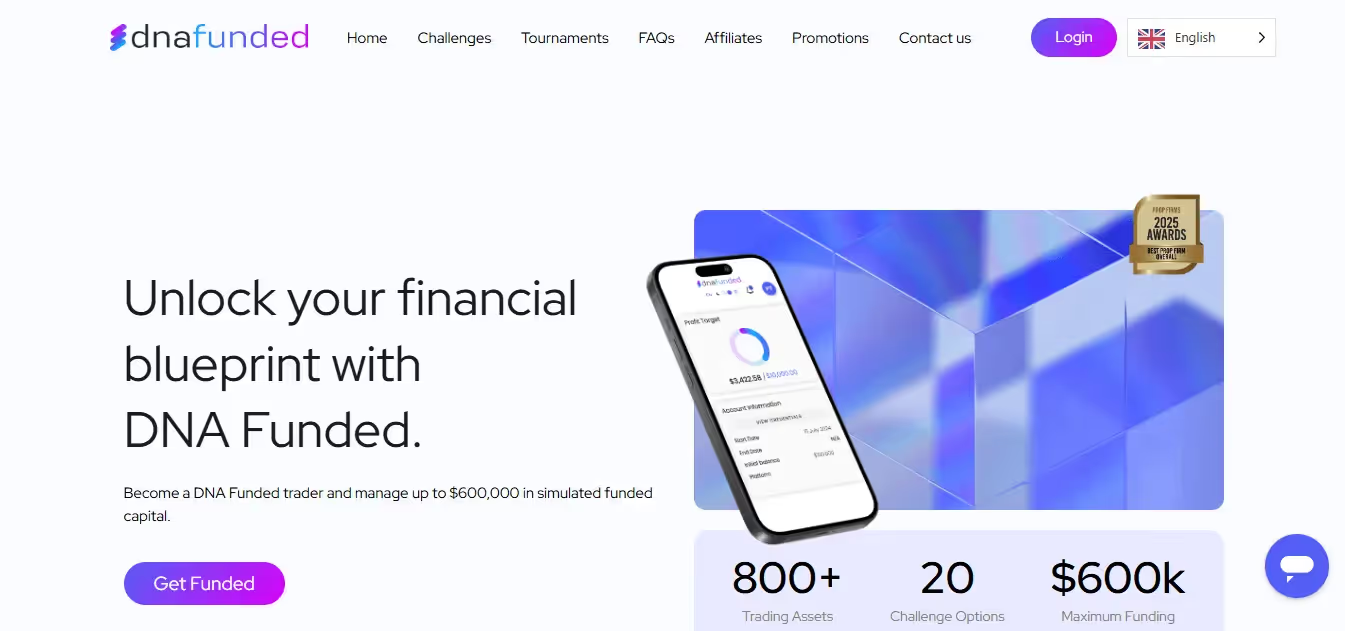
Backed by ASIC-licensed DNA Markets, DNA Funded brings regulated broker infrastructure to prop trading. Three challenge types (1 Phase, 2 Phase, Rapid Challenge) and Instant Funding let you skip evaluations for immediate capital access. Account sizes range from $5,000 to $200,000, with maximum allocation reaching $600,000 per trader.
What profit-sharing and trading conditions does DNA Funded offer?
Your profit split starts at 80% and upgrades to 90% with additional features. AquaFunded provides access to over 800 trading instruments across forex, commodities, indices, cryptocurrencies, and stocks. The platform runs on TradeLocker with TradingView integration for advanced charting. Raw spreads start at 0.0 pips with $5.00 commission per standard lot. You pay no monthly fees, only a one-time evaluation payment. You can trade the news except during the 10 minutes around major releases. Expert Advisors and weekend positions are approved for most challenges.
What are the key advantages and limitations of DNA Funded?
You can get paid weekly through add-ons, which enable faster access to your money for regular withdrawals. A regulated broker backs this service, providing better cash access and transparent operations. You can make up to 40% profit in a single day. The maximum drawdown uses a trailing calculation, which some traders find more limiting than static models. You must trade for at least three days before receiving payment. Accounts that are inactive for 30 days will be closed. Your first three payouts have a 5% profit cap, meaning slower initial earnings.
Related Reading
- Sources of Capital
- Cash Reserve Account
- Short Term Stock Trading
- Investment Performance Analysis
- Managed Account vs Brokerage Account
- Systematic Trading
- How to Analyze a Stock Before Buying
- Forex Capital Trading
- What is a Retracement in Trading
- How is Risk Involved in Calculating Profit?
- Convergence Trading
- Liquidity Trading
- Futures Trading Minimum Account Size
- What is Drawdown in Trading
- No Activation Fee Prop Firm
- Prop Firms That Allow Trade Copiers
- Best Prop Firms in UAE
- Regulated Prop Firms
- Prop Challenge
Think You Can't Trade Forex with Prop Firms? Here's the Truth.
Forex prop trading isn't dying. It's separating traders who choose firms based on marketing noise from those who evaluate operational fundamentals. Firms that survived regulatory shifts built sustainable models around transparent rules, reliable payouts, and trader-aligned incentives. Your job is to verify which firms deliver what they promise after you pass the evaluation, not find the one with the biggest advertised capital or flashiest campaign. Treat firm selection like trade selection. Check payout histories in community forums where traders share real withdrawal experiences. Verify the firm maintains stable broker relationships and regulated liquidity providers. Confirm drawdown calculations match published figures, not those enforced selectively when you become profitable. Read the complete rule set before paying an evaluation fee, and request written clarification for any vague policies.
Firms like AquaFunded address friction points by guaranteeing 24-hour payouts with compensation if they miss the deadline, offering 100% refundable evaluation fees, and providing instant funding paths that bypass multi-phase challenges. These commitments remove uncertainty between proving your skill and accessing capital. When you know exactly how payouts work, what triggers violations, and which trading styles receive permission, the evaluation becomes a test of ability rather than a gamble on the firm's obligations. Successful long-term traders with prop firms share a pattern: they trade the same strategy in evaluation that they plan to use when funded, manage risk conservatively to survive normal drawdown periods, treat firm capital with the same discipline as their own money, withdraw profits regularly to build a payout history, and stay active enough to avoid inactivity closures while remaining disciplined enough to wait for high-probability setups.
Forex prop trading works when you choose firms that treat your success as their business model rather than viewing evaluation fees as their primary source of revenue. The capital exists. The opportunity remains accessible. What changed is that you need to verify operational quality before risking time and fees on firms that won't be around long enough to pay you.
Related Reading
- How To Take Profits From Stocks
- Accumulation Distribution
- Short-Term Capital Gain Tax On Shares
- What Is Reit Dividends
- Cash Available To Trade Vs Settled Cash
- Best Pairs To Trade Forex
- Can You Day Trade In A Roth Ira
- What Is A Conditional Order
- Orb Strategy Trading
- Stop Loss Vs Stop Limit
- Flag Pattern Trading
- Characteristics of Growth Stocks
- Forex Compounding Plan
- Prop Firms That Use MT5
- Prop Firms With Instant Funding
