




10 Reliable Prop Trading Firms for Beginners
Looking for the best proprietary trading firms? Compare top-rated platforms, leverage high capital, and scale your trading career today.

You've spent years studying charts, refining strategies, and building the discipline to trade consistently. But there's one obstacle standing between you and your full potential: capital. What is a funded account? It's the bridge that connects skilled traders to substantial trading capital without risking their own savings. Understanding how proprietary trading firms work can transform your career, moving you from the constraints of personal funds to a professional environment backed by serious resources.
That's where a funded trading program like AquaFunded comes in. Through their evaluation process, you can prove your trading skills and gain access to firm capital, keeping a significant portion of the profits you generate. Instead of slowly growing a small personal account or taking on financial risk you can't afford, you trade with the backing of a prop firm that believes in rewarding talent and consistency.
Summary
- Proprietary trading firms experienced a massive industry shakeout in 2025, with 95% of firms launched in 2023-2024 either shutting down or facing serious regulatory scrutiny by mid-2025. This collapse exposed how many firms operated with unsustainable business models that treated trader evaluation fees as the primary revenue stream rather than shared trading profits.
- Most evaluation failures stem from psychological pressure rather than strategy flaws. Traders abandon tested approaches and increase position sizes prematurely when facing profit targets and time constraints, even when their original systems were statistically sound.
- Payout friction reveals a firm's true business model more reliably than marketing materials. According to industry analysis, 90% of traders fail evaluations within the first 30 days, but the critical red flag appears later when firms deny payouts after traders clear evaluation hurdles and produce consistent returns.
- Platform instability and manipulated execution conditions create account failures that wouldn't occur under normal market conditions. Abnormal slippage, delayed order execution, and unexpected stop-outs during standard volatility periods suggest the firm benefits more from failed accounts than funded traders.
- Matching your trading style to firm infrastructure determines success more than profit split percentages or account sizes. Scalpers require ultra-tight spreads and millisecond execution speeds, news traders need firms permitting aggressive positioning during high-impact releases, and swing traders holding multi-day positions require firms that don't penalise weekend holds or impose artificial time constraints.
Aqua Funded's funded trading program addresses evaluation pressure by removing time limits entirely and offering flexible paths (1-step, 2-step, 3-step, or instant funding) that match different risk tolerances, allowing traders to execute their systems properly instead of forcing positions to meet artificial deadlines.
Table of Contents
- Are Proprietary Trading Firms Reliable?
- Red Flags to Look Out For in Prop Firms
- How to Choose the Best Prop Trading Firm
- 10 Reliable Prop Trading Firms for Beginners
- Start Exploring Prop Trading the Smarter Way With Aqua Funded
Are Proprietary Trading Firms Reliable?

Yes, legitimate prop firms are reliable, but the industry includes both trustworthy operations and low-quality setups that are primarily designed to collect fees. The difference comes down to structure. Firms built around sustainable risk management models exist to identify disciplined traders and share profits with them. Others operate like subscription services, where evaluation fees generate more revenue than trader payouts ever will.
The Evolution of Risk Management in Modern Prop Trading
According to Investing.com Analysis, 95% of prop firms that launched in 2023-2024 either shut down or faced serious regulatory scrutiny by mid-2025. That mass collapse wasn't random. It exposed how many firms entered the market with unsustainable business models, treating trader fees as the primary revenue stream rather than as a shared trading profit. The firms that survived operate differently. They use evaluation processes as risk screening systems, not revenue traps.
Why Traders Assume the Worst
The belief that prop firms are scams stems from survivorship bias in trading communities. Success stories dominate social feeds, traders posting screenshots of quick wins or large payouts. What remains hidden is the volume of traders who attempt evaluations without proper risk management or structured plans. When those traders fail, they blame the firm's rules rather than their own trading behavior. The pressure to hit profit targets creates real psychological stress. Traders increase position sizes prematurely, abandon tested strategies, or take unnecessary risks to accelerate gains. Even profitable systems fail under these conditions when risk control breaks down.
Why 1% Risk is the Professional Standard
Evaluation models test consistency and discipline, not just the profitability of strategy. A trader might have a statistically sound approach but still breach drawdown limits during volatile sessions because they risked too much per trade or deviated from their plan under pressure. That's not a firm design flaw. It's the evaluation working exactly as intended, filtering out traders who can't operate within professional risk parameters.
What Separates Legitimate Firms From Fee Collectors
Trustworthy prop firms structure evaluations around institutional risk controls:
- Profit targets typically range between 5-10%
- Daily drawdown limits
- Maximum account drawdowns
- Position sizing restrictions
These aren't arbitrary barriers. They mirror the risk management systems used on professional trading desks. Firms allocate real capital to funded traders, so they need assurance that traders can protect that capital before scaling them up. The evaluation process screens for risk discipline, the ability to generate returns without violating strict limits.
The Transition From Retail Mindset to Institutional Discipline
Programs like Aqua Funded's funded trading program reflect this trader-first approach. They offer:
- Flexible evaluation models (1-step, 2-step, 3-step, or instant funding)
- No time limits on challenges
- Unlimited retake attempts
- 24-hour payout guarantees
The structure prioritizes trader success over fee extraction, transparent rules over hidden restrictions. When a firm removes artificial pressure and provides genuine support, the evaluation becomes what it should be: a test of whether your skill can meet their risk standards, not a designed failure point.
Related Reading
- What is a Funded Account
- How to Grow a Small Trading Account
- What is Trading Commodities
- Long Term Trading Strategy
- Capital Growth Strategy
- What is a Cash Account in Trading
- What is Compound Trading
- How Much Money Do You Need to Start Trading Stocks
- Scale Trading
- Small Account Trading
- How to Evaluate Investment Opportunities
- Blown Trading Account
- What is PNL in Trading
- Do Prop Firms Use Real Money
- Prop Firm Account Management
- Borrowing on Margin
- Trading Leverage
- Does FTMO Offer Instant Funding
- Prop Firm Static Drawdown
- Funding Traders Rules
- What Is Prop Firm Account
- Synthetic Funded Account
- What Is Funded Firm
- Trading Challenges
- Prop Firm IP Address Rule
- Instant Funding Rules
- Do Prop Firms Use Real Money
- How to Get a Funded Trading Account
- FTMO vs The5ers Comparison
- Best Forex Pairs to Trade
- Best Automated Crypto Trading Platform
- Prop Firms in USA
Red Flags to Look Out For in Prop Firms

The firms that vanished in 2025 shared predictable warning signs. Unreliable prop firms reveal themselves through payout friction, unstable platforms, and rules that shift after traders commit. Spotting these patterns early protects your time and capital before you invest months into a firm designed to collect fees rather than fund traders.
Payout Delays and Fabricated Violations
Traders often report the same sequence:
- Pass the evaluation
- Generate profits
- Request withdrawal
- Face a sudden account suspension
The firm claims a violation that never occurred during the trading period, a future-dated trade in the system, a phantom drawdown breach, or asymmetrical profitability despite conservative risk management.
The Anatomy of a Sustainable Payout Model
According to The Investor's Podcast Network, 90% of traders fail their evaluation within the first 30 days, but the real issue surfaces later: firms that deny payouts after traders clear those hurdles and produce consistent returns. When a firm introduces extra verification steps, extends payout reviews for weeks, or suddenly discovers rule violations only after withdrawal requests, they're signalling that payouts threaten their revenue model. Legitimate firms process withdrawals quickly because trader success validates their risk screening. Delays indicate the opposite: the business model depends on retaining your earnings rather than sharing them.
Platform Instability and Manipulated Conditions
- Abnormal slippage
- Delayed order execution
- Unexpected stop-outs
These aren't random technical glitches. Some firms use unstable platforms or manipulated pricing feeds to create account failures that wouldn't occur under normal market conditions. A tested strategy that manages risk properly should survive standard volatility.
Slippage, Latency, and the Cost of Execution
When traders experience consistent execution problems that make profitable approaches fail, the platform itself becomes the barrier. Reliable firms provide stable infrastructure because they need accurate performance data to assess trader skill. Poor execution conditions suggest the firm benefits more from failed accounts than funded traders.
Hidden Fees and Retroactive Rule Changes
The challenge fee gets you in. Then comes the access fee for:
- The funded account
- The liquidity provider penalty during payout
- The compliance review charge
Each new cost appears after you've already committed time and capital to the evaluation. Worse are the rule modifications:
- Tighter drawdown limits were introduced mid-challenge
- New consistency requirements that invalidate your trading approach
- Strategy restrictions that didn't exist when you started
These changes aren't improvements in risk management. They're designed to disqualify traders who would otherwise succeed under the original terms, extending the evaluation cycle and generating more fee revenue.
Vague Documentation and Unresponsive Support
Rules are buried in tiny print, missing documentation about termination conditions, and unclear explanations of what constitutes a violation. When firms communicate rules poorly, it's intentional. Ambiguity creates room to interpret trader behaviour as non-compliant whenever convenient. Customer support reveals the same pattern:
- Slow responses
- Automated replies that don't address specific questions
- Vague answers about payout timelines or account status
When your earnings are at stake, and support disappears, you're stuck with no resolution pathway. Firms built around trader success respond quickly because problems delay funded progression. Firms built around fee collection avoid clarity because confusion protects their revenue.
Why Fairness is a Business Strategy
Programs like Aqua Funded's funded trading program operate differently. Transparent rules, 24-hour payout guarantees, and 24/7 support exist because the firm's success depends on funding disciplined traders, not trapping them in evaluation loops. When a firm removes hidden conditions and provides real support infrastructure, the evaluation tests your trading skill against clear risk parameters, not your ability to navigate deliberately opaque systems.
How to Choose the Best Prop Trading Firm

You need to understand yourself before you evaluate any firm. Most traders reverse this sequence. They browse evaluation packages, compare profit splits, and scan payout timelines without asking the foundational question: how do I actually trade? Your trading personality determines which firm structures support your edge and which ones sabotage it before you place your first position. If you're naturally aggressive and thrive on rapid decision cycles, scalping strategies might suit you. If you prefer methodical analysis and holding positions through volatility, swing trading aligns better with your psychology. The sharpest traders don't adapt themselves to fit arbitrary firm restrictions. They identify their natural approach first, then find firms designed to accommodate it.
Match Your Strategy to Firm Infrastructure
Once you've defined your trading style, you need to filter firms by operational compatibility. Every prop firm operates with specific risk tolerances, instrument restrictions, and execution requirements. Some prohibit holding positions during major news events, such as NFP or FOMC announcements. Others restrict digital currency pairs entirely, even though your edge might depend on crypto volatility patterns.
Specialized Infrastructure for Diverse Trading Styles
Scalpers need ultra-tight spreads and execution speeds measured in milliseconds because their profitability depends on capturing small price movements repeatedly. News traders require firms that allow aggressive positioning during high-impact releases rather than forcing flat positions ahead of economic data. Swing traders holding multi-day positions need firms that don't penalize weekend holds or impose artificial time constraints on trade duration.
Aligning Your Trading DNA With Firm Parameters
The goal here is elimination. Create a list of your non-negotiable trading requirements, such as:
- Instruments
- Holding periods
- Strategy type
- Position sizing flexibility
You can now cross-reference it against firm policies. Don't compromise your edge to access capital. When a firm's structure conflicts with how you generate returns, you're building on a foundation designed to fail.
Read the Rules Like Your Account Depends on It
After narrowing your list to operationally compatible firms, you need to investigate their actual terms. Not the marketing copy on the homepage. The detailed rules buried in FAQs, terms of service, and challenge documentation. Many traders skip this step and discover critical restrictions only after committing time and fees to an evaluation. You need clarity on:
- Drawdown calculations (daily versus overall, static versus trailing)
- Trading-hour restrictions,
- Consistency requirements that might invalidate profitable but asymmetric performance,
- Refund policies if you breach during the evaluation
- Any strategy prohibitions that weren't disclosed upfront
Some firms advertise flexibility but restrict martingale strategies, hedging approaches, or high-frequency techniques in fine print. Others impose lot size caps that make your tested position sizing impossible to execute.
Decoding the Business Model Behind Your Payout
According to Trader Dale, 90% of prop firms fail within the first year, often because their business models prioritize fee collection over sustainable funding for traders. The firms that survive operate with transparent, consistent rule sets because their profitability depends on funding disciplined traders, not trapping them in perpetual evaluation cycles. When rules change mid-challenge or appear only after withdrawal requests, you're dealing with a firm designed around fee extraction, not partnership.
Evaluate Post-Funding Infrastructure
Passing the evaluation is the beginning, not the destination. You need to assess what happens after you receive funded status because that's where many firms reveal their actual priorities.
- Payout speed matters.
- Firms processing withdrawals within 24 hours demonstrate confidence in their risk screening and a genuine commitment to trader success.
- Multi-week payout reviews or sudden compliance holds after withdrawal requests signal that your earnings pose a threat to their revenue model.
- Support quality becomes critical when you encounter platform issues, need clarification on rules, or face account disputes.
Firms offering 24/7 responsive support treat traders as partners. Those with automated responses and vague timelines treat you as a fee source.
Transitioning from Trader to Portfolio Manager
Scalability determines your long-term earning potential. Can you progress from a $10K account to $100K or $200K based on consistent performance? Do they offer multiple account tiers or cap you at initial funding regardless of results? Programs like AquaFunded's funded trading program are structured around trader progression, offering:
- Flexible evaluation paths (1-step, 2-step, 3-step, or instant funding)
- No time limits on challenges
- Unlimited retake attempts
- Profit splits up to 100%
When a firm removes artificial barriers and provides genuine scaling infrastructure, the relationship shifts from a transactional to a collaborative one. Your success becomes their success, which is how sustainable prop firms operate.
10 Reliable Prop Trading Firms for Beginners
1. AquaFunded

AquaFunded removes the artificial pressure that most beginners face. When traders struggle with rigid challenge deadlines, they abandon tested strategies and take unnecessary risks to accelerate profits. AquaFunded eliminates time limits entirely, allowing you to execute your plan without calendar-induced panic. The instant funding option completely bypasses evaluation stress for traders who want to demonstrate consistency with real capital immediately. Profit splits reach 100% in advanced tiers, meaning your skill eventually captures the entire upside. The 24-hour payout guarantee and unlimited retake attempts signal a firm built around trader progression, not fee extraction.
Why Beginners Choose This Firm
Flexible evaluation paths (1-step, 2-step, 3-step, or instant) match different risk tolerances and experience levels. No time pressure means you trade your system properly instead of forcing positions to meet artificial deadlines.
Key Features
- Funding up to $400,000
- Profit splits up to 100%
- 24/7 support
- No time limits on challenges
- Unlimited retakes
- 24-hour payout cycles
Best For
Beginners who need gradual scaling and transparent rules as they develop disciplined trading habits.
2. FTMO

FTMO operates as the industry standard for structured prop firm evaluations. The dashboard breaks down every trade, showing exactly where risk management held or broke down. Beginners often fail because they don't understand “why” their approach stopped working under pressure. FTMO's analytics reveal those patterns clearly. The firm refunds your challenge fee after your first payout, thereby shifting the economic relationship from pure cost to a recoverable investment. Operating since 2015, FTMO has the longest verified payout history in the industry.
Why Beginners Choose This Firm
Performance analytics teach you what demo accounts never reveal about your actual trading behavior under funded conditions.
Key Features
- Two-step evaluation
- 10% profit target in phase one
- Profit split up to 90%, fee refund after first payout
- Advanced trading analytics
Best For
Beginners who want a highly structured environment with detailed performance feedback.
3. Funded Trading Plus

Funded Trading Plus built its reputation on simple pricing and flexible challenge structures. The firm allows algorithmic trading, which many prop firms restrict despite its legitimacy as a strategy approach. Scaling reaches $2.5M, though progression requires consistent performance over multiple funding cycles. The one-step challenge option reduces evaluation complexity for traders who prefer straightforward objectives over multi-phase testing.
Why Beginners Choose This Firm
Affordable entry and clear rules remove confusion about what the firm expects during evaluation.
Key Features
- One-step and two-step challenges
- Funding up to $200K (scalable to $2.5M)
- Profit splits up to 100%
- Algorithmic trading permitted
Best For
Beginners seeking an affordable entry without sacrificing scaling potential.
4. The Forex Funder
The Forex Funder removes strict time limits, which prevents the rushed decision-making that destroys otherwise profitable strategies. Profit splits reach 95%, among the highest in the industry for firms offering this level of scaling. The equity drawdown rules require discipline, but that's the point. Firms that don't enforce strict risk parameters attract traders who can't protect capital, which eventually forces the firm to tighten restrictions or shut down.
Why Beginners Choose This Firm
High profit share and flexible conditions create room to execute conservative strategies without feeling penalized for patience.
Key Features
- One-step and two-step evaluations
- Profit splits up to 95%
- Funding is scalable to $2.5M
- No strict time limits
Best For
Traders who already have basic strategy experience and need capital to scale properly.
5. FXIFY

FXIFY offers entry prices starting around $39, making it the most accessible firm for budget-conscious beginners. The three-step challenge option provides the slowest evaluation pace in the industry, which suits traders who need extended practice under simulated funded conditions. Supporting both forex and crypto expands instrument flexibility beyond what traditional prop firms permit. Consistency rules affect aggressive strategies, but that's intentional design. The firm filters for traders who generate returns through disciplined execution, not occasional large wins.
Why Beginners Choose This Firm
Extremely low entry cost allows multiple evaluation attempts without significant financial risk.
Key Features
- One-, two-, and three-step challenges
- Entry starting at around $39
- Funding up to $400K+
- Supports forex and crypto
Best For
Budget-conscious beginners are testing prop firm trading without a large upfront investment.
6. E8 Markets
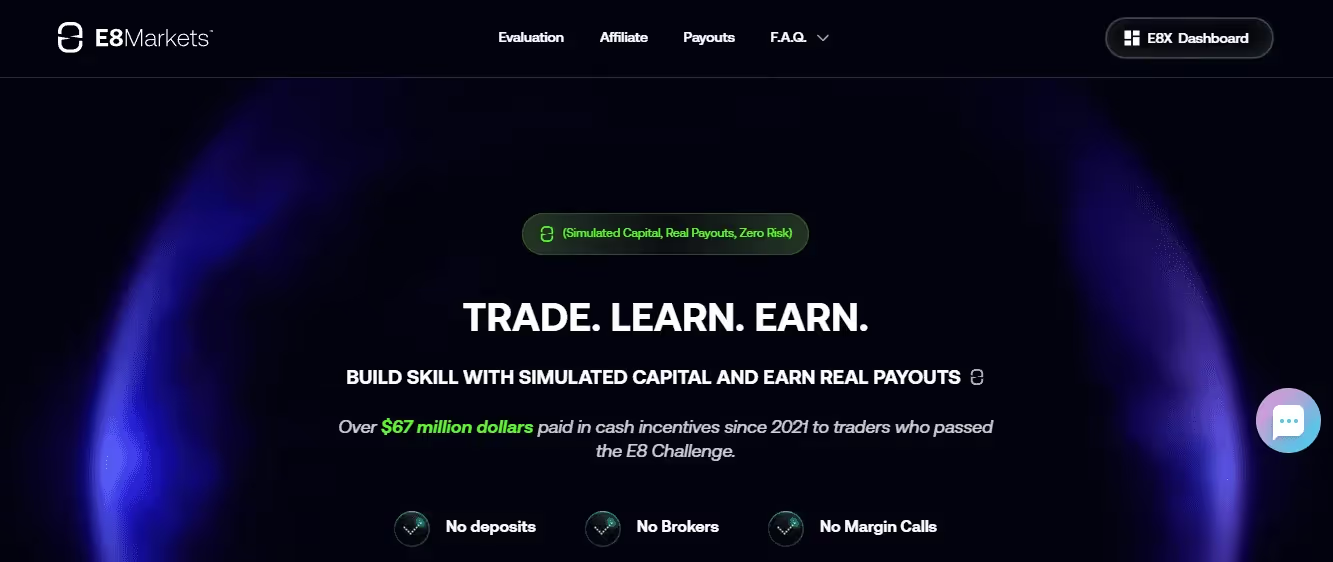
E8 Markets allows traders to customize profit targets and drawdown limits, which creates evaluation difficulty that matches current skill levels. Beginners often fail because they attempt professional-level objectives before developing the consistency those targets require. Customizable parameters let you start conservatively and increase difficulty as your discipline improves. The firm provides detailed performance tracking, showing exactly how your risk management evolves across evaluation attempts.
Why Beginners Choose This Firm
Adjustable challenge difficulty prevents the mismatch between trader skill and evaluation requirements that causes unnecessary failures.
Key Features
- Customizable profit targets
- Flexible drawdown limits
- Funding up to $500K
- No strict time limits
Best For
Beginners who want evaluation difficulty that adjusts to their current skill level.
7. Topstep

Topstep focuses exclusively on futures trading and has operated since 2012, making it one of the oldest continuously running prop firms. The Trading Combine evaluation uses clear rules and weekly payouts, which creates faster feedback loops than monthly payout cycles. You keep 100% of the first $10K in profits, which accelerates early earnings compared to firms that apply profit splits from the first dollar. The subscription pricing model differs from one-time challenge fees, which suit traders who prefer ongoing access over single evaluation attempts.
Why Beginners Choose This Firm
A long industry track record and strong educational programs reduce uncertainty about firm reliability.
Key Features
- Trading Combine evaluation
- Funding up to $150K
- Weekly payouts
- Keep 100% of first $10K profits
Best For
Beginners interested specifically in futures markets.
8. The 5%ers

The 5%ers emphasize long-term account growth instead of rapid profit targets. The firm scales accounts to $4M, but progression happens gradually based on consistent performance over extended periods. This structure suits traders who prefer to build capital slowly rather than chase aggressive monthly returns. Profit splits reach 100% at advanced tiers, meaning your earning potential eventually matches a fully independent trading operation.
Why Beginners Choose This Firm
A long-term growth focus encourages disciplined trading habits rather than short-term profit-chasing.
Key Features
- Multiple funding programs
- Scaling up to $4M
- Profit splits up to 100%
- Transparent rules
Best For
Traders who prefer slow, consistent capital growth over rapid scaling.
9. FundedNext

FundedNext offers 15% profit share during the evaluation phase, which is rare across the industry. Most firms treat evaluations as pure testing periods with no earnings potential. Early profit sharing changes the economic relationship, allowing you to generate returns before receiving full funding status. The firm provides multiple evaluation models, and scales accounts to $4M based on performance.
Why Beginners Choose This Firm
Earning potential during evaluation reduces the financial pressure of challenge fees.
Key Features
- Multiple evaluation models
- 15% profit share during evaluation
- Scaling up to $4M
- Fast payouts
Best For
Beginners want early earning opportunities while still in the evaluation phase.
10. Funding Pips

Funding Pips uses KPI-based evaluation systems that measure consistency across multiple performance metrics, not just profit targets. This approach rewards disciplined trading behavior even when absolute returns remain modest. The firm scales accounts to $2M and offers profit splits up to 100%. Transparent performance metrics help beginners understand exactly which trading habits need improvement.
Why Beginners Choose This Firm
Clear performance metrics create structured feedback that accelerates skill development.
Key Features
- Funding up to $100K initially
- Scaling to $2M
- Profit splits up to 100%
- KPI-based evaluation
Best For
Beginners who want structured performance tracking focused on consistency.
Related Reading
- Sources of Capital
- Cash Reserve Account
- Short Term Stock Trading
- Investment Performance Analysis
- Managed Account vs Brokerage Account
- Systematic Trading
- How to Analyze a Stock Before Buying
- Forex Capital Trading
- What is a Retracement in Trading
- How is Risk Involved in Calculating Profit?
- Convergence Trading
- Liquidity Trading
- Futures Trading Minimum Account Size
- What is Drawdown in Trading
- No Activation Fee Prop Firm
- Prop Firms That Allow Trade Copiers
- Best Prop Firms in UAE
- No Consistency Rule Prop Firm
- Regulated Prop Firms
Start Exploring Prop Trading the Smarter Way With Aqua Funded
If you've been hesitant about proprietary trading firms because of the myths surrounding them, the next step is understanding how these firms actually work and choosing a model that fits your trading style. Modern prop firms now offer different paths to funding, such as:
- One-step evaluations or instant funding, so traders can focus on risk management
- Consistency
- Disciplined execution rather than rushing to hit aggressive profit targets
The key to succeeding with proprietary trading firms isn't finding shortcuts. It's choosing the right funding model and developing disciplined trading habits from the start.
Matching Your Risk Profile to the Right Funding Path
AquaFunded provides multiple funding paths designed to help traders practice structured risk management while gradually scaling their capital. Instead of relying on a “secret strategy,” you can focus on the skills that truly matter in prop trading: position sizing, emotional discipline, and consistent performance. The firm's flexible evaluation models (1-step, 2-step, 3-step, or instant funding) remove the artificial pressure that forces traders into poor decisions, while 24-hour payout guarantees and 24/7 support demonstrate a genuine commitment to trader success rather than fee extraction.
Micro-Capital as a Professional Training Ground
Take time to research reputable proprietary trading firms, review their rules, and start with a smaller funded account or trial program. This allows you to experience:
- Real prop trading conditions
- Refine your strategy
- Build confidence before scaling to larger capital allocations
Your skill matters more than the size of your starting capital, and the right firm will give you room to prove that without hidden restrictions or manufactured obstacles.
Related Reading
- How To Take Profits From Stocks
- Accumulation Distribution
- Short-Term Capital Gain Tax On Shares
- What Is Reit Dividends
- Cash Available To Trade Vs Settled Cash
- Best Pairs To Trade Forex
- Can You Day Trade In A Roth Ira
- What Is A Conditional Order
- Orb Strategy Trading
- Stop Loss Vs Stop Limit
- Flag Pattern Trading
- Characteristics of Growth Stocks
- Forex Compounding Plan
- US-Based Prop Firms
- Top Trading Prop Firms
- Best Prop Firms for Stocks
- Prop Firms That Use MT5
