




How Do Prop Firms Work + How to Choose the Best One
How Do Prop Firms Work? AquaFunded explains proprietary trading, profit splits, evaluation processes, and selection criteria for traders.

Proprietary trading firms provide traders with capital to trade financial markets in exchange for a share of the profits. Understanding what a funded account is requires grasping how these companies operate through evaluation processes, profit-sharing models, and specific trading rules that govern the trader-firm relationship. The evaluation process typically focuses on risk management and consistent performance rather than requiring traders to risk personal capital. Traders who pass these assessments gain access to substantial trading capital, allowing them to scale their careers without the financial burden of funding their own positions through a funded trading program.
Summary
- Proprietary trading firms provide traders with capital in exchange for profit-sharing, but only 10% of traders pass evaluations, according to industry data. The low pass rate reflects the strict risk management requirements these firms enforce, particularly daily drawdown limits (typically 5%) and maximum account drawdowns (usually 10%). These constraints exist to protect the capital pool that funds hundreds of traders simultaneously, not to create arbitrary obstacles.
- The prop trading industry experienced massive consolidation in 2024 and 2025, with 95% of firms either shutting down or restructuring by the end of 2025. This shakeout separated platforms built around sustainable trader success from those optimizing for evaluation fee revenue. Firms that survived combined transparent payout histories with clear rule structures and documented withdrawal processing, proving their business models depended on active, funded traders generating volume rather than failed candidates paying for resets.
- Evaluation fees are the primary revenue source for most prop firms, but reliable platforms also profit from the trading volume generated by successful traders after funding. A single trader who scales from a $25,000 account to $200,000 and trades actively produces far more long-term revenue than ten failed evaluation attempts. This economic reality explains why firms offering 80-90% profit splits, instant funding options, and account scaling programs focus on trader retention rather than evaluation churn.
- Spreads and execution costs compound dramatically across hundreds of trades, making seemingly small differences (0.5 pips versus 1.5 pips on major currency pairs) shift monthly profitability by thousands of dollars on six-figure accounts. Firms that publish spread schedules upfront and maintain consistent execution during volatile sessions demonstrate transparency that matters more than promotional profit split percentages. Hidden costs buried in widened spreads during news events or high-volume sessions quietly tax profits when trading opportunities peak.
- Over 1,000,000 individuals now participate in funded trading globally, creating competition that forced the industry toward greater transparency and trader-friendly terms. Platforms responded with flexible evaluation structures (one-step, two-step, or instant funding), unlimited challenge timeframes, and educational resources extending beyond generic webinars. Firms investing in trader development through AI-powered coaching, performance analytics, and responsive support teams signal they're building long-term partnerships rather than processing one-time transactions.
- AquaFunded's funded trading program addresses these market dynamics by offering both instant funding and traditional evaluation paths with no time limits, 48-hour payouts, and scaling to $400K with transparent rules published before payment.
Are Prop Trading Firms Reliable?
Some prop firms pay traders consistently and operate with transparent rules. Others fold overnight or invent reasons to deny payouts. The difference isn't luck—it's structure, track record, and whether the firm profits by funding traders or by collecting evaluation fees from people who never get paid.

⚠️ Warning: Traders have watched firms vanish mid-payout cycle, leaving funded accounts worthless. Others discover rule changes buried in updated terms they never saw. When risking time and evaluation fees to access capital, trust isn't optional—it's the entire foundation.
"The prop trading industry has seen significant consolidation, with unreliable firms representing a major risk factor for aspiring traders seeking legitimate funding opportunities." — Financial Pipeline Research, 2024

🔑 Takeaway: The key to identifying reliable prop firms lies in examining their payout history, regulatory compliance, and whether their primary revenue comes from trader success rather than evaluation fees alone.
How do transparent terms separate reliable firms from others?
Reliable prop firms publish their terms before you pay anything. Profit splits, drawdown limits, payout schedules, and prohibited strategies appear in plain language rather than legal jargon. FunderPro Blog reports that only 10% of traders pass evaluations. Transparent firms want that 10% to succeed because their business model depends on funded traders generating volume, not on selling resets to those who never reach live accounts.
Why does payment history matter more than marketing?
Payment history tells you more than marketing ever will. Community forums track which firms process withdrawals within 48 hours and which delay withdrawals for weeks without a clear explanation. Firms that have paid thousands of traders over multiple years build reputations that matter more than affiliate commissions or flashy landing pages.
How do risk management rules protect firm solvency?
Risk management rules frustrate traders who see them as obstacles, but they protect firm solvency. A daily drawdown limit preserves the capital pool, enabling the firm to fund new traders the following month. Position size caps prevent one reckless trade from wiping out accounts that other traders depend on. These rules determine which firms survive volatile trading sessions and which collapse.
How does instant funding work with real capital backing
Beginners assume instant funding means fake money or practice accounts with no real payouts. This misconception dissolves when traders withdraw five-figure sums within days of passing evaluations. Instant funding works because the firm deploys real capital after verifying your risk management through the challenge. The system confirms you can manage drawdowns, and the account goes live. The structure matters more than the speed. Firms offering instant funding without clear rules or verified payout histories are selling hope, not capital. Firms that combine instant access with transparent terms and documented payment records provide a faster path to trading with someone else's money while retaining a significant share of the profits.
What revenue model do reliable prop firms use?
Most prop firms make money from evaluation fees. The question is whether they also profit when you succeed. Reliable firms do both: they collect fees upfront and earn from trading volume once you're funded. Unreliable firms optimize for resets, designing rules so subtle that traders fail without understanding why, then pay again to retry. Firms offering 100% profit splits on initial payouts or guaranteed 24-hour withdrawals aren't being generous—they're competing for skilled traders in a market where trust is scarce. By making capital access easy and withdrawals fast, they bet that successful traders will scale up, stay longer, and generate more volume than the cost of those perks.
What happens to the rules after you get funded?
Evaluation rules tell you if a company is serious. Live account rules tell you if they're reliable. If terms change once you're funded—new trading limits, hidden withdrawal fees, or stricter drawdown enforcement—the company wasn't built to help traders succeed over time. Reliable companies keep rules consistent because they want you trading actively, not managing surprises that drain your account.
Why do traders spread capital across multiple firms?
Traders who spread their money across multiple firms can manage concentration risk. Even trustworthy firms can face liquidity issues, regulatory changes, or acquisitions that alter payout structures. Spreading capital across two or three proven firms ensures one firm's problems won't end your trading career.
How can you tell if a firm supports trader success?
Some firms build businesses around trader success. Others build around trader hope. The difference shows up in payout timelines, rule consistency, and whether the firm celebrates funded traders publicly or obscures their terms in footnotes.
How Do Prop Firms Work
Prop firms give you access to trading capital you don't own, provided you prove you can manage risk without losing the account. You pay an upfront fee to enter an evaluation phase, during which you must meet profit targets while adhering to drawdown limits.
🎯 Key Point: The evaluation process is designed to filter out high-risk traders - most prop firms report that only 10-20% of traders pass their initial challenges.
"Proprietary trading firms typically require traders to demonstrate consistent profitability while maintaining strict risk management during evaluation periods." — Trading Industry Research, 2024

⚠️ Warning: Drawdown limits are non-negotiable - exceeding them means instant disqualification and loss of your evaluation fee, regardless of your profit performance.
What happens when you pass the evaluation?
Pass that test, and you get a funded account where profits are split between you and the firm, typically 70-90% in your favor. The firm profits from evaluation fees and their share of your trading gains, creating a conflict of interest: they benefit when you succeed and when most traders fail and pay to try again.
How do retail prop firms differ from traditional trading desks?
The term "prop firm" misleads people who expect these companies to operate like traditional proprietary trading desks at investment banks. Retail prop firms run evaluation platforms, not trading desks. You're not an employee—you're paying for access to a simulated capital challenge that, if passed, converts into a live account backed by real money. Investing.com reported that 95% of prop firms operating in early 2024 had either shut down or restructured by the end of 2025, demonstrating how swiftly the industry punishes firms unable to balance trader success with sustainable economics.
The evaluation phase filters for discipline, not genius
You pick an account size between $10,000 and $200,000 and pay a fee based on that size. For example, a $25,000 account might cost $150. Your goal is to make 8-10% profit within a set timeframe while staying under a daily loss limit (usually 5%) or a total drawdown limit (typically 10%). Some firms impose time limits, while others let you trade until you reach your profit target or break a rule.
Why does position sizing matter more than win rate?
The structure forces you to trade like an institutional investor. Position sizing matters more than directional accuracy. A trader who wins 60% of trades but risks 10% per position will fail faster than someone who wins 40% but risks 1% per trade with disciplined stop losses. The evaluation doesn't care about your win rate—it cares whether you can survive a losing streak without violating drawdown rules.
How do multi-step evaluations differ from single-step challenges?
Companies offer one-, two-, or three-step evaluations depending on the depth of the assessment. Single-step challenges require one phase of profit targets and risk compliance. Multi-step evaluations add verification phases with adjusted targets or stricter rules. More steps mean lower upfront fees but longer timelines before accessing live capital.
Funded accounts operate under the same constraints, but the money becomes real
Once you get funding, you trade using the firm's money under the same risk rules as your evaluation. Your profits become real payouts, usually processed on a schedule (weekly, biweekly, or monthly) with minimum amounts. Some firms offer 24-hour payouts after your first milestone, which matters when verifying they actually pay.
How do profit splits work in funded accounts?
TTT Markets notes that 80% profit splits are standard, with some firms offering 90% or even 100% on initial payouts. The firm's cut covers platform costs, risk management infrastructure, and capital funding. Larger accounts generate more trading volume, increasing firm revenue at lower percentage splits.
How do scaling plans help traders grow their accounts?
Scaling plans let you grow your account size as you hit performance milestones. A consistent trader might progress from $25,000 to $50,000, then $100,000 or higher. Firms benefit because larger accounts generate more trading volume and revenue.
How do prop firms actually make money from their business model?
Critics say prop firms make money by creating evaluations so difficult that traders fail repeatedly and keep paying to try again. This holds true for firms that want traders to fail. If a firm charges $150 for a $25,000 evaluation and 10% of traders pass, it collects $1,500 in fees per trader it funds. That trader then creates trading volume, enabling the firm to earn 10-20% of profits forever. A single successful trader who grows to $200,000 and trades actively for a year generates far more revenue than ten failed evaluations.
What's the difference between the A-book and the B-book models?
Companies using A-book models hedge trades with outside liquidity providers, earning money from spreads and commissions rather than betting against you. B-book models match trades internally, creating conflicts of interest when the company profits from your losses. Most evaluations run on demo accounts during testing, moving to live capital only after demonstrating consistent risk management.
Why do successful prop firms focus on trader retention?
Long-term survivors align their goals with trader success. They want you funded, trading actively, and growing because that's where steady revenue comes from. Firms that focus on evaluation fees eventually exhaust traders willing to pay after repeated failures, which explains the massive shakeout documented by Investing.com in 2025.
How does instant funding work without evaluation periods
Some firms offer instant funding, allowing you to skip the evaluation and trade live capital immediately. You still pay an upfront fee and operate under the same drawdown limits and profit split structures. The difference is speed: you're trading with real capital on day one instead of waiting weeks to pass a challenge.
What technology enables instant funding risk management
Instant funding works when companies use automated risk management to enforce drawdown rules immediately. Breaking a rule triggers an automatic account lock. This technology-driven enforcement lets companies fund traders faster without increasing risk exposure.
Which traders benefit most from instant funding options
Platforms like funded trading program combine quick funding with flexible evaluation options. Traders confident in managing drawdowns prefer instant funding to skip the wait between proving their skill and earning payouts. Those still building consistency use evaluations as structured practice before accessing live capital.
Why do prop firms implement strict risk management rules?
Daily loss caps and maximum drawdown limits prevent firms from risking insolvency while funding hundreds of traders simultaneously. If one trader loses 30% in a single session, it depletes the capital pool that funds other traders. Risk limits contain individual failures, so the firm can continue operating and funding new traders next month.
How do position size limits protect trader accounts?
Position size caps work the same way. A 2% risk-per-trade limit prevents concentration risk, where a single bad trade causes a drawdown that ends the account. Traders who follow these limits stay funded longer and earn more over time than those who push boundaries for faster profits. But knowing how these firms operate helps only if you can identify which ones support trader success instead of optimizing for evaluation revenue.
Related Reading
- What is a Funded Account
- How to Grow a Small Trading Account
- What is Trading Commodities
- Long Term Trading Strategy
- Capital Growth Strategy
- What is a Cash Account in Trading
- What is Compound Trading
- How Much Money Do You Need to Start Trading Stocks
- Scale Trading
- Small Account Trading
- How to Evaluate Investment Opportunities
- Blown Trading Account
- What is PNL in Trading
- Do Prop Firms Use Real Money
- Prop Firm Account Management
- Borrowing on Margin
- Trading Leverage
- Does FTMO Offer Instant Funding
- Prop Firm Static Drawdown
- Funding Traders Rules
- What Is Prop Firm Account
- Synthetic Funded Account
- What Is Funded Firm
- Trading Challenges
- Prop Firm IP Address Rule
- Instant Funding Rules
- Do Prop Firms Use Real Money
- How to Get a Funded Trading Account
- FTMO vs The5ers Comparison
- Best Forex Pairs to Trade
- Best Automated Crypto Trading Platform
- Prop Firms in USA
How to Choose the Best Prop Trading Firm for Beginners
Compare account costs against simulated capital, and verify spreads, drawdown rules, and payout terms in writing before paying. Beginners often overlook whether the firm processes withdrawals or whether hidden restrictions make passing evaluations nearly impossible. Choose a firm that publishes clear rules, offers flexibility if you fail, and provides support beyond taking your money.
🎯 Key Point: Always request written documentation of all terms before committing to any prop firm. Verbal promises mean nothing when it comes to payout disputes or rule clarifications.
"85% of prop trading failures stem from misunderstood rules rather than poor trading skills." — Prop Trading Research Institute, 2024
⚠️ Warning: Red flag firms often have vague withdrawal processes or impossible drawdown limits. If a firm can't provide clear answers about its payout history, look elsewhere.
How do spreads impact your trading profitability?
Spreads represent the difference between the buy and sell prices for an asset. A firm advertising tight spreads on major pairs but widening them during volatile sessions takes money from your profits when it matters most. Low spreads compound over hundreds of trades: a firm charging 0.5 pips versus 1.5 pips on EUR/USD can change your monthly P&L by thousands of dollars on a $100,000 account.
What should you look for in spread transparency?
Companies that publish spread schedules upfront demonstrate transparency. Companies mentioning "competitive spreads" without specific details hide costs you'll discover only after paying for an evaluation. Check whether spreads widen during news events or high-volume sessions. Some companies restrict trading around major announcements, protecting their risk exposure but limiting your ability to capitalise on volatility.
How does execution speed affect your trading results?
How quickly your order is filled matters as much as the spread. When markets move quickly, slippage can turn a profitable trade into a break-even or losing trade. Firms that use A-book execution send your orders to liquidity providers, so fill speed depends on market conditions. B-book firms match trades internally, which can provide faster fills but creates a conflict: the firm profits when you lose money.
How do capital requirements create trading leverage?
According to Phidias Propfirm, you can start with $55 for smaller evaluations. A $150 evaluation for $25,000 in simulated capital gives you 166x leverage on your investment. A $300 fee for $50,000 provides similar ratios. Compare these multiples across firms to determine where your upfront cost translates into meaningful trading power.
Why does account size affect position flexibility?
Your account size determines how flexible you can be with position sizing. A $10,000 account with 1% risk per trade limits your position to $100. A $100,000 account gives you $1,000 per trade, allowing you to spread capital across more positions or hold larger sizes without exceeding your risk limits. The benefit is having more room to manage trades without hitting constraints.
How do scale-up opportunities reveal firm intentions?
Scale-up opportunities separate firms that build long-term partnerships from those that optimize for one-time fees. Firms offering account growth after you hit consistency milestones (three consecutive profitable months, specific profit thresholds, zero rule violations) signal they want you to trade larger capital because that increases their revenue share. Firms with no scaling path bet you'll leave before hitting those milestones.
How do time limits reveal a firm's true intentions?
Time limits on challenges force frequent trading, increasing the risk of mistakes. Beginners with full-time jobs cannot spend 8 hours a day trading. Firms offering unlimited time windows let you trade at your own pace, matching evaluation conditions with how you'll trade once funded. Firms that impose 30-day or 60-day deadlines are designing for urgency, not to verify skill.
What do challenge phase rewards tell you about the firm?
Rewards during the challenge phase—refunded fees on your first payout, profit splits on evaluation gains, reduced costs for passing within specific timeframes—show that the firm makes money when you succeed. Firms offering nothing until you pass the profit from the evaluation process at your expense.
How do reset policies show whether firms want repeat customers?
Reset options and discounts reveal whether a company treats evaluations as recurring revenue. A company offering 20-30% discounts on resets or free attempts after near-misses (hitting profit targets but breaching the drawdown rule slightly) acknowledges that learning requires multiple attempts.
Why does rule clarity matter for evaluation success?
Being clear about the rules stops frustration. Does the firm prohibit trading during major news releases? Are there minimum or maximum holding periods? Can you maintain positions overnight or over weekends? Firms that answer these questions promptly and clearly respect your time. Firms that hide details in hard-to-read terms or change rules during testing without prior notice are deliberately creating confusion.
What support infrastructure do the best prop firms provide?
The best firms provide more than capital to trade with. They offer familiar trading platforms (MT4, MT5, cTrader), so you don't need to learn new interfaces while managing risk. They maintain support teams ready to answer questions about rules, payouts, or technical problems within hours, not days. They share educational content—webinars about risk management, explanations of common evaluation mistakes, and strategy guides for different market conditions—to help you pass evaluations and maintain funding.
How can you identify firms that treat traders as transactions versus partners?
Companies that offer bare-minimum support (automated email responses, FAQ pages with generic answers, no live chat or phone support) treat you like a transaction. Companies investing in trader education and real-time support build ecosystems where your success directly benefits their business model. Platforms like funded trading program combine instant funding with flexible challenge structures, letting you choose between immediate capital access or traditional evaluations based on your confidence level. AquaFunded's program is designed with this flexibility in mind, helping traders access capital in ways that suit their trading style.
Related Reading
- Sources of Capital
- Cash Reserve Account
- Short Term Stock Trading
- Investment Performance Analysis
- Managed Account vs Brokerage Account
- Systematic Trading
- How to Analyze a Stock Before Buying
- Forex Capital Trading
- What is a Retracement in Trading
- How is Risk Involved in Calculating Profit?
- Convergence Trading
- Liquidity Trading
- Futures Trading Minimum Account Size
- What is Drawdown in Trading
- No Activation Fee Prop Firm
- Prop Firms That Allow Trade Copiers
- Best Prop Firms in UAE
- Regulated Prop Firms
- Prop Challenge
13 Best Prop Trading Firms for Beginners
Choosing your first prop firm means finding one that matches how you evaluate trades, pays you reliably, and gives you trading flexibility based on your experience level. Beginners need firms with clear rules, quick evaluations, and educational support rather than hidden fees. According to Finance Magnates, over 1,000,000 people participate in prop trading globally, forcing the industry to separate platforms that truly help traders improve from those that seek to profit from evaluations alone.
"Over 1,000,000 people now participate in prop trading around the world, forcing the industry to separate platforms that truly help traders improve." — Finance Magnates, 2025
🎯 Key Point: The massive growth in prop trading participation means beginners must be extra selective when choosing their first firm to avoid evaluation-focused platforms.
💡 Tip: Look for firms that offer educational resources and clear payout structures rather than flashy marketing and unrealistic profit targets.

1. Aqua Funded

AquaFunded removes gatekeeping by offering instant-funded accounts alongside traditional challenge paths. You can choose immediate capital access or structured practice before going live. Profit targets remain flexible, daily limits are more relaxed than at legacy firms, and payouts are processed within 48 hours.
How does Aqua Funded scale trader accounts?
Accounts can grow to $400K with profit splits reaching 100% on initial withdrawals, and challenges have no time limits: you trade at your own pace without racing against deadlines.
What makes Aqua Funded's transparency different?
Transparency stands out: no hidden restrictions on stop losses, lot sizes, or instrument selection. Rules appear upfront in plain language, not buried in updated terms. The 48-hour payout guarantee demonstrates the firm's profits when you succeed, not when you retry failed challenges. Community support and responsive customer service answer questions within hours.
What are Aqua Funded's potential limitations?
Smaller starting accounts have lower limits than those offered by platforms with $200K starting capital. Profit split scaling rewards experience, so maximising earnings requires consistent performance over multiple months before unlocking top-tier percentages.
2. For Traders

For Traders combines access to multiple asset types (forex, crypto, futures, commodities, metals) with AI-powered performance coaching that analyzes your trades and reveals patterns you might miss on your own. You can customize challenges to match your risk parameters and profit targets. The built-in trading journal automatically tracks every position and includes analytics dashboards that show where your edge lies and where you're losing money.
What payment and community features does For Traders offer?
Fast 48-hour payouts and clear pricing eliminate payment confusion. The global community provides peer support, strategy sharing, and accountability to keep traders engaged. Platforms include MT5 and cTrader, though US residents face restrictions on certain interfaces due to regulatory limitations.
What challenges do beginners face with For Traders?
The advanced interface can confuse beginners unfamiliar with performance analytics or AI coaching tools, as you're learning data layers that experienced traders already understand.
3. FTMO
FTMO built its reputation on clear evaluation processes and comprehensive educational resources. The challenge structure breaks into three phases (evaluation, verification, funded account) with straightforward rules published before payment. Funding ranges from $10K to $200K, profit splits reach 90%, and the FTMO Calculator helps you model risk scenarios before entering positions.
What educational support does FTMO provide traders?
The educational library includes strategy breakdowns, risk management frameworks, and psychology modules that address why traders fail evaluations even when their technical analysis stays accurate. Community forums connect you with funded traders who share what worked during their challenges. The user interface is intuitive and responsive.
What challenges do traders face with FTMO's risk rules?
Strict daily loss and drawdown limits create pressure that beginners struggle to handle emotionally. One mistake can break the limits and end the challenge. Traders accustomed to looser risk parameters find FTMO's constraints frustrating until they understand that these rules mirror how institutional capital is managed.
4. OneFunded
OneFunded lowers entry barriers with $2K minimum account sizes and flexible rules allowing news trading, weekend position holds, and automated strategies (EAs). Profit splits reach 90%, challenges carry no time limits, and payouts remain transparent with published withdrawal schedules. The platform works well for traders seeking straightforward evaluations without complex multi-phase structures or hidden restrictions, as rules remain consistent between evaluation and funded phases. Smaller account sizes limit initial earnings compared to those of firms offering $100K+ in starting capital. Advanced tools like analytics, AI coaching, and performance tracking lag behind competitors with stronger trader development infrastructure.
5. The Funded Trader

The Funded Trader makes evaluation engaging by tracking progress, celebrating milestones, and providing visual feedback. You can choose from multiple challenge paths matching your trading style (scalping, swing trading, position trading) rather than following a standardised structure. Profit splits reach 90%, the maximum drawdown is 6% (fair for beginners learning position sizing), and the platform holds a 4.7/5 Trustpilot rating due to reliable payouts and clear rules.
What makes The Funded Trader user-friendly?
The interface suits traders wary of institutional-style platforms. Support responds quickly, and the community actively discusses strategies and evaluation tips. Rules remain fair and published upfront, avoiding hidden traps that plague firms optimising for reset fees.
What are the Funded Trader's limitations?
Global recognition lags behind FTMO or For Traders, meaning fewer peer reviews and less community documentation around specific evaluation strategies. The platform focuses mainly on forex and CFD trading, limiting access for traders seeking crypto or futures exposure.
6. Funded Trading Plus

Funded Trading Plus offers flexible programs for confident traders seeking instant funding or those preferring traditional evaluations for structured practice. Your account grows with profits, and profit splits increase to 100% at higher milestones.
What platform options and support does Funded Trading Plus provide?
You can trade on multiple platforms (MT5, cTrader, TradingView) that you may already know how to use. Our AquaFunded program offers 24/7 support across all time zones. Fast payouts and low entry costs (starting at $119) make it accessible for beginners.
How does the scaling structure reward consistent traders?
The scaling structure rewards consistency: traders who prove capital management skills gain access to larger accounts without restarting evaluations. Our funded trading program options require careful selection to match your trading style and experience level. Some programs involve simulated profits before scaling to live capital, extending the timeline between passing evaluations and accessing real payouts.
7. TopStep Trader

TopStep Trader focuses on futures trading with structured tests that help traders build sustainable habits rather than chase quick profits. The platform offers coaching, webinars, and educational resources to help build trading careers. Profit splits average around 80%, and the simulated evaluation closely mirrors real trading conditions, facilitating a smooth transition to funded accounts.
What advantages does TopStep's futures focus provide?
Focusing on futures creates deeper market knowledge and builds community connections that general platforms cannot offer. Traders in futures benefit from specialized support and industry connections.
What limitations should traders consider with TopStep?
Only futures trading means no access to forex or crypto, limiting beginners who want to explore multiple asset classes. The structured approach feels restrictive for traders who prefer flexible rules or alternative strategies outside TopStep's evaluation framework.
8. BrightFunded

BrightFunded started in 2,023 offering traders access to multiple asset types with unlimited growth potential. The platform rewards strong performers by scaling accounts from $400K to millions, with weekly payouts processed in as little as 4 hours. Top traders retain 100% of their profits. With 40+ crypto pairs available, the platform provides funded access to digital asset markets.
What makes BrightFunded's loyalty program unique?
The loyalty program rewards active, consistent traders and builds long-term partnerships. Fast payouts, clear rules, and a modern interface quickly establish trust.
What are the potential drawbacks of BrightFunded?
As a 2023 launch, BrightFunded has less long-term reputation data than firms operating for five or more years. The advanced platform may challenge total beginners unfamiliar with multi-asset dashboards or crypto mechanics.
9. The5ers

The5ers lowers barriers with instant funding and entry-level programs for traders building long-term careers. Profit splits reach 80%, flexible trading rules permit news trading and weekend holds, and accounts grow as you demonstrate consistency. The low entry cost and straightforward evaluation structure make The5ers accessible for beginners testing funded capital management. The platform encourages long-term thinking, aligning with how successful traders build careers. Smaller profit potential caps initial earnings even with strong trading performance. Advanced analytics tools lag behind competitors' investments in performance tracking and AI-powered coaching.
10. My Funded Futures
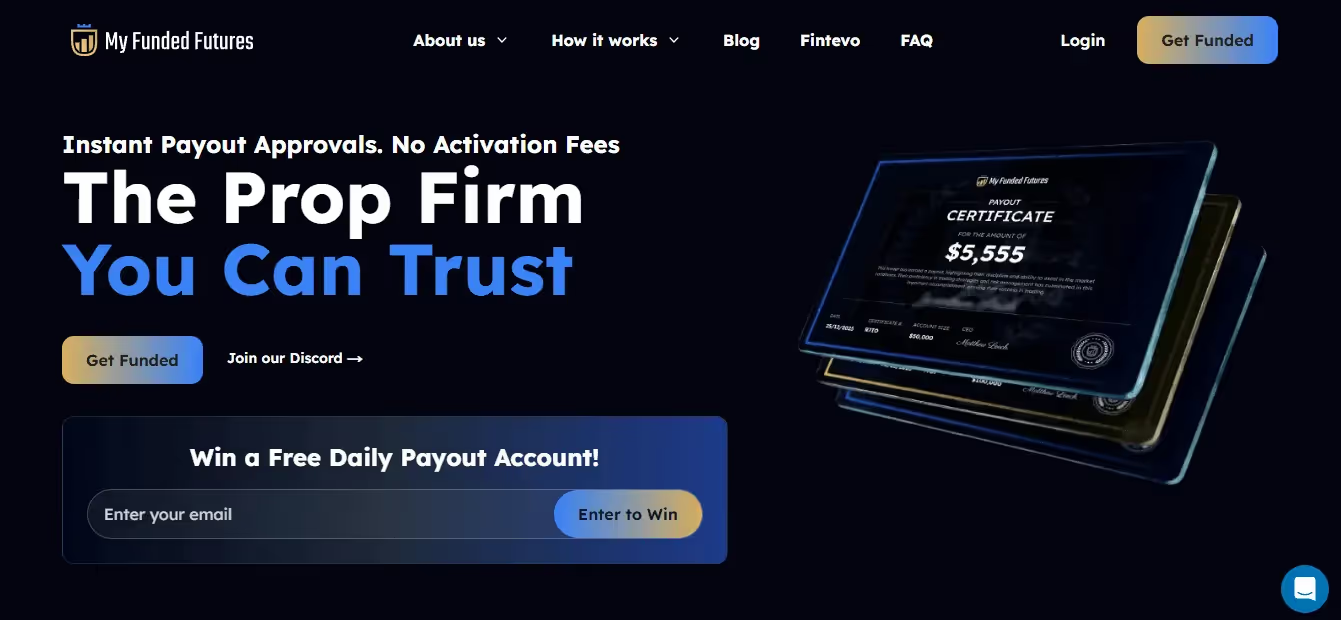
My Funded Futures simplifies capital access through a one-step evaluation process with no daily loss limits on most accounts. This removes the pressure that leads to overtrading or premature position exits. You retain 100% of profits on the first $10,000, then 90% thereafter.
What makes their futures trading platform specialized?
The platform focuses exclusively on futures trading at major exchanges (CME, CBOT, COMEX, NYMEX), providing deep market knowledge and high-quality execution. You can customise your payout frequency and account type to align with your trading schedule and financial goals. The one-step evaluation eliminates the multi-phase complexity that extends timelines at other firms.
What are the potential limitations for traders?
Focusing only on futures can limit beginners in forex or crypto trading. The platform may also require traders unfamiliar with futures-specific software and exchange mechanics to navigate steep learning curves.
11. SurgeTrader

SurgeTrader speeds up funding with fast evaluations and instant funding options. Capital grows to $250K with 80% profit splits and flexible rules that permit weekend and news trading. The shorter evaluation phase provides faster access to live capital. The platform works well for traders with proven edges seeking quick capital access without lengthy evaluation periods. Rules remain clear with responsive support. Lower profit splits (80% compared to 90-100% at competitors) reduce long-term earnings. The smaller global community offers less peer support and fewer shared evaluation strategies.
12. FXIFY
FXIFY supports instant payouts and unlimited trading days, removing time pressure from evaluations. Capital scales from initial funding of up to $400K, with potential to grow to $4M for consistently profitable traders. Profit shares reach 90%, and the platform supports automated strategies (EAs) for algorithmic trading. Large scaling potential rewards long-term consistency with capital growth matching institutional trading levels. Instant payouts validate skill quickly and demonstrate the firm's commitment to trader success. MT4/MT5 platforms require setup and familiarity, creating friction for beginners. Educational resources focus less on beginner development than competitors, offering extensive coaching and skill-building content.
13. BluFx

BluFx specializes in forex trading with low entry costs, no time limits on challenges, and transparent rules that are consistent across the evaluation and funded phases. Capital scales to $100K, profit splits range from 70% to 80%, and the platform supports automated trading strategies. Educational resources include strategy guides and risk management frameworks tailored to forex markets.
What are the main advantages of BluFx's approach?
The forex focus creates depth in currency-specific education and execution quality. Low entry costs make the platform accessible to beginners, allowing them to test whether prop trading suits their goals without a significant upfront investment.
What limitations should traders consider with BluFx?
Being limited to forex trading prevents traders from accessing crypto or futures if they want to trade multiple asset types. Smaller account sizes also limit earning potential compared to those offered by firms with $200K or more in starting capital. Most beginners spend too much time comparing features when they should be testing whether they can trade profitably under any firm's rules. The real question isn't which firm offers the best split or fastest payout—it's whether you're ready to prove your edge under pressure, since even the most beginner-friendly platform won't fund traders who can't manage risk consistently.
Turn Your Trading Knowledge into Real Funding with AquaFunded
Getting funded doesn't require perfection—just proving you can protect capital while generating returns. AquaFunded removes gatekeeping that makes most firms feel like obstacles. You choose instant funding if confident in your risk management, or pick a one-step, two-step, or three-step evaluation for structured verification before accessing live capital. Either path leads to accounts up to $400,000 with profit splits reaching 100% on initial withdrawals, no time limits, and 24-hour payouts once you hit thresholds.
🎯 Key Point: Multiple funding paths accommodate different trader confidence levels and risk management approaches.

The structure works because the firm profits when you trade successfully, not when you fail and retry evaluations. Over 42,000 traders worldwide have accessed capital through the platform, and $2.9 million in payouts validate that the business model aligns with trader success. Rules remain transparent from the start: no hidden restrictions on stop losses, no surprise lot size caps, no updated terms mid-challenge. Requirements don't shift once you're funded.
"Over 42,000 traders worldwide have accessed capital through the platform, and $2.9 million in payouts validates that the business model aligns with trader success."
🔑 Takeaway: AquaFunded's $2.9 million in verified payouts demonstrates a genuine commitment to trader profitability over evaluation fees.
Related Reading
- How To Take Profits From Stocks
- Accumulation Distribution
- Short-Term Capital Gain Tax On Shares
- What Is Reit Dividends
- Cash Available To Trade Vs Settled Cash
- Best Pairs To Trade Forex
- Can You Day Trade In A Roth Ira
- What Is A Conditional Order
- Orb Strategy Trading
- Stop Loss Vs Stop Limit
- Flag Pattern Trading
- Characteristics of Growth Stocks
- Forex Compounding Plan
- Top Trading Prop Firms
- Forex Prop Firms in the US
- Prop Firms That Use MT5
- Prop Firms With Instant Funding
